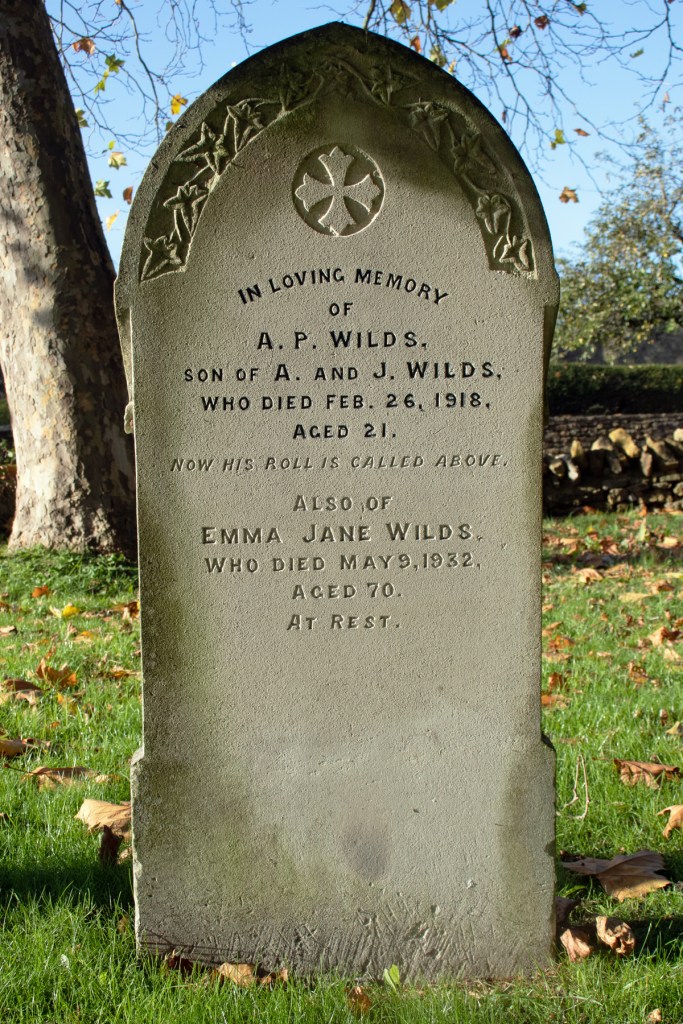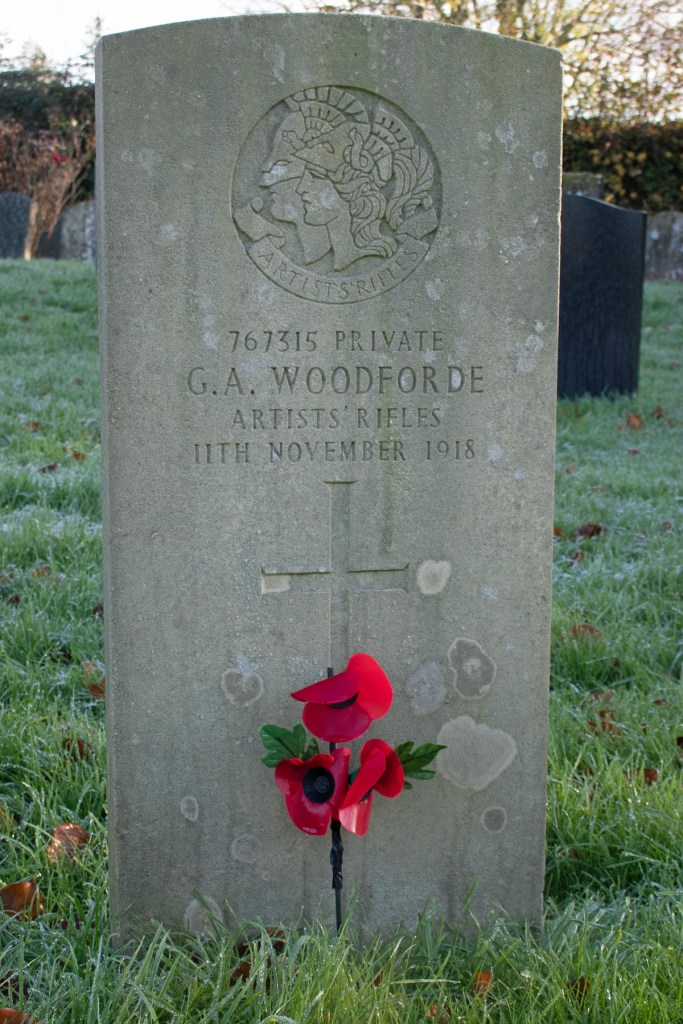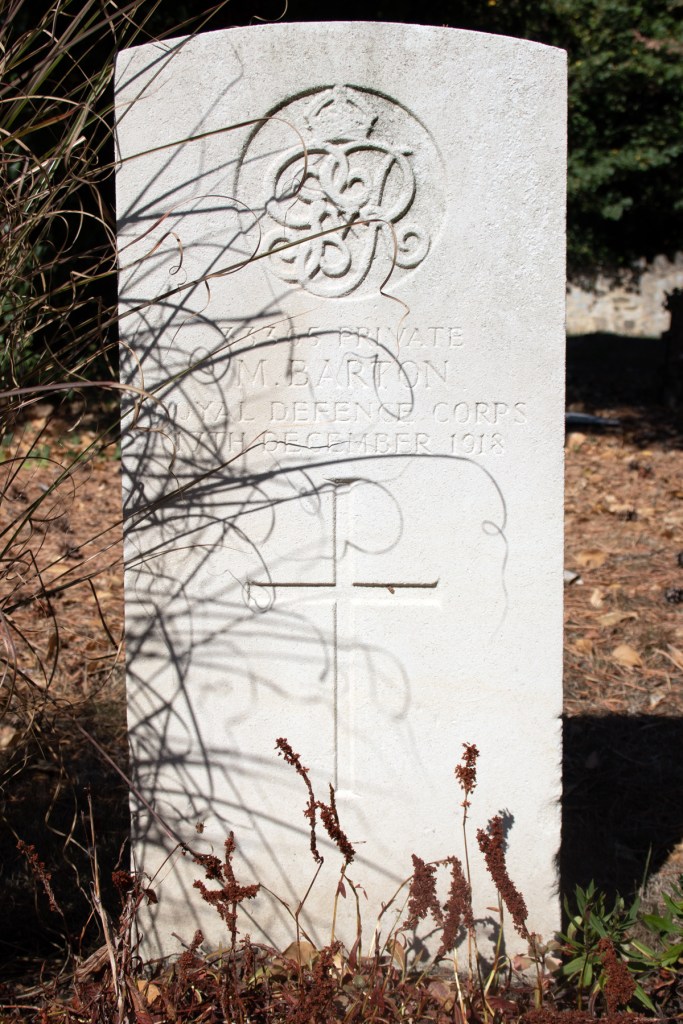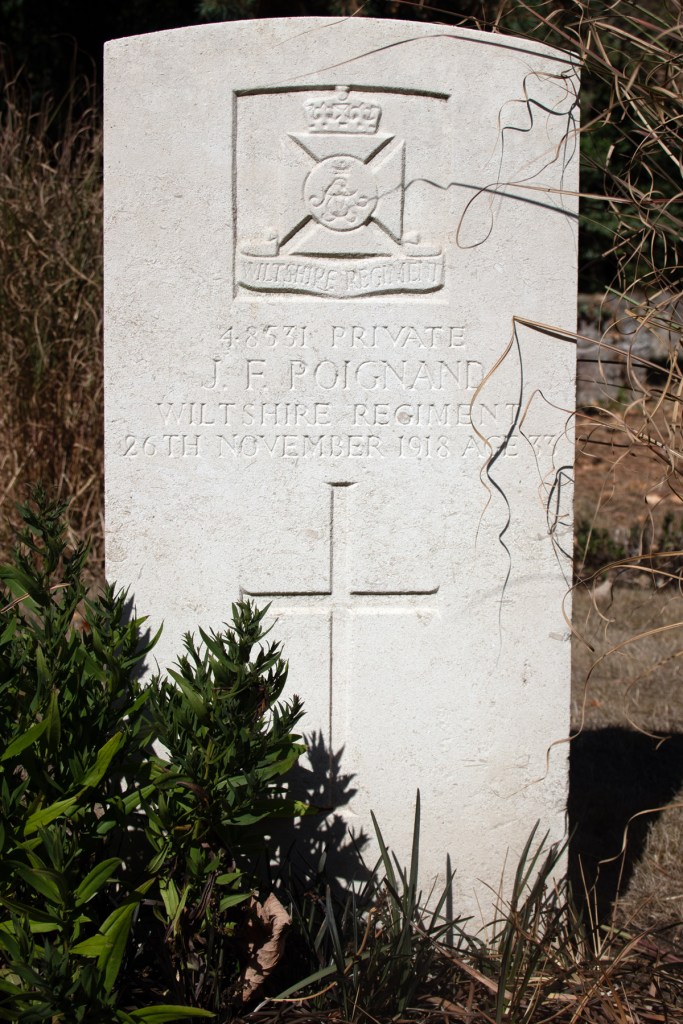
Archibald Percy Wilds was born in 1896 in Kilmington, Somerset. The youngest of three children, his parents were dairy farmers Charles and Emma Wilds. Charles passed away when Archibald was just a toddler, and with the help of her family, Emma raised their children while maintaining the business.
When he left school, Archibald also helped out on the farm, but war was coming, and he wanted to play his part for King and Country. Details about his service are sketchy, but it is clear that he joined the Somerset Light Infantry as a Private, before transferring to the Hampshire Regiment. He was assigned to the 15th (Service) Battalion, also known as the 2nd Portsmouth.
While Private Wilds’ battalion saw action in France, it is unclear whether he went with them. His records show that he was awarded the Victory and British Medals for his time in the army, but they do not give a date for him embarking for the continent.
The only other records relating to Private Wilds are those confirming his passing. The Army Register of Soldiers’ Effects confirms that he passed away on 26th February 1918 in a military hospital, while another database suggests that he died of wounds, although it is not possible to confirm how he was injured, or where specifically he passed. What can be confirmed is that he was just 21 years of age when he died.
Archibald Percy Wilds was brought to Somerset for burial. He was laid to rest in the family plot in the graveyard of St Michael’s Church in Blackford, not far from where his mother still lived.
Emma Wilds went on to live until she was 70 years old. She passed away in 1932 and was also laid to rest in the family plot, reunited again with her husband and son.
George Augustus Woodforde was born on 21st April 1892 in Leyton, Essex. He was one of six children to George and Harriet Woodforde, although, tragically, George had died shortly before his son was born.
George Sr had been born in Ansford, Castle Cary, Somerset and this is where he was laid to rest. He was a theological student in his twenties and, according to the 1891 census, he was living on his own means. This is something that Harriet was fortunate enough to be able to do once she was widowed.
George Jr studied into his late teens and, by the time war was declared in 1914, he was employed as a schoolmaster. He enlisted in April 1916, but was not mobilised until 17th November 1917. He served as part of the 28th Battalion (Artists’ Rifles) of the London Regiment and his records show that he was 5ft 8ins (1.73m) tall and was of a slight build, weighing in at only 110lbs (50kg).
Private Woodforde soon found himself in France, and fought on the front line for a while. He was caught up in the Battle of the Canal du Nord in late September 1918, and was badly wounded. He was medically evacuated to England, and admitted to the East Leeds War Hospital. He had received gunshot wounds to both thighs and feet, and had fractured the tarsal and metatarsals of his right foot.
Private Woodforde’s left leg became infected, and he then developed double pneumonia. It was this lung condition that he was to succumb to: he passed away at the hospital on 11th November 1918 – Armistice Day. He was just 26 years of age.
George Augustus Woodforde was laid to rest in the graveyard of St Andrew’s Church in Ansford, Somerset, close to where his father had been buried all those years before.
William Thomas Locke was born at the start of 1900 in the Kent village of Eccles. His parents were Thomas and Annie Locke, although it seems that he was orphaned early on. The 1901 census recorded him as living with his grandparents John and Mary Locke. Their daughter Annie is also recorded as living at the property, although there is nothing to confirm whether she was William’s mother or an aunt.
By the time of the 1911 census John Locke had died. Mary was living in the same house, with two of her sons – Frederick and Alfred – and her grandchildren, William and his cousin Gladys. Both of William’s uncles were labourers in the local cement works, and it seems likely that this would be work that he would have followed them into once he had completed school.
William’s trail goes cold at this point, although he would have been too young to join up at the outbreak of the First World War. Records confirm that he had enlisted by March 1918, and it seems likely that he would have done so as soon as he came of age.
Rifleman Locke joined the 5th Battalion of the King’s (Liverpool Regiment), but this is the only detail of his military service that can be confirmed. The next record for him confirms that he passed away on 5th October 1918, having been admitted to hospital in Oswestry, Shropshire, suffering from intestinal problems. He was just 18 years old when he passed.
William Thomas Locke’s body was brought back to Kent for burial. He was laid to rest in the graveyard of St Peter & St Paul’s Church in Aylesford, the parish church for his home village of Eccles.
The specific location of William’s grave is not known, although it is likely that he was laid to rest near his grandfather. Instead, he is commemorated on a joint headstone in the First World War section of the graveyard. William’s grandmother passed away the following year, and records confirm that his next of kin was noted as his aunt, Mary Ann Longley.
Ernest Green was born on 31st March 1881 – four days before that year’s census – in the Kent village of Aylesford. The middle of eleven children, his parent were William and Sarah Green. William was a labourer in the local clay works, and this is employment that Ernest and his brothers also entered into.
On 10th December 1904, Ernest married Emily Chapman. She was the daughter of another labourer, and the couple went on to have seven children, the oldest of whom was born in May 1905.
The family set up home in Aylesford, not far from Ernest’s parents, and life would have been set, had it not been for the intervention of the First World War.
Ernest enlisted early on, joining The Buffs (East Kent Regiment) in December 1914. His service records confirm that he was 33 years old when he enlisted, and stood 5ft 4ins (1.63m) tall. Sadly, Private Green’s service records are a little sketchy, and it is unclear whether he ever saw action overseas, although it is likely that he did at some point.
Private Green transferred to the Machine Gun Corps in February 1916, and then moved again – to the Labour Corps – in the summer of 1918. He joined the 426th Agricultural Coy, and was based in Canterbury.
Working outside through the summer and autumn, it seems that Ernest’s health may have begun to suffer and he was admitted to the Canterbury Military Hospital in December 1918, having contracted influenza. Sadly, the lung condition was to prove his undoing: Private Green passed away at the facility on 20th December 1918. He was 37 years of age.
Ernest Green was brought back to Aylesford for burial. He was laid to rest in the graveyard of St Peter & St Paul’s Church, although the exact location of his grave is not longer known. Instead, he is commemorated on a joint headstone in the First World War section of the graveyard.
Frederick Leonard Johnson was born in the spring of 1898, in Wandsworth, South London. His parents are recorded as Frederick and Catherine Johnson, although no other information about his early life remains.
On 16th February 1918, Frederick married Winifred Peters. She was a dock labourer’s daughter from Aberavon in Glamorganshire, and the couple wed at the parish church in the town. The marriage certificate confirms that Frederick was living in Port Talbot and working as a carpenter. It also notes that his father had died by this point.
It seems likely that the young couple married because Winifred was pregnant. The couple had a son, who they called Frederick, on 1st August 1918.
Frederick had enlisted in the army by this point. While his service records no longer exist, he joined up at some point towards the end of the war – no earlier than May 1918 – and was assigned to the 3rd (Reserve) Battalion of the Gloucestershire Regiment. This was a territorial force, and Private Johnson would have been based in Kent as part of the Thames and Medway Garrison.
Little else is known about Frederick’s service. The only other thing that can be confirmed is that he was admitted to the Preston Hall Military Hospital in Aylesford, Kent, in the autumn of 1918, suffering from a combination of influenza and pneumonia. Sadly, the lung conditions were to get the better of him and he passed away on 27th November 1918, at the age of just 20 years old.
Frederick Leonard Johnson was laid to rest in the graveyard of St Peter and St Paul’s Church, Aylesford, not far from the hospital in which he had passed. It is unclear whether he ever met his son.
In a quiet corner of St Peter & St Paul’s Churchyard in Aylesford, Kent, is a headstone dedicated to 35013 Private F Neale of the Gloucestershire Regiment. The memorial confirms that he died on 24th November 1918, but little more information remains on his life.
The Army Record of Soldiers’ Effects confirms his first name as Frederick, but that he was not eligible for the War Gratuity payment, which suggests that he had less than six months’ service when he passed.
The document also confirms that he was assigned to the 3rd Battalion of the Gloucesters, and that he had passed away at the Preston Hall Military Hospital in Aylesford. There is no next of kin of beneficiary for his personal effects, and so the trail goes cold.
With no age or date of birth it is impossible to trace any further details for Frederick. No other military records survive, nor is there any note of his passing or funeral in contemporary newspapers. Frederick Neale’s life is destined to remain lost to time.
Michael Barton was born in the spring of 1863 in the Kent village of Hadlow. The youngest of three children, his parents were farm labourer William Barton and his wife Annie. Michael became a farm labourer when he left school and, when William died in 1890, he remained at home to support his mother.
Annie passed away in 1905, and this proved a turning point for Michael. By the time of the next census in 1911, he was recorded in the Tonbridge Union Workhouse, one of its 600 inmates.
Michael’s trail is harder to pick up at this point. Despite his age, it seems that he sought a way out of his situation when war broke out and had certainly enlisted in the army by the last year of the conflict. Initially joining the Royal Defence Corps, Private Barton was soon transferred to the Labour Corps, and was assigned to 572nd Agricultural Coy.
The next document relating to Michael is that of his passing. He died on 17th December 1918 at the Preston Hall Military Hospital in Aylesford, Kent, although the cause of his death is not readily available. He was 55 years of age.
Michael Barton was laid to rest in the graveyard of St Peter & St Paul’s Church in Aylesford, not far from the hospital in which he had passed.
The Army Register of Soldiers’ Effects records that Michael’s belongings passed to a Miss Kate Burley when he died. Not one of his immediate relatives, it is likely that she was a friend or other relation.
John Francis Poignand was born in St Brelade, Jersey in 1885. The oldest of four children, his parents were farmers Jean and Louisa Poignand. John followed his parents into farming and moved to nearby St Lawrence.
It was here that he met and married farmer’s daughter Lydia Helleur. The couple set up home in St Lawrence, and went on to have two children, John and Clarence.
War was closing in on Jersey’s shores and, when the call came, it seems that John was keen to play his part. Sadly, full details of his military service have been lost to time, but what remains confirms that he had enlisted in the Wiltshire Regiment by the spring of 1918.
Private Poignand was assigned to the 3rd (Reserve) Battalion, a territorial force that remained on the British mainland. He was to be based in Kent, his troop forming part of the Thames and Medway Garrison.
The only other records of John’s service are that of his passing: he had been admitted to the Preston Hall Military Hospital, suffering from a combination of influenza and pneumonia, and these are what were to take his life. Private Poignand died on 26th November 1918, at the age of 33 years old.
John Francis Poignand was laid to rest in the graveyard of St Peter and St Paul’s Church in Aylesford, not far from where he had died.
Lydia went on to marry a man called Robinson. Her trail goes cold, but her and John’s younger son, Clarence, does appear in later records.
Flight Sergeant Poignand served with the Royal Air Force in the Second World War, and was based at Seletar in Singapore. He was taken as a Prisoner of War by the Japanese on 11th March 1942, but there is no other record for him. His PoW record confirms that he was married and living in Romford, Essex, at the time of his capture.
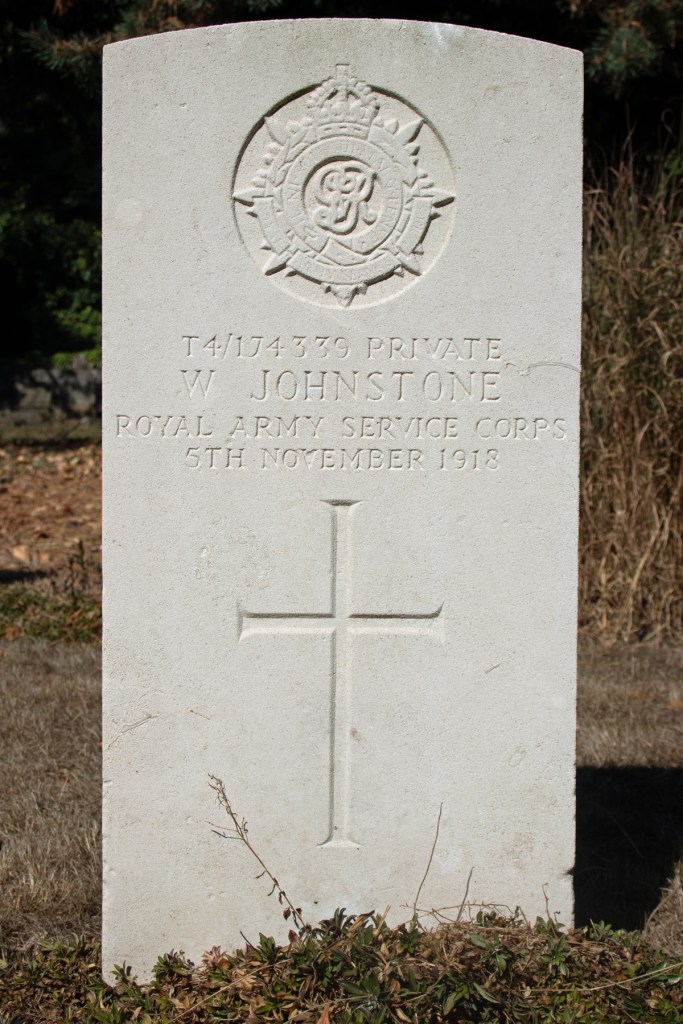
In the First World War section of St Peter and St Paul’s Churchyard in Aylesford, Kent, is a headstone dedicated to T4/174339 Private W Johnstone of the Royal Army Service Corps. Little other immediate information is apparent, and there are no military records available based on his service number.
The Commonwealth War Graves Commission website confirms that Private Johnstone transferred across to the 697th Agricultural Coy of the Labour Corps. He was given another service number – 440640 – and this allows access to a few more strands of his life.
Private Johnstone’s first name was William, and he had a dependent, Mrs CM Gunn, who lived at Moss Fall in Linwood, Paisley. The records, however, add a little more confusion to the story – Mrs Gunn is recorded as U/Wife and a guardian is also noted: Mrs Catherine McDree.
The waters are muddied further by the Army Register of Soldiers’ Effects. While this confirms that William had enlisted by the spring of 1918, it also highlights that his effects and war gratuity were not actually claimed.
With no date of birth for William, it is impossible to narrow down any further details of his early life: there are too many combinations of William and Catherine in the Paisley area to be able to identify them with any confidence.
The only thing that can be confirmed is that Private William Johnstone died from a combination of influenza and pneumonia on 5th November 1918, at the Preston Hall Military Hospital in Aylesford, Kent. He was buried in the nearby churchyard.
Albert Edward Rumbelow was born in 1879 in Wycombe Marsh, Buckinghamshire. One of eleven children, his parents were Suffolk-born paper maker Philip Rumbelow and his wife, Jane.
Little information is available about Albert’s early life, although by the time of the 1901 census, he is recorded as being a Private in the Rifle Brigade. The family had moved to the village of Little Chart in Kent by this point, where his father was still continuing in the manufacture of paper.
Private Rumbelow’s military service is evidenced in later documents. He served with the 1st Battalion from 1895 to 1907, was awarded the South Africa medals for 1901 and 1902: he was also granted the clasp for his involvement in the defence of Ladysmith. He appears to have been wounded at this point, and was invalided out of full military service and placed on reserve.
In 1904, Albert was back in England, and living in London. That year he married Ellen Sillis, a cordwainer’s daughter from Norfolk. The couple set up home in Fulham, and went on to have five children: Abert Jr, Iris, Florence, Doris and Hilda.
By the time of the 1911 census, Albert was working at the local Public Hall, as a labourer, hall attendant and cleaner. The family were living at 9 Crabtree Lane in Fulham, sharing the property with the Fitzgerald family.
War was closing in on Europe by this point, and, once again, Albert stepped up to plat his part. He enlisted within days of conflict being declared, and within weeks had been given the rank of Corporal. His service records note that he was 5ft 10ins (1.78m) tall, weighed 156lbs (70.8kg), had brown hair and blue eyes. He was also recorded as having a tattoo of crossed rifles and a crown on his right forearm, and scared on his left calf, knee and eyebrow.
By the spring of 1915, Albert had been promoted again, to the rank of Serjeant. He was sent to France on 19th May, having been assigned to the 7th (Service) Battalion. Serjeant Rumbelow was involved at the Somme and was awarded the Distinguished Conduct Medal “for conspicuous gallantry” on 3rd June 1916. “He exposed himself to machine-gun and rifle fire when going across the open to rescue a wounded man. Later he went under fire to fetch a stretcher.”
Serjeant Rumbelow appears to have been injured in the skirmish, and was invalided to the UK later that month. When he recovered he was posted again, this time to the 18th (London) Battalion of the Rifle Brigade.
The following February he made the transfer across to the Labour Corps, and by March 1917, Serjeant Rumbelow was back in France. In August he was promoted to Company Sergeant Major, but was invalided back to England with bronchitis in February 1918.
When he recovered Albert was assigned to the 364th Area Employment Coy. in Kent, and seems to have voluntarily taken a drop in rank – back to Serjeant – in doing so. His health was dogging him by this point and in the late summer of 1918, he was admitted to Preston Hall Military Hospital in Aylesford, suffering from VDH, or heart disease.
Sadly, the strain of his military service was to be his undoing. He passed away from the heart condition on 21st September 1918, at the age of 39 years of age.
Albert Edward Rumbelow was laid to rest in the graveyard of St Peter & St Paul’s Church in Aylesford, not far from the hospital where he had breathed his last.
Now widowed, Ellen was left with the unenviable task of raising five young children on her own. She married again, to Private William Lake, on 8th June 1919, and the family moved to Essex. She lived until the age of 79, and was laid to rest in Sutton Road Cemetery in Southend.