George Albert Knight was born in Dover, Kent, on 27th September 1888, the second of seven children to Thomas and Frances Knight. Thomas was a railway porter from Hampshire, and the family lived in a small terraced house a few minutes’ walk from his workplace, Dover Priory Station.
By the turn of the century, the family had moved to Faversham: Thomas was working a signalman, and two of George’s brothers also worked for the railway – one as a clerk, the other as a number taker. George, meanwhile, was working as a butcher.
In the summer of 1916, George married Alice Smith, who was working as a domestic servant for an government inspector in Willesborough, Kent. George was still working as a butcher at this point, and continued to do so up until the spring of 1918, when he was eventually called up.
Private Knight enlisted in March 1918, joining the Royal Naval Air Service shortly before it merged with the Royal Flying Corps to become the fledgling Royal Air Force. He was based in Cornwall, and his role included mechanic work.
On the evening of 21st September 1918, George collapsed and, despite being rushed to hospital in Truro, he passed away the following morning. It appears that he had not been unwell before, and his death came as a shock. He was just short of his 30th birthday.
George Albert Knight was brought back to Kent for burial. He was laid to rest in Faversham Borough Cemetery, not far from where his widow and family were living.
James Joseph Wing was born in Tonbridge, Kent, in the summer of 1876 and was the oldest of six children to Henry and Frances Wing. Henry was a labourer, but when he finished school, James found work as an errand boy for the post office.
This was not a long-term career, however, and by the time of the 1901 census, when James was 25, he was labouring for the railway. His mother had died in 1897, and Henry remarried, to a woman called Frances Stapley.
In the spring of 1902, James also married, to Sussex-born Mary Ann Goacher. The couple wed in Steyning, near Worthing, but settled in Henfield. James seemed to be picking up work where he could – the census of 1911 recorded him as a coal porter, but by the time he enlisted, in June 1916, he gave his trade as a gardener.
James joined the Royal Garrison Artillery as a Gunner, and was initially assigned to the No. 1 Depot in Newhaven. Full details of his service are unclear, but he transferred to No. 2 Depot in Gosport, Hampshire, in the summer of 1918.
Gunner Wing had only been in Gosport for a couple of months, when he was admitted to the 5th Southern General Hospital in nearby Fratton. At 12:15pm on 4th December 1918, he passed away, a post mortem revealing he had succumbed to a cerebral tumour. He was 42 years of age.
James Joseph Wing was brought back to Sussex for burial. He was buried in the cemetery in his adopted home town of Henfield.
George Dove was born in Wincanton, Somerset, on 4th December 1883. One of five children, his parents were farm labourer George Dove and his wife, Jane.
George Jr did not follow his father into farm work: the 1901 census found him boarding with a family in Radstock, working in one of the coal mines in the area. Ten years later, he was living back with his family, employed as a groom.
His work with horses stood him in good stead when war was declared. George enlisted early on, and was assigned to the 19th (Queen Alexandra’s Own Royal) Hussars as a Private. By October 1914, he was in France, returning to England with his squadron the following spring.
At some point during the conflict, Private Dove transferred to the Reserve Regiment of Cavalry. He was posted to the 5th Regiment, which trained men for the Northumberland Hussars and Yorkshire Dragoons, amongst others.
Further details of George’s life are scarce; at some point, he married a woman called Emily, although records of the couple’s wedding no longer exist. The only thing that can be confirmed is that George was admitted to the Bermondsey Military Hospital in Surrey, where he passed away on 24th October 1918. He was 34 years old.
The body of George Dove was brought back to Somerset for burial. He lies at rest in the cemetery in his home town, Wincanton.
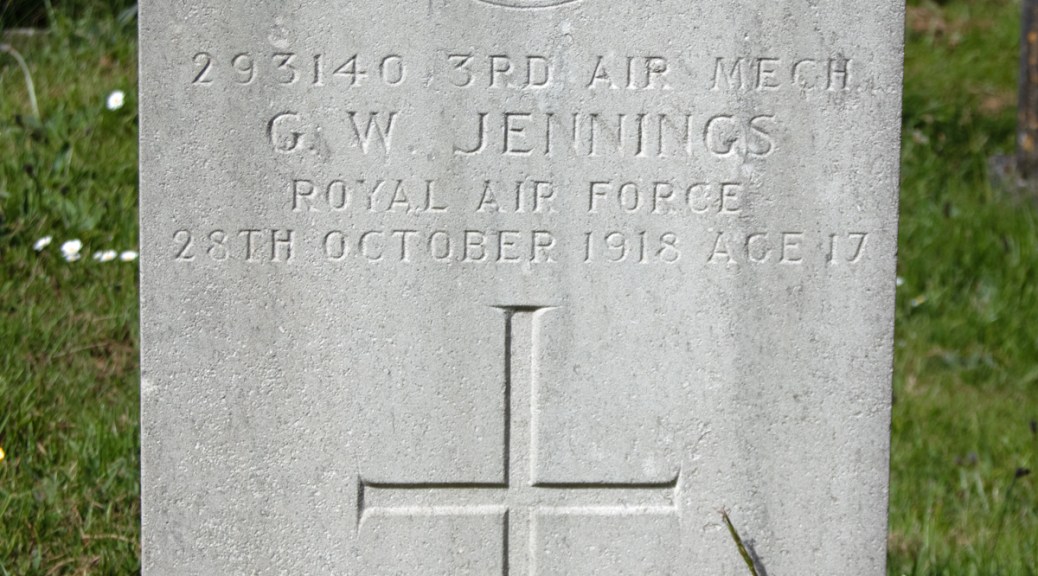
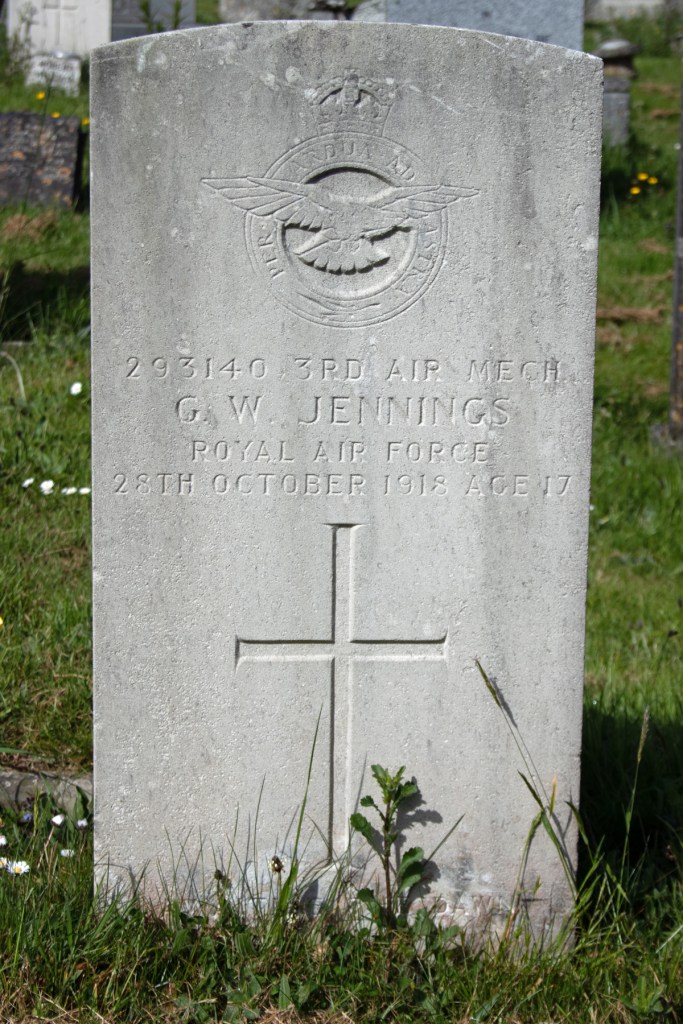
Gilbert William Jennings was born on 4th January 1901, and was the third of four children to William and Lily Jennings. Both were born in Chard, Somerset, and this is where they raised their young family. William was a foreman in one of the town’s lace factories and when he finished school Gilbert followed his father into the industry.
War broke out across Europe in 1914 and, while Gilbert was too young to enlist at the start of the conflict, it is evident that he wanted to play his part as soon as he was able to.
On 6th September 1918 he enlisted in the Royal Air Force: his experience with factory machinery led him to the role of Air Mechanic 3rd Class. His service records confirmed that he was 5ft 7ins (1.70m) tall, had brown hair, hazel eyes and a fresh complexion.
Air Mechanic Jennings was sent to Buckinghamshire for training, but his time there was to be tragically short. Within a matter of weeks he was admitted to the Central Military Hospital in Aylesbury with pneumonia. The condition was to prove too much for his body: he passed away on 28th October 1918. He had been in the Royal Air Force for just 52 days and was a victim of his desire to get involved in the war before it was too late to do so. He was 17 years of age.
Gilbert William Jennings’ body was brought back to Somerset for burial: he was laid to rest in the cemetery of his home town, Chard.
Thomas Harris – known as Tom – was born on 13th October 1876, the only son of Edmund and Mary Harris. Edmund was an agricultural labourer from the Somerset village of Seavington St Mary, and this is where Tom was born and raised.
Mary had married Edmund in the spring of 1876, but had been married before; she was widowed when her previous husband, Alfred Vickery, died ten years before. They had had seven children of their own, half-siblings to Tom.
Edmund died in the Wells Lunatic Asylum when Tom was only six years old. When he left school, he found work as a farm labourer, but sought bigger and better things, even though he was now the only one of Mary’s children still living at home.
Tom enlisted in the Somerset Light Infantry in January 1893, and soon found himself overseas. During his sixteen years’ service, he spent seven years in India and six months fighting in the Second Boer War. Corporal Harris seems to have had a sickly time of it, and while in India, was admitted to hospital a number of times for fever, ague and diarrhoea, as well as a bout of conjunctivitis.
When Tom’s contract came to an end in 1909, he returned to Britain, setting up home in Newport, South Wales, where he found work as a sheet weigher at the local steel works.
Mary died of senile decay and cardiac failure in May 1910. She was 74 years old, and sadly passed away in the Chard Workhouse, in similar circumstances to her late husband.
In October 1913, Tom married Ada Long in Chard. She was the daughter of a shopkeeper, and the couple set up home in South Wales, where Tom was still working.
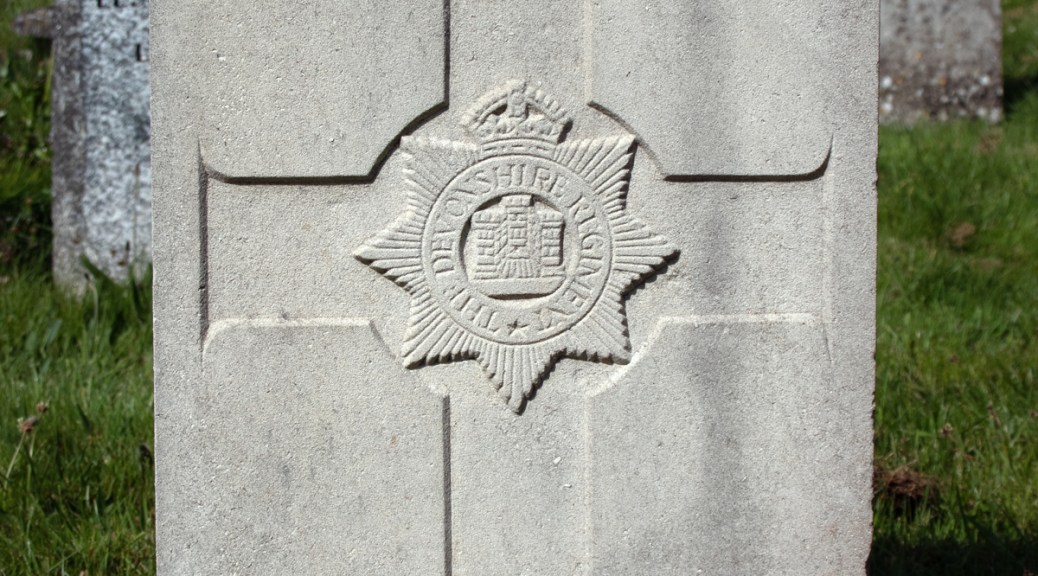
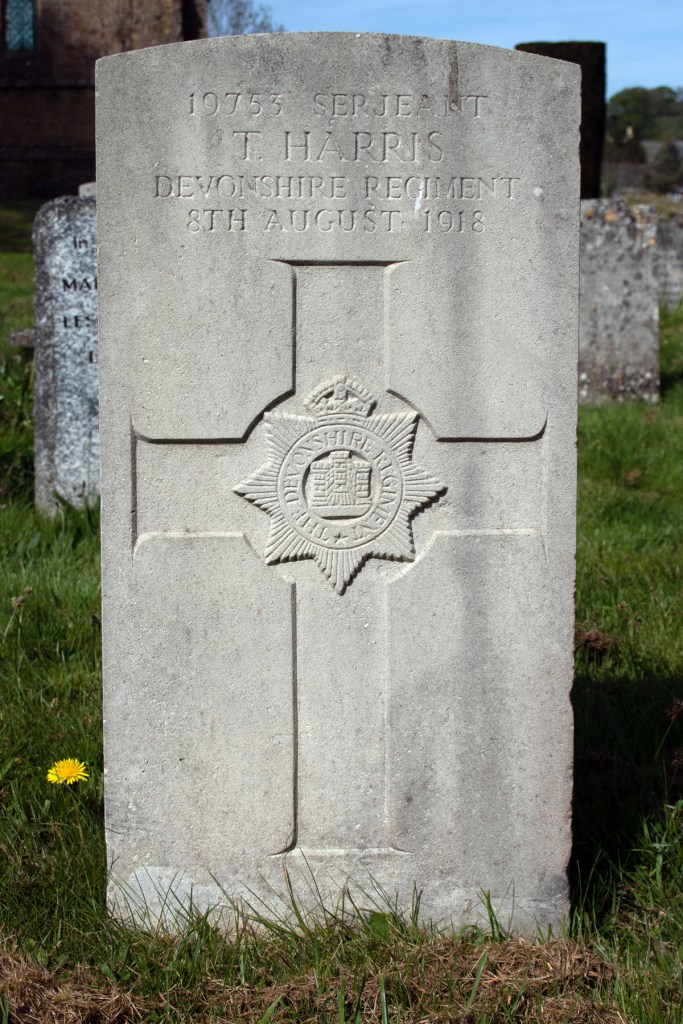
War, by now, was closing in on Europe, and Tom wanted to use his previous experience to serve his country once again. He enlisted on 20th August 1914 in Newport, joining the Devonshire Regiment as a Private, although he was quickly promoted first to Corporal and then to Serjeant. His service records show that he was 5ft 8ins (1.73m) tall, had blue eyes, brown hair and a tattoo of a Spanish girl on his right forearm.
After a year on the Home Front, Serjeant Harris was sent to Egypt in September 1915. On the way out, he contracted a severe cold, which left him deaf in his left ear. He was also suffering from varicose veins, which left him in pain in his right leg. He was treated for both conditions, and put on light duties for three months.
In November 1916, Serjeant Harris was supporting a food convoy when it came under attack. Buried in sand and wounded, he was laid up in a hole for two days and nights before help came. He was initially treated for shell shock in the camp hospital, but was eventually evacuated to Britain for treatment.
The incident had put too much of a strain on Tom, and he was medically discharged from the army in April 1917. While his medical report confirmed that the general paralysis he was suffering from was a result of the attack, it also noted on six separate occasions that he had previously suffered from syphilis, suggesting this may also have been a contributing factor to his mental state.
Tom was discharged initially to an asylum in South Wales, before returning home to Ada. The couple were soon expecting a child, and a boy, Sidney, was born in February 1918. By that summer, however, Tom’s condition had worsened enough for him to be admitted back to the Whitchurch Military Hospital in Cardiff.
It was here that Tom passed away, dying from a combination of chronic phlebitis – an extension of the varicose veins he had previously complained of – and general paralysis on 8th August 1918. He was, by this point, 41 years of age.
Tom Harris was brought back to Somerset for burial. He was laid to rest – finally at peace – in Chard Cemetery.
Edward James Phillips was born on 22nd January 1900 in Bedminster, Bristol, and was the oldest of two children to Ernest and Emily Phillips. Ernest was a bit of a jack-of-all-trades; the 1901 census recorded him as being a shopkeeper of glass and china, while by 1911 he was working as an architect’s clerk.
By this point, the family had moved to Chard, Somerset, and had set up home in a small, terraced house near the centre of the town. Storm clouds were gathering over Europe, and, while he was too young to enlist at the start of the war, it is clear that Edward wanted to play his part.
While details of his service are unclear, Edward joined the Merchant Navy. By the summer of 1918 he was on board the SS Polesley, working as a Wireless Operator. A newspaper report expanded on what became of him:
On the 21st September the SS Polesley was torpedoed off the Cornish coast by a German submarine and sunk. Later two bodies wearing life belts of the SS Polesley were washed ashore at Penreath, Cornwall. One of the bodies was identified as that of the mate of the ill fated vessel; the other was not recognised and was buried as unknown, both the gallant seamen being interred in one grave.
On learning that the bodies had been washed ashore form the torpedoed vessel, Mr EE Phillips… forwarded a photograph of his son, Edward James Phillips, who was wireless operator on the vessel, to the police at Penreath, and the undertaker and the person who recovered the bodies were able to identify the unknown remains as Wireless Operator Phillips.
Since then their sworn statements have been forwarded to the Home Office, with the result that the remains have been exhumed, and on Wednesday Mr EE Phillips, the father, went to Penreath and received the remains of his gallant son and brought them to Chard, where they will be interred.
Taunton Courier and Western Advertiser: Wednesday 29th January 1919
Edward James Phillips, who was just 18 years old when he died, was laid to rest in the family plot in Chard Cemetery.
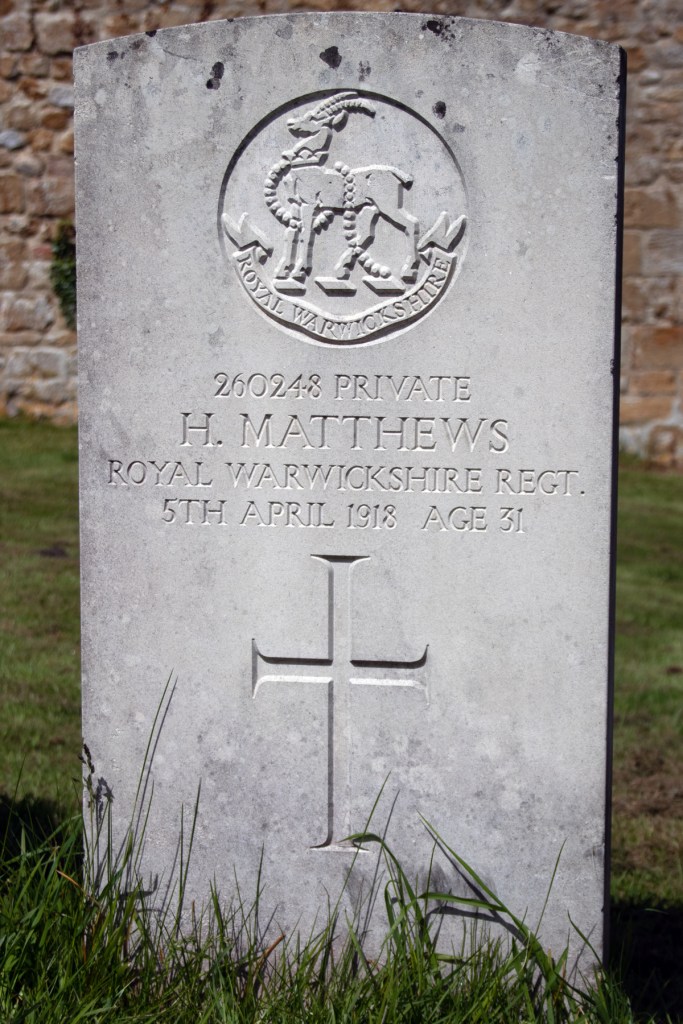
Herbert George Matthews was born in the autumn of 1886 in the Somerset village of Chillington. He was the oldest of two children to George and Elizabeth (known as Rosa) Matthews, and was baptised in the village church on Christmas Day that year.
George was a farm labourer, and this is work into which Herbert also followed. Rosa passed away in December 1910, leaving George a widow after 26 years of marriage.
War came to Europe in 1914, and Herbert signed up to play his part for King and Country. Full details of his service are not available, but he initially enlisted in the Somerset Light Infantry. He soon transferred across to the Royal Warwickshire Regiment (although the date of this is unclear) and was assigned to the 2nd/6th Battalion.
Private Matthews’ troop spent the war on the Western Front, and was involved at Fromelles, Ancre, Ypres and Cambrai. In the spring of 1918, he was caught up in the Battle of St Quentin – part of that year’s battles on the Somme. He was wounded, and medically evacuated to England, where he was admitted to the University War Hospital in Southampton.
Sadly, Private Matthews’ wounds proved too severe; he passed away from his injuries on 5th April 1918, at the age of 31 years old.
Herbert George Matthews was laid to rest in Chillington Cemetery, not far from where his mother was buried, and within walking distance of where his father still lived.
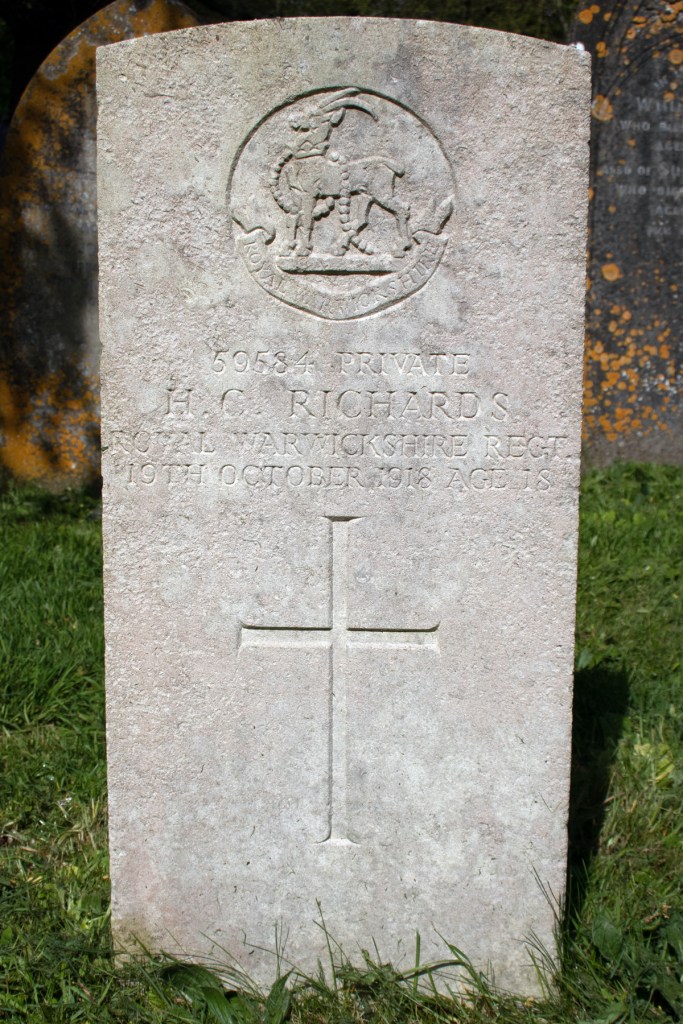
Howard Charles Richards was born in the summer of 1900, the youngest of seven children to George and Henrietta Richards. George was a sewing machine salesman from Combe St Nicholas in Somerset, and this was where the family were raised.
Howard was too young to join up when war was declared, but it seems to have been important to him. He enlisted in the 5th Battalion of the Royal Warwickshire Regiment soon after his eighteenth birthday and was sent for training.
Tragically, Private Richards’ time in the army was to be a short one. The next record for him confirms that he was admitted to the 1st Northern General Hospital in Newcastle-upon-Tyne, and that he passed away on 19th October 1918. The cause of his passing is not recorded, but he was just 18 years of age.
Howard Charles Richards’ body was brought back to Somerset for burial. He lies at rest in the graveyard of St Nicholas’ Church in his home town.
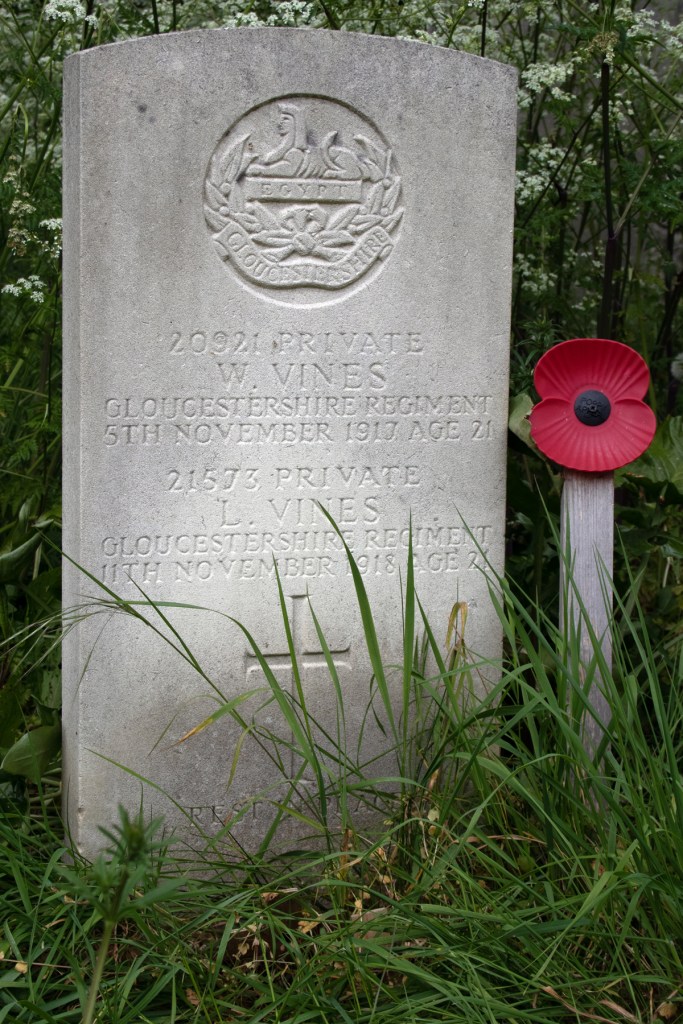
Leslie Vines was born on 16th September 1898, and was one of seventeen children to John and Emma. John was an elastic web maker or braider from Stroud, Gloucestershire, and it was in nearby Wotton-under-Edge that he and Emma raised their growing family.
Braiding and weaving ran in the family: the 1911 census recorded six of the Vines’ children who were over school age were employed in the local mill. When he finished school, Leslie also found work there.
When war came to Europe, Leslie was eager to play his part. He enlisted in the Gloucestershire Regiment on 18th June 1915, just a month after his older brother, Wilfred, had joined up. His service records confirm that he was 5ft 2ins (1.57m) tall: Keen as he was to follow his older brothers into glory, he gave his age as 19 (two years older than he actually was) in order to be accepted for duty.
Private Vines’ eagerness, however, was to be thwarted. On 29th June, less than two weeks after joining up, he was discharged from service. Details are scant, but this seems to have been on the basis that, following his medical examination, he was considered to be unfit for duty.
At this point, Leslie’s trail goes cold and the next available record is that for his death on Armistice Day, 11th November 1918. He was just 20 years of age. While the cause of his passing is not readily available, it was not reported on in any of the contemporary newspapers, so is likely to have been of natural causes.
Leslie Vines was laid to rest alongside his brother, Private Wilfred Vines, in the graveyard of St Mary the Virgin Church in his home town, Wotton-under-Edge.
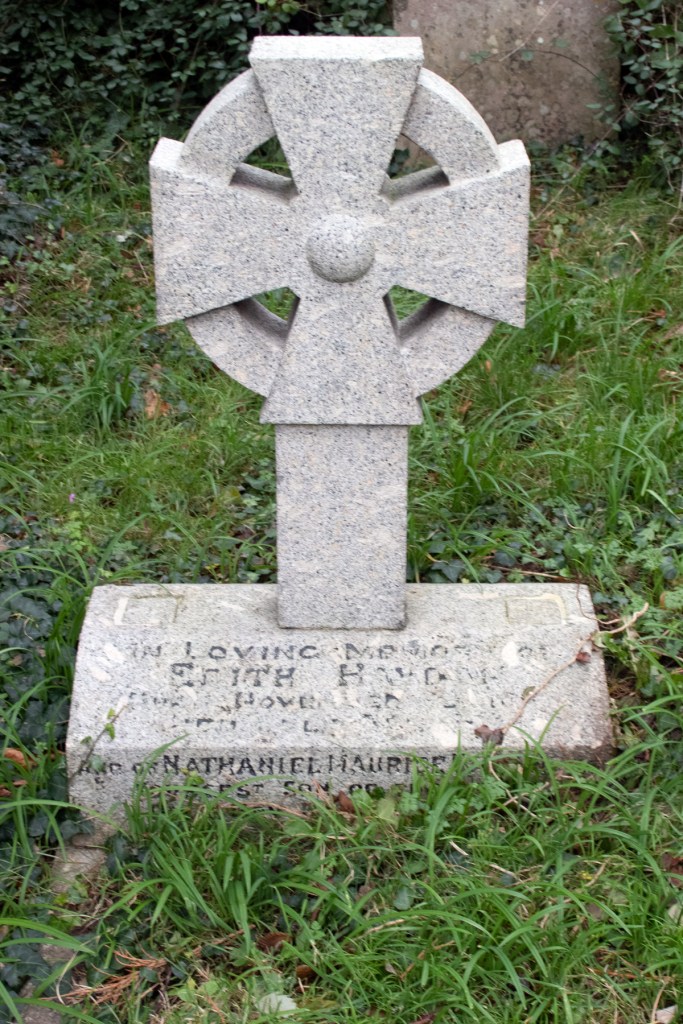
Nathaniel Maurice Haydon was born on 26th May 1900, and was the youngest of four children to Edgar and Edith Haydon. Edgar was a surgeon from Bovey Tracey, Devon, but the family were born and raised in Newton Abbot.
Edgar’s work gave them a comfortable lifestyle: the 1901 census shows the family had four live-in servants. Edith passed away from cancer in July 1903, when her youngest was only a toddler. Edgar married again – to a Gertrude Godwin, fourteen years his junior – four years later; given his role in the community, this is likely to have provided the family with a level of stability.
By the time of the 1911 census, Nathaniel and his older brother Frank were recorded as boarders in a private school in the town, while Edgar and Gertrude were listed at the family home with two domestics.
War was coming to Europe, but Nathaniel was initially young to become involved. Spurred on when his oldest brother, Edgar, was killed at the Somme in July 1916, he applied to join the Inns of Court Officer Training Corps in the summer of 1918. He was accepted, and sent off to Hemel Hempstead, Hertfordshire, for training that September.
Sadly, it was Private Haydon’s eagerness to emulate his brother that led to his undoing. While at the camp, he contracted pneumonia, and passed away on 1st November 1918, aged just 18 years old.
Nathaniel Maurice Haydon’s body was brought back to Devon for burial. He was laid to rest in the family plot in the graveyard of St Mary’s Church, Wolborough, Newton Abbot.