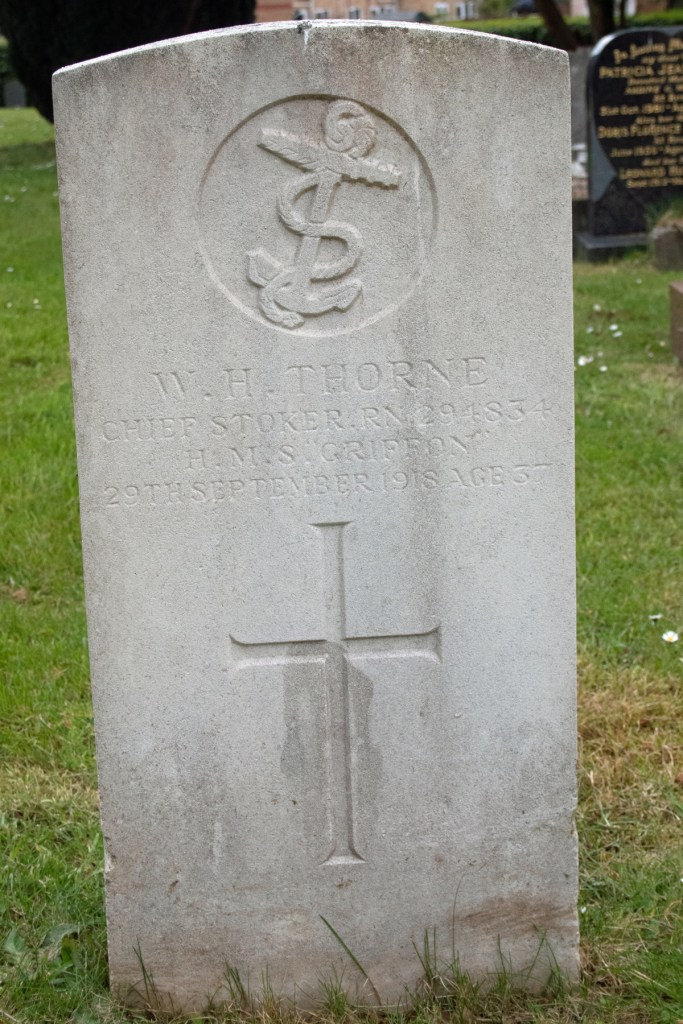
William Henry Thorne was born on 28th July 1881 in the Somerset village of Milverton. He was the oldest of five children to farm labourer Henry Thorne and his wife Mary.
William was a young man with a keen sense of adventure. In February 1900, he joined the Royal Navy as a Stoker. After his initial training in Devonport, he was assigned to HMS Thunderer and, after six months, joined HMS Hood, where he spent the next two years.
Over his twelve years of his service, Stoker Thorne served on six further vessels, attaining the rank of Stoker Petty Officer.
In 1907, William had married Mabel Cross, a young woman from Taunton. While her husband was away from England – the marriage certificate gives his address as ‘on the high seas’ – she set up home near the centre of town. The young couple went on to have two children, twins Phyllis and Doris, who were born in 1911.
Back at sea, and Stoker Petty Officer Thorne’s terms of service were extended in 1912, so that he would continue to be a part of the Royal Navy until the cessation of hostilities. He served on a further six vessels and was promoted to Chief Stoker in June 1917.
It was while he was serving on HMS Griffon in the autumn of 1918 that William fell ill. Brought back to shore, he was admitted to the Military Hospital in Taunton. There is nothing to confirm the illness he contracted, but it was one he would succumb to. Chief Stoker Thorne passed away on 29th September. He was 37 years old.
William Henry Thorne lies at peace in the St James Cemetery in his home town of Taunton.
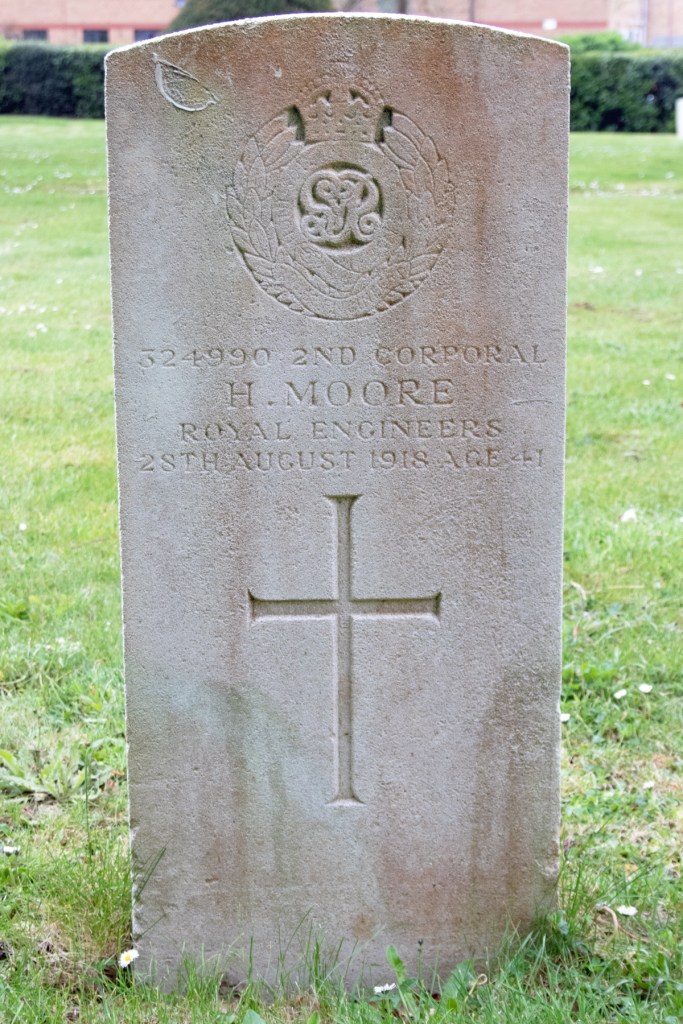
Harry Moore was born in Tiverton, Devon, in early 1877. He was the fourth of eleven children to James Moore, a railway policeman, and his wife Ann.
By 1890, James had moved the family to Taunton, in Somerset (where his work was now listed as railway porter). Over the next decade, Harry was to encounter tragedy and happiness.
In 1894, his father died from Bright’s disease (a kidney complaint), at the age of just 45 years old.
Three years later, Harry’s mother died, from what appears to have been heart failure. Ann was 49 years of age.
On 13th November 1898, Harry married Alice Mary Larcombe, a dressmaker from Taunton. The young couple set up home together in the north of the town. They went on to have five children, although, sadly, only one would live to reach their 20s.
By now Harry had found employment as an insurance agent, but war was coming to Europe. His military records are lost to time, but he enlisted in the Royal Engineers and was assigned to G Depot Company. (The Depot Battalions received men who had returned from the Expeditionary Force and also those men who had enlisted for Tunnelling Companies, Special Companies and other specialist units.)
The next evidence we have of Corporal Moore is in the Army Register of Soldiers’ Effects. This confirms that he had been admitted to the Southern General Hospital in Bristol with an illness, and that he subsequently passed away on 28th August 1918, at the age of 41.
Harry Moore was laid to rest in the St James’ Cemetery in his home town of Taunton.
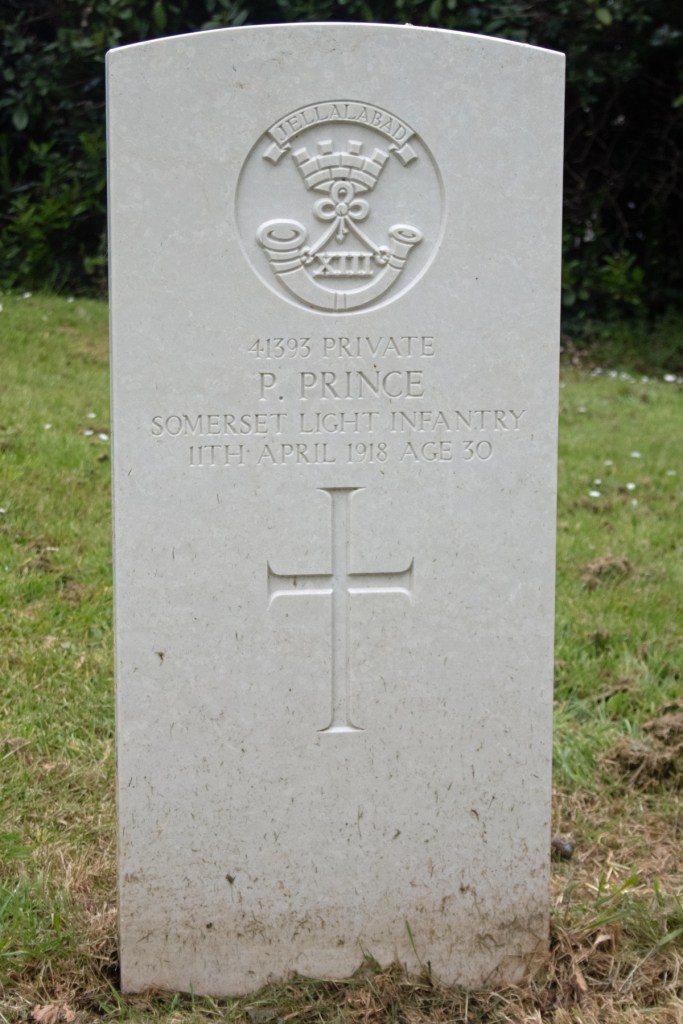
Percy Prince was born in 1890, one of seven children to John and Eliza Prince. John was an agricultural labourer and coal merchant, and brought his family up on the Somerset/Wiltshire border, near Bruton.
Percy followed in his father’s line of work when he left school, eventually moving to Frome. He met and married a woman called Florence Stickler in July 1909, setting up home in Water Lane, to the south of the town centre.
War was soon beckoning, and Percy enlisted in the Somerset Light Infantry as a Private. Sadly, his service records are lost to time, and so details of him time in the army are not available. What we do know is that he was assigned to one of the depots, although which one is not clear.
Sadly, that is about the limit of information available about Private Prince. He died on 11th April 1918, at the Military Hospital in Taunton. There is nothing to confirm a cause of death, but he just was 28 years old.
Percy Prince was buried in St James’ Cemetery in Taunton.
Newman Joynt Bailey was born on 1st August 1887, the eldest of five children to Newman Bailey and his wife Anna (née Joynt). Newman Sr worked as a switchman and signalman for Great Western Railway and had been born in Bath. He married Anna (whose maiden name was Joynt, and who had been born in Ireland) in 1885 and, after a short stint living across the county border in Devon – where Newman Jr was born – he settled his young family in Taunton.
When Newman Jr left school, he became an office boy, but he soon found himself following in his father’s footsteps. He became a fitter for the railways and, by 1910, was living with spitting distance of the GWR depot in the town.
It was here, in William Street, that he set up home with his new wife, Lily Gill, who he had married on 31t July 1910. Lily was the daughter of a Taunton lamplighter, and, to help make ends meet, worked as an ironer at the town’s collar factory.
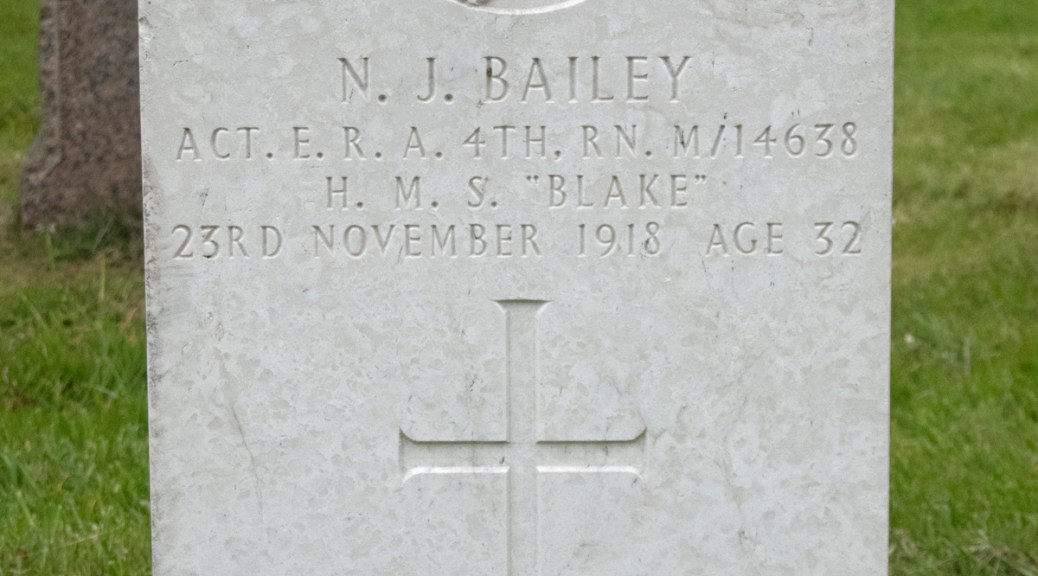
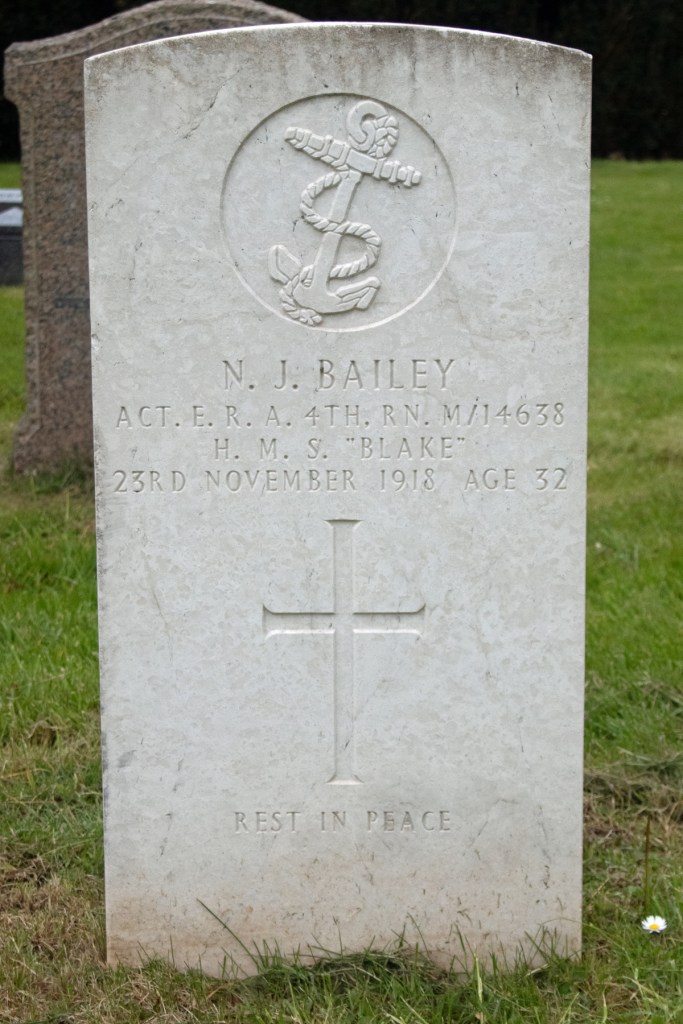
War was on the way, and in July 1915, Newman enlisted in the Royal Navy. After initial training aboard Vivid II, the shore establishment in Devonport, he was deployed on HMS Blake as an Engine Room Artificer.
HMS Blake was an auxiliary ship designed to provide maintenance support to a flotilla of destroyers or other small warships. With his experience with steam engines at GWR, his knowledge of mechanics would have made him ideally suited to this type of role.
While he survived the war, Artificer Bailey was to be struck down with something much closer to home. In the immediate post-war period, the Spanish Flu pandemic swept the globe, and Newman was to fall victim to it. Admitted to the Royal Naval Hospital in South Queensferry, near Edinburgh, he passed away from the lung condition on 23rd November 1918. He was just 32 years old.
Brought back home, Newman Joynt Bailey was laid to rest in St James Cemetery in his home town of Taunton.
Percy Payne was born in the village of Kingston Seymour, between Weston-super-Mare and Yatton, Somerset. His parents were agricultural labourer Harry Payne and his wife, Elizabeth, and he had three brothers.
It seems that Percy’s parents may well have separated by 1911; Elizabeth is listed as a widow in the 1911 census, but Harry appears to be alive and well and living in South Wales.
According to the census records, Elizabeth was working as a charwoman, while three of her children were working to help support the family. Percy’s two older brothers were employed as a carter and a domestic servant, while Percy himself was working as an errand boy.
By the time war broke out, Percy has stepped up the ladder. His service records listed his trade as a groom, working in Congresbury, near Bristol. He enlisted in March 1916, at the age of 19 years and 8 months, and was assigned as a Private in the Northumberland Fusiliers. He spent most of that year training on home soil, before being shipped out to France at the end of December.
Illness seems to have dogged Private Payne; he returned to England after a couple of months, and was transferred to the Labour Corps fairly soon afterwards. By September 1917 a further transfer was made, this time to the Royal Army Medical Corps, before he was finally discharged from military service on 21st January 1918, suffering from tuberculosis.
Sadly, the lung condition was to prove fatal, and Percy passed away on 26th June 1918. He was just 21 years old.
Percy Payne lies at rest in the graveyard of St Mary’s Church in the village of Yatton, Somerset.
In a quiet corner of the St Mary’s Cemetery in Taunton, Somerset, sit a pair of headstones.
Both are adorned with the word Portugal, and have the word Trabalhador (translated as Worker) and the phrase Corpo de Lenhadores Portugueses (or Portuguese Forestry Corps) inscribed on them.
During the Great War, vast quantities of timber were required by the Army in France. Initially imports from Canada provided most of what was needed but, as the war progressed, ships were required for other essential supplies, so imports of timber fell dramatically.
In 1916, the British government asked the country’s oldest ally, Portugal, to send workers to assist with the war effort. Soon both the Portuguese Forestry Corps and Canadian Forestry Corps had teams working all across the United Kingdom, totalling many thousands of men.
This side of the war effort was not without its casualties, and those serving were accorded Commonwealth War Graves.
There is no information readily available for Manuel Ferreira Maio. He would have come to England from Portugal at some point in 1916, but the only record of him is that of his passing.
He died on 7th October 1918, although the cause of his death and the age at which he passed are lost to time.
Manuel Ferreira Maio lies at rest in St Mary’s Cemetery in Taunton, Somerset.
In a quiet corner of the St Mary’s Cemetery in Taunton, Somerset, sit a pair of headstones.
Both are adorned with the word Portugal, and have the word Trabalhador (translated as Worker) and the phrase Corpo de Lenhadores Portugueses (or Portuguese Forestry Corps) inscribed on them.
During the Great War, vast quantities of timber were required by the Army in France. Initially imports from Canada provided most of what was needed but, as the war progressed, ships were required for other essential supplies, so imports of timber fell dramatically.
In 1916, the British government asked the country’s oldest ally, Portugal, to send workers to assist with the war effort. Soon both the Portuguese Forestry Corps and Canadian Forestry Corps had teams working all across the United Kingdom, totalling many thousands of men.
This side of the war effort was not without its casualties, and those serving were accorded Commonwealth War Graves.
There is no information readily available for Joaquim Maria Brandao. He would have come to England from Portugal at some point in 1916, but the only record of him is that of his passing.
He died on 3rd October 1918, although the cause of his death and the age at which he passed are lost to time.
Joaquim Maria Brandao lies at rest in St Mary’s Cemetery in Taunton, Somerset.
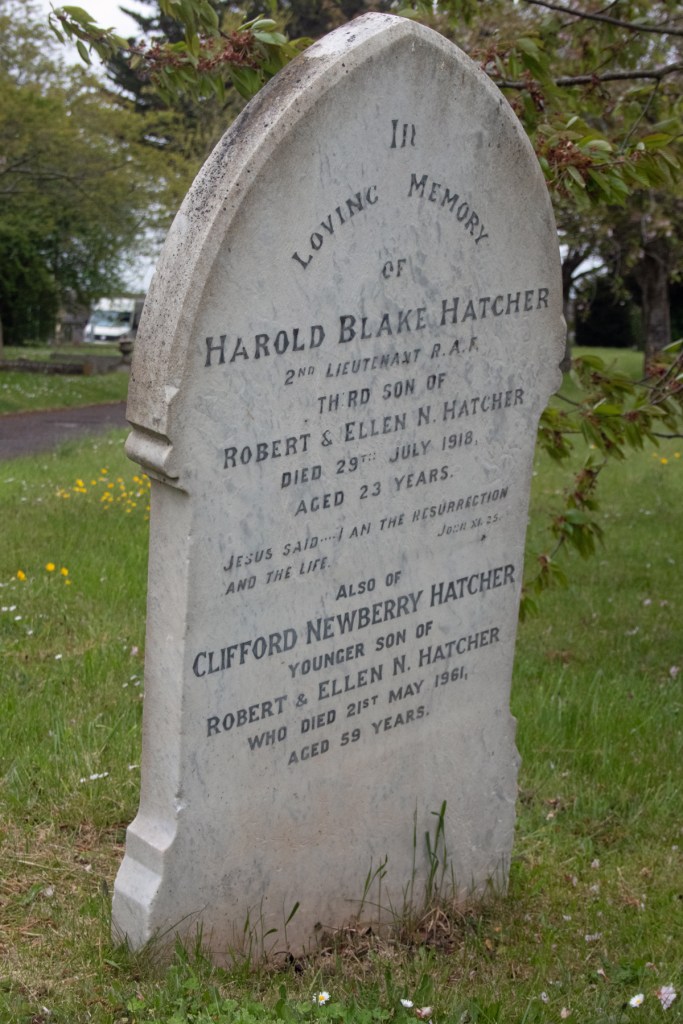
Harold Blake Hatcher was born on 11th February 1895, one of nine children to Robert Hatcher and his wife Ellen. Robert was a draper, and brought his family up in his home town of Taunton in Somerset. At least one of his children followed him into the cloth business, and, after he died in 1908, this seems to have fallen to Harold’s older brothers, Arthur and Ernest.
After leaving school, Harold became a dental student. Initially studying with Kendrick’s in his home town, he was about to begin training at Guy’s Hospital in London when war broke out.
Harold joined up in May 1915, and was initially assigned as a Lance Corporal to the 6th Battalion of the Somerset Light Infantry, before being transferred to the Middlesex Regiment.
In November 1917, he was badly injured in while fighting at Bourlon Woods, as part of the Battle of Cambrai. It was while he was recuperating that he transferred again, this time to the fledgling Royal Air Force.
Second Lieutenant Hatcher gained his wings in June 1918, and soon became a flying instructor. It was while he was working at RAF Fairlop in North West London, that an incident occurred. A local newspaper picked up the story.
Many in Taunton have learnt with sincere regret of the accidental death whilst flying of Lieutenant Harold Blake Hatcher of the Royal Air Force, third son of the late Mr Robert Hatcher of Taunton, and of Mrs Hatcher, now of Bristol.
The accident in which he met his death on Monday was a triple fatality, two other airmen being killed at the same time, Second Lieutenant Laurie Bell, of Bournemouth, and Flight Sergeant AR Bean, of Burslem.
At the inquest… it was stated in evidence that while Lieutenant Hatcher and Sergeant Bean were flying at a height of about 500ft, Second Lieutenant Bell, who w flying a single-seater, dived from a position some 700 feet higher, his machine striking and cutting clean through the double-seater, which folded its wings, hovered a few second, and then crashed to the earth. The three men were instantaneously killed.
A verdict of Accidental Death was returned.
Taunton Courier and Western Advertiser: Wednesday 7th August 1918
Further witness testimony described how the Sopwith Camel, piloted by Bell, cutting the AVRO airplane it in two. Hatcher fell out of the wrecked two-seater as the Camel’s wings slowly folded into a V and fluttered free following the fuselage to the ground. All three airmen lost their lives. Bean was found in a sitting position, still strapped in the front half of the AVRO’s fuselage, his instructor’s body was found unmarked thirty yards away in the grass where it had fallen. The wingless Camel crashed close by and Bell was found to have almost every bone in his body broken.
The accident took place on 30th July 1918. Second Lieutenant Hatcher was just 23 years old.
Harold Blake Hatcher lies at rest in St Mary’s Cemetery in his home town of Taunton, Somerset.
Ernest Frederick Hawkins was born in Street, Somerset, in 1884. He was the youngest of six children to Charles Hawkins and his wife Elizabeth. Both of Ernest’s parents were shoemakers in the Clark’s Factory in the town, and this was the trade Elizabeth continued in after her husband’s death in 1887.
Ernest’s life has some mysteries about it and there is a sense that he spent time trying to escape from something. In August 1904, he enlisted in the army, joining the Scottish Rifles (also known as the Cameronians). He did this under an assumed name, preferring to be called James Fisher.
“James” gave his next of kin as his parents, listing them as George and Annie in South Acton (even though these were not his actual parents’ names, and that his father had passed away 17 years previously).
His enlistment papers give an interesting insight into the young man. He was listed as 22 years old, 5ft 4ins (1.62m) tall, with brown eyes, black hair and a sallow complexion. His arms were adorned with a number of tattoos, including Buffalo Bill on his upper right arm and a ship surrounded by flags on his upper left.
Private Fisher served for a year on home soil, before being shipped out to India. He returned to the UK in October 1907, and transferred to the Army Reserve.
Ernest returned to Somerset, and it was here that he met Sarah Jane Manning. The couple married in a registry office in Bristol, and went on to have two children, Hubert and Iris.
War broke out, and Private Fisher was remobilised. By August 1914 he was promoted to Lance Corporal, and sent to France as part of the British Expeditionary Force. Here he became caught up in a number of the key battles of the conflict.
On 24th July 1916, during the British attacks on High Wood at the Somme, he was wounded in the right arm, and invalided back to England for treatment. Admitted to the War Hospital in Guildford, Surrey, it was confirmed that he had received a gun-shot wound to his right arm, which had resulted in a compound fracture of the humerus, radius and ulna. Sadly for Ernest, the only option was a full amputation of his right arm.
After some time to recover, Ernest was transferred to the Pavilion Military Hospital in Brighton where he was fitted for an artificial limb. He spent three months in the Brighton facility, before being moved to the Queen Mary’s Convalescent Home in Roehampton to recuperate. He was eventually discharged – from the hospital and the army – on 10th March 1917, and returned to his wife and family in Somerset.
There is little further documented information about Ernest. He and Sarah went on to have a further child – Leslie – in 1917. Sadly, where Ernest had been a toddler when his father had died, Leslie was consigned to be a babe-in-arms when Ernest passed away.
Ernest Frederick Hawkins – also known as James Fisher – died in Swindon on 2nd July 1918, at the age of 34. He lies at rest in St Mary’s Cemetery in his adopted home town of Taunton, Somerset.
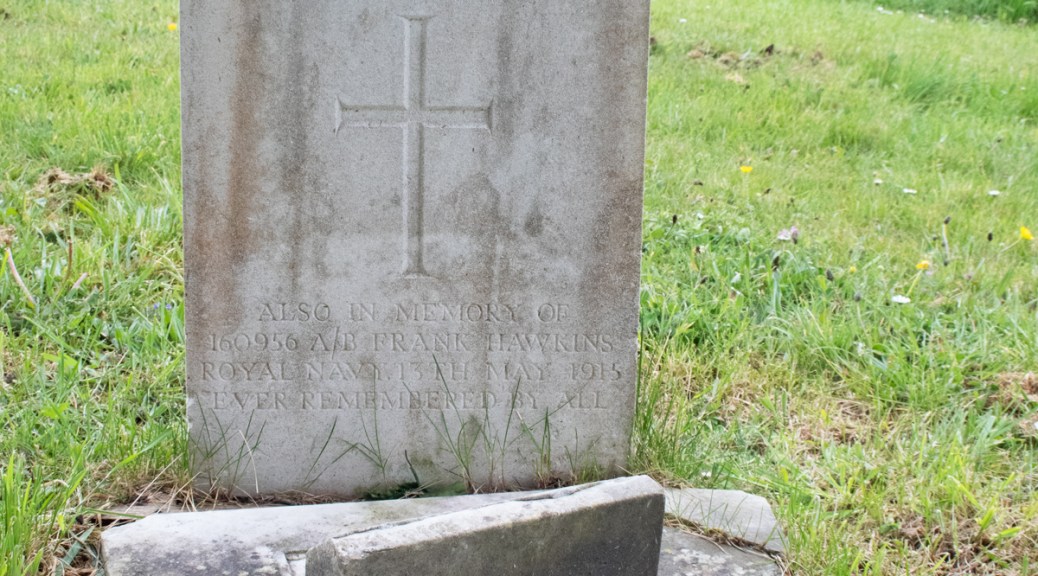
Ernest’s gravestone also commemorates his brother Frank Hawkins. Frank was nine years older than Ernest, and, like his younger brother, had decided that the military life was for him.
Frank enlisted in the Royal Navy in November 1894 and was assigned a Boy 2nd Class on HMS Impregnable – the training ship based in Chatham, Kent. Over the period of his twelve years’ service, Frank rose through the ranks to Able Seaman. When his term was up, he joined the Royal Fleet Reserve for a further five years.
When war came, Able Seaman Hawkins was immediately called back into action. He was assigned to HMS Goliath, serving off German East Africa and the Dardanelles. On the night of the 12th May 1915, the ship was guarding the water off Gallipoli, when it was struck by three Ottoman torpedoes. The resulting explosions caused the ship to sink quickly, and 570 souls – out of a total complement of 750 crew – were lost.
Able Seaman Hawkins was one of those lost, and was subsequently commemorated on his brother’s gravestone.
Leonard Francis Tucker was born in 1898, the middle of three children to Arthur and Frances Tucker. Arthur was a tailor from Taunton, Somerset, and this is where he brought his young family up.
Sadly, little documentation remains of Leonard’s life. His grave confirms that, when war came, he served in the Royal Navy, and, at the time of his death, he was a Deck Hand on HMS Vivid.
His Commonwealth War Graves Records confirm that his parents were living in Melbourne – his pension ledger confirms Arthur as his next of kin, with an Australian address. There is nothing to confirm their emigration, or whether Leonard emigrated as well.
Leonard’s young life is summed up in a short notice in the local newspaper, which has the simple comment “Tucker – Sept. 28th, at 10 Westgate-street, Taunton, Leonard Francis Tucker, aged 20.” [Taunton Courier and Western Advertiser: Wednesday 9th October 1918]
Slightly more confusing is the next name on that list: “Tucker – Sept. 29, at 10 Westgate-street, Taunton, Frances Ellen Tucker, aged 44.” It would seem that Leonard’s mother was in England, not Australia, at the time of his death, and that she passed away a day after him.
Combined with when Leonard died, it would suggest both he and his mother died from one of the respiratory conditions running rampant through England at the time, possibly influenza or pneumonia. There is nothing to confirm this outright, but it seems the likeliest outcome for the poor mother and son.
Leonard Francis Tucker lies at rest in St Mary’s Cemetery in his home town of Taunton.
As an aside to this, there is no record of where Frances was buried, but it is likely that she too was laid to rest in St Mary’s Cemetery.