William Thomas Cole was born in the spring of 1897, the youngest of three children to John and Caroline Cole. John was a bank cashier from Gillingham in Dorset, while Caroline was born in Battersea, London. By the time of William’s birth, however, the young family had settled in the Dorset town of Blandford.
John was a man with ambitions for himself and his family. The 1911 census records him and Caroline living in Axbridge in Somerset, where he was now a bank manager. William, meanwhile, was a student in Wareham, Dorset, and was lodging at a boarding house in the town.
There is little documented about William’s military service. His gravestone confirms that he had originally enlisted in the Dorsetshire Regiment, but had subsequently joined the Royal Air Force, when it was formed in April 1918. By the time of his death, he had reached the rank of Lieutenant, so it would seem that his John’s ambitious nature had rubbed off on his only son.
William’s death was reported in a number of contemporary newspapers:
Lieutenant WT Cole and First Air Mechanic H Keates were killed while flying in South Essex last night. They were both in the same machine, which nose-dived and crashed into the ground. Cole’s home is at Shaftesbury, Dorset, and Keates’ at West Wood Grove, Leek, Staffordshire.
Dundee Evening Telegraph: Thursday 24th October 1918
Lieutenant Cole was flying in Hornchurch, Essex, and was in an Avro 504K bi-plane. He was just 21 years old when he died on 23rd October 1918. There is little further information about the accident, but highlighting the real danger in aviation at the time, this was one of eight fatal plane crashes across the UK that day alone.
The body of William Thomas Cole was brought back to Shaftesbury, where his parents were by then living. He was laid to rest in the Holy Trinity Churchyard in the town.
Sidney William Alner was born in Shaftesbury, Dorset, in March 1899, one of eleven children to Sidney and Ellen Alner. Sidney Sr was a grocer’s porter, and the family lived on the celebrated Gold Hill in the town.
War was to come when Sidney Jr was only young – he had just turned 15 when it broke out. He saw his older brothers go off to war and was obviously keen to do his bit as well. Until he was old enough, however, he worked as an errand boy for his father’s employers, Stratton Sons and Mead.
His time would come, of course, although dates for Sidney’s enlistment are not clear. A contemporary newspaper record confirms that he arrived in France in January 1918, so it is likely that Private Alner joined up at some point during the previous year.
He joined the Hampshire Regiment, and was assigned to the 1st Battalion. Heavily involved during most of the conflict, the battalion was seen as key to the Final Advance of the autumn of 1918. Private Alner was caught up in the fight to break the Hindenburg Line, fighting on the River Selle and capturing the town of Monchaux.
It was while his battalion was advancing on the village of Préseau on 2nd November, that Private Alner was injured. Shot in the arm, he was evacuated back to England, and admitted to the Cambridge Military Hospital in Aldershot. He would have survived his injuries, had pneumonia not set in, and it was to this that he would succumb on 19th November. He was just 19 years old.
Sidney William Alner’s body was brought back to Dorset. He lies at rest in the Holy Trinity Churchyard in Somerset, within walking distance of his family’s home.
Sidney was the second member of the Alner family to die as a result of the Great War.
His older brother Harry, who had become a chauffeur and went to live in London, joined the Royal Army Service Corps in 1915. Private H Alner had served three years in France when he was killed on the front line just three weeks before his brother. He was 32 years old, and left a widow and two children.
When researching Sidney Alner in newspaper articles, an interesting report surfaced.
An unfortunate accident has happened to a little girl, not quite four years old, the daughter of Sidney Alner, who resides in Gold Hill. Heals’ steam hobby horses visited the town on Friday and Saturday in last week, and on the evening of the former day, Alner took his little girl for a ride on the horses.
Whilst they were in motion, the bolt that kept the horse on which Alner sat with his child attached to the connecting rod came out, and he and the little girl were precipitated to the ground.
Alner escaped without injury, but his daughter had one of her legs fractured above the knee. She was taken home, and Dr Evans set the injured limb. Later in the evening she was removed to the Westminster Cottage Hospital.
Salisbury and Winchester Journal: Saturday 31st October 1891
This Sidney Alner was Private Alner’s father, and the daughter would have been his older sister Sarah. Nothing more is reported of the incident, and Sarah went on to live until 1945, when she was 57 years old.
Alfred Fear was born towards the end of 1898, the youngest of nine children to Charles and Eliza Fear. Charles was a mason from Weston-super-Mare in Somerset, who raised his family in the town of his birth.
Sadly, given his youth, there is little documented about Alfred’s early life. He was still at school at the time of the 1911 census and, while he would have found some sort of employment after leaving, there is no record of what that would have been.
Alfred’s military service records are also sparse. He enlisted in the Royal Field Artillery and was assigned the role of Driver in the 321st Brigade. While dates cannot be confirmed, he would have enlisted before the spring of 1918.
The next two documents relating to Driver Fear are his Pension Ledger record and the Army Register of Personal Effects. These confirms that he passed away on 22nd October 1918 at the Norfolk War Hospital. The cause of death given was infirmation of the brain, (or possibly inflammation of the brain). He was just 20 years old.
Alfred Fear’s body was brought back to Weston-super-Mare for burial. He lies at rest in the town’s Milton Cemetery.
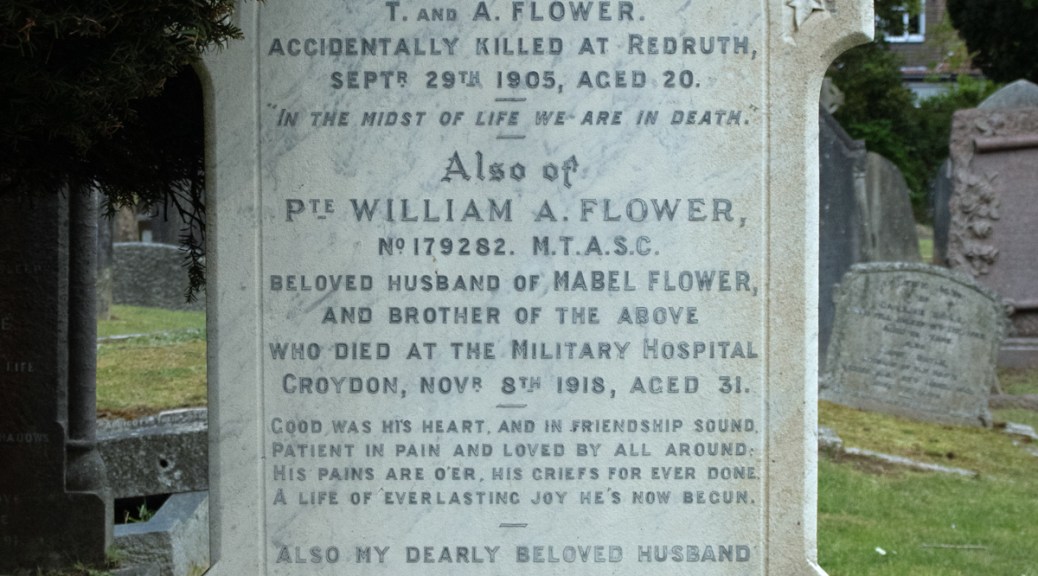
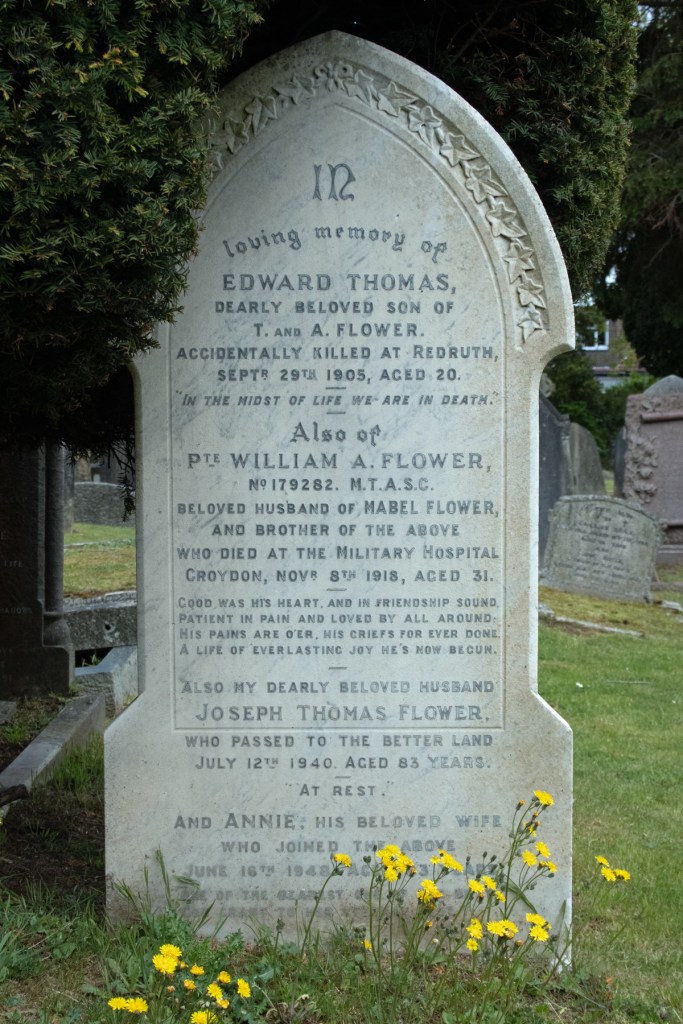
William Alister Flower was born in 1887, one of five children to Joseph and Annie Flower. Joseph was a platelayer for the local railway, and brought the family up in Weston-super-Mare, in his home county of Somerset.
When he left school, William worked as an errand boy for a local greengrocer; he stuck with it, and, by the time of the 1911 census, he was employed as a van driver for the grocer.
War was on the horizon and, while William enlisted in the army, it is difficult to get a complete handle on his military service. There are a number of servicemen with similar names, but the documentation that is available is not easy to directly connect them with the gravestone in the Weston-super-Mare cemetery.
What is clear is that William enlisted as a Private in the Army Service Corps at some point before May 1918. He was assigned to the Motor Transport division (this was likely on the back of his van-driving experience). His time seems to have been spent on home soil, although he was awarded both the Victory and British Medals for his service.
At some point, he had married a woman called Mabel. Exact details again are unclear – ancestry.com confirms the marriage of a William Flower and Mabel Richardson in December 1909, but as this took place in Northamptonshire, it is unlikely to be the Somerset Flowers researched here.
Details of Private Flower’s passing are also scarce. He died on 8th November 1918, in the Military Hospital in Croydon, Surrey, but the is no information as to the cause of his death. He was just 31 years old.
William Alister Flower’s body was brought back to Somerset; he lies at rest in the family grave, in the Milton Cemetery of his home town.
While I was researching William Flower, I was taken by the note of the accidental death of the first name on the family grave.
Edward Thomas Flower was two years William’s senior who, after leaving school, had gone on to be an errand boy for a local butcher.
Edward had decided to follow in his father’s footsteps and join the railways, leaving his home town in 1905 to work in Cornwall. After initially working as an engine cleaner, he progressed to be a fireman, helping to stoke the engine with coal. The local newspaper of the time picked up the story of the accident.
At the moment of the accident, a goods train was standing in the Redruth station, shunting having been temporarily suspended to admit the passage of the down motor rail car.
It appears that the flap of one of the cattle trucks in the goods train… had been allowed to remain down, and the folding doors above it had been insecurely fastened, with the result that as the motor rail car ran into the station the doors of the truck suddenly flew open outward and one of them struck deceased on the side of the face and head, inflicting terrible injuries.
There was a very extensive fracture of the skull, the whole of the left side of the face was driven in and there was also a formidable wound at the back of the head, death occurring within a few moments.
It appears that the rail motor was not proceeding at a greater rate than some five or six miles an hour, according to the statement made at the inquest by the driver, and the latter noticed that when the doors of the goods truck swung open they struck one of the handles on the fore part of the car. He applied the brake immediately, but did not know that Flower had been struck until afterwards.
Weston Mercury: Saturday 7th October 1905
The inquest found that there had been some neglect on the part of the porter and guard in not ensuring that the goods truck’s doors had been secured, and it seems that this was something that had been highlighted previously.
Edward had shortly been due to marry, leaving a fiancée, as well as a family, bereft. He was just 20 years old.
His body was brought back to Weston-super-Mare, and was the first to be buried in the family grave.
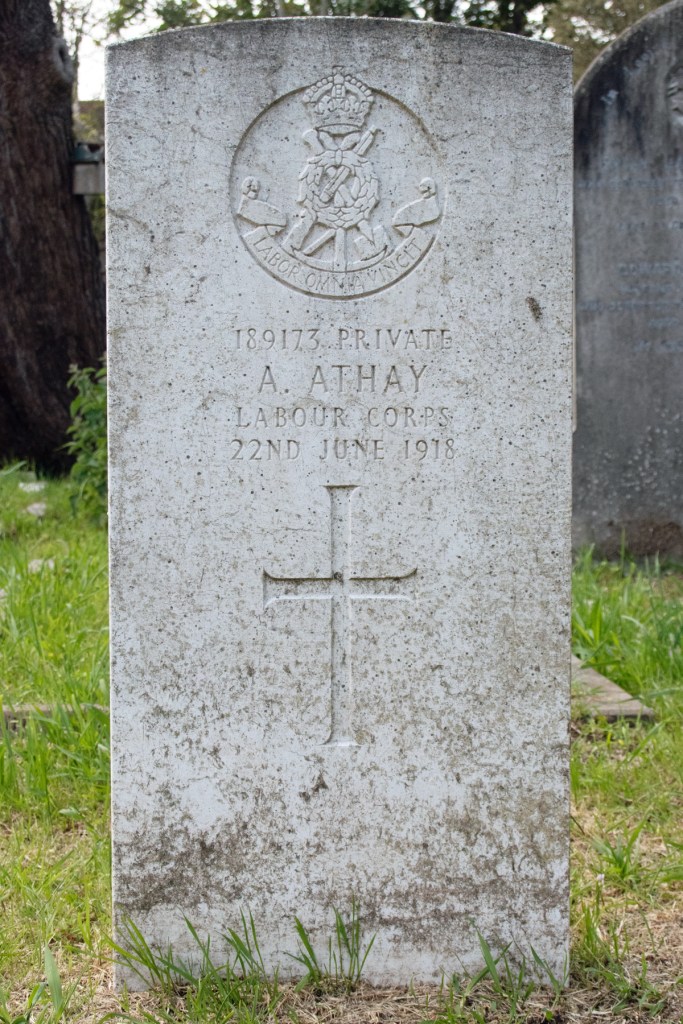
Albert Athay was born in 1887, one of eight children to Thomas and Emily. Thomas was a labourer for the local council in Weston-super-Mare, and the family lived in a small house on a road leading inland from the seafront.
Thomas died when Albert was only 14 years old, and, having left school, he found labouring work to help support his now widowed mother and younger siblings.
In August 1910, Albert married Mable Dunstone, a cowherd’s daughter from Somerset. The couple continued to live with Albert’s mother and brother right up until the outbreak of war. They went on to have three children, Milicent, Freda and Charles.
Albert, by this time, has been volunteering with the local Labour Battalion; he formalised his military service in June 1917, officially enlisting in the Labour Corps. He served as part of the territorial force, in and around Salisbury Plain.
Private Athay fell ill in the summer of 1918, and was admitted to hospital on 11th June with pneumonia. Sadly, as the days progressed, so did the condition, and he passed away from it just eleven days later. He was just 31 years old.
Brought back to Weston-super-Mare, Albert Athay was laid to rest in the Milton Cemetery in his home town.
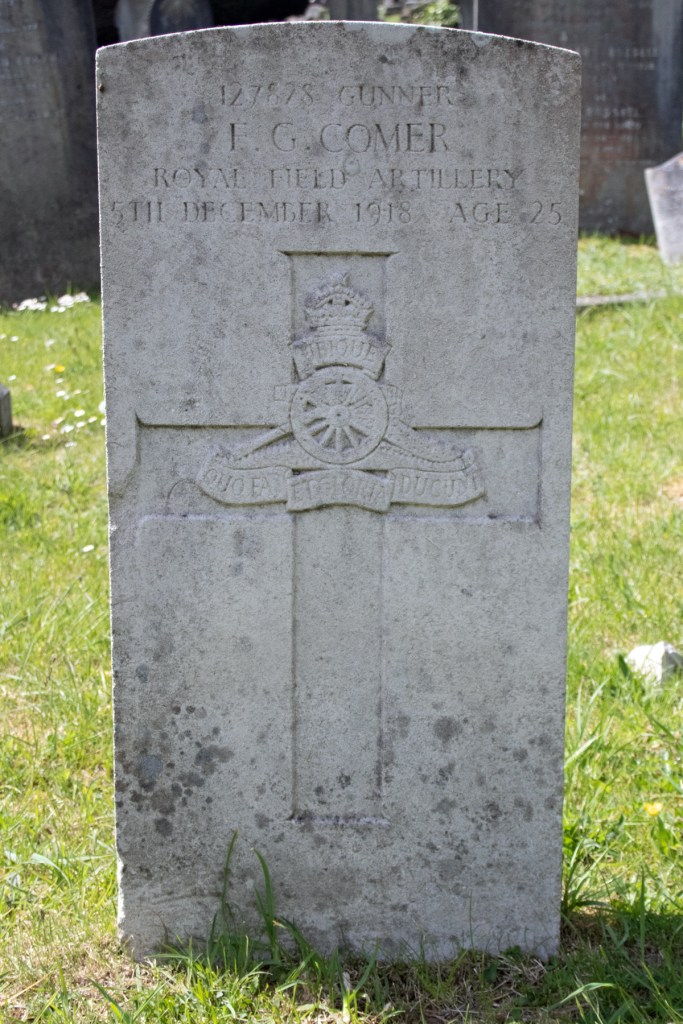
Frederick George Comer was born on 8th July 1893, the older of two children to Fred Comer and his wife Fanny. Fred Sr was a decorator, and raised his family in his town of his birth, Weston-super-Mare.
While his younger brother Clifford followed in his father’s footsteps and became a decorator, Frederick Jr had set his sights elsewhere. The Western-super-Mare Gazette and General Advertiser reported on 31st December 1910, that he had gained a certificate by Pitman’s Shorthand with a speed of 60 words per minute. Within a year, he was working as a news reporter in the local area.
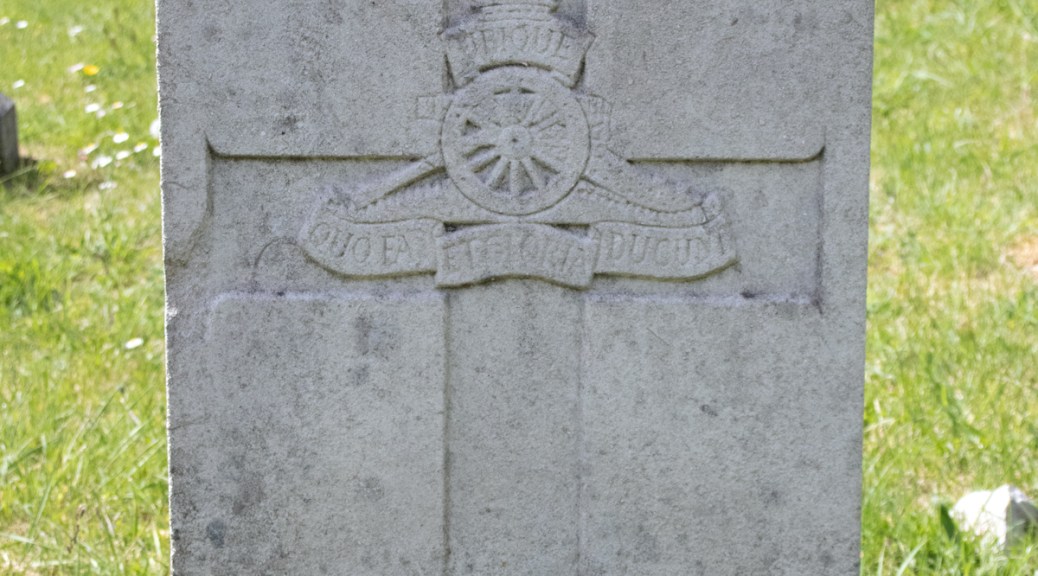
War was on the horizon, but sadly this is where Frederick’s trail goes a bit cold. He enlisted in the Royal Field Artillery, although existing documents do not confirm a date for this. Gunner Comer definitely served overseas, however, and was wounded in action.
Sadly, the other information available confirms that Gunner Comer died from his wounds on 5th December 1918. He was just 25 years old.
Frederick George Comer’s body was brought back to Weston-super-Mare; he lies at rest in the Milton Cemetery in his home town.
Charles William Dyer was born on 12th May 1895, the youngest of seven children to Harry and Mary Dyer.
Harry was a farmer, who brought his family up in the village of Kewstoke, just to the north of Weston-super-Mare, Somerset. He seems to have been keen to try new things because he and Mary lived for a while in Australia, and their first two children were born there. They then moved back to the UK in around 1887, settling back in Somerset.
By the time of the 1911 census, Charles was 16 years old, and all of the family were helping out on the farm. He seemed to share his father’s sense of adventure; in 1913, he emigrated to Canada, setting himself up as a farmhand in Winnipeg.
War was coming to Europe, however, and Charles joined up. He enlisted in October 1917, joining the Canadian Infantry. Leaving Canada on a troop ship on 19th February 1918, he arrived back in England on 4th March.
Private Dyer was soon installed at the Canadian Infantry camp at Bramshott in Hampshire. Within weeks of arriving in England, however, he had contracted influenza; this developed into pneumonia, and was admitted to the camp’s Military Hospital on 22nd May. Sadly, a week later, Private Dyer was dead. He was just 23 years old.
Charles William Dyer was taken back to Weston-super-Mare and laid to rest in the Milton Cemetery there.
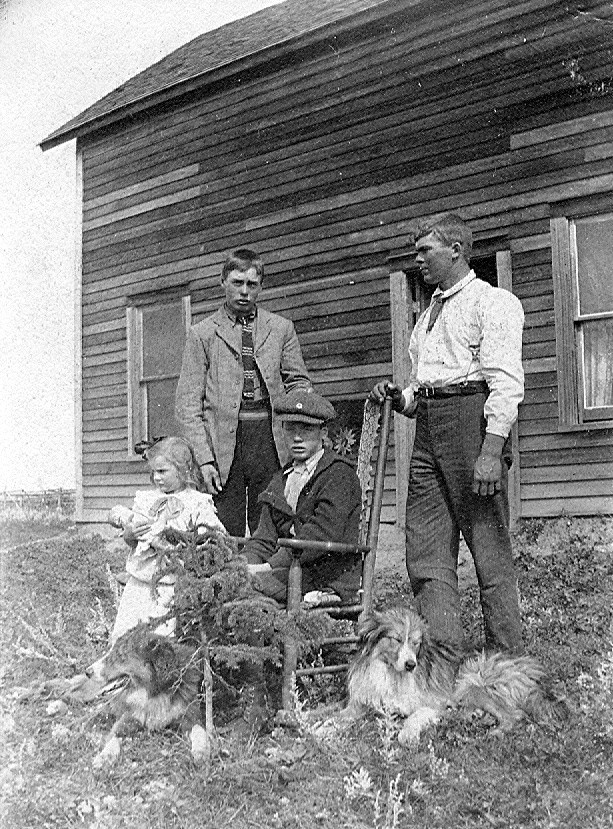
Charles Dyer (on right) in Canada (Courtesy of ancestry.co.uk)
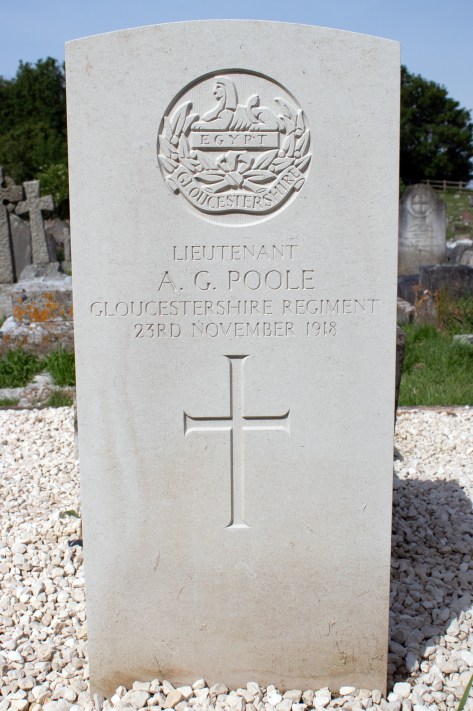
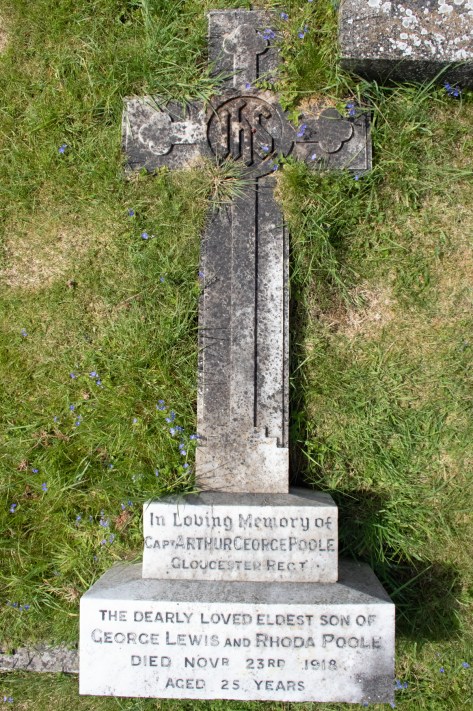
Arthur George Poole was born in Brislington, Somerset, in April 1893. His father, George, was a master builder, and with his mother, Rhoda, the family raise their five children in the Bristol suburb.
Arthur was obvious a bright lad; he attended the Bristol Grammar School, excelling at football, hockey and cricket. After finishing school, he joined a firm of Bristol solicitors and was also appointed secretary of the Bristol Law Society. He went on to continue his studies, when he was accepted to read law at Emmanuel College, Cambridge.
The war was on the horizon, however, and he was called upon to do his duty.
He joined Bristol’s Own (12th Gloucester Regiment) in 1914, and was musketry officer at Chiseldon for some months before going to France in 1915, where he was attached to the 6th Gloucester Regiment.
Within three months he had a severe attack of trench fever, and was home on sick leave for a few weeks. He was severely wounded in October 1917, and came back to England for good. Some months later he was mentioned in despatches. He spent a year in hospital, and although not discharged, was allowed to resume his law studies.
Gloucestershire Echo: Saturday 14th December 1918
While in hospital, Captain Poole contracted influenza, which then became pneumonia. Although recovering from his injuries, it was these conditions that were to get the better of him, and he passed away on 23rd November 1918, at the age of 25 years old.
Arthur George Poole was laid to rest in the pretty graveyard of St Andrew’s Church in Clevedon, Somerset, where his parents now lived.
Harry Stephens was born in Banwell, near Weston-super-Mare on 4th January 1873. He was one of six children to Frederick Stephens and his wife, Emma. Frederick was a butcher, and this was a trade that both Harry and his older brother, Fred, would go into when they left school.
It appears that being a butcher was not the full-time career that Harry was looking for, and so, in the 1890s, he found other employment as a farmer, and moved to Lynton, on the north coast of Devon.
It was here that he met Norah Watts, another farmer’s daughter and, in 1898, the couple married. They set up home at Furzehill Farm, and went on to have four children, Frederick, Alice, Albert and Herbert.
By the time of the 1911 census, Harry had moved his family back to Banwell, where they lived in a four-roomed house on the High Street. Harry was now a cattle dealer, and was presumably supplying meat to his mother who, having been widowed in 1902, was now running the butcher’s shop with three of Harry’s siblings.
War was coming, though, and on 21st July 1915, Harry enlisted. Given his farming background, he was assigned to the Army Veterinary Corps and, while remaining on the Home Front, over the next few years he gained promotion.
Towards the end of 1917, when Serjeant Stephens was serving in Romsey, Hampshire, he fell ill, complaining of chest pains and breathlessness. He was taken to Hursley Hospital near Winchester for cardiac checks, and it became apparent that he was no longer fit for active duty.
Discharged from military service on 5th July 1918, he returned home. Admitted to the Military Hospital in Taunton, it was only a matter of weeks later than Serjeant Stephens passed away. He was 45 years of age.
Harry Stephens was laid to rest in the St James’ Cemetery in Taunton.
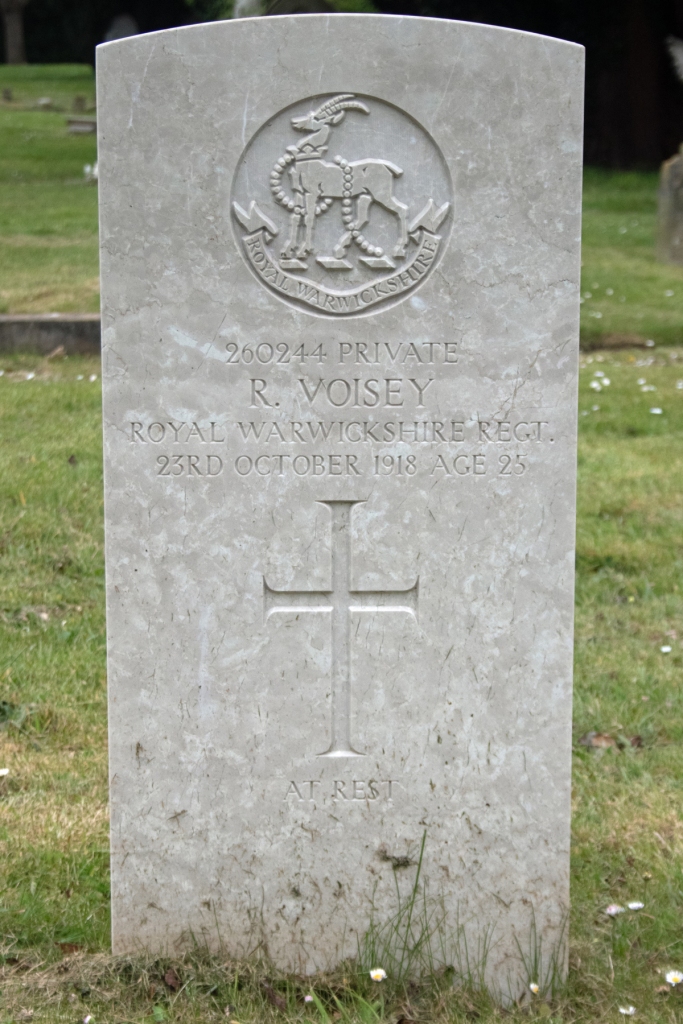
Robert Voisey was born towards the end of 1891, one of six children to Richard and Sophia. Richard was a tailor and, while both he and Sophia had been born in Cullompton, Devon, by the time Robert was born, they had moved to the Somerset town of Taunton.
When he left school, Robert followed his father’s trade and, by the time of the 1911 census, he was living with his parents and two of his sisters in a terraced house not far from the town’s station.
With the outbreak of the Great War, Robert was keen to do his bit. While full details of his military service are not available, it seems that he initially enlisted in the Somerset Light Infantry, but was subsequently transferred to the Royal Warwickshire Regiment. Joining the 6th Battalion as a Private, he saw action on the Western Front, and was wounded in April 1918.
Evacuated to England for treatment, Private Voisey was admitted to the 5th Northern General Hospital in Leicester. He seemed to be recovering well from his injuries, but then contracted influenza.
Sadly, this developed into pneumonia and Private Voisey subsequently died on 23rd October 1918, at the tender age of 25 years old.
Robert Voisey’s body was brought back to Somerset and he was laid to rest in the St James’ Cemetery in the town.
Robert’s funeral was written up in the local newspaper, and the report sheds more of a light on the Edwardian attitude towards some medical and mental health conditions than it does on the actual service.
The very fact of [Robert] ever having been a soldier, considering the great disability he was afflicted with through an incurable impediment in his speech, testifies abundantly to his high and noble interpretation of duty and patriotism.
Had he insisted he could at any time have evaded military service, but so eager was he to serve his country that it was not until he had actually been four times rejected as “physically unfit for military service” was he eventually accepted.
To the writer o this brief notice, who was his friend and fellow shop-mate for a long while, but who was at the time doing duty at Castle Green Recruiting Office, he often time used to express his indignation at not being accepted, and on the last occasion he spoke to the writer, it was to emphatically declare himself “as fit to be a soldier as anyone who had yet left Taunton.”
He dreaded the thought of being considered a shirker, and his opinion of many who have, even up till now, successfully evaded service, though far more physically fit than he was, was contemptuous to the bitterest extreme.
He was a true Britisher, a faithful friend and shop-mate, and a courageous soldier of whom no fitter epitaph could be written than “he gave himself in defence of home, country and liberty.”
Taunton Courier and Western Advertiser: Wednesday 6th November 1918