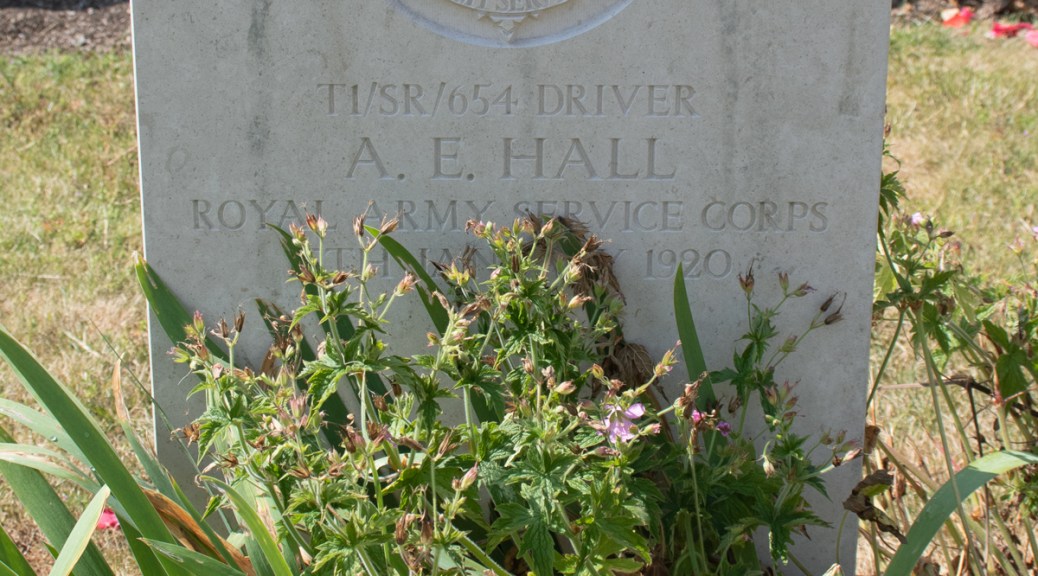
The life of Albert Edward Hall is a challenging one to unpick. His headstone, in Bath’s Locksbrook Cemetery, confirms that he was a Driver in the Royal Army Service Corps, and passed away on 15th January 1920.
Driver Hall’s service records confirm that he enlisted in Gloucester on 21th September 1914, at which point he was 45 years of age. He was born in Bristol, stood 5ft 6.5ins (1.69m) tall and weighed 172lbs (78kg). He had blue eyes and brown hair. The only next of kin that Albert recorded were two brothers, Arthur and Alfred, although their addresses were not known.
Driver Hall was sent to France within a couple of weeks of enlisting. He became attached to the 23rd Field Ambulance Unit, and, barring leave, remained on the Western Front for the next four-and-half years. His service appears to have been impeccable, although in August 1918, he docked a week’s pay when he returned back to the unit a day late following a period of leave.
In June 1919, having been back on home soil for a month, Albert was discharged from the army. This seems to have been partially on medical grounds, as his records suggest he was suffering from heart disease.
At this point, Albert’s trail goes cold. He may well have returned to Bristol, but by the start of 1920 it is likely that his health was failing. He was admitted to the Pensioner’s Hospital in Bath, Somerset, and it was here that he breathed his last. He was 50 years of age.
Albert Edward Hall was laid to rest in the sweeping visa on the city’s Locksbrook Cemetery.
Much of Henry John Cordas’ early life is destined to remain a mystery. The first record for him is the 1881 census, which gives is his address as St Mary’s Orphanage in Heston, Middlesex, where he was one of 650 children.
The 1891 census recorded Henry as living in Humber Street, Grimsby, Lincolnshire, right next to the town’s docks. He is noted as being a fisherman, and is married to a woman called Mary, who was born in Deptford, Surrey.
The next available census record for Henry adds confusion to his story. The document, dating from 1911, confirms that he and Mary are now living in Hotwell Road, Bristol, Gloucestershire, again within spitting distance of the docks. Henry was employed as a marine fisherman in the merchant service. The document suggests that the couple had been married for ten years, and give Mary’s place of birth as Swansea, Glamorganshire.
While the document matches previous information for Henry, it seems unlikely that the Marys in the 1891 and 1911 censuses are one and the same. Either way, the couple were sharing their house with Mary’s niece, Ellen.
Henry seems to have joined the merchant fleet in a more official capacity in the autumn of 1900. His records show that he was 5ft 11ins (1.8m) tall, with blue eyes and a fair complexion. He served out of Bristol and, in the years leading up to the outbreak of war, he was assigned to a number of ships, travelling the Atlantic to Montreal and Jamaica, amongst other far-flung places.
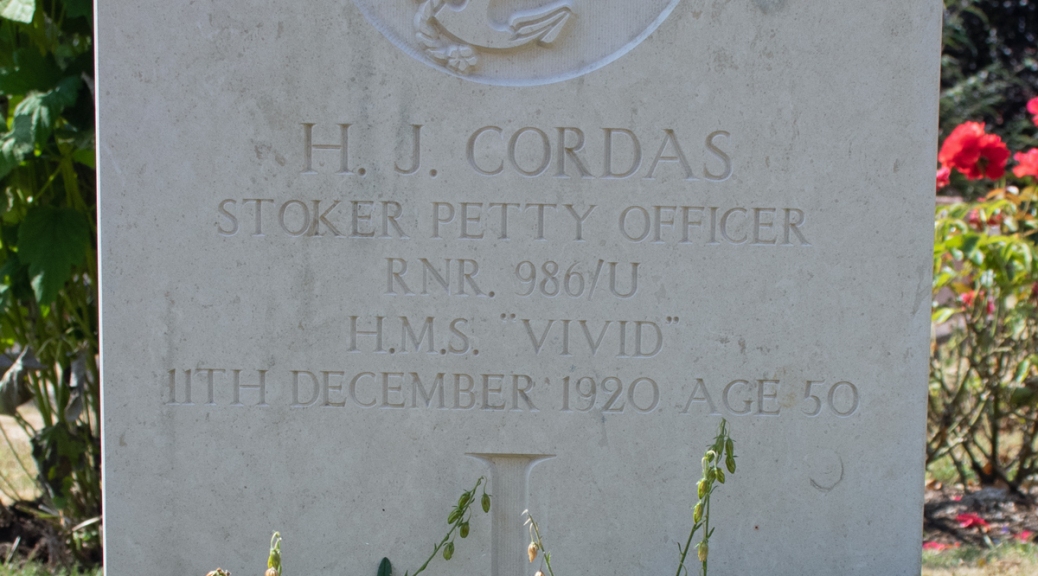
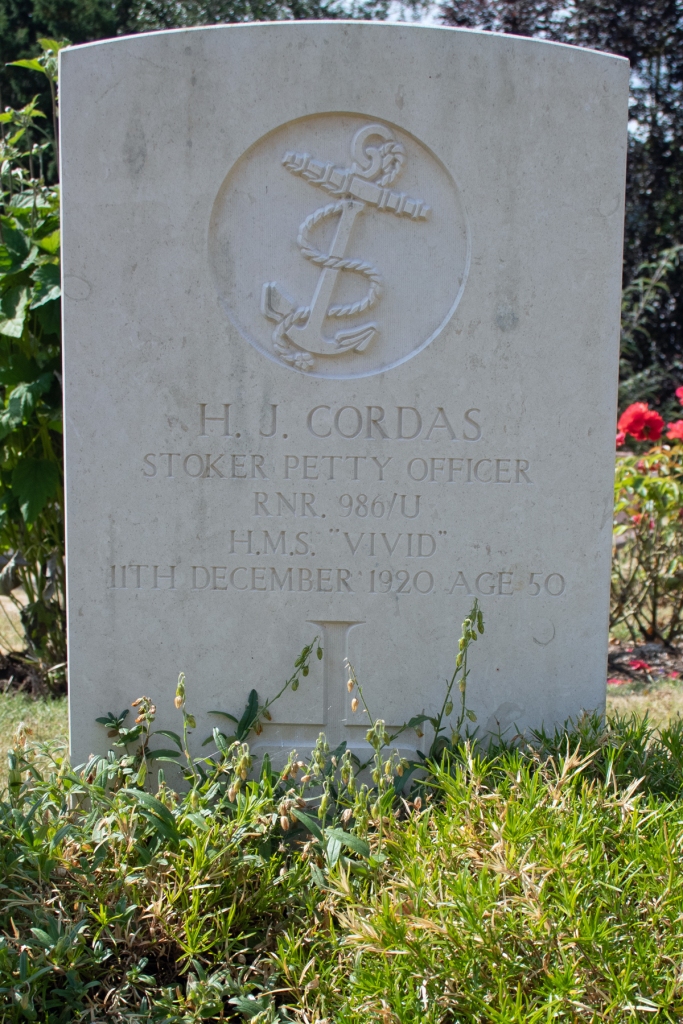
When hostilities commenced, Henry was assigned to the Royal Naval Reserve. Over the next few years, he served on a number of ships, including the armoured cruisers HMS Suffolk and HMS Doris. He worked as a Stoker, but by the end of the conflict had been promoted to Stoker Petty Officer.
In December 1918, Henry’s service came to an end. He was, by now, based at HMS Vivid, the Royal Naval Dockyard in Devonport, but his health was suffering. Medically discharged with a combination of chronic bronchitis and rheumatic pain, he seems to have returned to Bristol.
On 6th December 1920, Henry was admitted to Bath War Hospital in Somerset, as he was coughing up blood. The plan was to transfer him to Greenwich Hospital in Surrey, but he suffered an aneurysm before that move could be made. He passed away on 11th December 1920, at the age of 50 years old.
The body of Henry John Cordas did not travel far for burial. He was laid to rest in the peaceful expanse of Bath’s Locksbrook Cemetery.
Maurice Chapman was born in the summer of 1883 in Newington, Surrey (now in the London borough of Southwark. The younger of two children, his parents were Charles and Jessie Chapman. Charles was a horse collar maker and, by the time Jessie passed away in 1899, Maurice was following in his father’s footsteps.
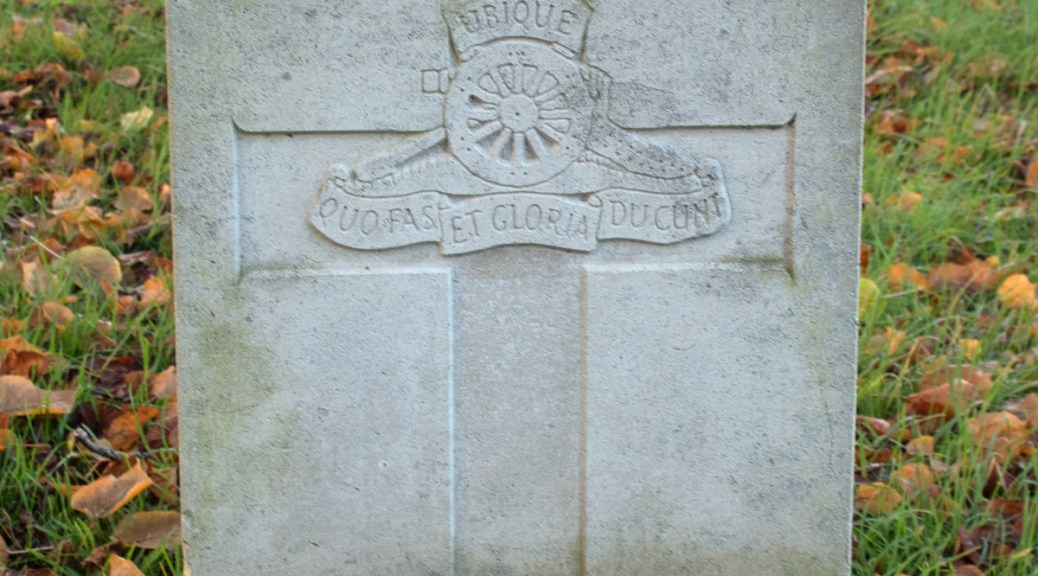
Maurice sought a bigger career, however, and, on 6th April 1899, he enlisted in the Royal Artillery. His service records show that he was 5ft 6ins (1.68m) tall, and that he weighed 118lbs (53.5kg). In the section relating to any distinguishing marks, it was noted that his eyebrows met, he had a scar on his forehead and two tattoos, one on each forearm.
Maurice’s military career was not to be a lengthy one. He was recorded as being absent without leave on 18th May, and docked 6 days’ pay. Admitted to a hospital in Woolwich on 26th May, he spent a week there, suffering from scabies. On 27th July, Maurice was formally discharged from the army, when it was discovered that he had lied about his age: on his enlistment papers, he stated he was 18 years 7 months old (he was, in fact, just sixteen.
Returning to the family home, Maurice took up his father’s trade once more. Charles remarried in 1905, to a woman called Rosa. The 1911 census found the two living in two rooms in a house in Kennington Lane, but of his children, there is no sign. Maurice does not appear on any of the 1911 census records. It is also not possible to track down his older sister Charlotte either, there are a number of Charlotte Chapmans in the that year’s records, and it is also unclear whether she had married by this point.
Maurice only reappears on 1st March 1916, when he stepped up to serve his King and his Country. Initially signing up for the Labour Corps, he wasn’t formally mobilised for eighteen months. Maurice gave his profession as a barman, but also noted that he had served for two years in the 2nd Battalion of the Dragoon Guards, before being discharged in 1904, although there is no other record to corroborate this.
Private Chapman’s service records provide some, but not a lot of, information. There is no record of him spending time overseas, but he spent ten months with the Labour Corps, before transferring to the Tank Corps on 30th August 1918. Over the next year-and-a-half, he moved between a couple of the regiment’s depots and their reserve unit, and remained on active service long after the Armistice was signed.
Maurice remained on active service with the Tank Corps until November 1920, when he was medically discharged. He had been unwell for a while by this point, and a combination of diabetes and a perineal fistula meant that he was no longer physically fit enough to serve.
It is likely that Maurice was in the War Hospital in Bath, Somerset, when he was discharged, as this is where he passed away, on 22nd December 1920. He was 37 years of age.
Maurice Chapman did not travel far to his final resting place. He was buried in the grounds of the Locksbrook Cemetery in Bath, Somerset.
Abraham James Scott was born in Bathford, Somerset, in the spring of 1893. He was one of fourteen children to Abraham and Lucy Scott, and became known as James, to avoid any confusion with his father. Abraham was a shepherd, who travelled where work took him: both he and Lucy were from Wiltshire, but had moved to Somerset by the end of the 1880s. When James was just a babe-in-arms, the family had relocated to Gloucestershire, but by the time of the 1901 census, they were back in Wiltshire once more.
Abraham Sr died in 1910, at the age of just 41 years old. The following year’s census found the now widowed Lucy living in North Wraxhall, Wiltshire, with eight of her children. Abraham Jr is absent, and, indeed, does not appear on any of the 1911 censuses.
Lucy needed options and, on Christmas Day 1912, she married carter William Amblin in the village church. Abraham was, by this time, living in Bath and working as a carter.
When war came to Europe, Abraham felt the need to step up and play his part and, on 15th December 1915, he enlisted in the army. His service records show that he was 5ft 5ins (1.65m) tall and weighed 132lbs (59.9kg). He had a vaccination mark on his left arm which, according to the document’s section on ‘distinctive marks’, has a tendency to rupture.
Private Scott was mobilised in March 1916, and was assigned to the 1st/5th Gloucestershire Regiment. He soon found himself on the Western Front, and, having transferred to the 1st/4th Battalion, served at the Somme.
Abraham was in for a chequered time in Northern France. On 26th August 1916, he was injured when he received a gunshot wound to his scalp. He was admitted to the 1st Canadian General Hospital in Etaples, the moved to Rouen to recuperate. Private Scott rejoined his unit on 21st October 1916.
Just weeks later, however, Abraham was back in a hospital in Rouen, having fractured his ankle. After a couple of weeks in the 1st Australian General Hospital, the injury was deemed severe enough for him to be evacuated back to Britain for recuperation, and he was posted to Ballyvonare Camp in County Cork. Abraham returned to his unit in France in September 1917, nine months after his ankle injury.
On 1st March 1918, Abraham transferred to the Royal Engineers where, as a Sapper, he was attached to the Depot in Rouen. He remained there for more than a year, during which time he was admitted to hospital once more, this time with trench fever. Little additional information is available about this spell in hospital, other than that Lucy had written to the regiment thanking them for informing her of her son’s illness, and confirming a new address for her.
Sapper Scott’s health continued to suffer, however. In May 1919, he was admitted to a camp hospital, suffering from appendicitis. He was operated on, and medically evacuated to Britain for further treatment and recuperation. Abraham was admitted to the Bath War Hospital on 25th July 1919, and remained there for four months.
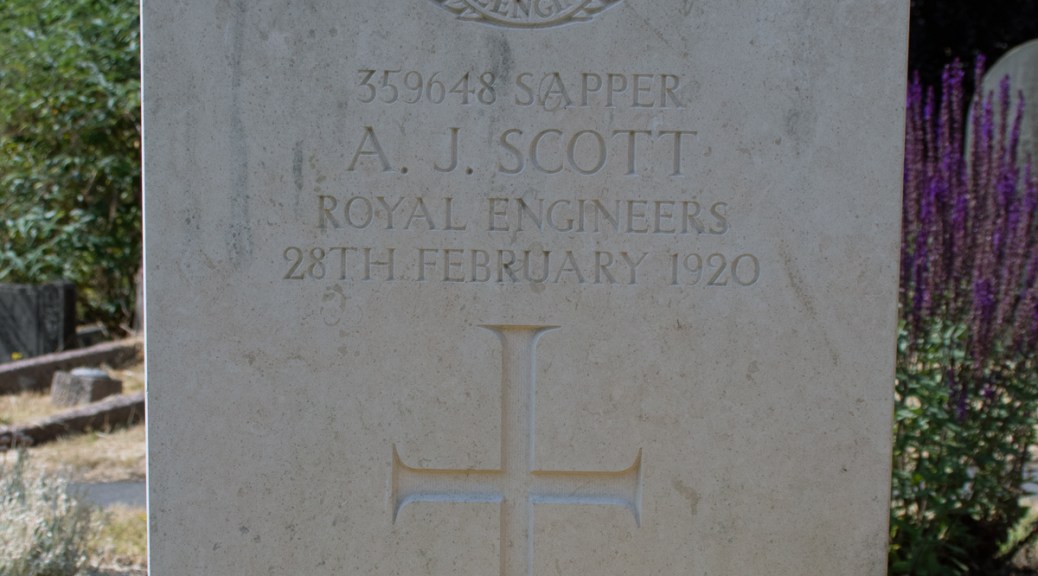
Abraham’s health seemed to improve, albeit slowly, and he was moved to the Pension’s Hospital in Bath on 27th November. The head wound, broken ankle and bout of trench fever appear to have taken their toll on his body which, by this point, seems to have been too weak to recover. On 28th February 1920, two months after being transferred to the Pension’s Hospital, he passed away there from a combination of appendicitis and pelvic cellulitis. He was just 26 years of age.
Abraham James Scott’s body did not have to travel far after this point. He was laid to rest in the sprawling Locksbrook Cemetery in his adopted home city of Bath.
Henry Wiggs was born in Camberwell, Surrey, in the autumn of 1880. One of eleven children, his parents were dock labourer Thomas Wiggs and his wife, Sarah.
When he finished his schooling, Henry also took up labouring work and, by the time of the 1911 census, was working as a partition block maker in the building trade. The census shows him a living with his brother William and his family.
On 3rd August 1913, Henry married Blanche Hill. She was eight years older than Henry, and the daughter of a Sergeant in the Royal Horse Artillery. Blanche had been widowed ten years earlier, and had four children, who Henry took on as his own.
At this point, Henry’s trail goes cold. When war broke out, he stepped up to play his part, initially joining the Worcestershire Regiment. At some point he was transferred to the Royal Berkshire Regiment, subsequently becoming attached to the Labour Corps.
Details of Private Wiggs’ military service are lost to time, and it is unclear whether he served on the Home Front or overseas. He survived the war, and was discharged from the army on 13th March 1919. He was suffering from heart disease, directly attributable to his military service.
Again, Henry falls off the radar at this point. He and Blanche made the move to Somerset, setting up home in Weston-super-Mare. His heart problem seems to have dogged him, however, and likely caused his admission to a hospital in Bath towards the end of 1920. It was in the city that he passed away, on 28th December 1920, at the age of 40 years old.
Henry Wiggs’ body was not brought back to Weston-super-Mare for burial – the cost of doing so may have been too much for the now twice-widowed Blanche to afford. Instead, he was laid to rest in the sweeping Locksbrook Cemetery in Bath.
Austin Neal Raison was born in the spring of 1896 in Crewkerne, Somerset. The eighth of thirteen children, his parents were bootmaker Charles Raison and his wife, Lucy.
Austin’s siblings found a variety of trades, from dressmakers and costumiers to grocers and stationers. When Austin left school, however, he was apprenticed to a printer, a career laid our in front of him.
When war came to Europe, Austin joined the Royal Fusiliers. Full details of his military service have been lost to time, but a local newspaper, reporting on his funeral, provided a summary of his war experience:
The funeral took place at the Cemetery on August 24 of Corporal Austin Neal Raison… who died on the previous Thursday from wounds received in action. Deceased was 24 years of age and in September 1914, he volunteered for service in the Army, joining the Royal Fusiliers. He went to France in October 1915, and took part in most of the important battle from that date until he was severely wounded in the retreat from Cambrai. He returned home, and everything possible was done for him, but he never recovered health, and gradually sank, dying at his father’s house to the sorrow of all who knew him.
Western Chronicle: Friday 3rd September 1920
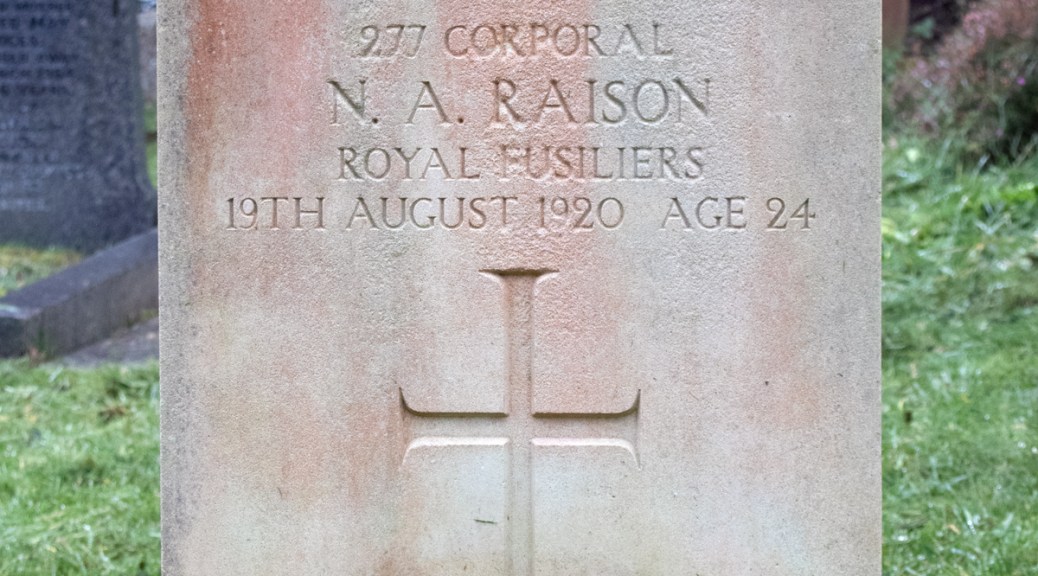
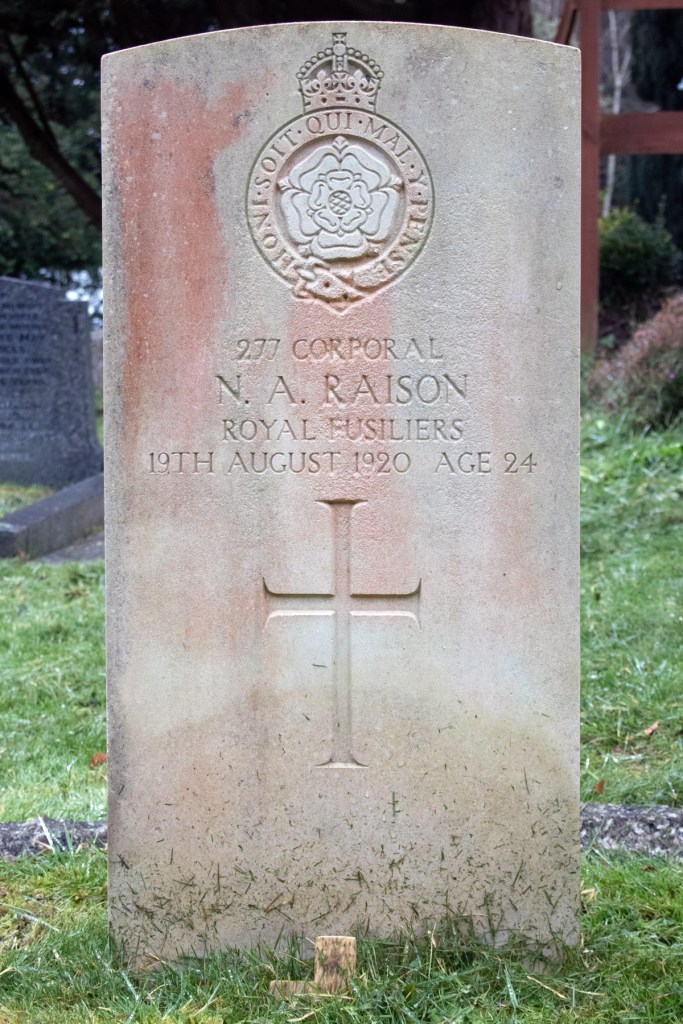
Corporal Austin Neal Raison died on 19th August 1920. He was laid to rest in the Townsend Cemetery, Crewkerne, within sight of the family home.
The Commonwealth War Graves Commission gives Corporal Raison’s name as Neal Austin, while all other records, including his service documents, confirm his name as Austin Neal.
William Charles Green was born on 27th December 1897, one of five children – and the only son – to William and Mary Green. The family’s backstory is a bit hard to decipher.
William Sr was born in the Bath Union Workhouse in 1869 and the only details of his parentage comes in his marriage certificate, which suggests that his father was also called William Green, who was deceased. The same document records the groom as being a miner, and that he and Mary were living in Widcombe, Bath.
The Greens do not appear on the 1901 census – or at least that census record for them is lost to time. The next census return, in 1911, does have the family recorded as living in three room in St George’s Place, Widcombe. This particular census was the first to put the onus on the resident to complete the form, and, in William Green Sr’s case, this has led to a handful of anomalies in the record.
William Sr notes his trade as “going out with commercial travellers and hotel work also”. He confirms that he was “Somerset-born”, but suggests that Mary was born in “South Wells” (a spelling error, which should be South Wales), even though her birth and marriage certificate confirm she came from Bath.
The Greens certainly spent some time in Wales – their eldest daughter was born in Merthyr Tydfil, while William Sr was working as a miner there. By the time of William Jr’s birth, however, the family seem to have returned to England – he is recorded as coming from Bath.
William was 13 years old at the time of the 1911 census, and still at school. When he left education, he found work at a fishmonger, but with war closing in on Europe by this point, he was keen to serve his King and Country.
On 7th May 1915, William enlisted in the Royal Navy and, as he was just under age, he was given the rank of Boy 2nd Class. His service records note that he was 5ft 1in (1.55m) tall, with brown hair, blue eyes and a fresh complexion. Intriguingly the records give the place of his birth as Aberdare, Glamorganshire, but whether it is this document or the 1911 census that is incorrect is impossible to confirm.
Boy Green was initially sent to HMS Impregnable, the training establishment based in Devonport, Devon. He spent four months there and, on the day he was promoted to Boy 1st Class, he was assigned to HMS Defiance, the navy’s Torpedo School, off the Plymouth coast. In October 1915 he was assigned to HMS Fox, and remained on board for the next three years.
Fox was a cruiser that patrolled the seas from the East Indies to Egypt and the Red Sea. While on board, William came of age, and was formally enrolled in the Royal Navy as an Ordinary Seaman. With a character that was classed very good, even if his ability was noted as satisfactory, within eighteen months he was promoted again, to Able Seaman.
In August 1918, William was assigned to HMS Mantis, a river gunboat that patrolled the Tigris around Baghdad. He remained on board until the end of the year, when he was assigned to HMS Vivid, the Royal Naval Dockyard in Plymouth.
Over the next fifteen months, Able Seaman Green’s time was split between Plymouth and HMS Columbine, the naval base at Port Edgar on the Firth of Forth. It was when he was back in Devon, early in 1920, however, that he fell ill.
Able Seaman Green had contracted influenza, which had developed into pneumonia, and it was the combination of lung conditions that was to ultimately take his life. He passed away at the naval base on 5th March 1920, at the age of just 22 years old.
William Charles Green’s body was brought back to Somerset for burial. He was laid to rest in St James Cemetery, Bath, to be reunited with his parents when William Sr died in 1938 and Mary passed away in 1959.
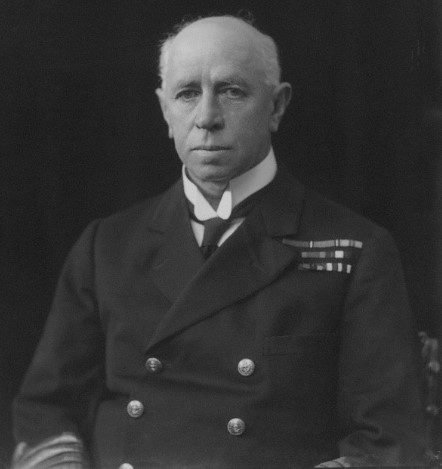
George Astley Callaghan was born in London on 21st December 1852, the third of six children to Frederic and Georgiana Callaghan. Frederic was born in Ireland and was the son of MP and landowner Daniel Callaghan. He built a career for himself as a magistrate and set up home in Bath, Somerset with Cheltenham-born Georgiana.
The family had means and the 1861 census records them living at a five-storey Georgian house in Catharine Place, Bath, with five live-in servants: a butler, cook, housemaid, nursemaid and nurse.
George enlisted in the Royal Navy in January 1866, and was assigned to the training ship HMS Britannia. From here, his career was to prove meteoric. He was promoted to the rank of Midshipman in October 1867 and by 1870 he was serving in the East Indies. On 15th April 1872 he gained the rank of Sub-Lieutenant, and was promoted to full Lieutenant exactly three years later.
In 1877, Lieutenant Callaghan received a commendation for saving the lives of sailor whose boat had capsized in the Irrawaddy River. George was assigned to HMS Excellent, a gunnery school, in 1880, and formally joined the staff there in 1882. Back on the open seas by 1885, he was promoted to Commander on 31st December 1887 and given control of the battleship HMS Bellerophon. By 1894, George had been promoted again, to the rank of Captain, and took on the additional duties of naval advisor to the War Office.
As the new century dawned, George was mentioned in dispatches for his support during the Boxer Rebellion. Further commands followed, including HMS Edgar and HMS Caesar, both in 1901. He was made Captain of Portsmouth Dockyard and then naval aide-de-camp to the King in 1904. By the following year, he was given the rank of Rear Admiral, became Second-in-Command of the Channel Fleet in 1906, Second-in-Command of the Mediterranean Fleet in 1908. In December that year he was awarded Knight Commander of the Royal Victorian Order for the aid he provided to survivors of the Messina earthquake.
In April 1910, George was knighted and promoted to Vice Admiral, and within eighteen months he was made Commander-in-Chief of the Home Fleet, gaining the rank of Admiral in November 1911.
During this time of military promotion, George had also had his own family. On 2nd February 1876, he had married Edith Grosvenor in St Andrew’s Church, Walcot, Bath. The couple went on to have four children: Dorothy, Cyril, Noël and Stella.
A naval officer’s wife was destined to be a lonely life, and the census records seem to reflect this. In 1881, Edith and Dorothy were visiting a curate and his family in Wiltshire. Ten years later, Edith and her four children were living at the family home in Bathwick, with one visitor and three servants. The 1901 census found Edith, Cyril (who was now a midshipman himself) and Noël living in Devonport with a cook and two other servants. By 1911, Edith had moved again. She was 54 by this point, and based at a house in Havant, Hampshire, with a cook and two maids. All of this time, of course, George was away at sea, performing his duties.
George, by this point, had spent years preparing for the war he knew was coming. However, in July 1914, the First Lord of the Admiralty, Winston Churchill, commanded Sir John Jellicoe to relieve George of his position as Commander-in-Chief of the Home Fleet. Whether Churchill believed that Sir Callaghan was now too old to successfully carry out the duties the advancing conflict would impose upon him is unclear. It must have disappointed the 62-year-old George, however.
His work continued, however: he was appointed First an Principal Naval Aide-de-Camp to the King in September 1914, and became Commander-in-Chief of The Nore in three months later. He was promoted again, to Admiral of the Fleet, in April 1917, but subsequently retired less than a year later.
George’s life over the next couple of years goes a little quiet. Indeed it is only in November 1920 that further information is available.
The death occurred in London yesterday afternoon of Admiral of the Fleet Sir George Callaghan KCB. He had been ill for some months, and the immediate cause of death was an affection of the heart.
The Scotsman: Wednesday 24th November 1920
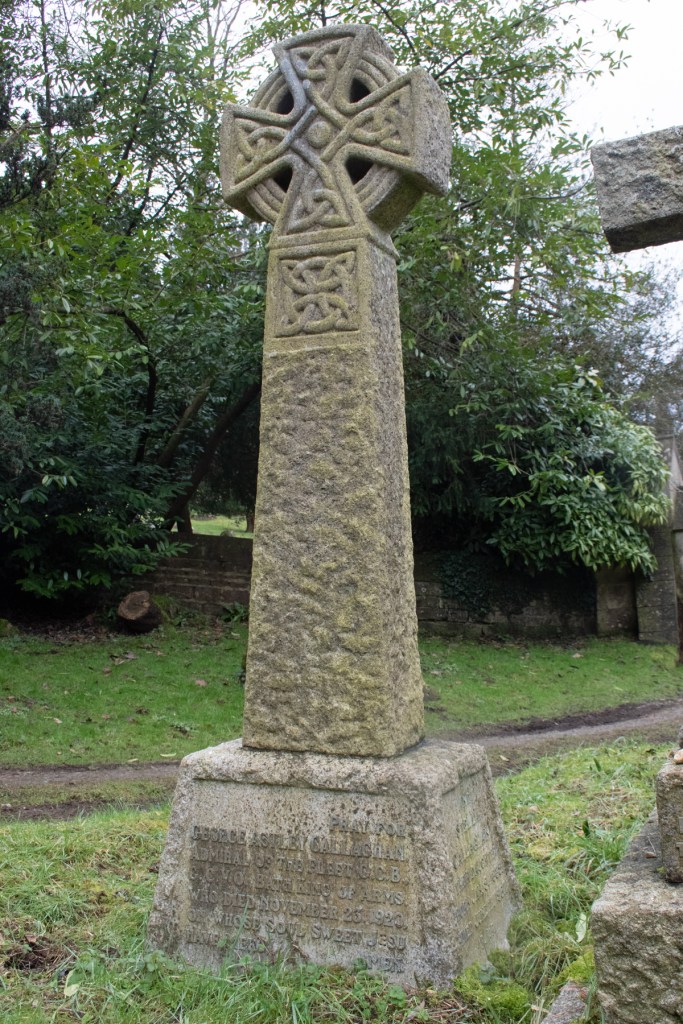
Sir George’s passing at his London home was reported in most of the press, highlighting his military achievements and decorations. His funeral was held at Westminster Abbey, and he was then laid to rest in the graveyard of St Mary’s Church in Bathwick, not far from his and Edith’s main home.
Richard Avary Arthur Young Jordan was born on 24th May 1866 in Cashel, Tipperary, Ireland. His father, Richard Jordan, died a week after his son’s birth, leaving his mother, Annabella, to raise him.
The 1871 census records mother and son living in Woolwich, London, with Annabella’s widowed mother, Grace. They were obviously a well-connected family, with Grace living as an annuitant, or pensioner, one son a Surgeon Major in the army and another as a Colonel in a different regiment. Annabella herself was recorded as a landowner, and the family had support with a cook and housemaid living in.
Surrounded by army servicemen as he was, it is no surprise that a military career called to Richard. He enlisted on 10th November 1886, joining the King’s Shropshire Light Infantry as a Lieutenant. Assigned to the 1st Battalion, his service records confirm that he had attended Burney’s Gosport School – a military academy – and was 5ft 7.5ins (1.71m) tall.
Richard was sent to Egypt just before Christmas that year, and over the next five years, he served both there and in Malta. On 11th May 1889 he attained the rank of Captain and, in December 1891 he was sent further afield, to Hong Kong.
After three years in the Far East, returned to Britain, and spent the majority of 1895 back on home soil. His travels were not at an end, however, and by the end of the year, Captain Jordan found himself in India. He spent three-and-a-half years in the sub continent, returning to the UK in May 1899.
At this point, details of Richard’s life get a little sketchy. He seems to have settled in Pembroke Dock, South Wales, and, on 18th April 1904, he married Ella Mary Caroline Grove. She was eight years his junior, and the daughter of a late Lieutenant in the Highland Light Infantry. The couple married at St George’s Church, Hanover Square, London.
Richard’s trail goes gold again, for a couple of years. He retired from the army on 8th August 1906, after nearly twenty years’ service. By the time of the 1911 census, he and Ella had set up home in Heywood House, on the outskirts of Tenby, Pembrokeshire, with two servants – Beatrice and Edith – as two live-in staff.
War came to Europe in the summer of 1914, and Richard seemed to keen to play his part once again. He enlisted again in August 1915, and was assigned the rank of Major in his former regiment. While it is not possible to determine Major Jordan’s complete service at this time, he definitely arrived in France the following month. If he remained in France, it is likely that he saw fighting at the Somme in 1916, Cambrai in 1917 and at Lys and on the Hindenburg Line in 1918.
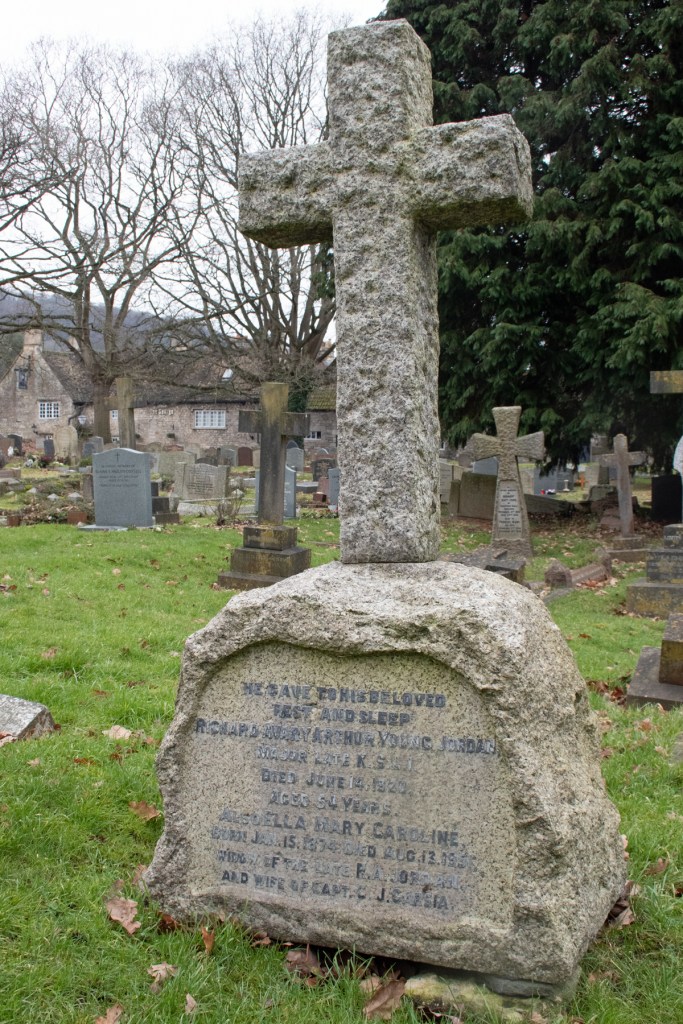
Again, Major Jordan’s post-war life remains tantalisingly elusive. By the summer of 1920, he and Ella were living at Holcombe Lodge in Bathampton, on the outskirts of Bath. It was here on 14th June, that Richard passed away. He was 54 years of age.
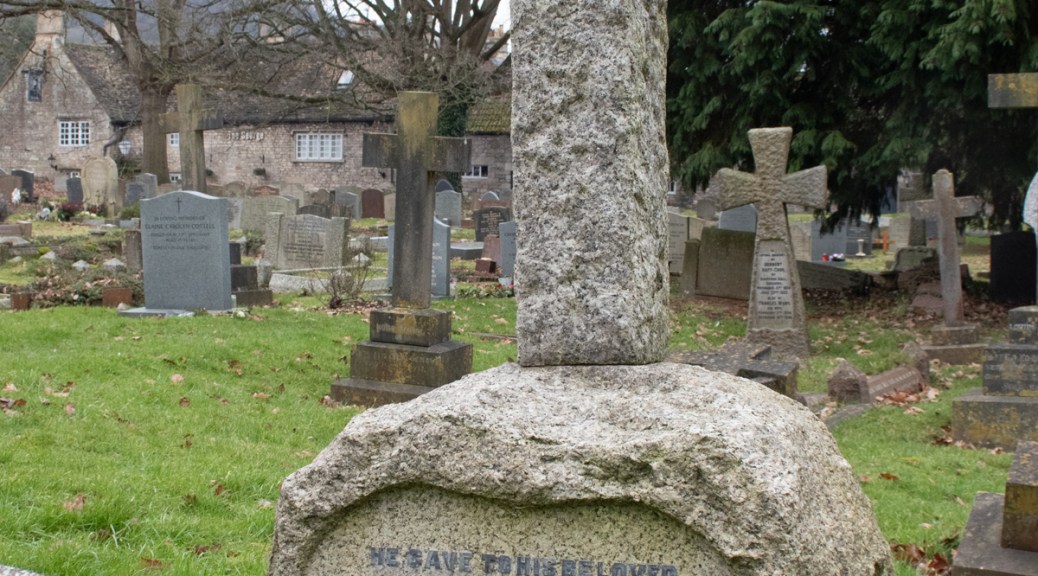
Despite all his travelling, it seems that Ella was comfortable living in Bathampton, and this is where she laid her late husband to rest. Richard Avary Arthur Young Jordan was buried in the graveyard of St Nicholas’ Church in the village.
The widowed Ella married again, to Captain Clare Garsia, on 9th October 1921. She remained in Bathampton, and lived to the age of 77, passing away on 13th August 1951. She was laid to rest in the same plot as her late husband.
When Captain Garsia died the following year, he was also buried in St Nicholas’ Churchyard, in a neighbouring plot to his beloved Ella.
James Oscar Stuckey was born in the summer of 1886, in Milford Haven, Pembrokeshire. The second of eight children, his parents were James and Minnie Stuckey. James Sr was a carter from Langport in Somerset, and his work took him across the country. James Jr’s older sister was born in Sandown, on the Isle of Wight, and, when his next sibling was born, the family had moved back to Somerset and were living in the village of Curry Rivel.
By the time of the 1901 census James Sr was working as a warehouseman. James Jr had also left school and found employment as an agricultural labourer.
On 24th March 1913, James married Margaret Beatrice Tilley – who was better known as Beattie. The couple set up home in Curry Rivel, and went on to have two children, Cecil and James.
By this time war was coming to Europe and, in January 1915, James stepped up to play his part for King and Country. He enlisted in the Royal Field Artillery, and was given the rank of Gunner. Over the next couple of years, he served in France and Italy, rising through the ranks to Bombardier and Corporal.
During this time, however, James’ health was being impacted. His troop was gassed while in France, and he was hospitalised a couple of times with bronchitis and tuberculosis, and it was TB that saw him evacuated to Britain for treatment in September 1918.
His condition was such that Corporal Stuckey was medically discharged from the army on 23rd November 1918, as he was no longer fit for duty. He returned to civilian life, and settled back into Curry Rivel.
He was well-known in the district, and being of a jovial disposition, was liked by everyone with whom he came into contact. He was a member of the Curry Rivel Male Friendly Society.
Langport & Somerton Herald: Saturday 11th December 1920
James’ lung conditions were to get the better of him. After a protracted illness, he finally succumbed, breathing his last on 3rd December 1920. He was just 34 years of age.
James Oscar Stuckey was laid to rest in the graveyard of St Andrew’s Church, in Curry Rivel.









 Death and Service