George Henry Curtis was born in Oldland, near Bristol, in around 1887. His parents were George and Frances (Fanny) Curtis, and he was one of their four children.
There is little direct information about George’s life: his was a common name in the Gloucestershire area, and so it is difficult to identify if some documents are related to him nor not.
The first piece of concrete evidence for him is his marriage certificate. He wed Elizabeth May Henly on 7th November 1914. She was the daughter of an engineer, while George gave his trade as a tobacco operator (possibly making cigars and cigarettes). The wedding took place at St Anne’s Church in Oldland, local to bother bride and groom.
When war broke out, George stepped up to play his part and enlisted in the Royal Garrison Artillery as a Gunner. He did not see action overseas, but was awarded both the Victory and British Medals for his service.
Gunner Curtis’ adult life is hard to piece together. All that can be confirmed is that he passed away on 9th July 1921, at the age of 32 years old.
George Henry Curtis was laid to rest in the graveyard of the church in which he had been christened and married, St Anne’s in his home village, Oldland.
Alfred John Bishop was born on 25th April 1896 in the Devon village of Kingswear. The older of two children, his parents were John and Susanna Bishop. John was a farm worker, and his expertise with horses was not lost on Alfred, who became a delivery driver for a baker in Marldon, to the north of Paignton, when he left school.
On 3rd September 1917, Alfred married road contractor’s daughter Bessie Webber. Originally from Staverton, her family had settled in Ipplepen, and this is where the newlyweds made their home.
War had come to Europe by this point, and Alfred had enlisted in the Royal Army Service Corps (RASC). His background with horses came in useful, as he was assigned to the Yeomanry Remount Depot. Details of Private Bishop’s military service are lost to time, so it is unclear if he was attached to one of the RASC depots in the UK, or if he served abroad.
Alfred survived the war and, by 1919, was back home. He and Bessie had a son, Leslie, who was born on 23rd October 2020. Time with his son was to be tragically brief, however, as Alfred passed away on 14th April 1921. The cause of his death is not known, but he was just 25 years of age.
Alfred John Bishop was laid to rest in the graveyard of St Andrew’s Church in Ipplepen.
Bessie went on to marry again, to James Joint in the autumn of 1932. She passed away in Newton Abbot in 1980, at the age of 85.
Alfred’s brother James’ life was also cut short. He married Ethel Warren in 1925, and is recorded has having passed away in London in the autumn of 1935, when he was only 35 years old. Ethel was left with two young children to raise, and John and Susanna were to outlive both of their sons.
Albert Septamus Smith was born in Maidstone, Kent, on 12th January 1881. The oldest of three children to George and Frances Ditcher, he may has been born before the couple married, and seems to have retained his mother’s maiden name throughout his life.
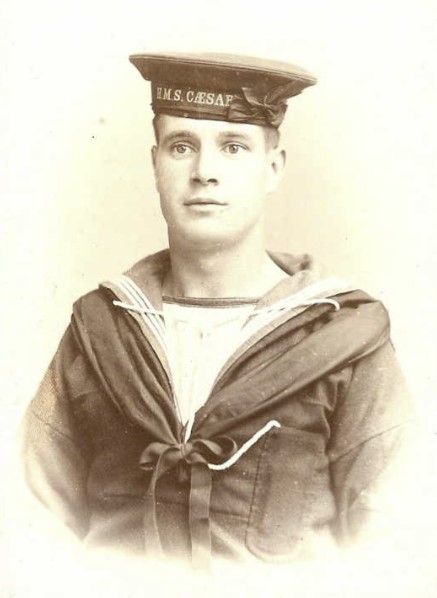
When he left school, Albert sought a life at sea, joining the Royal Navy as a Boy 2nd Class on 12th January 1898, when he was just fifteen. Albert’s naval career was a long and varied one which began on board HMS Impregnable, a training ship. After a month’s training, he was assigned to HMS Lion, where he spent more than a year, gaining a promotion to Boy 1st Class in the process.
In October 1897, Albert transferred to HMS Pembroke, the Royal Naval Dockyard in Chatham, Kent. In the four months that he spent on shore, he turned seventeen and, as a result, came of legal age to formally be enlisted in the navy. Ordinary Seaman Smith signed up for a period of twelve years, and his service records showed that he was 5ft 8ins (1.73m) tall, had brown hair, brown eyes and a dark complexion. He was also noted to have a scar on his right wrist, and a tattoo of a flower and bracelet on the same wrist.
Ordinary Seaman Smith was dedicated to his career. Over the next twelve years he served on board nine different vessels, and rose through the ranks, gaining promotion to Able Seaman (in May 1899), Leading Seaman (January 1903), and Petty Officer 2nd Class (September 1903). He returned to the rank of Leading Seaman, doing so in August 1906, but this seems to have been a deliberate choice, as his service record appears unblemished.
In 1910, Albert’s initial period of service came to an end and he chose not to renew his contract. He had married Ellen Miles on 6th October 1900, and, with four young children, it appears that family had become more important to him. Returning to Maidstone, he found work on the railways, joining the South East and Chatham company as a platelayer. The family home was in Bearsted, a village to the east of Maidstone, now part of its suburbs, and they shared is with Ellen’s sister, Dorothy.
Life was going well for the Smith family, but war was coming to Europe and, with his previous naval experience, Albert was to be called upon again. He was called out of reserve on 2nd August 1914 and, after an initial couple of weeks at HMS Pembroke, Leading Seaman Smith was soon back at sea.
After a couple of years on board the seaplane tenders HMS Engadine and Campania, Albert was promoted to Petty Officer again, and assigned to HMS Sandhurst, a fleet repair ship based at Scapa Flow. He was on board when an explosion in the boiler room killed seventeen seamen on 27th February 1917, although he was not hurt.
It was while Petty Officer Smith was on board HMS Sandhurst that he contracted tuberculosis. He returned to Chatham Dockyard, but the condition was severe enough for him to be medically discharged from active service in February 1918.
Albert returned to civilian life again, and his trail goes cold for a couple of years. His lung complaint continued to haunt him, however, and he passed away from tuberculosis on 4th March 1921. He was 40 years of age.
Albert Septamus Smith was laid to rest in the graveyard of Holy Cross Church in Bearsted, not far from his family home.
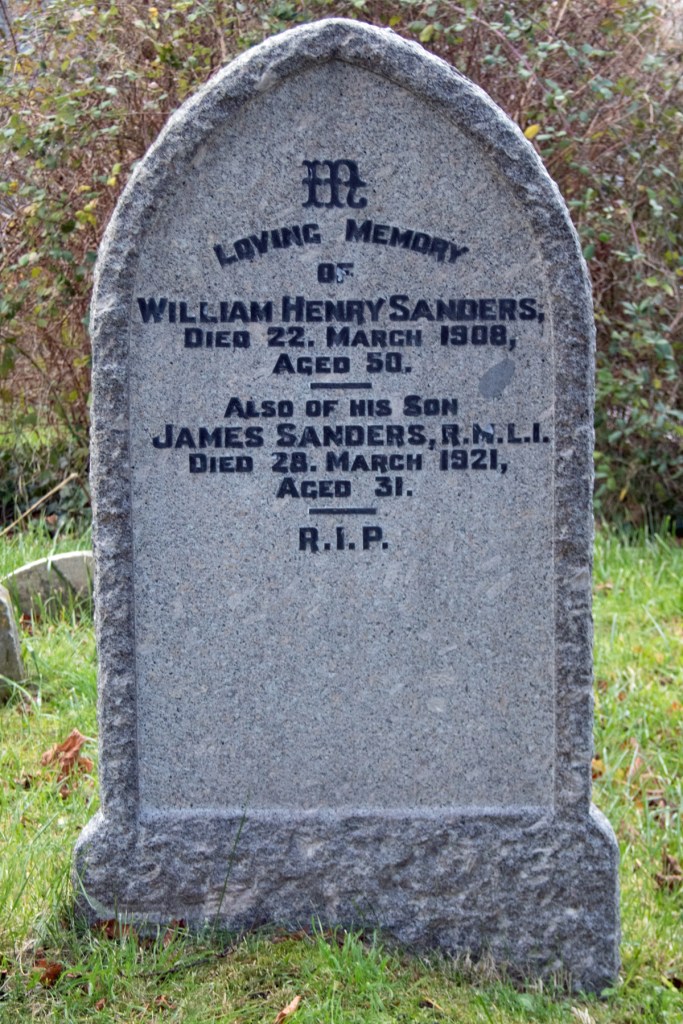
James Sanders was born on 17th April 1889. One of nine children, his parents were William and Emily Sanders. William worked for a clay company in his home town of Kingsteignton, Devon. He had various roles, including caretaker, inspector and messenger.
William’s son, however, was after bigger things in life and, on 17th July 1907, he enlisted in the Royal Marine Light Infantry. James’ service records show that he was 5ft 6ins (1.67m) tall, had light brown hair, grey eyes and a fresh complexion.
Based out of Plymouth, Private Sanders signed up for an initial period of twelve years. During this time, and throughout the war, he served on six vessels, including 30 months on HMS Argyll (where he was based for the 1911 census) and more than five years on HMS Colossus.
In April 1919, Private Saunders returned to land. When his initial contract was up, he re-enlisted, this time remaining at the Naval Dockyard in Plymouth.
James’ trail goes a little cold for the next couple of years, although he continued in his role with the Royal Marine Light Infantry. On the night of the 28th March 1921, however, he encountered some trouble. The local newspaper reported on the subsequent inquest.
Kingsteignton Man’s Mysterious Death
At an enquiry held at Teignmouth on Saturday afternoon into the circumstances attending the death of Private James Sanders, RMLI… who was found drowned in the river Teign on Friday, it was stated that deceased and seven other Kingsteignton men on Monday visited Teignmouth to attend a football match, at which Sanders acted as touch-judge.
After the match they went to a public house, where deceased had three or four pints of beer and some spirits, which made him unsteady.
They left to catch a bus, but at Station Road deceased turned back. One of his companions followed him, but could not persuade him to return, so he left deceased on his own to travel back home.
The man considered Sanders was in a condition to look after himself. An open verdict was returned.
Wester Times: Friday 8th April 1921
Private James Sanders died on 28th March 1921, aged 31 years old. He was laid to rest with his father, William, who had died in 1908, in the graveyard of St Michael’s Church in Kingsteignton.
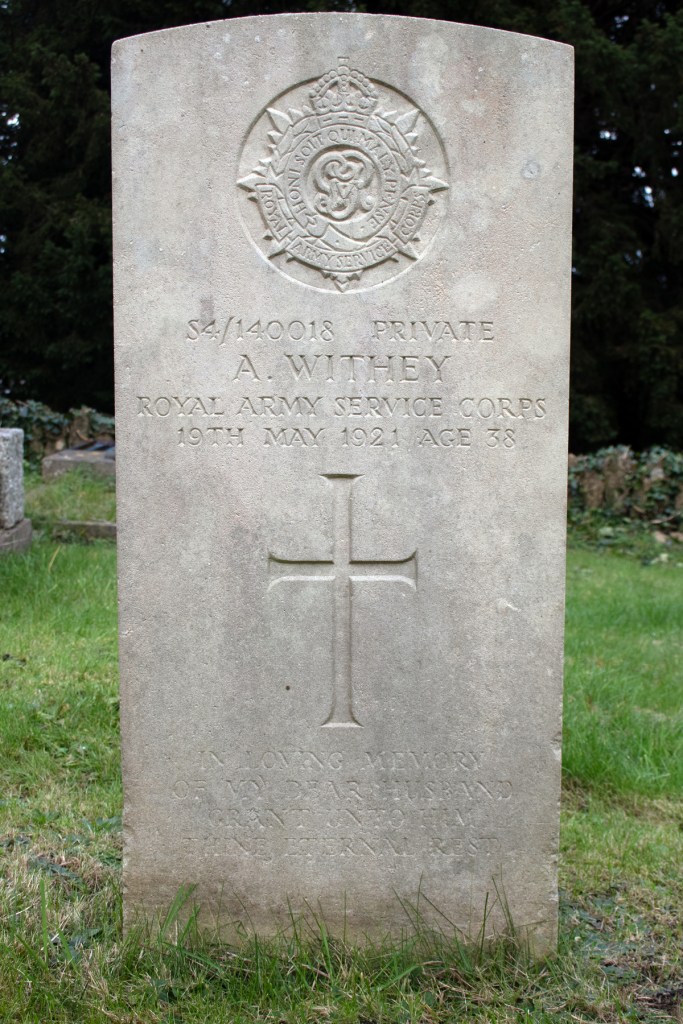
Albert Withey was born in Frome, Somerset in November 1882. One of ten children, his parents were John Withey, a coal dealer, and his wife Elizabeth. John passed away in 1891, Elizabeth eight years later, which led to Albert becoming an orphan while still in his teens.
Information on Albert’s early life is scarce and, indeed, his trail goes cold until 26th September 1915, when he enlisted in the Army Service Corps, as part of the war effort.
Private Withey’s service records give more insight into his life: he was 5ft 7ins (1.70m) tall, and had varicose veins on both legs. The document also confirms that he had married local woman Annie Louisa Stent on 2nd January 1912. Both attended Holy Trinity Church, and it is likely that this is where they met. Annie was the daughter of a local house painter, while Albert had become a baker; it is probable that it was this work that led him to be assigned to the ASC.
Within weeks of joining up, Private Withey was in Egypt, and it was here that he worked as part of the Supply Corps for the next four years. Albert remained in North Africa long after the Armistice was signed and, in fact, did not return to England until the August after the war had ended. He was officially demobbed on 30th September 1919.
At this point, Albert’s trail once again goes cold, and the next document relating to him is a short notice in the Somerset Standard, two years later, when, “at Pensions Hospital, Bath, Albert Withey, aged 38 years, [died] after a long and painful illness, patiently borne.” [Somerset Standard: Friday 27th May 1921]
Albert Withey was laid to rest in the graveyard of the church in which he was baptised and married, Holy Trinity Church, Frome.
Albert’s widow, Annie, was the sister of Bertie Stent, who had also died after coming home from war. Read his story here.
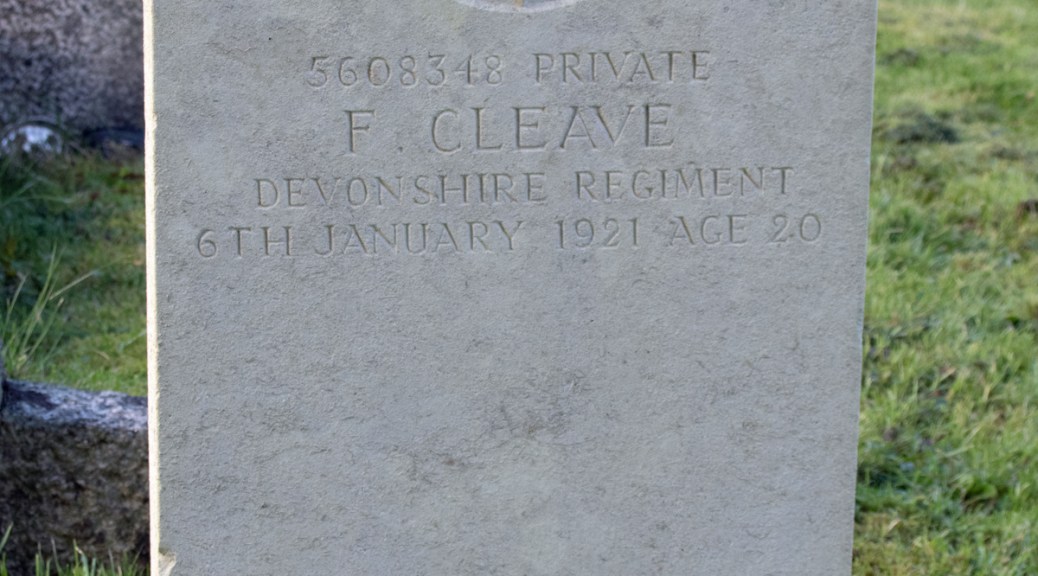
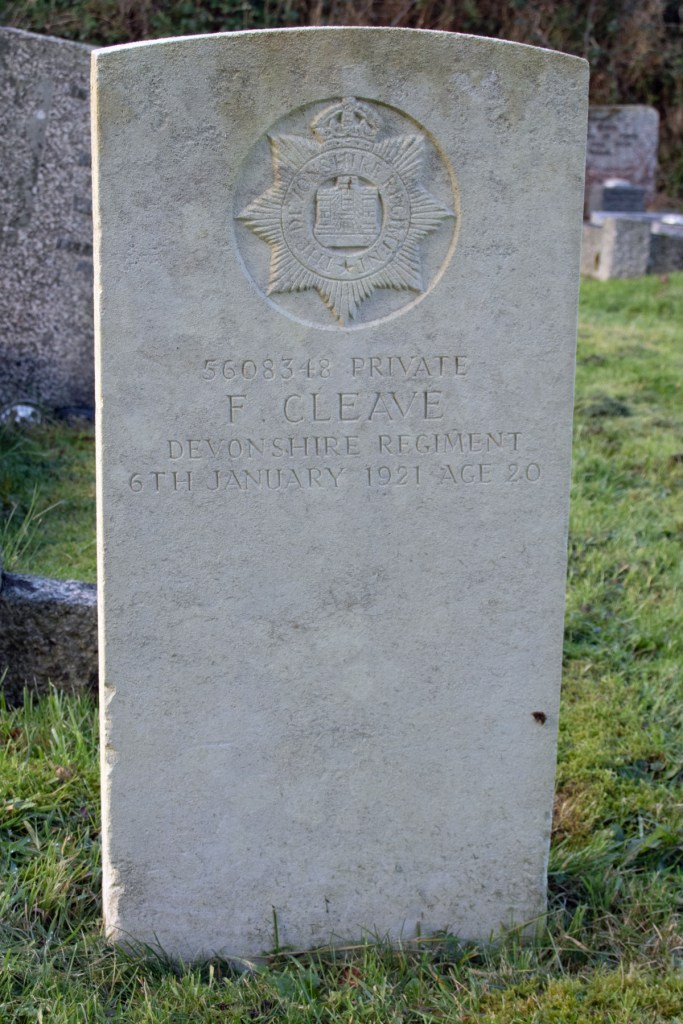
Frederick Cleave was born in Chudleigh, Devon, early in 1899, and was one of nine children to Charles and Eva Cleave. Charles worked as a waggoner – for a grocer, according to the 1901 census, and for a stonemason in the 1911 one.
There is little specific information about Frederick’s early life, and even details of his military service are only evident from a contemporary newspaper report of his funeral:
The funeral took place at the cemetery on Tuesday afternoon of Private F Cleave of the 1st Devon Regiment, son of Mr and Mrs C Cleave of Woodway Street, who died at Fermoy Hospital, Ireland… from disease contracted on foreign service… He joined the Army in 1915, and served through the war in France, and afterwards in the Russian Expedition.
Western Times: Friday 14th January 1921
The report suggests a couple of things. Firstly, Frederick was underage when he enlisted – he would have been 16 years old. He would also have been involved in some of the fiercest fighting of the conflict: the 1st Battalion of the Devonshire Regiment fought at the Somme in 1916, Arras and Ypres in 1917, and Lys, the Somme and the Hindenburg Line in 1918.
The Russian Expedition mentioned was part of the Allied attempt to intervene after the country’s civil war – actions that were to prove unsuccessful.
Fermoy Military Hospital was part of the British Army’s barracks in the County Cork town; it is likely that Private Cleave had contracted one of the lung conditions running rampant across Europe in the immediate aftermath of the First World War – influenza, tuberculosis or pneumonia. He passed away on 4th January 1921 at the age of 21 years old.
Brought back home, Frederick Cleave lies at rest in the cemetery of his home town, Chudleigh, Devon.
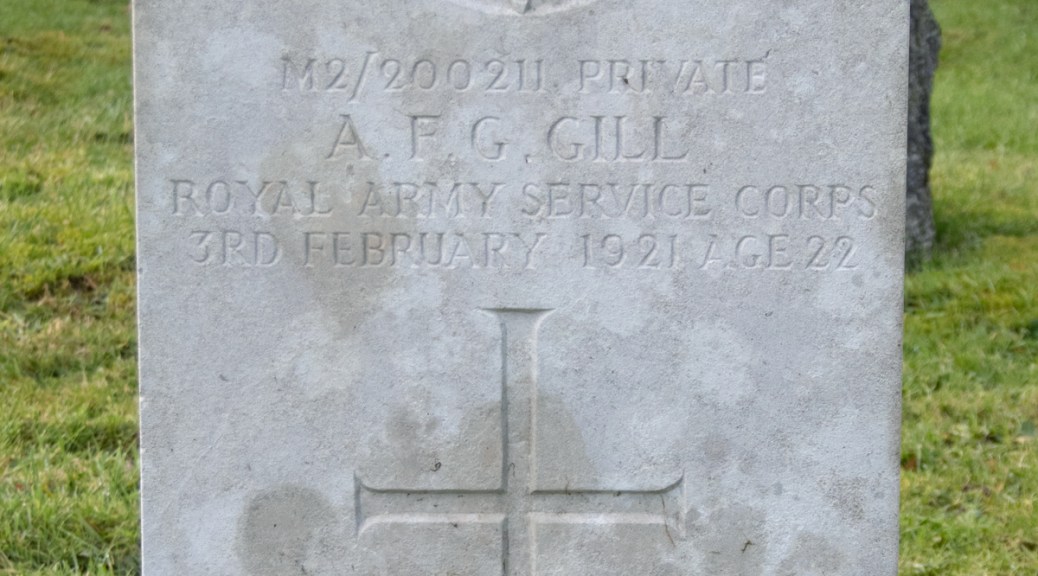
There are parts of AFG Gill’s that are destined to remain a mystery. The Commonwealth War Graves Commission give his parents’ names and address – Edwin and Annie Gill of 15 Old Exeter Street, Chudleigh, Devon. Combined with his service number – M2/200211 – this would suggest that the FG in his name is Frederick George, but the initial A remains stubbornly absent.
Frederick George Gill was born in 1898, in the village of Chudlegh, and was one of seven children. His father – Edwin – was a carrier and haulier in the area, and the family lived in the middle of the village.
When war came to Europe, Frederick was keen to do his bit – he enlisted in the Royal Army Service Corps as a Private and was assigned to the Mechanical Transport division.
There is very little information on Private Gill’s military service. He was awarded the Victory and British Medals for his service, but there is nothing to confirm when he enlisted or if he served abroad.
Private Gill survived the war, but was discharged on medical grounds on 18th November 1919 – he had contracted pulmonary tuberculosis during his time in the army, and was not longer fit to serve.
At this point, Frederick’s trail goes cold. While nothing can be confirmed, it would seem that the lung condition got the better of him – on 3rd February 1921 he passed away at home. He was just 22 years of age.
Frederick George Gill was laid to rest in the cemetery of his home village.
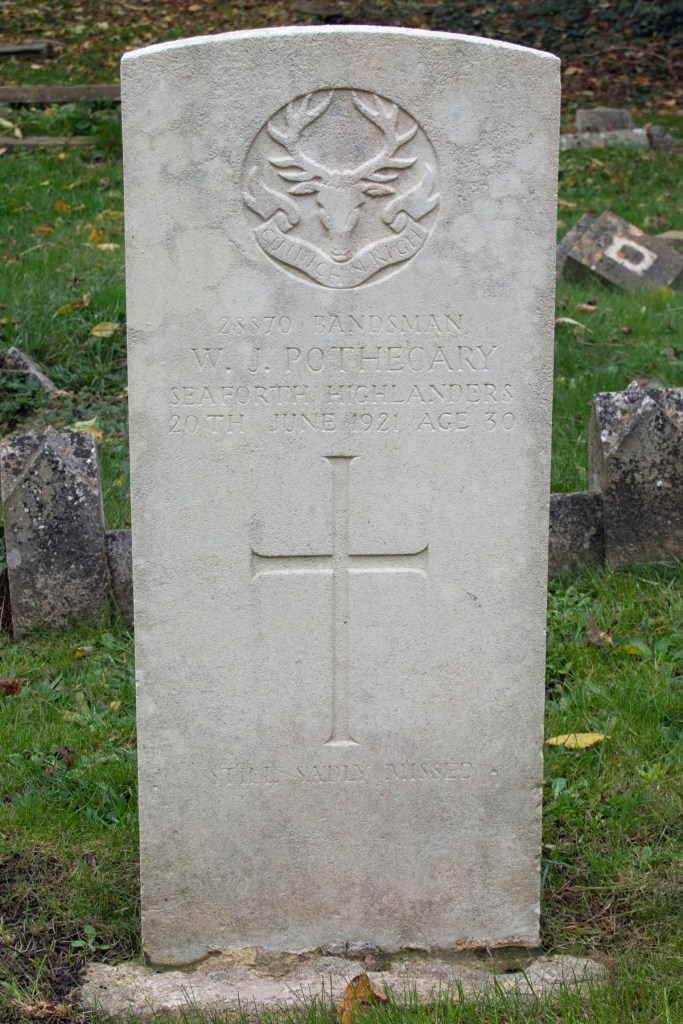
William James Pothecary was born in Frome, Somerset, on 24th April 1891, one of six children – and the only boy – to Francis and Annie Maria Pothecary. Francis was a groom, and the couple raised the family in Pilly Vale (now Willow Vale) which ran alongside the River Frome in the centre of the town.
Little further information on William’s early life is available, although it seems he was a keen musician, and took up the oboe at an early age. He joined the 2nd Seaforth Highlanders in 1909 as a Bandsman, and, from later reports, was a talented player.
When was broke out, William was sent to the front, but in 1915, while caught up in the Second Battle of Ypres, he was buried and seriously wounded by a bomb. He was sent to a convalescent home in Ireland, recovered reasonably well and returned to France, where he served until the end of the war.
Bandsman Pothecary was demobbed in July 1919 and returned to Somerset. The following year, he needed an operation following the recurrence of the issues he encountered following his injury, and all seemed to be going well for a long-term recovery.
William had a relapse in the summer of 1921, and was admitted to Bath Hospital. Sadly, however, he was not to recover this time, and he passed away on 20th June. He had just turned 30 years old.
William James Pothecary was laid to rest in the graveyard of Christ Church in his home town of Frome.
The Somerset Standard gave a glowing obituary for young William:
Death of an “Old Contemptible”
The was, through the fighting is over, still claims victims from the ranks of survivors. On Monday, Mr William James Pothecary, one of the “Old Contemptibles”, died in the Pensions Hospital at Bath from the effects of wounds which he received in 1915. He was the only son of Mr and Mrs FW Pothecary, of Bath Street, and very deep sympathy is felt with the parents and sisters in their great bereavement. Mt WJ Pothecary was an old Regular.
Nearly twelve years ago he joined the 2nd Seaforths. He was a talented player of the oboe, and it was his love of music which prompted him to become a bandsman in the 2nd Seaforths. He had previously been a bugle boy in the old Volunteers, and afterwards a member of the Territorial Band. And at the time of his death he was one of the most valued players in the Frome Town Military Band.
He went to France with his regiment in 1914. In 1915 he was seriously wounded and buried by a bomb. His condition was critical for a long time, but he slowly recovered and was sent to a convalescent camp in Ireland. He remained there for a considerable time, and when he was deemed medically fit he was sent to France a second time. He continued to serve in France until after the Armistice. He was discharged from the Army in July 1919.
Last year it was necessary for him to undergo a very serious operation in hospital. The operation was successful, and it was hoped there would be a permanent recovery. But on Thursday last there was a recurrence of an old trouble, and he was removed to Bath Hospital, where he died on Monday morning.
He was a talented and promising young fellow, and his death is deeply deplored by his many friends, and not least by his fellow members of the Frome Town Military Band.
Paolo Spiteri was born in Valetta, Malta, on 25th January 1881, the son of Stephen Spiteri. Sadly there is very little further information on his early life, other than he worked as a cook when he left school.
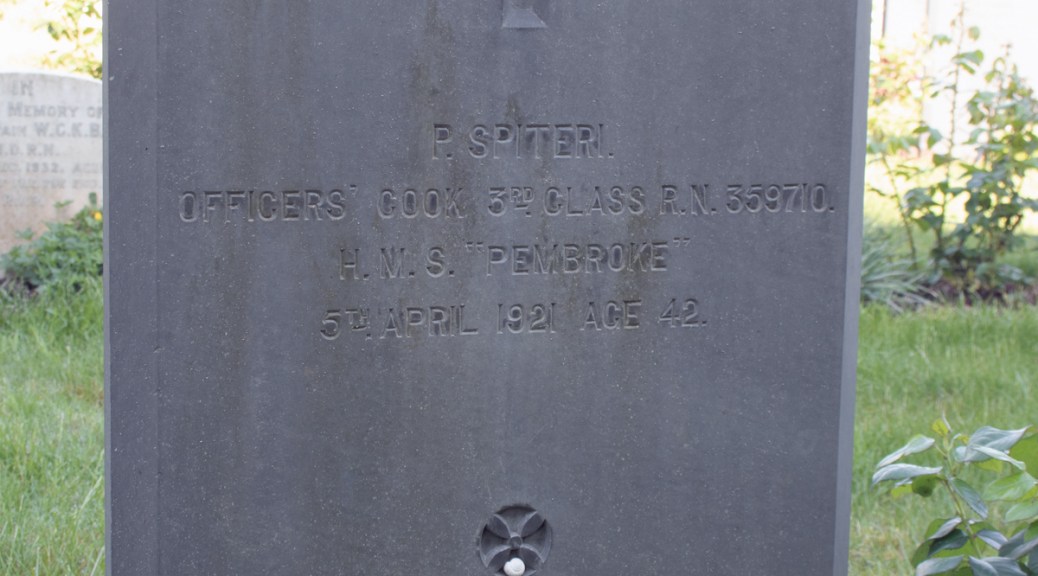
Paolo saw a life at sea as a good career, and, in August 1901, aged 20, joined the Royal Navy. Over the next twenty years, he travelled the world, serving on more than twenty ships and working his way up from a domestic in the kitchen to an Officer’s Cook 3rd Class.
By 1921, Paolo was based at HMS Pembroke – the shore establishment at the Naval Dockyard in Chatham, Kent – and contracted pneumonia there. Admitted to the Naval Hospital in the town, the condition sadly got the better of him, and he passed away on 5th April 1921. He was 42 years old.
Officer’s Cook Paolo Spiteri was laid to rest in the Woodlands Cemetery, not far from the dockyard at which he was based.
Percy George Macey was born in Frome, Somerset, in the autumn of 1889. He was the oldest of six children and the only son to Arthur and Susan Macey. Arthur was a general labourer and domestic gardener from Wiltshire, whose family had moved to Somerset in the 1870s.
When he left school, Percy found work at a local foundry, and, by the time of the 1911 census, was listed as a brass fitter. By this point he had met Winifred Rowe, a labourer’s daughter from Wiltshire, who had found work as a servant to a Frome butcher. The couple married at the start of 1913, and went on to have a son – who they called Arthur, after Percy’s recently deceased father – later that year.
War was coming, and Percy joined the Somerset Light Infantry. Full details of his military service are not available, although at some point during the conflict he was promoted to Serjeant and transferred to the Labour Corps under the Devonshire Regiment. He was awarded the Victory and British Medals, but does not appear to have seen any service overseas.
By the end of the war, Percy had risen to the rank of Quartermaster Serjeant. The end of his life is, however, shrouded in a bit of mystery. He passed away on 15th March 1921 in Cheltenham, Gloucestershire; although no cause for his death is evident, it seems likely to have been from an illness of some sort, as there are no contemporary newspaper reports to suggest anything out of the ordinary. He was just 31 years old.
Percy George Macey was brought back to Frome; he was laid to rest in the Dissenters’ Cemetery in Vallis Road.









 Death and Service