Tag Archives: bronchitis

Rifleman Ernest Parsons

Rifleman Ernest Parsons

Ernest Charles Parsons was born in 1881, and was one of six children to bricklayer Robert Parsons and his wife Mary Ann. Robert was a labourer and bricklayer from Watford, while Mary Ann was born in Arundel, West Sussex. The couple moved to where his work was, having their first children in Hertfordshire and Sussex They finally settled in London, which was where Ernest was born.

Where he first left school, Ernest worked as a painter, but soon found a career as a postman., something he would continue to do through to the outbreak of war.

Ernest married Frances Olive Eynott on 28th February 1904; they went on to have a daughter, Doris, the following year. It seems, however, that their marriage was destined to be a short one; Frances passed away within a couple of years.

With a daughter to raise and a living to earn, Ernest married again. Elizabeth Kate Dew was born in Fulham in 1883, and the couple married in the spring of 1907. Again, however, their happiness was to be short; Elizabeth died eighteen months later.

Widowed twice, and with Doris now a toddler, Ernest moved back in with his parents in Chiswick. He continued his work as a postman, but alongside this had been an active volunteer in the London Regiment (Post Office Rifles) since early 1908.

Rifleman Parsons’ initial year’s service was extended and extended and, by the time of the outbreak of the First World War, had been serving for some six years.

By 1914, Ernest had found love for a third time, and married Lilian Frances Cromie on 25th March that year. With war imminent, his time was take up more with military duties; while part of the territorial force, Rifleman Parsons had been officially mobilised.

The sudden intermingling of men from different parts of the country in small, packed training camps made the perfect environment for illness and disease to circulate. Ernest had initially contracted bronchitis while on service in 1912; this had dogged him intermittently oved the next few years until, in March 1915, it was serious enough for the Medical Examination Board to declare him unfit for military service.

Ernest moved his family to Worthing, in West Sussex, presumably as the air was fresher there than in the bustling capital. He may also had had family in the area, as his mother had been born just up the road in Arundel. Sadly, though, it seems that his health was not to recover sufficiently, and he passed away on 4th October 1918, at the age of 37.

Ernest Charles Parsons was buried in the Broadwater Cemetery in the town, not far from where his widow and daughter were then living.


Coincidentally, when researching another soldier, Lance Corporal Edgar Godden, this turns out to be the address where he also died, just ten months earlier on 22nd December 1917. There is no apparent other link between the two men.

Private Henry Oaten

Private Henry Oaten

Henry Oaten was born in 1876, the second youngest of seven children to Henry and Mary Ann Oaten. Henry Sr was an agricultural labourer, who raised his family in his home village of Pitminster, to the south of Taunton in Somerset.

When he left school, Henry Jr followed in his father’s footsteps as a farm worker. Sadly, however, there is very little further documentation to expand on his life.

Henry married a woman called Emily; this is likely to have been at some point around 1900, although there is nothing to confirm an exact date. The couple went on to have four children – John, Albert, William and Howard.

When war broke out, Henry joined up. Again, dates for his military service are not available, but he enlisted in the Devonshire Regiment as a Private. He was assigned to the 13th (Works) Battalion, which was a territorial force, based in Plymouth.

Little further documentation exists in relation to Private Oaten. The next time he appears is on his pension record, which confirms that he passed away on 20th February 1917, having been suffering from bronchitis. He was just 40 years old.

Henry Oaten was brought back to Taunton and laid to rest in the St James’ Cemetery in the town.


As an aside to this story, while researching Private Oaten, an additional piece of information about his father came to light. A record confirms that, on the 1st October 1851, at the age of just 16, Henry Oaten was admitted to gaol. Sadly further details – including that of his crime and his sentence – are lost to time, but it adds an interesting footnote to his son’s background.


Private John Thick

Private John Thick

John Valentine Thick was born in 1883, the youngest of two children to John Thick and his wife Anna. John Sr was a plumber, and evidently moved around with his work. He was born in Surrey, Anna came from Berkshire; their older child, Grace was born in Hampshire, while John Jr was also born in Berkshire.

By the time of the 1891 census, John Sr had moved the family down to Blandford Forum in Dorset. Little more is known about his son’s early life, but by 1907, he was back in Berkshire, and married Henrietta Entwistle, who had grown up in Chelsea.

The young couple went on to have three children – John, Muriel and Margaret – and settled down in Reading, Berkshire. John, by this time, was working as a domestic gardener.

Little documentation exists relating to John’s military service. He enlisted in the Hampshire Regiment, and was assigned to the 1st Labour Company. Private Thick would have been part of the regiment’s territorial force, presumably using his gardening skills to help with the war effort.

While it is difficult to confirm the dates of his service, it seems that John had enlisted towards the end of 1916. It was early the following year that he fell ill, and was soon admitted to hospital with bronchitis. Sadly, this condition was to get the better of him, and Private Thick passed away on 8th March 1917. He was just 34 years old.

John Valentine Thick lies at rest in St Mary’s Cemetery in Taunton, Somerset.


Private Ernest Baker

Private Ernest Baker

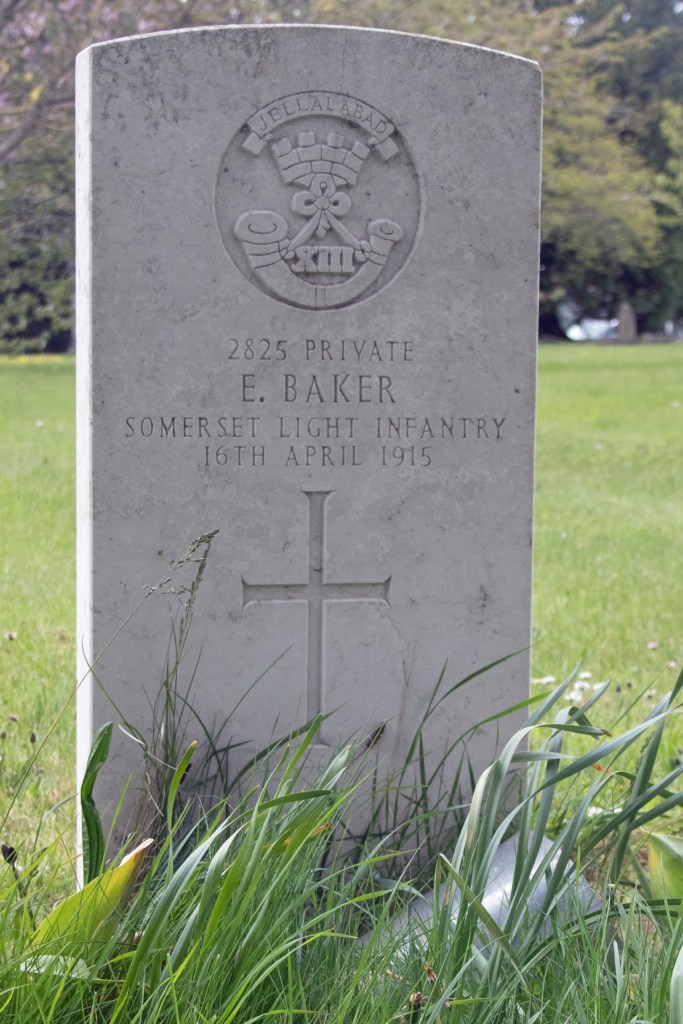
Ernest Baker’s early life is a bit of a muddle; Born in 1878 in Somerset, it’s a challenge to unpick specific details, as there are two Ernest Bakers, both of whom have parents of the same name – Henry and Sarah – and have siblings with similar names too. Was Ernest’s father, therefore, a thatcher from Meare near Glastonbury or a travelling draper from Taunton.

In fact, it was a newspaper article from April 1915 that helped unlock the confusion.

The Taunton Courier and Western Advertiser confirmed that Ernest’s full name was Ernest Bond Baker, and that his father – who had passed away by the time of Ernest’s death – was from Bishop’s Hull, a village near Taunton.

This would seem to confirm, therefore, that his father was a travelling draper.


Ernest was one of ten children. His father died when he was only fifteen years old, by which time Ernest had left school and found employment as a basket weaver, a trade which was prevalent on the Somerset Moors.

Sarah, a widow at only forty, took in laundry to make ends meet. Of Ernest’s two older brother, one had passed away as a teenager, while the other had gone on to have a wife and family of his own. It was left to Ernest, therefore, to remain at home and support his mother and younger siblings.

Ernest met and married local butcher’s daughter Bessie Glover in 1900, and the couple went on to have seven children. After a spell living in Wiltshire, the young family moved back to Somerset, settling in Bridgwater, where Ernest continued to ply his trade.

Ernest’s military service records are lost to time; he enlisted in the Somerset Light Infantry, joining the 5th Battalion at some point early in the war (certainly before October 1914). Private Baker’s battalion seems to have been part of a territorial/reserve force, and he was based in his home town of Taunton.

In early April 1915, Ernest fell ill, and was admitted to the Voluntary Aid Detachment Red Cross Hospital in Yeovil, suffering from bronchitis and pneumonia. Sadly, the lung conditions were such that he was succumb to them, and he passed away on 16th April 1915. He was just 36 years old.

Ernest Bond Baker lies at rest in St Mary’s Cemetery in his home town of Taunton, Somerset, the same cemetery where his father and brother were buried.


Private Ernest Baker

Chief Engine Room Artificer 2nd Class Charles Miller

Artificer Charles Miller

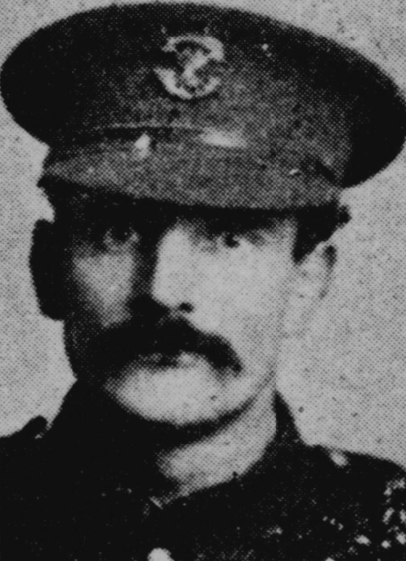
Charles Frederick Caleb Miller was born on 12th December 1887 in Gillingham, Kent. His parents were Charles and Harriet Miller, and he had two younger siblings, Mabel and Harriet.

Tragically, Charles Jr’s mother died when he was only three years old; his father went on to marry again – to his widow’s younger sister, Jane – and the couple had two further children – Jane and Beatrice – who were Charles Jr’s half-sisters.

Charles Sr worked as a ship’s rigger in the Military Dockyard in Chatham, and naval life obviously caught his son’s eye. In 1903, having left school, he enlisted in the Royal Navy, started as a ‘boy artificer’, working in the engine and boiler rooms of ships.

His initial service was for twelve years, and he worked on a number of vessels, as well as being assigned to HMS Pembroke, the shore base in Chatham. He worked his way through the ranks to Engine Room Artificer 2nd Class by 1915.

In June of that year, Charles married Ellen Holden. the daughter of a dairyman from Chelsea. The couple went on to have a daughter, Joan, who was born in 1918. At the time of their wedding, Charles was based on HMS Lance, and his military service was to continue.

His period of service extended until the end of the war, Charles served on a number of other vessels, including HMS Surprise, Blenheim and Prince George and rose to Chief Engine Room Artificer 2nd Class.

It was while he was assigned to HMS Ganges in January 1920 that he became unwell, however. He had contracted bronchial pneumonia, and died of a combination of that and heart failure on 9th February 1920. He was 32 years old.

Charles Frederick Caleb Miller lies at rest in Woodlands Cemetery in his home town of Gillingham, Kent.


Charles Miller (from ancestry.co.uk)

Lance Corporal Sidney Turner

Lance Corporal Sidney Turner

Sidney Joseph Turner was born in 1888, the oldest of four children to Sidney and Matilda Turner from Bridgwater in Somerset. Sidney Sr was a carter, while his son became a labourer in a local cement works. Sadly, Sidney Sr died in 1903, when Sidney Jr was 15, leaving Matilda with three other children, one of whom was only 18 months old.

Sidney Jr travelled to get work, and had moved to South Wales to work as a miner by 1909. Here he married Rose Shattock, who was born in Bristol, although within a couple of years the young couple had moved back to Somerset.

Sidney and Rose had a son, also called Sidney, although sadly he died when he was only a couple of months old. Tragically for Sidney, the records seem to suggest that Rose may have died in childbirth, or shortly after, as her passing was registered in the same quarter as her son’s birth.

By this time, Sidney was living in Bailey Street, Bridgwater, a short distance from some railway sidings. This might have driven some determination in him as, by the following year, he was listed as an engine driver. In December 1913 he married his second wife, Bessie Sharman. She was the daughter of a mariner, who had become a machinist in a shirt factory by the time of their marriage. The couple went on to have a son, also called Sidney, in April 1914.

When war broke out, Sidney enlisted in the Highland Light Infantry, initially in the 12th (Service) Battalion. They landed in France in July 1915 and were there for the remainder of the war. At some point, Lance Corporal Turner transferred to the 53rd (Young Soldier) Battalion. Very much a training brigade, it seems that Sidney’s experience of the front line may have proved useful for the upcoming recruits.

Lance Corporal Turner was demobbed on 21st March 1919; his pension record shows that, during the course of his service, he had fractured his tibia and had contracted bronchitis. The 1921 census found Sidney back in Bridgwater. He was listed as being a gas engine driver for John Board & Co., although he was, at that point, out of work. He, Bessie and Sidney Jr were living at 1 Price’s Buildings.

Sidney’s health conditions were to prove his downfall, as, within a months of the census return, he had succumbed to pulmonary tuberculosis and exhaustion. He died on 2nd July 1921, aged just 32 years old.

Sidney Joseph Turner lies at rest in St John’s Cemetery in his home town of Bridgwater, Somerset.

Able Seaman Alfred Walters

Able Seaman Alfred Walters

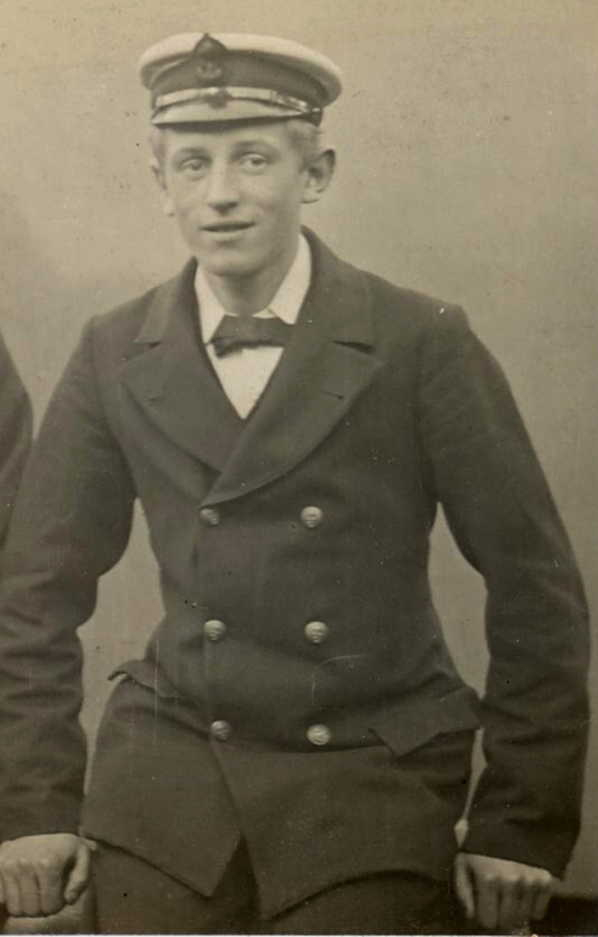
Alfred Charles Walters was born in March 1900, one of six children to Alfred and Sarah Walters from Bridgwater, Somerset. Alfred Sr was a labourer in a brickyard, and the family lived in the centre of the town.

When war broke out, Alfred seemed very eager to be involved. Lying about his age (giving his date of birth as 26th August 1898), he enlisted in the Royal Naval Reserve. Training in Portsmouth – on HMS Victory II, HMS Excellent and HMS President III – he was assigned to the SS Tanfield.

The steamer was heading out of London en route for Bombay and Karachi in April 1918, and was making its way west through the English Channel. On 15th April, it was located and tracked by the German U-Boat UB74, under the command of Ernst Steindorff. The German fired a torpedo, which hit and crippled Able Seaman Walters’ ship. Thankfully, there was no loss of life, and the Tanfield managed to limp back to port.

Little else remains of Able Seaman Walters’ military life. In February 1919, he was admitted to the Dreadnought Seaman’s Hospital in Greenwich, suffering from influenza and bronchial pneumonia. Sadly, he succumbed to the disease, passing away on 20th February 1919. He was just 18 years old (although his military record and gravestone give him as 19).

Alfred Charles Walters lies at peace in the Wembdon Road Cemetery in his home town of Bridgwater, Somerset.


Private James Godden

Private James Godden

James Godden was born in the autumn of 1879. The youngest of six children to Charles and Mary Ann Godden, the family lived in Bridgwater, Somerset. Charles was a labourer and, while his older brothers followed in a similar vein, by the time of the 1901 census, aged 21, was listed as a hairdresser.

James married Hester Addicott in 1906, and the couple had three children – Ruby, Leslie and Freda. Hairdressing may not have been that well paid; according the to 1911 census, the young family had four boarders, ranging from 17 to 60 in age.

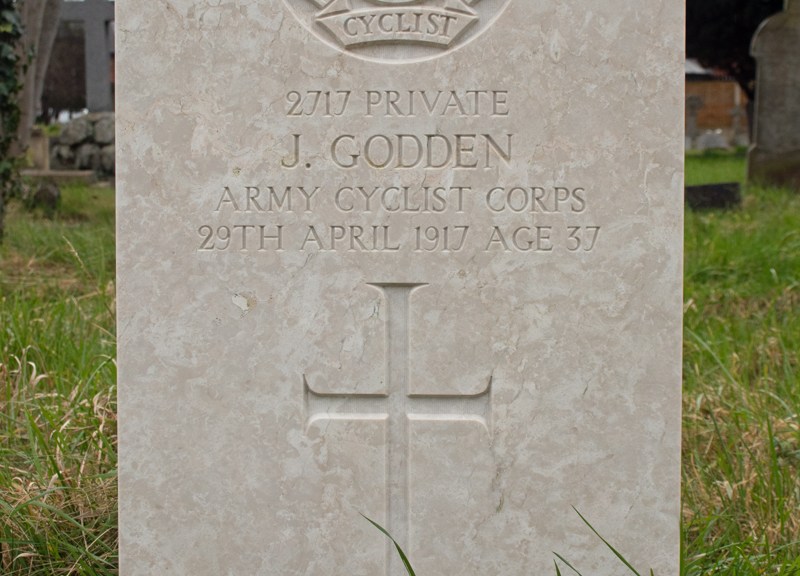
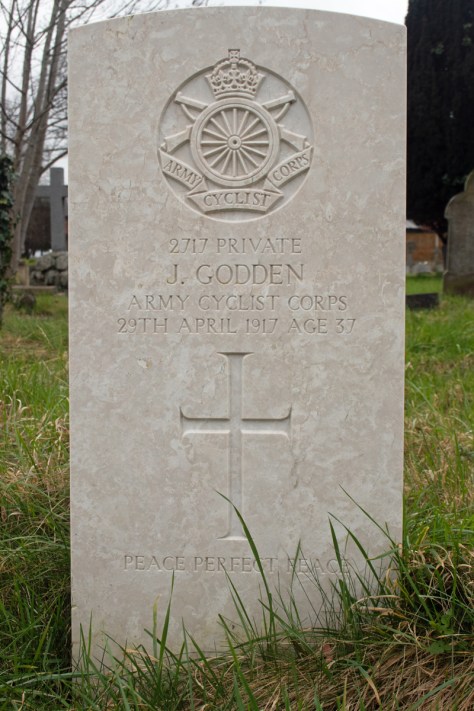
War was on its way, and James enlisted at the end of 1914. Initially joining the Somerset Light Infantry, he was soon transferred to the Army Cyclist Corps. Sadly, full details of his military service are not readily available, but it seems likely that he was part of the company’s First Line, who saw service overseas.

Private Godden served three years before being medically discharged from the army. His discharge records give a startling insight into his health.

Originated at Chiseldon Camp: April 12th 1917.

He is in a condition of violent excitement, talks without ceasing and suffers from insomnia. Refuses solid food, but will take a little milk. Not result of, but aggravated by, strain of ordinary military service.

Permanent total incapacity. Treatment in an asylum required.

Cause of discharge: Medically Unfit – Acute Mania

James Godden: WW1 Pension Records

James was admitted to the Somerset & Bath Asylum in the village of Codford, near Taunton. For good or bad, his time there was brief. Within a couple of weeks, he contracted bronchitis. Sadly, James was to succumb to this, and passed away on 29th April 1917. He was 27 years of age.

An additional twist in the tail came from the local newspaper report on his passing:

Somerset Athlete Killed

The death is reported of a former well-known athlete in the person of Mr James Godden, who before joining the Army carried on business as a hairdresser at Bridgwater. The deceased, who was 37 years of age, enlisted in December 1914, and was subsequently transferred to a cycle corps. He death occurred at a Somerset institution after a short illness. The deceased was well known throughout the West of England as a crack cyclist, and competed at big athletic meetings at Exeter, Plymouth, Bath and Bristol, in addition to local sports. He had won altogether over 400 prizes. He leaves a widow and three children.

Wells Journal: Friday 4th May 1917

James Godden lies at rest in the Wembden Road Cemetery in his home town of Bridgwater, Somerset.


James Godden, celebrated on an Ogden’s Cigarettes card
(with thanks to John Boyland)

Private Robert Hunt

Private Robert Hunt

Robert Edward Nichols Hunt was born in Somerton, Somerset in 1894. One of five children to Charles and Rose Hunt, his father was a bootmaker.

By the 1911 census, however, things had taken a different turn; Charles and two of his sons were working for a brewer, Rose was working as a shop assistance in Boots, and the youngest of the family, Kate, was apprenticed to a dressmaker.

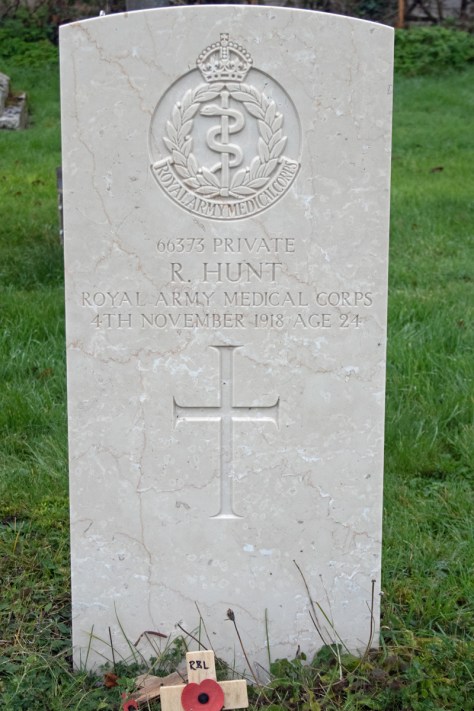
It was against this backdrop that war came, and, within a year, Robert had enlisted in the Royal Army Medical Corps. His sign-up documents confirm that he was short sighted, although this was corrected with glasses and he was deemed fit for active service.

Sent to the Western Front in October 1915, Private Hunt definitely found himself in the thick of the action.

In August 1916, he was supporting the fighting at High Wood on the Somme, when a gas shell exploded near him. He fell and, when he woke, he remembered little of what happened. Robert had inhaled a lot of gas, however, and was left coughing with difficulty breathing. He was transferred back to England by train and ship to recover, arriving back on the 2nd September.

There is no record of Robert having gone back to the front. The impact of the gas appears to have been severe and long-lasting. At the end of October 1918, he was admitted to the Becket House Auxiliary Hospital in St Albans with influenza and bronchial pneumonia. Sadly, this was to be a battle he would not recover from, and he passed away on 4th November 1918. He was 24 years old.

Robert Edward Nichols Hunt lies at rest in the cemetery of his home town, Somerton.


Private Nelson Pitman

Private Nelson Pitman

Nelson Victor Pitman was born in April 1890, the fourth of eight children to George Pitman and Amy Roles Pitman (née Treasure). George was a butcher’s assistant, and the family lived in their home town of Sherborne in Dorset.

As with a number of the other servicemen I have been researching, Nelson’s military records are sparse, probably lost to time. He is not listed as living with his parents on the 1911 census and, in fact, is nowhere to be found.

On 2nd January 1915, Nelson marries Alice Moores at the parish church (Sherborne Abbey). His profession is listed as soldier, so we know that, but this point in the war, he had enlisted.

While there are no records of Private Pitman’s service, his battalion, the 1st Royal Warwickshire Regiment was involved in a number of the key battles of the war, including the second Ypres, Arras and Passchendaele. The battalion was also involved in the Christmas Truce, so there is a slight chance that Nelson played football with his German counterparts in one of the defining moments of the Great War.

Private Pitman survived the war to end all wars, but was discharged on 22nd February 1919 with a disability. He was suffering from bronchitis, and steadily went downhill.

Private Nelson Pitman passed away eighteen months later, on 21st November 1920. He was 31 years old.

He lies at rest in Sherborne Cemetery.