Tag Archives: brothers

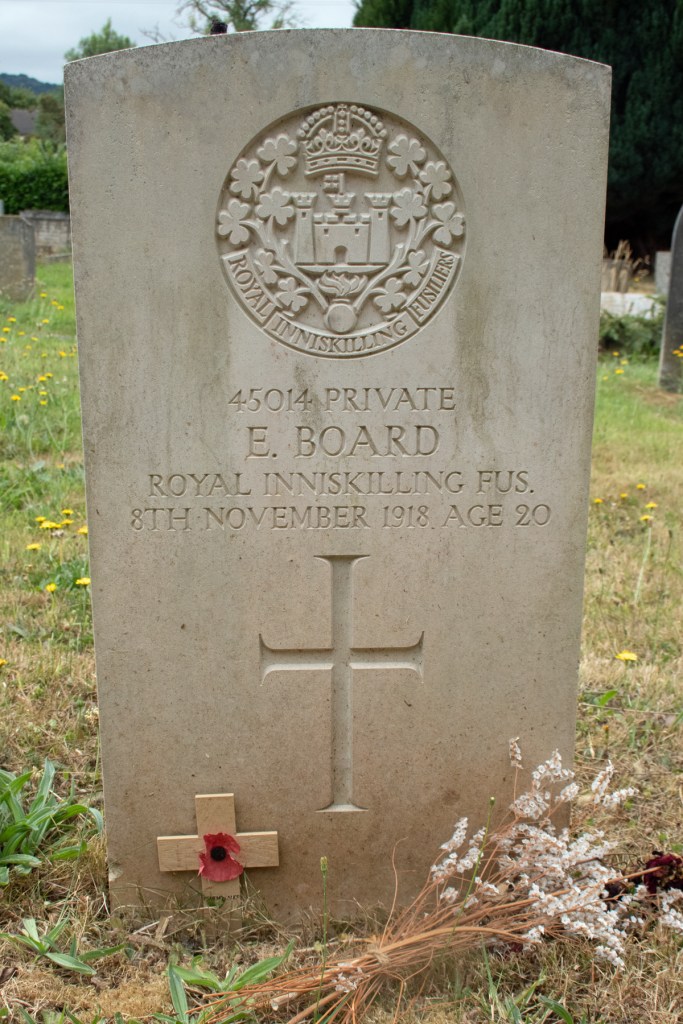
Private Ernest Board

Private Ernest Board

Ernest Board was born in Taunton, Somerset, on 20th September 1898 and was one of at least six children to Walter and Mary Board. Walter was a carter for the town’s gasworks, but, when Mary passed away in 1910, things changed dramatically for the family.

The 1911 census found Walter working as a cowman on a farm in Milverton, Somerset. All but two of his children are missing from that year’s national record, but Ernest and his older brother Arthur are noted as being ‘inmates’ at the National Nautical School in Portishead, near Bristol.

This was an establishment set up in 1869 for the destitute and neglected boys of the area. Ernest and Arthur were two of more than 320 students at the school which, at that time, was under the control of Commander Willoughby Still. School life was very strongly based on the running of a ship, with hammocks instead of beds, and a parade ground in front of the building.

There is no information about how long the brothers remained at the school, but, when war came to Europe, it would seem that they were keen to play their part. Sadly little detail remains of Ernest’s military life.

What can be determined, however, is that he enlisted in the Royal Inniskilling Fusiliers, and was assigned to the 1st Battalion as a Private. His battalion fought at, and were evacuated from, Gallipoli, before moving to France. There is no record where Private Board was involved, sadly, although his Medal Roll Card shows that he was assigned the Victory and British Medals, although may not have actually seen time overseas.

Private Board’s passing is also lost to time. All that can be confirmed is that he died on 8th November 1918, and was just 20 years of age.

Ernest Board was laid to rest in Wellington Cemetery, Somerset: as this is not far from where his father was recorded on the census seven years earlier, it is likely that his place of burial was due to family connections in the area.


Serjeant-Trumpeter Alexander de Vere

Serjeant-Trumpeter Alexander de Vere

Alexander Johnstone de Vere was born on 10th August 1889 in Murree, India (now Pakistan). He was one of five children to Norfolk-born Alexander Johnstone (also known as John Ralph de Vere), and his wife Dorothea who had been born in Sangor, India. Alexander Sr was a Sergeant Major in the 12th Lancers, and the family returned to England not long after his son was born, settling first in Aldershot, then in Sandhurst.

Alexander’s youngest sibling, George, was born in Cairo, Egypt, so the family was on the move again. Sadly, Alexander Sr died in a nursing home in the city just two years later and, after returning to England, Dorothea passed away in a Holborn infirmary just two years later.

Documents for the de Vere children – Ellen, Alexander, Dorothea, William and George – are few and far between. The 1911 census places Dorothea boarding with a family in Kingston-upon-Thames, where she was employed as a dress maker. The same document records William as a Bandsman in the 1st Battalion of the Seaforth Highlanders, based at Chanpatia, in Northern India. George, meanwhile, was a schoolboy at the Duke of York’s Royal Military School on the outskirts of Dover. Of the two eldest siblings, however, there is no record.

In the autumn of 1912, Alexander married Emily Louise Collins. Born in Norfolk in 1884, she was working as a servant in a house in Surrey when she and Alexander met. The couple married in Faversham, Kent, and settle down there, their daughter, Dora, being born in the town in January 1915.

Given his family’s military background, it is not unsurprising that Alexander enlisted in the army almost as soon as war was declared. He may have already seen military service, as he enlisted in the 11th Hussars as a Lance Corporal. By 15th August 1914, Alexander was in France.

Lance Corporal de Vere was quickly caught up in the fighting. He saw action at Mons and Nery in 1914, and at Ypres the following year. By this point, he had been promoted to the rank of Sergeant Trumpeter, reflecting the musical connection he shared with his younger brother, William.

Alexander remained in France until January 1916, when he was invalided home. He was admitted to Dorchester County Hospital in Dorset, suffering from a cerebral abscess. Despite treatment, he succumbed to the condition, passing away on 17th March 1916, at the age of just 26 years old.

Alexander Johnstone de Vere was brought back to Kent for burial. He was laid to rest in Faversham Borough Cemetery.


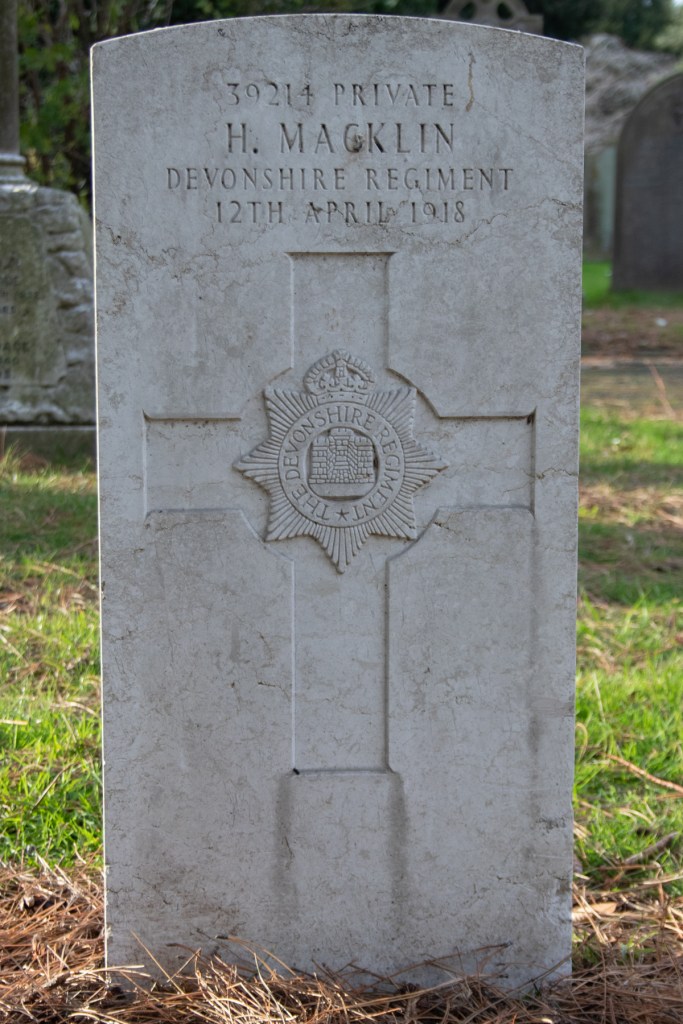
Private Herbert Macklin

Private Herbert Macklin

Herbert Macklin was born in Lambeth, Surrey, on 14th August 1897, the youngest of six children to Enos and Sarah Macklin. Enos was a general labourer and, after his mother died in 1909, Herbert worked around his school as a baker’s errand boy, to bring in a little more money for his family.

After Enos passed away in 1912, and with his older sisters all having families of their own, Herbert and his older brother William did what they could to survive, getting some support from the local poor school.

The outbreak of war gave the brothers a sense of purpose, and both enlisted. William joined the Royal Field Artillery, and was sent to France in September 1915.

Herbert, being six years younger than his brother, enlisted later than his sibling. He joined the Middlesex Regiment, on 10th May 1916, and his service records show that he was 5ft 4.5ins (1.64m) tall, 126lbs (57.2kg) in weight and had a fair physical development. While Herbert had a fair physical development, he was also recorded as having flat feet, which somewhat limited his army service.

Private Macklin transferred across to the Devonshire Regiment a few months after enlisting. He was then assigned to the regiment’s Labour Corps in the summer of 1917, and remained with them for the rest of his service.

While William was serving abroad, Herbert remained on home soil for the duration. By the spring of 1918, he was working in Kent, but was admitted to hospital in Faversham, suffering from acute tonsillitis. Sadly, this was to prove too much for Private Macklin’s body to take: he suffered cardiac failure, and died on 12th April 1918. He was 21 years of age.

Herbert Macklin was laid to rest in the Borough Cemetery of the town in which he passed, Faversham.


Tragedy was to strike again for the Macklin brothers: as the war moved into its closing months, Driver William Macklin was based in Salonika, Greece. He was not to see England’s shores again, sadly: he passed away on 23rd November 1918, aged just 27 years old.


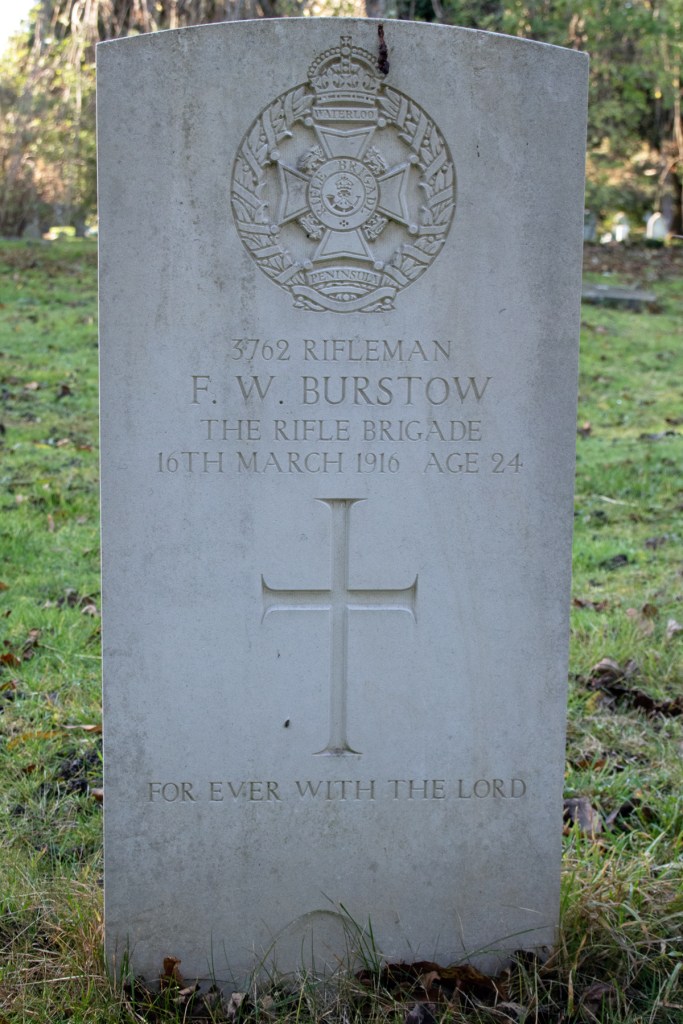
Rifleman Frederick Burstow

Rifleman Frederick Burstow

Frederick William Burstow was born in the summer of 1893, and was one of thirteen children. His parents were plasterer Alfred Burstow and his wife, Lydia. Both came from Sussex, and it was in Bexhill-on-Sea where they raised their family.

There is little documented about Frederick’s early life, but he sought a life outside of Sussex and, in around 1900, he enlisted in the 2nd Battalion of the Rifle Brigade, serving in India for a time.

Rifleman Burstow was still serving when, in August 1914, war was declared. His battalion was sent to France that November, and he ended up serving two terms on the Western Front.

In the summer of 1915, Frederick married Priscilla Epps. She was from Faversham, Kent, and this is where the couple set up home together.

It was while on his second term in France that Rifleman Burstow became ill. He had contracted enteric fever – also known as typhoid – and, at the beginning of 1916, he was sent home to recuperate. While here, Priscilla gave birth to a child, Alice.

Sadly, however, Frederick’s condition was to get the better of him: he passed away at home on 16th March 1916, at the age of just 24 years old.

Frederick William Burstow was laid to rest in the Borough Cemetery in his adopted home town of Faversham.


Rifleman Frederick Burstow
(from ancestry.co.uk)

Frederick was not the only Burstow family member to die during the war. His older brother, Arthur Edward James Burstow, fought on the Western Front with the 2nd Battalion of the London Regiment.

Private Burstow was caught up in the fighting in Arras in the spring of 1918, and was killed in action on 13th April. He was 38 years of age, and left behind a widow and six children.

Arthur Edward James Burstow is commemorated on the Ploegsteert Memorial in Belgium.


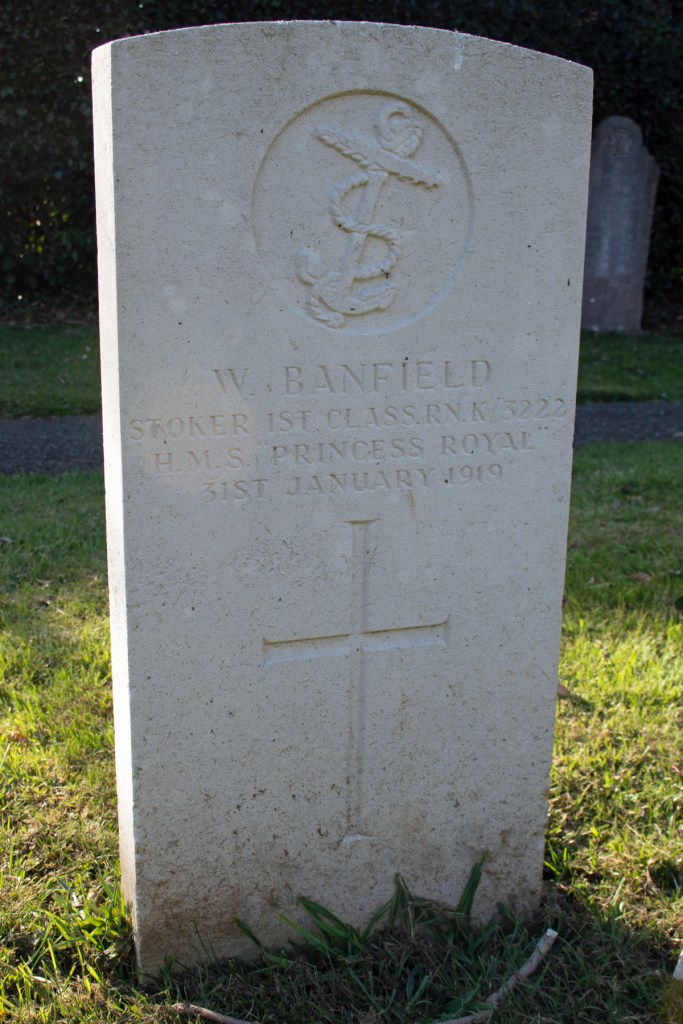
Stoker 1st Class William Banfield

Stoker 1st Class William Banfield

William Banfield was born on 7th November 1890, in Henfield, near Horsham, West Sussex. He was the second youngest of seven children to George and Ellen Benfield. George was a carpenter, and this was a trade his two sons – William and his older brother, George – were initially both to follow as well.

William had a longing for the sea, however, and, on 11th June 1909, he enlisted in the Royal Navy as a Stoker 2nd Class. His service records show that he was 5ft 7.5ins (1.71m) tall, had brown hair, blue eyes and a fair complexion.

Stoker Banfield was based out of HMS Victory, the Royal Naval Dockyard in Portsmouth, Hampshire, but, over the eventual decade of his service, he spent no more than seven months ashore. Instead, he served on a total of nine ships. This included the battleship HMS Exmouth where, during the eighteen months he spent on board, he was promoted to Stoker 1st Class, and also spent 14 days in the brig, for reasons undisclosed.

On 27th September 1915, William was assigned to HMS Princess Royal. He served aboard for nearly three and a half years, patrolling the North Sea, coming under fire during the Battle of Jutland, and providing support during the Second Battle of Heligoland Bight.

Towards the end of January, Stoker 1st Class Benfield fell ill, and was admitted to the Edinburgh City Hospital. Suffering from encephalitis, sadly the condition proved too much for his system to bear and he passed away at the hospital on 31st January 1919. He was 28 years of age.

William Banfield was brought back to Sussex for burial. He was laid to rest in the cemetery of his home town, Henfield.


William’s older brother, George, was also to fall victim to the First World War. He had enlisted in the Royal Navy three years before his younger sibling, and also served as a Stoker 2nd Class (subsequently being promoted to Stoker 1st Class in 1907).

George was also based out of HMS Victory, and, in April 1911, was stood down to the Royal Naval Reserve, having completed an initial five years’ service.

When war broke out, George was called back into service, and was assigned to HMS Good Hope, travelling from English shores to Nova Scotia, before heading to South America and into the Pacific.

Caught up in the Battle of Coronel on 1st November 1914, the Good Hope was sunk by the German cruiser SMS Scharnhost. All souls on board – all 926 of them – were lost; this included Stoker 1st Class George Banfield. He was only 27 years of age.


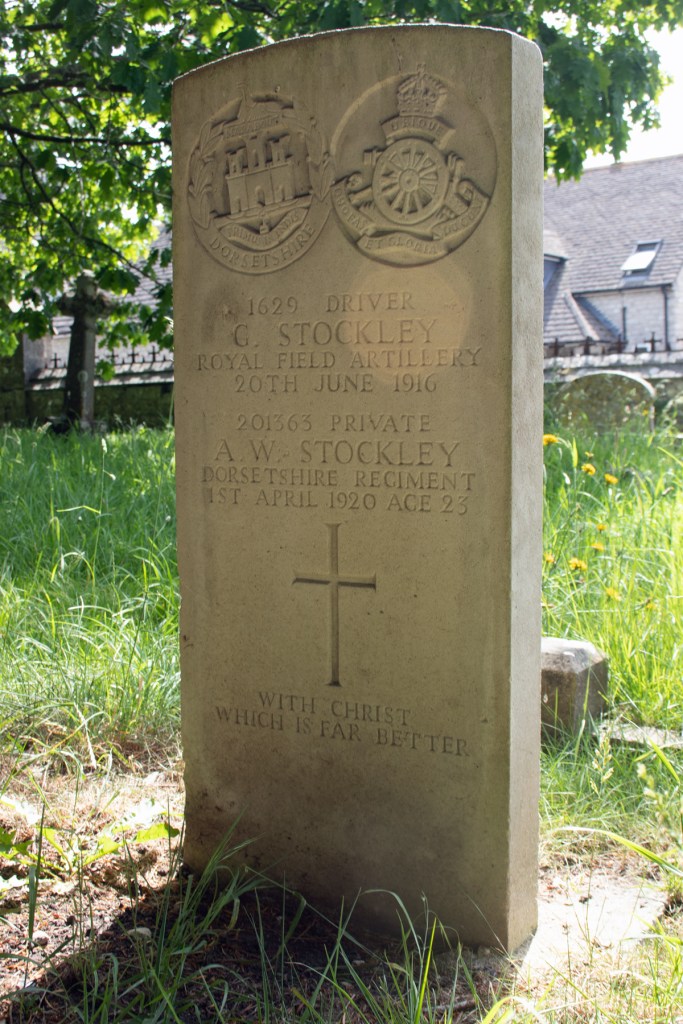
Private Albert Stockley

Private Albert Stockley

Albert William Stockley was born in the spring of 1897, the youngest of twelve children to Frank and Mary Ann Stockley. Frank was a clay cutter from Dorset, and he and his wife raised their family in the picturesque village of Corfe Castle.

Sadly, much of Albert’s life is lost to time. He would have been 17 years old when war broke out, so it seems likely that he would not have been in the first wave of men to enlist.

Albert joined the Dorsetshire Regiment and, as a Private, was assigned to the 1st/4th Battalion. His troop was based in India for the first part of the war, before moving to Mesopotamia in 1916. There is nothing to confirm, however, whether Private Stockley served abroad, or if he remained as part of a territorial force.

Private Stockley was demobbed on 22nd May 1919, and awarded the Victory and British Medals for his service. He returned to Dorset, but is it at this point that his trail goes cold.

All that is evident is that Albert William Stockley passed away on 1st April 1920, ages just 23 years old. was laid to rest in the Old Church Cemetery in his home town of Corfe Castle.


Albert shares his grave with his older sibling, George Stockley, who died in June 1916. The brothers are commemorated on the same headstone.


Driver George Stockley

Driver George Stockley

George Stockley was born in December 1888, one of twelve children to Frank and Mary Ann Stockley. Frank was a clay cutter from Dorset, and he and his wife raised their family in the picturesque village of Corfe Castle.

When he left school, George found work as a house painter but it seemed this was not to be a career. In March 1913, he married Lillian May Stockley, who had been born in Frome, Somerset, but who was working as a barmaid in nearby Weymouth. Later that year, the couple had a daughter, Georgina, and, by the time he enlisted two years later, George was working as a barman, and the young family were living in Bournemouth.

George had joined up on 10th February 1915, and was assigned to the 3rd/6th Hampshire Battery of the Royal Field Artillery. His service records show that he was 5ft 4ins (1.63m) tall, but they also confirm that, when he had his medical examination on 30th May, he was deemed as medically unfit for military service.

Sadly, there is no further information to confirm why Driver Stockley’s military career was cut so short. His trail goes for a year, until, on 20th June 1916, he passed away, aged just 27 years old. The cause of his passing is also lost to time

George Stockley was laid to rest in the Old Church Cemetery in his home town of Corfe Castle.


George shares his grave with his youngest sibling, Albert William Stockley, who died in April 1920. The brothers are commemorated on the same headstone.


Private Walter Chapman

Private Walter Chapman

Walter Stanley Chapman was born in the summer of 1897, the younger of two boys to William and Sarah (known as Annie) Chapman. William was a carter on a farm in North Cadbury, near Yeovil, Somerset, and this is where the young family grew up.

When he left school, Walter became apprenticed to a local carpenter, but war was on the horizon. His older brother Frederick was quick to enlist, joining the Royal Marine Light Infantry as a Private. He served on HMS Hood during the Battle of Jutland in the spring of 1916, and was killed during the fighting. He was buried at sea, and was just 23 years old when he died.

The loss of his brother may have spurred Walter into action. He enlisted as well, joining the 1/4th Battalion of the Somerset Light Infantry as a Private. Details of his service are limited, but his battalion served in Mesopotamia during the conflict, and it is likely that he spent some time in the region.

Private Chapman survived the war, and returned to Somerset on furlough, waiting to be demobbed. Sadly, he passed away during this time, breathing his last on 19th April 1919, at the age of just 21 years old. William and Annie had lost both of their sons because of the conflict.

Walter Stanley Chapman was laid to rest in the graveyard of St Michael’s Church in his home village of North Cadbury. His gravestone also commemorates the passing of his older brother.


Private Arthur Wellman

Private Arthur Wellman

Arthur Wellman was born in the spring of 1891 and was one of nine children. His parents – road builder Thomas and collar machinist Eliza – were both born in Somerset, and it was in Chard that they married and raised their family.

Arthur and his siblings found work in the local lace industry – the 1911 census recorded him living with his family in Chard, working as a lace hand, minding the machinery in the mill.

In the summer of 1915, Arthur married Daisy Jane Slade, the daughter of an agricultural labourer from North Curry, Somerset. They went on to have a daughter, Beryl, who was born in May 1916.

By May 1916, Arthur had seen two of his brothers serve and die in the war: Private Bert Wellman had been killed serving with the Somerset Light Infantry in Mesopotamia, while Gunner William Wellman died from tuberculosis having served with the Royal Field Artillery. Whether through a sense of duty or a sense of guilt, he put his name forward to play his part. Full details are not available, but he enlisted in the Somerset Light Infantry that autumn.

Private Wellman was assigned to the 4th (Reserve) Battalion, and was sent for training. Sadly, while in barracks, he contracted cerebrospinal meningitis; he died in hospital on 20th March 1917, at the age of just 25 years old.

Arthur Wellman’s body was brought back to Somerset for burial. He was laid to rest in Chard Cemetery, not far from his brother, William.


Gunner William Wellman

Gunner William Wellman

William Wellman was born in March 1890 and was one of nine children. His parents, road builder Thomas and collar machinist Eliza were both born in Somerset, and it was in Chard that they married and raised their family.

William and his siblings found work in the local lace industry – the 1911 census recorded most of the family in Chard, but William was boarding in Stapleford, Derbyshire, with his older brother Fred; both were working as lace hands.

War was coming to Europe, and, as a previous member of the territorial force of the Somerset Light Infantry, William was keen to play his part. In February 1915, he enlisted in the Royal Field Artillery: his records show that he was 5ft 7ins (1.69m) tall, had light brown hair, grey eyes and a slender build, weighing 129lbs (58.5kgs).

Gunner Wellman was sent to Wiltshire for training but, while in barracks, he fell ill. Having contracted tuberculosis of the kidney, he was admitted to a hospital in Sutton Veny. After two months’ treatment, his health did not improve sufficiently enough, and he was discharged from the army on medical grounds in February 1916.

William returned to Chard, but was not to get any better. He passed away at home on 1st April 1916; he was just 26 years old.

William Wellman was laid to rest in the cemetery of his home town, not far from his brother, Private Arthur Wellman.


William and Arthur were not the only two of the siblings to fight in the Great War.

Their youngest brother, Private Bert Wellman fought with the Somerset Light Infantry, and died in fighting in Mesopotamia on 22nd November 1915. He was just 20 years of age.