The personal life of Jack Hogan is a challenge to piece together, and much of the information is pulled from his service record. This confirms that he was born in 1890 in Cork, Ireland, and gives his next of kin as his mother, Annie Hogan, who was living in Southsea, Hampshire. He seems to have been born John Hogan, Jack being a common nickname, but there are too many census records with potential matches to narrow down a definite connection.
A Roman Catholic, Jack was 5ft 5.5ins (1.66m) tall. He had dark hair, brown eyes and a fresh complexion. He was also noted as having two small moles on his left cheek. He enlisted in the Royal Flying Corps as an Air Mechanic 2nd Class on 1st October 1915, leaving his job as a motor and cycle fitter to do so.
Jack seemed to have been proficient at what he was doing, and was promoted to Air Mechanic 1st Class less than a year after enlisting. On 5th February 1918 he rose again, taking the role of Acting Sergeant. When the Royal Air Force was formed in April that year, his rank was made permanent.
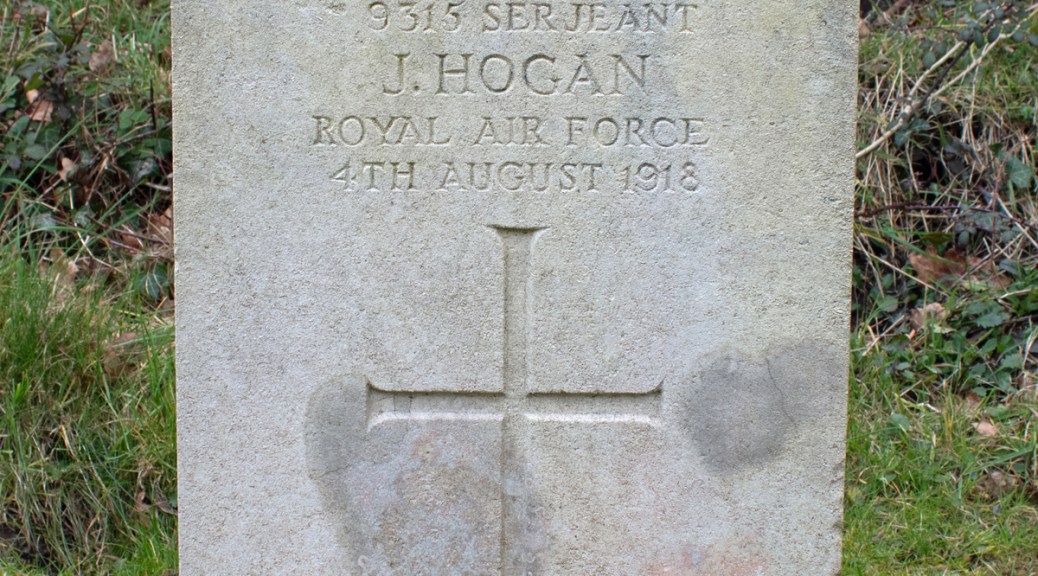
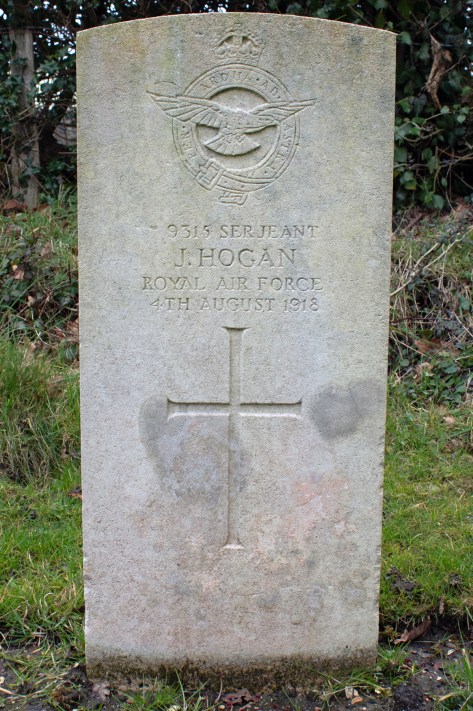
Sergeant Hogan was attached to the 29th Training Depot Station near East Boldre, Hampshire. On 4th August 1918, he was piloting an Avro 504, when it collided with another aircraft. There is little recorded about the incident, and his RAF Casualty Card does not give details of the other vehicle or its pilot. Jack’s biplane fell to the ground and he was killed. He was 28 years of age.
The body of Jack Hogan was laid to rest in the graveyard of St Paul’s Church in East Boldre, not far from the base that had become his home.
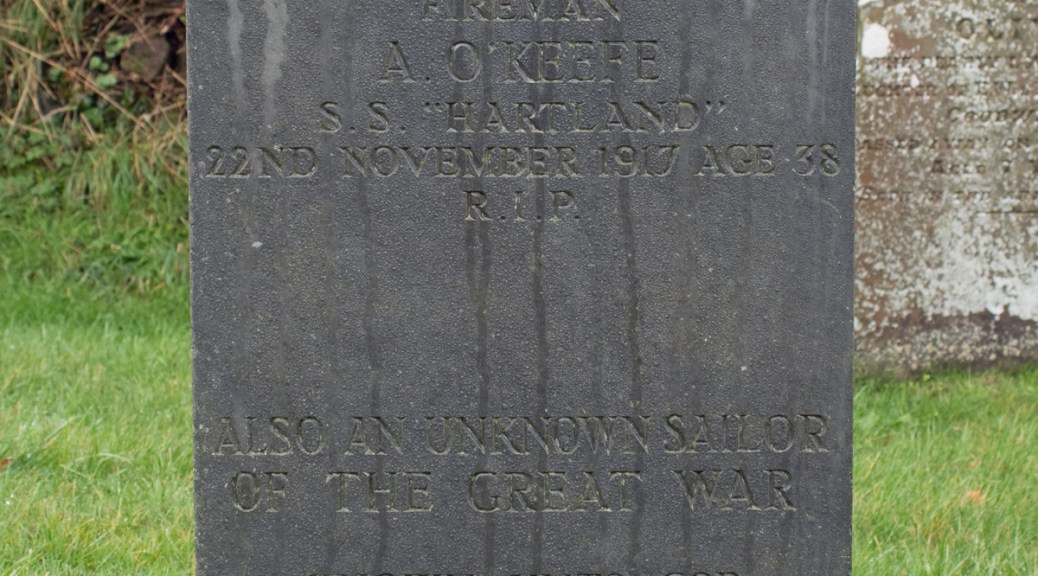
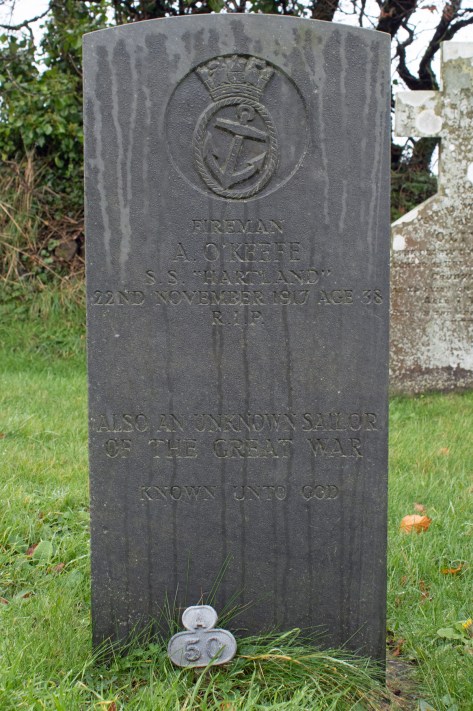
O’KEEFE Fireman Arthur. SS “Hartland.” 22nd Nov., 1917. Age 38. Son of John and Mary O’Keefe of Cork.
The search for information about Arthur O’Keefe has proved a challenging one. He does not appear with his parents on any census records, and there is precious little documentation about his life.
Arthur found work as a Fireman in the Mercantile Marine, and served on board at least four ships. In the autumn of 1917, he was based out of Glasgow, Scotland, and was attached to the SS Hartland. She had been requisitioned by the Admiralty, and was put to use transporting wheat from India.
On 22nd November the Hartland was travelling from Glasgow to Barry, South Wales, when she was hit by a torpedo from the submarine U-97, 21 miles south west of Bardsey Island. The ship was damaged, and two of the crew – Fireman O’Keefe and Fireman Thomas McGaw – were killed.
An American destroyer, the USS Conyngham, was at the head of the Hartland’s convoy, and managed to rescue the remaining 28 members of the crew, taking them to Holyhead. The Hartland was towed to Fishguard Harbour and refloated.
Arthur O’Keefe was 38 years of age when he was killed. He was laid to rest in Llanwnda Cemetery, not far from Fishguard, Pembrokeshire.
Arthur’s headstone notes that he was buried with an unknown sailor of the Great War. There is no indication who this might have been, but there are no records of his colleague Thomas McGaw being laid to rest. Given both men died in the same incident, and their bodies were transported to Fishguard with their ship, it seems possible that they may have been buried together.
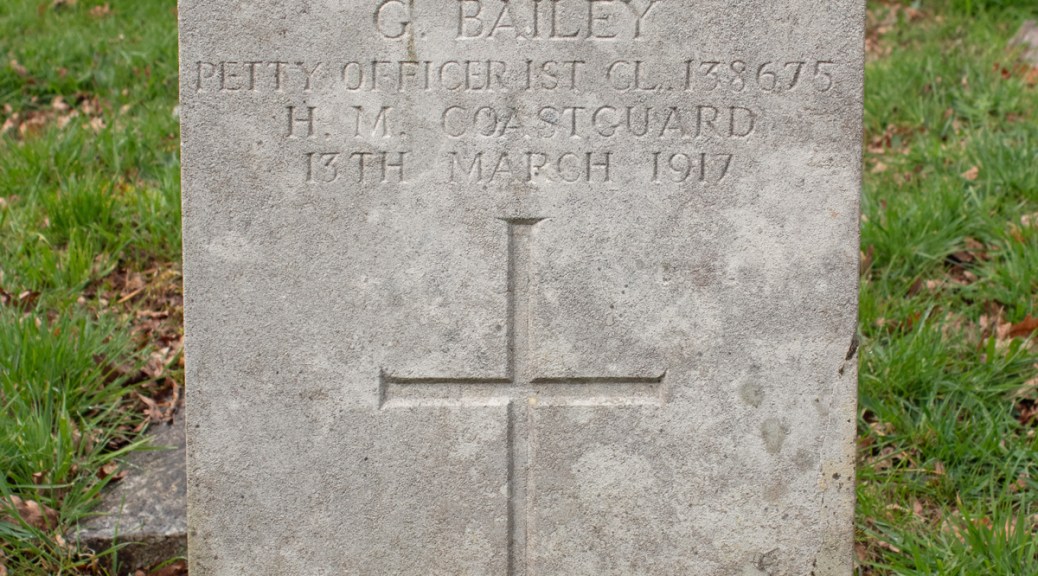
George Bailey was born in Bedminster, Somerset, on 20th August 1871. One of six children, his parents were George and Anna (or Hannah) Bailey. George Sr was a labourer and, when he died in 1876, Anna moved the family to Clifton, near Bristol.
The 1881 census found the family living in a small cottage at 5 Crosby Row in the then village. Hannah was listed as a late general labourer’s wife, while her three older children were all working for a dairy.
When George finished his schooling, he sought out a career. Joining the Royal Navy, this would prove a long-term role, bringing in a relatively decent wage for him and his family, but also gave him some adventure, not surprising given the number of ships he would have seen going to and fro from Bristol.
George was only 15 years old when he joined up on 25th September 1886, and so was below the age to formally enlist in the navy. Taken on with the rank of Boy 2nd Class, he was sent to HMS Impregnable, the training ship based in Devonport, Devon. Over the next three year he learnt his craft, and served on a few ships, including the battleship HMS Iron Duke.
In October 1887, George was promoted to Boy 1st Class and, on 20th August 1889, while assigned to the Iron Duke, he came of age, and was formally inducted into the Royal Navy. Ordinary Seaman Bailey’s service records show that he was 5ft 5.5ins (1.66m) tall, with auburn hair, blue eyes and a fresh complexion. He was also noted as having a spot tattooed between the finger and thumb of his left hand, a scar on his left leg and another in the centre of his back.
Over the next seven years, George served on a total of ten ships, and saw the world. In between voyages he returned to HMS Vivid, the Royal Naval Dockyard in Devonport. In 1895 he married Elizabeth Bull, from Burrington, Somerset, and the couple went on to have six children.
George’s naval career continued, and he rose through the ranks, to Able Seaman in September 1890, Leading Seaman in June 1895, and to Petty Officer 2nd Class and 1st Class the following year.
In January 1899, George’s life took a different direction. After some time training at HMS Collingwood in Hampshire, he joined the Coastguard service, and would spend the next twelve years serving on the coast of Southern Ireland. This opportunity allowed him to have his family with him, and his and Elizabeth’s four youngest children were born in County Clare and County Cork.
By 1911, the family returned to Britain, setting up home in Brixham, Devon. That year’s census found the Baileys living at 6 Coastguard Station on the waterfront. The family remained there through to October 1913, when George was transferred to the Royal Naval Reserve, having served for 26 years.
George found work as the caretaker of the Electric Theatre in Tiverton, Devon, and this is where he and Elizabeth settled down.
Petty Officer Bailey’s time out of active service was to be limited, however, as, just nine months later, war was declared. Called back into action, he was sent to Western Stack Fort in Milford Haven, Pembrokeshire.
An interesting personality has passed away in First-Class Petty Officer George Bailey, who died suddenly on Tuesday… He came home about a fortnight ago on sick leave, and seemed to be improving in health, and on Tuesday went out for a walk. After retiring to bed his death came suddenly as a result of heart failure.
[Crediton Gazette: Saturday 24th March 1917]
George Bailey died on 13th March 1917: he was 45 years of age. He was laid to rest in Tiverton Cemetery.
James Hurley was born in Timoleague, County Cork, Ireland, on 1st August 1894. His was not an uncommon name so full details of his early life are a challenge to unpick. However, later records confirm that his father was also called James Hurley, and when he finished his schooling, he found work as a farm labourer.
When war broke out in Europe, James Jr was quick to step up and play his part. He enlisted in the Royal Navy on 12th January 1915, and took the role of Stoker 2nd Class. His service records show that he was 5ft 5.5ins (1.66m) tall, with dark brown hair, grey eyes and a fresh complexion.
Stoker 2nd Class Hurley was sent to HMS Pembroke, the Royal Naval Dockyard in Chatham, Kent, for his training. However, his time there was to be tragically brief. He was admitted to the Welcome Hospital when he contracted pneumonia and empyema, but the condition was to prove too severe. He passed away on 6th February 1915, at the age of just 20 years old. He had been in the Royal Navy for just 25 days.
James Hurley’s parents were unable to bring him back to Ireland for burial. Instead, he was laid to rest in the Roman Catholic section of the Woodlands Cemetery in Gillingham, not far from the dockyard in which he had so briefly served.
Thomas Wood was born in Bristol, Gloucestershire, in the summer of 1862. The third of ten children, he was the oldest son to Thomas and Emma Wood. Thomas Sr was a cabinet maker, but his son was not to follow in his father’s footsteps, seeking a life of adventure instead.
Thomas enlisted in the army and, while documents relating to his early life are not readily available, the 1891 census recorded him as being billeted at the Cambridge Barracks in Portsmouth, Hampshire. A member of the Royal Artillery, he seems to have been enlisted for a while, as he had risen to the rank of Corporal.
In 1894, Thomas married Leah Barrett, who was born in Oxfordshire. The army life underscored where the family would settle. They had four children and, according to their ages, the Woods were in Liverpool by 1895, Gosport, Hampshire, in 1896 and Cork in Ireland by 1899. The 1901 census found the family living in Wicklow, with Thomas having now achieved the rank of Company Sergeant Major.
Ten years later, and Thomas had stepped away from the army life. Now 48 years of age, he and Leah had been married for 17 years. The couple had settled in the Worle, on the outskirts of Weston-super-Mare, Somerset, where Thomas had set himself up as a butcher, with Leah assisting him.
War came to Europe in 1914, and it seems that Thomas felt drawn to play his part once more. He joined the Royal Defence Corps as a Serjeant when it was formed in the spring of 1916, and was assigned to the regiment’s 263rd Company.
Little information is available about Serjeant Wood’s army service, but by the autumn he had been admitted to the Shell Shock Hospital (now the Maudsley Hospital) in Denmark Hill, London. His entry to the hospital, however, was actually due to kidney disease, and this was what would claim his life. Thomas died from a combination of nephritis and uraemia on 21st November 1916. He was 54 years of age.
Thomas Wood was brought back to Somerset for burial. He was laid to rest in the graveyard of St Martin’s Church in Worle.
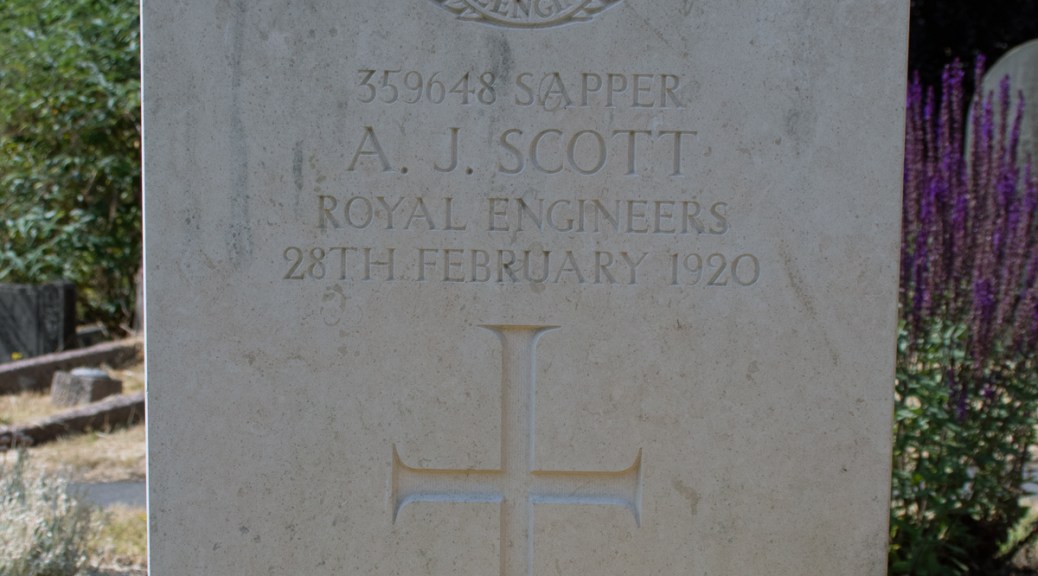
Abraham James Scott was born in Bathford, Somerset, in the spring of 1893. He was one of fourteen children to Abraham and Lucy Scott, and became known as James, to avoid any confusion with his father. Abraham was a shepherd, who travelled where work took him: both he and Lucy were from Wiltshire, but had moved to Somerset by the end of the 1880s. When James was just a babe-in-arms, the family had relocated to Gloucestershire, but by the time of the 1901 census, they were back in Wiltshire once more.
Abraham Sr died in 1910, at the age of just 41 years old. The following year’s census found the now widowed Lucy living in North Wraxhall, Wiltshire, with eight of her children. Abraham Jr is absent, and, indeed, does not appear on any of the 1911 censuses.
Lucy needed options and, on Christmas Day 1912, she married carter William Amblin in the village church. Abraham was, by this time, living in Bath and working as a carter.
When war came to Europe, Abraham felt the need to step up and play his part and, on 15th December 1915, he enlisted in the army. His service records show that he was 5ft 5ins (1.65m) tall and weighed 132lbs (59.9kg). He had a vaccination mark on his left arm which, according to the document’s section on ‘distinctive marks’, has a tendency to rupture.
Private Scott was mobilised in March 1916, and was assigned to the 1st/5th Gloucestershire Regiment. He soon found himself on the Western Front, and, having transferred to the 1st/4th Battalion, served at the Somme.
Abraham was in for a chequered time in Northern France. On 26th August 1916, he was injured when he received a gunshot wound to his scalp. He was admitted to the 1st Canadian General Hospital in Etaples, the moved to Rouen to recuperate. Private Scott rejoined his unit on 21st October 1916.
Just weeks later, however, Abraham was back in a hospital in Rouen, having fractured his ankle. After a couple of weeks in the 1st Australian General Hospital, the injury was deemed severe enough for him to be evacuated back to Britain for recuperation, and he was posted to Ballyvonare Camp in County Cork. Abraham returned to his unit in France in September 1917, nine months after his ankle injury.
On 1st March 1918, Abraham transferred to the Royal Engineers where, as a Sapper, he was attached to the Depot in Rouen. He remained there for more than a year, during which time he was admitted to hospital once more, this time with trench fever. Little additional information is available about this spell in hospital, other than that Lucy had written to the regiment thanking them for informing her of her son’s illness, and confirming a new address for her.
Sapper Scott’s health continued to suffer, however. In May 1919, he was admitted to a camp hospital, suffering from appendicitis. He was operated on, and medically evacuated to Britain for further treatment and recuperation. Abraham was admitted to the Bath War Hospital on 25th July 1919, and remained there for four months.
Abraham’s health seemed to improve, albeit slowly, and he was moved to the Pension’s Hospital in Bath on 27th November. The head wound, broken ankle and bout of trench fever appear to have taken their toll on his body which, by this point, seems to have been too weak to recover. On 28th February 1920, two months after being transferred to the Pension’s Hospital, he passed away there from a combination of appendicitis and pelvic cellulitis. He was just 26 years of age.
Abraham James Scott’s body did not have to travel far after this point. He was laid to rest in the sprawling Locksbrook Cemetery in his adopted home city of Bath.




 Death and Service