Tag Archives: Driver

Driver Frederick Virgin

Driver Frederick Virgin

Frederick Henry Virgin was born in 1888, the second eldest of ten children. His parents were carter Thomas Virgin and his wife, Ellen, and the family lived in Taunton, Somerset.

Frederick craved adventure and this came in the form of military service. In August 1906, he enlisted in the Royal Field Artillery, and was assigned as a driver. Initially serving at home, he was shipped to India for four years, returning to England in December 1912.

Driver Virgin met and married Alice Shattock in April 1914, but had been shipped off to France within months, when war broke out. He served overseas for eighteen months, before transferring back to England again. By this point he was suffering with sciatica, and this is what saw him assigned lighter duties in the Reserve Brigade on the home front.

Alice fell pregnant, and the couple had a little boy in February 1917; sadly, his life was brief, and he passed away at the age of just two days. One can only imagine the impact this had on his parents.

Frederick’s health issues continued to be a problem, and he was medically discharged from the army later that year. While the sciatica was not solely attributed to his military service, his discharge report confirmed that his time in the army contributed to the issue. Driver Virgin’s time with the Royal Field Artillery came to an end in December 1917.

Sadly, it is at this point that Frederick’s trail goes cold. His records confirm that he passed away nearly a year later, on 26th November 1918, but there is no record as to the cause of his death. He was 30 years of age.

Frederick Henry Virgin lies at rest in St Mary’s Cemetery in his home town of Taunton, Somerset.


Driver Ernest Smith

Driver Ernest Smith

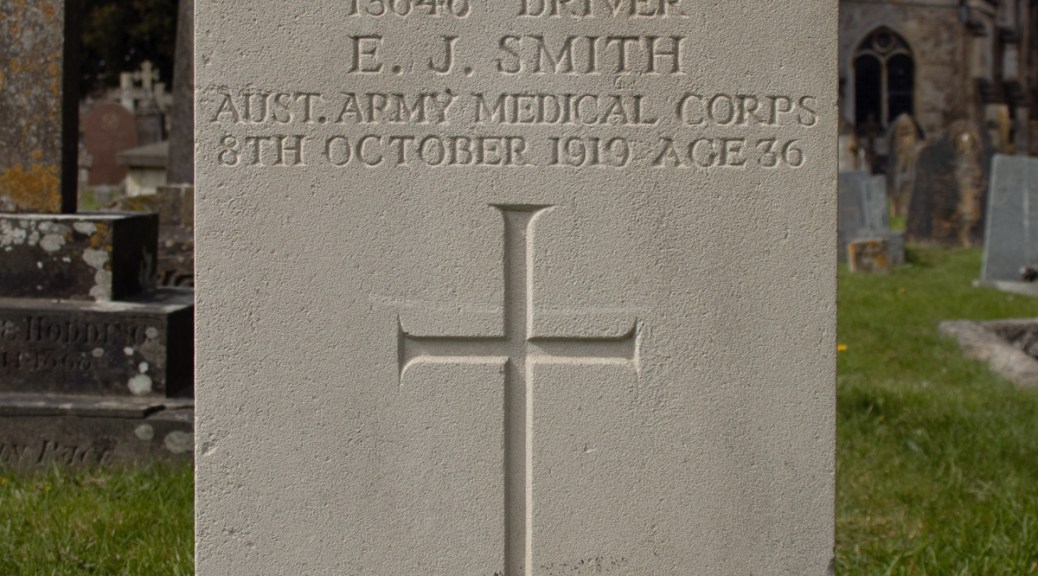
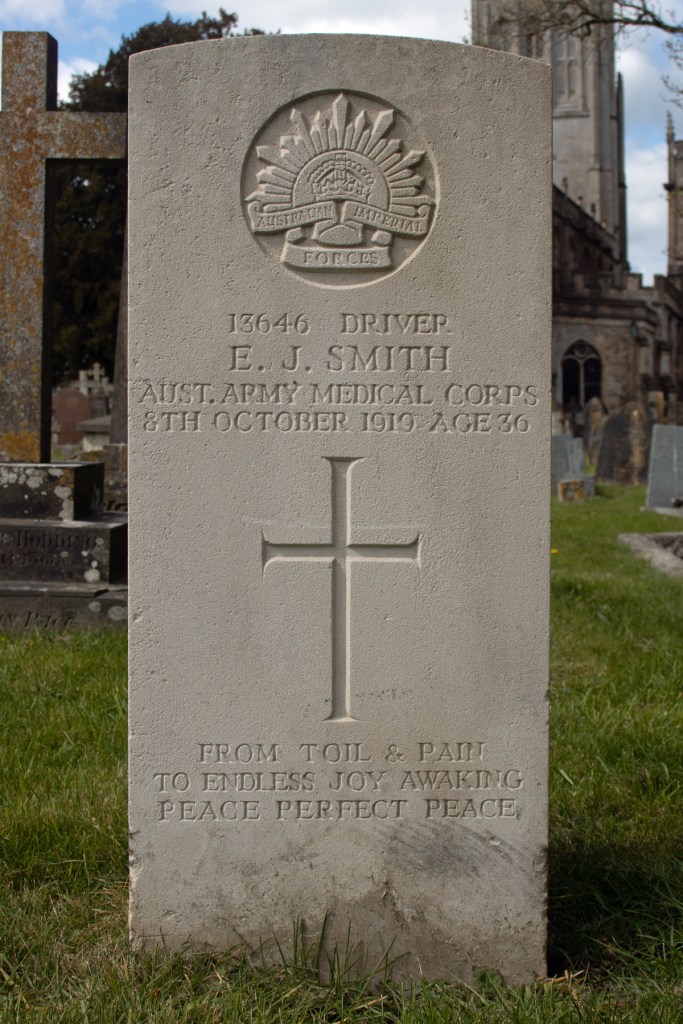
Ernest John Smith was born in 1883, one of seven children to John Smith and his wife Sarah Jane. John was a coal merchant, and the family lived in the Somerset town of Bruton. When Ernest initially left school, he worked as a farm labourer, but at some point, a sense of adventure caught him, and he emigrated to Australia. Sadly, details of his travels are not available, but he left England at some point before 1915.

When war broke out, however, he was still keen to do his bit. He was living in Queensland when he enlisted on 26th October 1915, and was assigned to the Australian Army Medical Corps.

Driver Smith’s battalion left Australia for Europe in March 1916, and served in France for the duration. He was dogged by ill health, catching pleurisy a couple of times, and had a number of fibromas operated on.

In October 1918, he was appointed Lance Corporal, but was shipped back to England later that year with ongoing fibroma issues. He was admitted to Torquay Hospital as dangerously ill in December of that year, and spent most of the next nine months in hospital, initially in Torquay, but then when he was able to be moved, he was transferred to the 1st Australian General Hospital near Warminster.

Sadly, the cysts Driver Smith has developing were malignant, and he passed away on 8th October 1919. He was just 36 years old.

Ernest John Smith was brought back to his home town for burial, and lies at rest in the graveyard of St Mary’s Church in Bruton.


Driver Ernest Wood

Driver Ernest Wood

Ernest James Wood was born in 1891, one of ten children to Alfred and Charlotte Wood. Alfred was a carpenter and machinist for a timber merchant, and, by the time of Ernest’s birth the family lived in Bridgwater, Somerset.

When hostilities broke out, Ernest was quick to enlist. He joined the Royal Army Service Corps in September 1914. Driver Wood was assigned to the Horse Transport Depot Company at Park Royal in London, and there is a note of him being injured on 29th July 1916. Sadly, little else of his military service remains.

In January 1916, Ernest married Hilda Williams. She was the same age as her new husband, and was the daughter of Thomas and Elizabeth, who were also from Bridgwater.

The trail of Driver Wood goes a little cold after that. He was demobbed om 6th January 1919 and on the release form declared that he was not medically unfit as a result of his military service.

Frustratingly, the trail goes totally cold at that point. All we know for certain is that Ernest died on 2nd March 1919, two months after leaving the army. There a no records confirming a cause of death but, as he does not appear in any contemporary newspapers, it is likely that the cause was not unusual; perhaps one of the respiratory conditions going around at the time, such as influenza or pneumonia. Whatever the cause, Ernest was just 28 years old when he died (his headstone is based on an incorrect date of birth).

Ernest James Wood lies at peace in the St John’s Cemetery in his home town of Bridgwater, in Somerset.


Driver Stanley Pearce

Driver Stanley Pearce

Stanley Arthur Robert Pearce was born in September 1895, the fourth of five children to Edwin and Rosetta Pearce from Bridgwater, Somerset. Edwin was a painter and sign-writer, and it was in the creative trades that his children followed.

Stanley’s eldest brother Clifford became a gardener; his next oldest Edwin Jr was a mason’s labourer; while his older sister Dorothy became a cardboard box maker. By the time of the 1911 census, when Stanley was 16, he was listed as a painter’s errand boy, presumably helping out his father.

War was on the horizon, and Stanley was keen to do his bit. In October 1914, he enlisted, becoming a Driver in the Royal Army Service Corps. Assigned to the 662nd Heavy Transport Company, he was based in London. There was still time for visits home, however, and the local Bridgwater newspaper reported on an ASC football match in which Driver Pearce was involved in October 1915.

By this time, Stanley had met Flossie Vickery, from nearby North Petherton. The couple married the following year, and had two children, Ada and Geoffrey.

In 1916, Driver Pearce’s battalion was shipped off to Salonica in Greece, as part of the British Expeditionary Force in the Balkans. While there, he contracted malaria and dysentery, and was evacuated back to England for treatment in September 1918.

Driver Pearce recovered well enough to enjoy a month’s recuperation, but fell ill again, with a recurrence of malaria, combined with influenza and pneumonia. He was admitted to the Brook War Hospital in South East London, but sadly not recover, and passed away on 10th November 1918, a day before the Armistice was signed. He was just 23 years old.

Stanley Arthur Robert Pearce lies at rest in the Wembdon Road Cemetery in his home town of Bridgwater.


Stanley’s older sister Dorothy – the cardboard box maker – contracted influenza around the same time as her brother and, tragically, died just five days after him. The siblings were buried in a joint funeral at the cemetery.


Driver Thomas Humphries

Driver Thomas Humphries

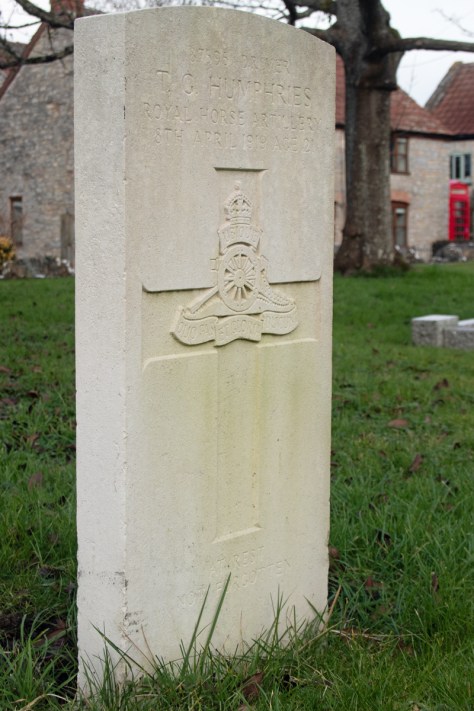
Thomas George Edward Humphries was born in November 1897, one of six children to George and Annie Humphries, from North Wootton in Somerset. George was a farm labourer, and had been married to his wife for 19 years before her untimely death in at the age of 40.

When war came, Thomas was just 16 years old. He enlisted quickly, though, joining the Royal Horse Artillery as early as the summer of 1915. Driver Humphries joined the 120 Brigade of the Royal Field Artillery, which was one of the many Howitzer brigades moving the large long-barrelled field guns along the front line.

Given the high use of horses during the way, and that Thomas was a Driver, it is likely that his role would have been guiding the animals in his care – this may also account for why his gravestone gives his troop as the Royal Horse Artillery.

Little remains of Thomas’ service records; he was awarded the Victory and British Medals and well as the 1915 Star, so would have been in the thick of the fighting and seen action on the Western Front.

When it comes to his passing, again details are scant. His pension records simply state that he died of ‘disease’, and he passed in the military hospital in Southwark, South London. Again, given when he died and the lack of any contemporary media report on his passing, it seems likely that the cause was a lung condition – influenza, pneumonia or tuberculosis – but that is a presumption on my part,

Whatever the cause, Driver Humphries died on 8th April 1919, aged just 21 years old.

Thomas George Edward Humphries lies at rest in the quiet graveyard of St Peter’s Church in his home village of North Wootton.


Driver Sidney Hoskins

Driver Sidney Hoskins

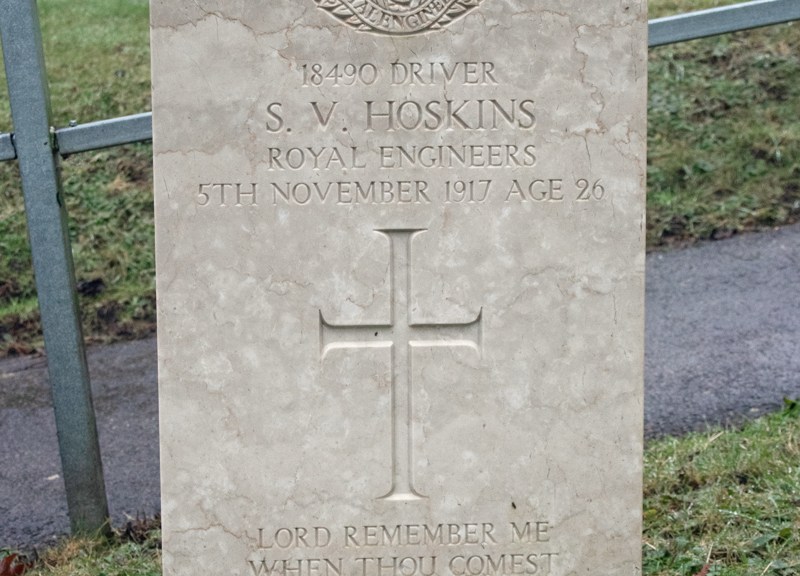
Sidney Victor Hoskins was born in February 1892, one of eleven children to Sidney and Elizabeth Hoskins from Shepton Mallet in Somerset. Sidney Sr worked as a quarryman and labourer in local factories.

Sidney was keen to make a life for himself, enlisting in the army in 1909. He served two years as a driver for the Royal Engineers, before being put on the reserve list. By the time of the 1911 census, he was listed as a packer on the railway. In November of that year, Sidney married Ada Lambert, also of Shepton Mallet.

While working on the line in April 1913, Sidney had an accident, suffering a fractured skull. He wasn’t able to carry out any hard labour form that point.

War broke out and Sidney was remobilised; just a month after Ada gave birth to their one and only child, a daughter they named Ada.

New baby notwithstanding, Driver Hoskins was shipped to France as part of the British Expeditionary Force. After two months he was sent down the line after suffering a fit, and was subsequently treated for pleurisy in Nantes. In November 1914, he returned to England and was ultimately discharged on medical grounds in February 1915.

During his time in France, he had also developed tuberculosis, and eventually spent three months in a sanitorium in Taunton, Somerset, to recover.

The condition continued to haunt Sidney, however, and he succumbed to the illness on 5th November 1917. He was 25 years of age.

Sidney Victor Hoskins lies at rest in the cemetery of his home town of Shepton Mallet.


Sidney’s younger brother, William Napier Hoskins, was also involved in the Great War. He had enlisted in the Somerset Light Infantry, and was based in India. Injured in fighting in the Persian Gulf, he was invalided back to India to recover. He was well enough to return to the fray, and was shipped to Mesopotamia, where he was injured again. He died of his wounds in Kut-al Amarah, Iraq, in 1915, aged just 20 years old.

The boys’ older brother Charles had also died in 1895, aged just six years old. While Sidney Sr and Elizabeth had had a family of eight girls, they were to outlive all three of their sons.


Sergeant Joseph Wilkinson

Sergeant Joseph Wilkinson

Joseph Wilkinson was born in the village of Greystoke, Cumbria in the summer of 1888. His parents were John and Margaret Wilkinson, and he had two siblings, also called John and Margaret. Joseph’s father worked as a railway signalman, and the industry employed a large number of people in the village.

Joseph’s life was to take a different turn, however, and it was likely the railway that took him there. He next appears on the 1911 census, boarding in a house in the village of Wedmore in Somerset. At 23 years old, he is listed as a Solicitor’s Cashier.

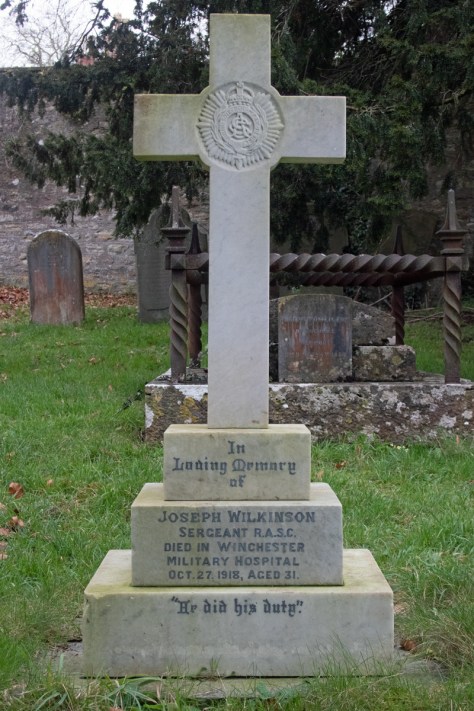
As with so many other fallen men and women, Joseph’s trail goes cold. There is not enough evidence to detail his military career – he joined the Royal Army Service Corps as a Driver and was promoted to Sergeant.

The UK Army Register of Soldiers’ Effects show that he was married to a woman called Ethel, although there are no records of their wedding. The document also confirms that he died at the Union Hospital in Winchester, Hampshire on 17th October 1918, but there is no cause of death given. He was 31 years old.

“He did his duty” says his impressive gravestone, but it is tragic that that duty is lost to time.

Sergeant Joseph Wilkinson lies at rest in the churchyard of St Mary’s in Wedmore, the Somerset village that came to be his home.


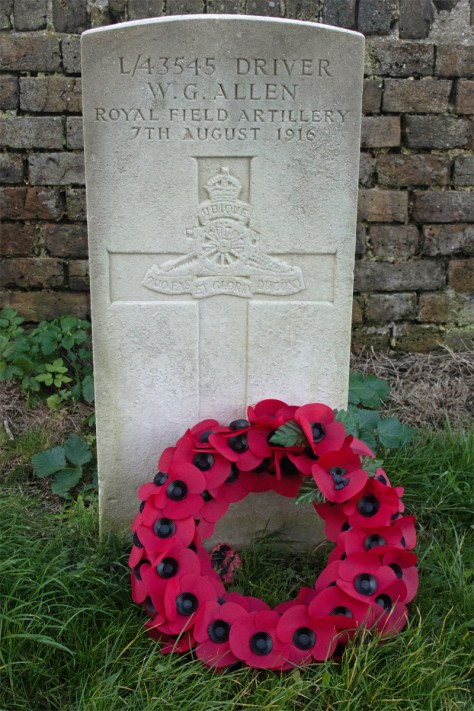
Driver William Allen

Driver William Allen

There are some times where no amount of research on a person will reveal their information.

William George Allen is one such person.


The only details I have been able to uncover for this man is his gravestone and the Army Register of Soldier’s Effects.

William Allen was a driver for the Royal Field Artillery. His troop – the 156th Camberwell Brigade – was raised in South London in early 1915, although I have no record of when Driver Allen enlisted.

At some point, the 156th Brigade were stationed at Port Victoria – the fort on the Isle of Grain in Kent.

It was during their time at the fort that William died. He passed on 7th August 1916 and there is no cause of death recorded, and he does not appear in any contemporary newspapers. This might suggest that his death was not out of the ordinary or unexpected.

Unusually for the Register of Soldier’s Effects, nobody is listed for the war gratuity payments to be made (this would normally be a next of kin – father, mother or spouse). In total a payment of £6 19s 2d was paid out, not an extravagant amount for that regiment.

So Driver Allen remains a mystery. A (presumably) young life lost too soon, and lost to time.

William George Allen lies at peace in the graveyard of St James’ Church in Grain, North Kent, metres from the fort in which he passed.


Driver Walter Colchin

Driver Walter Colchin

Walter George Colchin was born in 1884 in Borden, Kent. His parents, Herbert and Frances, moved the family – three sons, including Walter, and a daughter – to the village of Iwade, where they ran the Woolpack Inn.

There isn’t a great deal of information about Walter’s life. He married Bertha Sparks from the neighbouring village of Milton in 1916.

Walter joined the war effort at some point after that – I have been unable to find an exact date – and enlisted in the Royal Army Service Corps, before transferring to the Agricultural Company Labour Corps.

Private Colchin was on active service in Steyning, West Sussex, when the war came to a close. On 23rd December 1918, he suffered a cerebral haemorrhage and died. He was 34 years old.

Walter Colchin is buried in the graveyard of All Saints Church in his home village of Iwade.

Driver Harry Austin

Driver Harry Austin

Harry Austin was born in the small Kent village of Bobbing in 1890. One of nine children to Richard and Emma Austin, his father was the village blacksmith, a trade two of his brothers followed after leaving school. Harry, however, became a general labourer in the coal industry.

Sadly, most of Harry’s wartime service is lost to time; we know that he enlisted in the Royal Field Artillery and served as a driver. The RFA was responsible for the medium-calibre guns and howitzers deployed close to the front line; Harry’s role, therefore, was likely to have involved driving the horses to and from the sites where the guns were needed.

Again, Driver Austin’s military records are somewhat lacking when it comes to his passing. However, where they mark him as ‘dead from disease’, a contemporary newspaper in memoriam gives a little more detail.

In ever loving memory of Driver Harry Austin, RFA… who passed away November 10th 1918, in the 1st Southern General Hospital, Birmingham, from influenza following Gun Shot wounds, aged 29 years.

East Kent Gazette – Saturday 23rd November 1918.

An untimely death for Harry, but particularly poignant, given that he passed the day before the Armistice was signed.

Driver Harry Austin lies at peace in the graveyard of St Bartholomew’s Church in his home village of Bobbing, Kent.