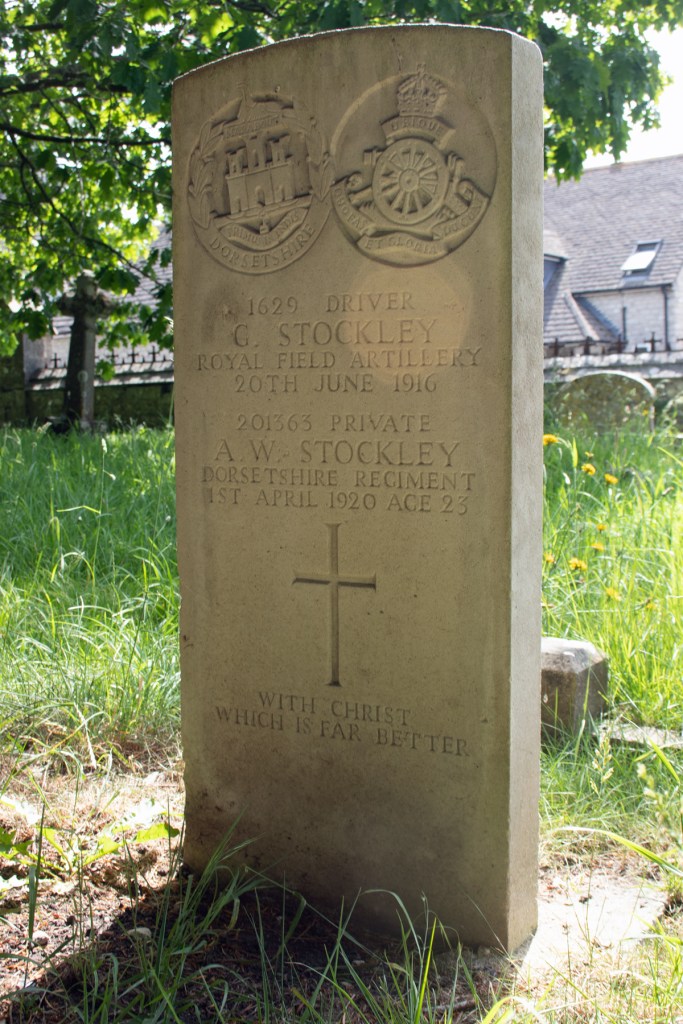
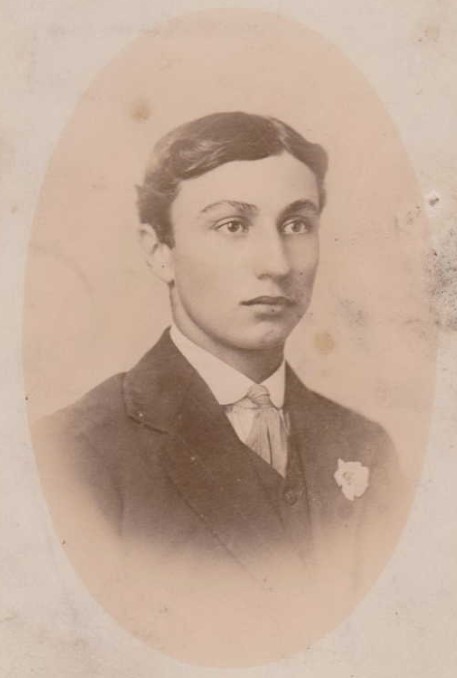
George Stockley was born in December 1888, one of twelve children to Frank and Mary Ann Stockley. Frank was a clay cutter from Dorset, and he and his wife raised their family in the picturesque village of Corfe Castle.
When he left school, George found work as a house painter but it seemed this was not to be a career. In March 1913, he married Lillian May Stockley, who had been born in Frome, Somerset, but who was working as a barmaid in nearby Weymouth. Later that year, the couple had a daughter, Georgina, and, by the time he enlisted two years later, George was working as a barman, and the young family were living in Bournemouth.
George had joined up on 10th February 1915, and was assigned to the 3rd/6th Hampshire Battery of the Royal Field Artillery. His service records show that he was 5ft 4ins (1.63m) tall, but they also confirm that, when he had his medical examination on 30th May, he was deemed as medically unfit for military service.
Sadly, there is no further information to confirm why Driver Stockley’s military career was cut so short. His trail goes for a year, until, on 20th June 1916, he passed away, aged just 27 years old. The cause of his passing is also lost to time
George Stockley was laid to rest in the Old Church Cemetery in his home town of Corfe Castle.
George shares his grave with his youngest sibling, Albert William Stockley, who died in April 1920. The brothers are commemorated on the same headstone.
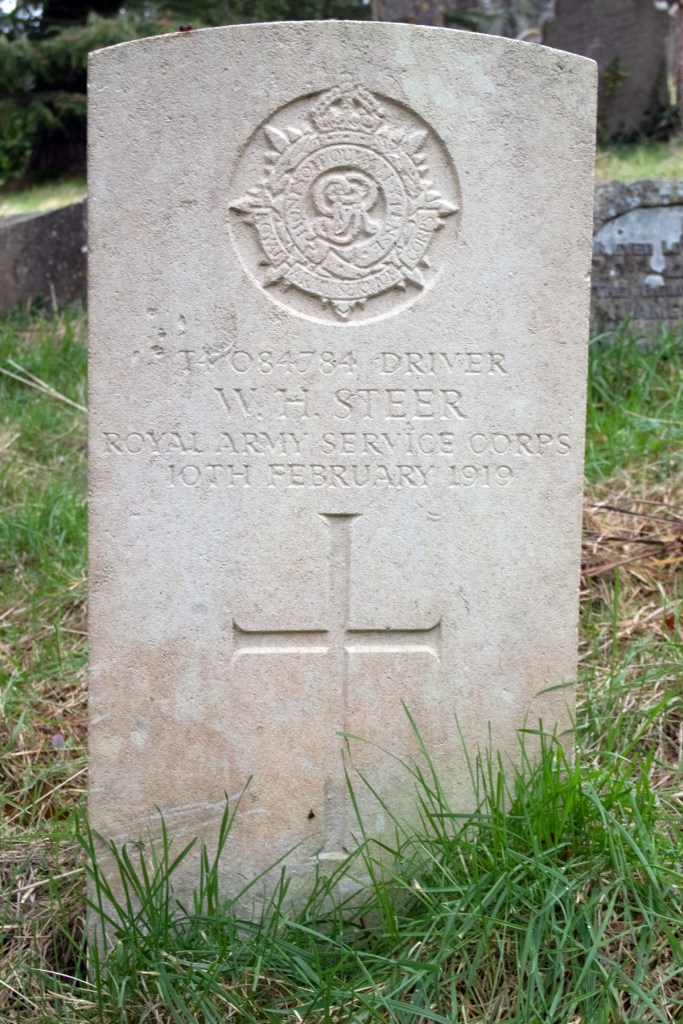
The life of WH Steer is destined to remain lost to time. Details of his first names and date of birth are not obtainable and, other than the fact that his father was called Thomas, there is no other information about his family.
He had enlisted as a Driver in the Army Service Corps by August 1918, but there is no record as to where he served or for how long he did so. All that can be confirmed is that he was based in Warwick after the conflict ended, and this is where died, of causes unknown, on 10th February 1919.
WH Steer was brought to Devon for burial – presumably this is where Thomas and the rest of his family lived – and he was laid to rest in the graveyard of St Mary’s Church in Wolborough, near Newton Abbot.
Lionel Shearn was born in April 1895, one of twelve children to, and the youngest son of, Joseph and Emily Shearn. There were two main industries in Paulton, Somerset, where the Shearn family lived, and, over time, Joseph was employed in both. He began in the boot-making industry – this was his trade when Lionel was born – but, by the time of the 1911 census, he had found work as a coal miner. Lionel, who was sixteen by the time of that document, was also working at the colliery as a carter.
War came to Europe in the summer of 1914, and Lionel was one of the first in the town to enlist. Little documentation remains about his military service, but he joined the Royal Field Artillery as a Driver and, by October was in Portsmouth, Hampshire.
Sadly, this is all the service information that’s available, as Driver Shearn passed away in the General Hospital in Southsea, Hampshire on 27th October 1914. His death certificate, which was submitted by his brother, Gilbert, gives a cause of death as otitis media (an infection of the middle ear) and meningitis. He was just 19 years of age.
Lionel Shearn was brought back to Somerset for burial. He was laid to rest in the picturesque Paulton Cemetery.
Edmund George Durnford was born in the spring of 1881 in the Somerset village of Pitcombe. The second oldest of twelve children, he was the oldest son to Edmund and Eliza Durnford. Edmund Sr was an agricultural labourer who travelled with the work – the 1891 census recorded the family living in Mells, near Frome.
When Edmund Jr left school, he found work at an ironmonger’s. He moved to Midsomer Norton and, in 1907, he married local carter’s daughter Bessie Welch. The young couple set up home in a terraced house on the road to nearby Radstock, and went on to have two children: Ian, who was born in 1908, and Ronald, born the following year.
War came to Europe, and Edmund was keen to play his part. He enlisted in the Royal Army Service Corps as a Driver, and was assigned to the 827th Company. Full details of his service are not available, but he remained a part of the territorial force and was promoted to Lance Corporal.
The local newspaper of the time reported on what became of Edmund:
Lance Corporal Edward [sic] G Durnford, Army Service Corps… son of Mr and Mrs EG Durnford… died suddenly on April 18 at Duston Hospital, Northampton, from shell shock and hemorrhage [sic] of the brain, was 38 years of age. The body was brought back from Northampton, and the deceased accorded a military funeral at Midsomer Norton last week.
Somerset Guardian and Radstock Observer: Friday 3rd May 1918
There are a couple of inconsistencies with the report. The newspaper has Edmund’s name wrong, while his pension record does not mention shell shock as the cause of death (it confirms the cerebral haemorrhage, but also cites a granular kidney). Given that Lance Corporal Durnford did not serve abroad, it seems unlikely that shell shock was a contributing factor.
The same article also places three of Edmund’s brothers in the war, and gives an insight into what had become of them before the conflict. Gunner Percy Durnford was with the Canadian Field Artillery, training in the South of England; Sergeant Major Arthur Durnford, of the Australian Light Horse, was based in Sydney; Bombardier Horace Durnford, of the Royal Garrison Artillery, had served in France, where he had been gassed, but was, at the time of his oldest brother’s death, based in Egypt.
Edmund George Durnford died in Northampton on 18th April 1918. He was 38 years of age. His body was brought back to Somerset, and he was laid to rest in the graveyard of St John the Baptist Church in Midsomer Norton.
Edmund’s younger son, Ronald, served in the Second World War. He joined the Royal Artillery, reaching the rank of Lance Bombardier. Ronald was serving in the Far East early in 1942, and for the next year, no news was heard of him.
However, contact was made in March 1943, confirming that Ronald had been captured by the Japanese, and was a prisoner of war in Borneo. Three months later, his wife, Kathleen, received a postcard from him, confirming he was a prisoner of war, well and unwounded.
Tragic news was quick to follow, however:
In last week’s issue it was stated that Mrs [Bessie] Durnford… had received through her daughter-in-law news that her son, Lance Bombardier Ronald Durnford, was a prisoner of war in Jap hands and was unwounded.
On Saturday she received the sorrowful news that he was dead in the following messages, which her daughter-in-law had sent on:
“I deeply regret to inform you a report has been received from the War Office, that [Ronald], who was reported a prisoner of war in Borneo Camp, had died from dysentery. The date of his death is not yet known, but you may rest assured as soon as any further information is received, I will immediately let you know.”
Somerset Guardian and Radstock Observer: Friday 30th July 1943
Lance Bombardier Durnford was laid to rest in the Labuan War Cemetery in Malaysia.
Further family tragedy, albeit with a life well-lived, was to follow as, on 6th September 1943, Bessie too died at the age of 86. She was laid to rest alongside Edmund in the family plot. Her obituary confirmed that “She leave a husband, seven daughters, and four sons to mourn her loss. One son and one daughter are in Canada, and one son in Australia, and one daughter and son in London.” [Somerset Guardian and Radstock Observer, Friday 17th September 1943]
Bessie had not, in fact, remarried: the husband was, in fact, the one who had died some 25 years before.
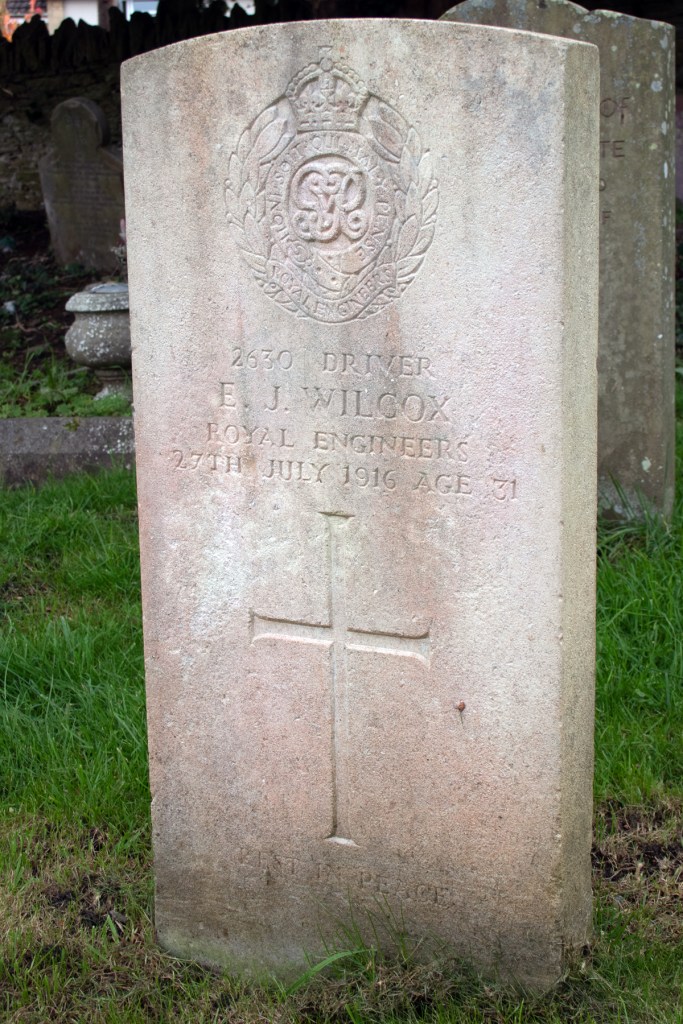
Edgar James Wilcox was born in Frome, Somerset, on 2nd February 1885, and was the third of six children to Robert and Louisa Wilcox. Robert was a coal dealer and he and Louisa raised their family in the town of their own birth.
When he left school, Edgar found work on a local farm, tending to, and milking the cows. He met a woman called Ellen Snelgrove and, on 31st October 1908, the couple married at the parish church in Ellen’s home village of Corsley, just over the border in Wiltshire.
By the time of their wedding, Edgar had found employment as a carman for the local railways. The young couple set up home in Frome, and went on to have four children, Edward, Phyllis, Gladys and Cecil.
War was coming to Europe, and, when the conflict broke out, Edgar initially enlisted in the National Reserves in Frome. From there, he joined the Royal Engineers and was assigned as a Driver in the Wessex Regiment Field Company. In his new regiment, he was first based in Taunton, but soon moved to the East Coast.
It was while Driver Wilcox was here that Germany carried out a number of Zeppelin raids on the east of the country. One of these raids, in the spring of 1916, proved too much for Edgar and he suffered a nervous breakdown. He was brought back to Somerset for treatment and admitted to a hospital in Bath.
A contemporary newspaper picked up his story:
On Thursday last week Mrs Wilcox paid her husband one of her periodical visits. They spent several happy hours together, and in the afternoon he went to see her off by train. She then wishes him good-bye, when he seemed as usual, and Mrs Wilcox went to catch a train. It now seems that deceased did not return to the hospital, and after being missing for three days his body was found in the river at Bath.
Somerset Standard: Friday 4th August 1916
Driver Wilcox had taken his own life on 27th July 1916. He was just 31 years of age. An inquest was held and the verdict of ‘drowned’ was reached.
Edgar James Wilcox’s body was brought back to Frome: he was laid to rest in the graveyard of the Holy Trinity Church in the town.
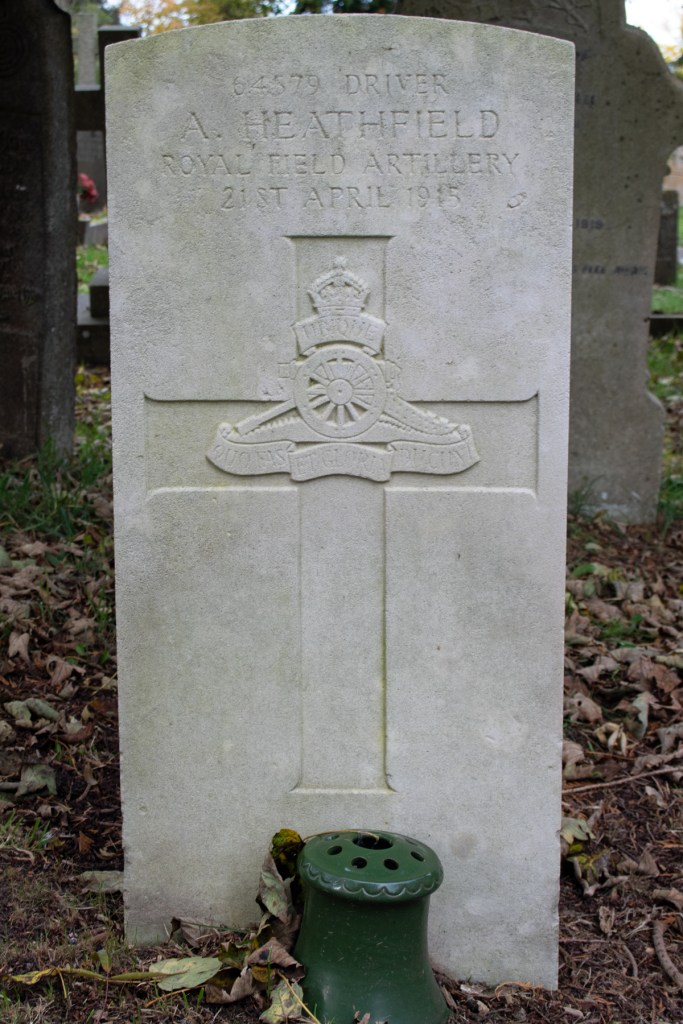
Arthur Heathfield was born in Shefford, Bedfordshire, early in 1897, the oldest child to Ellen Grace Heathfield. Ellen married William Lewis in 1903, and went on to have four children in total.
When he left school, Arthur found work as a farm labourer, but by this time, war was coming to Europe. Full details of his military career are not available, but he enlisted in the Royal Field Artillery at some point towards the end of 1914.
Driver Heathfield was assigned to the 14th Brigade, which saw fighting on the Western Front, although it is not possible to determine whether Arthur himself went overseas. What is certain is that, by the spring of 1915, he was admitted to hospital in Frome, Somerset, suffering from meningitis. Sadly, he was to succumb to the disease on 21st April. He had not long turned 18 years old.
Arthur Heathfield was laid to rest in the graveyard of Christ Church, in the town in which he died.
Patrick Tynan was born in Roscrea, Southern Ireland, on 9th June 1893. He was the eldest of four children to John and Anne Tynan, but sadly, there is no further information available for his early years.
Patrick’s story really picks up on 14th December 1915, when he joined the Royal Engineers as a Private. His service record states that he was living in Bangor, Gwynedd, and that he was a stall keeper at a fairground – a subsequent document noted his trade as a showman. He was noted to be 5ft 8ins (1.72m) tall, weighed 151lbs (68.5kg), and had numerous scars on his back.
Private Tynan did not stay in the UK for long. Assigned the new role of Driver, he was attached to the GHQ Signal Company and sailed from Devonport on 30th June 1916, bound for Mesopotamia. Arriving in Margil – the port connected to Basra – he was based here for more than a year, before moving north to Baghdad.
By this time, Patrick had risen to the rank of Lance Corporal, and was obviously a trustworthy member of the company. Towards the end of 1917, he had again been promoted, this time to Corporal.
During his time in modern day Iraq, Patrick was admitted to hospital a handful of times; there is little information on the conditions he suffered, but none appear to have been life threatening, as they were only for short periods. It’s also interesting to find that his service records confirm a month’s leave in May 1918, spent in India.
When the war came to a close, Corporal Tynan was still in the Middle East. Ready to be demobbed, his company moved to India and boarded the SS Chupra in Calcutta on 26th February 1919, bound for home.
Back in the UK, however, Patrick was not ready to give up the formal military life. Having returned to Gillingham in Kent, where the Royal Engineers were based, he initially found work as a tram conductor, but soon signed up for a five year term with the Royal Navy as a stoker.
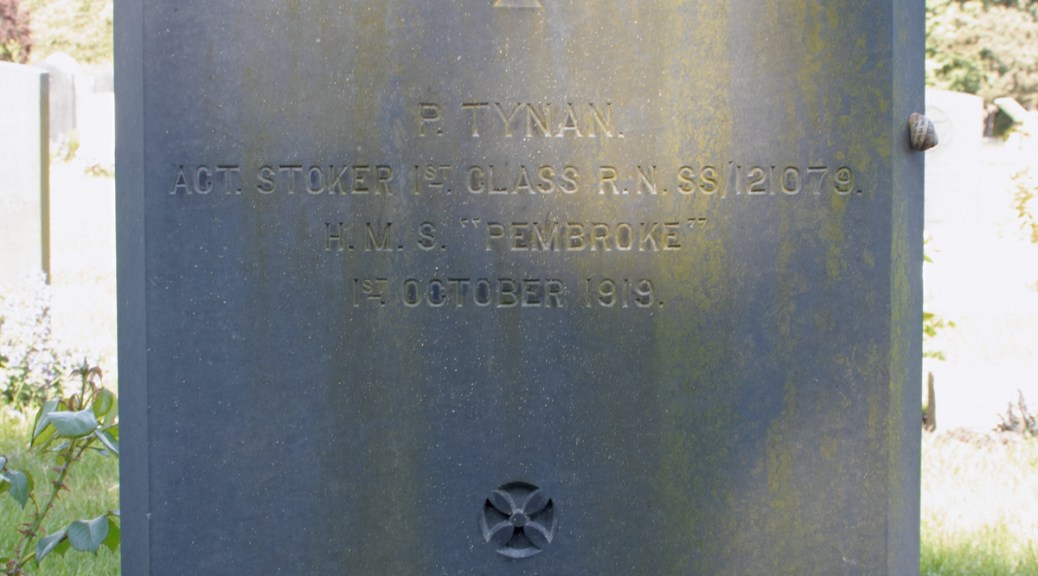
He was based on HMS Pembroke II, the shore-based establishment at Chatham Dockyard, but sadly, his time in the navy was to be a short one. Admitted to the Royal Naval Hospital in the town with pneumonia, he passed away form the condition on 1st October 1919. He was just 26 years old.
Patrick Tynan was laid to rest in the Woodlands Cemetery in Gillingham. He had a short but full life, something his modest gravestone doesn’t begin to hint at.
Alfred Fear was born towards the end of 1898, the youngest of nine children to Charles and Eliza Fear. Charles was a mason from Weston-super-Mare in Somerset, who raised his family in the town of his birth.
Sadly, given his youth, there is little documented about Alfred’s early life. He was still at school at the time of the 1911 census and, while he would have found some sort of employment after leaving, there is no record of what that would have been.
Alfred’s military service records are also sparse. He enlisted in the Royal Field Artillery and was assigned the role of Driver in the 321st Brigade. While dates cannot be confirmed, he would have enlisted before the spring of 1918.
The next two documents relating to Driver Fear are his Pension Ledger record and the Army Register of Personal Effects. These confirms that he passed away on 22nd October 1918 at the Norfolk War Hospital. The cause of death given was infirmation of the brain, (or possibly inflammation of the brain). He was just 20 years old.
Alfred Fear’s body was brought back to Weston-super-Mare for burial. He lies at rest in the town’s Milton Cemetery.
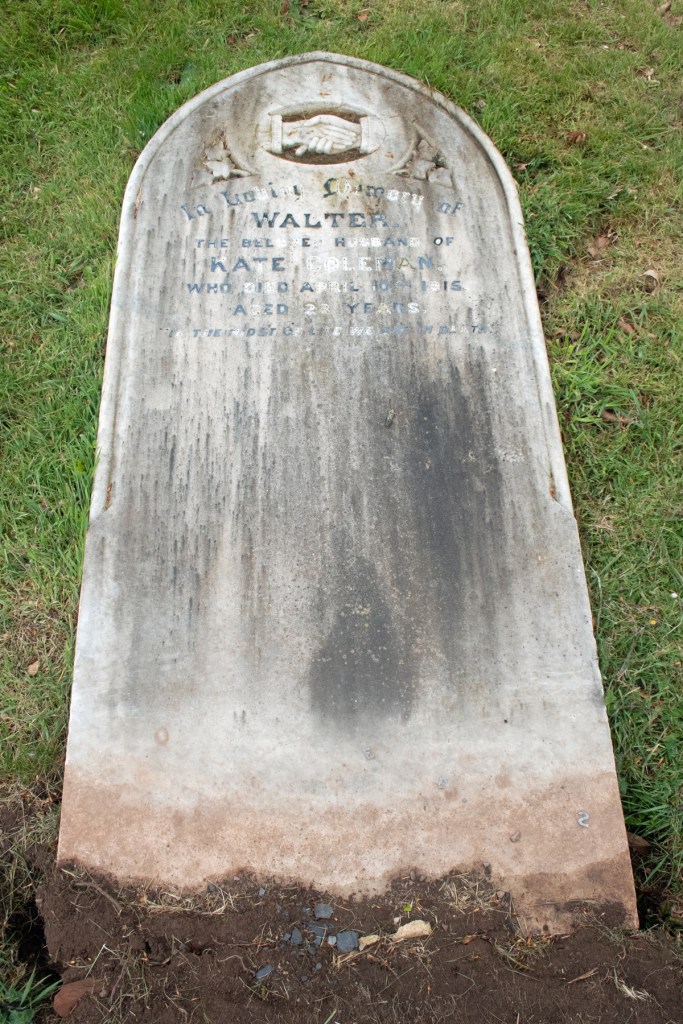
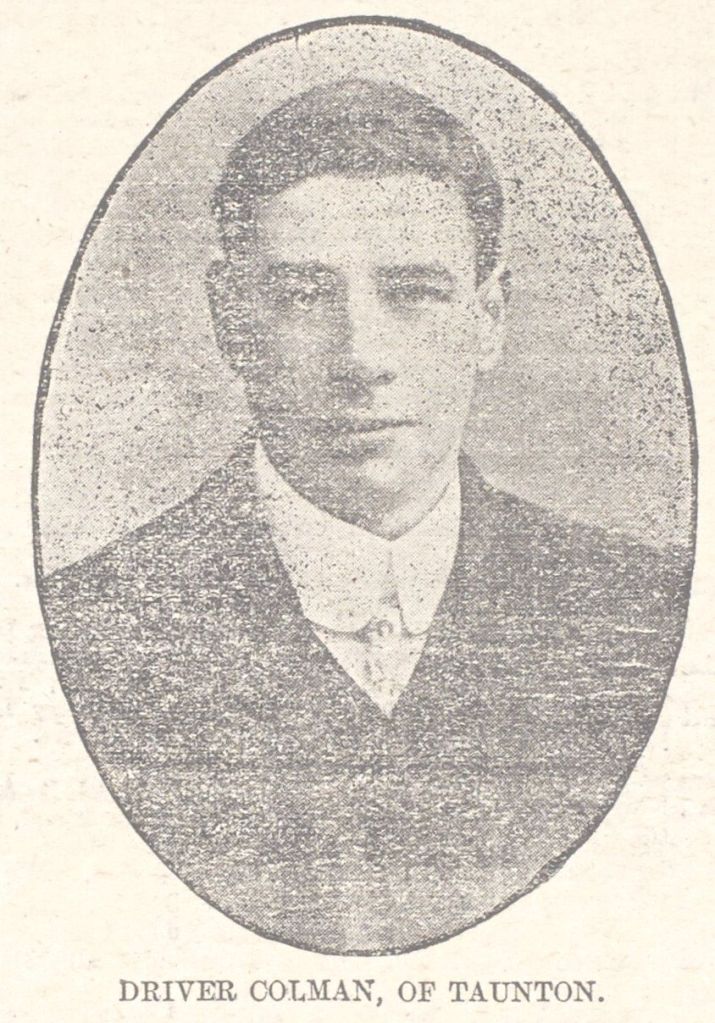
Walter Coleman was born in the spring of 1887, one of seven children to James and Emily Coleman. James was a hairdresser and the family lives in the Somerset town of Taunton.
Walter didn’t follow his father’s trade; instead, after a spell working at a collar factory when he left school, he was soon employed as a groom.
On Christmas Day 1910, he married Kate Norris, and the couple set up in a two-up, two-down in the middle of the town.
War was on the horizon, however, and when it broke out, Walter signed up straight away. He joined the 72nd Brigade of the Royal Field Artillery as a Driver and trained at the Bulford Camp on Salisbury Plain. It was while he was here on 10th April 1915 that he had an accident and fell off his horse. Sadly, Driver Coleman fractured his skull and died of his injuries that day. He was just 28 years old.
Walter Coleman lies at rest in the St James’ Cemetery in his home town of Taunton.
Walter Coleman (from findagrave.com)
Walter’s older brother Henry James Coleman also served in the Great War. Posted to France as part of the Labour Corps, he died of wounds on 12th April 1918. He was 33 years old, and left behind a widow and four children. He is buried at the Longuenesse Souvenir Cemetery in France.
Frederick Henry Virgin was born in 1888, the second eldest of ten children. His parents were carter Thomas Virgin and his wife, Ellen, and the family lived in Taunton, Somerset.
Frederick craved adventure and this came in the form of military service. In August 1906, he enlisted in the Royal Field Artillery, and was assigned as a driver. Initially serving at home, he was shipped to India for four years, returning to England in December 1912.
Driver Virgin met and married Alice Shattock in April 1914, but had been shipped off to France within months, when war broke out. He served overseas for eighteen months, before transferring back to England again. By this point he was suffering with sciatica, and this is what saw him assigned lighter duties in the Reserve Brigade on the home front.
Alice fell pregnant, and the couple had a little boy in February 1917; sadly, his life was brief, and he passed away at the age of just two days. One can only imagine the impact this had on his parents.
Frederick’s health issues continued to be a problem, and he was medically discharged from the army later that year. While the sciatica was not solely attributed to his military service, his discharge report confirmed that his time in the army contributed to the issue. Driver Virgin’s time with the Royal Field Artillery came to an end in December 1917.
Sadly, it is at this point that Frederick’s trail goes cold. His records confirm that he passed away nearly a year later, on 26th November 1918, but there is no record as to the cause of his death. He was 30 years of age.
Frederick Henry Virgin lies at rest in St Mary’s Cemetery in his home town of Taunton, Somerset.