Leonard Henry Gulliford was born on 26th January 1895 in the village of Cothelstone, near Bishops Lydeard, Somerset. One of eleven children, he was the son of farm labourer William Gulliford and his wife, Jane.
When he completed his schooling, Leonard also found employment on the farm. However, it seemed he wanted bigger and better things and, on 7th April 1913, he enlisted in the Royal Navy as a Stoker 2nd Class. His service records show that he was 5ft 4.5ins (1.64m) tall, with fair hair, blue eyes and a fresh complexion.
Stoker Gulliford spent the first six months of his naval career at HMS Vivid, the Royal Naval Dockyard in Devonport, Devon. This was to be the base to which he would return in between voyages. His records show unusual activity for his time, as he was assigned to just one ship – the battle cruiser HMS New Zealand – during his six years’ service. Leonard spent five years on board, from September 1913 to February 1919, with just one month based back in Devonport during this time.
Leonard rose through the ranks over the years, receiving a promotion to Stoker 1st Class in April 1914, Acting Leading Stoker in July 1918 and Leading Stoker in July 1919, by which point he was, once again, based at HMS Vivid.
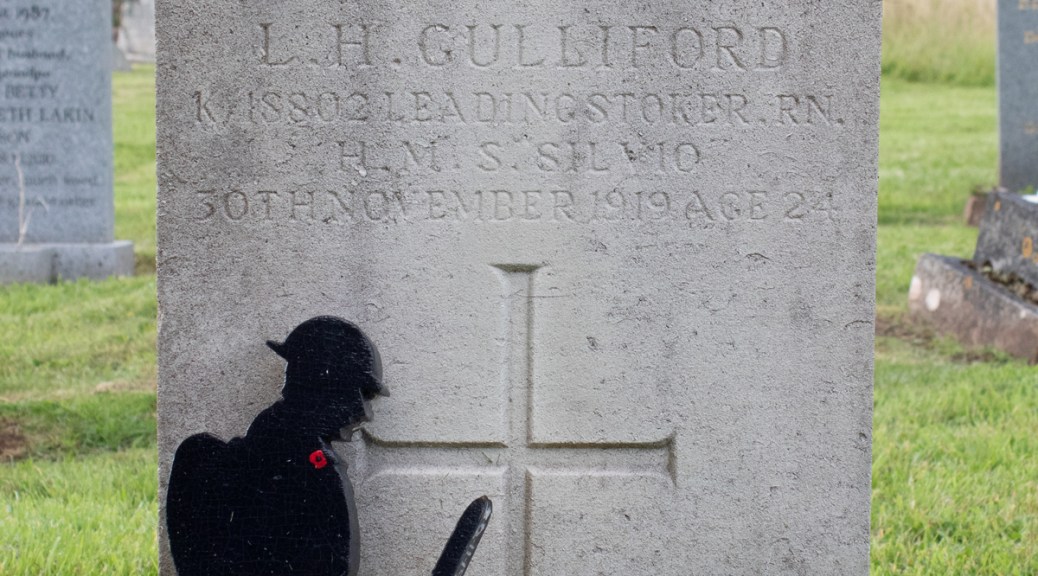
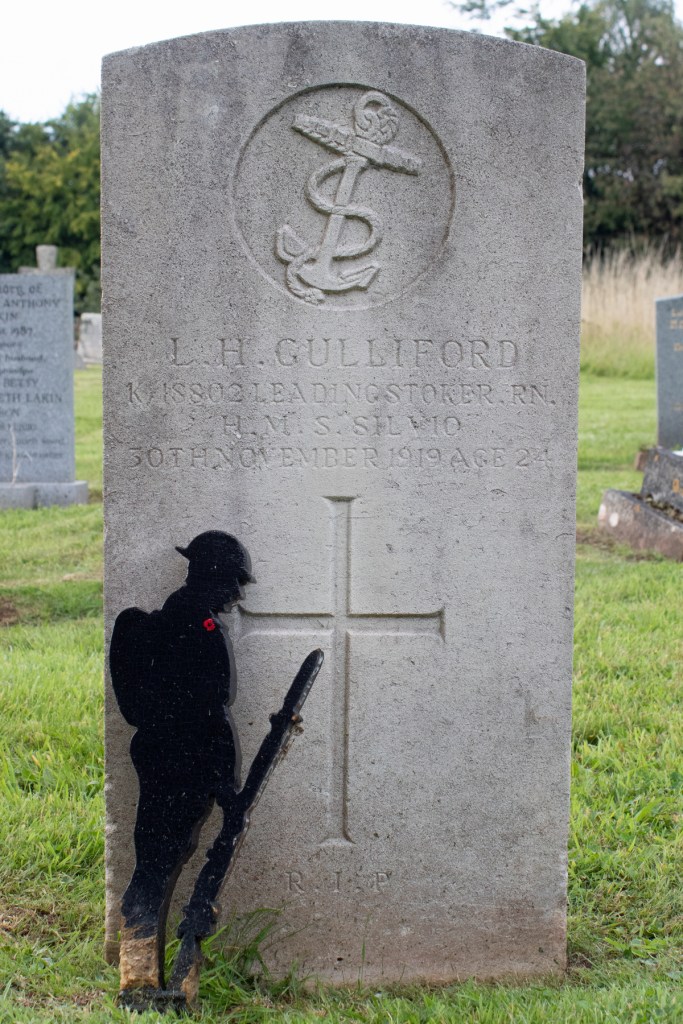
In November 1919, Leonard was attached to the sloop HMS Silvio, based in the River Tamar. A party of the crew, Leading Stoker Gulliford included, left the ship without leave, taking a boat to shore.
The bodies of the seven men who were missing from two warships in the Tamar Estuary were recovered this morning, and a mystery has thus been cleared up.
The men left two ships, HMS Swindon and HMS Silvio, on Sunday evening, and it is believed visited Saltash, a riverside town. Later an upturned boat and two naval caps were found…
The bodies were found close together on the mudflats in shallow water in Tamar Creek, on the eastern side of the River Tavy, near the Tavy railway bridge.
Daily News (London): Friday 5th December 1919
A subsequent inquest into the sailors’ deaths determined that, after their time in Saltash, they took their boat, which, at just 13.5ft (4.1m) long, proved too small for seven man, back to their ships. The wind and choppy waters proved too much, and the boat capsized, throwing all of them into the water to their doom. A verdict of accidental death was recorded.
The body of 25-year-old Leonard Henry Gulliford was taken back to Somerset for burial. He was laid to rest in the graveyard of St Mary’s Church in Bishops Lydeard.
George Williams was born in West Bromwich, Staffordshire, in 1895. One of ten children, his parents were George and Sarah. When George Sr died in 1908, his widow was left to raise the family herself. By the time of the 1911 census, all of the children were still living at home, and four of them, including George Jr, who was working as a labourer, were bringing in a wage.
When conflict broke out, George stepped up to play his part. He enlisted in the Duke of Cornwall’s Light Infantry before the end of 1914 and, as a Private, was assigned to the 8th Battalion.
Little information is available about George’s military life and, indeed, the only other details available for him are that of his passing, based on reports available in a contemporary newspaper.
About half-past eight on Thursday [3rd June 1915] the body of a soldier was found in the river at Bath… The corpse was in a somewhat advanced state of decomposition, its condition suggesting it may have been in the river about three weeks. The man had on his full regimentals, with top coat.
Papers found in the pocket indicate that the deceased is Private George Williams, of the 8th Battalion Duke of Cornwall’s Light Infantry, now encamped at Sutton Veny, Wilts. This regiment was quartered in Bath during the winter, and left the city some weeks ago.
There are.. no marks of violence on the body.
There was found on the body a pass dated 14th May, giving him three days’ leave. The leave expired at 11:55pm on May 17th. The permit allowed him to proceed to Birmingham. There was also found on the deceased a telegram addressed to 22 Green Street, West Bromwich, which said “Leave extended.”
The supposition is that Williams returned as far as Bath, on his way back to camp, by Midland Railway, and when in the city by some means or other fell into the river.
Curiously enough, the Bath police had been advised of the absence without leave from camp at Sutton Veny of a soldier of the same name. But in this case the man belonged to the 10th Devons. They had received no notification regarding Private Williams of the 8th Cornwalls.
Bath Chronicle and Weekly Gazette: Saturday 5th June 1915
The telegram mentioned in the report is likely one sent to George’s family, who was living at 22 Queen Street (possibly an error on the newspaper’s part).
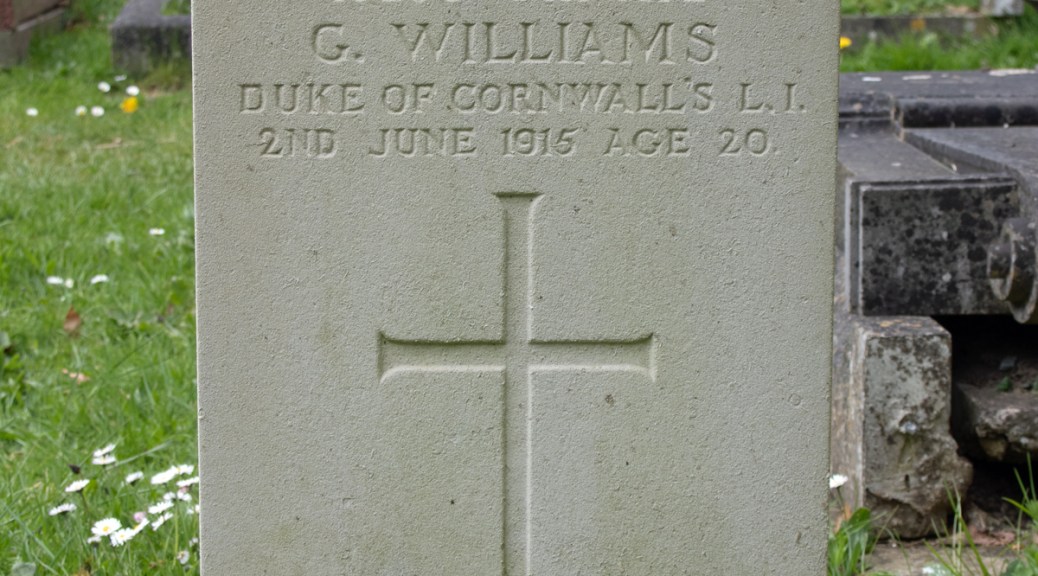
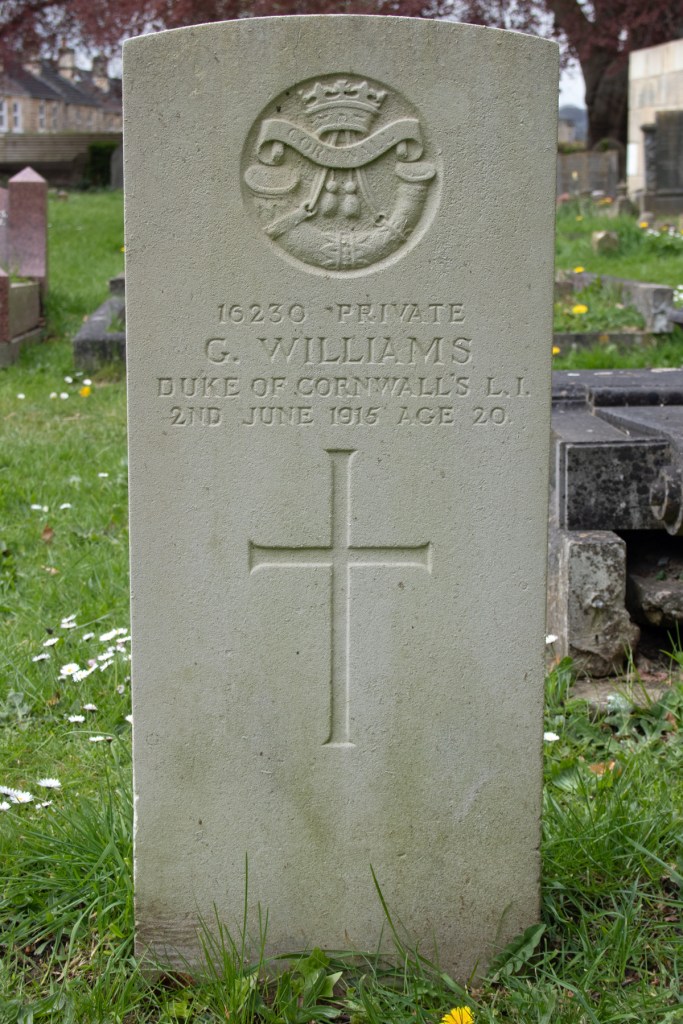
George was just 20 years old when he died: the army report gave the date of his death as 2nd June 1915, although it seems likely that he had passed some weeks before.
Sarah and the family were possibly unable to afford to have George’s body taken back to Staffordshire for burial. Instead, he was laid to rest in the Twerton Cemetery in Bath, with Sarah and two of his brothers, Leonard and William, in attendance. Another member of his battalion, “deceased’s chum” [Bath Chronicle and Weekly Gazette: Saturday 5th June 1915] Private Fred Cotton, was also at the funeral, and sent his own wreath – from “his old pal Fred” [Bath Chronicle and Weekly Gazette: Saturday 5th June 1915].
William Ephraim Stitch was born in Biddisham, Somerset, on 6th August 1879. The oldest of seven children, his parents were James and Mary Stitch. James was a farmer, and this was a trade into which William followed.
The 1901 census found William boarding with a farmer in nearby Badgworth. His employer was George Burrow, who had a live-in housekeeper, Ellen Norris. Ten years later, William was boarding with another family in the village – Benjamin and Bertha Wall and their two children – and, at 32 years old, he was still employed as a farm labourer.
When war came to Europe, William stepped up to play his part for King and Country. He enlisted in the Royal Army Service Corps on 3rd December 1915, and was assigned to the 530th Horse Transport Company. His service records note that he was 5ft 4ins (1.63m) tall and weighed 126lbs (57.2kg).
Driver Stitch was based in Northumberland, and remained on home soil throughout his time in the army. He returned to Somerset a couple of times, most noticeably in September 1917, when he married Bertha Wall, who he had been boarding with according to the 1911 census. There is no evidence of the passing of Bertha’s husband, Benjamin, but William’s service records note that he classed Bertha’s two children as his own.
Driver Stitch went back to Somerset on leave over Christmas 1917, arriving back in Blyth, Northumberland, on 28th December. He was billeted at Link View Villa in the town, and looked after the horses stabled there.
William was last seen in the Orderly Room that evening, by a Corporal John Kearton, his senior officer who was based in the same digs. He disappeared, and, despite a lengthy search, it was only on 1st February 1918 that his body was found in the brickyard pond, close to where the horses were stabled.
At the subsequent inquest, the doctor who carried out the postmortem confirmed that there was no sign of violence. Corporal Kearton suggested that, as William was getting water from the pond, he might have slipped into the water accidentally. With no evidence of any deliberate intention to end his life, the jury returned a verdict of drowning, but that there was no evidence to show how Driver Stitch had gotten into the water. William was recorded as having died on 28th December 1918, at the age of 39 years of age.
The body of William Ephraim Stitch was brought back to Somerset for burial. He was laid to rest in the quiet graveyard of St Congar’s Church in Badgworth.
Phillip George Clemett was born on 5th December 1891, one of eight children to Albert and Mary Jane Clemett. Albert was a carpenter from Devon, Mary Jane came from Somerset, but by the time Phillip was born, the family had moved to Fulham in Middlesex.
The 1911 census records the family as having moved back to Somerset. Mary Jane had been born in the village of Huntspill, and it was here that the Clemetts returned. Albert was now working as a farmer, so it is possible that they had moved to work on the family farm.
Labouring was not a job to satisfy Phillip, though, and he sought a career on the high seas. On 3rd February 1913, he enlisted in the Royal Navy as a Stoker 2nd Class. His service records show that he was 5ft 4ins (1.63m) tall, with brown hair, brown eyes and a fresh complexion.
Stoker Clemett’s was initially sent to HMS Vivid, the Royal Naval Dockyard in Plymouth, Devon. Here he received a few months’ training, before being given his first posting, on board the battleship HMS Indefatigable. He remained on board for the next fifteen months, gaining a promotion to Stoker 1st Class in the process.
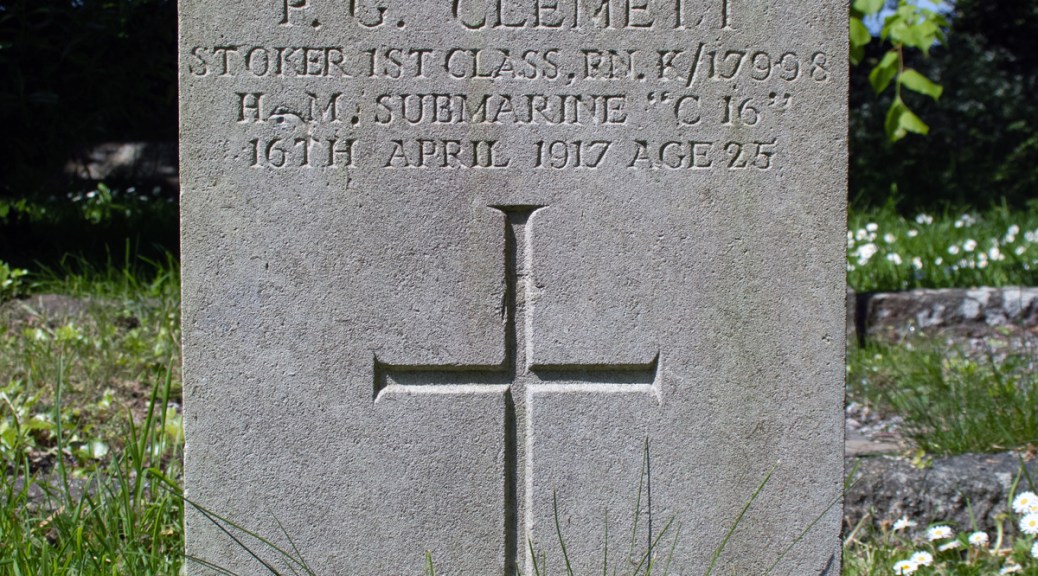
Over the next couple of years, Phillip served on a couple more vessels, but on 11th February 1917 he was assigned to the submarine HMS C16. Stoker Clemetts was on board for a couple of months, as she was patrolling off the Essex coast. On 16th April 1917, the C16 was accidentally rammed by the destroyer HMS Melampus. She sank to the bottom and a couple of attempts were made for the crew to escape, but they became trapped and all perished, including Stoker 1st Class Clemetts. He was 25 years of age.
Contemporary newspaper reports give little detail about the accident – stating simply that Phillip ‘perished at sea’ [Western Daily Press – Tuesday 01 May 1917] His service documents are equally cagy about the incident, confirming jus that he ‘lost his life on duty.’ The records, however, show that on each of his five annual reviews, his character was noted as ‘very good’, while his ability was ‘superior’.
When the submarine was salvaged, Phillip George Clemett’s body was brought back to Somerset for burial. He was laid to rest in the peaceful graveyard of St Peter’s Church in Huntspill.
Sidney Goddard was born on 2nd January 1889 in the village of Oldland Common, near Bristol. The youngest of three children, his parents were Albert and Frances Goddard. Albert was a shoemaker, but by the time of the 1911 census, he and Frances had set up home in Saltford, between Bristol and Bath, where he was recorded as being a bootmaker and innkeeper at the village’s Jolly Sailor.
Sidney, by this time, had gone his own way. On 17th January 1917, he enlisted in the Royal Navy as a Stoker 2nd Class. His service records note that he had been working as a collier when he joined up, so it seemed that coal ran through him. The same records note that Sidney had dark brown hair, brown eyes and a fresh complexion. He was also recorded as being was 5ft 5.5ins (1.66m) tall, and having a number of tattoos: a true lovers’ knot on his left wrist, several dots on his left arm. He had three dots on his right arm, a scar on his back and another on the inside of his left shin.
Stoker Goddard was initially sent to HMS Vivid, the Royal Naval Dockyard in Devonport, for training. After a couple of months he was assigned to the cruiser HMS Amphitrite. It is evident that Sidney showed promise, because he was promoted to Stoker 1st Class on 22nd April, just three months after he enlisted. He returned to Devonport in May, but this was only to change assignments: he boarded HMS Blake, another cruiser, a few days later.
Over the next eight years, Stoker 1st Class Goddard served on five further vessels, returning to HMS Vivid in between assignments. On 1st July 1915, he was assigned to the newly commissioned minesweeper HMS Larkspur. In November that year, she came into Merklands Wharf in Glasgow.
[Sidney] met his death while assisting in docking his ship at Glasgow on the afternoon of Wednesday, November 3rd. By some mischance he was thrown into the dock, and in falling his head struck either on the boat’s side or on the dock. It is believed that he was rendered unconscious by the blow, as otherwise, being a good swimmer, he would have been able to keep afloat till help came.
Bath Chronicle and Weekly Gazette: Saturday 13th November 1915
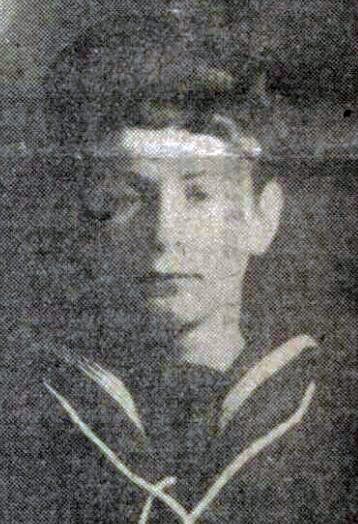
Stoker 1st Class Sidney Goddard was just 26 years of age when he died. His body was brought back to Somerset for burial. He was laid to rest in the peaceful graveyard of St Mary’s Church, Saltford, within walking distance from the Jolly Sailor, where his parents still lived.
Sidney has the dubious honour of being the only member of HMS Larkspur’s crew to die during the First World War. His two older brothers also served in the conflict, Maurice in the Royal Marines and William, who was a Leading Seaman on board HMS Spitfire when he was killed during the Battle of Jutland.
Stoker 1st Class Sidney Goddard (from britishnewspaperarchive.co.uk)
Francis Benjamin John Doel was born in Glastonbury, Somerset, on 26th August 1897. The oldest of five children, his parents were Frederick and Alice Doel. Frederick was a mason’s labourer and, by the time of the 1911 census, the family had set up home in the village of Berkley, on the outskirts of Frome. Intriguingly, the census clearly gives Francis’ middle name as Crossman, although no other record confirms this.
When war broke out, Francis had left school, and was employed as a labourer in a brass foundry. By the start of 1916, however, he stepped up to serve his King and Country, and enlisted in the Royal Navy. His service records give his height as 5ft 3.5ins (1.61m) and note that he had brown hair, grey eyes and a fresh complexion.
Francis was assigned the role of Stoker 2nd Class, and was sent to HMS Vivid – the Royal Naval Dockyard in Devonport – for training. Within a matter of weeks, he was given his first posting, on board the cruiser HMS Dublin, although he only remained there for a month.
After having returned to HMS Vivid for a few weeks, Francis was assigned to another cruiser, HMS Essex. He appears to have been good at his job, and in November 1916 was promoted to Stoker 1st Class.
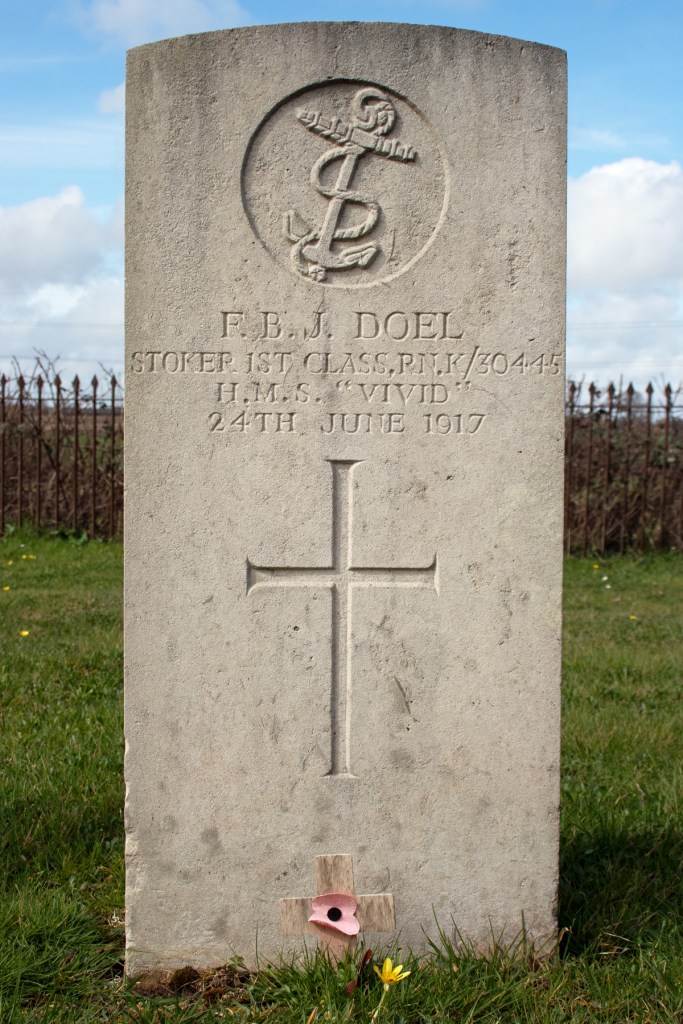
Stoker Doel returned to HMS Vivid in May 1917, preparing for his Leading Stoker exams. They were not to be, however, as on 24th June, he died, having ‘accidentally drowned’. No further information is available on his death, and the newspaper report of his funeral only notes that he “…met his death on Sunday week. His body was landed from his vessel, and was brought home for burial…” [Somerset Standard: Friday 6th July 1917]. He was just 19 years of age.
Francis Benjamin John Doel was brought back to Berkley for burial. He was laid to rest in the village’s church cemetery.
Reginald Thomas Bainton was born in Bath, Somerset, in the spring of 1889. The second of five children, his parents were bakers and confectioners Thomas and Mary Bainton.
While Reginald’s older brother Robert followed in his father’s trade, the 1911 census recorded that he had followed a different route, and was working as a hairdresser and tobacconist.
On Christmas Day 1913, Reginald married Henrietta Skinner, who was the daughter of a farmer. The couple went on to have a son, Reginald, who was born in July 1916.
War was, by this point, raging across Europe, and Reginald stepped up to play his part for King and Country. He enlisted in the autumn of 1916, and was assigned to the Royal Army Service Corps. Initially stationed in London, he moved to a camp near Reading, Berkshire, in March 1917.
One evening towards the end of that month, tragedy occurred.
[Private Bainton] was missing from his company, and when his service cap was found on the banks of the Thames there were fears that the worst had befallen him. On receipt of the news of his disappearance his wife proceeded to Reading in the hope of getting some information respecting him, and she remained there until the discovery of the body in the Thames on Monday. During the short period he was in the Reading camp, Private Bainton acted as the storekeeper.
At the inquest… the much-decomposed body was identified by [Reginald’s] father, and medical evidence was given that it had probably been in the water for three weeks to it is highly probable that Private Bainton was drowned on the first day he was mussed. There was not the slightest evidence as to how he got into the river, and the jury returned a verdict of “Found drowned”.
Bath Chronicle and Weekly Gazette: Saturday 28th April 1917
The date of Private Bainton’s death was recorded as 23rd April 1917 – the day he was found. He was 27 years of age.
Reginald Thomas Bainton’s body was brought back to Somerset for burial. He was laid to rest in St James’ Cemetery in his home city of Bath.
Theophilus Walter Burdock was born on 18th June 1871 in Whitminster, Gloucestershire. One of nine children, his parents were painter and decorator Nathaniel Burdock and his wife, Mary.
While he found labouring work when he left school, Theophilus – who went by his middle name, Walter – decided that he wanted bigger and better things and, on 30th December 1889, he enlisted in the Royal Artillery. His service records show that he was 5ft 5ins (1.65m) tall and weighed 115lbs (52kg). The document also records that he has a tattoo of a man, star and crown on his left forearm.
Initially assigned to the 1st Depot 2nd Battery as a Driver, over the next couple of years Walter made solid progress within the regiment. By September 1892, he was promoted to Gunner, within a couple of years he was raised to Bombardier, and by April 1895 he had made the rank of Corporal.
By his last formal year in the ranks, things seemed to take a different turn. On 9th March 1896, Corporal Burdock received a contusion to his face. He was formally transferred to the Army Reserve when his contract of service ended in December 1896, but within eighteen months he re-enlisted.
At this point, however, Corporal Burdock’s conduct began to race downhill. In August 1898 he was tried for an undisclosed reason, and his rank was reduced to Bombardier. Within a couple of months, he was tried for a second crime, and reduced in rank again, back to Gunner.
For a time Walter kept his nose clean, and, in February 1900, he was promoted back to the rank of Bombardier. This was to be only a fleeting move, however, as he reverted back to Gunner less than two months later.
Over the next couple of years, Walter generally kept his head down. On 30th April 1901 he was injured by a kick in the eye, although, again, details are tantalisingly scarce. By April 1902, his contract came to an end and this time he was stood down and formally demobbed.
Civilian life seemed to be something to which Walter was not to be destined. He enlisted again almost immediately, joining the Imperial Yeomanry in May 1902. He lasted less than a year with the regiment, however, having served ten months in South Africa.
In January 1904, was recalled to the Royal Artillery for further service in South Africa. His medical report showed the man he had become in the fifteen years since he had first joined up: he was now 5ft 7ins (1.7m) tall, and weighed 141lbs (64kg).
Private Burdock served six months on home soil, but in July 1904, he was sent to South Africa, having never actually seen any overseas service before. He returned to Britain in September 1905, and was discharged from service, specifically so that he could re-enlist with the Royal Artillery and complete his fourteen years’ service with them.
Gunner Burdock remained with the Royal Artillery until February 1906, presumably as he had finished his fourteen years. Interestingly, his discharge papers noted his conduct as ‘indifferent’.
Walter’s trail goes at this point. His mother, Annie, passed away in Gloucestershire in the spring of 1908. His father, Nathaniel, died Bristol in 1912. The next evidence for their son comes in September 1914, in attestation papers for the Canadian Expeditionary Force.
Walter was, by this point, living in Victoria, British Colombia, and working as a lumberjack. He had been unable to completely leave his army days behind him, and his service records give his year of birth as 1876, five years younger than he actually was at the time.
Those service records give similar physical characteristics to his 1904 papers, and confirm the presence of some additional tattoos: a butterfly and pair of hands with the words true love.
Walter was assigned to the Royal Canadian Horse Artillery, and given the rank of Gunner. He arrived back in Britain in October 1914, but his previous indifference seems to have recurred. He was imprisoned for a week from 21st October for having been absent without leave, and was found to be absent again at reveille on the morning of 30th October.
Yesterday afternoon the body of a man was found floating in the Avon just below Bathampton Weirs, and close to the entrance to the back-water on the Batheaston side of the river.
The body was floating face downwards some yards from the bank, and only the top of the head was visible.
The body was recovered shortly before five o’clock. It appeared to be that of a middle-aged man of medium height. The trousers had something of the appearance of a mechanic’s overall and deceased was wearing a sleeve vest.
The conjecture naturally arises whether the body is that of the missing Canadian soldier Burdock, whose clothes were discovered on the bank at Batheaston on Saturday, October 31st, and of whom nothing has been heard since. Burdock was a member of the Canadian contingent now in training on Salisbury Plain. It is known that the missing soldier had several tattoo marks on his arms… so the question will not long remain in doubt when the body has been brought to the bank.
Bath Chronicle and Weekly Gazette: Saturday 14th November 1914
The body did indeed turn out to be that of Gunner Burdock. An inquest reached a verdict of suicide while temporarily insane. He was 43 years of age.
Theophilus Walter Burdock was laid to rest in the graveyard of St John the Baptist Church in Batheaston. Interestingly, while his next of kin was identified as his brother Frederick Burdock, Walter’s service records add a further dimension to his passing:
A maple tree has since been planted at the head of the grave by Miss Henderson, The Hill, Batheaston, who took a great interest in the case. Miss Henderson also sent a beautiful wreath when deceased was buried.
George Charles Walrond Sweet was born on 4th December 1889, the oldest of three children to Reverend Charles Sweet and his wife Maud. A Church of England vicar, Charles moved around with his work, and, when George was born, he was based in Winterborne Kingston in Devon.
George was sent away to school, and, by the time of the 1901 census, Charles and the family had moved to Milton Lilbourne in Wiltshire, to tend the local flock.
After school, George studied at Oxford, then followed in his father’s footsteps by taking holy orders, and was soon appointed rector of Symondsbury, Dorset.
When war broke out, his calling was to serve in the Royal Army Chaplain’s Department. Details of his time during the conflict are unclear, although by the spring of 1919, he was attached to the headquarters of the Army of the Rhine.
It was here that he met Phyllis Squire Hickson, who was serving as a Nurse in the Queen Mary’s Auxiliary Army Corps. The couple fell in love and, in June 1919 they returned to England to marry. The wedding occurred on 6th August 1919, and the newlyweds set off on honeymoon the following day.
On his honeymoon tour, the Revd. George C Walrond Sweet… was drowned on Thursday evening in the Cherwell at Oxford, in the presence of his wife.
Mr and Mrs Sweet engaged a punt at Tims’s boathouse and went for a trip on the river. On returning about seven o’clock, when within 300 yards of the boathouse, the punt pole was embedded in the mud and, in attempting to dislodge it the pole broke.
Mr Sweet fell on the side of the boat and then over-balanced into the river. His wife tried to reach him, but without success, and then jumped into a second punt and from that into another boat, but failed to reach him, and he disappeared. The body was not recovered until a quarter of an hour had elapsed, and life was then extinct.
Mr Sweet, who was an MA of Keble College, was only married on Wednesday at St James’s Church, West Hampstead…
[Phyllis’ father] Mr William Hickson… said his daughter became engaged to Mr Sweet in France. He did not meet him until last Tuesday. They came to England to be married. Mr Sweet met with a bicycle accident some years ago and [he] understood from his daughter that her husband was unable to swim or take any active exercise, but while he had been in France his health had much improved.
It was stated [at the inquest] that Mr and Mrs Sweet had been married only one day when the accident occurred and Dr Brooks, a university coroner, said that the tragedy was one of the saddest that had ever come under his notice.
Taunton Courier and Western Advertiser: Wednesday 13th August 1919
The inquest confirmed that the punt pole had broken about 2.5ft (0.76m) from the top. When George was dragged from the river, artificial respiration was carried out for around 50 minutes, but proved unsuccessful. The inquest returned a verdict of accidental death. George was just 29 years of age.
Reverend George Charles Walrond Sweet’s body was brought to Somerset for burial. He was laid to rest in the graveyard of Holy Cross Church in Sampford Arundel, more than likely because he or his father had been vicars there.
This was the second tragedy to befall the Sweet family. George’s younger brother, Leonard, had been schooled in Sherborne, then at the Military College in Sandhurst. He joined the 1st Battalion of the Hampshire Regiment as Second Lieutenant on 5th February 1913, and was promoted to full Lieutenant in September 1914, and Captain in October 1915.
Captain Sweet was then attached to the 29th Squadron of the Royal Flying Corps, and gained his wings at the British Flying School in Le Crotoy, France, in August 1915. On 22nd June 1916, he was on patrol duty over the British lines, when he was involved in a skirmish, and his plane crashed, killing him instantly. He was just 23 years of age.
Captain Leonard Sweet was laid to rest at the Lijssenthoek Military Cemetery in Poperinge, near Ypres.
Captain Leonard Sweet (from findagrave.com)
Phyllis Sweet never remarried. By the time of the 1939 England and Wales Register, she was living in Bridport, Dorset, and working as a political organiser and speaker. She passed away in August 1944 in Cannock, Staffordshire, at the age of 63 years old.
Edward James Phillips was born on 22nd January 1900 in Bedminster, Bristol, and was the oldest of two children to Ernest and Emily Phillips. Ernest was a bit of a jack-of-all-trades; the 1901 census recorded him as being a shopkeeper of glass and china, while by 1911 he was working as an architect’s clerk.
By this point, the family had moved to Chard, Somerset, and had set up home in a small, terraced house near the centre of the town. Storm clouds were gathering over Europe, and, while he was too young to enlist at the start of the war, it is clear that Edward wanted to play his part.
While details of his service are unclear, Edward joined the Merchant Navy. By the summer of 1918 he was on board the SS Polesley, working as a Wireless Operator. A newspaper report expanded on what became of him:
On the 21st September the SS Polesley was torpedoed off the Cornish coast by a German submarine and sunk. Later two bodies wearing life belts of the SS Polesley were washed ashore at Penreath, Cornwall. One of the bodies was identified as that of the mate of the ill fated vessel; the other was not recognised and was buried as unknown, both the gallant seamen being interred in one grave.
On learning that the bodies had been washed ashore form the torpedoed vessel, Mr EE Phillips… forwarded a photograph of his son, Edward James Phillips, who was wireless operator on the vessel, to the police at Penreath, and the undertaker and the person who recovered the bodies were able to identify the unknown remains as Wireless Operator Phillips.
Since then their sworn statements have been forwarded to the Home Office, with the result that the remains have been exhumed, and on Wednesday Mr EE Phillips, the father, went to Penreath and received the remains of his gallant son and brought them to Chard, where they will be interred.
Taunton Courier and Western Advertiser: Wednesday 29th January 1919
Edward James Phillips, who was just 18 years old when he died, was laid to rest in the family plot in Chard Cemetery.








 Death and Service