Tag Archives: Gibraltar

Private George Wilson

Private George Wilson

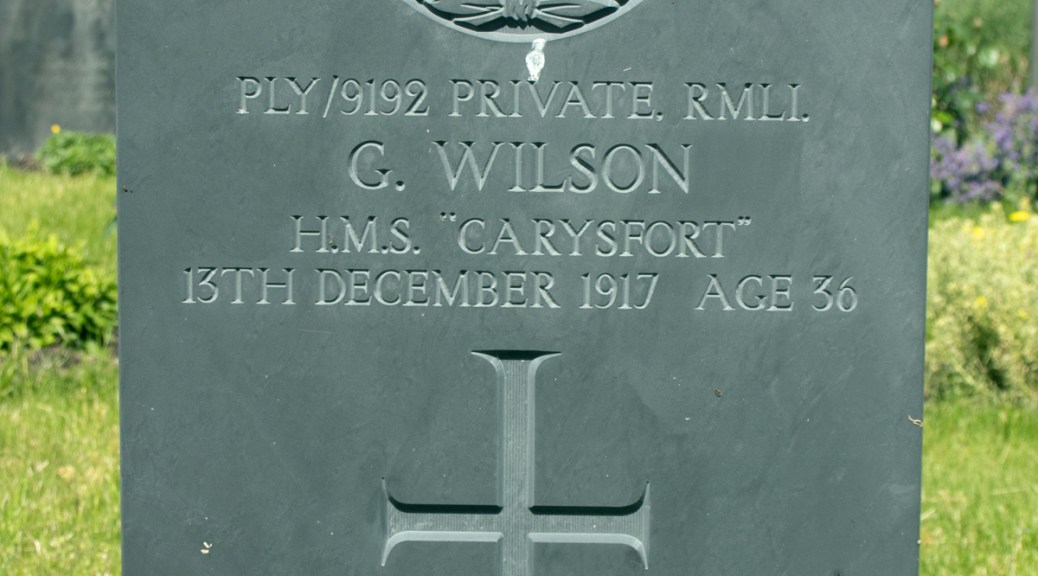
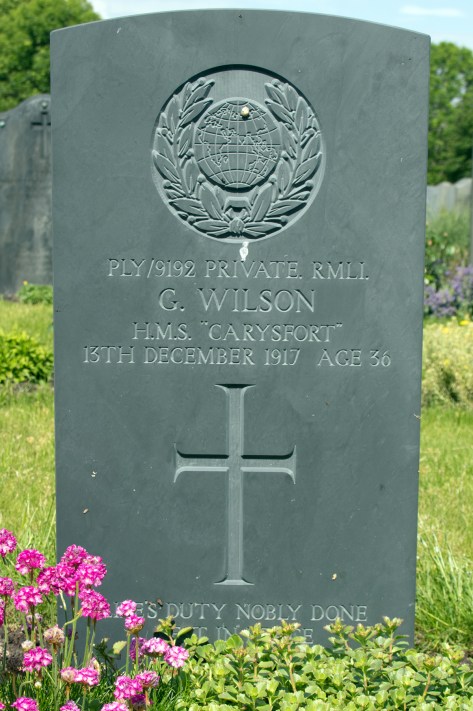
George Wilson was born on 1st February 1879 in the village of Worfield, Shoprshire. Details of his early life are unclear, although his father’s name was John.

When he completed his schooling, George found work as a porter. However, he was keen on adventure and a decent career, and so, on 31st May 1898, he enlisted in the Royal Marine Light Infantry. His service papers show that he was 5ft 7.5ins (1.71m) tall, with brown hair, blue eyes and a dark complexion. He was also noted as having a birth mark above his navel.

Private Wilson signed up for a period of twelve years and, during that time, he would serve around the world. Initially sent to barracks in Walmer, Kent, he would become based at Plymouth, Devon, in between assignments. Time overseas would include two years attached to HMS Magnificent (the 1901 census recording the battleship being moored in Gibraltar), two years on board HMS Spartan and three aboard HMS Encounter.

Away from the military, love blossomed and, in January 1909, George married Annie Curtis. She had a daughter, Gladys, who was either George’s, or was adopted by him. The couple set up home in Plymouth, and went on to have a son, Leslie, in 1911.

By this point, Private Wilson had renewed his military contract, and would go on to serve for a further seven years in the Royal Marines. In June 1915, he was assigned to the light cruiser HMS Carysfort. Part of the Harwich Force, her role was to patrol the waters off the east coast of England. During his time on board, George would have been involved in a number of sorties, including an attempt to intercept an enemy raid on Sunderland in August 1916, and another attempt to make contact with German ships off Zeebrugge, Belgium, that October.

In December 1917, while patrolling off Orford Ness, Suffolk. the Carysfort collided with the SS Glentaise, a collier ship. Two crew were killed in the incident, including Private Wilson: he was 37 years of age.

Carysfort sailed to HMS Pembroke, the Royal Navy Dockyard in Chatham, Kent. From here the body of George Wilson was taken to Woodlands Cemetery in nearby Gillingham, and he was laid to rest in the naval section there.

Lieutenant Colonel Thomas Bingham Day

Lieutenant Colonel Thomas Bingham-Day

Thomas Hulkes Bingham Day was born on 2nd January 1855 in Frindsbury, Kent. The youngest of four children, his parents were Thomas and Emma Day. Thomas Sr was a banker and a justice of the peace. He died when his youngest was just a child, and Emma was left to raise the family, albeit with the help of five servants.

Thomas sought out a life in the military. After volunteering in the local militia, for a number of years, he gained a commission in the Dorsetshire Regiment. He took on the role of Lieutenant on 29th November 1876.

Over the next two decades, Thomas served around the world, spending time in Malta, Gibraltar, and the East Indies. He was also promoted through the ranks, rising to Captain in 1883 and Major in 1893.

On 25th March 1884, while serving in India, Thomas married Katharine Watts. The couple had a daughter, Winifred, who was born in July 1885, and, eventually they settled in Wiltshire as their base in Britain.

Major Bingham Day served in South Africa during the Boer War, taking part “in the operations at Parde Kraal, and in the operations at Poplar Grove… Vet River, Zand River, Johannesberg and Pretoria. He had the Queen’s and the King’s medals with five bars.” [Lincoln Leader and County Advertiser – Saturday 28 April 1917]

Thomas retired in 1903, and his trail goes cold until the time of the 1911 census. He and Katherine were on holiday when it was taken, and they were listed as boarding at the Beach Lodge on Roseville Street in St Helier, Jersey.

When war broke out, Thomas stepped up to play his part once more. He was put in charge of the 4th (Reserve) Battalion of the Devonshire Regiment, which was based at Sutton Veny in Wiltshire. It seems that he lived off site, as he and Katherine moved into a house in nearby Warminster.

A military funeral took place… on Monday, when Lieutenant-Colonel TH Bingham-Day, in command of a regiment at Sutton Veny, was laid to rest in the churchyard. The deceased officer died suddenly while at mess, as the result of a seizure.

[Devizes and Wilts Advertiser: Thursday 19th April 1917]

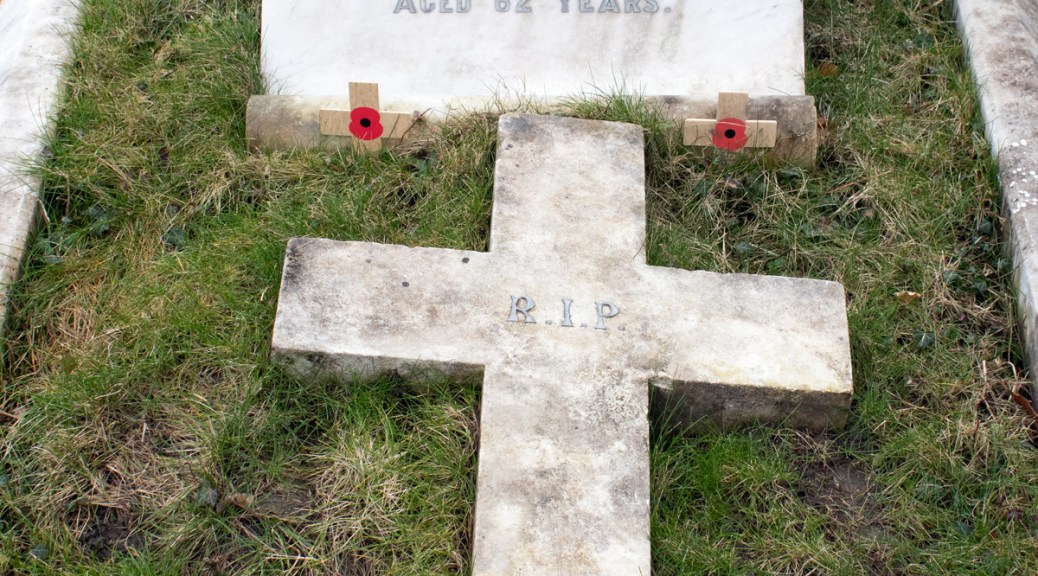
Lieutenant Colonel Thomas Hulkes Bingham Day was 62 years of age when he passed away on 11th April 1917. He was laid to rest in the graveyard of St Aldhelm’s Church in Bishopstrow, Wiltshire, not far from the base at which he had so dutifully served.


Private John Devan

Private John Devan

John Devan was born in Gibraltar in the autumn of 1879 and was the son of Michael and Catharine. Michael was a gunner in the Royal Artillery, and his work took the family around the world, from Britain, to Jersey, to Japan. The 1881 census found them living in family quarters at Dover Castle in Kent.

Much of John’s life is lost to time, and the documents that remain give only a tantalising glimpse into it. He married Mary Byrne in around 1913: she came from Cashel in County Tipperary, so it is fair to assume that John spent time in Ireland. The couple had a daughter – Catharine – who was born in February 1914.

John’s entry on the Army Register of Soldier’s Effects is equally intriguing. It shows that he enlisted in the army on 24th April 1905, and worked as a kitchen man. A Private in the 2nd Battalion of the Scots Guards, in the opening months of the First World War, he was based in a camp in Lyndhurst, Hampshire.

The only other document relating to Private Devan is his entry on the Pension Ledger: this confirms that he died on 4th October 1914, of self inflicted wounds during insanity. He was 35 years of age.

Mary and Catharine were still in Ireland at this point, and so John Devan was laid to rest in Lyndhurst Cemetery, not far from the camp in which he had been based.


Sapper Percy Hunt

Sapper Percy Hunt

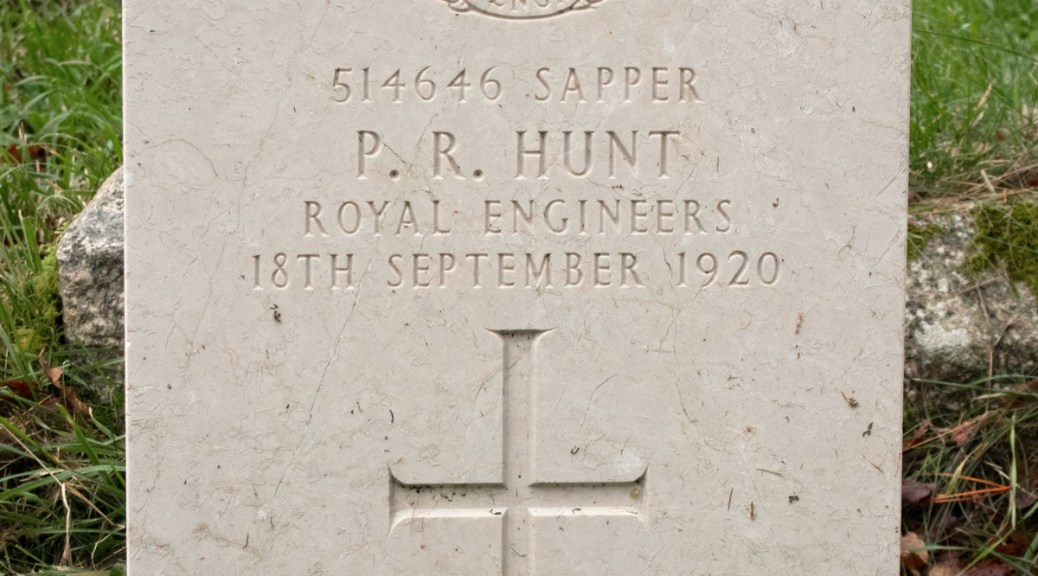
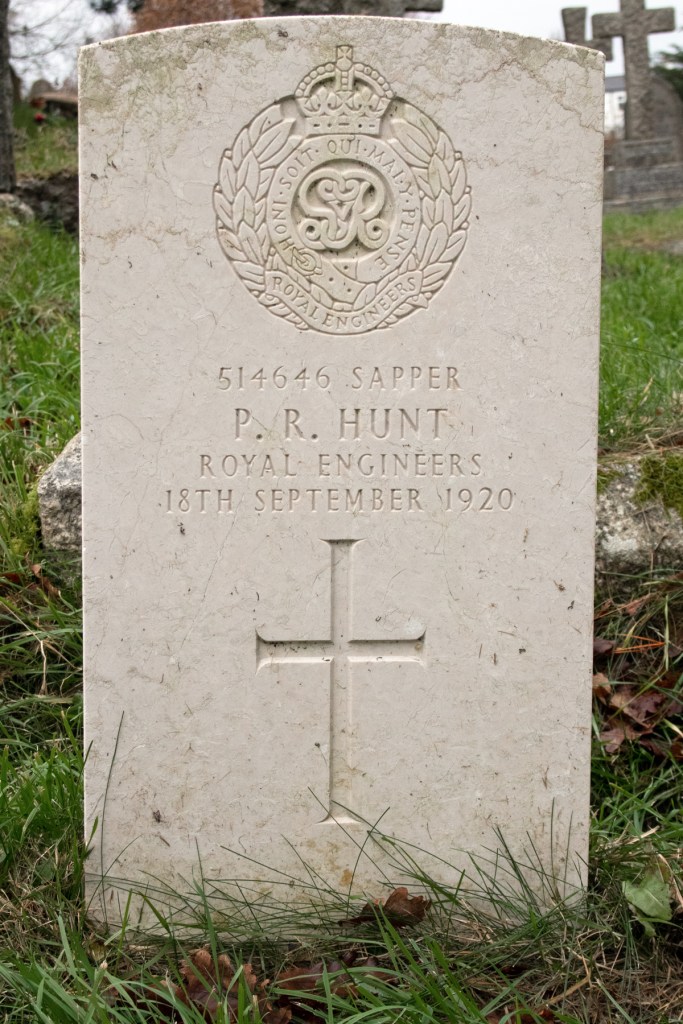
Percy Rendall Hunt was born on 25th May 1893, one of five children to Walter and Mary. Walter was a carpenter for the railway, and had been born in Newton Abbot, Devon, where he and Mary raised their young family.

When Percy left school, he found labouring work, but soon followed his father into carpentry. He met and married a woman called Ellen; the couple married, and went on to have two children. In his spare time, he volunteered for the Devonshire Royal Engineers and, when war broke out, despite now working in Chipping Sodbury, Gloucestershire, this was the regiment he joined.

Sapper Hunt enlisted on 2nd December 1914; his records show that he stood 5ft 7ins (1.70m) tall, had good vision and was of fit physical development. In March 1915, Percy was shipped off to Gibraltar, spending the next eighteen months in the territory. After a couple of months back in England, he was sent to France. He spent the next two years split between serving on home soil and with the British Expeditionary Force, before being demobbed in March 1919.

Percy returned to his old job with the railways, but, in December 1919, he found himself in court, charged with assault. Caroline Webber, an elderly married woman, was on the beach in Dawlish one afternoon, looking for shells, when a man approached her. According to a newspaper report:

“…suddenly he made a grab at me, put his hand under my clothes, and caught hold of my left knee. I screamed, and he ran away. ran after him because I was determined to see where he went. He went over to the railway wall, and disappeared under the archway of Dawlish tunnel.”

Western Times: Wednesday 24th September 1919

Mrs Webber went to the police, who returned to the police with her, then traced a trail of footprints back to the tunnel. Percy was questioned, but denied all knowledge of the incident, and of knowing Caroline. A plaster cast was taken of one of the footprints that evening, and a match alleged with his boots. Percy was committed for trial, with bail being allowed.

When the trial started in January 1920, the boots were again presented as evidence. However, on questioning, the policeman admitted than there had been a delay in getting the impression, and that “there were some other impressions in the sand at the time”.

For the defence, a number of witnesses saw Percy at work around the time of the incident, and the timings seemed to prove that he could not have had enough time to get to the beach and back to carry out the alleged assault. Based on this defence, the jury found Percy not guilty, and the case was concluded.

After this incident, Percy’s trail goes cold for a few months. The next record is that confirming his death, on 18th September 1920. The cause of his passing is not evident, but he was 27 years of age.

Percy Rendall Hunt was laid to rest in the graveyard of All Saints Church in Highweek, Newton Abbot, not far from his family home.


Seaman Alexander Kennedy

Seaman Alexander Kennedy

Alexander Kennedy was born in Cromore on the Isle of Lewis on 15th June 1895. He was one of five children – four of them boys – to John and Isabella Kennedy.

Living in the remote coastal township, he would have grown up knowing the sea and, when the opportunity arose, he volunteered for the Royal Naval Reserve. His service records show that he enlisted on 12th December 1913; they also note that he was 5ft 6.5ins (1.69m) tall, had blue eyes, a fresh complexion and a scar under his chin.

Seaman Kennedy was kept on a retainer until war broke out the following summer, at which point he was sent to the other end of the country – HMS Pembroke, the Royal Naval Dockyard in Chatham, Kent – for formal training. His time in the navy was then split between the dockyard and the battleship HMS Implacable.

Over the next couple of years, Seaman Kennedy toured the Mediterranean, berthing in Egypt, Malta and Gibraltar between stops back in the ports on the English coasts. By the summer of 1917, he had returned to HMS Pembroke for good.

At that point in the war, Chatham Dockyard was a particularly busy place, and Alexander was billeted in overflow accommodation set up in the naval barracks’ Drill Hall.

On the night of the 3rd September, the German Air Force conducted the first night time raid on England. Chatham came in the firing line, and the Drill Hall received a direct hit. Seaman Kennedy was among those killed. He was just 21 years of age.

Alexander Kennedy was laid to rest in the Woodlands Cemetery in nearby Gillingham, along with the other victims of the Chatham Air Raid.


Seaman Alexander Kennedy
(from ancestry.co.uk)

Private Albert Sparrow

Private Albert Sparrow

Albert Edward Sparrow was born in Frome, Somerset, in March 1880. One of four children, his parents were Albert and Louisa Sparrow. Albert Sr was a labourer at an iron foundry, and the family were raised close to the centre of the town.

When he left school, Albert Jr found work as a labourer. However, after his father passed away in 1895, he sought longer term prospects. On 11th November 1898 he enlisted in the Royal Fusiliers as a Private for a period of twelve years. His service records show that he stood 5ft 6in (1.67m) tall, weighed 115lbs (52.2kg), had brown eyes, curly brown hair and a sallow complexion.

During his time in the army, Private Sparrow served in Gibraltar, South Africa and Burma. He returned home in March 1903, was placed on reserve in November 1906, and then ended his contract four years later.

At this point, Albert’s trail goes cold. However, when war was declared, he was keen to play his part. He re-enlisted on 27th August 1914, and was assigned to the Somerset Light Infantry. Assigned to the 6th (Service) Battalion, he was sent to France in December that year.

In July 1916, while fighting at the Somme, he was hurt when he received a gunshot wound to his right buttock. The injury proved enough for him to be medically evacuated back to England, and he spent the next five months recovering, and then working, on home soil.

In December 1916, Private Sparrow was sent back out to France. Six months later, he contracted bronchitis and was again evacuated back to England. He was admitted to the Royal Infirmary in Liverpool and, after a month there, he was moved to the Plas Tudno Nursing Home in Llandudno to recover.

Albert’s condition meant that he could not continue in military service, and he was discharged from the army on 18th December 1917. He returned home to Somerset, but his lung condition proved too much; he passed away on 19th January 1918, at the age of 37 years old.

Albert Edward Sparrow was laid to rest in the graveyard of Holy Trinity Church in his home town of Frome.