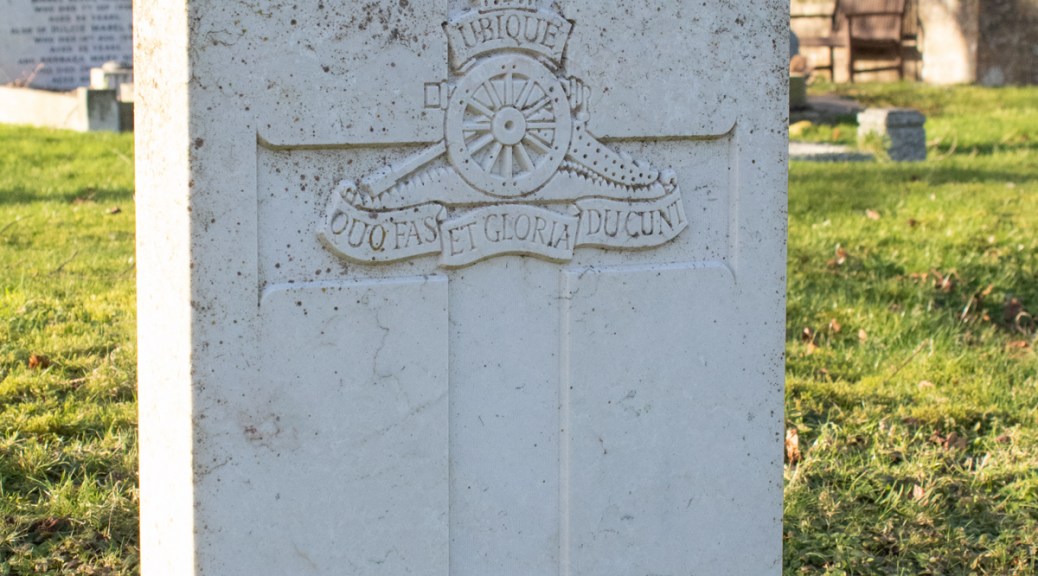
In a corner of the peaceful St Mary’s Churchyard in Codford, Wiltshire, is a headstone dedicated to L/17062 Gunner K Marsh. He served in the Royal Field Artillery, and passed away on 5th January 1916.
Gunner Marsh’s entry in the Army Register of Soldier’s Effects gives his first name – Kei – and that of his widow – Edith. The parish record for his funeral giving an age of 34 years old, and from here it is possible to piece together some of his family’s past.
Kei was born in Burnley, Lancashire, in the autumn of 1882, and was the son of engineer Alfred Marsh. He and Edith married in 1907, and were living with her widowed mother, Sarah, and their three children, John, Sarah and Edith, by the time of the 1911 census. The house – 30 Thorn Street in Burnley – was crowded. Along with the Marshes, Sarah also had her other six children living with her: a total of eight adults and four children sharing four rooms in the small terraced house.
Kei was working as a miner by this point, but had enlisted in the Royal Field Artillery by the summer of 1915. He acted as a Gunner in the 32nd Division Ammunition Column, although it is unclear whether or not he spent any time overseas.
By the end of 1915, Gunner Marsh had been admitted to the military hospital in Codford. The cause of his admission is unclear, but it was to be one that he was to succumb to: he passed away on 5th January 1916. Kei lies at rest in the quiet Wiltshire churchyard.
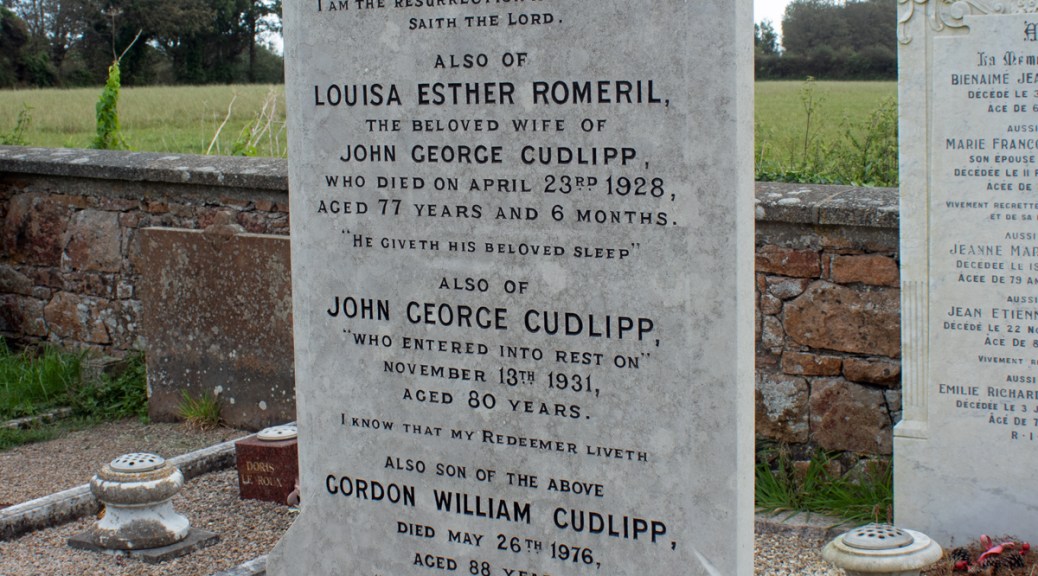
Herbert Henry Cudlipp was born in St Peters, Jersey, in around 1891. He was one of ten children to farmers John and Louisa Cudlipp. The family had moved to Mont à L’Abbé, on the outskirts of St Helier, by the time of the 1911 census, at which point the whole family were involved in the farm in one way or another.
Little information is available about Herbert’s military life. He enlisted in the Royal Garrison Artillery at some point during the war, and was attached to the 38th Siege Battery. The unit was based in Egypt from December 1915, and later moved to France. However, records are unclear as to when and where Gunner Cudlipp served.
Details of Herbert Henry Cudlipp’s later life are also lost to time. Herbert survived the war, but died on 4th June 1919, at the age of 28 years old. He was laid to rest in the family plot in Macpela Cemetery, St John’s, Jersey.
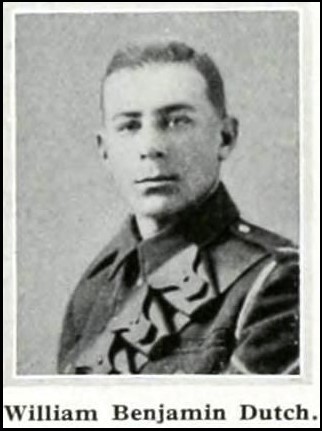
DUTCH, WILLIAM BENJAMIN, Sergt., No. 83812, 47th Brigade, Royal Field Artillery, [son] of William Dutch, of Bladud House, Bath, Accountant, by his wife, Alice, [daughter] of Alderman Alfred Taylor, of The Red House, Bath; b. Lower Weston, Bath, 21 April 1894; educ. Bathforum, and Bath City Secondary School 93 years’ Scholarship), and was employed in the engineering works of Stothert and Pitt Ltd., of Bath. He joined the Army, 17th Aug. 1914; was made Bombardier, 1 November 1914; Corpl., 14 November 1914; and Sergt., 1 January 1915; and died at the Thornhill Isolation Hospital, Aldershot, 11 April 1915, of septic scarlet fever; [unmarried]. He was buried at Locksbrook Cemetery, Bath, will full military honours. His Capt. wrote: “I cannot exaggerate the loss he is to me personally and to the whole battery, had picked up a wonderful knowledge of gunnery and his work in general was out and out the best sergeant I had, and would have gone far in the service.” He was a keen sportsman and a popular football player.
[De Ruvigny’s Roll of Honour, 1914-1919]
William Benjamin Dutch was the second of five children to William and Alice. His father initially worked as a grocer and wine and spirit shopkeeper, and the 1901 census found the family living above the shop on the corner of Chelsea Road and Park Road, Bath.
By the time of the 1911 census, however, things had changed. The Dutches had moved to Walcot, nearer the centre of Bath, and William was working as a tramway clerk. Alice was running the family home – 3 Bladud Buildings – as a boarding house, and employed a housemaid and kitchen maid to help look after the lodgings.
William’s dedication to his army role – and his rapid rise through the ranks – is outlined in the article above. He seems, however, to have spent his time on home soil, remaining at his Hampshire base from his enlistment to his passing. His service records give an insight into his physical nature: he stood 5ft 6.5ins (1.69m) tall, and weighed 153lbs (69.4kg). He had light brown hair, grey eyes and a fresh complexion.
Serjeant Dutch’s illness seems to have come on him quickly:
On Sunday a telegram reached [his parents] saying that their son… was seriously ill in hospital at Aldershot. Mr Dutch went thither at once, only to find that his son had passed away. He was attacked last week with bronchial pneumonia, and tracheotomy was performed in the hope of saving his life, but in vain. The deceased was… a young soldier of rare promise and fine physique.
[Bath Chronicle and Weekly Gazette – Saturday 17 April 1915]
William Benjamin Dutch was just 20 years old when he passed away. His body was taken back to Somerset for burial. He was laid to rest in the family plot in Bath’s sweeping Locksbrook Cemetery, within sight of William Sr’s former shop on Chelsea Road.
On Saturday last an inquest was held at the Seaman’s Institute on the body of Gunner Wm. Moore, RNTS.
Mrs Brennan, sister of the deceased, stated that he was 43 years of age, and lived when off duty with her at Somerville, Seacombe, Cheshire. He joined the Royal Marine Light Infantry over 20 years ago.
Mr R Sussex Langford, Lloyd’s agent, stated that he saw deceased on landing. He help to get him into a cart, but found he was too ill to travel that way, so he had him put on an ambulance and taken to the Royal National Mission for Deep Sea Fishermen, and immediately sent for the doctor. Deceased was semi-conscious and very sick. He was a gunner from a torpedoed ship. Deceased died on Thursday [25th July 1918] at 6 o’clock.
Dr Sargent stated that he was called on the 23rd to see deceased, and found him semi-conscious, complaining of great pain in the abdomen and vomiting. He lay in that condition until the 25th, when death took place. The cause of death was acute traumatic peritonitis, the result of injuries received by the explosion of an enemy torpedo.
[Newquay Express and Cornwall County Chronicle – Friday 02 August 1918]
Other than the details outlined in the newspaper report, little concrete information is available about the life of William Moore. The name does crop up in the 1891 census in Seacombe, Cheshire, and, if this relates to Gunner Moore, then he was one of five children to widowed lithographer Margaret Moore. Beyond that one census, however, it is not possible to find any more specific details.
William was on board the steam ship SS Anna Sophie in the summer of 1918, which was sailing from Rouen to South Wales, On 23rd July, she was torpedoed by the German submarine U-55 off Trevose Head, Cornwall. The Anna Sofie was sunk, Gunner Moore was one of those who subsequently passed from their injuries.
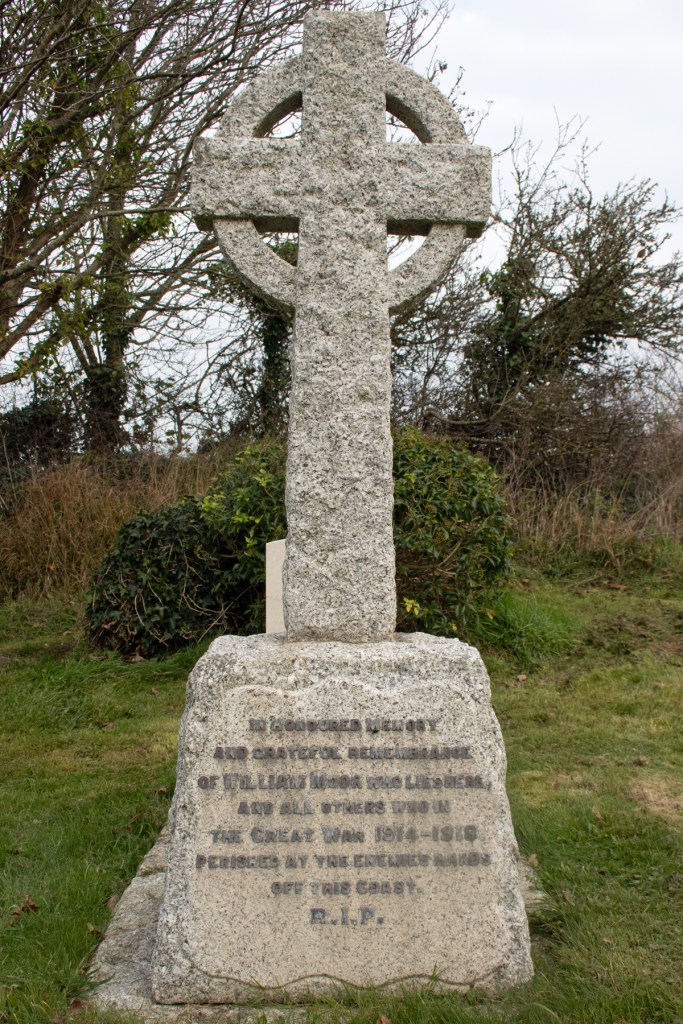
William Moore’s sister may not have been able to pay for her brother to be brought back to Cheshire for burial. Instead, he was laid to rest in Padstow Cemetery, and shares his resting place with another member of the crew, Lance Corporal William Whitmore.
William’s headstone reads: “In honoured memory and grateful remembrance of William Moor [sic] who lies here, and all others who in the Great War 1914-1918, perished at the enemies hands off this coast. RIP.”
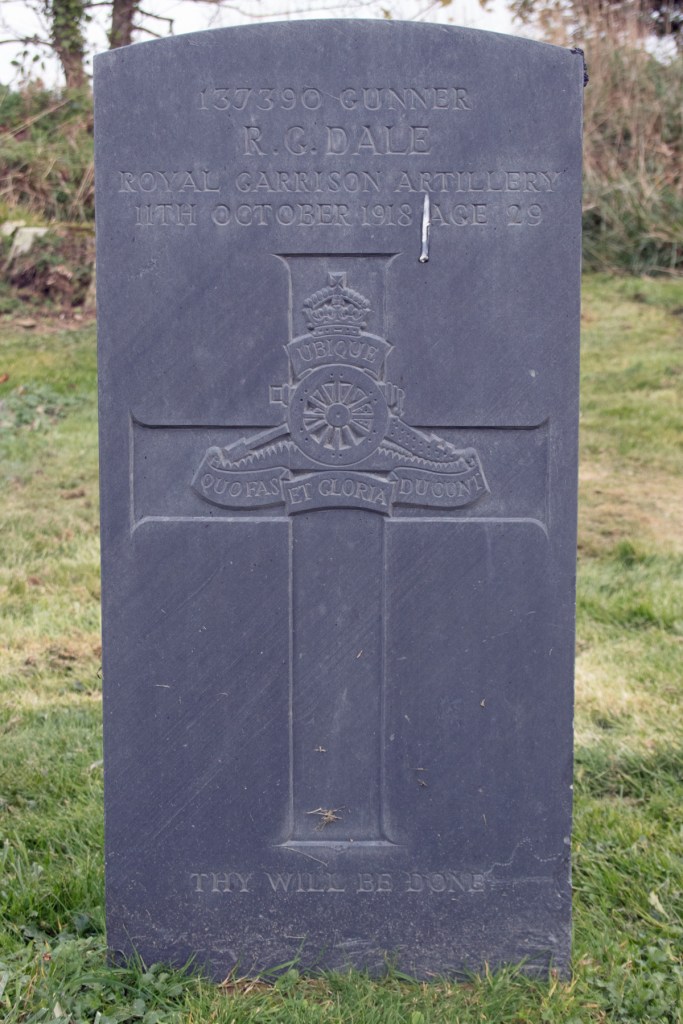
Richard George Dale was born Padstow, Cornwall, in the summer of 1889, the oldest child to Alice Dale. She married Frederick Bryant in March 1894, but and went on to have two children – Frederick and Albert – but, by the time of the 1901 census, her husband has passed away. The document gives Richard’s surname as Bryant, but there is no real indication that he was Frederick’s son.
Alice had been living with her greengrocer parents, but the 1901 census in a small cottage off Lanadwell Street, a couple of door away from them. As a widow at 31 years old, she is noted as being on parochial relief.
Details of Richard’s later life are a challenge to track down. Absent from the 1911 census, it was around that time that he married Agnes MacKintosh. While she was born in Edinburgh, the wedding took place in St Columb, Cornwall.
When war broke out, Richard was working as a farmer. He enlisted the day after hostilities were declared, and joined the Royal Garrison Artillery. Gunner Dale was, according to the records, 5ft 3ins (1.6m) tall, with medium colour hair, blue eyes and a fresh complexion. He had a scar between his eyebrows.
Gunner Dale served for nearly four years, all the time being based on home soil. He suffered from epilepsy, however, and this is what led to his eventual discharged from armed service in March 1918.
Richard returned home, but his health was compromised. He passed away on 11th October 1918, from a combination of influenza and pneumonia. He was 29 years of age.
Richard George Dale was laid to rest in Padstow Cemetery, in sight of his younger brother Albert, who had passed away eleven years before.
The life Albert Bendell is one of dedication to naval service. Born in Portsmouth on 28th May 1865, his parents were Master at Arms John Bendell and his Jersey-born wife, Eliza.
The family had moved to St Martin, Jersey, by the time of the 1871 census. Given the amount of time her husband spent at sea, it would seem likely that Eliza, who had three young children to raise on her own, wanted to be close to her family.
Albert was keen to follow in his father’s footsteps and, on 6th December 1880 he enlisted in the Royal Navy. Just fifteen years old, his service records show that he was just 5ft 1.5ins (1.56m) tall, with blue eyes, light hair and a fair complexion.
Albert’s dedication to the role was obvious: starting off as Boy 2nd Class, he steadily – and rapidly – rose through the ranks. Over the next twelve years, he served on seven ships and shore bases. He was promoted to Boy 1st Class in September 1891, while serving on the training ship HMS St Vincent.
When he came of age in May 1883, he was given the rank of Ordinary Seaman: within a year he had risen to Able Seaman, and achieved the role of Leading Seaman in January 1888. Just three months later, Petty Officer Bendell was beginning a two-year service on board HMS Fearless.
In April 1893, Albert received a further promotion, and a change in direction within the Royal Navy. He was now a Gunner, a standing officer’s role, permanently attached to HMS Duke of Wellington – returning to the first ship he had been assigned to nine years earlier.
On 17th September 1900, Albert married Amelia Renouf, the daughter of a land proprietor from St Martin, Jersey. The couple wed in St Helier, Albert giving his profession as Warrant Officer. At 37, Amelia was a year older than her new husband: the couple would not go on to have any children.
Albert’s rise through the ranks continued. The 1911 census found him moored in Malta. He was Chief Gunner on HMS Egmont: the importance of his role on board highlighted by the fact that he was the 11th person out of 188 to be recorded on the document.
When war came to Europe, Albert served his King and Country proud. He was promoted to the rank of Lieutenant and, in June 1919, he was awarded the MBE “for valuable services as Officer-in-Charge, Defensively Armed Merchant Ships, Southampton.” [The Edinburgh Gazette, 1st July 1919]
This distinguished life was beginning to take its toll, however, and, on 16th March 1920, after nearly 40 years in naval service, Albert was medically stood down. Suffering from dyspepsia, he returned to Jersey, and his home, La Rosaye, in St Martin.
Albert Bendell’s health was to get the better of him. He passed away on 26th April 1920, at the age of 54 years of age. He was laid to rest in the peaceful graveyard of St Martin’s Church, Jersey.
Amelia remained on the island for the remainder of her life. She passed away on 31st August 1943, at the height of Jersey’s German occupation, at the age of 80 years old. She was laid to rest with Albert, husband and wife reunited after more than 23 years.
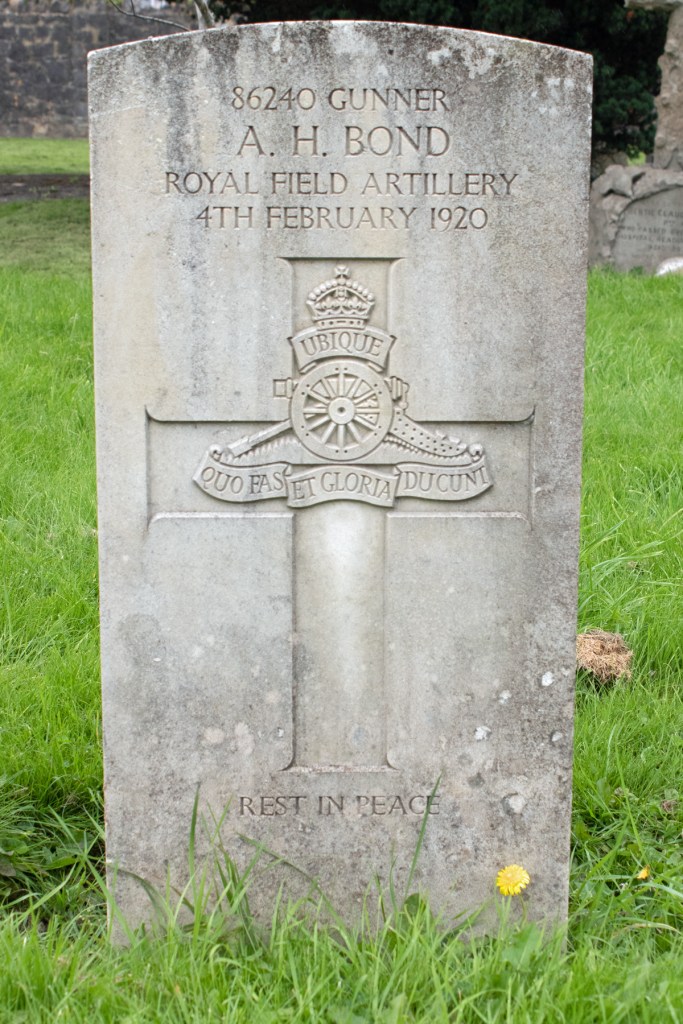
Arthur Henry Gordon Bond was born on 28th July 1894 in Huntspill, Somerset. He was the younger of two children to Henry and Sarah. Henry was a sawyer, something Arthur’s older brother, Frederick, also became. According to the 1911 census, however, Arthur took work as a land refiner. The family were living in a four-roomed cottage on Clyce Place, to the south of the town, overlooking the river.
Details of Arthur’s military career are sparse. He enlisted in the Royal Field Artillery and was attached to the 5th Reserve Brigade. It is unclear whether we served overseas or not, but Gunner Bond survived the war as was eventually stood down on 7th May 1919.
At this point, Arthur’s trail goes cold although he seems to have returned to Somerset. He passed away on 4th February 1920, his death being registered in Shepton Mallet. He was 25 years of age.
Arthur Henry Gordon Bond was laid to rest in Highbridge Cemetery, walking distance from where his family still lived.
William James Stevens was born in the autumn of 1891, and was the fourth of eight children to William and Emily Stevens. William Sr was a carter on a farm in Stogumber, Somerset, and this is where the family would come to be raised.
William Jr followed his father’s trade when he finished his schooling, but stepped up to serve his King and Country when war was declared. Little information remains about his time in the army, but it is clear that he had enlisted in the Royal Field Artillery by the spring of 1916.
The only other records relating to William are those connected to his passing. He was discharged from the army on medical grounds in November 1916, and was suffering from tuberculosis. He appears to have been admitted to a hospital that winter, and died from the lung condition on 16th February 1917. He was 25 years of age.
William James Stevens was laid to rest in the tranquil surroundings of St Mary’s Churchyard in Stogumber.
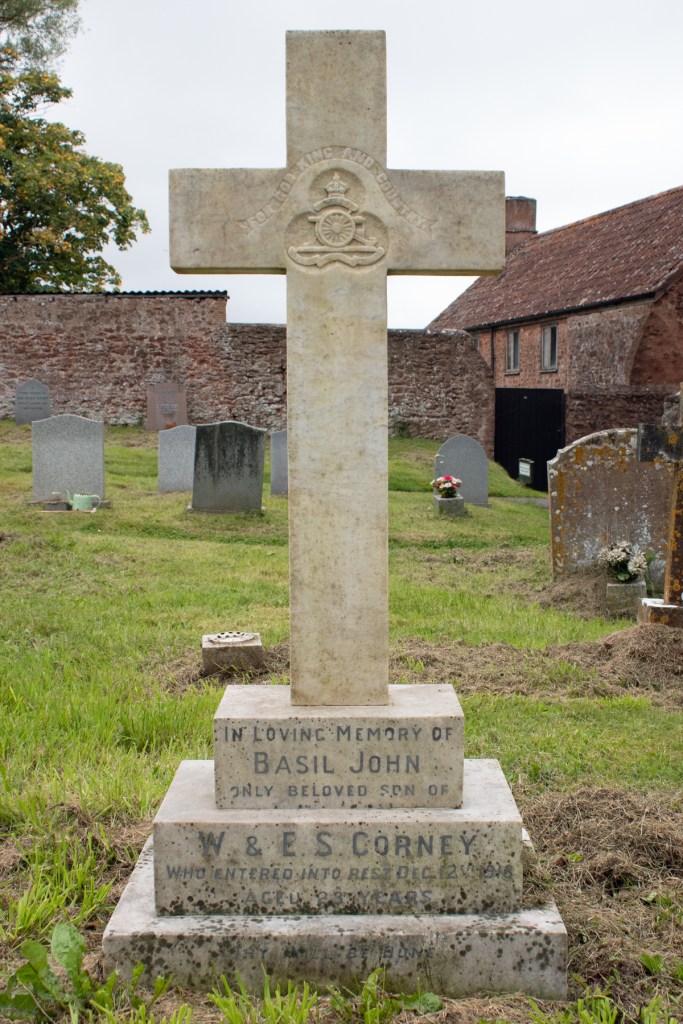
Basil John Corney was born in Berrynarbor, Devon, in the summer of 1895. The fourth of five children, his parents were William and Elizabeth. William’s work as a farm bailiff, took the family across the area: by 1901, they had moved to Shapwick in Somerset, and the next census record, in 1911, found the family living in Stogumber, where William had taken up management of the White Horse Hotel. Basil, meanwhile, was employed as a butcher’s assistant in the village.
When war came to Europe, Basil stepped up to serve his King and Country. He enlisted on 10th December 1915 and, from this point, preferred to go by his middle name, rather than his first. He asked to be assigned to the Royal Army Service Corps, but by the time he was mobilised in April 1916, he was attached to the Royal Garrison Artillery. Gunner Corney’s service records show that he was 20 years and 8 months old, stood 5ft 10ins (1.77m) tall and weighed 155lbs (70.3kg).
Basil was assigned to the 143rd Siege Battery and, by August 1916, he was sent to France. His time in Europe was to be brief, however, as, on 1st October, he was shot and wounded by shell fire in his right knee while fighting at the Somme. Invalided to Britain for treatment, he eventually seemed to recover, and was transferred to the regiment’s No.2 Depot.
In April 1918, Gunner Corney was admitted to hospital in Edmonton, Middlesex, as his injury was causing some issues again. An examination identified that his kneecap had all but disintegrated, and this led to his eventual dismissal from armed service on medical grounds. He left the Royal Garrison Artillery on 14th November 1918 and was awarded the Silver Badge, noting the reason for him not being in the army.
Basil returned to Somerset, but his time back with his family was to be brief. He passed away at home on 12th December 1918: he was 23 years of age.
The body of Basil John Corney was laid to rest in the peaceful graveyard of St Mary’s Church in Stogumber, across the road from, and within sight of, where his family still lived and worked at the White Horse Hotel.
Lot Evans was born in Street, Somerset, on 30th October 1895. The second of two children, his parents were George and Elizabeth Evans. Lot’s mother had four children from a previous marriage and, by the time of the 1901 census, the family had set up home in the coastal village of Brean. George was employed as a farm labourer there, as were Lot’s older half-brothers.
When Lot completed his schooling, he also found work as a farm labourer. The next census return, in 1911, recorded the family of four still living in Brean. George had eased up on the manual work – he was 67 by this point – and was employed as a domestic gardener. Lot’s older brother Ben was a bricklayer’s labourer, so there were three wages – albeit probably meagre ones – coming in to support the household.
When war came to European shores, both Lot and Ben stepped up to play their part. Lot enlisted on 10th November 1915, but was not actually mobilised until January 1918. He joined the Royal Garrison Artillery as a Gunner, and was assigned to the 4th Siege Battery.
On 28th March 1918, Lot married his sweetheart, Hester Puddy. Theirs was to be a brief honeymoon, as he was sent to France just three days later.
Gunner Evans remained overseas until the end of the year, returning home on 5th February 1919 in advance of being demobbed.
He was very ill with influenza. He went to bed and we had the Doctor. It developed into pneumonia and he died last night [13th February 1919].
Letter from Private Ben Evans to the Royal Garrison Artillery
Gunner Evans was just 23 years old when he died. The letter sent by his brother – who was also at home and waiting to be demobbed from the Wiltshire Regiment – explained that Hester was living with their family and his question to the regiment concerned how to claim his brother’s pension.
Lot Evans was laid to rest in the graveyard of St Bridget’s Church in Brean. Now surrounded by caravan parks and holidaymakers, at the time, this would have been a place of sanctuary bordering the Somerset coastline.












 Death and Service