Arthur Reuben Thomas was born in Banwell, Somerset, on 27th September 1899. The older of two children, his parents were blacksmith Edwin Thomas and his wife, Mary.
Little information about Arthur’s life is documented. At the time of the 1911 census he was still a schoolboy, and it is likely that he helped his father out in the smithy when he finished his education.
By this point war was raging across Europe, and it is likely that young Arthur was keen not to miss out. Details of any military service are lost to time, but it seems possible that he joined up as soon as his age allowed.
Private Thomas was assigned to the 53rd (Young Soldier) Battalion of the Hampshire Regiment, and sent to Rollestone Camp on Salisbury Plain, Wiltshire, for training.
Sadly, Arthur’s time in the army seems to have been a short one. He was admitted to a camp hospital in nearby Tidworth, suffering simply from ‘disease’, and it was from this that he passed away on 6th January 1918. He was just eighteen years of age.
Arthur Reuben Thomas’ body was brought back to Somerset for burial. He was laid to rest in the quiet graveyard of St Andrew’s Church in his home village of Banwell.
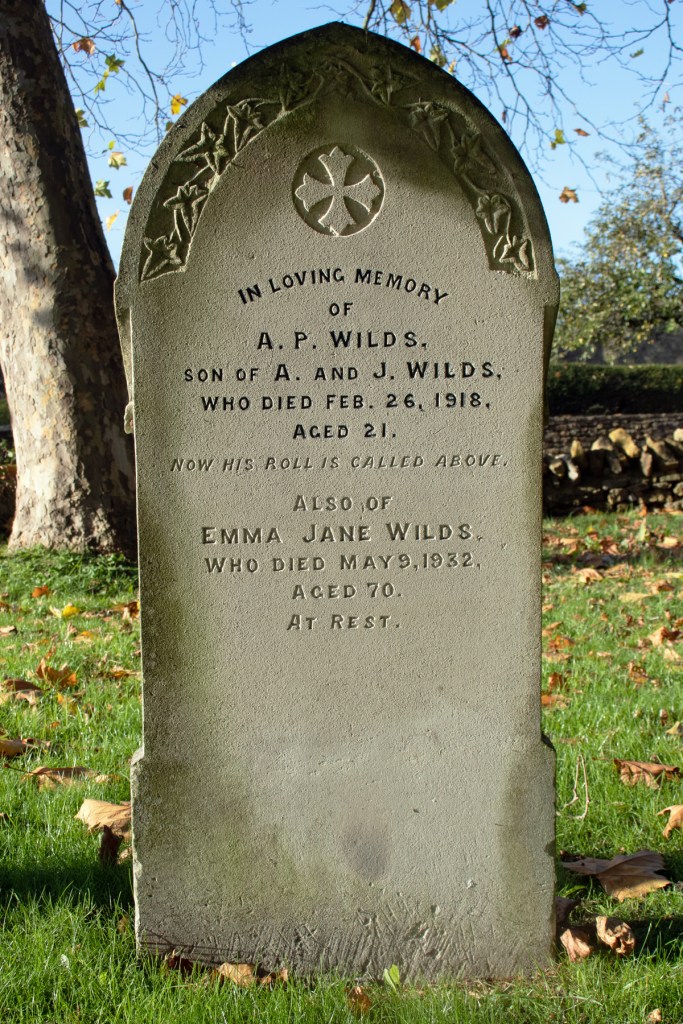
Archibald Percy Wilds was born in 1896 in Kilmington, Somerset. The youngest of three children, his parents were dairy farmers Charles and Emma Wilds. Charles passed away when Archibald was just a toddler, and with the help of her family, Emma raised their children while maintaining the business.
When he left school, Archibald also helped out on the farm, but war was coming, and he wanted to play his part for King and Country. Details about his service are sketchy, but it is clear that he joined the Somerset Light Infantry as a Private, before transferring to the Hampshire Regiment. He was assigned to the 15th (Service) Battalion, also known as the 2nd Portsmouth.
While Private Wilds’ battalion saw action in France, it is unclear whether he went with them. His records show that he was awarded the Victory and British Medals for his time in the army, but they do not give a date for him embarking for the continent.
The only other records relating to Private Wilds are those confirming his passing. The Army Register of Soldiers’ Effects confirms that he passed away on 26th February 1918 in a military hospital, while another database suggests that he died of wounds, although it is not possible to confirm how he was injured, or where specifically he passed. What can be confirmed is that he was just 21 years of age when he died.
Archibald Percy Wilds was brought to Somerset for burial. He was laid to rest in the family plot in the graveyard of St Michael’s Church in Blackford, not far from where his mother still lived.
Emma Wilds went on to live until she was 70 years old. She passed away in 1932 and was also laid to rest in the family plot, reunited again with her husband and son.
Alexander Popham Spurway was born on 8th April 1891 in Newbury, Berkshire. He was the second of six children to Edward and Gertrude Spurway. Edward was a clergyman, and the family moved to Heathfield in Somerset when Alexander was a small boy. Education was key to Edward and, the 1901 census records show Alexander as being a boarder at the Portmore School in Weymouth, Dorset.
Reverend Spurway set the family up well in Heathfield: by the time of the next census in 1911, the family were living in the village rectory, with five members of staff.
Alexander, meanwhile, had taken a different route, entering the Royal Naval College at Osborne on the Isle of Wight in January 1904. He was a keen sportsman and, while there, he represented the college at both cricket and football.
In September 1908, he passed out from the college as a Midshipman, and served on HMS Canopus in the Mediterranean. His career continued, and he was made Sub-Lieutenant in December 1911, and Lieutenant two years later.
Reverend Spurway died at home in February 1914 and, by the time war broke out, Lieutenant Spurway was assigned to HMS Achilles. He remained on board the cruiser for the next two years and it was during this time that he developed diabetes: something that was to prove an ongoing issue for him.
Returning home in the autumn of 1915, the condition was to prove too much, and he passed away on 29th November 1915, at the age of 24 years old.
Alexander Popham Spurway was laid to rest in the graveyard of his late father’s church, St John the Baptist in Heathfield.
Lieutenant Spurway (from findagrave.com)
Sadly, Alexander was not the only member of the Spurway family to lose their life as a result of the war.
Richard Popham Spurway, Alexander’s older brother, was a 2nd Lieutenant in the Somerset Light Infantry, and was attached to the Hampshire Regiment, when it was moved to Gallipoli in 1915. He was killed on 13th August 1915, and is commemorated on the Helles Memorial at Canakkale, Turkey.
Alexander’s younger brother, George Vyvyan Spurway, joined the Royal Fusiliers, before transferring to the Machine Gun Corps. He had arrived in France in September 1916, and was killed while fighting on the Western Front on 28th March 1918. He was laid to rest at Arras and is commemorated on the memorial there.
Victor Frank Langdon was born in the autumn of 1897, the only child to Francis and Martha Langdon. Frank was a carter and cowman from Clatworthy in Devon, but it was in Bradford-on-Tone in neighbouring Somerset that Victor was raised.
Victor was 16 years old when war was declared, but he was still keen to play his part. While full details of his military service are not available, he initially enlisted in the Hampshire Yeomanry, before transferring across to the 15th (Service) Battalion of the Hampshire Regiment in 1917.
Records suggest that Private Langdon served as part of a territorial force and, by the summer of 1918, was based in Norfolk. It was here that he fell ill, and, while in the camp hospital on 15th June 1918, he passed away. Details of his condition are lost to time, but it was noted as “disease”. He was just 21 years of age.
Victor Frank Langdon was brought back to Somerset for burial. He lies at rest in the graveyard of St Giles’ Church, in his home town of Bradford-on-Tone.
Herbert William Towell was born in the autumn of 1899, the oldest of six children to James and Prudence. James was a wool sorter in a factory, who had been born in Rockwell Green, on the outskirts of Wellington, Somerset, and this is where he and Prudence raised their children.
The Towell family were locals to Rockwell Green. James’ brother Charles lived just a few doors away from him and the 1911 census recorded James and Prudence living at 105 Rockwell Green Road, while Herbert, aged eleven, was living with his paternal grandparents, William and Charlotte, at 131 Rockwell Green Road.
When he left school, Herbert found work as an engine cleaner. War, however, was imminent and he was keen to play his part, but was initially too young do so. His time came, though, and on 30th June 1917 he was enlisted into the 34th Training Reserve Battalion.
At seventeen years and nine months, Private Towell’s service record gives his height as 5ft 11ins (1.80m), his weight as 144lbs (65.3kg) and confirms that he had a mole on his right cheek. He was initially assigned to the 53rd (Young Soldier) Battalion of the Hampshire Regiment, and posted to the army base at Durrington, close to Stonehenge.
In November 1917, Private Towell was admitted to the camp hospital with diarrhoea. Sadly, he had also contracted tuberculosis and it was recommended that he spend some time in a sanatorium. On 6th February 1918, he was discharged from service on medical grounds, and ordered to present himself for review the following year.
Herbert was not to get the chance to do so: within a month of his discharge he succumbed to the lung condition, breathing his last on 5th March 1918. He was just 18 years of age.
Herbert William Towell was brought back to Somerset for burial. He was laid to rest in Wellington Cemetery, within sight of his parents’ home.
Tragedy was to strike James and Prudence again less than a year later, when Herbert’s younger sister, Florence, passed away, aged just ten years old. No further information about her passing is available, so she may also have succumbed to one of the lung conditions running rampant across Europe in the aftermath of the war.
Thomas George Willcocks was born on 18th April 1882, in the Devon village of Chudleigh Knighton. The oldest of five children, his parents were William Willcocks and his wife Emma. William worked as a clay cutter, and this was a trade Thomas followed when he left school.
By 1899, Thomas had met Sophy Gale, a clay cutter’s daughter from nearby Hennock; the couple married and had a daughter, Violet. Thomas was also working as a cutter, and moved into his in-laws house to start raising his young family.
Life can be cruel: the 1911 census shows that Thomas and Sophy had moved to Chudleigh Knighton – where Sophy was originally from. Violet had, by this point, sadly passed away; Thomas’ brother-in-law, Albert, had moved in with the couple to help pay their way.
War was coming to Europe and, although full details of Thomas’ service no longer remain, it is possible to piece together some of his time in the army.
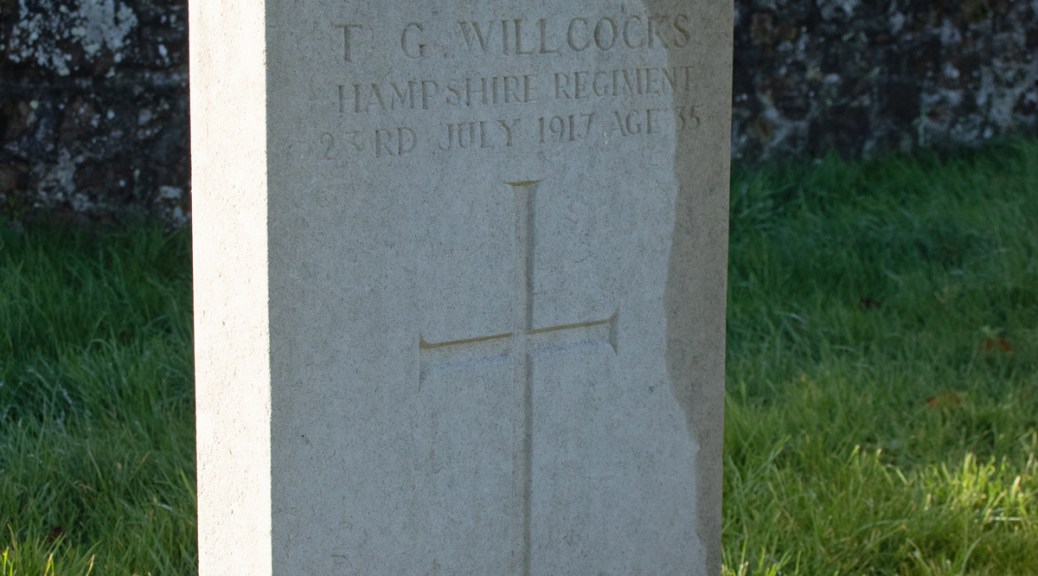
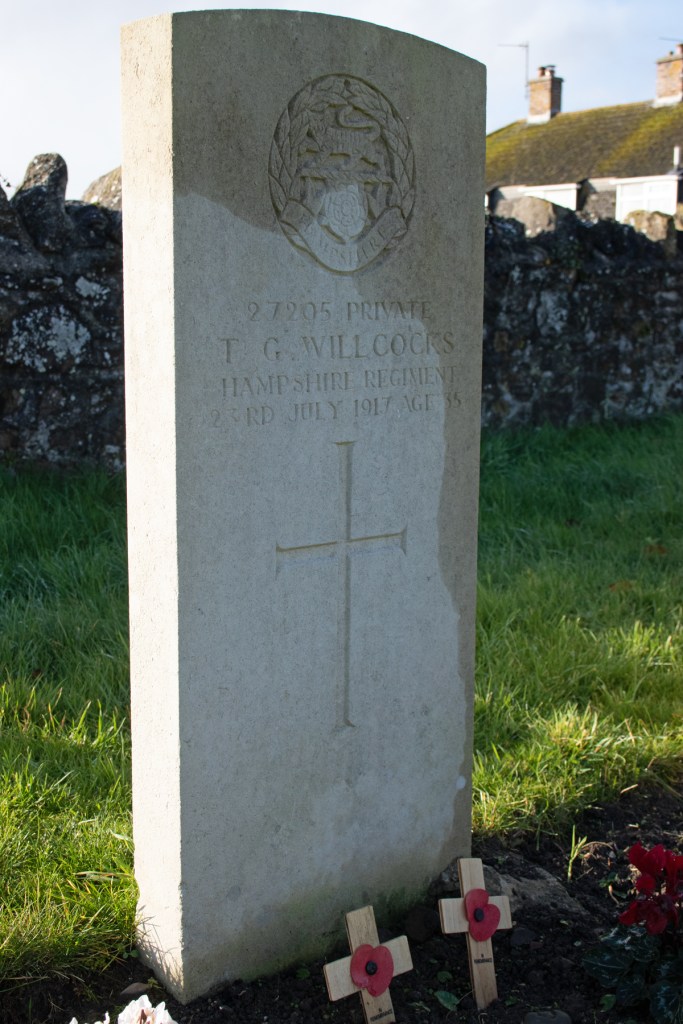
Private Willcocks enlisted in the Duke of Cornwall’s Light Infantry at some point before January 1917, although he soon transferred across to the Hampshire Regiment. His battalion – the 15th – were moved to France in the summer of 1916, and it seems that Thomas was caught up in a gas attack, while in the trenches of the Western Front.
Private Willcocks’ health deteriorated and he was medically evacuated back to the UK for treatment. He was admitted to the Red Cross Hospital in Glasgow, but reports are confused – some identify the impact of the gas on his lungs, while others suggest he was suffering from rheumatism and trench fever. Regardless of the cause, he passed away on 23rd July 1917 at the age of 35 years old.
The body of Thomas George Willcocks was brought back to Devon for burial. He was laid to rest in the graveyard of St Paul’s Church in Chudleigh Knighton.
Thomas’ brother in law, Albert, also died as a result of the First World War; he lies in the grave next to Thomas. His story can be found here.
Thomas’ neighbour was Alfred Moist. He also lies in the same churchyard and his story can be found here.
Sidney William Alner was born in Shaftesbury, Dorset, in March 1899, one of eleven children to Sidney and Ellen Alner. Sidney Sr was a grocer’s porter, and the family lived on the celebrated Gold Hill in the town.
War was to come when Sidney Jr was only young – he had just turned 15 when it broke out. He saw his older brothers go off to war and was obviously keen to do his bit as well. Until he was old enough, however, he worked as an errand boy for his father’s employers, Stratton Sons and Mead.
His time would come, of course, although dates for Sidney’s enlistment are not clear. A contemporary newspaper record confirms that he arrived in France in January 1918, so it is likely that Private Alner joined up at some point during the previous year.
He joined the Hampshire Regiment, and was assigned to the 1st Battalion. Heavily involved during most of the conflict, the battalion was seen as key to the Final Advance of the autumn of 1918. Private Alner was caught up in the fight to break the Hindenburg Line, fighting on the River Selle and capturing the town of Monchaux.
It was while his battalion was advancing on the village of Préseau on 2nd November, that Private Alner was injured. Shot in the arm, he was evacuated back to England, and admitted to the Cambridge Military Hospital in Aldershot. He would have survived his injuries, had pneumonia not set in, and it was to this that he would succumb on 19th November. He was just 19 years old.
Sidney William Alner’s body was brought back to Dorset. He lies at rest in the Holy Trinity Churchyard in Somerset, within walking distance of his family’s home.
Sidney was the second member of the Alner family to die as a result of the Great War.
His older brother Harry, who had become a chauffeur and went to live in London, joined the Royal Army Service Corps in 1915. Private H Alner had served three years in France when he was killed on the front line just three weeks before his brother. He was 32 years old, and left a widow and two children.
When researching Sidney Alner in newspaper articles, an interesting report surfaced.
An unfortunate accident has happened to a little girl, not quite four years old, the daughter of Sidney Alner, who resides in Gold Hill. Heals’ steam hobby horses visited the town on Friday and Saturday in last week, and on the evening of the former day, Alner took his little girl for a ride on the horses.
Whilst they were in motion, the bolt that kept the horse on which Alner sat with his child attached to the connecting rod came out, and he and the little girl were precipitated to the ground.
Alner escaped without injury, but his daughter had one of her legs fractured above the knee. She was taken home, and Dr Evans set the injured limb. Later in the evening she was removed to the Westminster Cottage Hospital.
Salisbury and Winchester Journal: Saturday 31st October 1891
This Sidney Alner was Private Alner’s father, and the daughter would have been his older sister Sarah. Nothing more is reported of the incident, and Sarah went on to live until 1945, when she was 57 years old.
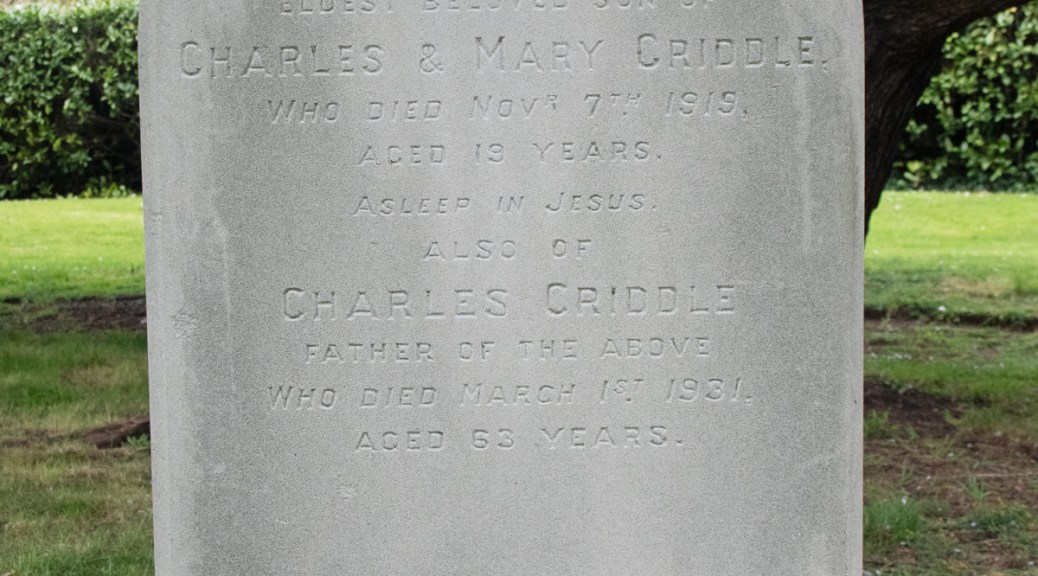
Charles Pretoria Criddle was born on 18th June 1900, the second of five children to Charles and Mary Criddle. Charles Sr was an army reservist, who worked as a labourer for the local council, and the family lived in Taunton, Somerset.
Sadly, little detail of Charles Jr’s life is documented. The Great War broke out when he was only 14, so was too young to enlist at the beginning of the conflict. However, he did volunteer, albeit later on, and joined the 15th Battalion of the Hampshire Regiment at some point in 1918.
Private Criddle’s was one of those lives to be cut tragically short, not by conflict, but by illness. He survived the war, but was subsequently admitted to a military hospital in Brighton, Sussex, where he passed away ‘from disease’ on 7th November 1919. He was just 19 years of age.
Charles Pretoria Criddle lies at rest in the St James Cemetery in his home town of Taunton, Somerset.
Tragedy was to strike again for Charles Criddle Sr. Less than a week after his son had passed, he was called upon to identify the body of his sister, Emma Cable. She had taken her own life after suffering an increasing number of fits over the previous few years.
Emma was a widow, and, since the previous winter, had become increasingly depressed and less physically able, having suffered a debilitating bout of influenza. Early on the morning of Sunday 16th November 1919, she took herself out, dressed in only her nightgown and a pair of boots, and had drowned herself in the River Tone.
At the inquest into her passing, her doctor noted that he had seen her on the previous Thursday “but her condition was not such that he could certify her as insane, but she had been violently hysterical.” [Taunton Courier and Western Advertiser: Wednesday 19th November 1919]
The Coroner recorded a verdict that the deceased drowned herself while of unsound mind.
John Valentine Thick was born in 1883, the youngest of two children to John Thick and his wife Anna. John Sr was a plumber, and evidently moved around with his work. He was born in Surrey, Anna came from Berkshire; their older child, Grace was born in Hampshire, while John Jr was also born in Berkshire.
By the time of the 1891 census, John Sr had moved the family down to Blandford Forum in Dorset. Little more is known about his son’s early life, but by 1907, he was back in Berkshire, and married Henrietta Entwistle, who had grown up in Chelsea.
The young couple went on to have three children – John, Muriel and Margaret – and settled down in Reading, Berkshire. John, by this time, was working as a domestic gardener.
Little documentation exists relating to John’s military service. He enlisted in the Hampshire Regiment, and was assigned to the 1st Labour Company. Private Thick would have been part of the regiment’s territorial force, presumably using his gardening skills to help with the war effort.
While it is difficult to confirm the dates of his service, it seems that John had enlisted towards the end of 1916. It was early the following year that he fell ill, and was soon admitted to hospital with bronchitis. Sadly, this condition was to get the better of him, and Private Thick passed away on 8th March 1917. He was just 34 years old.
John Valentine Thick lies at rest in St Mary’s Cemetery in Taunton, Somerset.
William Diamond was born in around 1888, although documentation relating to his life are tantalisingly absent. From what does remain, the following can be identified.
William was one of ten children, whose mother was Maryann (or Mary Ann) Diamond. His father had passed away by the time of the 1911 census, by which point the Maryann was living with six of her children, including William, in the village of Litton, on the north side of the Somerset Mendips.
When war broke out, William enlisted, and was assigned to the 15th Battalion of the Hampshire Regiment. Again, there is little documentation to confirm his military service; sadly, the next time Private Diamond appears in the records is to confirm his passing.
The local newspaper reported on his funeral:
The funeral took place on Sunday afternoon, at Litton, his native place, of Private W Diamond, 28 [sic], late of the Hampshire Regiment, who died in hospital in Northampton after a serious illness, after serving some seven months at the front.
Among the chief mourners was a younger brother in khaki (an elder one is now serving in India) and several officers of the AOF, of which deceased was a member.
Shepton Mallet Journal: Friday 24th August 1917
Private William Diamond passed away on 15th August 1917, at the age of 29 years old. He lies at rest in the churchyard of St Mary the Virgin, in Litton, Somerset.









 Death and Service