Tag Archives: Hampshire

Officer’s Steward Giovanni Teuma

Officer’s Steward Giovanni Teuma

Giovanni Teuma was born on 25th December 1878 in Valetta, Malta. There is little information about his early life, but documents confirm that his parents were Paulo and Vinza Teuma.

Most of the information about Giovanni comes from his service records. He enlisted in the Royal Navy on 13th February 1898 as a Domestic 3rd Class. He was noted as being 5ft 5ins (1.65m) tall, with brown eyes, black hair and a dark complexion.

Giovanni’s first posting was on the cruiser HMS Venus. He remained on board for more than three years, which would be his longest assignment. Over the next fifteen years, he would serve on another dozen vessels, returning to shore at HMS Victory and HMS Pembroke – the Royal Naval Dockyards in Portsmouth, Hampshire, and Chatham, Kent, respectively – in between voyages.

Giovanni continually attained a Very Good rating at his annual reviews, and rose through the ranks over the years. He was promoted to Domestic 2nd Class in March 1905 and Officer’s Steward 2nd Class in October 1907. At this point, however, his ranks started to vary, spending just over a year as Officer’s Cook 1st Class before returning to the rank of Officer’s Steward 2nd Class.

On 21st January 1914, Giovanni was stood down: he seems to have requested extended shore leave. He returned to action three months later, retaking his previous rank. On 11th August, just a few weeks after war was declared, he was assigned to the light cruiser HMS Arethusa, as Officer’s Steward 1st Class.

The Arethusa had been launched in the autumn of 1913, and was confirmed as the flotilla leader of the Harwich Force when was was declared. Within weeks of Officer Steward Teuma boarding her, she was involved in the Battle of Heligoland Bight. Severely damaged by two German cruisers, a number of the crew were killed and injured, and she had to be towed home.

When the Arethusa docked at HMS Pembroke, those who were injured were taken to the Royal Naval Hospital in Chatham. Officer’s Steward Teuma was one of those treated there but, sadly, his wounds were to prove too severe. He passed away on 29th August 1914, the day after the battle: he was 35 years of age.

Givoanni Teuma was laid to rest in Woodlands Cemetery, Gillingham, not far from the Kent naval base he had visited regularly.


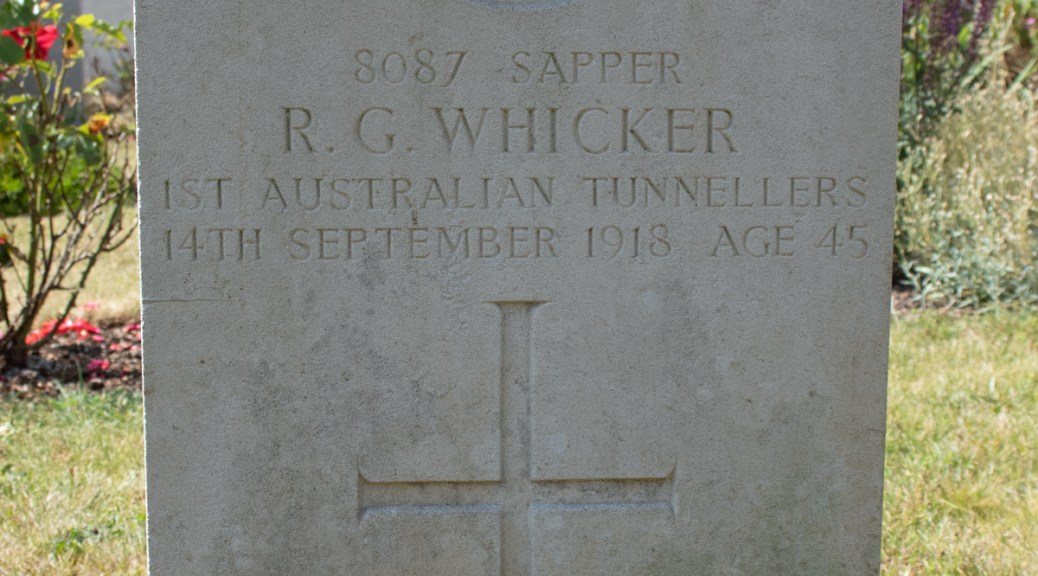
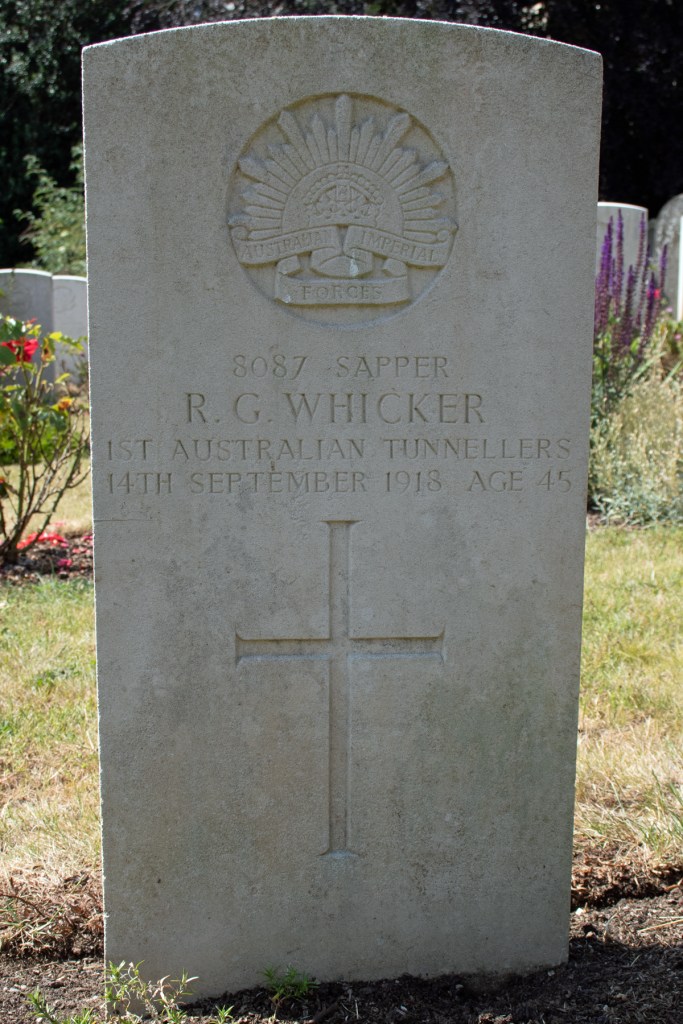
Sapper Rupert Whicker

Sapper Rupert Whicker

Rupert Gilchrist Whicker was born in Derby, Derbyshire, on 6th February 1873, one of eight children to Walter and Susannah Whicker. There is little information about the family’s early life, and it appears than one of both of Rupert’s parents had died by the time he was 14 years of age.

The Whicker siblings seemed to have gone their own ways at this point, emigrating to the United States and Australia, and it was to Ballarat in Victoria, Australia, that Rupert sailed in 1896. His trail goes cold for then nine years, at which point he married the Australian-born Ellen Ward. The couple would go on to have six children, eventually setting up home in Melbourne.

It is only Rupert’s military records – from when he enlisted on 21st September 1917 – that we discover more about what he had been doing. He gave his trade as miner, and the document suggests that he had tried to join up earlier in the war, but had been rejected as being under height: he was just 5ft 1.5in (1.56m) tall. Rupert’s medical also confirmed that he was 107lbs (48.5kg) in weight, and had auburn hair, hazel eyes and a fair complexion. He was noted as having a birth mark on the side of his left foot and two scars on his left cheek, between the eye and the bone.

Sapper Whicker was assigned to the 1st Battalion of the Australian Tunnellers. He left Australia on board the SS Indarra on 26th November 1917, bound for Europe. After leaving Port Said, Egypt, on 9th January 1918, Rupert’s unit landed in the south of France eleven days later. They travelled to Cherbourg by train, and finally landed in Southampton, Hampshire, on 2nd February 1918.

Rupert would remain on British soil until the beginning of April. His unit arrived in Caëstre in the middle of the month, and he then found himself on the Western Front. Sapper Whicker would serve there for the next four months, and it was only because of illness – a bout of gastritis – that he was brought back from the Front Line.

The stomach condition was severe enough to warrant Rupert’s medical evacuation to Britain for treatment, and he was admitted to Bath War Hospital in Somerset. What was initially thought to be an infection turned out to be far more serious. Sapper Whicker was diagnosed as having stomach cancer, and it has quickly taken hold. Sadly, it would prove fatal, and Rupert passed away on 14th September 1918: he was 45 years of age.

Rupert Gilchrist Whicker had died thousands of miles from his home. He was laid to rest in the military section of Bath’s Locksbrook Cemetery, not far from the hospital in which he had breathed his last.


Private Edward Brooke-Smith

Private Edward Brooke-Smith

Edward Charles Brooke-Smith was born in Muizenberg, South Africa, on 2nd March 1892. The eighth of nine children, his parents were mariner Alfred Brooke-Smith and his wife, Louisa.

Little further information about Edward’s early life is available. The 1901 census recorded the family as having returned to Britain – where both Alfred and Louisa had been born. The family had set up home in a cottage in Woodbridge, Suffolk, but by the spring of 1911 Edward had moved again, emigrating to Canada to make a life as a farmer.

When war came to Europe, the empire was called upon to fight for peace. Edward, who was working as a merchant in Valcartier, Quebec, by this point quickly stepped up to play his part. He enlisted in the Canadian Expeditionary Force on 17th September 1914 as a Private.

Edward’s service record give an insight into the man he had become. He was noted as being 5ft 11ins (1.8m) tall, with dark brown hair, grey eyes and a dark complexion. Private Brooke-Smith was also noted as having vaccination scars on his left arm, a small scar on his right knee and two moles on the centre of his back.

Details of Edward’s travel back to Europe are lost to time, but he was attached to the 7th Battalion of the Canadian Infantry and, by the spring of 1915, he was in Northern France. In March he had a bout of bronchitis, which was quickly followed by influenza, and he was hospitalised in Rouen.

Private Brooke-Smith returned to his unit in May 1915, but he was dogged by flu for the next couple of months. Sadly, things were not to improve for him.

On 19th August 1915, Edward’s unit was fighting at Wimereux, France, when he was shot. The bullet shattered the top of his right thigh and pelvis, and, after treatment on site, he was evacuated to Britain for further medical support.

Edward was to spend the next sixteen months in hospital. He was initially admitted to the Cambridge Hospital in Aldershot, Hampshire, where his primary treatment took place. In November 1915, he was moved to the Duchess of Connaught Canadian Red Cross Hospital in Taplow, Buckinghamshire for ongoing recuperation.

On 13th March 1916, Private Brooke-Smith was moved to the Auxiliary Hospital in Torquay, Devon. Here further physiotherapy and recuperation took place, before an operation to correct the position of his thigh was undertaken 9th December. Despite the precautions that had been put in place, Edward did not come round from the procedure: he was 24 years of age.

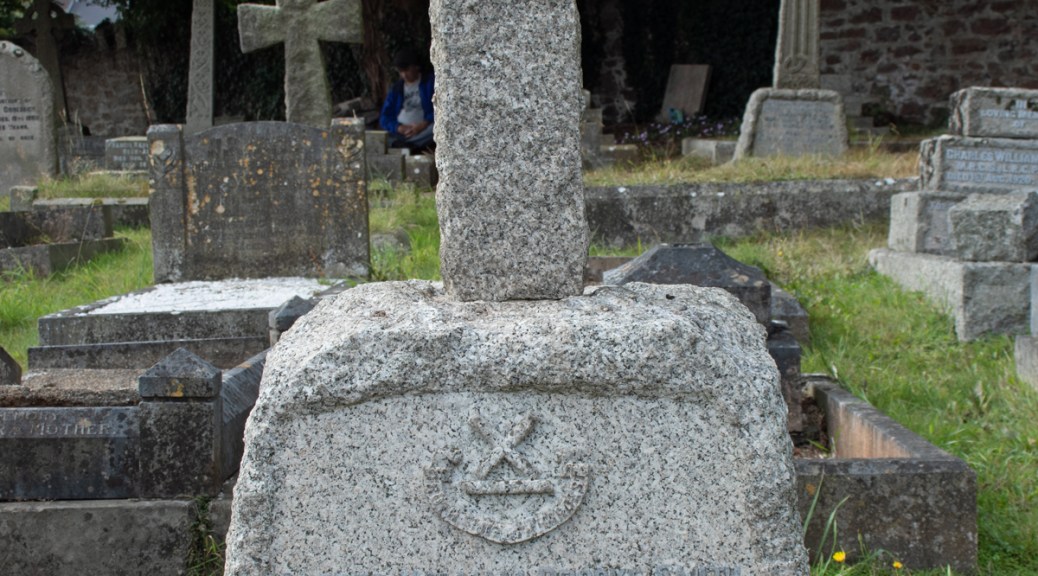
Alfred and Louisa had settled in Paignton by this point – given the year their son had spent in the hospital, it seems likely that they had moved to be nearer to him. Edward Charles Brooke Smith was, therefore, laid to rest in the family plot in the town’s cemetery. When Alfred died nine months later, he was buried alongside his son.


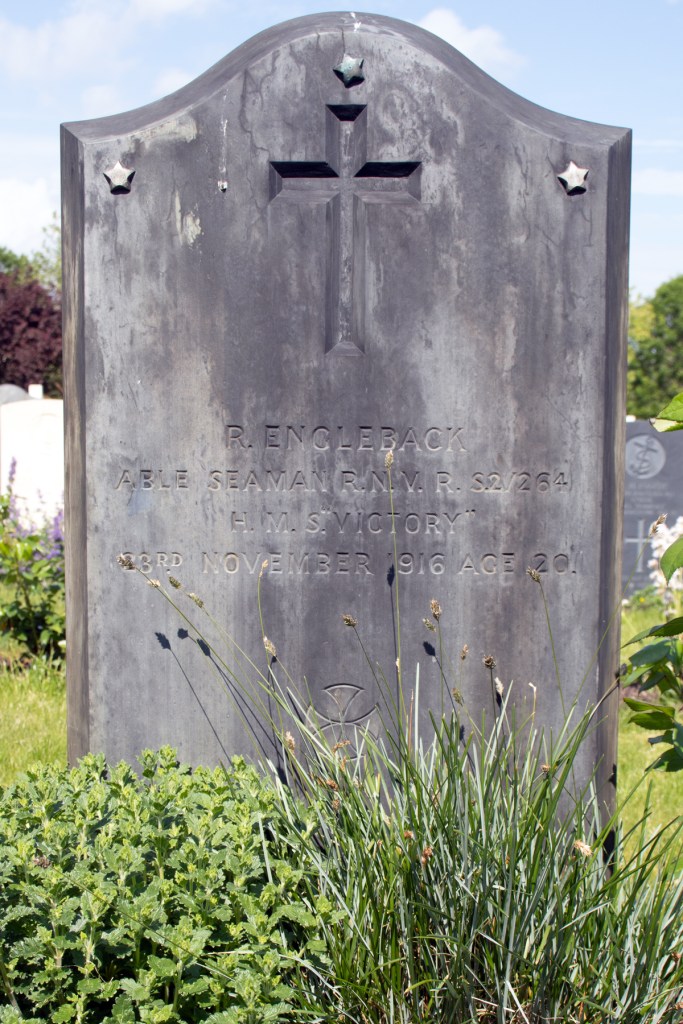
Able Seaman Russell Engleback

Able Seaman Russell Engleback

The life of Russell Engleback seems destined to remain lost in the mists of time and the only concrete information for him relate to his military service.

Ordinary Seaman Engleback joined the Royal Naval Volunteer Service on 3rd July 1914, just weeks before the declaration of war. His records confirm his date of birth – 11th August 1896 – and his occupation, which was a printer. He was 5ft 5ins (1.64m) tall, and had dark brown hair, brown eyes and a dark complexion.

Russell was sent to HMS Victory – the Royal Naval Dockyard in Portsmouth, Hampshire – for training, before being assigned to the battleship HMS Commonwealth in October. He remained on board for the next two years, rising to the rank of Able Seaman during this time.

Able Seaman Engleback returned to HMS Victory in August 1916, but may have moved to another naval base, HMS Pembroke in Chatham soon afterwards. Certainly he was at the Kent dockyard when he fell ill in November, as he was admitted to the Royal Naval Hospital around this time.

Russell was suffering from nephritis – kidney disease – by this point, and it was a condition that was to ultimately kill him. He passed away on 23rd November 1916, while still admitted in hospital: he was just 20 years of age.

Russell Engleback was laid to rest in Woodlands Cemetery, Gillingham, not far from the Chatham dockyard. His pension records give Fred and Amelia Tiffin – Russell’s Sussex-based mother and stepfather – as his next-of-kin.


Private John Merritt

Private John Merritt

John Merritt was born on 17th August 1880 in Shoreditch, London, and was the youngest of three children to James and Emily Merritt. James was a dock labourer, who passed away when his son was just four years old. Emily remarried the following year, having a child with her new husband, George Wise, in 1888.

When he completed his schooling, John found work as a stoker. However, he sought bigger and better things and, on 21st February 1898, he enlisted in the Royal Marine Light Infantry. Not yet eighteen years old, his service records show that he was 5ft 5.5ins (1.64m) tall, with grey eyes, brown hair and a fresh complexion. His service records also record a couple of tattoos: an anchor on his left forearm, and a crossed heart on his right.

Over the next two decades, Private Merritt sailed and saw the world. Primarily based out of the Royal Naval Dockyard in Chatham, Kent, he served on ten ships in all. His superiors obviously thought highly of him, as his records note his character and ability as very good throughout his service.

On 3rd July 1909, John married Harriett Wise. She was a lighterman’s daughter from East London, who was working as a cork cutter when the couple exchanged their vows. They went on to have two children: Florence, who was born in 1910, and Reginald, who came along six years later.

By the time war was declared in the summer of 1914, John seems to have been mainly shore-based, his time being split between Chatham and Portsmouth, Hampshire.

On 7th March 1917, Private Merritt was on board the gunboat HMS Spey, which was carrying out diving operations in the Thames Estuary. At 4 o’clock in the afternoon, in “bitterly cold and boisterous conditions” [Whitstable Times and Herne Bay Herald: Saturday 24th March 1917], the ship lost an anchor, and the decision was made to return to base at Sheerness, Kent. Another vessel, the HMS Belvedere, was close by and turned towards the Spey, and, despite trying to avoid a collision, the smaller ship was struck a glancing blow.

The Spey was 40 years old, and the impact sheered numerous rivets from the side. Water gushed in, and the gunboat sunk beneath the Thames within a matter of minutes. Some of the crew had managed to escape on a life raft, but it was not fitted with lights or flags. The boat drifted and was not found until five hours later, partially submerged: all on board had died.

In total, twenty of the thirty-seven crew perished on that March afternoon, including Private Merritt. He was 36 years of age.

It would seem that Harriett was unable to cover the cost of bringing her late husband’s body back to London for burial. Instead, John Merritt was laid to rest in Woodlands Cemetery in Gillingham, Kent, not far from the naval base in Chatham which he had called home for so long.


Officer’s Steward Thomas Ounan

Officer’s Steward Thomas Ounan

Thomas Peter Ounan was born on 21st July 1894 in St Helier, Jersey. The oldest of three children, his parents were Thomas and Augustine Ounan. Thomas Sr was a groom from England, who had married his Jersey-born wife and settled on the island to raise their family.

There is, in fact, little documented information about young Thomas’ life. From his military service records, it would seem that he found employment as a steward when he left school. When war broke out, he was called upon to play his part and, on 10th June 1916, he enlisted in the Royal Navy as an Officer’s Steward 3rd Class.

Thomas was initially sent to HMS Victory – the Royal Naval Dockyard in Portsmouth, Hampshire – for training. After a month he was assigned to the steam ship HMS Lucia, spending the next few months on board. At this point, he became unwell, having contracted tuberculosis. and was admitted to hospital in Portsmouth for treatment.

On 30th August 1916, Officer’s Steward Ounan was medically discharge from naval duty due to the condition. He returned to Jersey, remaining in the family home for the next year.

Thomas’ condition was to get the better of him, though. He passed away from tuberculosis at home on 6th October 1917: he was 23 years of age.

Thomas Peter Ounan was laid to rest in the peaceful La Croix Cemetery in Grouville.


Serjeant Fred Maynard

Serjeant Fred Maynard

Details of Fred Maynard’s early life are a challenge to piece together. His First World War service records give his age as 44 years old when he enlisted in September 1914, and confirm his place of birth as Melksham, Wiltshire.

A newspaper report of his funeral gives the name of three brothers – Charles, Frank and Arthur – while only one census return, from 1881, provides a potential match for the family. This suggests Fred’s parents were iron fitter Alfred Maynard and his wife, Deborah, and gives the family’s address as Waterworks Road in Trowbridge.

Fred joined the army in the autumn of 1888. Initially assigned to the Gloucestershire Regiment, he had transferred to the Wiltshire Regiment by the following spring. Private Maynard showed a commitment to duty: in December 1890 he was promoted to Lance Corporal, rising to Corporal in the summer of 1893.

Fred was stood down to reserve status after his seven years’ active duty, but was recalled to the army in December 1899, when war broke out in South Africa. Promoted to Serjeant, he was sent to fight in the Boer War, and was mentioned in dispatches on 2nd April 1901 for special and meritorious service in South Africa. He was stood back down to reserve status in October 1901.

On 21st November 1895, Fred had married Louisa Card. The couple set up home in Trowbridge, but soon moved to London. They went on to have six children: Ernest, Nora and Leslie, who were all born in the London; and Arthur, Martha and Stuart, who were born in Cardiff, the family having moved to Wales by 1910.

The army was not finished with Fred, however, and, within weeks of war breaking out in the summer of 1914, he was called back into service. Given the rank of Serjeant again, he was attached to the South Wales Borderers. Fred was 44 years of age by this point, his service records confirming that he stood 5ft 8ins (1.73m) tall, weighed 164lbs (74.4kg) and had brown hair and hazel eyes.

Attached to one of the regiment’s depots, it seems unlikely that Fred saw service overseas this time around. He was discharged from the army on 1st September 1916 and this seems to have been on medical grounds. Later documents suggest that Serjeant Maynard had been diagnosed with carcinoma of the pylorus, or stomach cancer.

Fred returned to Cardiff, but his time back home was to be short. He was admitted to the Lansdown Road Military Hospital, and passed away on 23rd November 1916. He was 46 years of age.

It seems that Fred’s brother’s had some sway in his funeral. Instead of being laid to rest in Cardiff, where Louisa and the children were living, he was, instead, buried in the Locksbrook Cemetery, Bath, Somerset. His sibling Charles, who was a sergeant in Bath City Police, lived in the city, as did another brother, Frank.


Fred’s headstone also commemorates his and Louisa’s son, Leslie. He had joined the army in the 1920s and, in the summer of 1943, was in Yorkshire, undergoing officer training.

The death of an officer cadet through the accidental discharge of a rifle whose bolt had jammed was described at an inquest…

Captain WH Price said he was in charge of an exercise on the moors which involved the used of small arms and the firing of live ammunition. A squad of cadets lay on the ground in front of a trench firing over a range. All finished firing except Cadet Frank Holroyd, who said his bolt had hammed while firing a second round. [Price] told him to release the bolt by knocking the cocking piece up and back.

This attempt failed, and he told Holroyd to get back into the trench, turn the rifle magazine upwards, place the butt on the side of the trench, and kick the bolt down with his foot. While Holroyd was doing this he noticed Maynard standing in the trench about 4ft away from Holroyd and on his right-hand side.

Captain Price said he saw the rifle was pointing down the range when Holroyd kicked the butt. The cartridge suddenly exploded and Maynard dropped into the trench, shot in the head, and was dead when they reached him.

[Bradford Observer: Saturday 19th June 1943]

Officer Cadet Leslie Maynard was 36 years of age when he was killed. His body was taken back to Somerset for burial: he was laid to rest in the same grave as Fred, father and son reunited after 27 years.


Louisa remained somewhat elusive as time wore on. Fred’s military records confirm that she had moved from Cardiff to the Isle of Wight by 1922. By the time of her son’s death, she was living in Sidcup, Kent.


Gunner Daniel Davies

Gunner Daniel Davies

Daniel Rees Davies was born on 10th August 1887, one of eight children to Daniel and Katherine Rees. Daniel Sr was a coal miner, born in Brecon, South Wales, and it was in Aberdare that the family were born and raised.

By the time of the 1901 census, five of the Davies family were working as coal miners. However, something changed dramatically over the following decade. The next census return, taken in 1911, found Daniel Sr working as a butcher, with Daniel Jr employed as his assistant. The two Daniels and Katherine were living in a six-roomed house with Daniel’s younger brother, Moses, his older sister, Margaret, and her husband, another Daniel.

In the autumn of 1913, Daniel Jr married Daisy Loud. She was a milliner from Bath, and it was in the Somerset city that the couple exchanged their vows. The couple set up home in Bath, and went on to have two children, Maurice and Norman. He continued working as a butcher and, by the time war was declared, he was employed by Larkhall.

When war came to Europe, Daniel stepped up to play his part. Sadly, full details of his service have been lost to time, but it is clear that he enlisted in the Royal Field Artillery in the spring of 1917 and he was attached to the 88th (Howitzer) Brigade.

Gunner Davies served in Northern France and was badly injured on 3rd June 1918. He was initially hospitalised in Rouen, but then medically evacuated to Britain for treatment. Admitted to Netley Hospital in Hampshire, the wounds he had received to his arm and shoulder were to prove too severe. A telegram was sent to Daisy for her to come to the hospital, but her train was delayed, and she arrived too late to see her husband before he passed away. He died on 17th June 1918, at the age of 30 years old.

The body of Daniel Rees Davies was taken back to Somerset for burial. He was laid to rest in Bath’s majestic Locksbrook Cemetery.


Gunner Daniel Davies
(from ancestry.co.uk)

Able Seaman William Turner

Able Seaman William Turner

Details of William Alliston Turner’s life are a challenge to track down. According to later military records, he was born on 28th February 1888 in St Helier, Jersey. While there are a couple of census returns that may be connected to him, there is nothing to definitively confirm his early life.

William enlisted in the Royal Navy on 9th January 1904. He was just shy of his 14th birthday, and so was given the rank of Boy 2nd Class. Over the next fifteen months, he was attached to the training ship HMS St Vincent, moored at Haslar in Hampshire. In August 1902, he was promoted to Boy 1st Class, and was given his first posting, on board the cruiser HMS Edgar, in May 1905.

After a short spell at HMS Victory, the Royal Naval Dockyard in Portsmouth, William was assigned to HMS Powerful, a protected cruiser, and he would spend two years on board. During this time, he came of age, and was given the rank of Ordinary Seaman. His service records at the time confirm that he was 5ft 5.5ins (1.66m) tall, with dark hair, brown eyes and a fresh complexion. He was also noted as having two tattoos – a heart on the back of his right hand, and the letter T on the back of his left.

William seemed to have taken to his life at sea with some ease. On 1st January 1907 he was promoted to the rank of Able Seaman, and over the next eight years, he served on twelve different vessels, returning to Portsmouth between each voyage.

What had become a good career for Able Seaman Turner, began to take a bit of a downturn. He spent six separate periods of time in the brig between 1908 and 1914, totalling 121 days in total. On 19th March 1915, William was medically discharged from naval service, suffering from neurasthenia, or PTSD as it is now known.

At this point, William’s trail goes cold. He returned to the Channel Islands, and passed away on 13th April 1917: he was 29 years of age.

William Alliston Turner was laid to rest in the quiet graveyard of St Lawrence Church in Jersey.


Stoker 1st Class Frederick Carder

Stoker 1st Class Frederick Carder

Frederick Albert Carder was born on 2nd March 1893 in Dartmouth, Devon. The youngest of ten children, his parents were shipwright Samuel Carder and his wife, Julia. Frederick lost both of his parents in 1909, when he was just 14 years of age. He was taken in by his older brother, Ernest – who was better known as James – and his family and, by the time of the 1911 census was working as a porter for the local Co-operative Stores.

War came to Europe in the summer of 1914, and, two years later, Frederick stepped up to play his part. He enlisted in the Royal Navy on 4th July 1916, and was given the rank of Stoker 2nd Class. He was sent to HMS Victory – the Royal Naval Dockyard in Portsmouth, Hampshire – for his initial training.

By the end of August, Stoker Carder was assigned to HMS Broke, a destroyer that formed part of the Dover Patrol, monitoring the waters off the Kent coast. He remained attached to the patrol and was promoted to Stoker 1st Class in January 1917.

On 20th April 1917, the Broke and another ship, HMS Swift, took on six German torpedo boats who were attacking the Dover Barrage – a network of nets and mines in the English Channel, designed to stop U-boats. The Broke rammed the torpedo boat SMS G42, and the two ships became locked together. Enemy sailors boarded the Broke, and hand-to-hand combat ensued. Eventually Broke managed to break free, and the G42 sank.

HMS Broke was towed back to shore, but 21 of her crew had died in the Battle of Dover Strait, including Stoker 1st Class Carder. He was 23 years of age.

The body of Frederick Albert Carder was taken back to Devon for burial. He was laid to rest in Paignton Cemetery, close to his brother, James, who had died in the summer of 1916. Read more about him by clicking here.