Tag Archives: illness

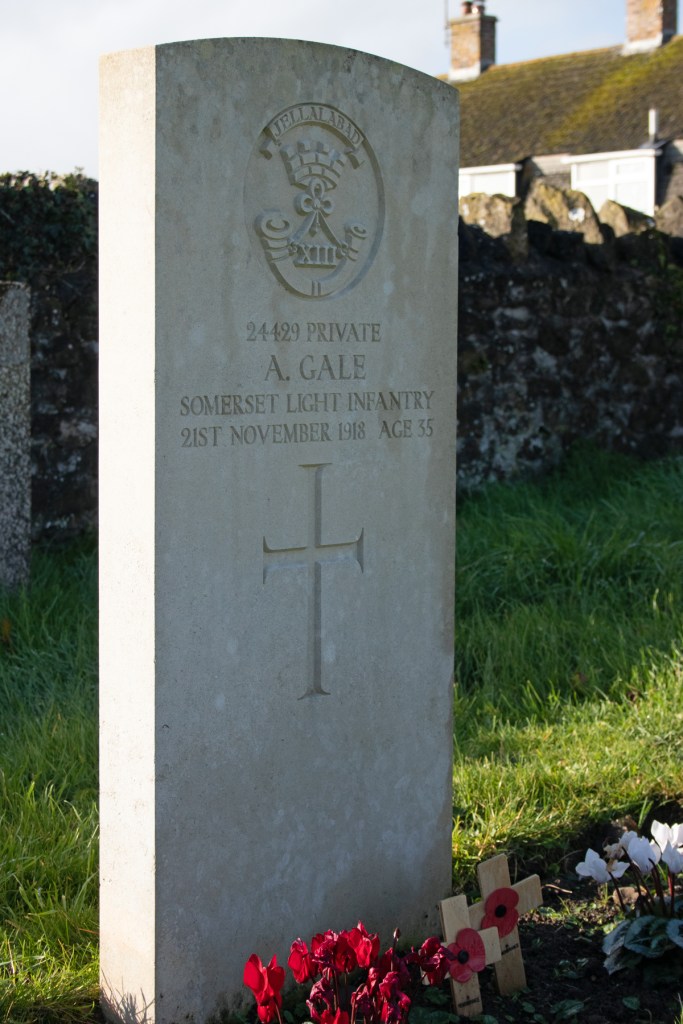
Private Albert Gale

Private Albert Gale

Albert Gale was born in the Devon village of Chudleigh Knighton in October 1883, one of five children to John and Elizabeth Gale. It seems that Elizabeth may have died when Albert was young, as, by the time of the 1901 census, John was married to a Sarah Gale, and the family were living in the village of Hennock.

John was a clay cutter, and this was a trade into which Albert followed his father. Again, as time moves on, things change; the 1911 census found Albert boarding with his sister Sophy and her husband, fellow cutter Thomas Willcocks, back in Chudleigh Knighton.

War was coming to Europe and, in April 1916, Albert enlisted, joining the Somerset Light Infantry as a Private. He would have cut a commanding figure; his enlistment papers show that he stood at 5ft 10ins (1.77m) tall.

Albert served on home soil. While attached to the Somerset Light Infantry, he was assigned to the 661st Agricultural Company of the Labour Corps, working in Kent and Sussex.

During this time, he received hospital treatment on four separate occasions: in August 1916, he was admitted with cellulitis of the arm; in December 1916 and January 1917, he was treated on two separate occasions for scabies. In November 1918, however, he was admitted to the Military Hospital in Chichester, West Sussex, as he was suffering from influenza. Sadly, this last condition was to worsen and, on 21st November 1918, Private Gale died, having subsequently contracted pneumonia. He was 35 years old.

Albert Gale’s body was brought back to Devon for burial. His brother-in-law Thomas had died the previous summer; his story can be found here. Albert was laid to rest in the grave next to his sister’s husband in the churchyard of St Paul’s in Chudleigh Knighton.


With Thomas dead, Sophy had been left a widow. Understandably bitter at what the war had taken from her, when she was asked if she wanted a memorial for her brother, she returned the form with the following statement: “I don’t require the plaque and scroll in memory of my dear brother; a piece of paper won’t keep me.”

Private John Clarke

Private John Clarke

John Clarke was born in Devon on 28th June 1881, the son of Edward and Mary Ann Clarke. Sadly, little documented information remains on his life, but from what does exist, a semblance of his life can be pieced together.

Edward and Mary Ann lived in the village of Ashcombe in their later years, although it seems that John had been born closer to Exeter. At some point before October 1915, he married local woman Rhoda; they did not go on to have any children.

When the First World War broke out, John was working as a farm labourer. He signed up, joining the 7th Battalion of the Devonshire Regiment. His enlistment papers confirm that he had already been volunteering for the 8th Battalion of the same regiment. They also note that he stood 5ft 6ins (1.68cm) tall, weighed 140lbs (63.5kg) and, intriguingly, that he was of poor physical development.

Private Clarke’s time in the army was not destined to be a lengthy one. In January 1916, he was admitted to the Canadian Red Cross Hospital in Taplow, Buckinghamshire, suffering with neuralgia. A couple of months later, he was admitted again, this time with influenza.

Shortly afterwards John’s military service came to an end. He was dismissed as medically unfit due to a gastric ulcer; his final day in the army was 30th March 1916, and he had served for 175 days.

At this point, Private Clarke’s trail once again goes cold. He passed away on 3rd December 1918 – more than eighteen months after leaving the Devonshire Regiment – although there is no documentation to confirm the cause of his passing. He was 37 years of age.

John Clarke was laid to rest in the graveyard of St Nectan’s church in Ashcombe, Devon.


Able Seaman Hubert Banks

Able Seaman Hubert Banks

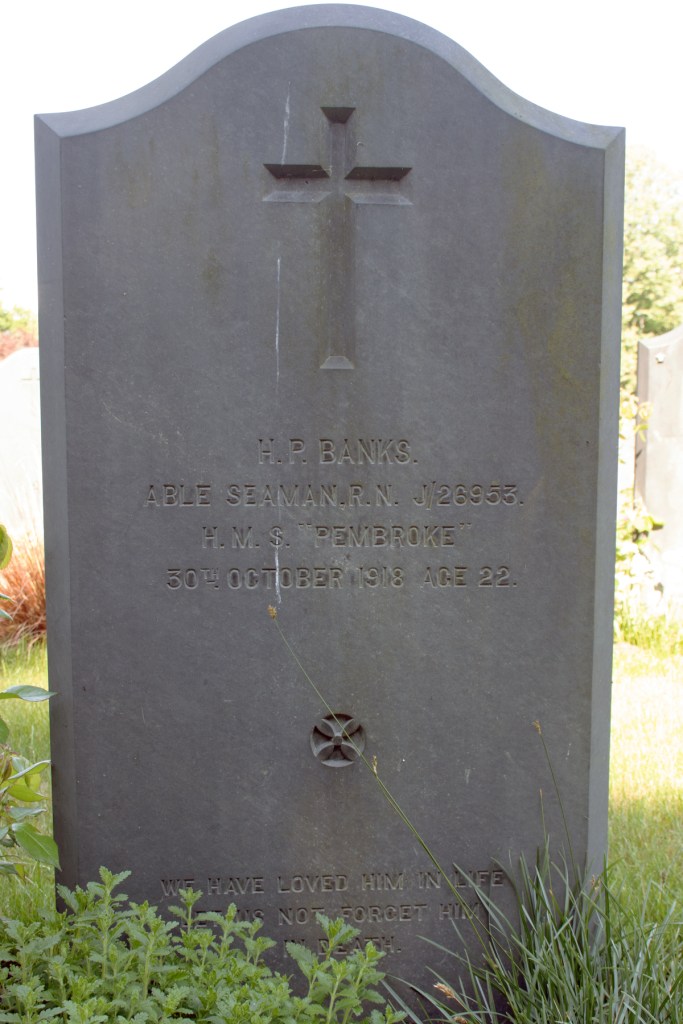
Hubert Philip Banks was born on 13th September 1896 in Tottenham, London and was one of eight children to Wilfrid and Mary Banks. Wilfrid was a gas engineer, but when he left school, Hubert found work as a clerk. By the time of the 1911 census, the family had moved to Edmonton.

Hubert had a sense of adventure, and wanted a career that reflected that. On 23rd September 1913, he enlisted in the Royal Navy; as he was underage at this point, he was given the role of Boy. Within a year he turned 18 and was formally given the rank of Ordinary Seaman.

After initial training at HMS Pembroke – the shore-based establishment at the Royal Naval Dockyard in Chatham, Kent – he was assigned to HMS Cornwallis, a dreadnought class vessel that served in the Mediterranean. Hubert spent two years on Cornwallis, during which time he was promoted to Able Seaman.

Over the next few years, Hubert served on three more vessels – HMS Quernmore, HMS Agamemnon and HMS Europa. In between times, he was based back in Chatham before moving back to HMS Pembroke on a more permanent basis in July 1918.

It was while he was back in Kent that Hubert fell ill. He was admitted to the Naval Hospital in Chatham with pneumonia, and was to succumb to the lung condition on 30th October 1918. He was just 22 years of age.

Hubert Philip Banks was laid to rest in the Woodlands Cemetery in Gillingham, Kent, not far from the naval base he called home.


Greaser Humphrey Donoghue

Greaser Humphrey Donoghue

Humphrey Donoghue was born in Kerry, Southern Ireland, on 13th December 1859. He was the oldest of two siblings, boys to John and Mary Donoghue. John was a labourer who, by the time Humphrey’s younger brother was born, had moved the family to the village of Llantarnam in South Wales, presumably for work.

Humphrey seemed to be looking for adventure, and the trip across the Irish Sea may have been the spur for that. By the time of the 1891 census, he was recorded as being a Stoker on board HMS Tretis. This was a screw corvette ship which, on the day of the census, was plying the waters of the Pacific.

Sadly, full records of Humphrey’s life at sea are no longer available, so it’s not possible to track his progress over the following years. It would seem that he Stoker Donoghue persisted with his naval career, continuing through what would have been his initial twelve years’ service. Whether he had any breaks in that service is unknown, but he was certainly still serving – or had been called back into duty – by the time of the Great War. His gravestone confirms that was serving as a Greaser – maintaining the engines – on HMS Achtaeon.

The next available document for Humphrey is the record of his death. He passed away on 26th February 1917, at the Royal Naval Hospital in Chatham, Kent, having been admitted there with pneumonia. He was 57 years old.

Humphrey Donoghue was laid to rest in the Woodlands Cemetery in Gillingham, Kent, close to the Naval Dockyard where he may have been based.


Stoker 1st Class Christopher Hickey

Stoker 1st Class Christopher Hickey

Christopher Hickey was born on Christmas Eve 1891, in Wicklow, Southern Ireland. Full details of his early life are not available, but his mother was called Mary and he had at least one sibling, a sister called Catherine.

When he left school, he worked as a gardener but, when the war broke out, he enlisted, joining the Royal Navy on 5th November 1915. His enlistment records show that he stood 5ft 6ins (1.67m) tall, had brown hair, brown eyes and a fresh complexion.

Stoker 2nd Class Hickey received his initial training at HMS Pembroke, the shore establishment at the Naval Dockyard in Chatham, Kent. In February 1916, he was assigned to HMS Champion, a cruiser that, during his time on board, served as a flagship during the Battle of Jutland that summer.

Christopher returned to HMS Pembroke in November 1916, having been promoted to Stoker 1st Class. He served there until the following March, when he was admitted to the local Naval hospital with pyaemia (or sepsis). Sadly, this proved too much for his body to take and he died on 20th March 1917 at the age of 25 years old.

Christopher’s body was laid to rest in the Woodlands Cemetery in Gillingham, Kent, not far from the base at which he had served.


Interestingly, the Irish Memorial Records for the Great War confirm Christopher’s passing, but give the cause of death as ‘died of wounds’, although I have been unable to find anything else to corroborate this. It may be that sepsis set after he was wounded, but it is reasonable to assume that full details will remain lost to time.


Private John Lodge

Private John Lodge

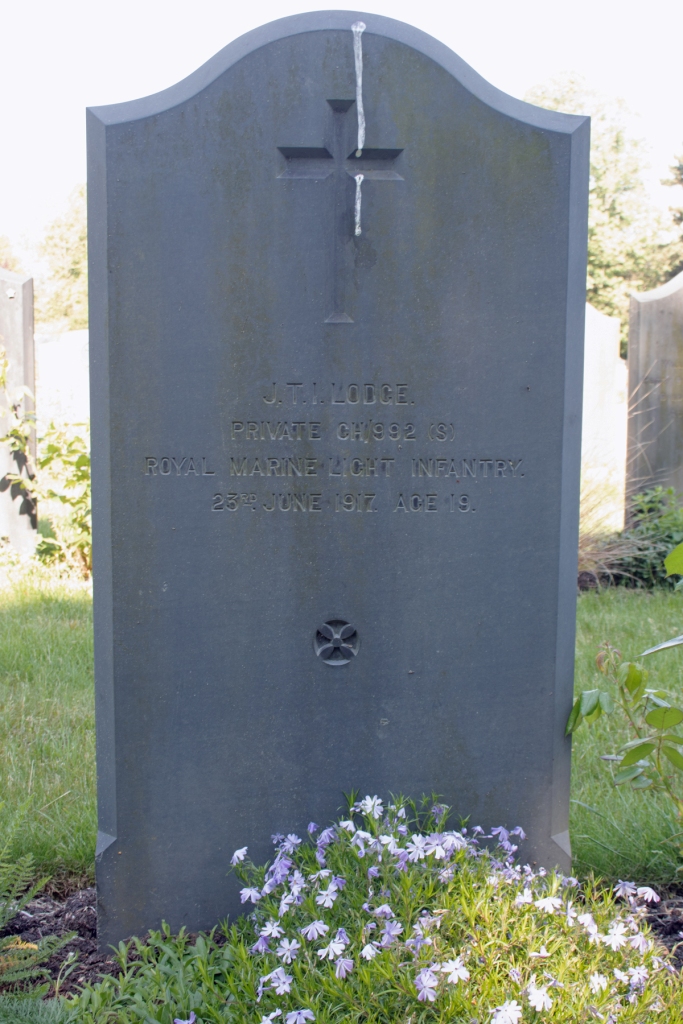
John Thomas Inskip Lodge was born in Shefford, Bedfordshire, on 31st January 1899, one of seven children to John and Florence Lodge (née Inskip). When his son was young, John Sr worked as a bead lace manufacturer, but by the time of the 1911 census, he had become the manager of a steam laundry.

Florence, by this time, had passed away, and in November 1911, John Sr married again, to Florence Yarnell. The couple would go on to have four children, John Jr’s half-siblings.

By this time, war was on the horizon, and John was eager to leave his laundry job and volunteer. He joined the Royal Marine Light Infantry on 4th September 1915, giving his date of birth as three years earlier in order to ensure he was accepted. His service record shows that he stood 5ft 4ins (1.62m) tall, had a fresh complexion, brown eyes and brown hair.

As a Private, John served with the Chatham Division of the regiment; he would have seen action in some of the key battles of the war, including at Gallipoli in 1915/16 and later on the Western Front. It was while he was fighting in France in September 1916 that he was injured, and he was medically evacuated back to England for treatment.

Private Lodge recovered, and served on in Chatham, Kent, where he was billeted at the naval barracks in the town. At the start of June 1917, he had some leave owing, and so visited his parents back in Bedfordshire. When he returned to Kent, he fell ill and was admitted to the Naval Hospital in the town. Sadly, John was not to recover; he passed away on 23rd June 1917, aged just 18 years old.

John Thomas Inskip Lodge was laid to rest in the Woodlands Cemetery in Gillingham, not far from the Chatham barracks at which he was based.


Stoker 1st Class James Duffy

Stoker 1st Class James Duffy

James Albert Duffy was born on 21st May 1888 in the town of Monaghan, Ireland. The son of Francis and Elizabeth Duffy, he was one of ten children. Francis was a policeman, but James took up plastering when he left school; by the time of the 1911 census, the family had left Monaghan and moved to Belfast.

War was coming, and James received his call up in March 1916. He joined the Royal Navy as a Stoker 2nd Class; his service record shows that he stood 5ft 5ins (1.65m) tall and had fair hair, blue eyes and a fresh complexion.

After two months’ training at HMS Pembroke in Chatham, Kent, Stoker Duffy was assigned to HMS Chatham, a cruiser that served in the Mediterranean. He spent eighteen months on board, and was promoted to Stoker 1st Class for his service.

At the end of 1917, James returned to Chatham Dockyard. While there, he fell ill, and was admitted to the Naval Hospital in the town. Sadly, while in hospital he passed away, having suffered a cerebral abscess. He died on 29th January 1918, aged just 29 years old.

James Albert Duffy was laid to rest in the Woodlands Cemetery in Gillingham, not far from the dockyard at which he had been based.


Petty Officer 1st Class George Fawcett

Petty Officer 1st Class George Fawcett

George Fawcett was born on 3rd February 1873, one of ten children to John and Maria (or Mary). John was a stonemason who raised his family in Essex, and it was in Stratford that George and most of his siblings were born.

When George left school, he was drawn to a life of adventure. He joined the Royal Navy on 5th May 1888, and was first assigned the role of Boy, as he was under age. He was formally enlisted on 3rd February 1891 – his 18th birthday. He had, by this point, been serving on HMS Hotspur for nine months, and was given the rank of Ordinary Seaman. His hard work must have held him in good stead, because he was promoted to Able Seamen just two months later.

Over the course of his initial twelve years’ service, Able Seaman Fawcett served on eight different ships, and continued to rise through the ranks. He mad made Leading Seaman by 1894 and Petty Officer 2nd Class five years later. By the time his first term of service had ended, he had been promoted again, this time to Petty Officer 1st Class.

George voluntarily renewed his service in 1903, and over the next few years, he served on a number of other vessels. His shore base was always HMS Pembroke, though, and his time at sea was interspersed with periods at the Naval Dockyard in Chatham.

Petty Officer Fawcett had been in the Royal Navy for 23 years by the time war was declared. He was still at sea in August 1914, but was transferred to a permanent shore role at the beginning of the following year. He spent three years fulfilling his duties at HMS Pembroke, but fell ill in the spring of 1918.

He was admitted to the Naval Hospital in Chatham with liver disease, and this was a condition he was not to recover from. Petty Officer Fawcett passed away on 12th April 1918, at the age of 45.

George Fawcett’s body was laid to rest in the Woodlands Cemetery, Gillingham, not far from the naval base at which he was based.


Trimmer John Kelly

Trimmer John Kelly

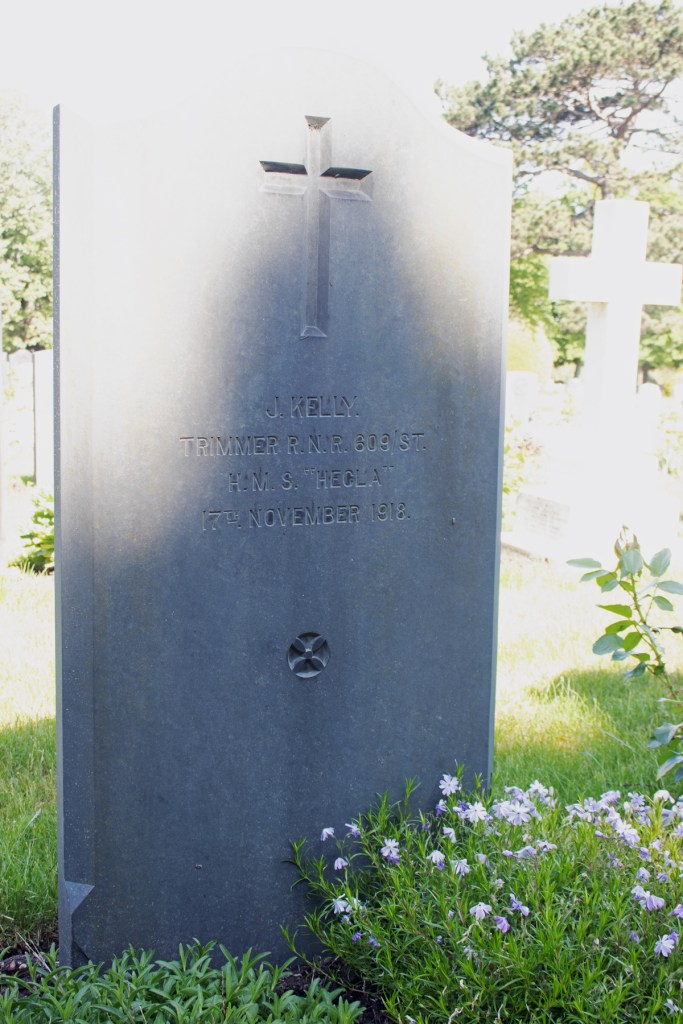
John Kelly was born in East London on 11th January 1871, the son of Charles and Jane. There is not a lot of concrete information about his early life, but he seems to have married an Isabella Coles in the late 1890s, and the couple went on to have at least one child – a daughter they called Lizzie.

On 13th May 1915, with the First World War raging, John enlisted. He joined the Royal Navy for the duration of the war as a Trimmer (or Stoker), His enlistment papers show that he stood at 5ft 6ins (1.67m tall), had a fair complexion and blue eyes. He is also noted as having a scar on his chin.

During his time at sea, Trimmer Kelly served on board a number of vessels; his primary base, however, remained HMS Pembroke, the shore-based establishment at the Royal Naval Dockyard in Chatham, Kent.

It was while he was on board HMS Hecla, a depot ship, that John fell ill with stomach problems. Returned to Chatham, he was admitted to the Naval Hospital in the town, but died of a carcinoma of the stomach on 17th November 1918. He was 47 years old.

John Kelly was laid to rest in the Woodlands Cemetery, Gillingham, a short distance from the dockyard where he had been based.


Stoker 1st Class James Kilmartin

Stoker 1st Class James Kilmartin

James Kilmartin was born on 24th June 1894, one of four children to James and Mary Kilmartin. James Sr was a farmer from Tobercurry in County Sligo, and this is where he raised his family.

When he left school, James Jr helped his father out on the farm, but by the time he was 22, war was raging in Europe and he received his call-up papers. He joined the Royal Navy as a Stoker 2nd Class on 11th April 1916 and was sent to England for training.

After initially being based at HMS Pembroke – the shore-based establishment at the Naval Dockyard in Chatham – Stoker Kilmartin was assigned to HMS Greenwich. He served on board for nine months, during which time he was promoted to Stoker 1st Class.

James’ next assignment was on board HMS Bacchante, where he spent two years, through the Armistice and beyond. Returning back to HMS Pembroke in February 1919, he fell ill, contracting bronchial pneumonia. Admitted to hospital, the condition sadly got the better of him, and he died on 24th February 1919, aged just 24 years of age.

James Kilmartin was laid to rest in the Woodlands Cemetery, Gillingham, a short walk from the dockyard at which he had been based.


Tragically, less than two weeks after James died, his brother Michael, also passed away, at home in Tobercurry. While I have been unable to locate any specific documentation around military service, it seems likely that he too would have been in some way involved in the conflict.