Tag Archives: India

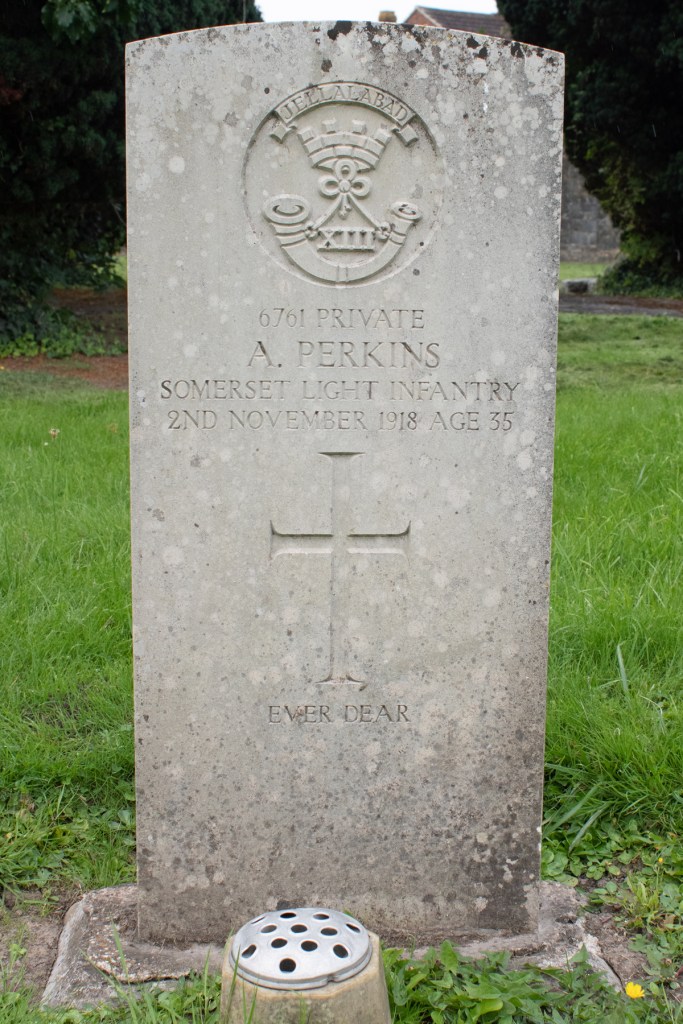
Private Arthur Perkins

Private Arthur Perkins

Arthur Perkins was born on 22nd April 1883, the seventh of eight children to James and Jane Perkins. James was a farm labourer who subsequently found work on the railways. The family were all born in Huntspill, Somerset, moving the few miles north to Highbridge when James’ work changed.

Arthur initially took on labouring work, but sought a more reliable career. On 26th February 1903, he enlisted in the army, joining the Somerset Light Infantry, for whom he had previously been a volunteer. His service records show that he was 5ft 7ins (1.7m) tall and weighed 122lbs (55.3kg). He had brown hair, hazel eyes and a fresh complexion, and his medical records note that he had a scar above his right eye.

Private Perkins was initially attached to the 2nd Battalion, remaining on home soil until September 1904. At this point, Arthur was moved to the 1st Battalion and, as a result, was sent to a unit in Quetta, India. He remained overseas for more than eighteen months, and, during his army career had a number of spells in hospital. He was admitted for bronchial catarrh in March 1904, a swollen stomach in December, a blistered foot in January 1905, syphilis in April and dyspepsia in September.

Arthur returned to Britain in May 1906, and at this point was stood down to reserve status. He returned to Somerset and, by the time of the 1911 census, was living with his older brother Harry and his family.

The Perkinses shared a small cottage in Benedict Street (at the time known as Station Road), Glastonbury. Arthur and Harry both laboured in a timber yard, while one of the yard’s engineers, William Webb, boarded with the family to bring an extra income in.

By the time war broke out in 1914, Arthur had moved back to Highbridge. He had taken up employment as a butcher, but this came to an end when he was mobilised on 5th August. Attached to the 1st Battalion of the Somersets again, Private Perkins was sent to France with his unit within weeks of the conflict being declared.

On the 18th September, Arthur was caught up in the Battle of the Aisne. He was wounded in the arm, and subsequently knocked unconscious by a shell burst nearby. From that point on, Private Perkins was dogged by a persistent tremor, which resulted in him being medically evacuated to Britain, and ultimately discharged from active service. “He had a functional tremor of the whole body. He he typically neurasthenic and depressed and convinced he will never be any better. No treatment is of the slightest avail.” [Medical discharge papers for Private Arthur Perkins: 26th June 1915]

Following Arthur’s discharge from the army, his trail goes cold. It is likely that he returned to Highbridge, although it is also likely that he spent periods of time – or longer – hospitalised because of his condition. He married a woman called Florence, although details of her are also scarce.

Arthur Perkins died through causes unknown on 2nd November 1918: he was 35 years of age. He was laid to rest in the cemetery of his home town, Highbridge.


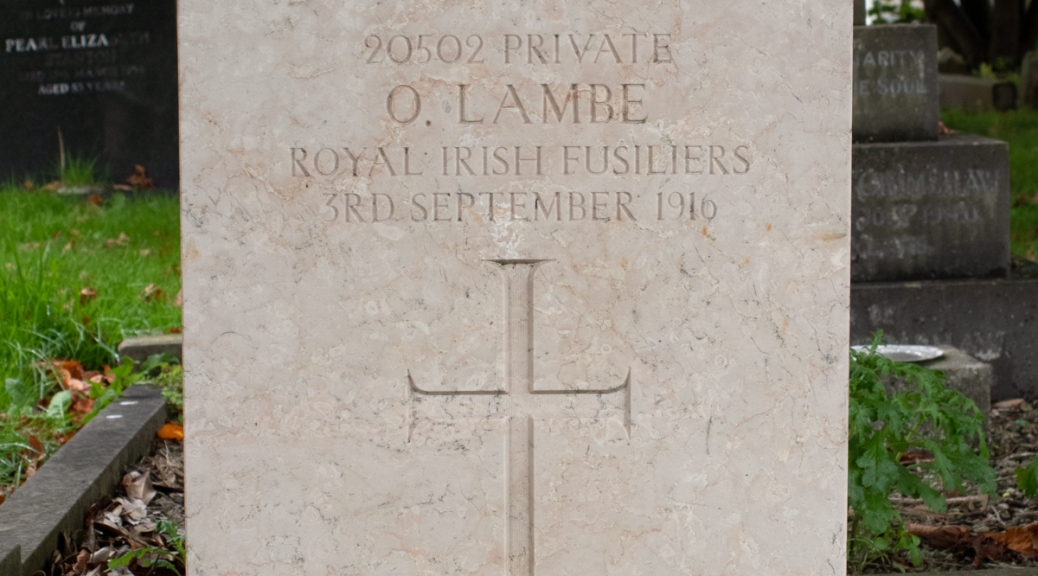
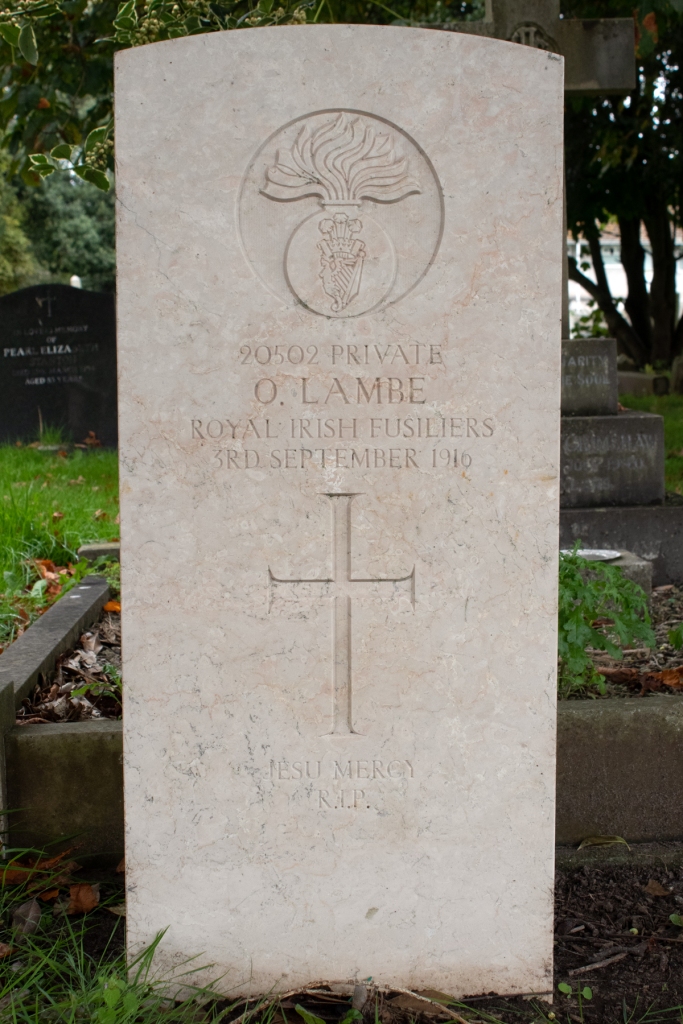
Private Owen Lambe

Private Owen Lambe

Owen Lambe was born in Drogheda, Co. Louth, Ireland, in November 1873. There is little information about his early life, but later documentation confirms that he was the son of John and Ellen Lambe, and that he had three brothers and one sister.

When Owen finished his schooling, he found work as a baker. He was also volunteering as a soldier in the 6th Battalion of the Royal Irish Rifles at the time, however, and this sparked a career move for him. On 7th May 1890, he formally enlisted: his medical report shows that he was 5ft 4ins (1.63m) tall, and weighed 128lbs (58kg). He was noted as having brown hair, grey eyes and a dark complexion.

Over the twelve years of his contract, Private Lambe saw a fair bit of the world. After eighteen months on home soil, he was sent to Malta, where he remained until November 1894. His battalion was then moved to India, where they remained for more than three years.

With seven years’ service under his belt, Owen returned to Britain. Put on reserve status, he was recalled to active duty in October 1899, as hostilities broke out in South Africa. He served in the Second Boer War for nearly three years, until, in July 1902, he returned home once more. By this point, he had completed his contract, and formally stepped down from the army on 31st August.

Owen’s trail goes cold at this point, and it is only possible to pick up details from later documents relating to his death. These confirm that he had re-enlisted by the spring of 1916, and that he joined the 8th (Service) Battalion of the Royal Irish Fusiliers. Based on his previous army experience, Private Lambe would have been sent to the Western Front fairly readily, and his battalion was certainly involved in the fighting at the Battle of the Somme.

It was here, on the front line, that Owen was injured. Again, details are sketchy, but he received gun shot wounds severe enough for him to me medically evacuated to Britain for treatment. He was taken to Somerset and admitted to the Volunteer Aid Detachment Hospital in Burnham-on-Sea for treatment. Private Lambe’s wounds were to prove too severe, however: he passed away from his injuries on 3rd September 1916, at the age of 42 years old.

Owen Lambe was laid to rest in the Roman Catholic section of Burnham Cemetery. His headstone was paid for by the local Catholic church.


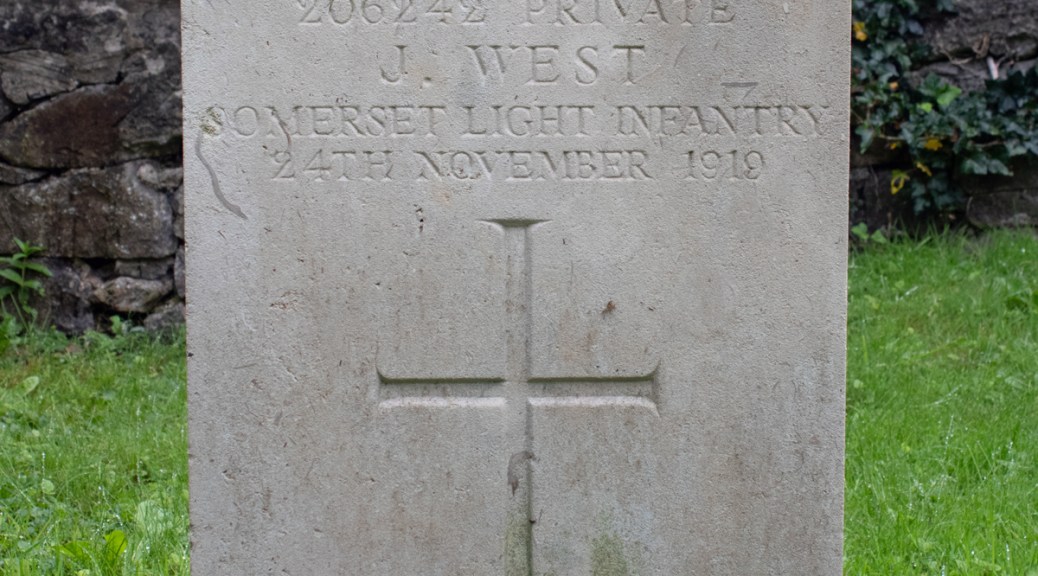
Private Jeremiah West

Private Jeremiah West

Jeremiah West was born in the spring of 1892, the oldest of eight children to John and Laura West. John was an agricultural labourer from Somerset, and it was in the village of Bleadon that the family were born and raised.

When he finished his schooling, Jeremiah followed in his father’s footsteps. By the time of the 1911 census, he was working as a servant on the nearby Shiplette Farm, where he was employed by Kate Poole.

War came to Europe in 1914, and Jeremiah stepped up to play his part. He enlisted in the Somerset Light Infantry in 1915, and was assigned to the 4th Battalion. Private West set sail for India that August, and seems to have remained overseas for some time.

Records are not clear, but it would appear that Jeremiah returned to Britain at some point, and became attached to the 3rd Battalion of the Bedfordshire Regiment. This was a garrison troop, based in Harwich, Essex, and Jeremiah found himself part of the battalion’s Labour Corps.

Private West survived the war, but came down with pneumonia in the autumn of 1919. He passed away on 24th November 1919: he was 27 years of age.

Jeremiah West was brought back to Somerset for burial. He was laid to rest in the peaceful graveyard of St Peter and St Paul’s Church in his home village of Bleadon.


Gunner John Edmonds

Gunner John Edmonds

John Edmonds was born on 12th November 1871 in Bath, Somerset. The oldest of five children, his parents were market gardener Albert Edmonds and his wife, Ellen.

When he finished his schooling, John found work as a miner. He sought a more adventurous career, however, and, on 8th November 1894 he enlisted in the army. Assigned to the Royal Artillery, Gunner Edmonds’ service records noted that he was 5ft 8ins (1.73m) tall and weighed 149lbs (67.6kg). He had brown hair, grey eyes and a sallow complexion, with a couple of marks above and below his left eye.

Gunner Edmonds was assigned to the 4th Mountain Battery and spent most of the next year training on home soil. On 17th September 1895, however, he was transferred to the 5th Mountain Battery, and shipped off to India, where he was to spend the next nearly nineteen years. During his time on the Asian sub continent, John was awarded the India Medal, with clasps for the Punjab Frontier and Tirah (both 1897-98). He was also awarded the Delhi Durbar Medal in 1911.

When war came to Europe in August 1914, John was recalled to British shores. He was not to remain on home soil for long, however as, on 9th December he was sent to France as part of the Royal Garrison Artillery. He spent just over a year on the Western Front before his troop was dispatched to Salonika, Greece, in December 1915.

Gunner Edmonds was to remain in the Eastern Mediterranean for a little over three years. During this time he had a short period in hospital, having contracted malaria, but saw the war out in Greece, returning home in March 1919. John was formally stood down from military service on 25th April 1919, having completed 24 years 169 days in the army.

Returning to Bath, John’s health had started to suffer. He had developed cancer, and passed away from the condition on 4th October 1919. He was 47 years of age.

John Edmonds’ body was laid to rest in the military section of Bath’s Locksbrook Cemetery.


Private Harold Hill

Private Harold Hill

In a quiet corner of St John’s Churchyard, Staplegrove, is a commemorative headstone to three soldiers of the Somerset Light Infantry. The bottom two, share the same surname, and are, in fact, father and son: Francis and Harold Hill.


Harold James Hill was born 23rd November 1896 in Milverton, Somerset. He was the only child to former army man turned storekeeper, Francis Hill and his wife, Florence.

When he finished his schooling, Harold found work as an office boy. By the time of the 1911 census, the family had moved six miles east of Milverton, to the village of Staplegrove. Francis was employed as a house painter, Florence had taken in work as a glove maker, and the Hills also had a boarder, Reginald Cave, who was a nursery foreman.

Storm clouds were brewing by this point and, when war broke out, Harold was keen to play his part, possibly because he wanted to emulate his father’s army life. He enlisted in the Somerset Light Infantry and was assigned to the 2nd/5th Battalion. Private Hill’s medical records show that he was 5ft 10ins (1.78m) tall, and weighed 140lbs (63.5kg). By coincidence, these are almost exactly the same measurements as those of his father, when he joined the army 28 years before.)

After three months’ training, Harold’s battalion was sent overseas, and he arrived in India on 12th December 1914. Within a matter of months, his health began to suffer and, between May 1915 and February 1916, Private Hill was admitted to hospital on six separate occasions, all but one for intestinal problems.

In the end, Harold was taken back to Britain for treatment: he arrived on home soil at the end of March 1916, and within three months had been medically discharged from the army.

At this point, Harold’s trail goes cold, although he did return to Somerset. His illness continued, however, and he passed away from his stomach condition on 23rd October 1916. He was just 19 years of age.

Harold James Hill was laid to rest in the graveyard of St John’s Church, Staplegrove. His grave is lost to time, but it can be assumed that he was buried close to his father, who had died just nine months before. Father and son are commemorated on a special memorial, close to the entrance of the church.


One can only imagine the heartache for Florence Hill, having lost her husband and her only child within a year. Details of her late husband’s life can be found here.

Few details remain of her life, although she is recorded on the 1939 England and Wales Register boarding with an Eda Cummings in Greenway Avenue, Taunton. She was noted as a widow, and employed to do household duties.


Serjeant Robert Priddle

Serjeant Robert Priddle

Zebulon Priddle was born in the autumn of 1876 in Curry Mallet, Somerset. One of ten children, who included Meliam, Cornelius, Absalom, Ebenezer, Lancelot and Jabez, his parents were Robert and Mary Priddle.

Robert was a farm labourer, and his son followed suit at first, but a career away from home beckoned and, on 16th January 1894, he enlisted in the Royal Artillery. Aged just 18 years and 2 months, Zebulon had volunteered in the Somerset Light Infantry, a militia group at that point. His service records confirm that he was 5ft 5ins (1.65m) tall and weighed 122lbs (55.3kg).

Driver Priddle was based on home soil for eighteen months before his wish for a life of adventure was realised. On 16th September 1894, his battalion set sail for India, and he was to remain there for more than six years. Zebulon returned to Britain in February 1902, where he was placed on reserve status. He completed his twelve years’ service in January 1906, and stepped down from the army.

Britain’s shores could not contain Zebulon, however, and at some point he emigrated to Canada. Little information of his life in North America is available, other than that the move seemed to have provided him with an opportunity to change his name, as in documents from this point on he is known as Robert Priddle.

The next record for Robert is that of his re-enlistment when war broke out. He was living in Winnipeg by this point, and, as he gives his mother, Mary, as his next-of-kin, it seems that he did not marry or have children.

Robert joined up again on 16th December 1914, and was attached to the 9th Battalion of the Canadian Infantry. Promoted to the rank of Sergeant, he arrived back in England in March the following year. His time there was to be brief, however, and within a matter of weeks, Robert arrived on the Western Front.

Over the next six months, Sergeant Priddle’s health suffered significantly, and he had several periods in hospital. Initially suffering from bronchitis, in July 1915 he was medically evacuated to Britain with cardiac angina. He remained in England and, when rheumatism set in in October, he was transferred to reserve status.

Sadly, this was not to be the last time Sergeant Priddle’s health suffered: he was admitted to hospital in Shorncliffe, Kent, with a ruptured aortic aneurysm. He succumbed quickly, passing away on 25th January 1916, at the age of 39 years old.

The body of Robert Priddle was brought back to Somerset for burial. He was laid to rest under his assumed name, in the peaceful graveyard of St James’ Church in his home village of Curry Mallet.


Private Walter Fry

Private Walter Fry

The youngest of three children to William and Annie, Walter Harold Fry was born in the summer of 1897 in Shepton Mallet, Somerset. William’s job as a railway guard and porter meant the family moved around the area and, by the time of the 1901 census, they had settled in Twerton, to the west of Bath.

Little information is available about Walter’s early life and, indeed, documents from that time seem to record him as both Walter Harold and Harold Walter. When war came to Europe, He was keen to serve his country, presumably because his older brother, William Jr, was already serving overseas in the Somerset Light Infantry.

Walter enlisted in the Gloucestershire Regiment, and, as a Private, was assigned to the 4th (City of Bristol) Battalion. His initial training took place in Wiltshire and Essex, but by March 1915, the battalion had been sent to the Western Front.

Private Fry’s service records no longer exist, by his headstone, in the family plot, suggests that he was injured in France in March 1916. He was medically evacuated back to Britain, although, again, details are sketchy, and admitted to a military hospital in Aldershot, Hampshire.

At this point, Walter’s trail goes cold. The next record for him is that of his passing, while still admitted to the hospital, on 31st December 1916. He was just 19 years of age.

The body of Walter Harold Fry was brought back to Somerset for burial. He was laid to rest in Bath’s Twerton cemetery, a short walk from the family home.


Walter’s brother William had enlisted in the Somerset Light Infantry by 1911. That year’s census recorded him as being billeted at St Andrew’s Barracks in Malta, but by the time war broke out, his troop, the 2nd Battalion, was based in Quetta, India.

He remained based in this far outpost for the duration of the conflict and, while his service records are no longer available, he seemed to have been dedicated to his job as, by October 1918, he had risen to the rank of Sergeant.

William was based in Rawalpindi by that point, and it was here that he died, through causes unknown, on 31st October 1918. He was 26 years of age.

Buried in Rawalpindi Military Cemetery, Sergeant William Fry is also commemorated on the family grave in Twerton.


Serjeant Frederick Reid

Serjeant Frederick Reid

Frederick William Reid was born in January 1876 in Liverpool, Lancashire. Little information is available for his early life, and his trail only really becomes traceable when he joined the Royal Irish Regiment at the age of 16 years old.

Frederick’s service records confirm that his mother was called Elizabeth, who lived in Bedminster, near Bristol. He was already volunteering for the regiment when he enlisted, and was working as a musician when he joined up. His papers confirm that he was 5ft 4ins (1.63m) tall, and weighed 112lbs (60.8kg). He had brown hair, hazel eyes and a fresh complexion.

Frederick was given the rank of Drummer when he joined up and was attached to the Royal Irish Regiment’s 3rd Depot. He spent more than seven years on home soil, rising to the rank of Corporal in May 1898. The following January he reverted to the rank of Private at his own request, but his superiors obviously saw something in him, and he was supported in a new role – Lance Corporal – just a month later.

In October 1899, however, Frederick’s life was to take a new turn, when he was sent to India with his troop.

Corporal Reid was based in Lahore, and had found the life that he was seeking. Over the next forty months, he successfully took on a variety of clerical roles. He was promoted to Lance Sergeant in October 1901 and given oversight of the Officers’ Room.

In March 1903, Frederick returned to Britain. With the move came a further promotion, to the rank of full Sergeant, again, overseeing the Officer’s Room. He seems to have been based in Gloucestershire by this point, as, on 18th November 1903, he married Isabella Jane Parke at a Registry Office in Bristol. There is no further record for the young couple, however, so the new Mrs Reid is destined to remain a mystery.

Frederick was destined to return to India, and in January 1905, that is exactly what he did. His regiment returned to Lahore, and he was given the role of Clerk Steward at one of the Lawrence Memorial Asylum. The name is misleading, as the asylums were a series of four military-style boarding schools across India. Sergeant Reid’s records do not confirm which of the four he was attached to, but it would have been Sanawar, Mount Abu, Lovedale or Ghora Gali.

Given his military background, it seems that the role of clerk was something Frederick settled into quite happily. He was recalled back to army service in November 1909, and, within seven months, he requested a discharge from the army. This was granted, as he had, by this point, completed more than eighteen years’ service.

Frederick remained in India, however, and on 28th September 1913, he married Elizabeth Marshall in Lahore. They had two children, Florence, who was born in Quetta on 2nd September 1914, and Lily, who was born on 1st January 1916 in Lahore.

War had come to the world by this point, and in spite of his age – he was 39 by now – Frederick felt it only right to step up and play his part again. On 28th October 1914, he enlisted again, and was assigned to the 1st Battalion of the Duke of Wellington’s (West Riding Regiment). His new medical noted that he was 5ft 7ins (1.7m) tall, and weighed in at 9st (57.2kg). His complexion was recorded as pale, while he had a number of tattoos on his left forearm: the crossed swords, harp and crown of the Royal Irish Regiment, along with the initials VR.

While part of the West Riding Regiment, Sergeant Reid was attached to the 3rd Mule Corps of the Indian Supply & Transport Corps. He was involved in arranging provisions for the various battalions who needed them.

By March 1916, his battalion had been sent to Salonika, and it was here that Frederick contracted tuberculosis. Medically evacuated to Britain, he was admitted to the Southwark Military Hospital. He was confirmed as no longer being medically fit for army service and was discharged on 16th August 1916. His medical report noted that he “is anxious to have sanatorium treatment, but is not an insured man, owing to having been stationed in India.”

On his discharge, Frederick moved to Weston-super-Mare, Somerset, which is where his mother was by now living. His wife and children also came to live in England and, the family settled in Pawlett, near Bridgwater.

After leaving the army, Frederick’s trail goes cold. The next confirmation of his life is that of his passing. He died on 12th October 1919, presumably from his lung condition. He was 43 years of age.

Frederick William Reid, who had been born in Liverpool, who had had two separate careers in the army, and who had lived and married in India, was laid to rest in the peaceful graveyard of St John the Baptist’s Church in Pawlett, Somerset.


Private Frederick Chilcott

Private Frederick Chilcott

Frederick Chilcott was born in Bridgwater, Somerset, early in 1867. He was the fifth of thirteen children to labourer and kiln worker Henry Chilcott and his wife, Ellen.

When he finished his schooling, Frederick also found labouring work. He wanted bigger and better things, however, and the opportunity for a career in the army offered him just that. On 14th January 1888 he enlisted in the Royal Artillery. His service records confirm he was 5ft 6ins (1.68m) tall, and weighed 119lbs (54kg). He was noted as having dark brown hair, dark hazel eyes and a fresh complexion. He also had a scar on his forehead and a tattooed dot on his right forearm.

Frederick was initially given the rank of Driver and was assigned to the regiment’s 3rd Brigade Depot. He was sent to India in February 1889, and remained there until November the following year, when his troop returned to Britain.

Back on home soil Frederick’s role changed and he was given the rank of Gunner. On 1st January 1892, he was promoted to Acting Bombardier, but, on his own request, he reverted to his previous rank just three months later. On 15th January 1895, Gunner Chilcott was stood down to reserve status, having completed seven years’ service.

On 16th April 1895, Frederick married Eliza Stockham. She was a labourer’s daughter from the village of Puriton, to the north of Bridgwater, and it was here that the couple settled. Living in a small cottage, they went on to have six children between 1898 and 1911.

Frederick’s time in the army, however, wasn’t quite done. With the Second Boer War breaking out, he was recalled to the now Royal Field Artillery in January 1900. Sent to South Africa, Gunner Chilcott remained overseas for a year and was recognised for his commitment in the campaign.

Frederick returned to Britain on 3rd January 1901, and was finally stood down from the army in March that year, having fulfilled his twelve years’ contract. He returned home to Puriton, his service records noting that his character was ‘very good’.

The 1911 census found Frederick employed as a labourer in the local cement works. He and Eliza living in a small cottage in Puriton with four of the children (their oldest son was with Eliza’s parents, while she was pregnant with their youngest).

Conflict was knocking on England’s shore by this point, and when conflict broke out, Frederick appears to have stepped up to play his part once more. He was 47 years old when war was declared and, as such, would not have been required to enlist. Full details of his service are no longer available, but he had certainly joined the Army Veterinary Corps by the summer of 1917.

Private Chilcott is likely to have remained on home soil, but towards the end of his service was based in Curragh, County Kildare, Ireland. It was while here, on 23rd December 1917, that he suffered an aneurysm, passing away in the town’s military hospital as a result. He was 50 years of age.

Frederick Chilcott’s body was brought back to Somerset for burial. He was laid to rest in the quiet graveyard of St Michael’s Church in his home village, Puriton.


Captain Frederick Walker

Captain Frederick Walker

Frederick Murray Walker was born on 29th July 1862 in the village of Terregles, Kircudbrightshire, Scotland. The fifth of eleven children, his parents were Colonel Sir George Gustavus Walker, Member of Parliament for Dumfries & Galloway, and his wife, Anne. Sir George owned the Crawfordton Estate, and this is where Frederick was raised, with a retinue of fourteen staff to help the family.

Following his father’s military career, Frederick felt a draw to serve. On 15th July 1875, he entered the Royal Navy as a Midshipman. He set out to build a dedicated career, visiting most parts of the world in the process.

While Frederick’s initial service took him to the Mediterranean – where he received the Egyptian Medal and Alexandria Clasp – by 1883 he was out in China, but he also spent time in India and South Africa. In 1882 he was promoted to Sub Lieutenant, three years later he rose to the rank of Lieutenant. By 1899, Frederick had become a Commander.

By his own request, Frederick retired from the Royal Navy on 1st August 1909. He was now 47 years old, and had spent 34 years in service and was given the rank of Captain as a mark of his career.

On 19th June 1891, Frederick had married Lucy Scriven in St Saviour’s Church, Paddington, London. They would go on to have seven children, and to begin with, the life of a Naval Captain took Lucy around the coastal ports of Southern England. When Frederick retired, however, the family settled in a large house in Milford-on-Sea, Hampshire, where they were supported by a governess, cook, parlour maid and housemaid.

When war broke out in 1914, Captain Walker stepped up once more to serve his King and Country. He remained in territorial waters and was given successive command of the yachts James, Zaria and Albion III. By 1917, Frederick’s health was beginning to suffer, and he was placed on HMS Victory’s reserve books, ready should Portsmouth’s Royal Naval Dockyard need his service.

Frederick was not to be called to action again. By the time the Armistice was declared Frederick’s condition was worsening. He had developed cancer of the tongue, and it was having a real impact. He was admitted to the Haslar Hospital in Portsmouth, and passed away there on 7th February 1919, at the age of 46 years old.

By this point the family had relocated to Bath, Somerset, and this is where Frederick Murray Walker’s body was brought for burial. He was laid to rest in the prestigious Lansdown Cemetery, overlooking the city.


Captain Frederick Walker
(from ancestry.co.uk)