Tag Archives: killed

Private William Moore

Private William Moore

On Saturday last an inquest was held at the Seaman’s Institute on the body of Gunner Wm. Moore, RNTS.

Mrs Brennan, sister of the deceased, stated that he was 43 years of age, and lived when off duty with her at Somerville, Seacombe, Cheshire. He joined the Royal Marine Light Infantry over 20 years ago.

Mr R Sussex Langford, Lloyd’s agent, stated that he saw deceased on landing. He help to get him into a cart, but found he was too ill to travel that way, so he had him put on an ambulance and taken to the Royal National Mission for Deep Sea Fishermen, and immediately sent for the doctor. Deceased was semi-conscious and very sick. He was a gunner from a torpedoed ship. Deceased died on Thursday [25th July 1918] at 6 o’clock.

Dr Sargent stated that he was called on the 23rd to see deceased, and found him semi-conscious, complaining of great pain in the abdomen and vomiting. He lay in that condition until the 25th, when death took place. The cause of death was acute traumatic peritonitis, the result of injuries received by the explosion of an enemy torpedo.

[Newquay Express and Cornwall County Chronicle – Friday 02 August 1918]

Other than the details outlined in the newspaper report, little concrete information is available about the life of William Moore. The name does crop up in the 1891 census in Seacombe, Cheshire, and, if this relates to Gunner Moore, then he was one of five children to widowed lithographer Margaret Moore. Beyond that one census, however, it is not possible to find any more specific details.

William was on board the steam ship SS Anna Sophie in the summer of 1918, which was sailing from Rouen to South Wales, On 23rd July, she was torpedoed by the German submarine U-55 off Trevose Head, Cornwall. The Anna Sofie was sunk, Gunner Moore was one of those who subsequently passed from their injuries.

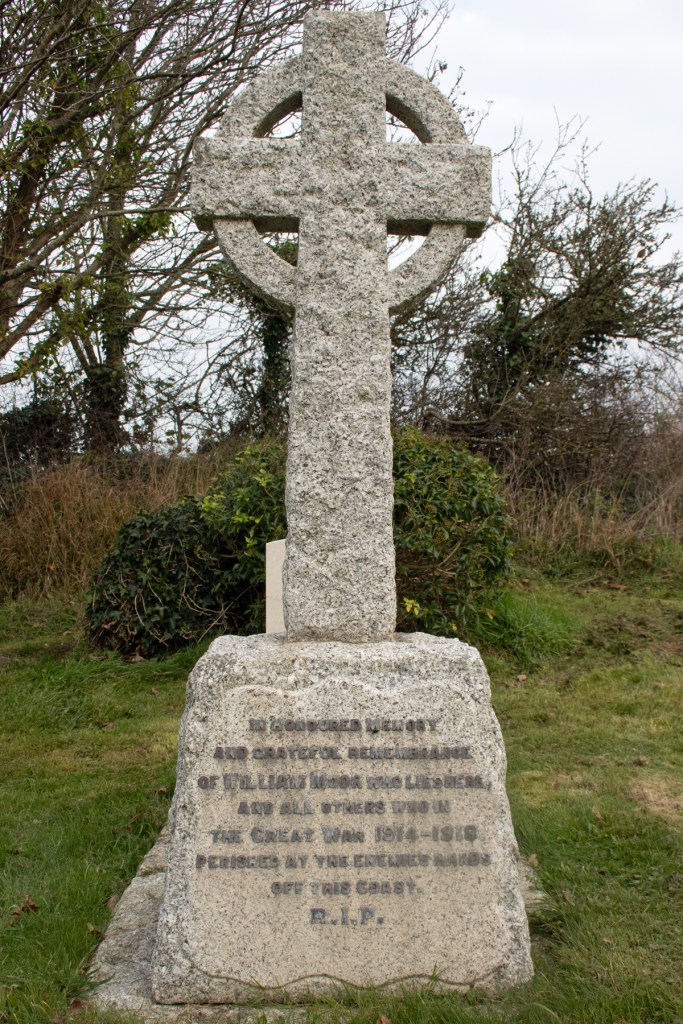
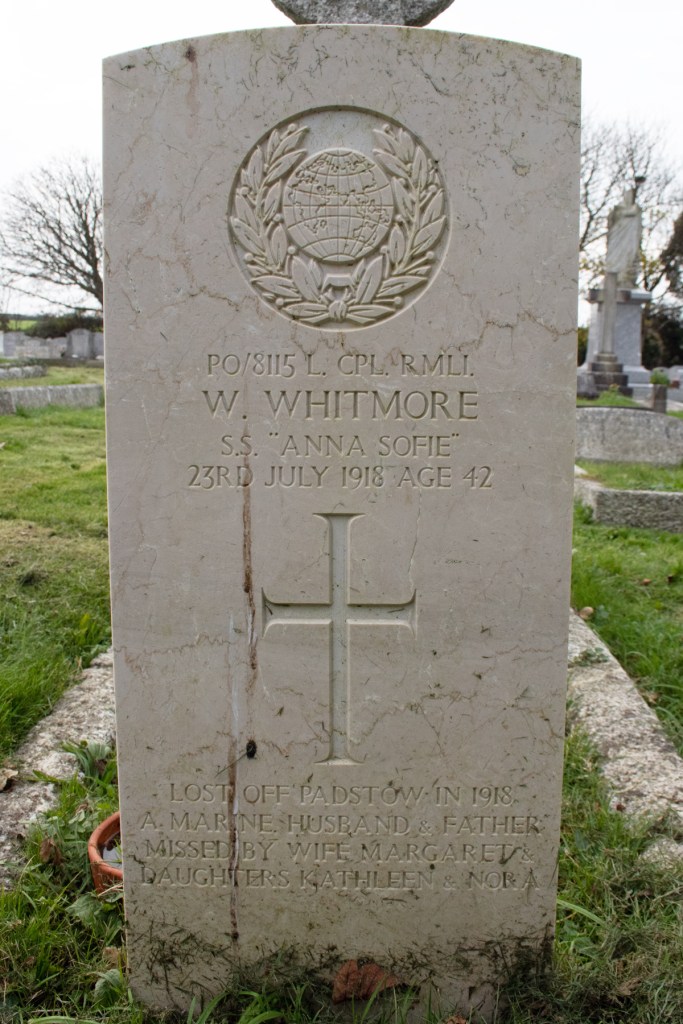
William Moore’s sister may not have been able to pay for her brother to be brought back to Cheshire for burial. Instead, he was laid to rest in Padstow Cemetery, and shares his resting place with another member of the crew, Lance Corporal William Whitmore.

William’s headstone reads: “In honoured memory and grateful remembrance of William Moor [sic] who lies here, and all others who in the Great War 1914-1918, perished at the enemies hands off this coast. RIP.”


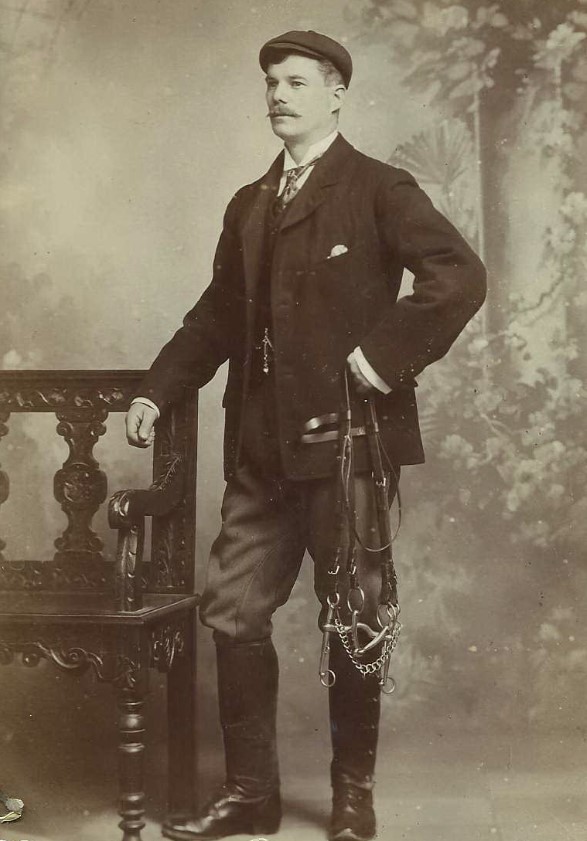
Lance Corporal William Whitmore

Lance Corporal William Whitmore

William Henry Whitmore was born in Stoke-on-Trent, Staffordshire, on 21st May 1875. One of nine children, his parents were William and Mary Whitmore. He was not the first of their sons to be called William – a brother born nine years previously was also called by that name, but he died when just a few months old.

William Sr was a journeyman joiner, and seems not to have played much of a part in his family’s life. The 1881 and 1891 census returns found Mary raising her children as the head of the household, and this seems to have paid a toll. By the time of the 1901 census, she was one of 150 patients at the North Staffordshire Infirmary in Stoke-on-Trent. She died in 1907, at the age of 67 years old.

William Jr, meanwhile, had been making a life for himself. On 28th August 1895, he enlisted in the Royal Marine Light Infantry, set on a career at sea. His service records confirm that he was 5ft 8ins (1.73m) tall, with brown hair, grey eyes and a fresh complexion. The document also highlights two tattoos on his left forearm, one of a crossed heart.

Private Whitmore was sent to Walmer in Kent for his initial training. He spent nine months on site, before moving to what would become his shore base, the Royal Naval Dockyard in Portsmouth. Over the twelve years of his contact, he would go on to serve on six ships, each time returning to the Hampshire port.

On 18th February 1904, William married Margaret Cook. She was the daughter of a farm labourer from Somerset, but the couple wed in the parish church of Eastry, near the Royal Marines base in Walmer.

William’s term of service came to an end in September 1907, and he was placed into the Royal Fleet Reserve. He and Margaret, together with daughter Kathleen, settled in Wellingborough, Northamptonshire. Their home was a small terraced cottage on Salisbury Road, close to the train station. William had found employment as a labourer in a blast furnace not far from home. A second child, daughter Nora, was born in 1910, and the family was complete.

Private Whitmore was called into service once more when war was declared. After initially returning to Portsmouth, he was assigned to the converted liner HMS Carmania, spending nearly two years on board. After a brief spell back on dry land, William found himself assigned to the steam ship SS Anna Sophie.

On 23rd July 1918, the ship was en route from Rouen to South Wales, when she was torpedoed the German submarine U-55 off Trevose Head, Cornwall. The Anna Sofie was sunk, and one member of the crew died. Others subsequently passed from their injuries, including the now Lance Corporal Whitmore. He was 43 years of age.

William Henry Whitmore’s body was recovered, but his family were unable to cover the cost of bringing him back to Northamptonshire for burial. Instead, he was laid to rest in Padstow Cemetery, in a shared grave with fellow crewman Gunner William Moore.


Lance Corporal William Whitmore
(from ancestry.co.uk)

Sailor Angus MacIver

Sailor Angus MacIver

Angus MacIver was born in 1887 in the isolated hamlet of Geshader (Geisiadar), on the Isle of Lewis, Scotland. His parents were Murdo and Marion MacIver, and he was one of seven children.

Detail of Angus’ early life are a challenge to uncover. It would seem that he worked with boats when he completed whatever schooling he undertook. Given Geshader’s proximity to the coast, it is likely that Murdo was a fisherman, and that his three sons – Angus included – followed suit.

By the time war broke out in 1914, Angus had joined the Canadian Merchant Navy. He held the rank of Sailor: records suggest that he would have been an Able Seaman, had he been in the Royal Navy.

In the spring of 1918, Sailor MacIver was serving on board the SS Tagona, a Canadian steamer, ferrying goods across the Atlantic. The ship was en route for Glasgow, having sailed from Bilbao, Spain, and, on 16th May she was passing close to the North Cornish coast. Five miles (8km) from Trevose Head, Tagona was torpedoed by the German submarine U-55, and sank. Eight crew members, including Angus, drowned. He was 31 years of age.

The body of Sailor Angus McIver washed ashore in the Camel Estuary: the remains were identifiable, but his family were unable to bring him back to Lewis. Instead, he was laid to rest in the peaceful graveyard of St Menefreda’s Church in St Minver, Cornwall.


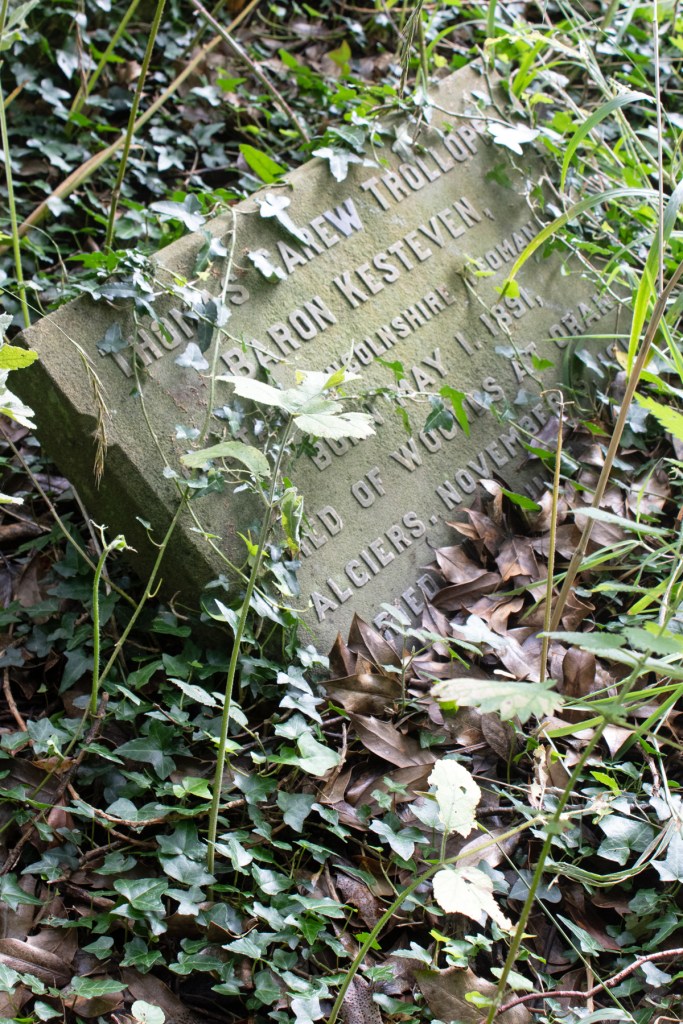
Captain Sir Thomas Trollope, Baron Kesteven

Captain Sir Thomas Trollope, Baron Kesteven

Official intimation has been received of the death of Capt. Lord Kesteven, of the Lincolnshire Yeomanry, who sailed for the Balkans last week. Sir Thomas Carew Trollope… third Baron Kesteven, who was born in May 1891, was the only son of the late Hon. Robert Cranmer Trollope and the Hon. Mrs Trollope, of Crowcombe Court, Taunton, and was educated at Eton. He succeeded to the barony on the death of his uncle, the second Baron, in July last. He joined the Lincolnshire Yeomanry about six years ago, when his uncle was Colonel of the regiment, and was gazetted Captain in October 1914. He had seen service in France during the present war, being attached to Jacob’s Horse, Indian Cavalry, until he succeeded to the title. Lord Kesteven was unmarried, and the title becomes extinct, but the baronetcy goes to Mr William Henry Trollope.

Bath Chronicle and Weekly Gazette: Saturday 13th November 1915

Thomas Carew Trollope was born in Middlesex, London on 1st May 1891. He was the younger of two children to Robert and Ethel Trollope, whose main residence was Crowcombe Court in Somerset.

Thomas was destined for great things. The 1901 census recorded him as being a boarder at Naish House Preparatory School in Wraxall, Somerset, while his older sister, Dorothy, remained at home with their parents and ten live-in servants.

Ten years later, and on his way to being prepared for the barony, Thomas was living with his uncle, John Trollope, the Baron Kesteven, at his estate, Casewick, in Uffington, Lincolnshire.

On the 5th November 1915, on Thomas’ journey to the Balkans, the ship he was on, the SS Mercian, was shelled by U-Boat SM U-38. After more than an hour being bombarded, the Mercian escaped. By that time, however, 78 men were wounded, 23 were killed, and 22 troops and eight crew members were missing. The Mercian managed to dock at Oran, Algeria, and those killed were either buried at sea or in the city’s cemetery.

Captain Sir Thomas Carew Trollope was also killed: he was just 24 years of age. It is unclear whether Thomas’ body was brought back to Britain or was buried in Oran, but the family plot includes a memorial to him.

A memorial service was held in the Church of the Holy Ghost, Crowcombe, on Monday 15th November 1915, the villagers commemorating the untimely passing of their favourite “Mr Tom Trollope”.


Captain Sir Thomas Trollope, Baron Kesteven
(from findagrave.com)

Sapper Walter Stone

Sapper Walter Stone

Walter Stone was born at the start of 1880 in Lympsham, Somerset. The middle of three children, his parents were coal merchant George Stone and his wife, Ellen.

When he finished his schooling, Walter found work as a painter and plumber. In January 1902 he married Alice Charman. Eighteen years older than Walter, she was the widow of a milkman from Bristol, and had raised her son, Edgar, since her husband had passed away a few months before. The couple settled in the village of Brent Knoll, and went on to have three children of their own: Albert, Florence and Alice.

When war came to Europe, Walter was called upon to play his part. He enlisted after June 1916, and joined the Royal Engineers as a Sapper. He was attached to the Inland Waterways and Docks division, but, as no documentation remains to confirm his service, it is not possible to confirm whether he saw any action overseas

Sapper Stone’s time in the army was not to be a long one. The next record for him is that of his admission to a military hospital in Herne Bay, Kent. He was suffering from pneumonia, and this would take his life on 18th January 1917. He was 36 years of age.

Walter Stone’s body was brought back to Somerset for burial. He was laid to rest in the tranquil graveyard of St Michael’s Church in Brent Knoll.


Further tragedy was to strike Walter’s widow, Alice. Edgar, her son from her first marriage, enlisted in the Somerset Light Infantry when war broke out. Attached to the 7th (Service) Battalion, he found himself on the Front Line by the end of July 1915.

Private Stone is reported to have been accidentally killed on 1st May 1917. No other detail is given, but he was just 24 years of age when he passed. He was buried at the Thiepval Memorial at the Somme.

Alice had lost her husband and her oldest child within a matter of months.


Lance Corporal Henry Rowell

Henry Edward Rowell was born on 22nd May 1898 in Southwark, Surrey. One of five siblings, of whom only three survived childhood, his parents were Henry and Jane Rowell. Henry Sr was a bricklayer’s labourer from Southwark, and the family were brought up in a small terraced house on Brandon Street, Walworth.

When he finished his schooling, Henry Jr found work as a turner’s improver but, when war came to Europe, he was called upon to play his part. He enlisted on 29th May 1915, and, as a Private, was attached to the 12th (Service) Battalion (Bermondsey) of the East Surrey Regiment. His service records tell a little of the man he was, confirming that he stood 5ft 3.5ins (1.61m) tall, and suggesting that he gave his age a 19 years old (he was just 16 at the time).

Henry seemed to have made an impression on his superiors as, in early October, he was promoted to Lance Corporal. His early service was based on home soil, primarily in Witney, Surrey.

In December 1915, Henry was temporarily released from military duty for munitions work. Sent to work for the engineering company Peter Hooker Ltd, in Walthamstow, Essex, Lance Corporal Rowell was to remain here for the next four months. On 25th March 1916, however, he was called back to service, as his battalion readied itself to move from its base, by that point in Aldershot, Hampshire, to Northern France.

Lance Corporal Rowell found himself in the thick of things very quickly. From 1st July, the 12th Battalion was caught up in the Battle of the Somme, and he remained entrenched there for the next couple of months.

On 15th September 1916, the British launched an attack on the German front line at Flers-Courcelette, mid-way between Albert and Bapaume. Lance Corporal Rowell was involved in the battle, which lasted until the end of the month, and was cut down on the very first day. He was just 18 years of age.

Henry Edward Rowell was laid to rest in the Bulls Road Cemetery in Flers, Picardie.


Henry Edward Rowell was my paternal grandmother’s first cousin.


Gunner Stanley Parry

Gunner Stanley Parry

Stanley William Parry was born in the spring of 1890 in St George’s on the outskirts of Bristol, Gloucestershire. One of four children to Herbert and Susannah Parry, Stanley was a twin to brother Roland. Herbert was a commercial clerk for a chemical manufacturer, and this afforded the Parry boys a level of education, with both Roland and Stanley attended the Colston Endowed School in Bristol.

Tragically, Susannah had died when Stanley and Roland were just 3 years old: their younger brother, Wilfred, had died the year before, when just a babe-in-arms. By the time of the 1911 census, Herbert had moved the family to Portishead. He was still working as a clerk, while both of the twins were employed as insurance clerks. Their older brother, Edwin, was also a clerk, in the docks at Bristol, and Herbert had employed a live-in housekeeper, Mary Govier, to look after him and his sons.

When war came to Europe, both Stanley and Roland enlisted. The two of them joined the Royal Field Artillery as Gunners. While full service records are not available, Stanley was assigned to the 40th Trench Mortar Battery, while Roland became attached to A Battery of the 240th Brigade.

Stanley was serving in France in the summer of 1916, when he became ill.

The funeral took place on Saturday afternoon, at Portishead Cemetery, of Gunner Stanley Wm Parry, who… died at Mile End Hospital, London, on September 19th. The deceased, who was 27 years of age, was always somewhat delicate in health, but was anxious to serve his King and country, and joined the [Royal Field Artillery]. He was brought to London from France on the previous Saturday suffering from enteritis, and although he lived until his father reached him, he died shortly after. He was the third son of Mr HC Parry… whose two other sons are also serving, one in France and the other in Egypt.

Bristol Times and Mirror: Monday 25th September 1916

Gunner Stanley William Parry was laid to rest in Portishead Cemetery, just a short distance from the family home.


Gunner Stanley Parry
(from findagrave.com)

Roland continued to serve his country in France, but tragedy was to strike the family once more.

Mr HC Parry… has received the sad intelligence that his son, Rowland G Parry [sic], of the [Royal Field Artillery], was killed in action on the 17th September. A letter from deceased’s officer stated that Gunner Parry was returning to the battery when a shell burst on the track, killing deceased instantaneously, death being absolutely painless. The letter further states that Gunner Parry had been a very valuable member of the battery, and will be missed by them all. Gunner Parry was the second of Mr Parry’s three sons to lay down his life in the great fight, a twin brother having died in a military hospital in London last year. The other son, the eldest, is serving in Palestine.

Bristol Times and Mirror: Saturday 29th September 1917

Roland George Parry was 28 years of age when he died. He was laid to rest in the Vlamertinghe New Military Semetery, in Ypres.

Gunner Roland Parry
(from findgrave.com)

Herbert Parry passed away in the summer of 1920, at the age of 62. He had outlived three of his sons, as well as being a widower for 27 years. He was laid to rest in Portishead Cemetery with his son Stanley.

Edwin Parry, Stanley and Roland’s older brother, had returned from the First World War by the summer of 1919. He resumed his work as a clerk at the docks in Bristol, and married schoolteacher Annie Homewood in August 1919. They went on to have three children, Barbara, Gwladys and Roland. Edwin died in September 1959, at the age of 71 years old.


Stoker 1st Class Phillip Clemett

Stoker 1st Class Phillip Clemett

Phillip George Clemett was born on 5th December 1891, one of eight children to Albert and Mary Jane Clemett. Albert was a carpenter from Devon, Mary Jane came from Somerset, but by the time Phillip was born, the family had moved to Fulham in Middlesex.

The 1911 census records the family as having moved back to Somerset. Mary Jane had been born in the village of Huntspill, and it was here that the Clemetts returned. Albert was now working as a farmer, so it is possible that they had moved to work on the family farm.

Labouring was not a job to satisfy Phillip, though, and he sought a career on the high seas. On 3rd February 1913, he enlisted in the Royal Navy as a Stoker 2nd Class. His service records show that he was 5ft 4ins (1.63m) tall, with brown hair, brown eyes and a fresh complexion.

Stoker Clemett’s was initially sent to HMS Vivid, the Royal Naval Dockyard in Plymouth, Devon. Here he received a few months’ training, before being given his first posting, on board the battleship HMS Indefatigable. He remained on board for the next fifteen months, gaining a promotion to Stoker 1st Class in the process.

Over the next couple of years, Phillip served on a couple more vessels, but on 11th February 1917 he was assigned to the submarine HMS C16. Stoker Clemetts was on board for a couple of months, as she was patrolling off the Essex coast. On 16th April 1917, the C16 was accidentally rammed by the destroyer HMS Melampus. She sank to the bottom and a couple of attempts were made for the crew to escape, but they became trapped and all perished, including Stoker 1st Class Clemetts. He was 25 years of age.

Contemporary newspaper reports give little detail about the accident – stating simply that Phillip ‘perished at sea’ [Western Daily Press – Tuesday 01 May 1917] His service documents are equally cagy about the incident, confirming jus that he ‘lost his life on duty.’ The records, however, show that on each of his five annual reviews, his character was noted as ‘very good’, while his ability was ‘superior’.

When the submarine was salvaged, Phillip George Clemett’s body was brought back to Somerset for burial. He was laid to rest in the peaceful graveyard of St Peter’s Church in Huntspill.


Ordinary Seaman Herbert Fry

Ordinary Seaman Herbert Fry

Herbert Austin Fry was born on 30th January 1889 in the Somerset village of Moorlinch. He was the fifth of ten children and his parents were Joseph and Ellen Fry. Joseph was a farmer, and by the time Herbert was just two years old, the family had moved to Sutton Farm, in nearby Sutton Mallet.

The whole family chipped in to play their part on the farm, and, even before he finished his schooling, this was something that Herbert was also destined to do.

When war came to Europe, Herbert was keen to play his part. He enlisted in the Royal Naval Volunteer Reserve on 7th September 1916 as an Ordinary Seaman. His service records give a hint as to the young man he had become: he was 5ft 11ins (1.8m) tall, with sandy hair, blue eyes and a fair complexion.

Ordinary Seaman Fry was initially sent to HMS Victory – the Royal Naval Dockyard in Portsmouth, Hampshire – for training. Over the next year, he was given two sea-going postings, before returning to HMS President in London in September 1917.

On 31st October, Herbert boarded SS Dunrobin, a merchant ship. Having sailed to Almeria in Spain, she was returning to Britain, with a cargo of iron ore and grapes. On 24th November 1917, while 49 miles (79km) south-west of The Lizard in Cornwall, the Dunrobin was torpedoed by a German submarine. She sunk, and 31 lives – including that of Ordinary Seaman Fry – were lost. Herbert was 28 years of age.

Herbert Austin Fry’s body was recovered and brought back to Somerset for burial. He was laid to rest in the peaceful Sutton Mallet Churchyard.


Stoker 2nd Class Tom Mounter

Stoker 2nd Class Tom Mounter

Tom Mounter was born on 24th March 1890 in the quiet Somerset village of Kingsbury Episcopi. He was one of ten children to Robert and Ellen Mounter. Robert was a farm labourer, while Ellen earned a little more money for the family by stripping withy – or willow – branches for use in a variety of ways, such as basket weaving.

When Tom left school, he followed his father into agricultural work, employed to grow and manage the withy fields. In April 1911, he married Ellen Talbot, a farm labourer’s daughter from the village. The couple went on to have three children, Frederick, Martha and Horatio.

When war came to Europe, Tom stepped up to play his part. On 14th December 1916, he joined the Royal Navy, along with four others from the village.

Tom’s service records show that he was 5ft 6ins (1.68m) tall, with brown hair, blue eyes and a fresh complexion. Stoker 2nd Class Mounter was initially sent to HMS Vivid, the Royal Naval Dockyard in Devonport, for training, before being assigned to the cruiser HMS Ariadne on 31st March 1917.

The Ariadne had been converted into a minelayer that year, and worked in the English Channel. On 26th July 1917, she was torpedoed by the German submarine UC-65, and sunk, with the loss of all 38 hands, including Stoker Mounter. He was just 27 years of age.

Tom Mounter’s body was brought back to Somerset for burial. He was laid to rest in the peaceful Kingsbury Episcopi Cemetery, next to George Bonning, who had enlisted on the same day as him, and who had died six months before.

The local newspaper, when reporting on Stoker Mounter’s funeral, noted that he was “the seventeenth Kingsbury Episcopi man who has died for his King and country. It is stated that he had a strong presentiment that he would be killed.” [Langport & Somerton Herald: Saturday 4th August 1917]


Stoker 2nd Class Tom Mounter
(from findagrave.com)