Tag Archives: Lancashire

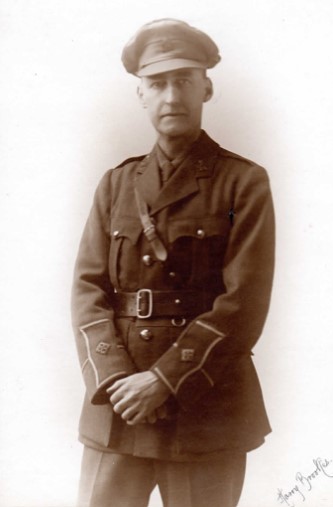
Second Lieutenant Algernon O’Donoghue

Second Lieutenant Algernon O’Donoghue

Algernon Leopold O’Donoghue was born on 4th June 1869 in Plymouth, Devon. The youngest of five children, his parents were Charles and Frances O’Donoghue. Charles had worked for the East India Company and the family travelled a lot while the children were growing up. He was in India when, in the spring of 1872, he passed away.

By the time of the 1881 census, Frances had moved the family to the Walcot area of Bath, Somerset. She was working as an assistant, and employed a servant of her own to help support the four children.

Over the next few years, Algernon’s trail goes cold. In 1900, he married Janette Hay, the daughter of a Justice of the Peace, who had been born in Ceylon. It seems likely that they met overseas: the 1911 census return records that she had been born in Ceylon, while he was a retired forest manager whose job had taken him to Burma (now Myanmar).

The census document found the couple living in a seven-room villa in Combe Down, on the outskirts of Bath. The had had a son by this point, with Algernon Jr making up the family.

Algernon was working for the Bombay Trading Company, and back out in India, when war broke out. He returned home, and stepped up to serve his King and Empire. While his service records have been lost to time, Private O’Donoghue joined the Royal Defence Corps, and quickly rose through the ranks: by the spring of 1917, he was a Second Lieutenant.

It was while serving in the north west of Britain that he fell ill: “[he got] wet while out in heavy rain, pneumonia following, and then double pneumonia.” [Bath Chronicle and Weekly Gazette: Saturday 26th May 1917] Second Lieutenant O’Donoghue was admitted to the Whitman Military Hospital in Manchester, but his condition was too severe. He passed away on 22nd May 1917, two weeks before his 48th birthday.

The body of Algernon Leopold O’Donoghue was taken back to Somerset for burial. He was laid in the family plot in Bath’s panoramic Locksbrook Cemetery, reunited with his mother, Frances, who had died a decade before.


Second Lieutenant Algernon O’Donoghue
(from findagrave.com)

Private Alexander Cain

Private Alexander Cain

Alexander Bertram Cain was born on 31st July 1885 in Ormskirk, Lancashire. He was the ninth of eleven children to concert promoter Robert Cain and his wife, Sarah.

By 1901, Robert and Sarah had moved the family to Jersey, setting up home in St Saviour’s. Robert was noted as living off his own means, but Alexander, who would have been 15 by this point, is noticeable by his absence and, in fact, does not appear on that year’s census return.

Robert died in 1909, and on 26th January 1911, Alexander married a woman called Hilda Bedford. They settled down in St Helier, and went on to have two children, daughters Yvonne and Elizabeth. The census taken three months after the couple’s wedding recorded Alexander as living on his own means, so money appeared not to be an issue for the young family.

When war came to Europe, Alexander was called upon to play his part. On 12th March 1917, he enlisted in the Royal Jersey Militia, and was attached to the regiment’s Garrison Battalion, stationed on the island. His service records confirm that he was 5ft 7ins (1.7m) tall, and that he had a scar on his left cheek. The document also suggests that he had spent time in the Gloucestershire Regiment, but no further information about this is available.

Private Cain spent the next two years in the army. Towards the end of this time, however, his health appears to have been impacted, to the point that, on 6th May 1919, he was medically discharged from the Royal Jersey Militia.

Whatever his condition, it was to prove fatal. Alexander passed away at home on 31st May 1919: he was 33 years of age.

Alexander Bertram Cain was laid to rest in the family plot in La Croix Cemetery in Grouville, Jersey, Hilda left widowed and with two children – Elizabeth just four months old – to raise.


Private John Turner

Private John Turner

John Francis Turner was born on 24th March 1899 in the St Ouen region of the Channel Island of Jersey. He was the only surviving child of Francis and Eugenie Turner, his older brother, Francis Jr, having passed away before John was born.

Francis was a farm labourer, but when John finished his schooling, he found work as a carpenter. When war broke out across Europe, he was conscripted to play his part and, on 31st March 1917, he enlisted in the army.

Private Turner was noted as being 5ft 5ins (1.65m) tall and weighing 115lbs (52kg). His medical records show that his vision was defective, but not so bad as to exclude him from service, but he was also found to have flat feet.

John was assigned to the Royal Army Medical Corps, and was sent to Blackpool, Lancashire, where he was attached to the local depot. He spent the next two years in the army, although his time was not without incident.

In December 1917, he was confined to barracks for five days for overstaying his pass by more than eight hours. This seems to have been Private Turner’s only misdemeanour, however, and there is nothing to suggest anything other than good service.

John’s time in the army does not seem to have been limited to home soil, and, in the spring of 1919, he was attached to one of the Russian convoys ferrying aid and supplies overseas. On his return, however, he fell ill, and on 2nd February, he was admitted to hospital in Edinburgh, suffering from pleurisy.

Private Turner was to remain in hospital for the next few months. He slowly recovered, but then contracted meningitis, and, with his body already weakened by illness, this was to prove his undoing. He passed away on 23rd June 1919, aged just 20 years of age.

John Francis Turner’s body was taken back to Jersey for burial. He was laid to rest in the peaceful churchyard of St Ouen’s.


Gunner Kei Marsh

Gunner Kei Marsh

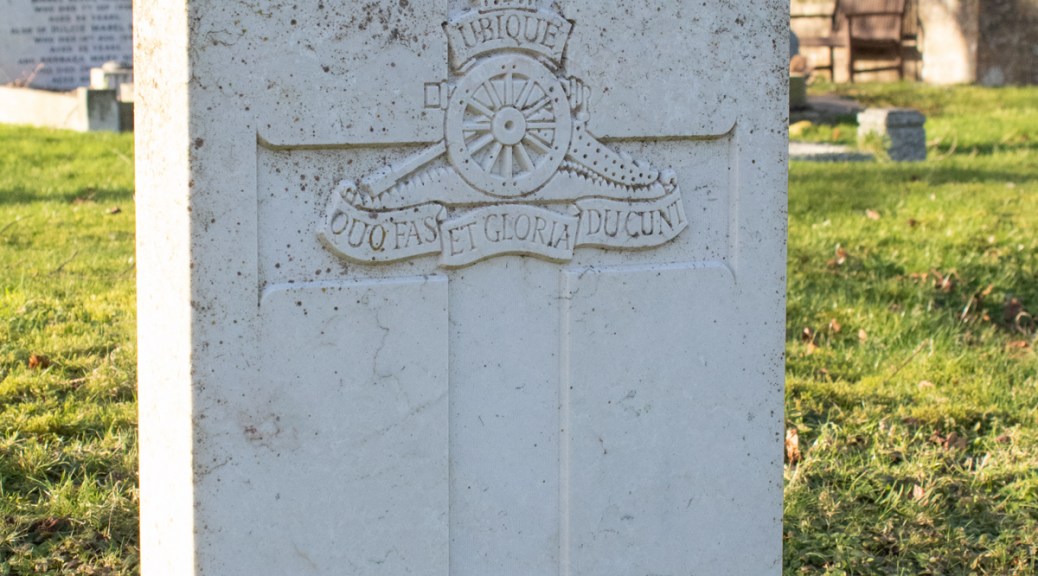
In a corner of the peaceful St Mary’s Churchyard in Codford, Wiltshire, is a headstone dedicated to L/17062 Gunner K Marsh. He served in the Royal Field Artillery, and passed away on 5th January 1916.

Gunner Marsh’s entry in the Army Register of Soldier’s Effects gives his first name – Kei – and that of his widow – Edith. The parish record for his funeral giving an age of 34 years old, and from here it is possible to piece together some of his family’s past.

Kei was born in Burnley, Lancashire, in the autumn of 1882, and was the son of engineer Alfred Marsh. He and Edith married in 1907, and were living with her widowed mother, Sarah, and their three children, John, Sarah and Edith, by the time of the 1911 census. The house – 30 Thorn Street in Burnley – was crowded. Along with the Marshes, Sarah also had her other six children living with her: a total of eight adults and four children sharing four rooms in the small terraced house.

Kei was working as a miner by this point, but had enlisted in the Royal Field Artillery by the summer of 1915. He acted as a Gunner in the 32nd Division Ammunition Column, although it is unclear whether or not he spent any time overseas.

By the end of 1915, Gunner Marsh had been admitted to the military hospital in Codford. The cause of his admission is unclear, but it was to be one that he was to succumb to: he passed away on 5th January 1916. Kei lies at rest in the quiet Wiltshire churchyard.


Private James McEwan

Private James McEwan

James McEwan was born towards the end of 1879 in Bury Lancashire. He was the older of two children to James and Mary McEwan. James Sr was a foundry worker, who died in the 1890s, leaving his widow to raise their two sons.

By the time of the 1901 census, all three members of the household were earning money: Mary was employed as a cotton card room hand in a mill; James was a wringing machine fitter, while his younger brother, Peter, was a printer’s apprentice.

The next census, in 1911, found James still living at home with his mother. He was now employed as a labourer in the local railway goods yard, and his maternal aunt, Annie, was living with them, working as a rover in the local mill.

When war broke out, James stepped up to serve his country. Full details are lost to time, but it is clear that he enlisted in the Lancashire Fusiliers, and was attached to the 4th/5th Battalion. This was a service and training unit, and Private McEwan did not spend any time overseas.

In the winter of 1915, James was based on Salisbury Plain, Wiltshire. While billeted there, he contracted bronchial pneumonia, and was admitted to a camp hospital. Sadly the condition was to prove too much for his body to bear, and he succumbed to it on 26th December 1915. He was 36 years of age.

It seems that Mary was unable to afford to bring her sone back to Lancashire. He was laid to rest in the peaceful St Mary’s Churchyard, in Codford, Wiltshire, not far from where he had breathed his last.


Serjeant Cecil Whitehead

Serjeant Cecil Whitehead

Details of Cecil Whitehead’s early life as lost to time. Born in 1882, he was the son of Henry and Annie Whitehead, from Openshaw in Manchester. There are no census returns for the family, so it is not possible to discover any more of their background.

The Commonwealth War Graves Commission confirm that Cecil wed a woman called Annie Ellis. His pension ledger notes four children: John, Cecil, Annie and Catherine, who died in 1917.

When war broke out, Cecil stepped up to serve his King and Country. He enlisted in the Manchester Regiment, and was assigned to the 3rd/8th Battalion. This was a reserve unit, based on home soil, and there is no evidence that Cecil spent any time overseas.

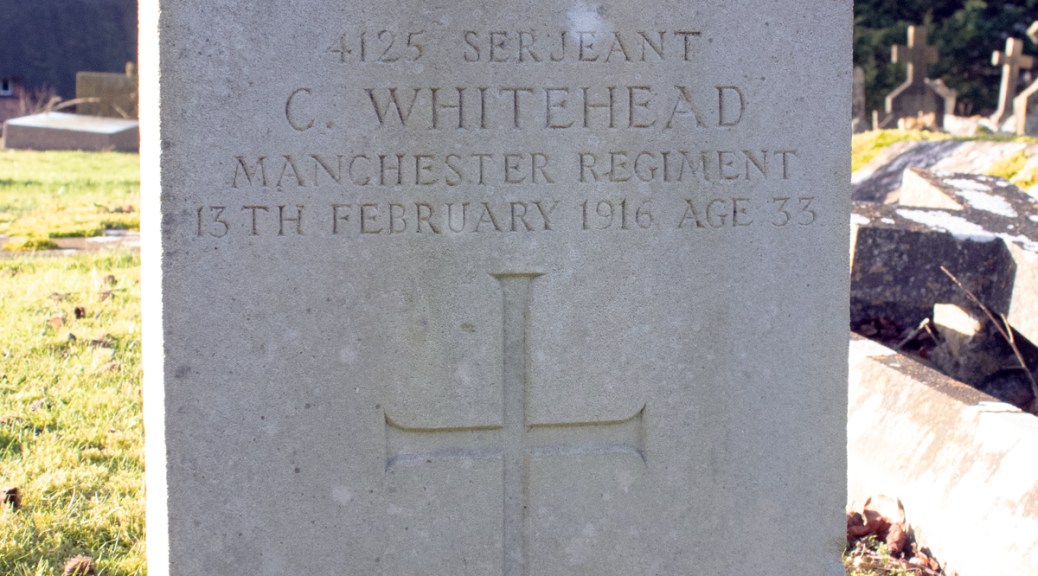
Cecil rose to the rank of Serjeant, by the winter of 1915, Cecil was billeted near Codford in Wiltshire. It was while he was here that he fell ill, contracting pneumonia. The condition was to prove too much for his body to bear, and he passed away on 13th February 1916, at the age of 33 years old.

Annie appear to have been unable to fund bringing her husband back to Manchester for burial. Instead Cecil Whitehead was laid to rest in the quiet graveyard of St Mary’s Church in Codford.


Private Rondaine Cary

Private Rondaine Cary

Rondaine Tristram Cary was born in Lancashire in the autumn of 1896 and was the oldest of two children to Henry and Wilhelmina. Henry was an insurance agent, and, by the time of the 1901 census, the family had moved to the parish of Linsfort in County Donegal, Ireland. This is near where Wilhelmina had been born, so it seems likely that the draw of family had been partially responsible.

The 1911 census found the Carys living a few miles down the road, in Buncrana. Rondaine was listed as being a scholar, while his younger brother, five year old John, completed the family setup. John was employed as a commission agent, and all four members of the household were listed as being Episcopalian.

When war came to Europe in 1914, Rondaine was keen to play his part. He seems to have enlisted almost at once, joining the Royal Inniskilling Fusiliers. Assigned to the 11th (Service) Battalion (Donegal and Fermanagh), Private Cary was sent to Ballymena, County Antrim, for training.

Rondaine had only been in the camp for a matter of weeks, when he contracted measles. He was admitted to a hospital in Ballymena on 17th February 1915, but his condition worsened, and his father came to visit. Private Cary passed away on 27th February 1915, aged just 18 years of age.

The Cary family seemed unable to afford the cost of bringing their son’s body back to Buncrana. Instead, the local authority paid for Rondaine Tristram Cary’s coffin and funeral at Ballymena Cemetery, while his army colleague funded his headstone.


Private Samuel Smith

Private Samuel Smith

Samuel Herbert Smith was born on 15th March 1886 in Liverpool, Lancashire. He was one of six children to parents Henry – a road labourer for the local council – and Elizabeth.

There is little concrete information about Samuel’s early life. While the 1901 census confirms he was employed as an apprentice, the writing is not legible enough to identify the trade he was in. A later record suggests he spent two years in the Royal Engineers, although, again, no supporting documents evidences this.

Samuel married a woman from South Wales. Her details are lost, but his war pension record gives the name Mrs SH Smith, and gives her address as 34 Albany Street, Newport, Monmouthshire.

It would seem that Samuel was keen to build a bigger and better life for the couple, and left Britain to find work overseas. By 1914 he was living in Valcartier, Quebec, and working as a bartender. War was declared in the summer of that year, however, and he immediately stepped up to serve his country.

Samuel enlisted in the Canadian Expeditionary Force on 23rd September, and was assigned to the 13th Battalion of the Canadian Infantry. His service records suggest he cut a striking figure: he stood 6ft 1in (1.85m) tall and weighed 168lbs (76.2kg). He had light brown hair, hazel eyes and a medium complexion, and his records note that he had a crossed hands tattoo on his right arm.

His unit set sail for England and, by the end of October, Private Smith was installed at Bustard Camp on Salisbury Plain, Wiltshire.

An enquiry was led into the death of Samuel Herbert Smith… Private Smith was travelling… in a motor car, and while the car was passing over uneven ground he fell into the road and was almost instantaneously killed.

George William Hincks, a private in the Canadian Force… was driving from Salisbury… in a motor car, which was meant to carry a machine gun, and was, therefore, open at the sides. Private Smith was seated next to [him] and was inclined to be rather sleepy. He had travelled in the train from Liverpool on the previous day. hey had gone some distance on their journey when deceased said “I want to get out of this.” [Hincks] said “Sit still, Bert. We will be soon be there,” Smith smiled and said “Oh, all right.” Almost immediately the car jolted on a rough piece of road, and Smith pitched on his head in the road. The car was immediately stopped, and [Hincks] went back to him and found him lying with his knees up, on his back, with wounds in his head. He was dead. [Hincks] returned to Salisbury and reported the occurrence to superior officers. The road on which fatality happened was rough and had been badly cut up, more especially at the place where deceased fell from the car.

Salisbury and Winchester Journal: Saturday 31st October 1914

The accident occurred on 29th October, Private Smith was just 28 years of age.

Samuel Herbert Smith’s widow was unable to cover the cost of bringing her husband back to Wales for burial. Instead, he was laid to rest in Amesbury Cemetery, not car from Bustard Camp.


Stoker Thomas McCall

Stoker Thomas McCall

Thomas McCall was born in Bootle, Lancashire, in 1892 and was one of two children to Francis and Elizabeth. Frank was a stoker on the steamers leaving Liverpool docks and, after working at the docks himself, Thomas soon followed his father onto the ships. By the summer of 1911, he had worked as a trimmer on at least two liners, the RMS Carmania and the RMS Empress of Britain.

When war came to Europe, Thomas stepped up, joining the Mercantile Marine Reserve – now better known as the Merchant Navy. By the summer of 1915, he was assigned to the seaplane carrier HMS Vindex, which spent most of the war in the North Sea.

Stoker McCall’s time there was to be brief. Details are sparse, but he passed away on 14th October 1915, with records suggesting this was due to disease. He was just 23 years of age.

Finances may have limited Frank and Elizabeth from bringing their son back to Lancashire: Thomas McCall was instead laid to rest in the Roman Catholic section of Woodlands Cemetery in Gillingham, Kent, not far from the dockyard in which he had been based.


Thomas’ headstone gives MaCall as his surname. This is an error: his name was spelt McCall.


Private Thomas Bastow

Private Thomas Bastow

Thomas Bastow was born in the spring of 1889, the youngest of five children to Frederick and Mary Bastow. Frederick was from Weston-super-Mare in Somerset, but had met his Liverpudlian wife in Lancashire, and it was in the North West of England that the Bastow family had been raised. Mary passed away in 1898, when she was jus 40 years of age. Frederick remarried in 1901, Florence Travis becoming the young Thomas’ stepmother.

Frederick was an inspector for a mineral water company, but when Thomas left school, he found work as a clerk for the land registry. In the autumn of 1916, he married Margaret Hughes. Sadly, there is little more information about her, although their wedding was registered in West Derby.

It may have been that Thomas was in the army at this point, or at least on the verge of going. He enlisted in the Royal Army Service Corps, and was attached to one of the supply units. He seems to have been based in Somerset, as this is where he was hospitalised when he came down with appendicitis.

Private Bastow’s condition was to get the better of him: he passed away on 4th May 1917 while admitted to the Bath War Hospital. He was just 28 years of age.

Finances seem to have limited Margaret’s options when it came to her late husband’s funeral. Rather then being taken back to the north wet for burial, Thomas Bastow was instead interred in Bath’s Locksbrook Cemetery.