Tag Archives: pneumonia

Private James Ellery

Private James Ellery

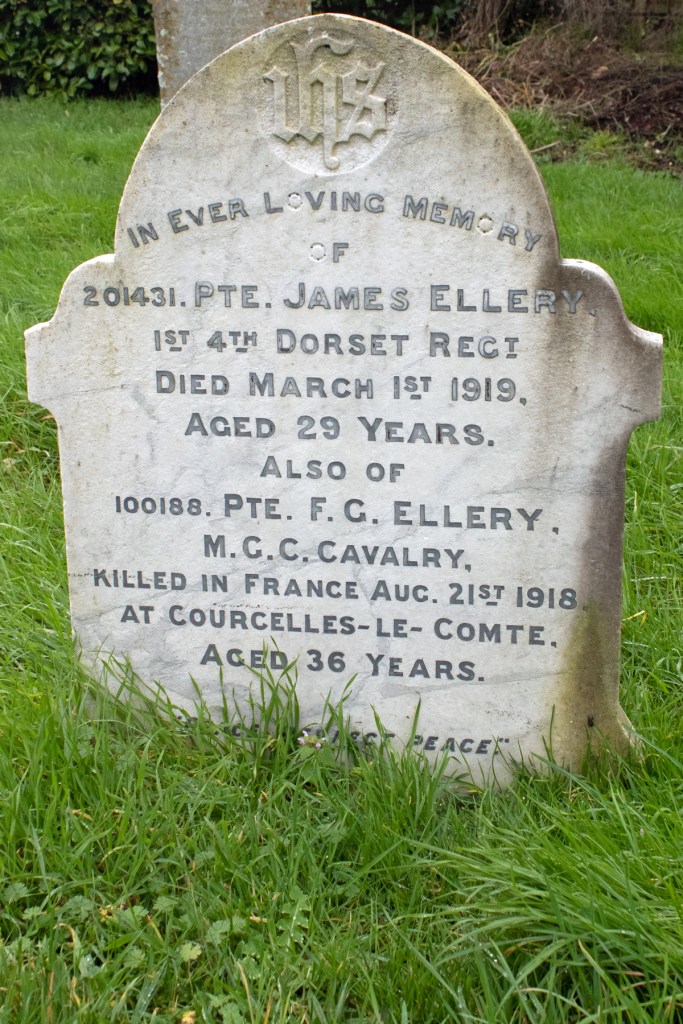
James Ellery was born in the autumn of 1889, and was the middle of seven children. His parents – Frederick and Mary – were born in Dorset, and the family were raised in the hamlet of Lillington. Frederick was a farm labourer, but James found his way into building work when he finished his schooling.

When war came to Europe, James stepped up to play his part. Full details of his military service have been lost to time, but it is clear that he had enlisted in the Dorsetshire Regiment and was attached to the 1st/4th Battalion.

Private Ellery’s unit served in India and Mesopotamia during the conflict, but it is unclear whether James saw any action overseas. Certainly by early 1919 he was back in Britain, as he was hospitalised in Sherborne following a bout of influenza. This developed into pneumonia, and he was admitted to the town’s Yeatman Hospital.

James’ immune system had become weakened during the conflict, and the pneumonia turned septic. It proved to be fatal, and James passed away on 1st March 1919. He was 29 years of age.

James Ellery’s body was taken back to Lillington for burial. He was laid to rest in the peaceful graveyard of St Martin’s Church.


James was not the first of the Ellery siblings to die during the Great War. His eldest brother, Frederick, had enlisted in the 2nd Battalion of the Machine Gun Corps Cavalry. He was killed in action on 21st August 1918, leaving behind a widow and three children. He was 36 years of age and is commemorated on the Vis-en-Artois British Memorial in Haucourt. France.


Private Reginald Lane

Private Reginald Lane

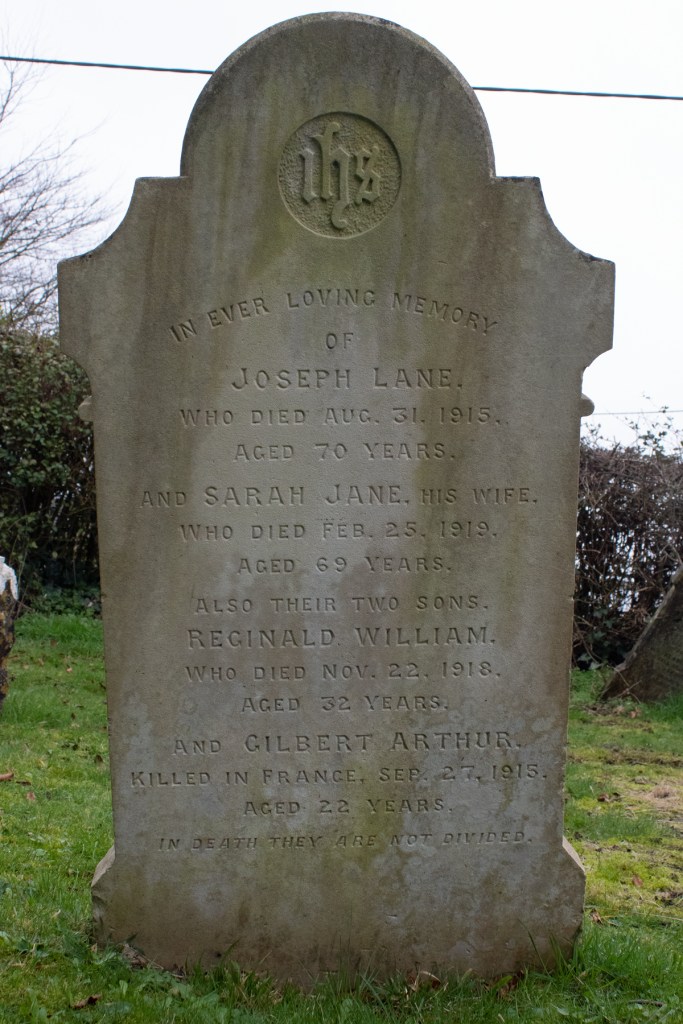
Reginald William Lane was born in the autumn of 1886, the eighth of ten children to Joseph and Sarah. Joseph was an agricultural labourer and he and his wife raised their family in their home village of Thornford in Dorset.

When he finished his schooling, he found work as a gardener’s boy. He went on to make a career out of this and was employed as a gardener when he married Evelyn Sharp on 15th April 1914. The couple exchanged vows in St Swithun’s Church, Hinton Parva, Dorset, the marriage certificate noting that the groom’s father was now employed as a woodsman.

War came to Europe later that year, and Reginald enlisted to serve the King and Empire. Little information is available about his military career: he joined the Dorsetshire Regiment, but there is no confirmation that he spent any time overseas. Private Lane transferred over to the 3rd (Reserve) Battalion of the Wiltshire Regiment, his new unit serving on home soil. Based in Kent, Reginald was part of the Thames & Medway Garrison.

Joseph died at the end of August 1915, and was laid to rest in the St Mary Magdalene Churchyard. Just weeks later, Reginald’s younger brother, Gilbert, a Private in the 3rd Battalion of the Middlesex Regiment, was killed during the Battle of Loos. He was commemorated on the Loos Memorial in Dud Corner Cemetery in France.

Private Reginald William Lane survived the war, but only by eleven days. While based in Kent, he contracted influenza and pneumonia. He died on 22nd November 1918, aged 32 years. His body was brought back to Dorset, and was laid to rest alongside his father.


There is no further information available for Evelyn.

Reginald’s mother, Sarah, however, only lived for another couple of months. She passed away on 25th February 1919, at the age of 69 years old. She was reunited with her husband and son in St Mary Magdalene Churchyard, the family headstone commemorating Private Gilbert Lane as well.


Private Ernest Brister

Private Ernest Brister

The early life of Ernest Brister is a challenge to piece together. His baptism record – at St Mary Magdalene Church in Thornford, Dorset – suggests that he was born in the summer of 1891, but gives only the name of his mother, Rosina Brister.

The 1901 census identifies the 9-year-old Ernest as a visitor to the house of Eliza Brister, a 65-year-old widow working as a laundress. There are several other Bristers in the village – including Eliza’s own to children – but Rosina is nowhere to be seen.

The next census, taken in 1911, sheds a little more light on the situation. Ernest is still living with Eliza, but he is now recorded as being her grandson. Aged 75, she was still taking in laundry, but Ernest was employed as a mason.

In the autumn of 1913, Ernest married Beatrice Chalker. She was a shepherd’s daughter from Dewlish in Dorset. The couple wed in Dorchester and went on to have two children, Doris and Edwin.

When war broke out, Ernest stepped up to play his part. He enlisted in the Dorsetshire Regiment, and found himself in France by the summer of 1915.

There is little information about Ernest’s time in the army, but later in the war, he seems to have transferred over to the Wiltshire Regiment. Attached to the 3rd (Reserve) Battalion, his new unit served on home soil and, based in Kent, was part of the Thames & Medway Garrison.

Private Brister was based in Maidstone in the autumn of 1918, when he contracted influenza and pneumonia. He was admitted to the military hospital in Aylesford, but the conditions were to prove to severe. He passed away on 24th November 1918, aged 27 years old.

Ernest Brister’s body was taken back to Dorset for burial. He was laid to rest in the graveyard of St Mary Magdalene Church. His grandmother, Eliza, passed away just a month later, at the age of 82. She was laid to rest close to her beloved grandson.


The 1910s were harsh for Ernest’s widow, Beatrice. Her youngest son was born in March 1915, her mother dying a couple of months later. She lost her brother, Edwin, to the war – he was serving with the 1st Battalion of the Gloucestershire Regiment, when he was killed on 28th August 1916. He was just 19 years of age. Two years later, she was widowed when Ernest passed away.


Private James Payne

Private James Payne

The early life of James Payne is a challenge to piece together. The first document that can be properly attributed to him is his marriage certificate from 27th May 1901.

This confirms that he was 21 years old, and working as a labourer. His father’s details are noticeable by their absence. The document also gives his wife’s name, Kate Bessie Warr, and information about her father – labourer Sydney Warr. James was also working as a labour at this point, and the two of them were living in Pulham, Dorset.

By the time of the 1911 census, the newlyweds had moved to the village of Yetminster. James was working as domestic gardener, and the couple had two children – Cyril and Louis. James’ place of birth is given just as Somerset, further clouding his past.

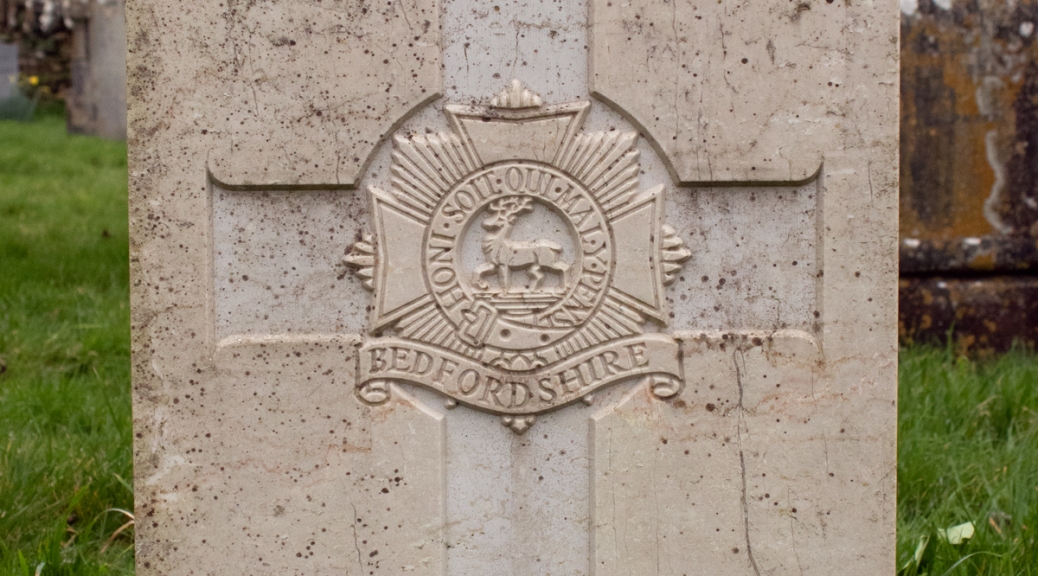
When war came to Europe, James stepped up to play his part. Full details of his time in the army are lost to time, but documents suggest that he had enlisted by October 1917 at the latest. Private Payne joined the Bedfordshire Regiment, and was attached to the 1st Battalion. His unit service on the Western Front throughout the conflict, although there is no evidence that James spent any times overseas himself.

Piecing the sparse number of documents together suggest that in March 1918, James was admitted to the 3rd Western General Hospital in Cardiff, Glamorganshire. He was suffering from nephritis and pneumonia, but it is unclear whether he was serving in Wales at the time, or was taken there for treatment. Either way, his condition was to prove too severe. Private Payne passed away on 20th March 1918: he was 38 years old.

James Payne’s body was taken back to Dorset for burial. He was laid to rest in the peaceful graveyard of St Andrew’s Church in his adopted home of Yetminster.


Private Albert Richomme

Private Albert Richomme

Albert John Richomme was born on 13th June 1885 and was one of eight children to Charles and Marie Richomme. Both were from France, but had moved to Jersey in the Channel Islands before Albert’s oldest sibling, Charles, was born. The couple farmed land near Grouville, the children helping out as they became old enough.

On 28th September 1904, Albert married Linda Rouland at St Thomas’ Roman Catholic Church. The couple set up home in Trinity, and went on to have six children. The 1911 census recorded Albert as being a jobbing gardener, with the family living in the four-roomed Sunny Side Cottage.

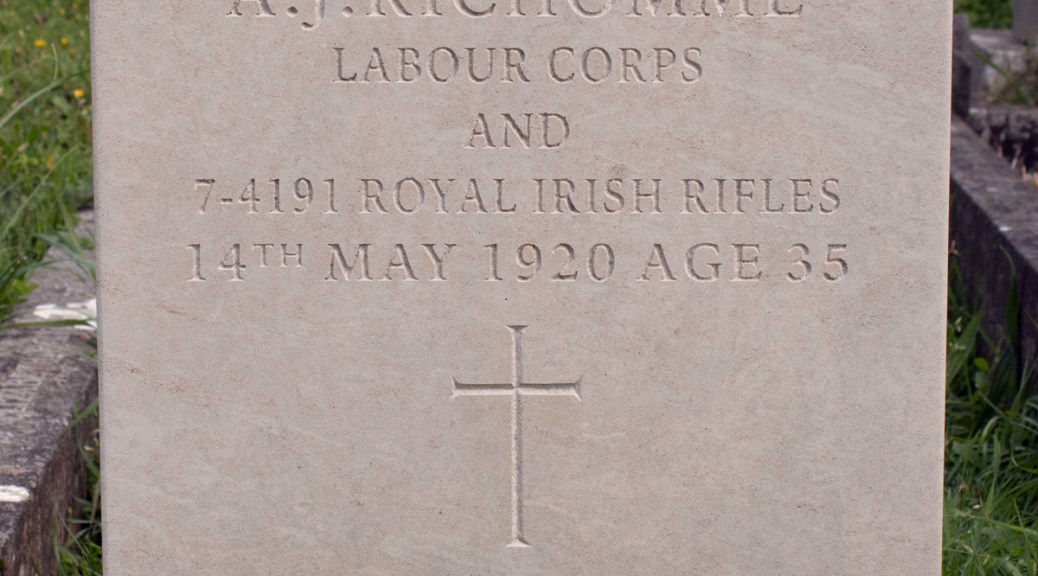
When war came to Europe, Albert stepped up to play his part. Initially enlisting in the Royal Jersey Militia, his unit was absorbed into the 7th (Reserve) Battalion of the Royal Irish Rifles. By the end of 1915, he found himself in France.

Full details of Private Richomme’s service are lost to time, but is seems that he was caught up in a gas attack and, after being medically evacuated to Britain to recuperate, he was transferred to the Labour Corps.

At this point, Private Richomme’s trail goes cold. He survived the war and returned home, but passed away from pneumonia on 14th May 1920, just short of his 35th birthday.

Albert John Richomme was laid to rest in the peaceful grounds of La Croix Cemetery in Grouville.


While meeting the appropriate criteria for his burial site to be granted a Commonwealth War Grave, Albert is not recognised by the Commission.


Private Albert Richomme
(from ancestry.co.uk)

Ordinary Telegraphist Thomas Morris

Ordinary Telegraphist Thomas Morris

Thomas Henry Morris was born in Bridgwater, Somerset, on 7th September 1898. The oldest of five children, his parents were Christopher and Jemima Morris. Initially a viceman for a carriage works, by the time of the 1911 census, Christopher had moved the family to the Weston area of Bath, where he was employed as an engineer’s fitter for a printing firm.

When Thomas – who was better knows as Harry – finished his schooling, he found work at a printer’s – Messrs. Goodalls in Westgate Buildings, Bath. In the summer of 1915, he enlisted in the Royal Navy as an Signaller.

He was then appointed to HMS Valiant, and was serving in this ship at the Battle of Jutland. As a result he was the victim of shell-shock, and totally unfitted for further active service. By this time he had passed his exams and had qualified as a telegraphist. After recovering he was put on the staff of the Admiral commanding the Orkney Island base, but nominally attached to HMS Cyclops…

[Bath Chronicle and Weekly Gazette: Saturday 1st March 1919]

It was while Ordinary Telegraphist Morris was serving on board Cyclops, he fell ill, contracting a combination of influenza and pneumonia. He was transferred to the Hospital Ship Agadir, but succumbed to the conditions on 21st February 1919. He was just 20 years of age.

Thomas Henry – Harry – Morris, was brought back to Somerset for burial. He was laid to rest in the sweeping grounds of Bath’s Locksbrook Cemetery.


Ordinary Telegraphist Harry Morris
(from britishnewspaperarchive.co.uk)

Lance Corporal George Fenn

Lance Corporal George Fenn

Much of George Fenn’s life is destined to be lost to time. Born in Bristol, Gloucestershire, in the summer of 1878, details of his parents are unknown. His was a common name in the late Victorian period, and census returns from the time identify at least two men born in the area around the same time.

The first document that can be directly connected to George is the 1911 census. This recorded him living at 13 Tankards Close in Clifton, where he was working as a dock labourer. His is noted as having been married to Minnie since 1902. The couple had one child, a son called William who was six years old.

When war broke out, George was quick to enlist. Full details of his service are lost, but he had certainly joined the Bedfordshire Regiment by the end of 1914. Attached to the 7th (Service) Battalion, by the start of the following year, his unit had moved to Salisbury Plain in anticipation of being sent to the Western Front.

George seems to have made his mark in the army, and he was soon promoted to the rank of Lance Corporal. In the spring of 1915, he contracted pneumonia, however, and was admitted to the military hospital in Codford, Wiltshire, close to where his unit was based.

Sadly, the condition was to prove Lance Corporal Fenn’s undoing: he passed away on 1st June 1915, at the age of 36 years of age.

George Fenn was laid to rest in the peaceful churchyard of St Mary’s, Codford, not far from where he had passed away.


George’s entry on the Army Register of Soldiers’ Effects and his Pension Ledger card shed a little more light on the family he had left behind. The first divides his belongings between his widow, Minnie, and the guardian of his child, Mrs Sarah Clarke. George’s pension ledger gives Sarah’s address as 14 Tankard’s Close, Bristol, and confirms that he was, in fact, separated from Minnie when he passed.


Private James McEwan

Private James McEwan

James McEwan was born towards the end of 1879 in Bury Lancashire. He was the older of two children to James and Mary McEwan. James Sr was a foundry worker, who died in the 1890s, leaving his widow to raise their two sons.

By the time of the 1901 census, all three members of the household were earning money: Mary was employed as a cotton card room hand in a mill; James was a wringing machine fitter, while his younger brother, Peter, was a printer’s apprentice.

The next census, in 1911, found James still living at home with his mother. He was now employed as a labourer in the local railway goods yard, and his maternal aunt, Annie, was living with them, working as a rover in the local mill.

When war broke out, James stepped up to serve his country. Full details are lost to time, but it is clear that he enlisted in the Lancashire Fusiliers, and was attached to the 4th/5th Battalion. This was a service and training unit, and Private McEwan did not spend any time overseas.

In the winter of 1915, James was based on Salisbury Plain, Wiltshire. While billeted there, he contracted bronchial pneumonia, and was admitted to a camp hospital. Sadly the condition was to prove too much for his body to bear, and he succumbed to it on 26th December 1915. He was 36 years of age.

It seems that Mary was unable to afford to bring her sone back to Lancashire. He was laid to rest in the peaceful St Mary’s Churchyard, in Codford, Wiltshire, not far from where he had breathed his last.


Serjeant Cecil Whitehead

Serjeant Cecil Whitehead

Details of Cecil Whitehead’s early life as lost to time. Born in 1882, he was the son of Henry and Annie Whitehead, from Openshaw in Manchester. There are no census returns for the family, so it is not possible to discover any more of their background.

The Commonwealth War Graves Commission confirm that Cecil wed a woman called Annie Ellis. His pension ledger notes four children: John, Cecil, Annie and Catherine, who died in 1917.

When war broke out, Cecil stepped up to serve his King and Country. He enlisted in the Manchester Regiment, and was assigned to the 3rd/8th Battalion. This was a reserve unit, based on home soil, and there is no evidence that Cecil spent any time overseas.

Cecil rose to the rank of Serjeant, by the winter of 1915, Cecil was billeted near Codford in Wiltshire. It was while he was here that he fell ill, contracting pneumonia. The condition was to prove too much for his body to bear, and he passed away on 13th February 1916, at the age of 33 years old.

Annie appear to have been unable to fund bringing her husband back to Manchester for burial. Instead Cecil Whitehead was laid to rest in the quiet graveyard of St Mary’s Church in Codford.


Lieutenant Hugh Lorimer

Lieutenant Hugh Lorimer

Hugh Cowan Lorimer was born on 27th November 1886 in Totnes, Devon. The oldest of four children, his parents were Scots-born draper Robert and his Devonian wife, Susan.

This was a family business, with Robert’s father – also called Robert – running the drapery at 59 Fore Street since the 1871 census. By 1891, Hugh’s father had taken over, and the family remained there until at least the time of the 1911 census return.

Hugh, by this point, had also taken on the mantle of draper. With the Lorimer business firmly set up in Totnes, he moved to Paignton, and opened a shop on the central Victoria Street. By 1911 he was listed as being the main employer, with his sister Muriel at his side, and a live-in servant, Bella Loram, helping to manage the household.

In the spring of 1914, Hugh married Gwendoline Pridham. Little information about her is available, but she had been born in Newton Abbot, and was a year younger than her new husband.

When war came to Europe later that year, Hugh was called upon to play his part: “He joined the Army in June, 1915, and received a commission in the 1/5th [Duke of Cornwall’s Light Infantry] with whom he served in France for 15 months prior to March 30th, where he was severely wounded, with the result that he had to undergo several operations, and only recently rejoined his Regiment.” [Western Times: Monday 2nd December 1918]

Lieutenant Lorimer was not fully out of harm’s way, however. As the summer moved to autumn, he fell ill, contracting influenza, which became double pneumonia. Admitted to hospital in Eastbourne, East Sussex, he succumbed to the condition on 27th November 1918: his 32nd birthday.

Hugh Cowan Lorimer was brought back to Devon for burial. He was laid to rest in Paignton’s sweeping cemetery, on the outskirts of the town he had made his home.


Gwendoline was pregnant when she was widowed: the couple’s child, Joyce, was born on 29th June 1919, never to know her father.


Hugh’s younger brother Kenneth was also caught up in the Great War. He had emigrated to Canada at some point after the 1911 census, but volunteered for army duty in 1915.

Lieutenant Lorimer was attached to the 4th Battalion of the Canadian Machine Gun Corps, and was entrenched on the Western Front. “He was in command of a section that was in a tank taking part in an attack north west of Le Quesnel. The tank was put out of action by enemy shell fire, and Lieutenant Lorimer was wounded by a splinter from a shell. He was removed from the tank and received First Aid but died shortly afterwards.” [Canadian War Graves Registers (Circumstances of Casualty)]

Kenneth Lorimer died on 8th August 1918, days short of his 30th birthday. He was laid to rest in Beaucourt British Cemetery in Picardie.