Tag Archives: pneumonia

Private Frederick Browning

Private Frederick Browning

Frederick Henry Browning was born on 19th March 1884, and was the third of five children to John and Elizabeth Browning. Born in Dunedin, New Zealand, there is little information about his early life, but as he grew up, he found work as a blacksmith.

When war broke out in Europe, Frederick was working for JS Collins at the Mountain Hotel in Queenstown. By this point he had also spent three years in military service, working for the Ambulance Brigade in Nelson, at the northern tip of South Island.

Frederick stepped up to play his part, enlisting on 22nd August 1916. His service documents show that he was 5ft 7ins (1.7m) tall, and weighed 153lbs (69.4kg). A Methodist, he had black hair, brown eyes and a dark complexion.

Attached to the New Zealand Otago Regiment, Private Browning was sent to Trentham, on the North Island, for training. An asthmatic, he spent two weeks in hospital with the condition in October 1916. On 30th December 1916 his unit departed for Europe on board the SS Athenic, a White Star Line ship conscripted for troop use at the start of the war.

Frederick’s asthma returned on the journey, and he spent a further week of the journey in his sick bed. The Athenic docked in Devonport, Devon, on 3rd March 1917, and Private Browning was sent straight to the town’s military hospital, his lung condition once again affecting him.

It would not be until 14th March that Frederick eventually re-joined his unit, who were based in a camp just outside the Wiltshire village of Codford. His health was really struggling, however, and he came down with a bout of pneumonia. On 24th March he was admitted to the No. 3 New Zealand General Hospital near the camp, but the condition was to get the better of his weakened body. Private Browning passed away on 31st March 1917, at the age of 33 years old.

The body of Frederick Henry Browning was laid to rest in the ANZAC graveyard extension of St Mary’s Church, Codford, not far from the base he had so briefly called home.


Private Herbert Kingdon

Private Herbert Kingdon

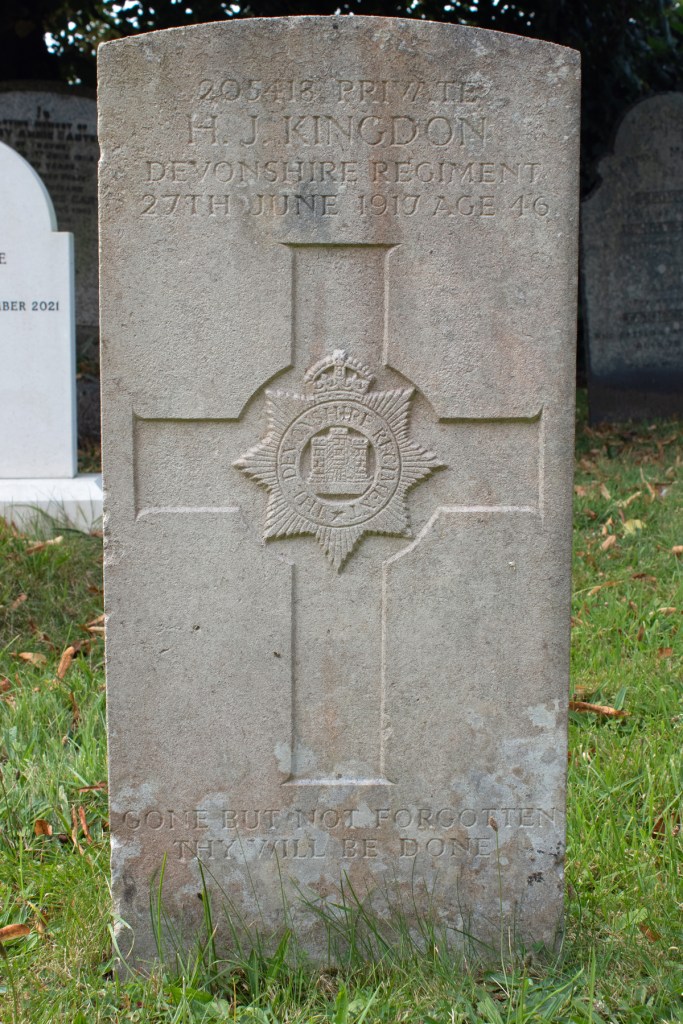
Born in the spring of 1872, Herbert James Kingdon was the ninth of ten children to George and Elizabeth. George was an agricultural labourer from the Devon village of George Nympton, it was here that the family was born and raised.

George died in 1900, at the age of 72, from this point on, Elizabeth also disappears from the records. In the spring of 1900, Herbert, now also a farm labourer, married Elizabeth – or Bessie – Speed. She was a farmworker’s daughter from South Molton, just two miles to the north. The couple set up home close to where Herbert had been living, and would go on to have five children by the time war was declared: Frederick, Florence, Frank, Annie and Herbert Jr.

George Nympton was a small village, and most of Herbert’s siblings remained close. The 1911 census found Herbert and Bessie living in the village, next door to Bessie’s parents who appear to have moved closer to support their daughter’s family. Three of their four children now old enough to attend the local school, while Herbert was still doing farm work, alongside his father-in-law, George Speed, and his brother-in-law, Fred.

When war broke out, Herbert stepped up to play his part. His full service records are no longer available, but the documents that do still exist suggest that he had enlisted by the start of 1917. Joining the Devonshire Regiment, he was assigned to the No. 4 Agricultural Company, and remained on home soil. By this point, Bessie had had a sixth child, Edward, and it is likely that she needed all the help she could get. With her husband remaining close by, and with her parents still living next door, she seems to have been supported.

By the summer of 1917, Private Kingdon had become unwell, and was suffering from a combination of pneumonia and pleurisy. Convalescing at home, the conditions were to get the better of him: he passed away on 27th June 1917, at the age of 45 years old.

Herbert James Kingdon was laid to rest in the graveyard of St George’s Church, George Nympton, in sight of his former home.


Bessie was pregnant when her husband passed: she gave birth on 13th January 1918, to a baby girl, Mary.

Bessie would only outlive her husband by five years. The last record for her is the 1921 census, when she was living in the family home with five of her children, and her parents, now in their mid-60s, living next door.


Gunner Charles Baker

Gunner Charles Baker

Charles Baker was born on New Year’s Day 1884, the youngest of six children to Henry and Mary Baker. Henry, was 64 when his son was born, and 21 years his wife’s senior, was a fisherman from Dartmouth, Devon. By the 1870s, however, the family had settled in Paignton, and this is where Charles had been born and raised.

The 1901 census found Henry, Mary, Charles and the oldest Baker daughter, Emma, living at 25 Roundham Cottages, to the south of Paignton town centre. He would have known the Putt family at No. 22, being of a similar age to Arthur Putt, another future soldier. Charles’ father Henry, now 81, was living off his own means, while Charles had completed his schooling, and was employed as a house painter.

In the spring of 1905, Charles married Helen Davey. Born in Hayle, Cornwall and six years her husband’s senior, there is little information about the new Mrs Baker, other than her father’s name, Thomas. The 1911 census found the couple living in a 5-roomed house on Norton Terrace, Paignton. At this point Charles was still employed as a house painter.

When war came to Europe, Charles stepped up to serve his King and country. Initially enlisting on 11th December 1915, he was not formally mobilised until the following September, when he was assigned to the Royal Garrison Artillery as a Gunner. His service records show hat he was 5ft 8ins (1,73m) tall and weighed 159lbs (72.1kg).

As part of the 257th Siege Battery, Gunner Baker was sent to Mesopotamia on 10th March 1917. He would remain in the Middle East for the next couple of years, returning home in March 1919. Charles returned to Devon, and was placed on furlough, awaiting to be demobbed.

Within a matter of weeks, however, Charles had fallen ill, contracting pneumonia. The condition was to prove his undoing, and he passed away on 7th May 1919. He was 35 years of age.

Charles Baker was laid to rest in Paignton Cemetery, overlooking his home town.


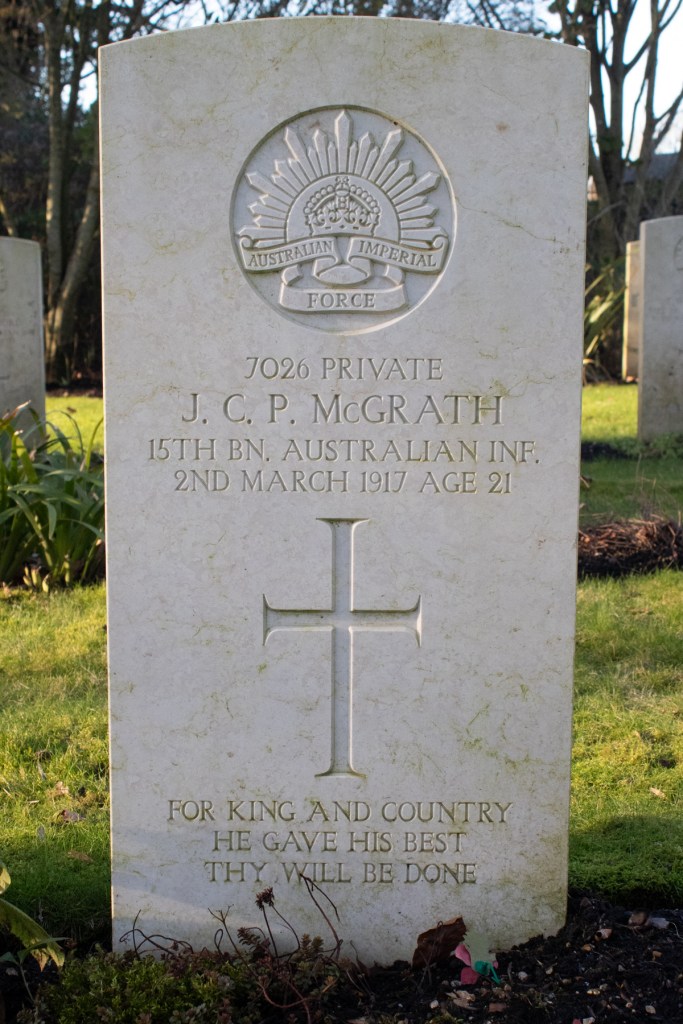
Private James McGrath

Private James McGrath

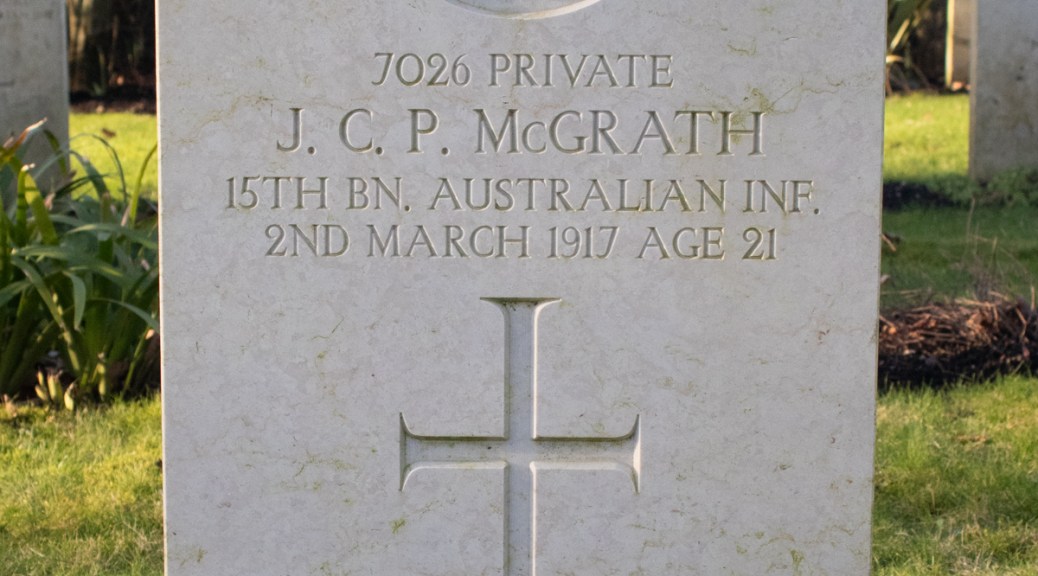
James Charles Patrick McGrath was born in June 1895 in the town of Marlborough, Queensland, Australia. He was the only child of Patrick and Margaret McGrath.

Little information is available about James’ early life. His father died in 1912, and he found work as a station hand when he completed his schooling.

When war broke out in Europe, James stepped up to play his part. Seeking adventure, and a reliable wage, he enlisted in the Australian Imperial Force in August 1916.

Private McGrath’s service records suggest he must have cut quite a figure, being 5ft 11.5ins (1.81m) tall, and weighing 172lbs (78kg). A Roman Catholic, he had hazel eyes, fair hair and a fair complexion.

James’ unit – the 15th Battalion of the Australian Infantry – departed Australia on 25th November 1916. Leaving from Sydney, his ship, the Beltana, took just under two months to reach its destination, Devonport, Devon. From here, Private McGrath’s battalion made the 130 mile (210km) journey to their base on the outskirts of the Wiltshire village of Codford.

James arrived in Codford on 30th January 1917, but soon fell ill. He was admitted to the camp hospital with influenza on 17th February, but his condition worsened. He passed away from pneumonia on 2nd March 1917: he was just 21 years of age.

Thousands of miles from home, James Charles Patrick McGrath was laid to rest in the cemetery extension to St Mary’s Church in Codford.


Private James McGrath
(from findagrave.com)
Private Percy Connelly

Private Percy Connelly

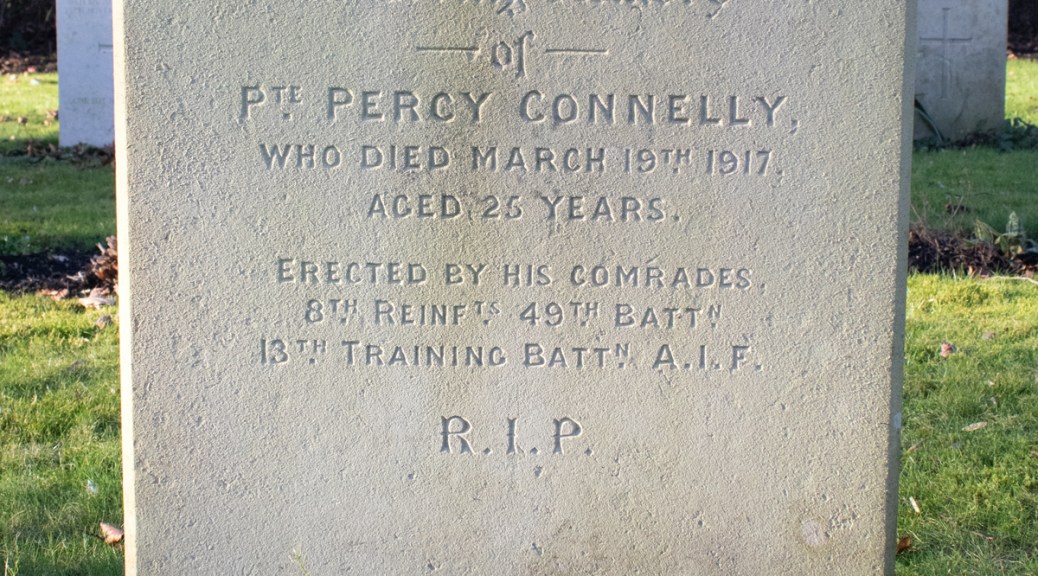
Percy Francis Connelly was born in October 1892 in Goulbourn, New South Wales, Australia. One of nine children – eight boys and one girl – his parents were Francis and Emily.

There is little information available about Percy’s early life. When he completed his schooling, he found work as a labourer and this is what he was doing when war was declared.

Percy stepped up to serve his King in November 1916, joining the Australian Imperial Force. His service records show that he was 5ft 8ins (1.72m) tall and weighed 147lbs (66.7kg). A Roman Catholic, he was also noted as having brown eyes, cark brown hair and a dark complexion.

Private Connelly’s unit – the 49th Battalion of the Australian Infantry – departed from Sydney on 22nd December 1916. His ship – the Demosthenes – took ten weeks to reach Britain. During this time, Percy was admitted to the ship’s isolation hospital, as he was suffering with venereal disease.

Percy’s unit arrived in Plymouth, Devon, on 5th March 1917. They were sent to their base near Codford in Wiltshire, for further training and preparation for a move to the continent. Private Connelly, however, would not be going with them. Just a week after arriving at the camp he was admitted to hospital, having contracted bronchial pneumonia.

The lung condition was to prove Percy’s undoing. He took his last breath on 19th March 1917: he was 24 years of age.

Percy Francis Connelly was laid to rest in the ANZAC section of St Mary’s Churchyard, Codford.


Percy’s younger brother, Francis, was also caught up in the First World War. Attached to the 42nd Battalion of the Australian Infantry, he had arrived in Britain more than a year before his older sibling.

Sent to France in November 1916, Francis was wounded just a couple of months later. He was medically repatriated to Britain for treatment, and eventually re-joined his unit in September 1917. He would spend most of the next year on the Western Front, and was killed in action on 29th September 1918. He was just 23 years of age.


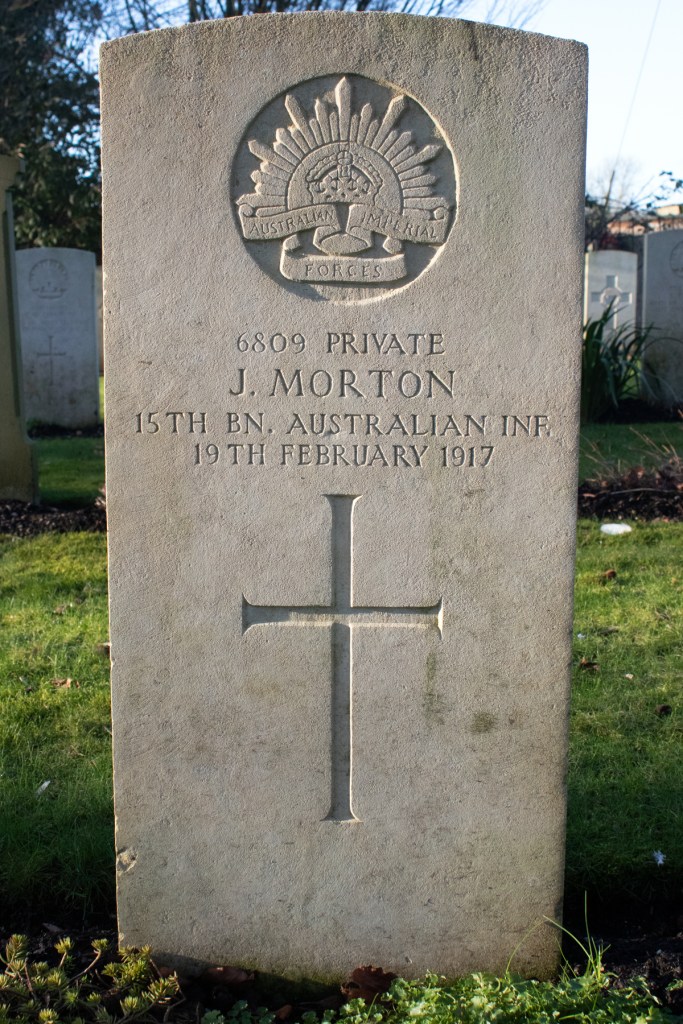
Private John Morton

Private John Morton

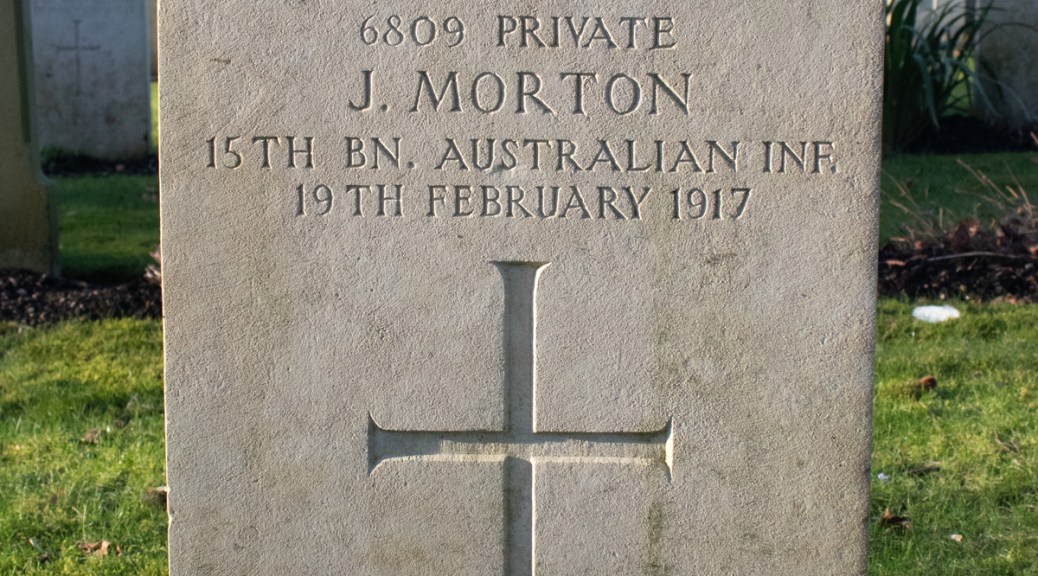
The life of Private John Morton is a challenge to unpick. His entry on the Commonwealth War Graves Commission website confirms that Morton was the name he served under, but that his birth name was John Lessells.

John’s army paperwork gives his age, 20 years old, his place of birth as Dunfermline, Scotland, and provides a next-of-kin, William Morton. John had enlisted on 9th September 1916 in Brisbane, Australia, although no emigration records remain. His service document noted that he was working as farmer, so, like thousands of others, it is likely that John sought a bigger and better life in a land of opportunity.

The medical section of John’s service records confirm something of the man he had become. He was 5ft 3ins (1.6m) tall, and weighed 125lbs (56.7kg). He had brown hair, blue eyes and a medium complexion. Interestingly, it also noted that John had been turned down for military service before because of an “under standard chest”.

Private Morton’s unit set sail for Europe on 17th November 1916. The transport ship – the Kyarra – departed from Brisbane, and arrived in Plymouth, Devon, nearly three months later. During the voyage, he was admonished for disobeying a reasonable order given by a superior order, although what the order was is unclear.

On landing in Britain, John was assigned to the 15th Battalion of the Australian Infantry. His unit was moved to a camp on the outskirts of Codford, Wiltshire, which would become their base of operations. Sadly, the journey from Australia seemed to have taken it out of John. On 14th February 1917, he was admitted to the camp hospital, suffering from a bout of influenza. His condition worsened, and two days later he was moved to a military hospital in nearby Sutton Veny.

Private Morton’s condition was to get the better of him. He passed away from pneumonia on 19th February 1917. He was 20 years of age.

John Morton, or John Lessells, was laid to rest in the graveyard extension to St Mary’s Church in Codford. He was surrounded by colleagues from the ANZAC regiments.


Private John Flanagan

Private John Flanagan

John Richard Flanagan was born in Healsville, Australia, in 1875. The second of four children – and the only son – his parents were Luke and Ann Flanagan.

Little information is available about John’s early life. Ann died in 1898, with Luke passing just seven years later, leaving John effectively an orphan in his early 30s. By this point he was working as a post and telegraph official, and this provided his employment when the world went to war in 1914.

John stepped up to serve his King in January 1916. His medical report confirms that he was 5ft 7ins (1.7m) tall, and weighed 166lbs (75.3kg). He had light brown hair, blue eyes and a florid complexion.

Assigned to the 16th Battalion of the Australian Infantry, Private Flanagan first had to travel from Healsville to Fremantle. From there his unit departed for Europe on board the Argyllshire. He left Australia on 9th November 1916, and arrived in Devonport, England, two months later. The 16th Battalion’s journey was not over yet, however: they made their way from Devon to Wiltshire, heading for a military camp on the outskirts of Codford.

Within a couple of weeks, Private Flanagan found himself confined to barracks. On 24th January he was sent to his billet for 24 hours by Major Turynarn (possibly Turynam), his offence was neglecting to obey an order.

Illness seemed to run rampant at Codford early in 1917, and John was not to escape health issues. On 18th February he was admitted to the camp hospital, having contracted pneumonia. Tragically his move the the medical facility was to prove too little, too late. Private Flanagan passed away the following day: he was 42 years of age.

Thousands of miles from home, John Richard Flanagan was laid to rest in in the graveyard of St Mary’s Church, not far from where he had breathed his last.


Private Arthur Couchman

Private Arthur Couchman

Arthur John Couchman was born in the spring of 1887, the oldest of seven children to John and Emma. John was a farm labourer from the parish of Wilmington, Kent, and this is where he and Emma raised their family.

When he completed his schooling, Arthur found work as a house boy, but soon turned his hand to gardening. When the opportunity was presented to him, however, and in the autumn of 1908, he emigrated to Australia, presumably to find work as a farmer.

Little about Arthur’s time overseas is detailed. He settled in Freemantle, to the south of Perth, and, early in 1916, he married Sarah McAlinden. She had left London for the Antipodes to work as a domestic four years previously. Their marriage seems to have been spurred on by Arthur’s imminent departure for the home country, as, on 19th June 1916, he enlisted in the Australian Imperial Force.

Working as a general labourer by this point, Arthur’s service records show that he was 5ft 3.5ins (1.61m) tall, and weighed 146lbs (66.2kg). He was found to have fair hair, grey eyes and a ruddy complexion. He also had tattoos on both of his forearms.

Private Couchman’s unit departed Freemantle on 9th November 1916, on a journey to Devonport, Devon, that would take two months. On his arrival, he was assigned to the 51st Battalion of the Australian Infantry, and dispatched to a camp near Codford in Wiltshire.

Tragically, Arthur’s army career was to follow a not uncommon path for those arriving in Britain from overseas. Within a matter of weeks he had been sent to the New Zealand Hospital in Codford, as he was suffering from bronchial pneumonia. On 15th February 1917, just four days after his admission he passed away from the condition. He was 29 years of age.

Thousands of miles from his Australian life, Arthur John Couchman was laid to rest in the new extension to St Mary’s Churchyard in Codford, not far from the camp in which he had been briefly based.


Private Albert Matthews

Private Albert Matthews

In Bath’s sweeping Locksbrook Cemetery, lies the body of Private Albert Edwin Matthews, of the Devonshire Regiment. There is little information available to fully piece together his life, but a range of records give tantalising glimpsed into the world that he inhabited.

The newspaper report of Private Matthew’s passing confirms that he died of pneumonia in the Red Cross Hospital, Lansdown Place, on 12th March 1915. His was a joint funeral with Private Harold Spackman, also of the Devonshire Regiment. He had enlisted at the start of the conflict, and had come from Plymouth, Devon. Frustratingly, the report does not give either of the soldiers’ ages.

Albert’s entry on the British Army Register of Soldiers’ Effects backs up a period of service of at least six months, and gives his unit as the 10th (Service) Battalion. It also provides his father’s name: Edwin Matthews.

Father and son do not seem to appear on any census records, and without a year of birth it is a challenge to track down any additional documentation.

There is a baptism record for an Albert Edwin Matthews, son of Edwin, from 28th September 1881, but this was in Sandown, on the Isle of Wight. While a connection is possible, there is no definitive link between the two men and Devon. (There is a 1911 census return for this Albert, but he is married with three children by this point and, as the military record gives Edwin Matthews as the sole beneficiary, it is unlikely that the two Alberts are one and the same.)

Albert’s life is destined to remain lost to time, therefore, one of the many mysteries in Locksbrook Cemetery.


Private Sidney Powell

Private Sydney Powell

Sidney Powell was born in the Walcot area of Bath, Somerset, in the spring of 1892. One of five children, his parents were corporation gardener Albert Powell, and his wife, Mary. The family lived at 2 Hedgemead Terrace for at least fifteen years, presumably as it was close to the park where Albert worked.

By the time of the 1911 census, Sidney had completed his schooling, and was employed as a draper’s porter. His was one of four wages being brought into the household: his father was gardening, his younger brother Frank was a law clerk, while his older step-brother, Mary’s son William, also worked as a draper’s porter.

When war came to Europe, Sidney stepped up to play his part. Sadly, details of his service have been lost to the mists of time, but it would appear that he enlisted in the Somerset Light Infantry no later than April 1916. Private Powell soon moved to the Machine Gun Corps, although documents do not confirm whether he spent any time overseas.

In the autumn of 1916, Private Powell was admitted to Birmingham War Hospital, having contracted pneumonia. The condition was to prove his undoing: he died while still admitted on 30th October. He was 24 years of age.

The body of Sidney Powell was taken back to Somerset for burial. He was laid to rest in the majestic grounds of the Bath’s Locksbrook Cemetery.