Tag Archives: pneumonia

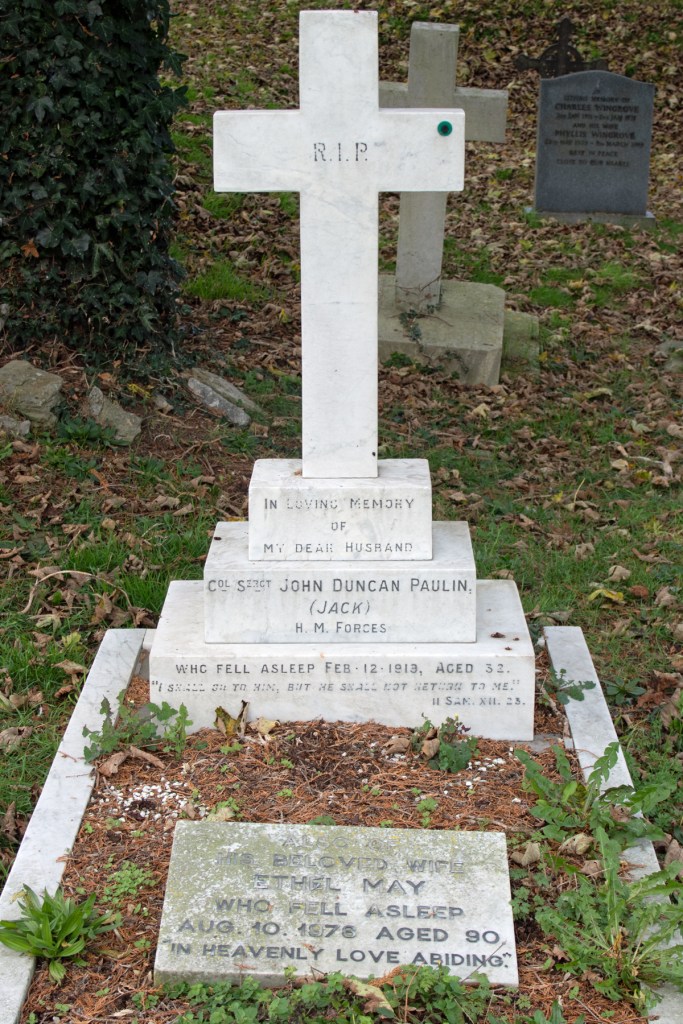
Colour Sergeant John Paulin

Colour Sergeant John Paulin

John Duncan Paulin was born in January 1885 in Liverpool, the youngest of two children. His parents – John Robert (known by his middle name) and Jane Paulin – were born in Scotland, but seemed to have moved to the Lancashire port by the late 1870s.

When he left school, John – who became known as Jack – found work as a clerk, but a life of adventure – and a more reliable career – beckoned. On 14th August 1904, he enlisted in the Border Regiment as a Private for a period of seven years. During that time, he served in barracks across the country – from Carlisle to Plymouth – and, by the time he was put on reserve in 1911, he had reached the rank of Corporal.

When war was declared, those servicemen on reserve were called back into action, and Jack found himself reposted with an increased rank of Sergeant. Over the next few years, he remained based in England and seemed to take on more of a training role, transferring to the Middlesex Regiment and, by the end of 1917, attaining the rank of Colour Sergeant.

At some point Jack met Ethel May Smith, who lived in Frome, Somerset. She was the same age as Jack, and was the daughter of the foreman of one of the cloth manufacturers in the town – she also went on to work in the factory. The couple married in St John’s Church in the town on 1st June 1916, but did not go on to have any children.

Colour Sergeant Paulin’s military career was free of any medical issues or hospital admissions until February 1919. He had not been demobbed by this point, even though the war was over. However, as with many other servicemen at the time, Jack fell ill with influenza, and was admitted to Grove Military Hospital (now St George’s Hospital) in Tooting, South London. Pneumonia set in, and Jack passed away on 12th February 1919, at the age of 34 years old.

Jack Duncan Paulin’s body was brought back to Somerset, and he was laid to rest in the graveyard of Christ Church, Frome. Ethel lived on until 1978; she was laid to rest with her husband.


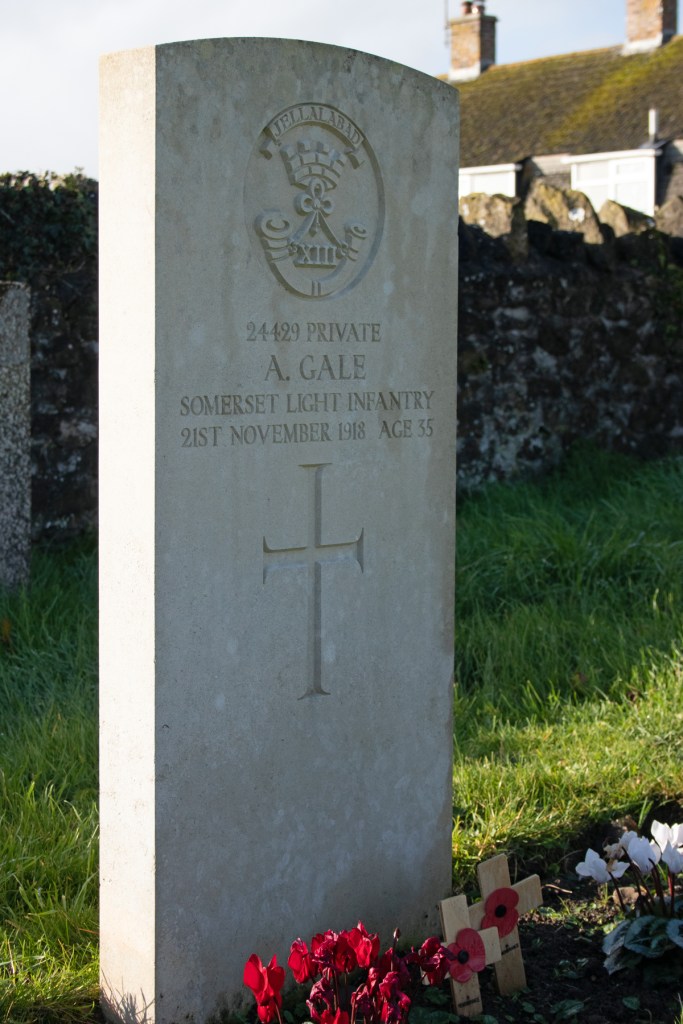
Private Albert Gale

Private Albert Gale

Albert Gale was born in the Devon village of Chudleigh Knighton in October 1883, one of five children to John and Elizabeth Gale. It seems that Elizabeth may have died when Albert was young, as, by the time of the 1901 census, John was married to a Sarah Gale, and the family were living in the village of Hennock.

John was a clay cutter, and this was a trade into which Albert followed his father. Again, as time moves on, things change; the 1911 census found Albert boarding with his sister Sophy and her husband, fellow cutter Thomas Willcocks, back in Chudleigh Knighton.

War was coming to Europe and, in April 1916, Albert enlisted, joining the Somerset Light Infantry as a Private. He would have cut a commanding figure; his enlistment papers show that he stood at 5ft 10ins (1.77m) tall.

Albert served on home soil. While attached to the Somerset Light Infantry, he was assigned to the 661st Agricultural Company of the Labour Corps, working in Kent and Sussex.

During this time, he received hospital treatment on four separate occasions: in August 1916, he was admitted with cellulitis of the arm; in December 1916 and January 1917, he was treated on two separate occasions for scabies. In November 1918, however, he was admitted to the Military Hospital in Chichester, West Sussex, as he was suffering from influenza. Sadly, this last condition was to worsen and, on 21st November 1918, Private Gale died, having subsequently contracted pneumonia. He was 35 years old.

Albert Gale’s body was brought back to Devon for burial. His brother-in-law Thomas had died the previous summer; his story can be found here. Albert was laid to rest in the grave next to his sister’s husband in the churchyard of St Paul’s in Chudleigh Knighton.


With Thomas dead, Sophy had been left a widow. Understandably bitter at what the war had taken from her, when she was asked if she wanted a memorial for her brother, she returned the form with the following statement: “I don’t require the plaque and scroll in memory of my dear brother; a piece of paper won’t keep me.”

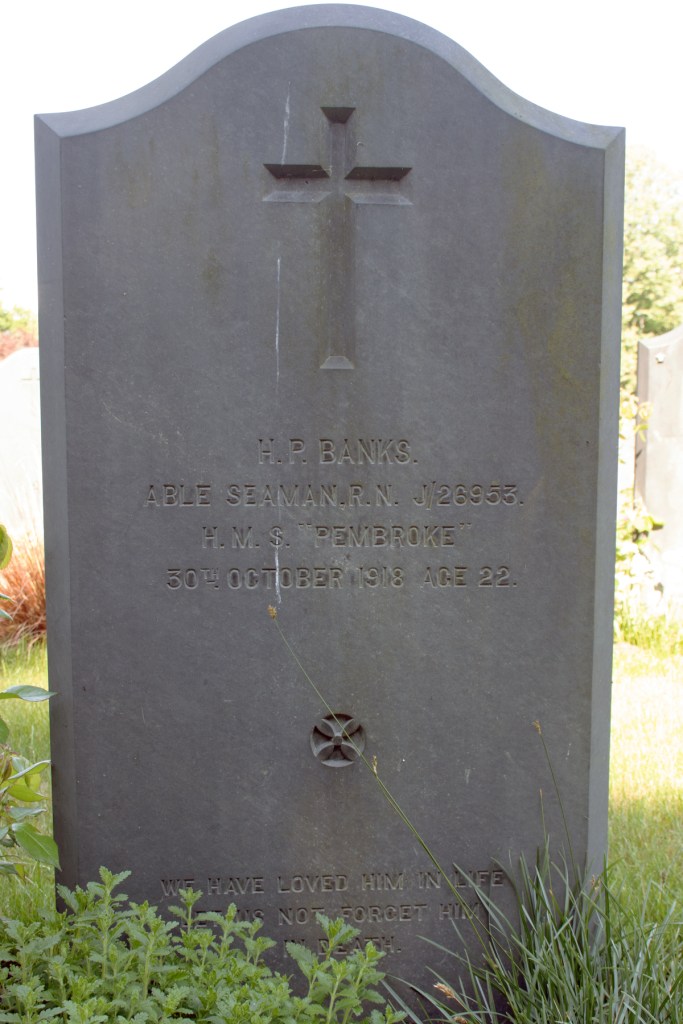
Able Seaman Hubert Banks

Able Seaman Hubert Banks

Hubert Philip Banks was born on 13th September 1896 in Tottenham, London and was one of eight children to Wilfrid and Mary Banks. Wilfrid was a gas engineer, but when he left school, Hubert found work as a clerk. By the time of the 1911 census, the family had moved to Edmonton.

Hubert had a sense of adventure, and wanted a career that reflected that. On 23rd September 1913, he enlisted in the Royal Navy; as he was underage at this point, he was given the role of Boy. Within a year he turned 18 and was formally given the rank of Ordinary Seaman.

After initial training at HMS Pembroke – the shore-based establishment at the Royal Naval Dockyard in Chatham, Kent – he was assigned to HMS Cornwallis, a dreadnought class vessel that served in the Mediterranean. Hubert spent two years on Cornwallis, during which time he was promoted to Able Seaman.

Over the next few years, Hubert served on three more vessels – HMS Quernmore, HMS Agamemnon and HMS Europa. In between times, he was based back in Chatham before moving back to HMS Pembroke on a more permanent basis in July 1918.

It was while he was back in Kent that Hubert fell ill. He was admitted to the Naval Hospital in Chatham with pneumonia, and was to succumb to the lung condition on 30th October 1918. He was just 22 years of age.

Hubert Philip Banks was laid to rest in the Woodlands Cemetery in Gillingham, Kent, not far from the naval base he called home.


Stoker 1st Class James Kilmartin

Stoker 1st Class James Kilmartin

James Kilmartin was born on 24th June 1894, one of four children to James and Mary Kilmartin. James Sr was a farmer from Tobercurry in County Sligo, and this is where he raised his family.

When he left school, James Jr helped his father out on the farm, but by the time he was 22, war was raging in Europe and he received his call-up papers. He joined the Royal Navy as a Stoker 2nd Class on 11th April 1916 and was sent to England for training.

After initially being based at HMS Pembroke – the shore-based establishment at the Naval Dockyard in Chatham – Stoker Kilmartin was assigned to HMS Greenwich. He served on board for nine months, during which time he was promoted to Stoker 1st Class.

James’ next assignment was on board HMS Bacchante, where he spent two years, through the Armistice and beyond. Returning back to HMS Pembroke in February 1919, he fell ill, contracting bronchial pneumonia. Admitted to hospital, the condition sadly got the better of him, and he died on 24th February 1919, aged just 24 years of age.

James Kilmartin was laid to rest in the Woodlands Cemetery, Gillingham, a short walk from the dockyard at which he had been based.


Tragically, less than two weeks after James died, his brother Michael, also passed away, at home in Tobercurry. While I have been unable to locate any specific documentation around military service, it seems likely that he too would have been in some way involved in the conflict.


Stoker 2nd Class William Bonham

Stoker 2nd Class William Bonham

William Bonham was born in Abbeyleix, Queen’s County (now County Laois) on 6th September 1895. One of ten children, his parents were labourer John Bonham and his wife Mary.

Little information about William’s early life is available; when he left school, he found work as a railway porter, but when he was 23, with war having be raging across Europe, he received his enlistment papers.

William joined the Royal Navy on 13th October 1918, and set sail for England. Assigned the role of a Stoker, he was sent to HMS Pembroke – the shore-based establishment at the Naval Dockyard in Chatham, Kent – for training. Less than eight weeks later, however, he was dead.

Stoker Bonham had contracted pneumonia that winter, and died at his home in Chatham on 12th December 1918. He was just 23 years old.

William was laid to rest in the Woodlands Cemetery in nearby Gillingham.


Officer’s Cook 3rd Class Paolo Spiteri

Officer’s Cook Paolo Spiteri

Paolo Spiteri was born in Valetta, Malta, on 25th January 1881, the son of Stephen Spiteri. Sadly there is very little further information on his early life, other than he worked as a cook when he left school.

Paolo saw a life at sea as a good career, and, in August 1901, aged 20, joined the Royal Navy. Over the next twenty years, he travelled the world, serving on more than twenty ships and working his way up from a domestic in the kitchen to an Officer’s Cook 3rd Class.

By 1921, Paolo was based at HMS Pembroke – the shore establishment at the Naval Dockyard in Chatham, Kent – and contracted pneumonia there. Admitted to the Naval Hospital in the town, the condition sadly got the better of him, and he passed away on 5th April 1921. He was 42 years old.

Officer’s Cook Paolo Spiteri was laid to rest in the Woodlands Cemetery, not far from the dockyard at which he was based.


Stoker 1st Class Herbert Rose

Stoker 1st Class Herbert Rose

Herbert Hastings Rose was born on 19th August 1893 in the Somerset town of Frome. He was one of four children, all of whom were boys, to Hastings and Emily Rose. Hastings was employed as a labourer, but he died young, passing away in 1900, when Herbert was only seven years old.

Emily was left raising her four boys alone – the youngest of whom was a mere babe-in-arms – and found domestic char work to bring in some money. By 1905, however, local carter Enos Bainton had taken the family under his wing, and the couple married.

The census return six years later found the family living in a small cottage near the centre of Frome. Herbert and his older brother, who were in their late teens by this point, were working with their stepfather, carting coal for a local merchant.

Herbert’s job was to stand him in good stead when hostilities broke out. When the call came in November 1915, he enlisted in the Royal Navy, and was employed as a Stoker 2nd Class. After his initial training on board HMS Vivid – the shore-based establishment in Plymouth – he was assigned to the cruiser HMS Constance. He served on board the ship for two years, gaining a promotion to Stoker 1st Class in the process.

After a month back in Plymouth, Stoker Rose was transferred to HMS Cambrian, another cruiser, on board which he spent three months. He then returned to HMS Vivid. It was during this time that Herbert fell ill. Admitted to hospital in Plymouth with pneumonia, this was to get the better of him; he passed away on 31st October 1918, aged just 25 years old.

Herbert Hastings Rose’s body was brought back to Somerset; he was laid to rest in the Dissenters’ Cemetery in Vallis Road, Frome.


Private Everett Ferriday

Private Everett Ferriday

Everett Ferriday was born in February 1899 in the Cornish town of Camborne. The second of four children, his parents were Methodist minister Jonah Ferriday and his wife, Elizabeth. Jonah’s calling took the family around the country, and, by the time of the 1911 census, they had settled in Frome, Somerset.

When Everett left school, he found employment at a motorcycle works in Bristol, and left home to move to the city. War was coming to Europe, however, and things were soon to change.

Everett got the call to join up in January 1917, just shy of his eighteenth birthday. His enlistment papers give his height as 5ft 11ins (1.8m) tall, and confirm that he weighed in at 126lbs (57.2kg). They also confirmed that he had found new employment as an insurance agent.

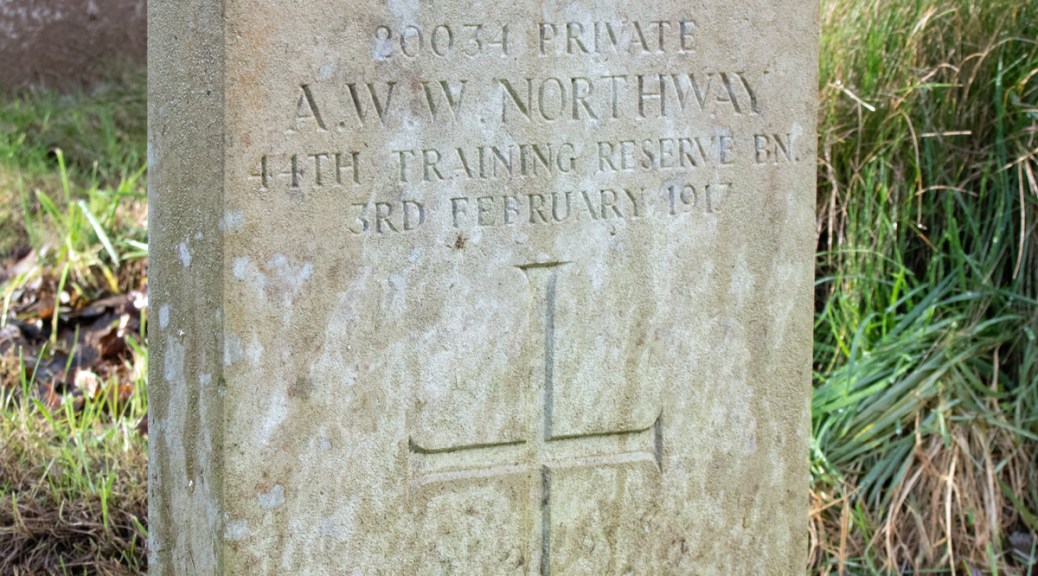
Private Ferriday was assigned to the 94th Training Reserve Battalion and sent to the army camp at Chiseldon, near Swindon at the beginning of March. Tragically, within a matter of weeks, he was admitted to the camp hospital with bronchial pneumonia. Sadly, this was too much for his body to take; he died at the hospital on 3rd April 1917, at just eighteen years old.

Everett Ferriday’s body was brought back to Frome; he was laid to rest in the Vallis Road Cemetery in the town.


Everett was not the only Somerset soldier to succumb to pneumonia at Chiseldon Camp that spring. Private Charles Oborne, died from the same condition a few weeks before him. Private Ivan Day, of the 93rd Training Battalion, passed away in the same hospital on the same day as Everett, also from pneumonia.

You can read their stories by following the links above.


Stoker 2nd Class Lionel Bennett

Stoker 2nd Class Lionel Bennett

Lionel James Fowler Bennett was born on 2nd September 1899, in the village of Cainscross, near Stroud in Gloucestershire. He was the only child of insurance agent Harry Bennett and his wife Louisa, who was a weaver.

By the time of the 1911 census, the young family had moved to the Somerset town of Frome. Louisa’s widowed mother had lived with the family since Lionel’s birth, and had moved to Somerset with her son-in-law. The family had also, by this time, taken in a boarder, presumably to help pay the rent.

With the move, Harry had also changed jobs, and was working as a power loom tuner, honing and fixing the weaving equipment. Lionel went into a similar role when he left school but, by now, war was imminent and, as soon as he was able to, he enlisted for King and Country.

Harry joined up shortly after his eighteenth birthday, serving as a Stoker in the Royal Navy. He was sent to HMS Vivid in Devonport for training in November 1917, but, sadly, this was to be his undoing.

Barracks were notorious breeding grounds for infections and, within weeks, Stoker Bennett had been admitted to the Naval Hospital in Plymouth, suffering from pneumonia. He passed away on 5th January 1918, aged just eighteen years old and having served for just sixty days.

Brought back to his home in Frome, Lionel James Fowler Bennett was laid to rest in the Vallis Road Burial Ground (also known as the Dissenters’ Cemetery).


Serjeant Edwin Lloyd

Serjeant Edwin Lloyd

Edwin Lloyd was born at the start of 1885 and was the youngest of ten children. His father, Henry, was from Bristol; while his mother, Mary, had been born in Ireland.

Henry had been a Serjeant in the armed forces, and his postings are reflected in the places where Edwin and his siblings were born. Henry and Mary’s oldest two children were born in Aden, Arabia (now Yemen), but by 1875, the family were back in England and their next oldest child was born in Dover, Kent. Sarah, the youngest of Edwin’s sisters, was born in Colchester, Essex the following year, but by 1879, Henry had left the army, and had moved the family to Frome, Somerset.

In his retirement, Henry took a job as a grocer, the family living above the shop on the main thoroughfare into the town. Edwin did not follow his father’s trade when he left school; instead the 1901 census lists him as a metal engineer, one of only two of the siblings still living above Henry’s shop.

Henry died in 1907 – a lot of the documentation about his life suggests he was a bit free about his age. The notice in the Somerset Standard announcing his passing gives his age as 69, although it is likely that he was closer to 80.

The following year, Edwin married Florence Emily Letchford in St Matthew’s Church, Bristol. Florence was the daughter of a travelling salesman, but their marriage record sheds more light onto Edwin’s life by this stage and he was recorded as a police constable.

Edwin’s time in the police seems to have been short-lived, however, as, by the census three years later, his role had reverted to memorial brass engraver.

War was coming to Europe, and, while Edwin’s full service records are not available, it’s possible to piece together some of his life in the army. He enlisted in 1915, joining the Dorsetshire Regiment, and was assigned to the 5th (Service) Battalion.

Edwin’s battalion fought at Gallipoli and served in Egypt, moving finally to France in the summer of 1916. He was obviously a diligent soldier, as, by the end of the conflict, he had made the rank of Serjeant.

A local newspaper reported on the end of his army life:

He had served with the forces for about four years, and on his way home from France he was taken ill, and was, when he arrived at home, in a somewhat critical condition. The fatigue of the journey told still further upon him, and he passed away three days after his arrival.

Somerset Standard: Friday 7th March 1919

Serjeant Lloyd’s pension record gives the cause his passing as influenza, pneumonia and syncope, sadly none of which were uncommon for soldiers returning from the front. He was just 34 years old when he died on 25th February 1919.

Edwin Lloyd was laid to rest in the Vallis Road Cemetery (also known as the Dissenters’ Cemetery) in Frome.