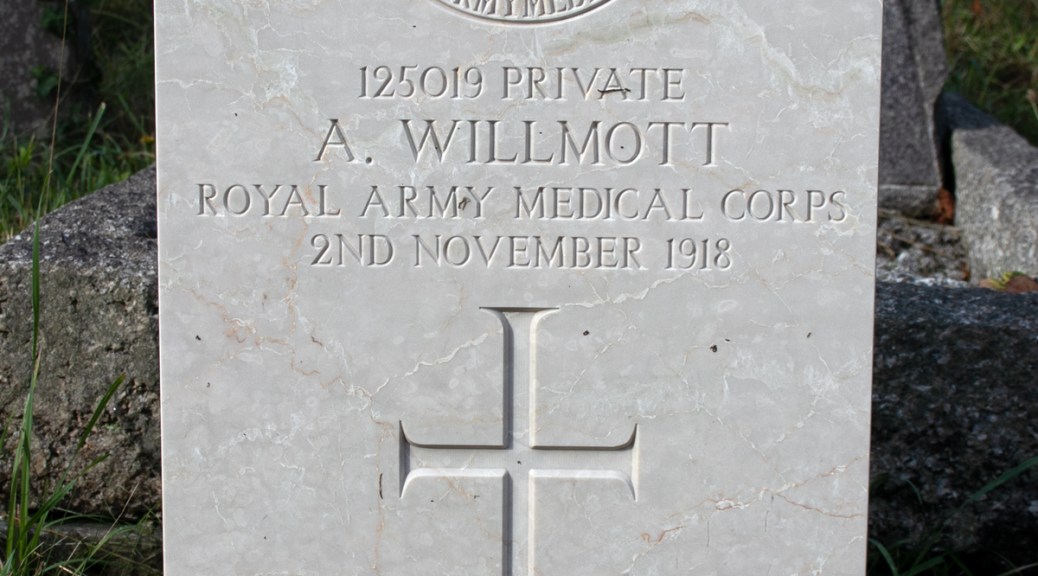
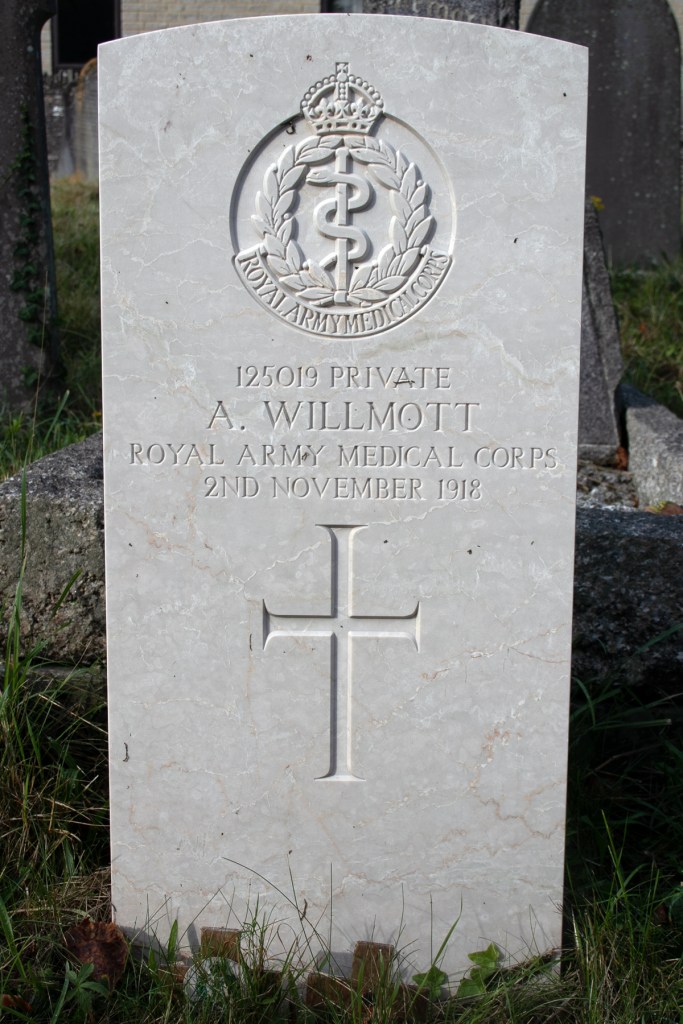
Alec William Willmott was born in 1886 and was one of six children to Henry and Ellen Willmott. Henry was a farm labourer from Oldland in Gloucestershire, and this is where the family were raised.
When he left school, Alec found work making shoes and boots at a local factory – this was work most of the Willmott children went into. On 24th April 1916, he married Elsie Frost in the local church. The couple set up home in Keynsham, and went on to have a son, Cecil, who was born in August 1917.
Alec played his part during the war. Full service details are not available, but it is clear that he had enlisted in the Royal Army Medical Corps by the spring of 1918. There is no confirmation of whether Private Willmott served at home or overseas, but, by October 1918, he had been admitted to the 2nd London General Hospital in Chelsea, suffering from a combination of influenza and pneumonia.
Sadly, these conditions put a strong pressure on his heart: Private Willmott passed away from cardiac failure on 2nd November 1918, at the age of just 32 years old.
Alec William Willmott was brought back to Gloucestershire for burial. He was laid to rest in the graveyard of St Anne’s Church in his home village, Oldland.
Little concrete documentation remains about the life of William Henry Jackson. He was born in Bedford, Bedfordshire, on 6th February 1872, although it is not possible to identify who his parents were.
He married a woman called Edith in 1903, and the couple settled in her home town of Beeston, Nottinghamshire. By the time of the 1911 census, he was recorded working as an electrician’s labourer at the local telephone works, while Edith, who was five years his senior, earned extra money as a blouse finisher.
Information about William’s wartime efforts are also limited. He enlisted in the Royal Marine Light Infantry, and was assigned to the Chatham Division. He was given the rank of Private and based at the Royal Naval Dockyard in the Kent town.
The only other information available for Private Jackson is that he died on 16th September 1916, having contracted a combination of pneumonia and tuberculosis. He was 44 years of age.
William Henry Jackson was laid to rest in Woodlands Cemetery, Gillingham, not far from the dockyard in which he had served. His headstone gives the initial H, rather than W, although no documents suggest he went by any name other than William.
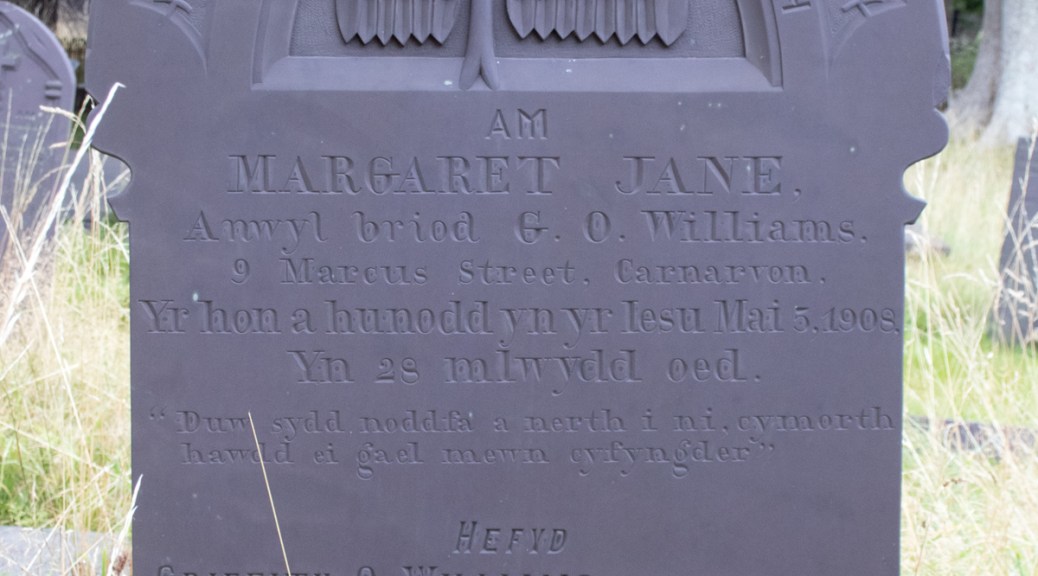
Griffith Owen Williams was born the autumn of 1876 in Llanberis, Gwynedd. One of nine children, his parents were blacksmith William Williams and his wife, Alice.
Little information remains about Griffith’s teenage years. The 1891 census record that, at 14 years old, he was a scholar, but the next document that can be attributed to him comes fourteen years later.
At this point, on 7th March 1905, he married Margaret Jane Williams at the parish church in Llanberis. Margaret was 24 years old, and the daughter of a quarryman: Griffith gave his profession as Post Office official, and he was living in Caernarfon, eight miles away, on the Menai Strait.
The young couple went on to have a daughter, Maggie, in January 1906. Sadly, Margaret died on 5th May 1908, when she was just 27 years of age. While the young family had been living in Caernarfon, she was laid to rest in the graveyard of St Peris Church in Llanberis.
At this point, Griffith’s trail goes cold once more. When war broke out, he enlisted in the Royal Field Artillery, and was assigned as a Driver in the 248th (Howitzer) Brigade. By April 1915, Griffith found himself on the Western Front and, by the next spring he was fighting at the Somme.
During the winter of 1916/17, Driver Williams fell ill. He contracted bronchial pneumonia, and was medically evacuated to Britain to recuperate. Sadly, the condition was to prove too much for his body to take. He passed away on 23rd February 1917, at the age of 46 years old.
Griffith Owen Williams’ was laid to rest with his late wife in St Peris Churchyard, in their home village of Llanberis.
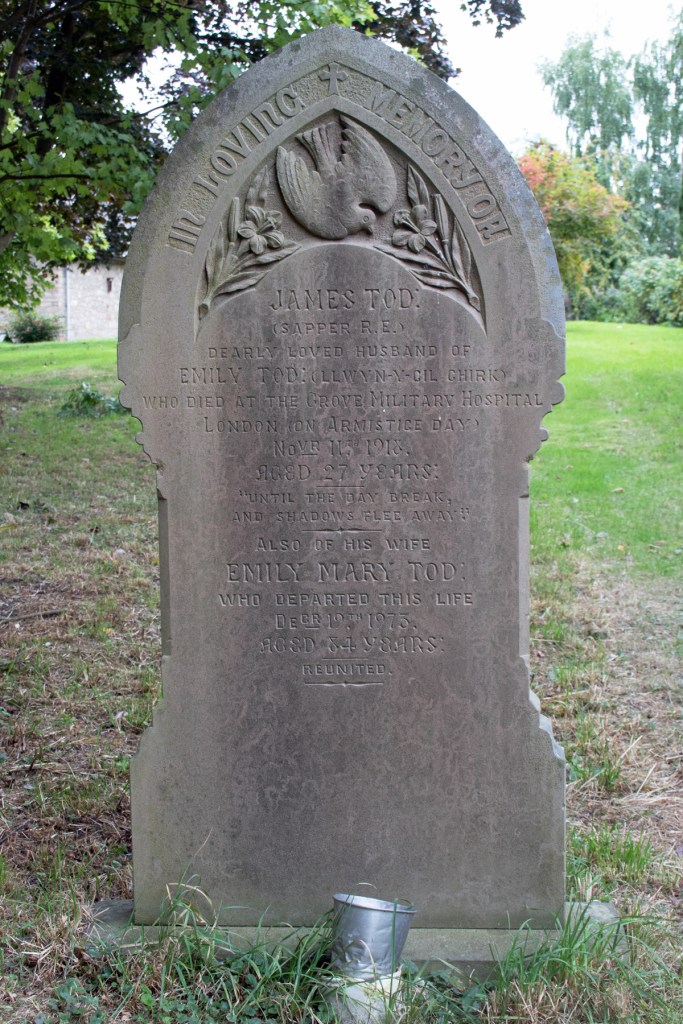
James Tod was born in the spring of 1891 in Chirk, Denbighshire, and was one of nine children. His parents were builder John Tod, who was from Scotland, and Margaret Tod, who had been born in Llangollen.
John passed away when James was in his teens and, when he left school, James found work as a joiner to help support his mother financially.
When war came to Europe, James was called upon to play his part. Full details of his military service are not available, but he had enlisted by the beginning of 1917. James joined the Royal Engineers as a Sapper, and was assigned to the London Electrical Engineers.
It is unclear whether Sapper Tod served overseas, but he certainly would have been based in the London area, carrying out repair works as needed. The London Electrical Engineers were also pioneers in the use of searchlights to spot enemy aircraft and Zeppelins raiding the capital. A detachment was also sent to France to position and man searchlights on the Western Front, although, again, it is not clear whether James was one of those involved.
It is clear that James was back in Wales at the start of 1917, however, as, on 18th January, he married his sweetheart, Emily Mary Edwards, at the parish church in his home town. Emily was the daughter of a gamekeeper from nearby Pontfadog, but it was in Chirk that the coupler were to make their home.
Sapper Tod was soon back on duty, however, and the next evidence available for him is that of his admission to the Grove Military Hospital in Tooting, South London. He had contracted a combination of influenza and pneumonia, and these lung conditions were sadly to get the better of him: he passed away on Armistice Day, the 11th November 1918. He was just 27 years of age.
James Tod was brought back to Wales for burial. He was laid to rest in the family plot in the graveyard of St Mary’s Church in the town.
It seems that James had been in some debt when he passed, as some of his war pension was held over to cover those costs.
Tragically, Emily was five months pregnant when James died. She gave birth to a son, who she named after his father, on 9th March 1919.
Emily never remarried, and, by the time of the 1939 Register for England and Wales, was recorded as the Lodgekeeper for Deer Park Lodge, which was attached to Chirk Castle. She passed away on 19th December 1973, at the age of 84 years old. She was laid to rest with her late husband, a couple reunited at last after more than five decades.
James Jr lived a long life, passing away in the spring of 1999, in his eightieth year.
Harold Stanley Weston’s early life is destined to remain a mystery. He was born, according to his Royal Air Force service records, in Southgate, Middlesex in 1887 and, before war broke our, was working as a waiter before enlisting.
On 3rd August 1915, he married a woman called Gertrude in Hastings, Eat Sussex, and it appears that this is where the couple set up home. Harold has initially enlisted in the army, but transferred across to the Royal Flying Corps on 28th October 1915. Air Mechanic 2nd Class Weston’s service records show that he stood just 5ft 2.5ins (1.59m) tall.
Over the next three years, Harold rose through the ranks to Air Mechanic 1st Class, and served in France for nine months during 1916. He then returned to England, and was based at an airfield near Detling, Kent. When the Royal Flying Corps and the Royal Naval Air Service merged in April 1918, he transferred across to the newly-formed Royal Air Force, and was attached to 27 Squadron.
In November that year, Harold was admitted to the Military Hospital in Maidstone, also in Kent, having contracted influenza and pneumonia. Sadly, the lung conditions were to get the better of him, and he passed away on 1st November 1918, at the age of just 31 years old.
Air Mechanic 1st Class Harold Stanley Weston’s body was laid to rest in the quiet graveyard of St Martin’s Church in Detling, not far from the base at which he served. Gertrude posted her thanks to “all [their] friends for their kindness and sympathy shown to her in her sad bereavement, more especially Captain Saunders, RAF, Major Chapman, KCC [Kent County Council?], Sergeant Fowle, KCC, and Sergeant Weller, RAMC [Royal Army Medical Corps]” [Maidstone Telegraph: Saturday 9th November 1918]
In a quiet corner of the village cemetery in Cuckfield, West Sussex, is a headstone dedicated to Private WG Sinclair. Attached to the East Yorkshire Regiment, he passed away on 12th February 1919.
A search of military records gives a little more detail: this was a George William Sinclair, who had died from pneumonia at the West Hylands Institution, which was Cuckfield’s workhouse. George was 29 years old, but there is little concrete information about his early life.
A newspaper report from the day before Private Sinclair’s death, however, begins to shed a little more light onto his life:
George William Sinclair was charged with being a deserter from the Cuckfield Union Workhouse, on November 6th, and carrying away clothing to the value of £1, the property of the Guardians of the Cuckfield Union. PC Upton said that he arrested the prisoner at the Somerstown Police Station. Prisoner was remanded, but as he was taken ill he was removed to the Workhouse Infirmary.
Mid Sussex Times: Tuesday 11th February 1919
George’s entry in the Army Register of Soldier’s Effects does not give a next of kin, so it is not possible to determine categorically where he was born and raised, or who his parents were.
A little more digging found a George William Sinclair recorded in the UK Calendar of Prisoners in 1916. He had been arrested for “feloniously breaking and entering the dwelling house of Sarah Waddingham, and stealing one bicycle, one pair of shoes, one purse, one tobacco box, one tobacco pipe and one microscope, the property of said Sarah Waddingham, at West Halton [near Hull], on the 7th July 1916.“
It is not possible to say definitively that this George William Sinclair is the same one buried in Cuckfield Cemetery, but, given the regiment he was attached to, and the newspaper report prior to his passing, it is likely to be more than just a coincidence.
George pleaded guilty, and was sentenced to six months’ hard labour. This was not his first offence, and had had spent a total of more than eighteen months behind bars over a period of ten years up to this point. On each occasion, he was convicted of theft.
It is possible, given that the country was at war by this point, that George was given the option to enlist, rather than serve his sentence. Again, this is an assumption, however, but Private Sinclair’s Pension Ledger confirms that he was discharged from the army on 6th November 1918.
George William Sinclair appears on another workhouse register, this time in Westminster, London, where he spent a couple of nights just before Christmas that year.
If these records all relate to the same man, his life seems to have been a troubled one. I can only hope that he found peace in that quiet corner of West Sussex.
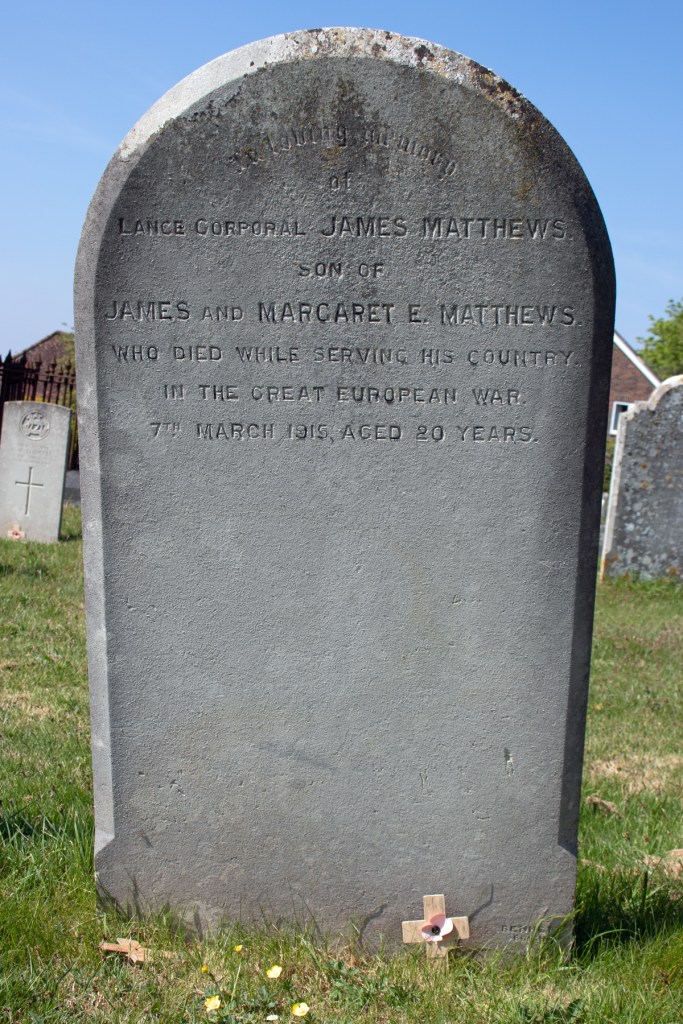
James Matthews was born in the summer of 1894, the youngest of five children to James and Margaret Matthews. James Sr was a farm worker from Cuckfield in West Sussex, and it was on Hodshrove Farm in nearby Ansty that the family were raised.
James Jr worked on the farm when he left school, but when war broke out, he found a bigger calling for himself. Full details of his military service are not available, but he seemed to have enlisted early on in the conflict, joining the 9th (Service) Battalion of the Royal Sussex Regiment. Originally formed in Chichester, West Sussex, he soon found himself billeted in the South Down near Portslade.
James must have impressed his superiors, as he was soon promoted to Lance Corporal for his work. All was not to go well, however, as, during the early months of 1915, he contracted pneumonia.
Lance Corporal Matthews was admitted to the 2nd Eastern General Hospital in Brighton, but the lung condition was to get the better of him, and he passed away on 7th March 1915. He was just 20 years of age.
James Matthews was brought back to his home village for burial. He lies at rest in Cuckfield Cemetery, in the shadow of Holy Trinity Church.
Charles Wilfred Tucker was born in the summer of 1898 in Penarth, Glamorgan. He was the oldest of four children to Wilfred and Elizabeth Tucker, restaurant owners on Windsor Terrace in the centre of the town.
Little information is available about Charles’ early life. When war broke out, he enlisted in the Welch Regiment, before transferring to the Machine Gun Corps at some point during the conflict. In the autumn of 1919, Private Tucker was put on furlough while waiting to be demobbed, and he returned home.
Sadly, it was while here that Charles contracted pneumonia, and it was from the lung condition that he was to pass away. He breathed his last on 30th October 1919, at the age of just 21 years old.
Charles Wilfred Tucker was laid to rest in the family grave in St Augustine’s Churchyard in his home town of Penarth.
Walter Wigginton was born in the Leicestershire village of Illston-on-the-Hill in the summer of 1880. The second of seven children, his father John was a grazier, managing cows over a six-acre pasture. His mother, Rebecca, who was also born in Leicestershire, raised the family and managed the home.
Walter turned his hand to carpentry, and, by the time of the 1901 census, he was boarding with a widow in Frimley, Surrey, employed for his woodworking skills. By 1905, his journeyman life had taken him to the Somerset village of Trull. It was here that he met and married Annie Oaten, and here that the couple settled down to raise their family. They had two children, Dorothy, born in 1906, and Winifred, who was born two years later.
War was closing in on Europe and, by the summer of 1916, Walter had joined up to play his part. Initially assigned to the 65th Training Reserve Battalion, he had not long transferred across to the Royal Engineers as a Sapper when he fell ill.
Sapper Wigginton was admitted to the Kinmel Park Military Hospital near Abergele on the North Wales coast, suffering from bronchial pneumonia. Sadly, this lung condition was to get the better of him, and he passed away at the hospital on 29th December 1916, at the age of 36 years old.
Walter Wigginton’s body was brought back to Somerset for burial. He was laid to rest in the graveyard of All Saints’ Church in Trull, where his widow and children still lived.
Cyril Robert Pratt was born on 31st October 1899 in the Somerset village of Halse. The younger of two children, his parents were local baker Robert Pratt and his wife, Elizabeth.
Little information about Cyril’s early life remains. He enlisted in the army not long after his eighteenth birthday, joining the Royal Warwickshire Regiment as a Private in November 1917. He was sent to Salisbury Plain for training, and was barracked in Larkhill, just north of Stonehenge.
Sadly, this seems to have been Private Pratt’s undoing. As with numerous other soldiers at the time, being billeted in cramped quarters with other men from across the country meant that disease was quick to spread. During his first winter at the camp, Cyril contracted pneumonia, and was admitted to the local Fargo Hospital. The lung condition was to get the better of him, and he passed away on 28th February 1918, at the age of just 18 years old.
Cyril Robert Pratt was brought back to Somerset for burial. He was laid to rest in the graveyard of St James’ Church in his home village, Halse.









 Death and Service