Tag Archives: Private

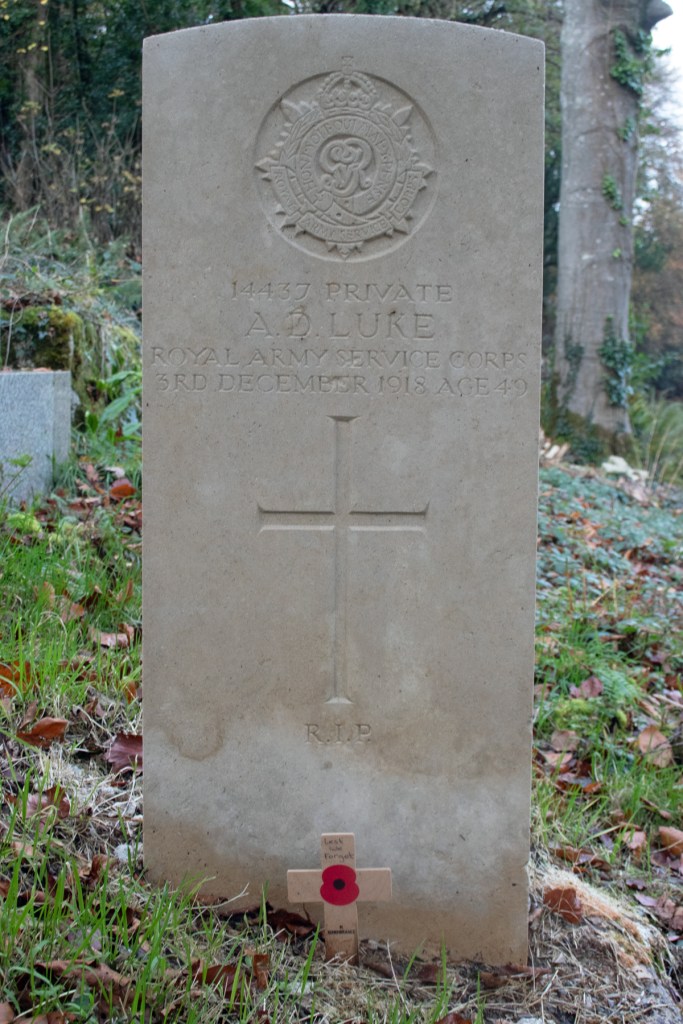
Private Alfred Luke

Private Alfred Luke

Alfred Docking Luke was born in 1869 in the village of St Breock, near Wadebridge, Cornwall. One of thirteen children, his parents were William and Selina Luke. William was a general labourer, and this is a trade into which Alfred followed.

Alfred wanted bigger and better things, however, and, on 27th September 1893, he enlisted in the Royal Garrison Artillery. Gunner Luke’s service records show that he was 5ft 9ins (1.75m) tall, and weighed 146lbs (66kg). He was noted as having blue eyes, brown hair and a fresh complexion. The record also noted a number of tattoos: a cross and a square and compass on his left forearm, the letters AL on the back of his left hand and rings on his middle and little fingers of the same hand.

Initially enlisting for seven years’ service, Alfred soon found himself sent to India. He served his whole time there, and it appears not to have been without incident. He was noted as having sustained a fractured skull on 2nd October 1896, although there is no further detail on the injury.

When Gunner Luke’s initial term of service came to an end, he elected to remain on active duty and, in the end, remained in India until December 1905, before returning home to be demobbed.

Back in Cornwall, Alfred built his life again. He found more labouring work, this time in a manure store in Wadebridge, and married the recently widowed Bessie Williams. She had two children, and the family set up home together.

A sense of duty, or a love of the army life, remained in Alfred’s heart, however and, when war was declared, he was keen to play his part again. He enlisted in the Royal Army Service Corps in July 1915, and, despite being 45 years old by this point, he soon found himself in Northern France.

Private Luke spent the next three years supporting the lines on the Western Front, but by the autumn of 1918, life was taking its toll on him. On 8th November 1918 he was admitted to a camp hospital, having contracted influenza. Tests for tuberculosis proved negative, although his breathing was laboured, and he was medically evacuated back to Britain for further treatment.

Admitted to St John’s Hospital in Cheltenham, the medical report makes for some grim reading:

Patient on admission had paralysis of soft palate lulateral and ptosis rt. eye. Tongue slightly pointing to the left. Difficulty in articulation due not only to palatal paralysis but also to apparently labial and dysphagia for fluids and solids. Fluids returned through nose. The symptoms, in short, of bulbar paralysis.

Private Luke’s condition worsened. He passed away the day after being admitted, on 3rd December 1918. He was 49 years of age.

Alfred Docking Luke’s body was brought back to Cornwall for burial. He was laid to rest in the peaceful, wooded graveyard of St Breoke’s Church in his home village.


St Breoke’s was the family church, and the Luke family were to be reunited again. Alfred’s mother Selina passed away a month after her son, at the age of 68; his father William followed in May 1919, at the age of 78.


Private William Julian

Private William Julian

William Julian was born in the spring of 1879, in the Cornish village of St Breock. He was one of five children to agricultural labourer John Julian and his wife Mary. Mary appears to have died when William was young as, by the time of the 1891 census, John was married to an Emily Julian, whose 10-year-old daughter, Fanny Jane Pinch, was also living in the family home.

At this point, it becomes difficult to accurately track young William’s life. The surname Julian is not uncommon in Cornwall at this point, and, while the 1901 census confirms he had moved out of the family home, gives a couple of potential alternatives. The most likely is a William Julian, boarding in St Germans, Cornwall, who working as a waggoner, although it is impossible to categorically connect the census return to this William Julian.

The next census, however, gives more confirmation of William’s location. He was working as a tin miner, and lodging with Richard and Jane Sweet in Withiel, Cornwall.

It is not long after this that he married Maud Brenton. The couple set up home in the hamlet of Burlawn, to the south of Wadebridge, and went on to have four children: William, born in 1912, John, born in 1914, and twins Jeremiah and Samuel, who were born in 1915.

By this point war was raging across Europe, and, while, as a miner William would have been in a protected profession, his time came to step up and serve King and Country. In the spring of 1917, he did just that, joining the Labour Corps as a Private. Little detail of his military service survives, but is is likely that he did his duty on home soil.

Private Julian’s time in the army was not to be a long one, however, and he developed haemoptysis, possibly as a result of a lung condition. This was to lead to his passing; he died on 29th August 1917, at the age of 38 years old.

William Julian was brought back to Cornwall for burial. He was laid to rest in the tranquil graveyard of St Breoke’s Church, the parish in which he was born and lived


Corporal Thomas Teague

Corporal Thomas Teague

Thomas Teague was born in the spring of 1884 in the Cornish town of Tintagel. He was one of ten children to quarryman and road labourer John Teague and his wife, Ellen. When he first left school, Thomas found work as a farm labourer. By the time of the 1911 census, he was still living in the family home, but had found more skilled work as a stone mason.

Much of the rest of Thomas’ life remains a mystery. John passed away in September 1914, and it is clear that, with war now raging across Europe, Thomas stepped up to play his part. He enlisted in the Royal Dublin Fusiliers, and was assigned to the 7th Battalion. The regiment served in Gallipoli, Salonika and Egypt, although it is not possible to identify where Private Teague served.

At some point, potentially because of health reasons, Thomas was transferred to the 655 Home Service Coy of the Labour Corps. Again, exact details of his service are unclear, but he had been promoted to the rank of Corporal, and appears to have been based in Curragh Camp, not far from Kildare, Southern Ireland.

The only other confirmed record relating to Corporal Teague is that of his passing. He died of heart disease in the camp, on the 2nd October 1917. He was 33 years of age.

Thomas Teague’s body was brought back to Cornwall for burial. He was laid to rest in the peaceful graveyard of St Materiana’s Church, overlooking his home village of Tintagel.


Thomas was buried in the family plot, alongside his father. When his mother, Ellen, passed away in 1930, she was reunited with her husband and son.


Private James Toms

Private James Toms

James Toms was born in Tintagel, Cornwall, early in 1886, and was the youngest of seven children to Lavinia Toms. Lavinia’s husband, quarry worker John Toms had passed away a few years before, and she had moved her young family in with her mother, Mary Emmett, by the time James was born.

James found work in the local slate quarry when he left school and, by the time of the 1911 census, he was living with his mother and two of his siblings in the town.

When war came to Europe, James stepped forward to play his part. While his service records are no longer available, other documents confirm that he enlisted in the Duke of Cornwall’s Light Infantry, and was on the Western Front by October 1915.

At some point, Private Toms transferred to the Royal Defence Corps: as this regiment was not created until March 1916, his move could obviously not have been before this point in the conflict. He was based back on home soil, and, by the end of the war, he was serving in Oxfordshire.

In the closing weeks of the war, Private Toms was admitted to the 3rd Southern General Hospital in Oxford, having contracted pneumonia. The condition was to get the better of him and, he passed away on 6th November 1918. He was 33 years of age.

Brought back to Cornwall for burial, James Toms was laid to rest in the quiet and picturesque graveyard of St Materiana’s Church. His epitaph reads: Home at last thy labour done, safe and blest the victory won.


Private Thomas Clarke

Private Thomas Clarke

Thomas Clarke was born on 18th July 1893 in the Cheshire town of Altrincham. The second of nine children, his parents were Irish-born couple Thomas and Mary Clarke. Thomas Sr worked in the building trade as a bricklayer, but, by the time of the 1911 census, his older children had found other trades. His oldest child, Nora, was a shop assistant, Thomas Jr was a shorthand typist, while the next two Clarke children worked in the printing industry.

Thomas Jr, however, wanted to see the world and, on 3rd October 1911, he took his first step towards that aim, enlisting in the Royal Marine Light Infantry. His service records note that he was 5ft 6ins (1.68m) tall, had blue eyes, fair hair and a fresh complexion. They also record a scar on his left hand and a tattoo on his right arm.

Private Clarke was first sent for training in Deal, Kent, and his swimming ability tested there on 6th December, presumably in the freezing English Channel. In August 1912 he moved to barracks in Portsmouth, Hampshire. Over the next couple of years, he served on two ships – HMS Prince of Wales and HMS Dido – returning to the Royal Naval Dockyard in Portsmouth after each assignment.

In July 1914, Thomas was assigned to the battleship HMS Bulwark. The ship patrolled the English Channel when he first came on board. By that autumn, however, she had moved to North Kent, guarding the waters around the Isle of Sheppey against potential German invasion.

Thomas was on board Bulwark on the morning of 26th November 1914, when an explosion ripped through the ship and sinking it. More than 740 lives were lost, Private Clarke among them. He was just 21 years of age.

Thomas Clarke was laid to rest in a marked grave in Woodlands Cemetery, Gillingham, not far from a mass grave where scores of his colleagues had been buried.


Note: While Thomas’ surname is spelt Clark on his headstone, all documents relating to him – and the Commonwealth War Graves Commission website – give the correct spelling as Clarke.


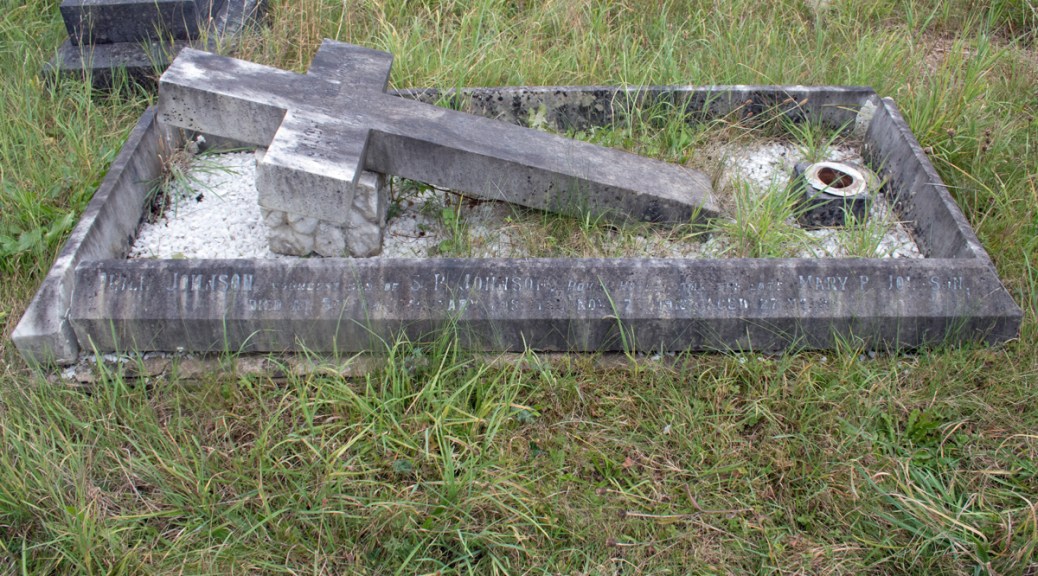
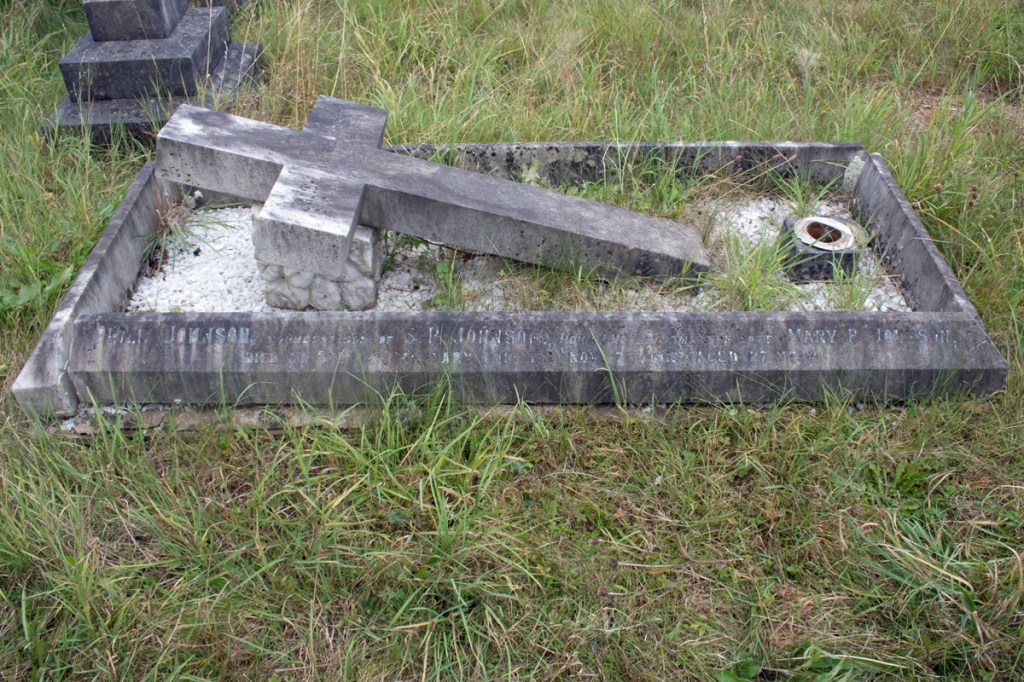
Private Philip Johnson

Private Philip Johnson

Philip Johnson was born in the summer of 1891 in Wrexham, Denbighshire. One of eight children his parents were Samuel and Mary Johnson. Samuel was a wine merchant from Scotland, while Mary had been born in Cheshire. When Philip was born the family were living and running the town’s Lion House inn on the High Street.

Mary died in 1897 and, in 1909 Samuel moved his family on. He bought the Royal Hotel in Llangollen, which occupied a large plot on the riverside, and which included a large garden.

The Royal Hotel was a busy business: to look after the guests, there were eleven members of staff living in. This was to be a Johnson family business, however, with Philip’s older sibling Elizabeth managing the hotel with her father, his brother Samuel Jr assisting, his sister Ethel acting as bookkeeper and Philip himself managing the bar.

In the spring of 1914, Philip married Elizabeth Kelsall, whose family ran the Eivion Hotel, down the road from The Royal. The couple set up home in the town – possibly even still living at Samuel’s hotel – and had two children.

When war came to Europe, Philip stepped up to play his part. Sadly, full details of his military service are lost to time, although it is clear from other documents that he had enlisted in the Royal Army Service Corps.

For The Royal Hotel, this was a challenging time. By December 1916, two of Samuel’s sons – including Philip – were away on service, as were nine of the hotel’s seventeen staff. Samuel applied for Samuel Jr’s exemption from war service on the basis that he was the hotel’s manager, but this was refused. A year later, he applied for another of the hotel’s servant’s, an Evan Edwards, exemption, but again this was refused.

Philip, meanwhile, was attached to the 728th Coy of the Motor Transport section of the Royal Army Service Corps. His troop served the RE Signal Service Training Centre, but it is unclear whether he saw any action overseas. By the end of the war, however, he was based in Hitchin, Hertfordshire.

With winter closing in, illness became rife in the cramped condition of army barracks. Private Johnson contracted pneumonia, and was admitted to the Bedford Military Hospital, not far from where he was based. Sadly, the lung condition was to get the better of him, and he succumbed to it, passing away on 7th November 1918, aged just 27 years old.

Philip Johnson’s body was brought back to Wales for burial. He was laid to rest in a family plot in the graveyard of St John’s Church in his adopted home town of Llangollen.


Private William Hughes

Private William Hughes

William Thomas Hughes was born on 4th August 1898 in Llangollen, Denbighshire. One of twins, he was also one of seven children to William and Margaret Hughes. William Sr was a bricklayer and the family lived on Fron Bache, a land to the south of the town, leading into the hills. The Hughes’ baptised their first five children on the same day – 5th October 1904 – in the parish church.

Little further information on young William’s life remains. When war broke out, he stepped up to play his part: details of when have been lost to time, but, according to later records, he had enlisted by December 1917.

Private Hughes joined the Royal Welch Fusiliers, and was assigned to one of their depots, possibly on the North Wales coast. Certainly this is where he was based by the spring of 1918 as, in May of that year, he was admitted to the Red Cross Hospital in Colwyn Bay, having contracted malaria.

Tragically, this condition was to get the better of him: Private Hughes passed away on 7th May 1918, at the tender age of just 20 years old.

William Thomas Hughes was brought back to Llangollen for burial He was laid to rest in the graveyard of the town’s St John’s Church.


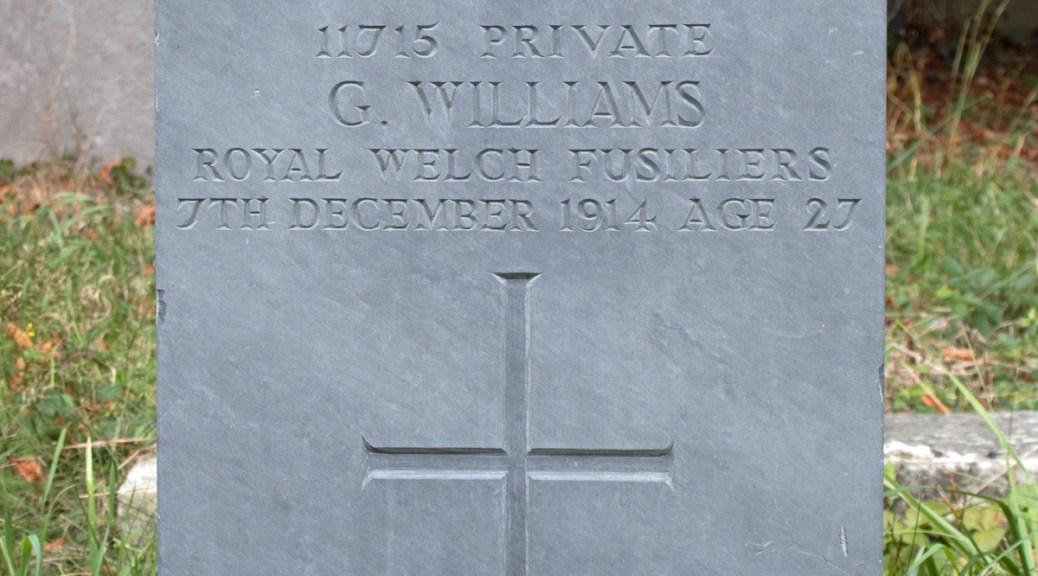
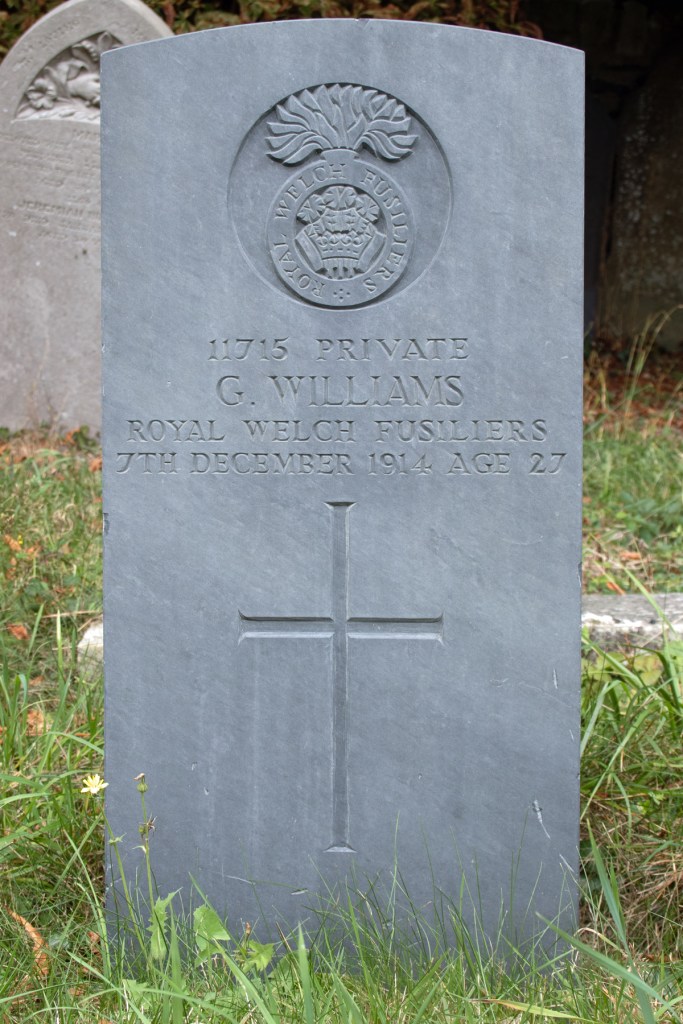
Private George Williams

Private George Williams

George Williams was born in 1887 in Ruthin, Denbighshire. One of thirteen children – of whom sadly only seven survived – his parents were John and Martha Williams. John was a carpenter and joiner and, when the children had grown a little, he and Martha took on the Registered Tramp Lodging House in Church Street, Llangollen.

The 1911 census recorded George living with his parents and working as a carter. His younger brother John was employed as a labourer, while the rest of his siblings were at school. The boarding house was full as Martha’s brother was staying there, along with four lodgers.

George married Catherine Edwards on 27th May 1911. She was an engineer’s daughter, also from Llangollen, and the couple tied the knot in St Collen’s Church, which was on the same street as the Williams’ boarding house. The newlyweds moved to Ruabon, six miles (10km) to the east of Llangollen, and had a daughter, Martha, who was born in 1912.

When war was declared, George was quick to enlist. He joined the 8th (Service) Battalion of the Royal Welch Fusiliers, and was sent to Salisbury Plain for his training. While here, however, Private Williams passed away. The cause of his passing is not readily available, but it seems likely that he succumbed to illness, possibly brought on by the sudden influx of men from across the country suddenly billeted together in the confines of an army camp. He died on 7th December 1914, aged just 27 years of age.

George Williams’ body was brought back to Wales for burial. He was laid to rest in the graveyard of St John’s Church in Llangollen.


Tragically, just six days after George’s death, Catherine gave birth to their second child. George Jr would never know his father.


Private James Jones

Private James Jones

James Ward Jones was born on 17th August 1871 in the Denbighshire town of Llangollen. He was the oldest of eleven children to William and Anne Jones. William was a bricklayer’s labourer, and James followed suit when he finished school.

On 30th April 1898, James married fisherman’s daughter Mary Jones. The couple set up home in Llangollen and went on to have ten children.

When war came to Europe, James stepped up to play his part for King and Country. Sadly, little detail of his military service remains available. but it is clear that he enlisted in the Royal Welch Fusiliers and, as a Private, he was assigned to the 47th Provisional Battalion. The troop was based on home soil, and James found himself sent to Norfolk for his war work.

It is unlikely that Private Jones was in camp for long. On Christmas Day 1915 he collapsed having had a seizure, and passed away. He was 44 years of age.

James Ward Jones’ body was brought back to Wales for burial. He was laid to rest in the graveyard of St John’s Church in his home town of Llangollen.


Mary was left with ten children to bring up on her own. She married again, to a Jack Evans, in the autumn of 1916. The couple had two children of their own. Mary passed away in December 1935, aged just 58 years old.


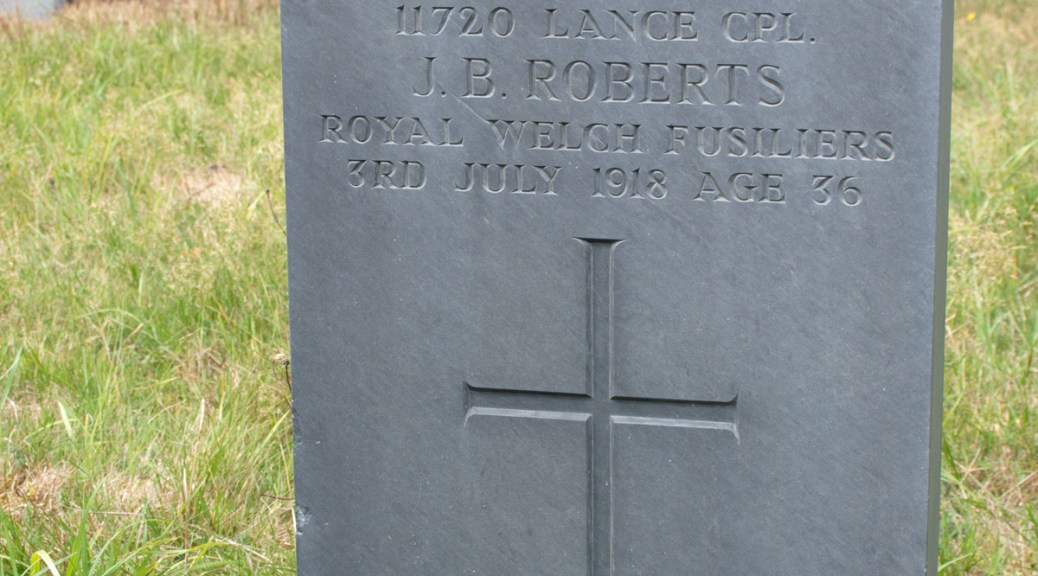
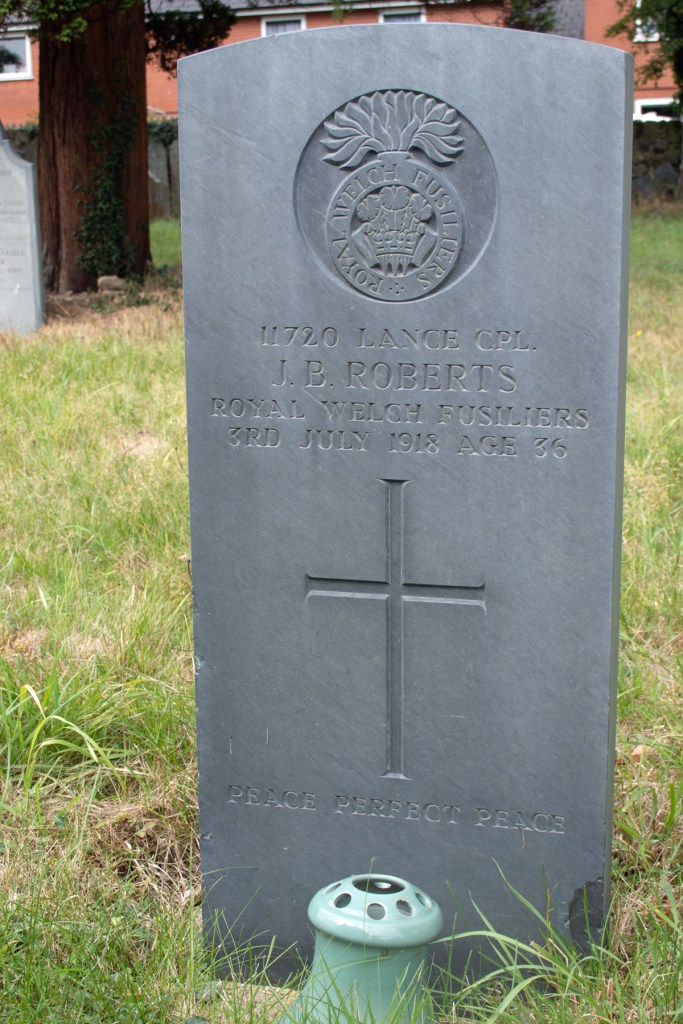
Lance Corporal John Roberts

Lance Corporal John Roberts

John Briscoe Roberts was born in 1882 in the Welsh village of Llanaelhaiarn. He was the oldest of ten children to the village’s sub-postmaster Samuel Roberts and his wife Elizabeth.

When he left school, John found employment with a local estate agent and, by the time of war was declared, he was working as a clerk for a timber mill in Llangollen, Denbighshire.

John was quick to enlist – he joined up on 15th August 1914 and, as a Private, was assigned to the Royal Welch Fusiliers. His service records show he was 5ft 7ins (1.70m) tall, and weighed 142lbs (64.4kg). They also note that he had black hair, brown eyes and a dark complexion.

Private Roberts’ initial service was carried out on home soil. He worked diligently and was rewarded for it, being promoted to Lance Corporal in December 1914. By the following June, his troop, the 8th Battalion, was sent overseas, first to Mudros in Greece, and then on to Gallipoli. In September 1915, Lance Corporal Roberts contracted dysentery and tuberculosis. He was medically evacuated back to Britain and admitted to the 1st Scottish General Hospital in Aberdeen to recover.

On 26th January 1917, John married Gladys Emily Edwards in Wrexham Parish Church. The couple settled down in Llangollen, where Gladys was from, and where John had been working before the war. His lung condition continued to dog him, however and, after another couple of months, he was deemed no longer fit for active service, and medically discharged from the army.

John took up his role in the timber yard again, remaining there for the next year or so. Tuberculosis was ultimately to get the better of him, however, and he passed away on 3rd July 1918, at the age of 36 years old.

John Briscoe Roberts was laid to rest in the graveyard of St John’s Church in Llangollen, Denbighshire.