Little concrete documentation remains about the life of William Henry Jackson. He was born in Bedford, Bedfordshire, on 6th February 1872, although it is not possible to identify who his parents were.
He married a woman called Edith in 1903, and the couple settled in her home town of Beeston, Nottinghamshire. By the time of the 1911 census, he was recorded working as an electrician’s labourer at the local telephone works, while Edith, who was five years his senior, earned extra money as a blouse finisher.
Information about William’s wartime efforts are also limited. He enlisted in the Royal Marine Light Infantry, and was assigned to the Chatham Division. He was given the rank of Private and based at the Royal Naval Dockyard in the Kent town.
The only other information available for Private Jackson is that he died on 16th September 1916, having contracted a combination of pneumonia and tuberculosis. He was 44 years of age.
William Henry Jackson was laid to rest in Woodlands Cemetery, Gillingham, not far from the dockyard in which he had served. His headstone gives the initial H, rather than W, although no documents suggest he went by any name other than William.
Owen Jonah Owen was born in 1880, the oldest of eleven children to Jonah and Elizabeth Owen. Jonah was a quarryman at one of the slate mines around Llanberis, Gwynedd, and this is where the family were raised.
Owen followed his father into the slate quarries and, on 26th September 1903, he married Ann Jones, the daughter of another quarry worker. The couple went on to have four children: Richard, Jonah, Delia and Gwyneth.
He was well known and respected in the village, had a passion for singing and “had conducted singing festivals held by the Congregationalists of the district.” [Caernarvon & Denbigh Herald: Friday 24th November 1916]
War was closing in on Europe, and Owen was keen to play his part. Sadly his service records have been lost over time, but it is clear that he had enlisted in the army by May 1916. Private Owen joined the Royal Welch Fusiliers, and was assigned to the 14th Battalion.
Part of the 38th Division, the battalion was to be caught up in some of the fiercest and most desperate fighting of the First World War. In July 1916, Owen would have been entrenched at The Somme and, after the first few horrific days, his battalion was one of those involved in the fighting at Mametz Wood.
Private Owen was badly wounded during the battle and medically evacuated to Britain for treatment. Admitted to a military hospital in Birmingham, he was to remain there for a number of months until, on 12th November 1916, his body finally succumbed to his injuries. He was 36 years of age.
Owen Jonah Owen was brought back to his home village for burial. He was laid to rest in the graveyard of St Peris Church in Llanberis.
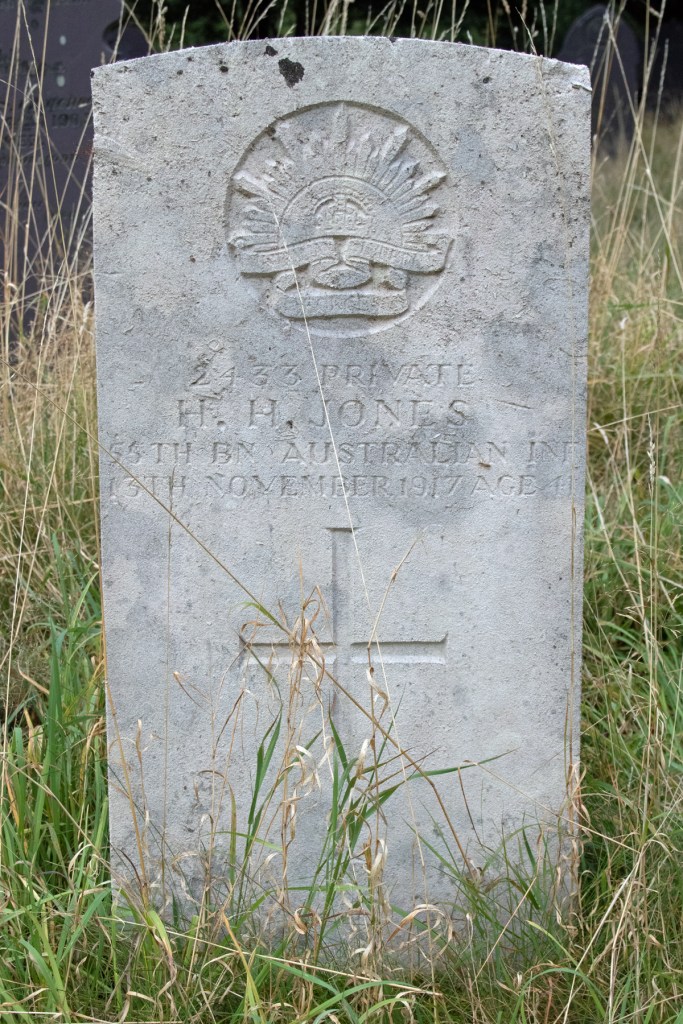
Hugh Henry Jones was born in around 1876 in the Welsh village of Llanberis, Gwynedd. He was one of seven children to quarryman John Jones and his wife Mary.
Slate was the big industry in Snowdonia, and Hugh and his brothers all followed his father into the quarries. Labour was plentiful and wages would not have been high, so when the opportunity arose for employment overseas, he seems to have taken it.
Exact details are sketchy, but Hugh emigrated to Australia at some point in the early 1900s. He settled in the city of Goulburn, New South Wales and the experience he had built up back home stood him good stead, as he continued working as a quarryman.
When war broke out in Europe, those in the British colonies were called upon to play their part, and Hugh was among those to serve King and Country. He enlisted on 29th December 1915, joining the 55th Battalion of the Australian Infantry.
Private Jones’ service records show that he was 40 years and six months old, stood 5ft 4ins (1.63m) tall and weighed 130lbs (59kg). He had a dark complexion, blue eyes and black hair. He also appears to have had a denture in his lower jaw.
After initial training, Private Jones set off for Europe at the end of September 1916, arriving in Plymouth six weeks later. Within a matter of weeks he was on the move again, sailing for France, and arriving at Etaples at the start of 1917.
Private Jones was ensconced on the Western Front for the next few months but, as spring came, he was starting to have some health issues. In April he was admitted to a field hospital suffering from dyspepsia (indigestion), which was subsequently diagnosed as gastritis.
Medically evacuated to Britain for treatment, Hugh spent the next few months being treated in hospitals in Kent, and Dorset, before being admitted to the Royal Infirmary in Liverpool. Sadly, by this point, his condition had been identified as stomach cancer and, while in Liverpool, he passed away. Private Jones breathed his last on 13th November 1917, at the age of 41 years old.
Hugh Henry Jones was brought back to Wales for burial. He was laid to rest in the graveyard of St Peris Church in his home village of Llanberis.
William Pierce Rowlands was born the summer of 1891 and was the oldest of three children to Thomas and Ellen Rowlands. Thomas was a slate dresser and quarryman from North Wales, and William was born in Ffestiniog, Gwynedd. By the time his sister Margaret was born, the young family had moved to Llanberis, settling in a small cottage on the outskirts of the village.
When he left school, William found work as a clerk, and this was the work he was carrying out when was broke out. He enlisted on 10th April 1915, joining the 14th (Service) Battalion of the Royal Welch Fusiliers. His service records show that he was 5ft 8ins (1.73m) tall.
Private Rowlands served on home soil for just over seven months, before being sent to France on 30th November 1915. He had been suffering from a cough for a couple of weeks, and this came to a head while he was overseas. He reported sick on 16th December, and was sent back to Britain for treatment a month later.
His condition was identified as pulmonary tuberculosis, aggravated by military service. Private Rowlands was medically discharged from the army on 8th February 1916, and returned home.
At this point, William’s trail goes cold. His condition appears to have worsened, however, and it was from tuberculosis that he was to die. He passed away at home on 18th February 1917, at the age of 25 years old.
William Pierce Rowlands was laid to rest in the quiet graveyard of St Peris Church, in the family home village of Llanberis.
Thomas and Ellen lived until 1932, when the passed away within a couple of months of each other (Thomas in August, Ellen in November). They were reunited with the son, and lie together in the family grave, along with Ellen’s brother, also called William, who had passed away in 1930.
Griffith Hughes was born in Llanberis, in modern day Gwynedd, in 1893. Sadly, there is little information about his early life, and records mention his mother – Margaret – but no father. The 1901 census records Griffith as living with his grandmother, Ann Hughes.
Ten year later, the two are living in a two-up, two-down cottage – 19 Snowdon Street, Llanberis – with Griffith’s aunt, Ann’s daughter Jane, and her husband, Thomas. Griffith is earning money by now, working as a slate dresser at one of the local quarries.
War was coming to Europe by this point, and Griffith was called upon to play his part. He initially enlisted in the Welch Regiment as a Private, although he seems to have transferred across to the South Wales Borderers during his service.
Private Hughes’ time in the army was spent on home soil, although he earned the Victory and British Medals for his service. He remained in the army through to the end of the war and beyond until, on 15th August 1919, he was medically discharged. He had developed tachycardia, and this was having an impact on his life.
When Griffith left the army, he was based in Lancashire, and was living in the village of Bryn, to the south of Wigan. He remained in the area for the next year, his health sadly deteriorating. Admitted to the cottage hospital in nearby Pemberton, he passed away from his heart condition on 18th September 1920. He was just 27 years old.
Griffith Hughes was brought back to Wales for burial. He was laid to rest in the quiet graveyard of St Peris Church, in his home village of Llanberis.
Thomas Merrall Rice was born on 4th January 1894, one of thirteen children to William and Martha. William was from Northamptonshire, but it was in Bearsted, near Martha’s home town of Maidstone, where the couple raised their family.
Little detail of Thomas’ early life remains. What is clear is that, by the summer of 1916, he was living in Plumstead, South East London and was working as a valet. He had met Annie Jane Rix by this point, and the couple married on 17th June 1916 at All Saints Church in Plumstead.
Thomas was called up for military duty not long after this and, on 1st November 1916, he enlisted in the 14th Battalion of the London Regiment, also known as the London Scottish. His service records show very specifically (although seemingly incorrectly) that he was 25 years and 300 days old. It was also noted that he stood 5ft 5.5ins (1.64m) tall and was, by this time, employed as an explosives worker at Woolwich Arsenal.
After his initial training, Private Rice was sent to France at the end of May 1917. His service overseas was not to be a long one, as, within a couple of months, his battalion had been the victims of a gas attack. Thomas was admitted to a field hospital but quickly developed pleurisy and tuberculosis, and was medically evacuated back to Britain in August, and discharged from the army as no longer fit for active duty just a couple of months later.
His failing health meant that Thomas was not able to actively work, and it seems that he had moved out of London and back to his family’s home on the outskirts of Maidstone. It is unclear whether Annie went with him, but, as they had a son, Albert, who had been born shortly before he was sent to France, it seems likely that they would have moved as a family unit.
William, Thomas’ father, died in the summer of 1919, and was laid to rest in the graveyard of Holy Cross Church, Bearsted. Sadly, Thomas was to follow him, passing away on 15th January 1920, a victim of the lung conditions that had dogged him since France. He had just turned 26 years of age.
Thomas Merrall Rice was laid to rest alongside his father in the quiet Holy Cross Churchyard.
In a quiet corner of the village cemetery in Cuckfield, West Sussex, is a headstone dedicated to Private WG Sinclair. Attached to the East Yorkshire Regiment, he passed away on 12th February 1919.
A search of military records gives a little more detail: this was a George William Sinclair, who had died from pneumonia at the West Hylands Institution, which was Cuckfield’s workhouse. George was 29 years old, but there is little concrete information about his early life.
A newspaper report from the day before Private Sinclair’s death, however, begins to shed a little more light onto his life:
George William Sinclair was charged with being a deserter from the Cuckfield Union Workhouse, on November 6th, and carrying away clothing to the value of £1, the property of the Guardians of the Cuckfield Union. PC Upton said that he arrested the prisoner at the Somerstown Police Station. Prisoner was remanded, but as he was taken ill he was removed to the Workhouse Infirmary.
Mid Sussex Times: Tuesday 11th February 1919
George’s entry in the Army Register of Soldier’s Effects does not give a next of kin, so it is not possible to determine categorically where he was born and raised, or who his parents were.
A little more digging found a George William Sinclair recorded in the UK Calendar of Prisoners in 1916. He had been arrested for “feloniously breaking and entering the dwelling house of Sarah Waddingham, and stealing one bicycle, one pair of shoes, one purse, one tobacco box, one tobacco pipe and one microscope, the property of said Sarah Waddingham, at West Halton [near Hull], on the 7th July 1916.“
It is not possible to say definitively that this George William Sinclair is the same one buried in Cuckfield Cemetery, but, given the regiment he was attached to, and the newspaper report prior to his passing, it is likely to be more than just a coincidence.
George pleaded guilty, and was sentenced to six months’ hard labour. This was not his first offence, and had had spent a total of more than eighteen months behind bars over a period of ten years up to this point. On each occasion, he was convicted of theft.
It is possible, given that the country was at war by this point, that George was given the option to enlist, rather than serve his sentence. Again, this is an assumption, however, but Private Sinclair’s Pension Ledger confirms that he was discharged from the army on 6th November 1918.
George William Sinclair appears on another workhouse register, this time in Westminster, London, where he spent a couple of nights just before Christmas that year.
If these records all relate to the same man, his life seems to have been a troubled one. I can only hope that he found peace in that quiet corner of West Sussex.
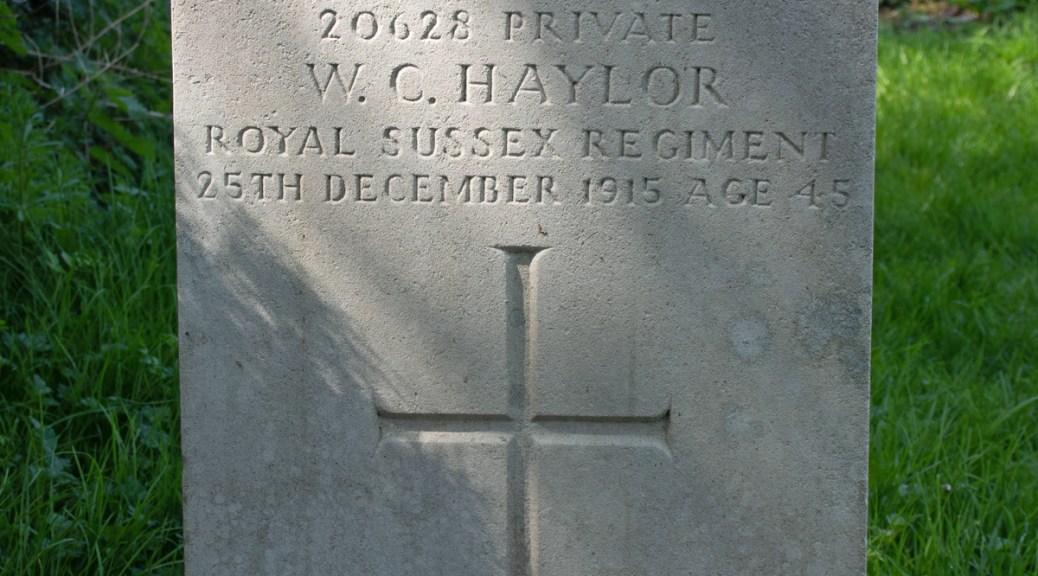
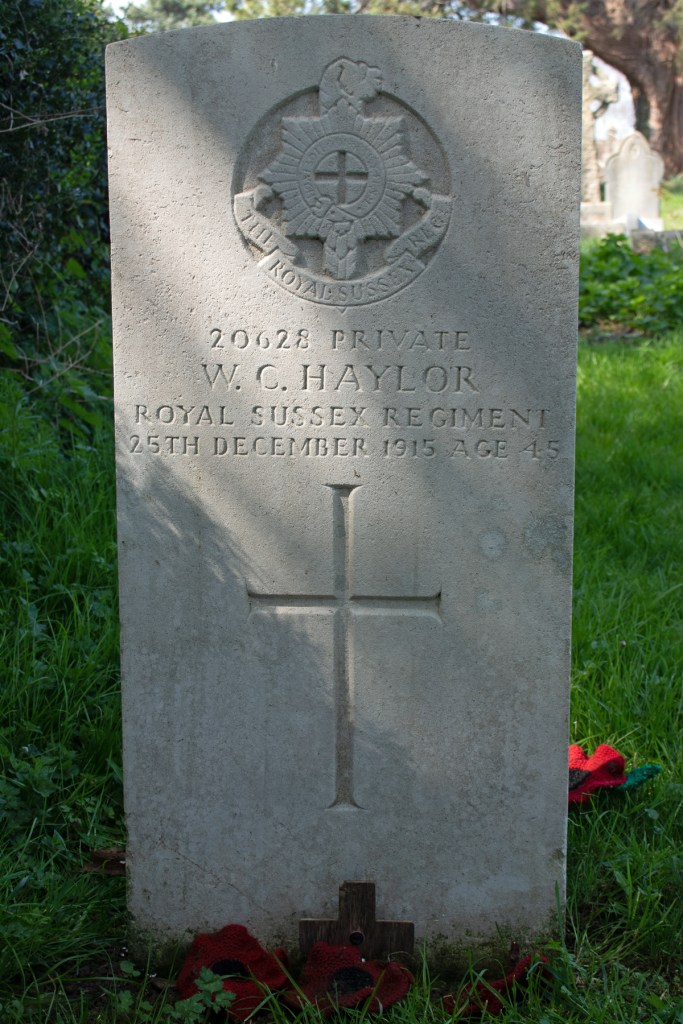
William Charles Haylor was born in the summer of 1870, in the West Sussex village of Cuckfield. He was one of eight children to agricultural labour Michael Haylor and his wife, Betsy. Michael passed away in 1886 and, with children to raise, his widow took in washing to earn money.
William found work as a farm labourer and, by the time of the 1901 census was living in a cottage at Beech Farm in the village, with his mother, younger sisters, one brother-in-law and six nieces and nephews.
On 25th October 1905, William married Florence Linstead. She was a carter’s daughter from South London, and it is not exactly clear how they met. It seems likely, though, that Florence had taken work on one of the estates in the Cuckfield area. The couple exchanged vows at St Antony’s Church in Florence’s home town, Nunhead, before settling down back in West Sussex.
When war came to Europe, William was keen to play his part. He enlisted in the Royal Sussex Regiment on 9th November 1914 and was assigned to the No.6 Supernumerary Company of the 2nd/4th Battalion. This was a territorial force, set in place for those older volunteers keen to serve King and Country.
Private Haylor’s time in the army was to be brief, however, as at his medical he was found to be medically unfit for military service. No further details are available, but it meant that William had spent just 82 days in the army.
At this point, William’s trail goes cold. He returned home, and presumably continued in his previous line of work. Again, however, the status quo was not to continue for long. He passed away at home, through causes unknown, on Christmas Day, 25th December 1915. He was 45 years of age.
William Charles Haylor was laid to rest in the cemetery in his home village, Cuckfield. He was accorded a military funeral.
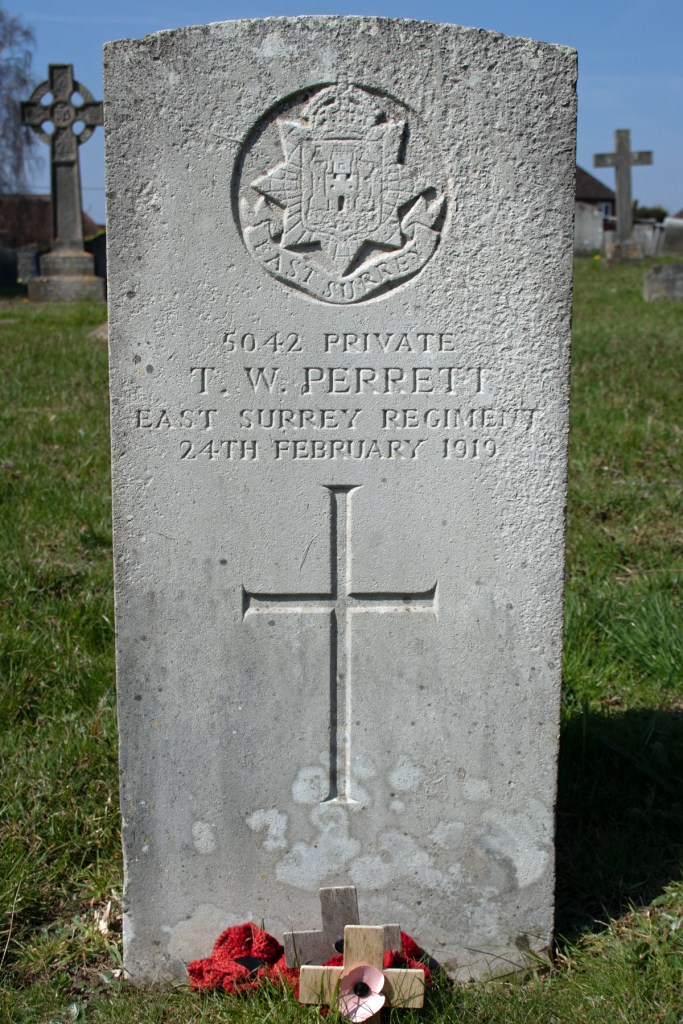
Thomas William Perrett was born in October 1878, the seventh of eight children to Lewin and Ann Perrett. Lewin was an agricultural labourer from Wiltshire, and it was in Aldbourn, near Marlborough, that the family were raised.
Initially finding work as a farm labourer, Thomas was soon drawn to the bright lights and big city. By the early 1900s he had moved to London, and it was here that he met, and in 1909 married, Mary Sterry, a labourer’s daughter from Middlesex. The couple went on to have three children, Elsie, Rose and Alice.
Thomas, by this point, had found work on the railways: the 1911 census records him as a railway porter, presumably at Paddington Railway Station, which was within a few minutes’ walk of where the Perrett family were living.
War came to Europe, and Thomas was keen to play his part. Full details of his service are not available, but he enlisted in the East Surrey Regiment, where he was assigned to the 2nd/5th Battalion. This was a second line unit, and Private Perrett remained on home soil for the duration of the war.
This territorial role was reinforced when he transferred across to the 696th Agricultural Company of the Labour Corps. Details of his work are not available, but it seems likely that he was assigned to farm work in the mid-Sussex area.
This too is where Private Perrett remained after the war and where, on 24th February 1919, he was to pass away. Details of his death are vague and the cause is unknown, but he was 40 years of age.
Thomas William Perrett was laid to rest in the cemetery in Cuckfield, West Sussex.
Harry Etherton was born in Ansty, near Cuckfield, West Sussex on 3rd April 1872. The oldest of five children, his parents were Edwin and Louisa Etherton. Edwin was an agricultural labourer, and this was work in which his son followed his father.
On 29th April 1899, Harry married Annie Eliza Pennifold, a labourer’s daughter who was also from Ansty. The couple set up home in Cuckfield, and went on to have five children. Harry was, by this point, working as a road labourer for the local council, and this was a job he was to continue doing until the outbreak of the war.
Harry enlisted in 1915, joining the Royal Sussex Regiment as part of the National Reserve. As Private Etherton, he was then transferred across to the Labour Corps, and was assigned to the 409th Labour Coy. which was based at the Infantry Depot in Lincoln.
It was while Private Etherton was here, in the spring of 1918, that he contracted meningitis, and was admitted to the Northern General Hospital in the city. Sadly, he was to succumb to the disease, passing away on 30th June 1918, at the age of 46 years old.
Harry Etherton’s body was brought back to West Sussex for burial. He was laid to rest in Cuckfield Cemetery, not far from where his widow and children still lived.










 Death and Service