Edward Foster was born in the spring of 1887, one of eight children to Alfred and Eliza. Alfred was an agricultural labourer, born and bred in North Newton, Somerset, and this is where he raised his family.
When he left school, Edward found work in the village as a basket maker, and this is a trade he continued in until war broke out. He enlisted early on, and was assigned to the Somerset Light Infantry as a Private.
His battalion was shipped to India in October 1914, but records are sparse, and it is not clear whether Private Foster also set sail. All that can be confirmed is that he was at home on 21st December 1914, as this is where he sadly passed away from heart failure. He was just 27 years of age.
Edward Foster was laid to rest in the graveyard of St Peter’s Church in his home village, North Newton.
Oliver Metford Parsons was born in North Newton, Somerset, on 3rd January 1897. His parents were Thomas and Lily Parsons, and he was one of four children.
Thomas was a carter and labourer on a farm, and this is the trade his son took up when he left school. The 1911 census recorded Oliver as living with the market gardener Edmund Durridge and his family – who lived in the same village – and working as a labourer for them.
Lily had passed away in 1907, so this move may have had something to do with a change in family circumstances – the 1911 census recorded Thomas living in the village with Hannah Parsons, having been married for just a year.
When war came to Europe, Oliver was keen to play his part for King and Country. While full service records are not available, documents confirm that he enlisted in the Somerset Light Infantry in the spring of 1917. Private Parsons was assigned to the 7th (Service) Battalion and soon found himself on the Front Line.
While it is not possible to pinpoint exactly where Oliver fought, his battalion fought at the Third Battle of Ypres and, in April 1918 moved to Amiens.
It was in June 1918 that Private Parsons was caught up in a gas attack. He was injured and medically evacuated to England for treatment, where he was admitted to the Ipswich Hospital in Suffolk. Sadly, his injuries proved too severe, and he passed away at the hospital on 10th June 1918. He was just 21 years of age.
Oliver Metford Parsons’ body was brought back to his Somerset home. He was laid to rest in the graveyard of St Peter’s Church in North Newton.
George Franklin was born in the autumn of 1887, one of eleven children to James and Eliza. James was a farm labourer from North Newton, Somerset, and this is where the young family were raised. Given the rural location, it is no surprise that, when he left school, George followed his father and became an agricultural labourer.
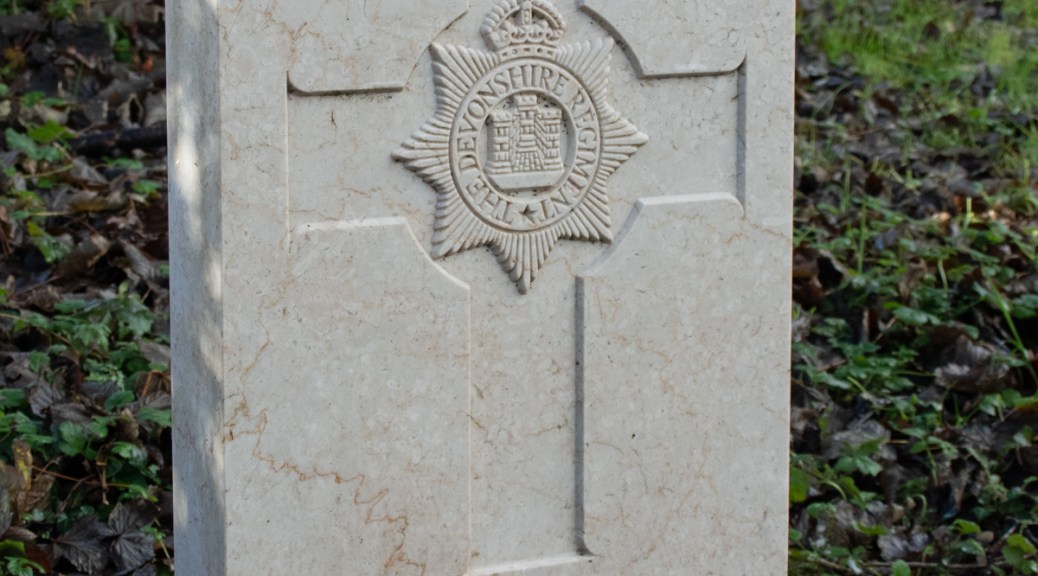
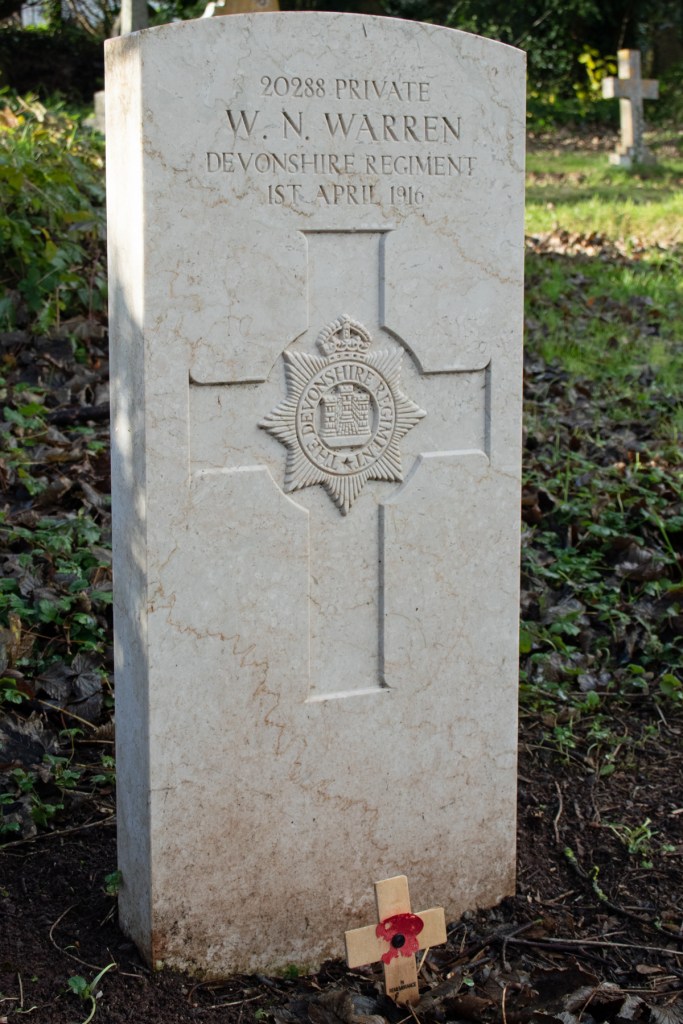
When war came to Europe, George was keen to play his part. Full details of his military service are not available, but he enlisted in the Devonshire Regiment as a Private. Little information is available about his role or where he was posted, and, sadly, the next set of documents relate to his passing.
Private George Franklin died on 10th April 1916, having been suffering from cerebro-spinal fever – meningitis. He was just 28 years of age. He was laid to rest in the graveyard of his village church, St Peter’s in North Newton.
Cuthbert William George Collard was born in the spring of 1899, one of nine children to William and Eliza Collard. William was an agricultural labourer from North Newton in Somerset, and this is where he and Eliza raised their family. While probably helping his father out as a child, Cuthbert found work at the local blacksmith’s when he left school.
Cuthbert was barely fifteen when war broke out in Europe, and so had to wait until April 1917 before he was of age to enlist. He joined the Devonshire Regiment, and his service records show that he was 5ft 2ins (1.57m) tall, had black hair, brown eyes and a pale complexion.
Assigned to the 4th (Reserve) Battalion, Private Collard served his time on home soil. While full details are not available, it appears that he contracted tuberculosis during his training. This was serious enough for treatment in a sanatorium to be recommended, and he was medically discharged from military service because of the lung condition on 9th January 1918. He had been in the army for just 280 days.
At this point, Cuthbert’s trail goes cold. Whether he was admitted for medical treatment is unclear, but it appears that he returned to North Newton. He passed away on 19th June 1919 at the family home, aged just 20 years old.
Cuthbert William George Collard was laid to rest in the graveyard of the village church, St Peter’s.
John Walker Lake was born in Eastbourne, East Sussex, in the spring of 1892, the only child of estate manager and auctioneer Percy Lake and his wife Elizabeth.
John’s mother passed away in 1900, when he was only eight years old, and details of his early life are hard to come by. However, by the time of the 1911 census, he had left school and enrolled in a mining college in Guston, near Dover, Kent.
When war broke out, John was quick to enlist. He joined the London Regiment on 18th September 1914, and was assigned to the 2nd/23rd Battalion. His service records show that he stood 5ft 8ins (1.72m) tall, had light hair, blue eyes and a fair complexion.
Private Lake was not to remain in the army for long. Within weeks of joining, he contracted tuberculosis and, on 22nd February 1915, after just 158 days, he was discharged from service as being no longer medically fit for duty.
At this point, John’s trail goes cold. He initially returned to live with his father in Eastbourne. By the autumn of 1918, however, he was in Weston-super-Mare, Somerset, probably for health reasons.
The tuberculosis got the better of John Walker Lake, however; he passed away on 20th October 1918, at the age of 26 years old. He was laid to rest in the Milton Road Cemetery in Weston-super-Mare.
Roderick Morgan Smith was born on 14th April 1896 in Upton Park, Essex. One of twin sons to Francis and Frances Smith, he had three siblings altogether. Francis is absent from the two census returns on which Roderick features, but the documents confirm that Frances – who was a certified teacher – was married, so he may have been elsewhere at the time.
By the time of the 1901 census, the family had moved from East London to Monmouthshire, where Roderick’s mother was teaching at the school in the village of Wonastow. Ten years later, they had moved across the River Severn to Withycombe in Somerset, not far from where Frances had been born. Other records show that they subsequently moved to Bath, then to Weston-super-Mare.
When war broke out, Roderick was keen to join up. He enlisted as a Private in the Durham Light Infantry, and was assigned to the 7th Battalion. He was sent to France in the spring of 1915, and would have been involved with his regiment at Ypres and the Somme.
It was at the Somme that Private Smith was gassed and wounded. Full details are not recorded, but they were enough for him to be medically evacuated to England. He was admitted to the military hospital in Taunton, but passed away on 7th May 1916. He was just 20 years of age.
Roderick Morgan Smith was brought to Weston-super-Mare and laid to rest in the town’s Milton Road Cemetery.
Roderick’s twin, Frank Morgan Smith, also played his part in the First World War. He enlisted in the Bedfordshire Regiment as a Private, and was assigned to the 7th Battalion. He also found himself embroiled at the Somme, and he too was wounded.
Sadly, Frank’s wounds were too severe for him to be repatriated to England; he died in a French hospital on 3rd December 1916, also aged 20 years old. He was laid to rest at the Wimeraux Cemetery.
John Thomas Holland was born in 1883 in Tunstall, Staffordshire, and was the son of Jane Holland. Sadly, neither name was uncommon in that area at that time, so it is a challenge to determine any further information about his early life.
John was 31 years old when war broke out and, while his service records no longer exist, he enlisted early on, joining the North Staffordshire Regiment as a Private. He was assigned to the 8th Battalion, and was soon billeted in Weston-super-Mare, Somerset.
Sadly, the next information available for Private Holland is a coroner’s report in a local newspaper.
Considerable mystery was associated with the evidence given before Mr Craddock, at the inquest… concerning the death of Private John Holland… now billeted in the town. Deceased was found killed on the railway line near Weston-super-Mare Station on Tuesday. The evidence revealed that Holland left his billet at 8:15am on that day, and announced that he was going to see a doctor. His body was found down the line at 12:30, the legs having been severed. From enquiries, it transpired that Holland had walked along a slip of garden fringing the line at a distance of about two miles from his billet. It was stated that deceased was of sober habits, and that he bore a good character. A verdict of Accidental Death was returned.
Shepton Mallet Journal: Friday 8th January 1915
Private John Thomas Holland died on 29th December 1914: he was 31 years of age. He was laid to rest in Weston-super-Mare’s Milton Road Cemetery.
Bert Mayled was born in the autumn of 1889, the fourth of four children – all boys – to Benjamin and Anna Mayled. Benjamin was a butcher from Somerset, who raised his young family in the seaside town of Weston-super-Mare.
The whole family followed in Benjamin’s trade, with all four siblings supporting in one way or another, either through farm work or, in Bert’s case, becoming a butcher as well.
On 6th July 1914, Bert married Catherine Swearse, a builder’s daughter from nearby Axbridge. They married in Catherine’s local church, but settled – albeit briefly – back on the coast.
Bert may even have enlisted by the time of the wedding. While he is noted as a butcher on the marriage banns, within weeks war had broken out across Europe, and he found himself in the North Somerset Yeomanry.
Private Mayled’s regiment was one of the first into the fray – he was soon on the Front Line at Ypres. He was wounded early on, and medically evacuated to England for treatment. Admitted to the 2nd Western General Hospital in Manchester, he succumbed to tetanus, contracted from his wounds. He died on 25th November 1914, at just 25 years of age.
Bert Mayled was brought back to Weston-super-Mare for burial. He lies at rest in the Milton Road Cemetery there.
John Spencer Payne’s life is a bit of a challenge to piece together, as there is little documentation available. He was born in 1894 in the village of Overton-on-Dee, near Wrexham and was one of two children to Charles and Elizabeth Payne. John was christened in Tenby, Pembrokeshire, at which point, his father’s trade was ‘gentleman’.
The next available document for John is the 1911 census. This records him as living in Weston-super-Mare, Somerset, where he was working as a bank clerk. He was living in Severn Road, to the south of the town centre, with his now-widowed mother, his older sister and his maternal aunt.
War came to Europe in 1914, and, while there is limited information about John’s service, it is clear that he had enlisted by September 1915. He joined the Royal Gloucestershire Hussars as a Private and was assigned to the 2nd/1st Battalion.
The battalion was a second-line unit, that remained in England until late in the war, when it transferred to Ireland. By the spring of 1916, it had become a cyclist unit although, with no other documentation for Private Payne, it is impossible to determine how or when he served.
Sadly, too, the only other document about Private Payne’s life is the confirmation of his death. He passed away at home on 10th February 1916, although the cause of his death is not recorded. He was just 22 years old.
John Spencer Payne was laid to rest in the Milton Road Cemetery in Weston-super-Mare.
Norman Stanley Allard was born on 3rd December 1892 in the village of Corsley, Wiltshire, halfway between Frome and Warminster. The younger of two children, his parents were Benjamin and Mercy Allard. Benjamin was a farmer who passed away when his son was only 14 years old. Mercy, who was born in Frome, moved the family back to her home town and Norman found work as a clerk at a printing firm in the area.
War came to Europe and, in December 1915, Norman was called up. There is little specific information about his military service, although his records show that he was 5ft 9ins (1.75m) tall and had varicocele – enlarged veins in his scrotum – listed as Distinctive Marks.
Initially assigned to the King’s Royal Rifles, Private Allard spent the first year of his service on home soil. He was eventually dispatched to France in March 1917, serving there for a year. On 22nd March 1918, he was wounded in a gas attack, and medically evacuated back to England.
He was called back into service, and assigned to the 9th Battalion of the Northamptonshire Regiment. He remained on home soil, working as part of the Labour Corps in Cley-next-the-Sea in Norfolk. Sadly, however, it seems that his injuries were to prove too much, and the now Corporal Allard was discharged from military service after just three months.
At this point, Norman’s trail goes cold. He returned home, and passed away there on 13th March 1919. He was just 26 years of age.
Norman Stanley Allard was laid to rest in the graveyard of Holy Trinity Church. This became a family grave, and his mother and sister were also buried there when they passed in 1924 and 1940.