Tag Archives: Private

Air Mechanic 2nd Class Jack Gauntlett

Air Mechanic 2nd Class Jack Gauntlett

Jack Wallis Gauntlett was born in Burbage, Wiltshire, in the spring of 1898. The oldest of four children, his parents were George and Florence Gauntlett. On Jack’s baptism record, George gives his trade as a yeoman, while later census records confirm he was a farmer.

Jack was baptised in St Mary’s Church in Stapleford, near Salisbury, some distance south of Burbage, and, given that his parents had no connection to that area, it seems that his father’s work took the family around the county. The 1901 census record found them Gauntletts back in Burbage, but by the time of the 1911 return, they had moved to Middleton Farm in Norton Bavant.

When war broke out, Jack stepped up to serve his country. He enlisted in the Royal Flying Corps in January 1917 and, as an Air Mechanic 2nd Class, was sent to Farnborough, Hampshire, for training.

Much sympathy is felt with Mr and Mrs FG Gauntlett, of Middleton Farm, in the loss they have sustained by the death of their eldest son, JW Gauntlett… He came home three weeks ago on leave before proceeding to France, and was then sickening for measles and had bronchitis. He was taken to Sutton Veny military hospital and died there on Friday from an attack of pneumonia.

[Wiltshire Times and Trowbridge Advertiser: Saturday 19th May 1917]

Jack Wallis Gauntlett was just 19 years of age when he died on 11th May 1917. He was buried in the family plot in All Saints’ Churchyard, Norton Bavant.


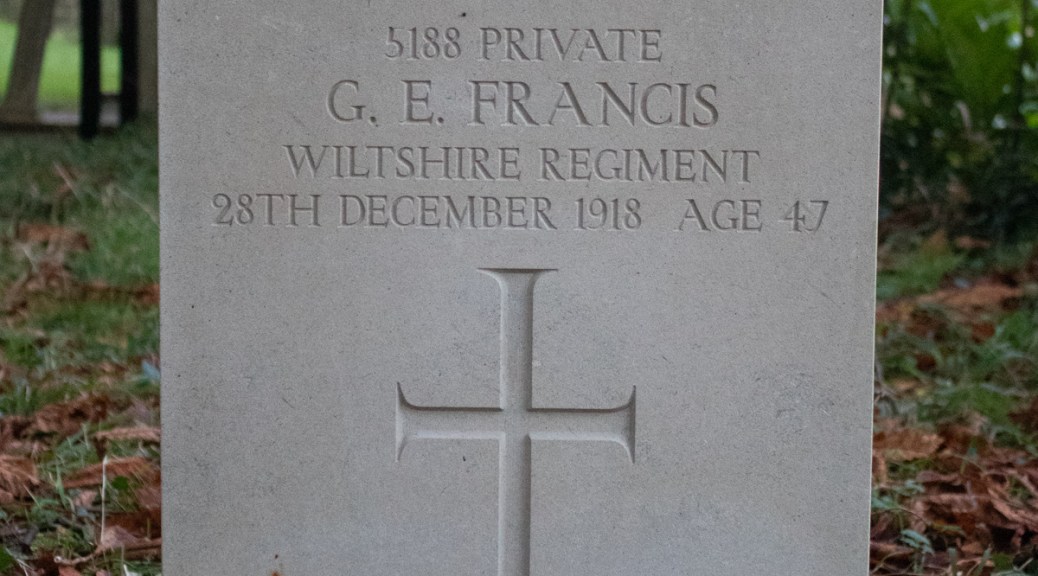
Private George Francis

Private George Francis

George Edward Francis was born at the end of 1871 in the Wiltshire village of Alvediston. The youngest of six children, his parents were Eli and Mary Francis. Eli was an agricultural labourer, and this was the line of work that George would also follow.

Eli died in 1885, and Mary moved in her daughter Elizabeth’s family, and the 1891 census noted that George and his older brother Samuel were also living there. George, now 19 years of age, was employed as a farm labourer.

On 11th July 1906, George married Alice Shirley. A year older than her new husband their wedding certificate notes that she was also born in Alvediston, but that her father wasn’t known. The couple settled in a house in Tollard Royal, a few miles south of their home village.

George stepped up to serve his country when war was declared. Full details of his time in the army are unclear, but he had definitely enlisted by the summer of 1918. He was initially assigned to the Wiltshire Regiment, but was later transferred to the 651st Agricultural Company of the Labour Corps.

The only other record for Private Francis’ time in the army, is a document relating to his passing. This confirms that he died on 28th December 1918 in camp at Norton Bavant, to the east of Warminster, Wiltshire: he was 47 years of age.

It seems likely that Alice was unable to cover the cost of bringing her husband’s body back to Tollard Royal for burial. Instead, George Edward Francis was laid to rest in the graveyard of All Saints’ Church in Norton Bavant.


Private Joseph Tyler

Private Joseph Tyler

Joseph Tyler was born in the spring of 1882, and was the youngest of three children to Joseph and Sarah. Joseph Sr was a carter from Staffordshire, and the family were born and raised in Wordsley.

The 1901 census found the Tylers living in Brierley Hill, with Joseph Jr having found employment as a glass worker. His father passed away in 1907, and so he remained at home to support his now widowed mother.

By the 1911 census, Sarah and Joseph had moved to Birmingham, and were living at 32 Wiggin Street, a terraced house in the Ladywood area. Joseph listed his employment as a glassblower, while his mother gave no employment, presumably looking after the home.

When war came to Europe, Joseph stepped up to play his part. Full details of his service have been lost, but it is clear that he enlisted early on in the conflict. He joined the Hampshire Regiment, and was sent to Wiltshire for training.

Tragically, Private Tyler’s time in the army was not to be a lengthy one. Barracked near the village of Boyton, he was quickly admitted to the local military hospital. Suffering from heart failure, this would take his life: Joseph died on 13th October 1914, at the age of 32.

The body of Joseph Tyler was laid to rest in Boyton Cemetery, not far from the camp that had, so briefly, been his home.


Private George MacFarlane

Private George MacFarlane

George McFarlane was born in Alexandria, Dumbartonshire, in 1879, and was the third of four children to George and Jane.

There is little concrete information about George Jr’s life, and most of that information comes from his army service records. These confirm that he was working as a printfield worker, employed by the local dye works to produce printed cloth.

The service papers also confirm that George had married Christina Kerr on 19th April 1905, and that they had four children: Irene, William, Christina and George. Christina had also had a son, Richard, from a previous relationship.

George had readily answered the call to serve his country when war broke out. He enlisted on 18th September 1914, and was assigned to the Argyll and Sutherland Highlanders. He is recorded as being 5ft 7ins (1.69m) tall and 135lbs (61.2kg), with auburn hair, grey eyes and a fresh complexion.

Private McFarlane was sent to Wiltshire for his training, and was barracked near the village of Boyton. His time there was to prove tragically short. Within a matter of weeks he contracted pneumonia, and succumbed to the condition on 4th October 1914. He was just 34 years of age, and had been in the army for 16 days.

Christina was unable to cover the cost of bringing her husband back to Scotland. Instead, George McFarlane was laid to rest in Boyton Cemetery, his headstone paid for by the men of his regiment.


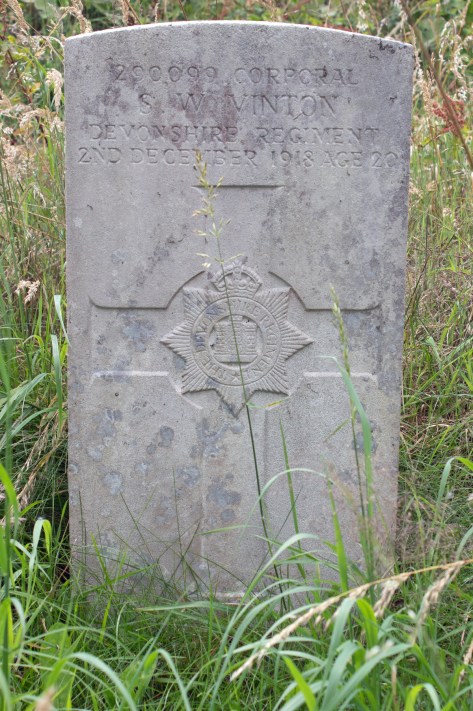
Lance Corporal Thomas Thorne

Lance Corporal Thomas Thorne

Thomas Thorne was born in Tiverton, Devon, in the spring of 1895. The older of two children, he was the only son to Thomas and Louisa Thorne. Thomas Sr was a carriage manufacture for a lace factory, and by the time of the 1911 census, the family of four were living in a small terraced house at 19 John Street in Tiverton.

At this point, Thomas Jr had completed his schooling, and had also found work at the lace factory. War was on the horizon, however, and things were to change.

On 6th December 1915, Thomas Jr made his way to Exeter to enlist. He joined the Devonshire Regiment as a Private, and his service records show that he was 5ft 4.5ins (1.63m) tall and weighed 112lbs (50.8kgs). He was of fair physical development, although there were issues with his teeth and he had a higher than normal heart rate.

Private Thorne was formally mobilised in July 1916. Initially assigned to the 13th (Works) Battalion, he spent his time on home soil. By the following spring, he transferred to the 311th Home Service Labour Company, and seems to have moved from Devon to Hampshire.

Thomas spent the next three years serving in the Labour Corps. By the winter of 1918/19, his health was becoming impacted, and he was admitted to the Shirley Warren Auxiliary Hospital in Southampton, suffering from a combination of influenza and pneumonia. The conditions were to prove fatal, and he passed away on 17th February 1919, aged just 24 years of age.

Thomas Thorne’s body was taken back to Devon for burial. He was laid to rest in Tiverton Cemetery, not far from the family home.


Interestingly, Thomas’ rank differs depending on the document you are looking at. I have used Lance Corporal, as this is what is recorded by the Commonwealth War Graves Commission, although his service papers state he was a Private.


Private Arthur Candey

Private Arthur Candey

Pte. Arthur Candey, of the Devon (Cyclists) Territorials, was found shot at Rotterdam, Talland, near Polperro, early on Friday morning. About six weeks ago Candey was drafted to Polperro from Looe and had been engaged in watching the coast, and the deceased and Pts. C Harris went on patrol duty. At Rotterdam Cottage, Candey complained of feeling tired and unwell. so Harris told him to remain in a hut close by while he went on alone and met the other patrol. While on the return journey Harris heard the report of a gun, and deceased was found dead with a bullet wound in the head. Death must have been instantaneous. Pte. Harris was away from the deceased for fifty minutes altogether…

At the inquest at Talland… the jury… returned a verdict that Candey took his life while temporarily insane.

[West Briton and Cornwall Advertiser: Monday 21st June 1915]

Arthur Candey was born in the spring of 1897 in Tiverton, Devon. One of thirteen children, and the youngest surviving son, his parents were Richard and Ellen Candey. Richard was a lace maker, and the family lived in a small terraced house in John Street, to the west of the town.

There is little information available about Arthur’s life. The 1911 census showed that he was still in school, and his army service records have been lost to time. It is clear that he enlisted in the 2nd/7th (Cyclist) Battalion of the Devonshire Regiment, and the newspaper report confirms that he served in Cornwall.

Private Arthur Candey was just 18 years of age, when he died on 18th June 1915. His body was taken back to Devon for burial. He was laid to rest in Tiverton Cemetery, a short walk from where his grieving family still lived.


Bombardier Frank Sloman

Bombardier Frank Sloman

Frank Sloman was born in the autumn of 1887, and was the youngest of five children to Frank and Emma. Frank Sr was a mason from Jersey, in the Channel Islands, but it was in Tiverton, Devon, that he and Emma made their home and raised their family. The 1891 census found the family living on Castle Street, but by 1901 they had moved down the road to St Peter’s Street.

Frank Jr found work as a painter when he finished his schooling, but he sought adventure and a career. He was already a volunteer for the Devonshire Regiment, and, on 7th May 1904, he officially enlisted as a paid member of the troop. Private Sloman’s records show that he was 5th 10.5ins (1.79m) tall, and weighed 129lbs (58.5kg). He was noted as having brown hair, grey eyes and a fresh complexion.

Private Sloman spent two years on home soil. He quickly extended his contract, and this led to more opportunities. By December 1906 his unit was in India, and he would go on to spend five and a half years there.

In December 1907, Frank transferred to the Royal Garrison Artillery. He initially held the rank of Gunner, before being promoted to Bombardier in January 1912, and Corporal just three months later. In October, Frank returned to Britain, and was stood down to reserve status. He returned to Tiverton, and found work as a porter at the local station.

War was on the horizon, however, and when conflict broke out, Frank was called upon to play his part once more. Initially taking up the rank of Corporal in the Royal Field Artillery, he reverted to the role of Gunner at his own request. By this point, his unit was in France, and he would remain there for the next eight months.

On 6th May 1915, Frank returned to Britain, and was attached to 2B Reserve Brigade. He was based at the training facility in Bettisfield Park in Clwyd, and would spend the next eighteen months there. In June 1916, he was once again promoted to the rank of Bombardier.

Love was on the cards, and, on 17th June 1916, Frank married Frances Hadlow. There is little information available for her, but the couple exchanged vows at the Register Office in Windsor, Berkshire.

By the autumn of 1916, Frank’s health was becoming an issue. He contracted phthisis, or tuberculosis, and was sent to the the south coast for recuperation. His condition would ultimately render him unfit for continued military service, and Bombardier Sloman was discharged from the army on 17th December 1916.

His papers show that he had grown to 6ft 2.5ins (1.89m) in height, and, while physically unfit, he was a steady, sober and reliable man. He and Frances had taken rooms at 7 Hawley Street, Margate, Kent, but it seems that the couple soon moved back to Devon. Their new home was a small cottage at 3 Westbrook Place in Tiverton.

At this point, Frank’s trail goes cold. It is unclear whether he took up work again – or was able to do so – but his lung condition was ultimately to get the better of him. He passed away on 3rd June 1918, at the age of 30 years old.

Frank Sloman was laid to rest in Tiverton Cemetery, on the outskirts of the town in which he had grown up.


Private Charles Leat

Private Charles Leat

Charles Leat was born at the start of 1888 in Tiverton, Devon. One of thirteen children, his parents were Sidney and Ann Leat. Sidney worked as a lace maker, and the family lived in a crowded cottage on St Andrew Street to the south of the town centre.

When Charles left school, he found work as a grocer’s errand boy. Sidney died in 1897, Ann had to take on lace work herself. The house was too small for the growing family, and so the 1901 census found Charles and his brother Arthur living with his maternal aunt, Mary.

Things had moved on as the new century progressed. By 1911, Charles had moved to South Wales, and was living with his older brother, James, and his family in Glamorgan. James was a house painter, but his sibling had taken on work as a railway porter, and the family lived in terraced house at 57 Tydfil Street, Barry.

When war hit Europe, Charles seemed keen to play his part. Sadly, full details of his military service have been lost to time, but it is clear that he initially enlisted in the opening weeks of the conflict. Joining the Devonshire Regiment, he was assigned to the 11th Battalion.

A later newspaper report suggests that he “had been through most of the fighting on the Western Front… [and] was seriously wounded in 1915.” [Western Times – Friday 15 November 1918] It was after he had recuperated that Private Leat was reassigned to the regiment’s Labour Corps.

By the summer of 1918, Private Leat was serving on Salisbury Plain, Wiltshire. While here, he fell ill, and was eventually admitted to the Amesbury Military Hospital. His condition, pneumonia, was to prove too severe for his body to take, however, and he passed away from the condition on 11th November 1918, Armistice Day. He was 30 years of age.

Charles Leat’s body was taken back to Devon for burial. He was laid to rest in Tiverton Cemetery, not far from where his family still lived.


Private James Chilcott

Private James Chilcott

James Chilcott was born in Eccles, Lancashire, in the autumn of 1885. One of twelve children, his parents were William and Mary Chilcott. William seemed to be able to turn his hand to most things: the 1891 census recorded him as a hawker of fish, while ten years later he was employed as an insurance agent.

The Chilcotts had moved to Tiverton in Devon in around 1891, setting up home on St Andrew’s Street, to the south of the town centre. James initially found work as a bookseller’s assistant when he left school, but things were to change.

In the autumn of 1908, James married Mabel Candey. The couple moved to Nottinghamshire, settling in the village of Cresswell, where they lived in a small cottage at 6 John Street. James had found work as a coal miner in the area, which had taken the couple away from the comfort of Devon.

Over the next four years, James and Mabel would have four children, all of whom died before they celebrated their first birthday. The series of tragic events may have driven a need for Mabel to be with family, and by 1913, the couple had moved back to Tiverton. Daughter Dorothy was born in 1914.

When conflict his Europe the following year, James stepped up to play his part. Full details of his military service hare long since lost, but it is clear that he enlisted in the Devonshire Regiment, and had done so at the beginning of the war.

Attached to the 2nd Battalion, Private Chilcott was in France by 9th February 1915. Over the next few years, the unit saw fighting in most areas of the Western Front, including the Somme and Ypres. It is unclear how much of this James was involved in, but it is unlikely that he would have come away completely unscathed.

Pte. James Chilcott, of the 2nd Devons, who went through the dispersal camp at Fovant on February 20, died at Exeter on Monday from influenza. A son of Mr WH Chilcott, of St Andrew-street, Tiverton, he joined up at the beginning of the war, and had seen considerable service. He leaves a widow and one child.

[Western Times: Wednesday 26th February 1919]

James Chilcott died on 24th February 1919: he was 33 years of age. His body was taken back to Tiverton for burial, and he was laid to rest in the town’s cemetery.


“He leaves a widow and one child” does no justice to the pain that Mabel had to go through, having lost four children and her husband in a matter of six years. The 1921 census recorded her living on St Andrew Street with Dorothy, and showing she was undertaking home duties. She had two lodgers, who helped bring in a little more money.

Mabel Chilcott never remarried: she passed away in Tiverton in January 1946, at the age of 62.


Serjeant Herbert Newman

Serjeant Herbert Newman

Herbert James Newman was born at the start of 1891, the fourth of five children – all sons – to Charles and Mary Newman. Charles was a general labourer, and the family lived on Well Head, to the north of Mere, Wiltshire.

Charles died when Herbert was just a boy, and Mary was left to raise the family on her own. By the time of the 1901 census, the family had moved to a cottage on Old Hollow, and she had taken work as a charwoman. Herbert’s older brother, Theodore and William, had also taken jobs to help with money.

In 1911, her boys had all grown up and were moving on, and Mary found more secure employment as a live-in servant to 80-year-old Anna Collard, a single woman who was living on her own means.

Herbert, meanwhile, had left Wiltshire for the capital, and was working as a compositor. He was boarding with widow Mary Ann Day and her two children, all living relatively comfortably at 41 St Thomas’ Road in Finsbury Park, Middlesex. Amongst the other lodgers were Jeweller John Tipping, conductor Wilfred Mustill and cycle mechanic Lester Rule.

When war came to Europe, Herbert stepped up to play his part. Full details of his military service have been lost to time, but it is clear that he had enlisted by December 1917. Initially joining the Tank Corps, It seems likely that Private Newman had seen service overseas, although there is nothing to confirm this either way.

As the conflict drew into its closing months, the now promoted Serjeant Newman seems to have been based in Dorset. In the spring of 1918, he fell ill, and was admitted to the Military Hospital in Wareham. The cause of his illness is unclear, but it would prove fatal: he passed away on 18th May 1918, at the age of 27 years old.

The body of Herbert James Newman was taken back to Wiltshire for burial. He was laid to rest in Mere Cemetery, on the outskirts of the town he had called home.


Interestingly, Serjeant Newman’s Pension Ledger Index Card gives his beneficiary as his mother, Mary. The British Register of Soldiers’ Effects, however, suggests his next-of-kin was his widow, Lucy, although there appears to be no record of Herbert having married.