Tag Archives: Rifle Brigade

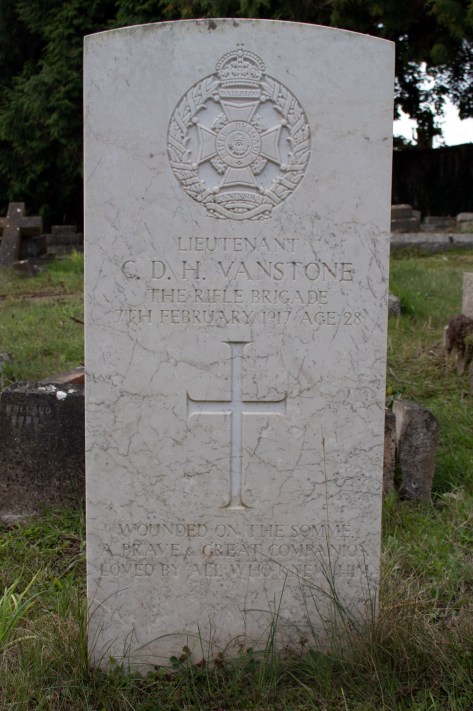
Lieutenant Charles Vanstone

Lieutenant Charles Vanstone

Charles Douglas Howard Vanstone was born in Paignton, Devon, on 27th October 1888. The fourth of seven children, he was the second son to Frederick and Charlotte Vanstone. Frederick was an architect’s surveyor and civil engineer, and the family lived comfortably in the seaside town.

The 1891 census found them living at Sorrento, a villa on Esplanade Road, overlooking the sea. By the time of the next census, they had moved to Torbay Park, and lived in a 12-room property. The family’s three sons all followed in their father’s trade, and, according to the 1911 return, four of the Vanstones were recorded as being civil engineer architects and surveyors.

When war came to Europe, Charles stepped up to play his part. He received a commission in August 1915 and, as a Second Lieutenant, was assigned to the Rifle Brigade. Attached to the 15th (Reserve) Battalion, the records suggest that he was in France by 23rd March 1916.

Lieutenant Vanstone seems to have been part of a Trench Mortar unit at the Somme. Wounded during the battle, he was medically evacuated to Britain for treatment. Admitted to the Reading War Hospital in Berkshire, his injuries were to prove too severe. Charles passed away on 7th February 1917: he was 28 years of age.

Charles Douglas Howard Vanstone’s body was brought back to Devon for burial. He was laid to rest in his home town’s sweeping cemetery.


Charles’ death was the third loss for the Vanstone family in as many years. His older sister, Constance, had died in 1914, while his younger brother, Stanley, a Lieutenant in the 20th Royal Fusiliers, died of wounds he received on the Western Front in October 1915. Just 25 years of age, he is buried in Merville Communal Cemetery, France.


Private Nicholas Paice

Private Nicholas Paice

Nicholas John Paice was born in the spring of 1867, the second of five children to John and Olive Paice. John was a railway policeman from Aldermaston in Berkshire, but his oldest son, Nicholas, was born in Poole, Dorset where Olive came from.

The Paice family seemed to move to wherever John’s work took him. The 1871 census found them living back in the Berkshire village of Shrivenham, while a decade later they were to be found in Longfleet, to the north of Poole. By this point, John was employed as a groom, and Olive a laundress.

When he completed his schooling, Nicholas found work as a butcher. He had also enlisted in the local militia, joining the 3rd Dorset Regiment. The army life seemed to suit him and, on 12th July 1886, he enlisted in the Rifle Brigade. His service records show that he was 5ft 7ins (1.7m) tall and weighed 148lbs (67.1kg). At 19 years and three months old, he was noted as having a fresh complexion, grey eyes and brown hair. The papers show that he had a scar on his left eyebrow, and tattoos on his forearms and the middle finger of his left hand.

Joining up for a period of twelve years, Private Paice would spend nearly seven of those in India and Burma. His time in the army was not without incident, however. Just three weeks after enlisting he deserted, and remained at loose for nearly a month. When he was captured, he was imprisoned for desertion for four weeks, his term of service extended to reflect the time he was AWOL.

In August 1896, having been back on home soil for just over two years, Nicholas was arrested again. Convicted of ‘begging’, he was confined for a week, before being released back to duty.

On 16th September 1898, Nicholas completed his contract, and was formally discharged from the army.

The next few years are a mystery for Nicholas. He had married Maria Andrews in 1896, and the couple would go on to have eight children, of which five would survive childhood. By the time of the 1911 census – the next document where we can pick him up – Nicholas and the family were living in two rooms at 2 New Corn Street, Bath, Somerset. Nicholas was working as a cattle drover, along with Maria, the household included her daughter Annie, and granddaughter Lily, and John and Maria’s son, Earnest.

When war came to Europe, Nicholas stepped up to play his part. He enlisted in the Somerset Light Infantry on 26th October 1915 but, with his age against him, he was transferred to the 263rd Coy. of the Royal Defence Corps the following April.

It seems that Private Paice’s health was also being impacted and he spend a month in the Red Cross Hospital in Portishead, having contracted influenza. Released to duty on 16th May 1916, just a month later he was re-admitted for three weeks, this time suffering from bronchial catarrh. On 10th September he was admitted to the hospital for a third time. This time it was identified that he had come down with pulmonary tuberculosis, and on 12th October 1916, he was formally discharged on medical grounds.

It is unclear what happened to Nicholas next. His service records suggest that he wasn’t immediately discharged from the Portishead hospital, and it seems likely that he would have returned home to Bath at some point. The next record for him is that of his passing, from tuberculosis, on 20th December 1919. He was 52 years of age.

Nicholas John Paice was laid to rest in the sweeping Locksbrook Cemetery in his adopted home town of Bath, Somerset.


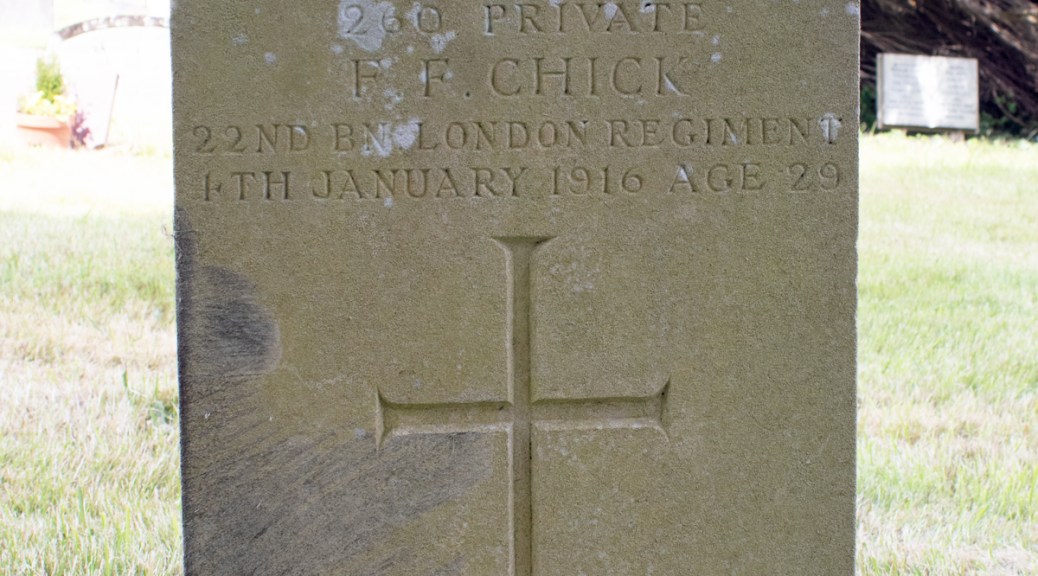
Private Francis Chick

Private Francis Chick

Francis Frederick Chick was born in the spring of 1886 in Axminster, Devon. One of eight children, his parents were brickmaker Edwin (or Edward) Chick and his wife, Elizabeth.

When he completed his schooling, Francis found work as a sawyer’s apprentice. However, he wanted bigger and better things and, on 19th November 1900, he enlisted in the army. At 14 years of age, he was just short of 5ft (1.52m) in height, and had fair hair, blue eyes and a fresh complexion.

Initially enlisting in the Royal Marine Light Infantry, Boy Chick was to serve three years in the naval division. The 1901 census found him based at the East Stonehouse Barracks in Devonport, Devon, where he was a Bugler.

In September 1903, Francis transferred across to the Devonshire Regiment, remaining within the band structure. He came of age in March 1904, and, as a Private, he took on the role of Drummer. By the start of 1909, his unit had moved overseas, and the next census, taken in 1911, found Private Chick billeted in St George’s Barracks in Malta.

Francis remained in Malta for three years, and moved to Egypt with his unit in January 1912. By this point, having completed nearly twelve years’ service, he elected to stay on and renewed his contract. While serving in North Africa, he completed his induction into the Camel Corps, although by the end of the year, he was back on home soil after nearly four years abroad.

At this point, Francis seems to fall off the radar. It is unclear whether his move back to Britain was because he had been placed on reserve status, or due to medical reasons. To add to the mystery, when war broke out, he did not re-join the Devonshire Regiment, but enlisted in the London Regiment instead. He was assigned to the 22nd (County of London) Battalion, but later records note a connection to the 22nd (Wessex and Welsh) Battalion of the Rifle Brigade.

Private Chick was in Buckinghamshire by the winter of 1915/16, and it was here that he became unwell. Admitted to hospital in Aylesbury, he died of pneumonia on 4th January 1916: he was 29 years of age.

The body of Francis Frederick Chick was taken back to Devon for burial. He was laid to rest in the cemetery of his home town, Axminster.


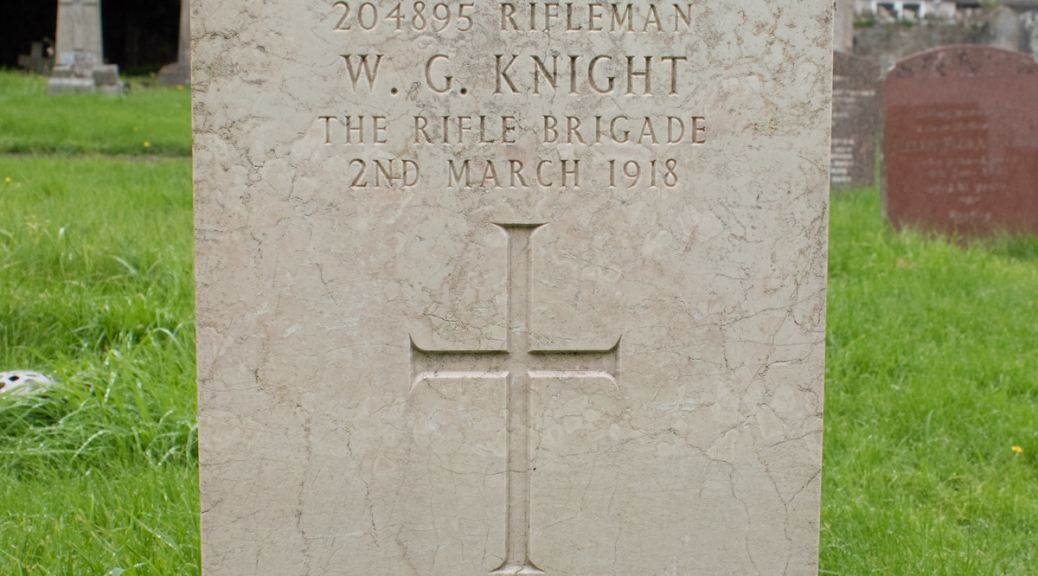
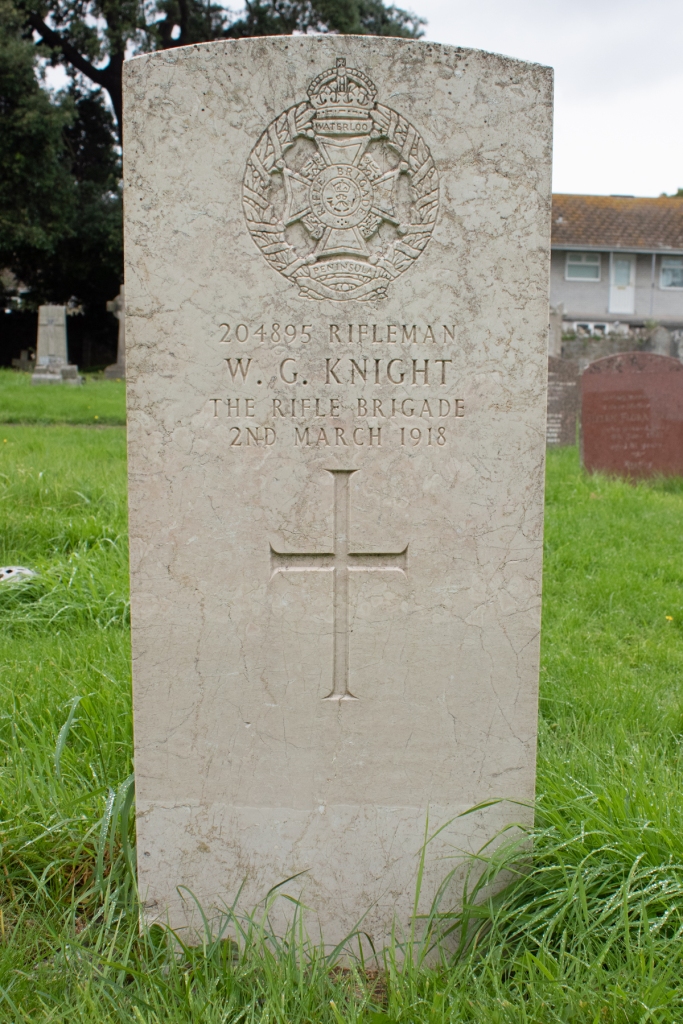
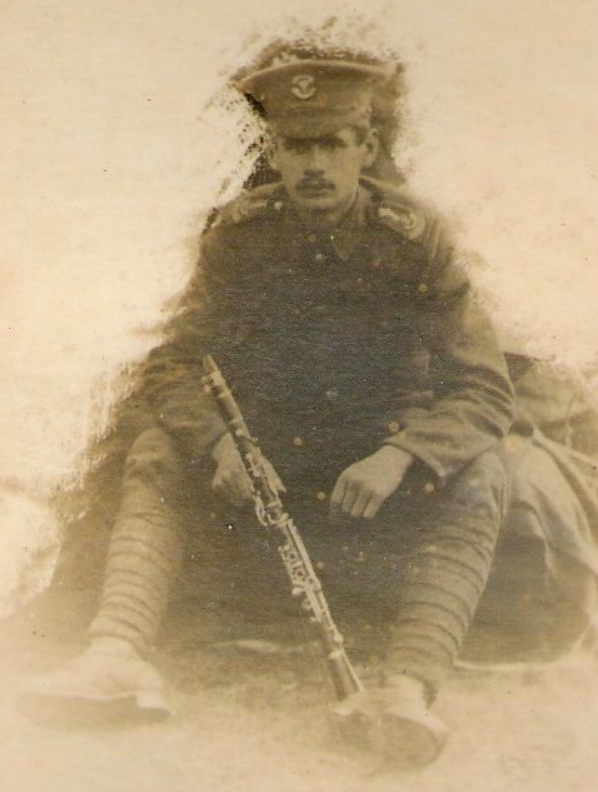
Rifleman Walter Knight

Rifleman Walter Knight

Walter George Knight was born on 27th December 1887 and was the older of two children to George and Mary. George was a gardener from London, Mary had been born in Devon, but it was in Weston-super-Mare, Somerset that they settled down to raise their family.

On 11th October 1910, Walter married Rosa Burford at St Saviour’s Church. While listed as a spinster, Rosa had two children by this point – Phyllis and Lionel. A later document records Walter as their stepfather, but their full parentage is unclear.

The marriage certificate notes Walter’s trade as a musician, but the following year’s census shows a more reputable trade, as he had taken to working as an insurance agent. He and Rosa had set up home in Cranleigh Road, Bridgwater, by this point, in a small terraced house they shared with the two children and Rosa’s widowed father, William.

By the summer of 1914, war was brewing over European shores, and Walter was quick to step up and support his country. He enlisted in the army on 14th October, joining the Somerset Light Infantry. He spent a year with the regiment, before transferring to the 22nd Wessex & Welsh Battalion of the Rifle Brigade.

By January 1916, Rifleman Knight found himself sailing for the Eastern Mediterranean, spending the next year in Egypt and Salonika. It was while he was overseas, in the spring of 1917, that he became ill and, having contracted tuberculosis, he returned to the UK.

Walter’s condition meant he was no longer fit for the army: he was formally discharged from the Rifle Brigade on 16th April 1917, having served for two-and-a-half years. He was admitted to the Cheddon Road Sanatorium in Taunton, the aim being to help manage his condition.

Rosa and the children had moved from Bridgwater by this point, settling in a small house in Ravensworth Terrace, Burnham-on-Sea. It is likely that Walter came here to visit the family during good spells in his health. The lung condition was to get the better of him eventually, however, and he passed away on 2nd March 1918, at the age of 30 years old.

Walter George Knight was laid to rest in the peaceful Burnham Cemetery, a short walk from where his grieving family lived.


Rifleman Walter Knight
(from findagrave.com)

Rifleman William Hooper

Rifleman William Hooper

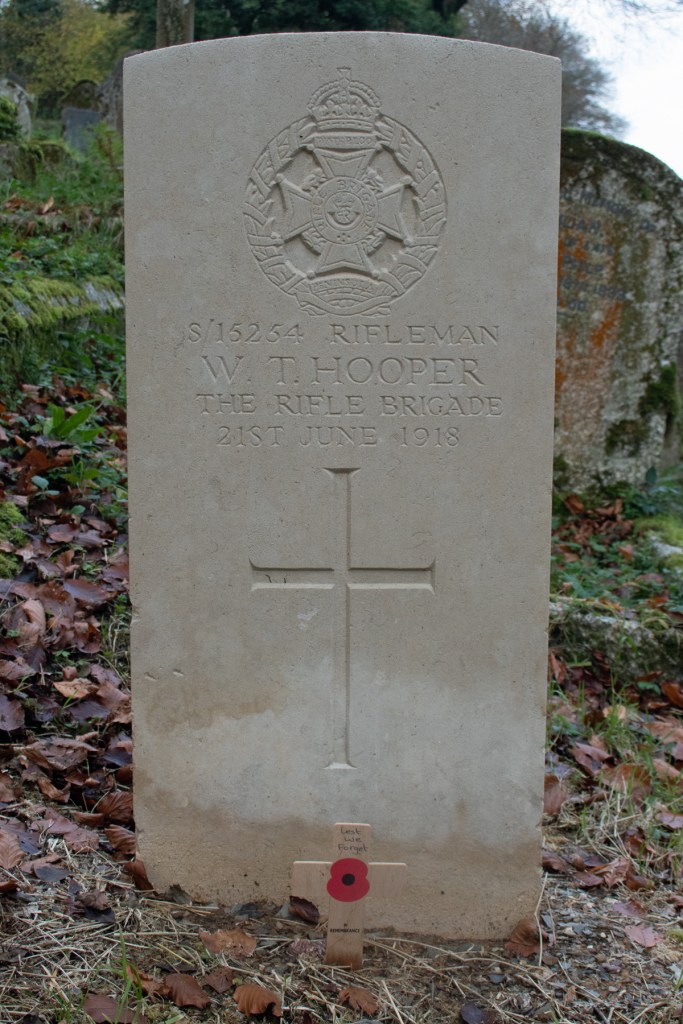
William Thomas Hooper was born in St Breock, near Wadebridge, Cornwall, in the summer of 1890. One of three children his parents were gardener William Hooper and his wife, Sarah.

When he left school, William Jr found work as a warehouseman and salesman, up in London, but when war broke out, he stepped up to play his part. He enlisted in December 1915, joining the Rifle Brigade, but was not formally mobilised for another couple of months.

Little detail of Rifleman Hooper’s military service survives, but records confirm that he was 5ft 6ins (1.68m) tall, and weighed 124lbs (56.3kg). It also notes that his left testicle had not descended, but that his condition was not severe enough for William to be refused for military service.

Rifleman Hooper’s was initially assigned to the 5th Battalion, based on the Isle of Sheppey, Kent, as part of the Thames & Medway Garrison. By the spring of 1916, however, he had been transferred to the 1st Battalion, and sent to France. He was involved in the Battle of Albert, and returned to the UK in August 1916 .

William appears to have been transferred back to the 5th Battalion and, in the spring of 1917, was hospitalised for three month, suffering from trench foot and rheumatism. By September that year, however, he was back with his unit.

Rifleman Hooper’s service documents become a little confused at this point. One record suggests that he was discharged from the army on 2nd January 1918 as being no longer medically fit for duty, while a second entry confirms that he passed away while on leave pending discharge.

Either way, William was back at home in St Breock when, on 21st June 1918, he passed away from a combination of pericarditis and pericardial effusion. He was just 27 years of age.

William Thomas Hooper was laid to rest in the wooded graveyard of St Breoke’s Church, in his home village.


An entry in the local newspaper confirmed that “Mr and Mrs Hooper and family… and Miss Ive Jones, London” [Cornish Guardian: Friday 18th June 1918] offered their thanks for the sympathy they had been shown in the bereavement. This suggests that, when he passed, William had been courting, his loss felt further.


Serjeant Albert Rumbelow

Serjeant Albert Rumbelow

Albert Edward Rumbelow was born in 1879 in Wycombe Marsh, Buckinghamshire. One of eleven children, his parents were Suffolk-born paper maker Philip Rumbelow and his wife, Jane.

Little information is available about Albert’s early life, although by the time of the 1901 census, he is recorded as being a Private in the Rifle Brigade. The family had moved to the village of Little Chart in Kent by this point, where his father was still continuing in the manufacture of paper.

Private Rumbelow’s military service is evidenced in later documents. He served with the 1st Battalion from 1895 to 1907, was awarded the South Africa medals for 1901 and 1902: he was also granted the clasp for his involvement in the defence of Ladysmith. He appears to have been wounded at this point, and was invalided out of full military service and placed on reserve.

In 1904, Albert was back in England, and living in London. That year he married Ellen Sillis, a cordwainer’s daughter from Norfolk. The couple set up home in Fulham, and went on to have five children: Abert Jr, Iris, Florence, Doris and Hilda.

By the time of the 1911 census, Albert was working at the local Public Hall, as a labourer, hall attendant and cleaner. The family were living at 9 Crabtree Lane in Fulham, sharing the property with the Fitzgerald family.

War was closing in on Europe by this point, and, once again, Albert stepped up to plat his part. He enlisted within days of conflict being declared, and within weeks had been given the rank of Corporal. His service records note that he was 5ft 10ins (1.78m) tall, weighed 156lbs (70.8kg), had brown hair and blue eyes. He was also recorded as having a tattoo of crossed rifles and a crown on his right forearm, and scared on his left calf, knee and eyebrow.

By the spring of 1915, Albert had been promoted again, to the rank of Serjeant. He was sent to France on 19th May, having been assigned to the 7th (Service) Battalion. Serjeant Rumbelow was involved at the Somme and was awarded the Distinguished Conduct Medal “for conspicuous gallantry” on 3rd June 1916. “He exposed himself to machine-gun and rifle fire when going across the open to rescue a wounded man. Later he went under fire to fetch a stretcher.”

Serjeant Rumbelow appears to have been injured in the skirmish, and was invalided to the UK later that month. When he recovered he was posted again, this time to the 18th (London) Battalion of the Rifle Brigade.

The following February he made the transfer across to the Labour Corps, and by March 1917, Serjeant Rumbelow was back in France. In August he was promoted to Company Sergeant Major, but was invalided back to England with bronchitis in February 1918.

When he recovered Albert was assigned to the 364th Area Employment Coy. in Kent, and seems to have voluntarily taken a drop in rank – back to Serjeant – in doing so. His health was dogging him by this point and in the late summer of 1918, he was admitted to Preston Hall Military Hospital in Aylesford, suffering from VDH, or heart disease.

Sadly, the strain of his military service was to be his undoing. He passed away from the heart condition on 21st September 1918, at the age of 39 years of age.

Albert Edward Rumbelow was laid to rest in the graveyard of St Peter & St Paul’s Church in Aylesford, not far from the hospital where he had breathed his last.


Now widowed, Ellen was left with the unenviable task of raising five young children on her own. She married again, to Private William Lake, on 8th June 1919, and the family moved to Essex. She lived until the age of 79, and was laid to rest in Sutton Road Cemetery in Southend.


Serjeant Frank Ely

Serjeant Frank Ely

Frank Harold Ely was born in November 1889, and was the oldest of four children. His parents were coal porter Frank Ely and his wife, Florence. They were both born in Kent, and raised their family in their home town of Faversham.

When Frank Jr left school, he found work as a bottler, but he had his eyes set on bigger adventures. In January 1908, at the age of 18, he enlisted in the 1st Battalion of the Rifle Brigade. His service records show that he was 5ft 5.5ins (1.66m) tall and weighed 109lbs (49.5kg). Rifleman Ely had brown hair, grey eyes and a fair complexion. He was also noted as having a scat on his right knee.

Rifleman Ely’s early service was wholly territorial, but not without incident: in 1909 he was treated for tonsillitis, two years later, he received treatment for syphilis.

He was also not one to toe the line. In August 1911, he was reprimanded for not appearing at the 6:30am parade. On 9th March 1912, he was severely reprimanded for ‘improper conduct in town, at about 11:35pm’. On 25th September 1913, he was reprimanded once again, this time for irregular conduct – using the officers’ latrines.

When war came to Europe, the Rifle Brigade were soon in the thick of it. On 26th August 1914, Frank was wounded in the hand during fighting at Ligny, France, and was then captured and held as a prisoner of war in Hamelin until the spring of 1918.

Moved to the Netherlands, Rifleman Ely was finally released after the Armistice was signed, and returned to England on 19th November 1918. He was demobbed the following March, but re-enlisted within weeks, was given the rank of Serjeant and was due to be shipped to India to continue his service.

However, while at an army camp in Aldershot, Frank contracted pneumonia. The struggles the previous few years had had on his health proved too much for him, and, on 26th August 1919 – five years to the day that he had been shot and captured – Serjeant Ely passed away. He was 40 years of age.

Frank Harold Ely was brought back to his home town for burial. He was laid to rest in Faversham Borough Cemetery.


Rifleman Frederick Burstow

Rifleman Frederick Burstow

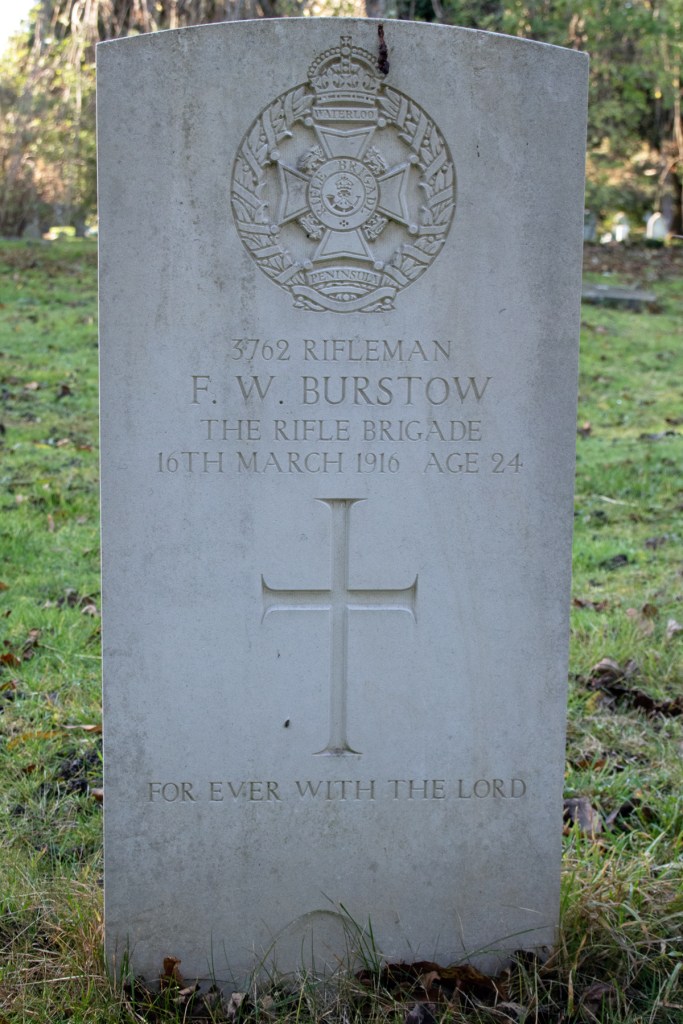
Frederick William Burstow was born in the summer of 1893, and was one of thirteen children. His parents were plasterer Alfred Burstow and his wife, Lydia. Both came from Sussex, and it was in Bexhill-on-Sea where they raised their family.

There is little documented about Frederick’s early life, but he sought a life outside of Sussex and, in around 1900, he enlisted in the 2nd Battalion of the Rifle Brigade, serving in India for a time.

Rifleman Burstow was still serving when, in August 1914, war was declared. His battalion was sent to France that November, and he ended up serving two terms on the Western Front.

In the summer of 1915, Frederick married Priscilla Epps. She was from Faversham, Kent, and this is where the couple set up home together.

It was while on his second term in France that Rifleman Burstow became ill. He had contracted enteric fever – also known as typhoid – and, at the beginning of 1916, he was sent home to recuperate. While here, Priscilla gave birth to a child, Alice.

Sadly, however, Frederick’s condition was to get the better of him: he passed away at home on 16th March 1916, at the age of just 24 years old.

Frederick William Burstow was laid to rest in the Borough Cemetery in his adopted home town of Faversham.


Rifleman Frederick Burstow
(from ancestry.co.uk)

Frederick was not the only Burstow family member to die during the war. His older brother, Arthur Edward James Burstow, fought on the Western Front with the 2nd Battalion of the London Regiment.

Private Burstow was caught up in the fighting in Arras in the spring of 1918, and was killed in action on 13th April. He was 38 years of age, and left behind a widow and six children.

Arthur Edward James Burstow is commemorated on the Ploegsteert Memorial in Belgium.


Rifleman George Hill

Rifleman George Hill

George Hill was born in Castle Cary, Somerset, in 1868. Documents relating to his early life are hard to pin down and, as his is a common name, it is not possible to identify any parental relationships.

The first document that can be categorically connected to George is the 1891 census. This confirms that he was living in his home town, and was married to a woman called Ellen. The couple had a year-old daughter, Elsie, and were both employed as horsehair workers, getting the material ready for use in upholstery.

It seems that Ellen must have died soon after the census as, in the autumn of 1893, he married Florence Cave, a stonemason’s daughter, who was also from Castle Cary. The 1901 census finds George and Florence living with Elsie, but with two children of their own, Laura and Edward.

By the time of the following census, in 1911, the family had grown again, with two more children, Percy and Doris. George’s eldest daughter was, at this point, working as a housemaid for a family in Winchester, while Laura was employed as a tailoress. George himself was still working as a horsehair curler, a trade he had been in for more than twenty years.

War was on its way, and despite being in his mid-forties, George appeared to have been keen to play his part. Full details are not available, but it seems that he had enlisted by May 1918, initially joining the Somerset Light Infantry, where he was assigned to the 4th Battalion. He was soon transferred over to the Rifle Brigade, however, and was attached to the 22nd (Wessex and Welsh) Battalion.

This particular troop initially served on home soil but was sent to Salonika in the Eastern Mediterranean in 1916. There is nothing in Rifleman Hill’s records to suggest that he went with them, however, and it may be that he had not yet enlisted at this point in the conflict. His medal records show that he was awarded the Victory and British Medals, but that these were for his territorial work, rather than anything overseas.

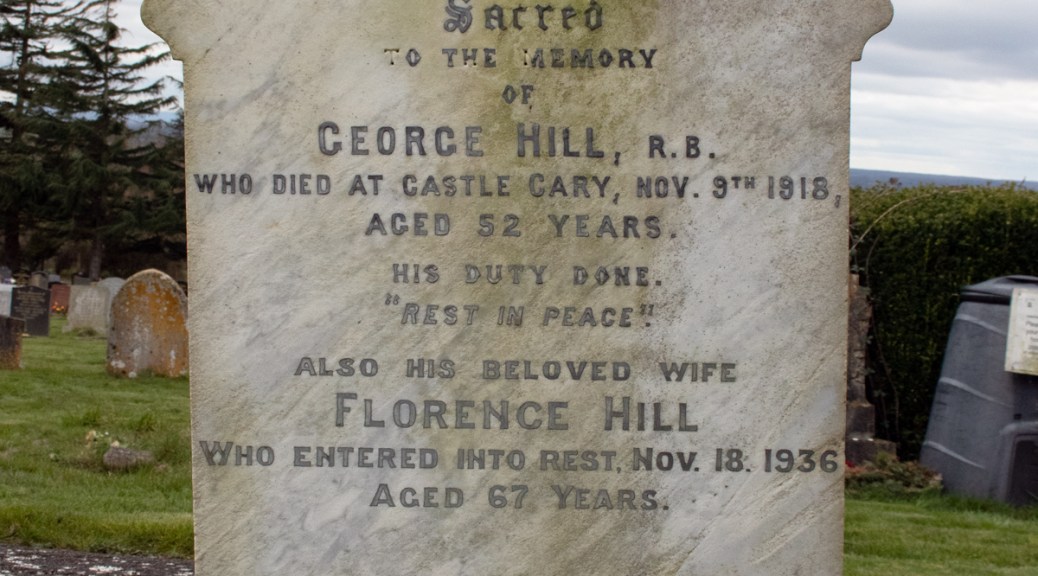
Rifleman Hill served until near the end of the war. He had returned home by November 1918, and it was here, on the 9th, that he passed away from pneumonia. He was 52 years of age.

George Hill was buried in the cemetery of his home town, in the family plot. Florence was also laid to rest there, some eighteen years later, husband and wife together again at last.


Lance Corporal Francis Hawkins

Lance Corporal Francis Hawkins

Francis Moreton Hawkins was born in Cottingham, Northamptonshire on 15th July 1895. He was the eldest of eight children to Francis and Louisa Hawkins. Francis Sr was a butcher and, by 1905, he had moved the family to Taunton, where he set up a ship on the main shopping street in the town.

When Francis left school, he became a clerk for the business; he went on to take civil service exams, gaining employment in the General Post Office and then Customs & Excise. War was looming, however, taking him in a different direction.

Sadly, a lot of Francis’ military records no longer exist. What the records do tell us, though, is that he initially enrolled with the Somerset Territorials in October 1914, transferring first to the Civil Service Rifles and then the Rifle Brigade. He served his term in the army, rising to the rank of Lance Corporal.

When the war came to a close, Lance Corporal Hawkins was placed on furlough while he waited to be demobbed, and returned home on 19th November 1918. Feeling unwell, he took straight to his bed, and, three days later, was admitted to the Military Hospital in Taunton with influenza and pneumonia.

Tragically, these were to get the better of him; Francis passed away at the hospital on 23rd November 1918. He was just 23 years old.

Francis Moreton Hawkins lies at rest in St Mary’s Cemetery in his home town of Taunton.