Tag Archives: Royal Army Service Corps

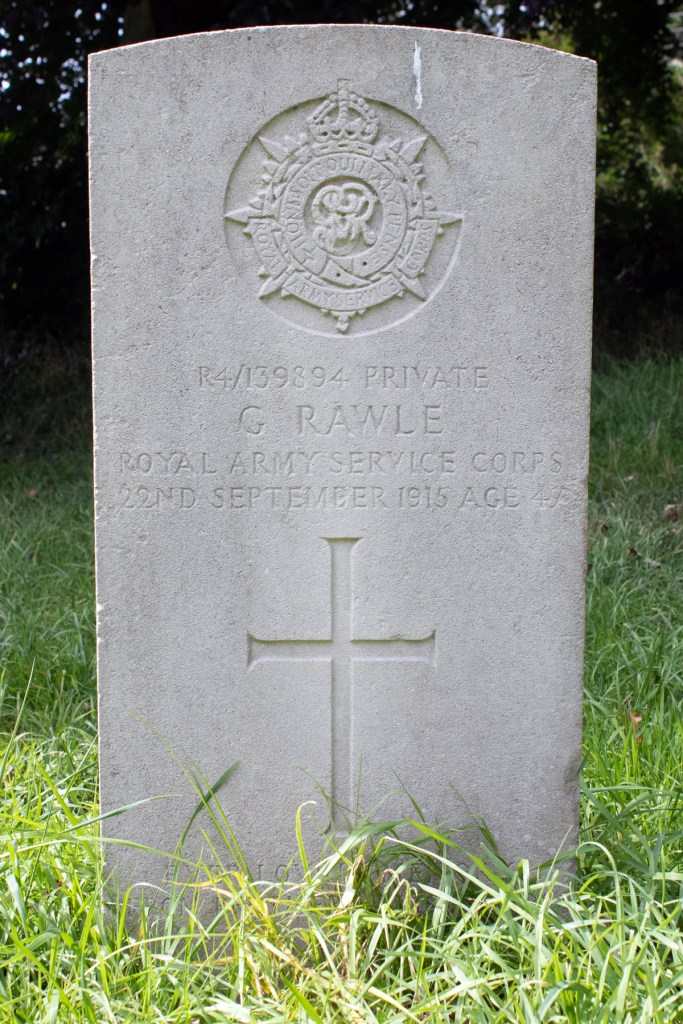
Private George Rawle

Private George Rawle

George Rawle was born on 26th April 1867 in the Somerset village of Milverton. One of nine children, his parents were William and Ann. William was a shepherd turned general labourer and, when he first finished his schooling, George was sent north to Nether Stowey, where he worked as a stable boy at Castle Hill House.

The 1891 census found George back living with his parents, who had moved to Milverton, presumably following William’s work. George, by this time, was employed as a domestic groom, although the next census found both him and William – now 74 years of age – working as general labourers.

William died in 1902, and Ann passed away seven years later. By 1911, George had moved just up the road to Wiveliscombe. He was living in a four-roomed cottage and employed as a jobbing gardener. He shared his home with two of his sisters: Jane was 46 years old and working as a housemaid; Alice, 33 years of age, was a housekeeper.

When war came to European shores, George felt the need to step up and play his part. He joined up at an enlistment drive at the brewery in Wiveliscombe, and was assigned to the Royal Army Service Corps as a Private. While waiting for his medical he returned to the home he shared with his sisters. It was here, just five days later, that he ended his life.

A painful sensation was caused in Wiveliscombe on Wednesday morning, through the action of Priv. George Rawle, of the E Squadron, Somerset Mule Depot, who took his own life under distressing circumstances at his residence at Higher Nunnington.

Deceased… had been restless through the night, and about five o’clock in the morning he told his sister he was going to get up to write a letter. The sister begged him to put his clothes on, but he would not do so, and went downstairs. She followed him in her nightdress. He picked up a gun in the hall, and she tried to take it away from him, but failed. Rawle went out to the path in front of the door of the house. His sister took hold of his arm, but he wrenched himself away, put the muzzle of the gun in his mouth, pulled the trigger, and fell down beside her, having blown out his brains.

Dr WH Randolph was in attendance shortly after, but could only pronounce life extinct.

The inquest took place on Friday, before Mr Foster Barham, coroner for West Somerset.

Jane Rawle, deceased’s sister, said her brother had suffered from nervous depression for many years, and seventeen years ago was a patient at Cotford Asylum. Lately he had been worried about the house in which he lived.

Taunton Courier and Western Advertiser: Wednesday 29th September 1915

The jury at the inquest returned a verdict of suicide while of unsound mind. George was 48 years of age.

George Rawle was laid to rest in the quiet graveyard of St Andrew’s Church, Wiveliscombe. His estate was shared between two of his sisters, Jane and Hannah.


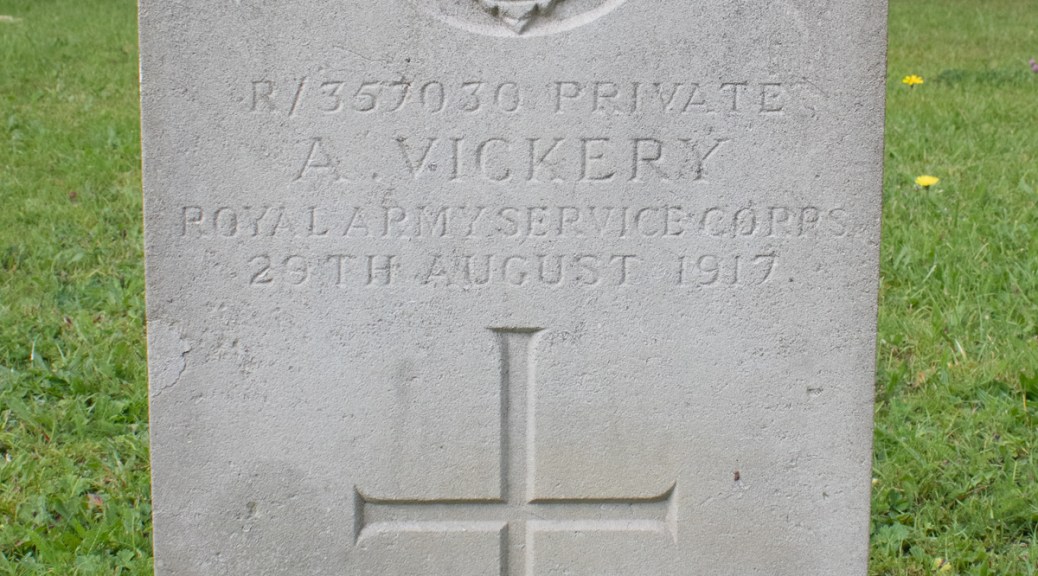
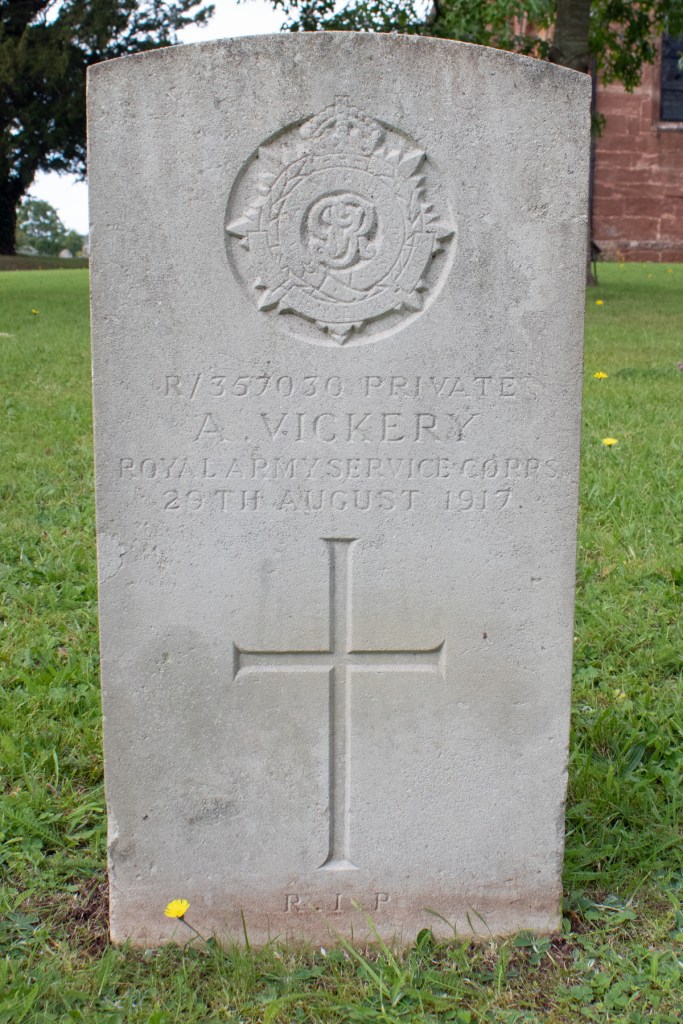
Private Amos Vickery

Private Amos Vickery

Amos Vickery was born in the autumn of 1886 in Bishops Lydeard, Somerset. He was the youngest of six children to William and Annie Vickery. William was a farm labourer, but when he finished his schooling, his son found work as a groom.

On 23rd February 1909, Amos married Alice Gratton. She was the daughter of a farm labourer from Halse, Somerset, who had taken up domestic duties in Bishops Lydeard. Not long after they were married, Amos took up new employment as publican of the Tynte Arms Inn in Enmore, and this is where he and Alice brought up their two children, Evelyn and William.

Amos’ time as a landlord seems not to have lasted long. By the time war broke out, the family had moved to Wiveliscombe, where he was working as a postman. Amos stepped up to play his part for King and Country, but was initially rejected. There are no longer any documents to confirm why this was the case, but it may have been based on any medical carried out.

Amos was finally accepted for armed service in June 1917, and was assigned to the Royal Army Service Corps. Private Vickery was attached to the Remounts Unit, and seems to have been posted around Bristol, Gloucestershire.

On Monday afternoon last the funeral took place… of the late Private Amos Vickery, ASC, who died somewhat suddenly from paralysis… at No 2 General Hospital, Bristol, at the age of 31, after a few days’ illness.

Taunton Courier and Western Advertiser: Wednesday 12th September 1917

Private Vickery’s service documents gave an official cause of death as hemiplegia and cerebral thrombosis: in effect, a stroke. He had been in the army for just ten weeks.

Amos Vickery was laid to rest in the graveyard of St Mary’s Church, Bishop’s Lydeard.


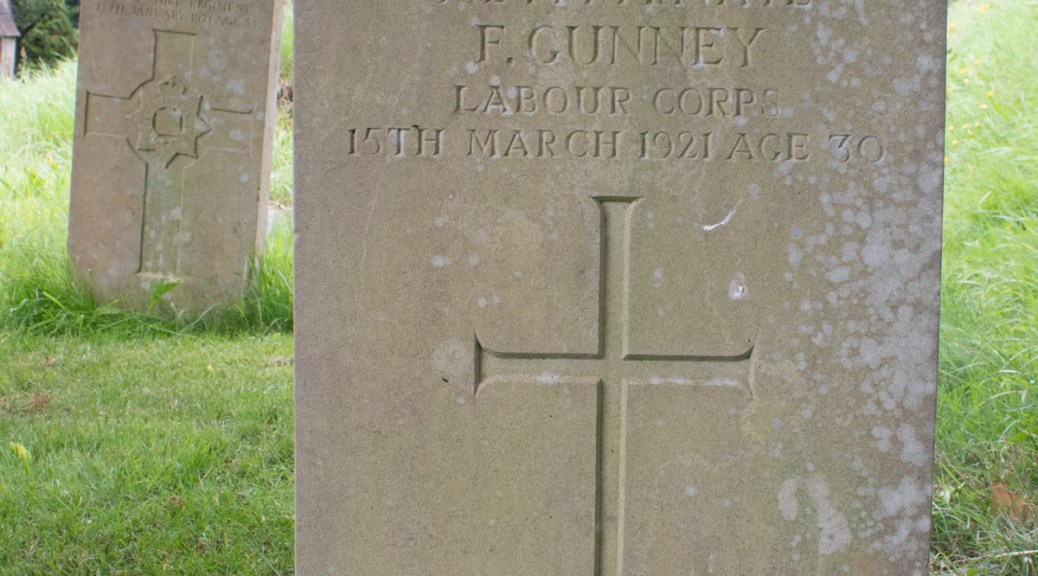
Private Frank Gunney

Private Frank Gunney

Frank Gunney was born in Brushford, Somerset, in the spring of 1890. The youngest of four children, with two sisters and a brother, his parents were William and Mary. William was a groom-turned-gardener, but when Frank left school, he found other employment: by the time of the 1911 census, he was recorded as being a tailor.

Frank’s older brother, James, followed his father’s trade, becoming a groom when he finished his schooling. His work took him to South Wales, where he met and married Emma Lewis. The couple went on to have two children: Hilda and Kenneth. When war came to Europe, James enlisted, joining the Royal Army Service Corps as a Private.

Frank followed his brother into the army, enlisting in the Somerset Light Infantry on 11th December 1915. This must have proved a tragic time for his mother, Mary, as, just ten days later, William died “after a long and painful illness.” [Western Times: Friday 24th December 1915]

Frank’s service records give little away about the man he had become, but do note that he was 5ft 5ins (1.65m) tall. He was re-assigned to the 1st/21st Battalion of the London Regiment, and was sent to France in June 1916.

Private Gunney’s service papers suggest that he was injured on 9th September 1916, having received a gun shot wound to the head. He appears to have been treated on site, and there seems to be no notable break in his time on the front line.

James was killed in action on 7th April 1917: he was 33 years of age, and was laid to rest in the Warlincourt Halte British Cemetery in Saulty. Mary had lost a husband and a son within eighteen months, and James had left a widow and two children.

In March 1917, Private Frank Gunney had transferred to the Labour Corps, and aside from a six-month period on home soil, would remain in France until September 1919. He then returned to Britain, and was demobbed a month later.

Frank returned to Somerset, but his trail then goes cold. Two documents give an idea as to what happened next, however. The first is a newspaper report about his burial:

The funeral took place in All Saints’ Churchyard, Dulverton… of Mr F Gunney, only don of Mrs Gunney… who died on Tuesday last. Deceased served three years in France, and has been in failing health practically ever since demobilisation, although the end came rather suddenly.

Western Times: Tuesday 22nd March 1921

His army Pension Ledger Card, confirms that he had been discharged from the army because of a ‘septic wound to his left thumb’, which was due to his military service. It appears that this had festered over the ensuing years: Frank Gunney passed away on 15th March 1921, aged 30 years of age.


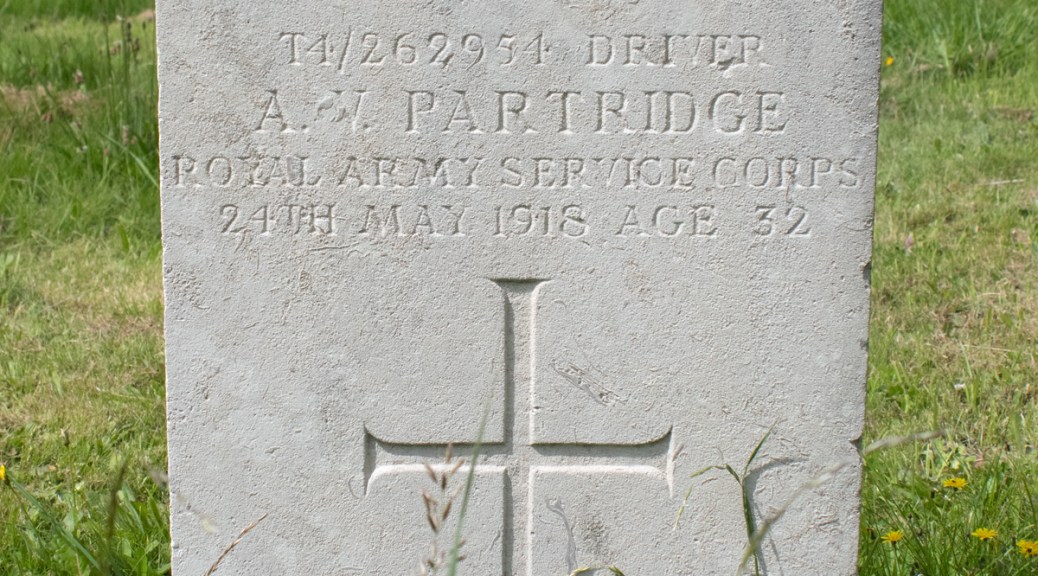
Driver Albert Partridge

Driver Albert Partridge

Albert Victor Partridge was born in the spring of 1885, in the north Somerset village of Abbots Leigh. The younger of two children, his parents were agricultural labourer James and his laundress wife, Elizabeth.

The family don’t appear on any surviving 1891 census records, but by the next return in 1901, James had been widowed and was living with his two children in Wraxall, near Nailsea. James was working as a carter on a farm, while Albert was employed as a domestic gardener.

Ten years later, and James had also passed away. Albert was now head of the household, and was working as a carter as his father had. Emily was sharing the home, and was employed, in the terminology of the day, as her brother’s housekeeper.

When war broke out, Albert was called upon to play his part. Details of his service are scant, but he joined up as a Driver in the Royal Army Service Corps and was attached to one of the Horsed Transport units. It is unclear whether he served on the home front or overseas, but what records remain suggested that he had enlisted by November 1917.

Driver Partridge was admitted to a hospital in London in May 1918. The only suggestion as to why comes through his Pension Ledger Card, which simply says ‘disease’. The condition was severe enough for him to pass away: Albert died on 24th May 1918, at the age of 32 years old.

Albert Victor Partridge was brought back to Somerset for burial. He was laid to rest in the peaceful grounds of All Saints’ Church in Wraxall.


Emily disappears from records at this point. She was 38 years old when her brother died, and it is unclear what became of her.


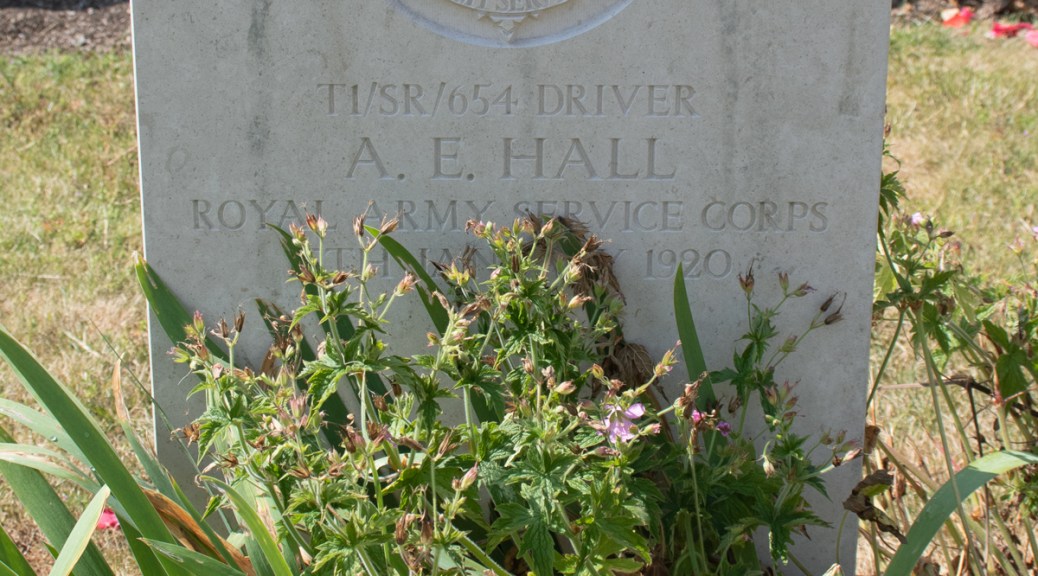
Driver Albert Hall

Driver Albert Hall

The life of Albert Edward Hall is a challenging one to unpick. His headstone, in Bath’s Locksbrook Cemetery, confirms that he was a Driver in the Royal Army Service Corps, and passed away on 15th January 1920.

Driver Hall’s service records confirm that he enlisted in Gloucester on 21th September 1914, at which point he was 45 years of age. He was born in Bristol, stood 5ft 6.5ins (1.69m) tall and weighed 172lbs (78kg). He had blue eyes and brown hair. The only next of kin that Albert recorded were two brothers, Arthur and Alfred, although their addresses were not known.

Driver Hall was sent to France within a couple of weeks of enlisting. He became attached to the 23rd Field Ambulance Unit, and, barring leave, remained on the Western Front for the next four-and-half years. His service appears to have been impeccable, although in August 1918, he docked a week’s pay when he returned back to the unit a day late following a period of leave.

In June 1919, having been back on home soil for a month, Albert was discharged from the army. This seems to have been partially on medical grounds, as his records suggest he was suffering from heart disease.

At this point, Albert’s trail goes cold. He may well have returned to Bristol, but by the start of 1920 it is likely that his health was failing. He was admitted to the Pensioner’s Hospital in Bath, Somerset, and it was here that he breathed his last. He was 50 years of age.

Albert Edward Hall was laid to rest in the sweeping visa on the city’s Locksbrook Cemetery.


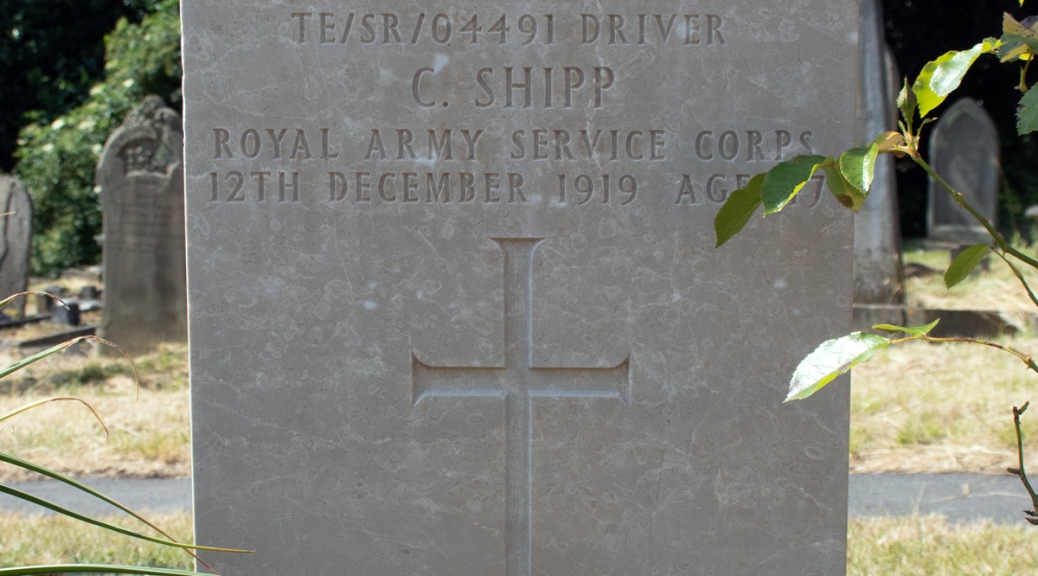
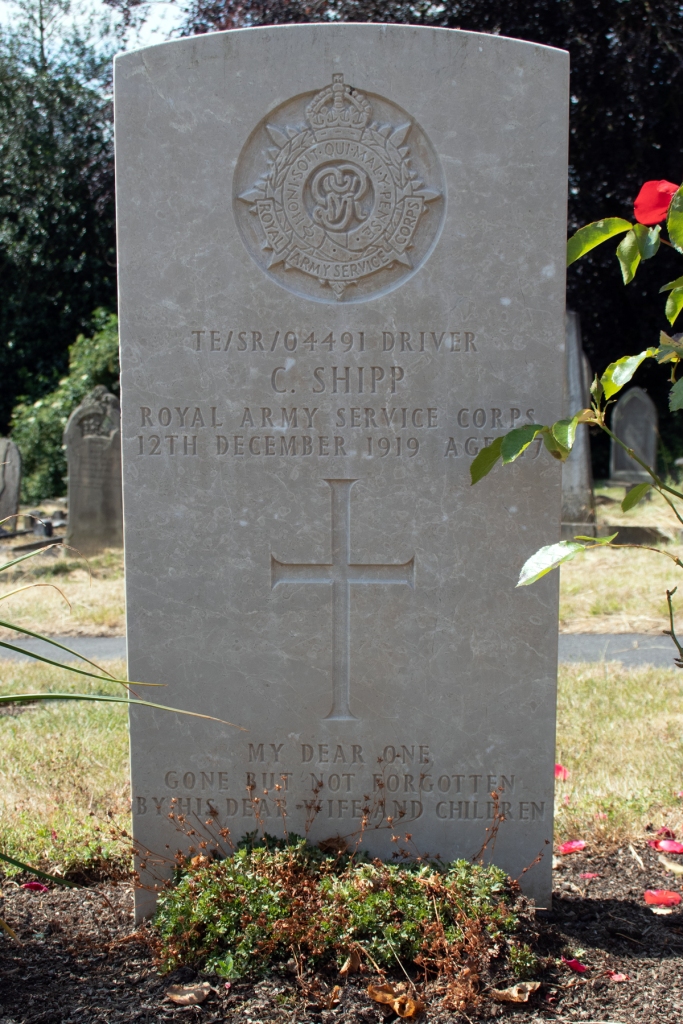
Driver Charles Shipp

Driver Charles Shipp

The early life of Charles Shipp is a challenge to unpick. Born Charles Morgan in Bath, Somerset, in 1872, his father was also called Charles. He found work as a labourer when he finished school.

Charles sought a life of adventure, however, and on 7th January 1890, he enlisted in the army, joining the South Wales Borderers. Private Morgan’s service records show that he was 5ft 5.5ins (1.66m) tall and weighed 116lbs (52.6kg). He had brown hair, grey eyes and a fresh complexion, with tattoos of crossed flags, a crown and VR on his left forearm.

Private Morgan spent three years on home soil, and is recorded as being based in North Camp Barracks in Farnborough, Hampshire, in the 1891 census. His battalion was sent to Egypt in December 1892 and spent the next three years overseas, moving to Gibraltar in the spring of 1895. The only details available for his time abroad relate to a couple of hospital admissions – for a fever in Cairo in August 1894, and for gonorrhoea in Gibraltar in the autumn of 1895. He returned to Britain at the end of November that year.

Charles appears to have been based in South Wales when he returned home and, on 20th December 1896, he married Lottie Walters in Llandough Parish Church. Interestingly, while the new bride’s father’s details are recorded – naval pensioner James Walters – Charles’ have been intentionally left blank. This is also the first document on which his surname is recorded as Shipp, so there seems to have been a deliberate distancing from his family at this point.

Charles was still committed to his military career. He served on home soil until January 1897, when he was placed on reserve, having completed seven years’ service. This respite was not to be for long, however, as he was recalled on three years later, and sent to South Africa, to fight in the Second Boer War.

Private Shipp, as he was now known, served in South Africa for more than two years, and was awarded the Johannesburg, Cape Colony, 1901 and 1902 clasps. In August 1902, he returned to Britain, and was formally stood down from army service.

Charles and Lottie moved to Bath, and set up home in a small cottage in Locksbrook Road. They went on to have seven children, all of them girls and, by the time of the 1911 census, Charles was working as a carter for the local gas works. His heart seems always to have been with his military career, however, and, when war broke out in 1915, he saw this as an opportunity to play his part once more.

On 25th October 1915, Charles enlisted in the Royal Army Service Corps as a Driver. His was not to be a war fought on home turf, and within a month, he was in the Mediterranean, potentially back in Egypt again. In April 1916, his battalion moved to Salonika, and he spent the next three years in Northern Greece.

Charles contracted malaria in the autumn of 1917, and this resulted in a hospital admission for just over two months. He returned to his unit, but spent another couple of months in a Macedonian hospital the following year when the condition recurred.

Driver Shipp survived the war, and returned to Britain in April 1919. His health was again suffering, and he was formally discharged from the army on medical grounds on 29th April.

At this point, Charles’ trail goes cold. He returned home to Lottie and their daughters, but there is nothing to account for the the last eight months of his life. He passed away on 12th December 1919, at the age of 47 years of age.

Charles Shipp was laid to rest in Bath’s majestic Locksbrook Cemetery, not far from where his family lived.


Shoeing Smith Samuel Treeby

Shoeing Smith Samuel Treeby

Samuel Treeby was born in December 1865 in Taunton, Somerset. The third of seven children, his parents were cordwainer Thomas Treeby and his wife, Anna (or Hannah).

When he finished his schooling, Samuel found work as a blacksmith at a collar factory in Taunton. His trade stood him in good stead away from the forge: he volunteered for the Royal Horse Artillery, becoming adept at shoeing the animals.

In 1906, Samuel married Sarah Parker. She was from Enmore, between Bridgwater and Taunton, although the couple married in Cardiff, Glamorgan. The couple settled back in Enmore, where Samuel continued his smithing trade.

War came to Europe in 1914 and, although he was 49 years old, Samuel stepped up to play his part. He was attached to the Royal Army Service Corps and given a rank that echoed his civilian profession, that of Shoeing Smith. His service records show that he was of average height – 5ft 6ins (1.68m) tall – but that he was illiterate: he signed his declaration with a cross.

Samuel spent several months on home soil, before being sent out to France in March 1916. He spent six months overseas, before being shipped back to Britain, suffering from rheumatism. Shoeing Smith Treeby was admitted to the East Leeds War Hospital before being discharged to the regiment’s Remount Depot in Woolwich, Kent.

Samuel returned home to Somerset, but his poor health still dogged him during the winter of 1916/17. He contracted bronchitis, and died of the condition on 27th February 1917, while still based in London. He was 51 years of age.

Samuel’s body was taken back to Somerset for burial. He was laid to rest in the peaceful graveyard of St Michael’s Church in Enmore, not far from where his widow still lived.


Private Percy Kitch

Private Percy Kitch

Percy Kitch was born in the spring of 1897 in Northmoor Green, to the south east of Bridgwater, Somerset. His parents were Francis and Mary Jane Kitch, and he was the youngest of their eight children. Francis – who was better known as Frank – was a farm labourer, and this is something that Percy and his siblings went into when they finished their schooling.

When war broke out, Percy was called upon to play his part, and enlisted in the Royal Army Service Corps as a Private. Unfortunately, little information still exists about his life at this time and, in fact, only one document – his pension ledger card – remains to confirm details of his service.

The card confirms that Private Kitch was attached to the Remount Service, and that he passed away on 31st October 1918, having contracted influenza. He was just 21 years of age. The document gives his mother, Mary Jane, as a dependent, and details the army pension she was awarded after his passing: 5 shillings per week, for life.

Percy Kitch was laid to rest in the peaceful graveyard of St Peter & St John’s Church in his home village of Northmoor Green.


Private William Lye

Private William Lye

William Harry Lye was born in Ilchester, Somerset, in the spring of 1875. The middle of five children, his parents were agricultural labourer Charles Lye and his wife, Sarah. Over the years, Charles found additional work as a groom and, by the time of the 1901 census, this is what William turned his hand to as well.

On 8th April 1901, William married Elsie Drayton, who was from Bishops Lydeard, to the west of Taunton. Elsie was the daughter of a labourer, and the couple married in St Mary’s Church her home village. The couple set up home in nearby Kingston St Mary, and went on to have two children, Herbert, who was born in 1902, and Reginald, who came along six years later.

When war came to Europe, William was called on to play his part. His service records are lost to time, but from what remains it is possible to confirm that he enlisted in the Royal Army Service Corps. His peacetime experience with horses made him an ideal candidate for the Remount division, and he was assigned to the 75th Squadron.

Private Lye survived the war, and by early 1919, was placed on furlough to await being demobbed. His trail goes cold at this point, and the last record for him is that of his passing, through causes unknown, on 24th May 1919. He was 43 years of age.

William Harry Lye was laid to rest in the quiet graveyard of St Mary’s Church, in Kingston St Mary, not far from where Elsie and the children still lived.


Major Montgomerie Boyle

Major Montgomerie Boyle

Montgomerie Boyle was born on 20th March 1859 in Hendon, London. The youngest of three children, his parents were John and Jane Boyle. John was a barrister, and the family lived in some comfort – the 1861 census found them living in a house in Harrow, Middlesex, with four live-in servants and a groom.

[Montgomerie] joined the South Notts Yeomanry 22 years ago. Subsequently he obtained an appointment at Weston-super-Mare, under the Somerset Territorial Force Association, and did much useful work in co-ordinating the Army Service Corps in the county.

Taunton Courier and Western Advertiser: Wednesday 2nd April 1919

In the spring of 1891, Montgomerie married Constance Smith. She was a banker’s daughter from Nottingham, and the couple tied the knot in Basford, now a suburb of the larger city. They went on to have a daughter, Marion, who was born the following year.

By the 1901 census, the young family had moved to Timsbury, Somerset. Montgomerie was recorded as living on his own means, and the family had a retinue of servants to support them. A decade later, they had moved into the manor house in Staple Fitzpaine, Somerset. Montgomerie was now listed as a Captain in the Army Service Corps.

Storm clouds were gathering over the continent and, when war broke out, Captain Boyle was called back into active service.

…he was stationed with his Regiment on the East Coast for twelve months, and then went to France, where he remained for six months. He was re-called for service with the Mechanical Transport Section of the Army Service Corps in German East Africa, contracted malaria at the end of fifteen months and was invalided home. On his recovery he was despatched to the Egyptian front, and was with the British troops in Jerusalem. He became ill while there, and, on going down to the base at Cairo, was for a month in the Citadel Hospital, where he was treated for a malignant disease. By slow stages, first in a hospital ship, then in a Red Cross train through France, he was conveyed to [Le] Havre. Here, curiously enough, the doctor in charge of the hospital ship upon which he was placed happened to be… an old friend and medical attendant. Major Boyle landed at Southampton, and went immediately to the 3rd London General Hospital at Wandsworth [Surrey], where he was examined by an eminent specialist. His condition was serious but on Monday week last he arrived at his old home, where, despite the devoted care of his wife and daughter, he passed away quietly.

Taunton Courier and Western Advertiser: Wednesday 2nd April 1919

Major Montgomerie Boyle passed away on 27th March 1919, a week after his sixtieth birthday. He was laid to rest in the quiet graveyard of St Peter’s Church, on the outskirts of the grounds of the manor house the Boyles had made their home ten years before.

When Constance died ten years later, at the age of 70 years old, she was laid to rest in the family plot, reunited with her late husband once more.


Major Montgomerie Boyle
(from findagrave.com)