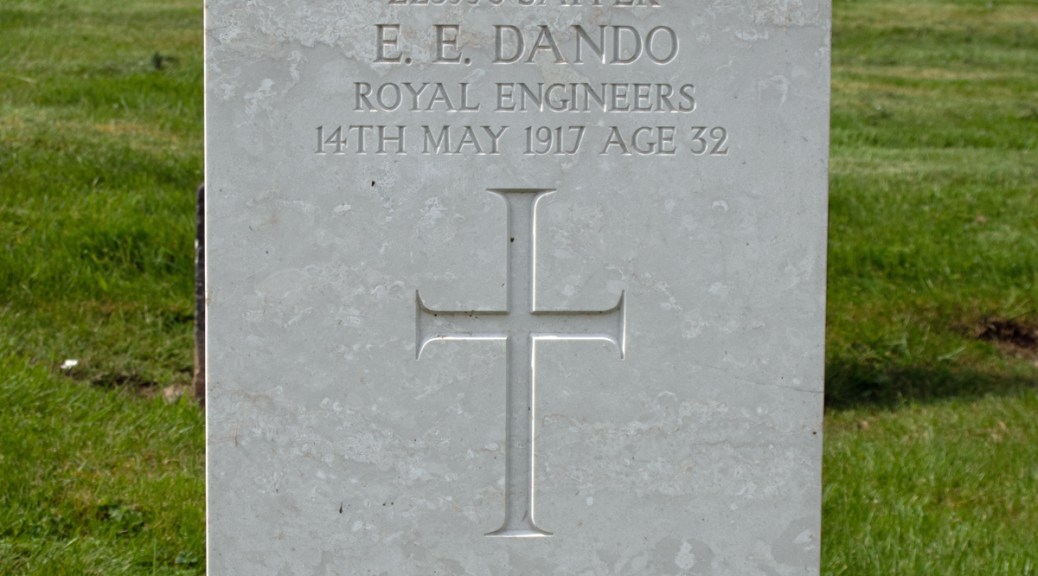
Ernest Edward Dando was born in November 1884, in Paulton, Somerset. One of eight children, his parents were Hezekiah and Emma Dando. Hezekiah was a shoemaker from the town and this is a trade into which Ernest followed when he left school and through to the outbreak of war.
On 20th December 1914, Ernest married bootmaker’s daughter Emma Elizabeth Elliott in Paulton’s Holy Trinity Church. With war raging across Europe by this point, it would eventually come to Ernest’s door, however, and, in January 1917, he enlisted in the Royal Engineers as a Sapper.
There is little documentation available about Ernest’s military life, although it is evident that his boot making skills were employed by the army. He was sent to Bangor, North Wales, for training, but contracted pneumonia while he was there. Admitted to a military hospital in the area, he passed away from the lung condition on 14th May 1917, at the age of 32 years old.
Ernest Edward Dando’s body was brought back to Somerset for burial. He was laid to rest in the picturesque Paulton Cemetery near the heart of the town.
Sapper Ernest Dando (from britishnewspaperarchive.co.uk)
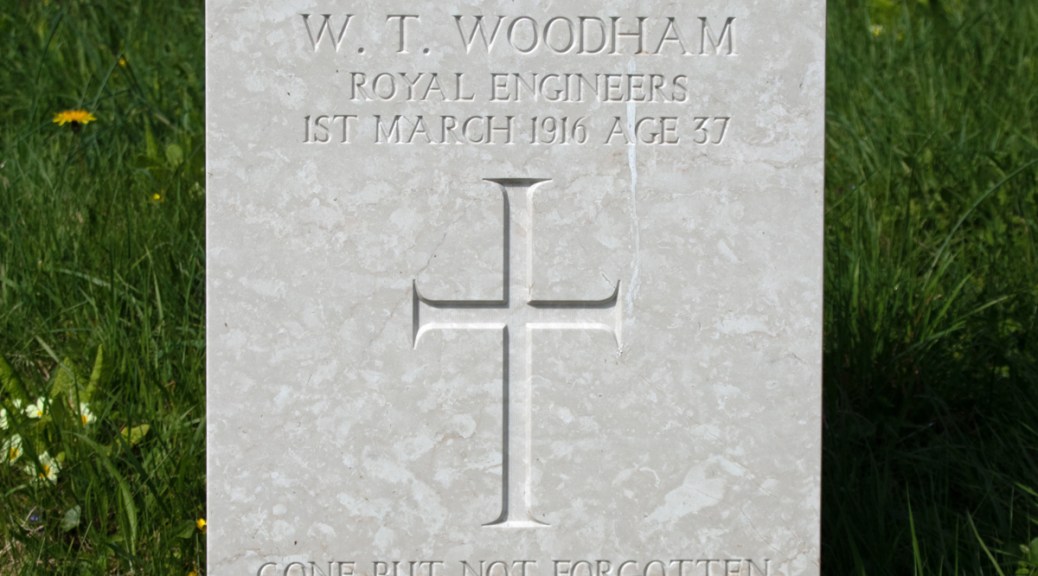
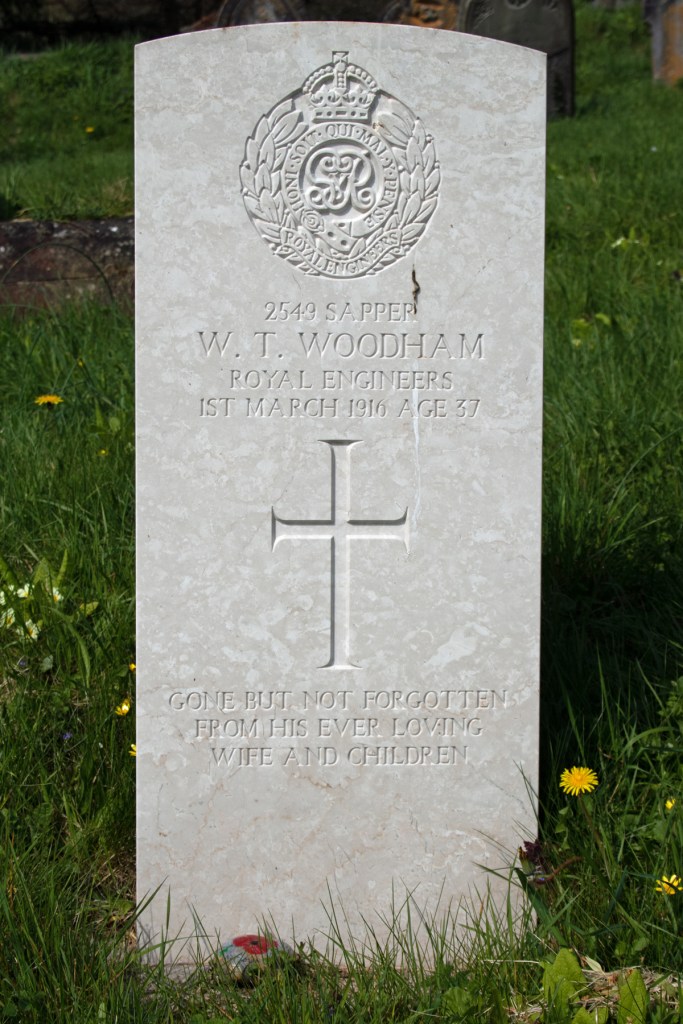
William Thomas Woodham was born at the end of 1877 in Peasedown St John, Somerset. One of four children, his parents were coal miner and pit worker William Thomas and his wife, Sarah. The young family quickly moved from Peasedown to nearby Radstock to set up home.
William Jr did not immediately follow his father to the mine: instead, when he left school, he found work as a cowherd for a local farm. By the time of the 1911 census, however, he was recorded as being a colliery stoker.
The following year, William married Matilda Gulliford. She was a local coal miner’s daughter: the couple went on to have three children, Gwendoline, Stanley and Irene.
In his spare time, William volunteered for the Somerset Light Infantry and, when war broke out, he was formally placed on reserve – mining was one of the reserved occupations. However, in June 1915, he transferred to the Royal Engineers, and was sent to the Military Barracks at Taunton for training.
Sapper Woodham was due to be sent to France in the spring of 1916, but started feeling unwell. He was admitted to the Taunton Military Hospital, suffering from pneumonia on 20th February, but his condition worsened. He passed away at the hospital on 1st March 1916, aged 38 years old.
William Thomas Woodham’s body was brought back to Radstock; he was laid to rest in the graveyard of the town’s St Nicholas’ Church.
Sapper William Woodham (from britishnewspaperarchive.co.uk)
James Valentine McDowell was born in Ashburton, Devon, on 2nd January 1865. He was one of eight children to William and Louisa McDowell. William was a labourer, and this was a trade that James also took up when he left school.
In the summer of 1884, James was brought up to the Devon Assizes in Exeter, on the charge of attempted suicide. A local newspaper reported that:
It appeared that on June 13th the prisoner, fully dressed, was seen lying at full length in the Yeo, his head resting on a stone, but the remainder of his body was under water. The stream, however, was but three feet deep and six feet wide at this particular point, so the actual danger was not very great.
A witness seeing the position of the prisoner called upon him to come out of the water. He did so. He was very drunk. On leaving the Yeo, the prisoner proceeded towards the Dart, and on his way wished the witness to bid his father and mother good bye. Arrived at the Dart the prisoner attempted to throw himself into the water, but was prevented and handed over to the police.
When in custody the prisoner said this was the second time he had been in the water: next time should be more lucky. Subsequently, however, he stated that he only went to the Yeo for a wash, and this statement he now repeated.
The jury returned a verdict of not guilty, and his Lordship, in discharging the prisoner, advised him next time he wanted a bath not to get drunk beforehand, or he might find himself in deeper water than that in which he was discovered on the present occasion.
Western Times: Saturday 26th July 1884
The same Assizes saw trials for embezzlement, horse stealing, larceny, stack-burning and endeavouring to conceal the birth of a child. The alleged perpetrator of a count of buggery was found not guilty (his alleged offence not named in the same newspaper), while a Henry Davy, 51, was sentenced to 18 months’ hard labour for indecently assaulting a 6 year old girl.
The following year found James back on track. He married local woman Mary Ellen Ellery; the couple set up home in Ashburton and went on to have seven children. The family settled into a routine – James worked as a mason’s labourer; in his spare time, he joined the 3rd Devon Militia. His and Mary’s daughters found work as wool spinners, while their sons also got into labouring work.
War came to Europe in 1914; despite his age, James wanted to play his part. He enlisted when the call came, joining the Royal Engineers as a Pioneer on 19th August 1915. Within a week he was sent to France, and this is where he stayed for the duration of the war.
Pioneer McDowell returned to England on furlough on 2nd February 1919, and was waiting to be demobbed. However, tragedy struck before that became a reality, the same newspaper picking up the story some thirty-five years later:
An Ashburton man named James McDowell, aged about 56 years, a private in the Royal Engineers Labour Battalion, who joined up in August 1915, and had been in France continuously since that time, was found drowned in the mill leat of the the River Yeo at the rear of the cottages in Kingsbridge-lane early on Saturday morning.
He left his home at Great Bridge about 8:30 on Friday night for a short time. To get to the town he had to pass along by the river, which was running very high through the recent heavy rain, and it is supposed that he must have fallen in and had been washed down to where he was found, which was a considerable distance.
He had been demobilised, and was on furlough, and every sympathy is expressed for the family on their sad loss. Dowell [sic] who was well known and was of a jovial disposition, leaves a widow and grown up family.
Western Times: Monday 24th February 1919
Later that week, a summary of the inquest was printed:
Dr EA Ellis said he found a ragged cut over deceased’s left eyebrow, but otherwise there was no sign of violence. The cut was inflicted before death. A post mortem revealed that the cause of death was drowning. His theory was that deceased fell into the river, his head coming into contact with a stone, which inflicted the wound and caused unconsciousness. The spot where the accident was supposed to have happened, he thought, was unsafe and dangerous.
…the jury returned a verdict that the deceased was found drowned, caused by accidentally falling over the wall at the top of North Street… and they wished… to call the attention of the responsible authorities to the danger at this spot, and to the unsatisfactory state of the lighting there.
Western Times: Friday 28th February 1919.
Pioneer James Valentine McDowell drowned on 21st February 1919: he was 56 years of age. His body was laid to rest in the graveyard of St Andrew’s Church in his home village.
Ronald James Ewart Blackwell was born in London in February 1890, one of eight children to Frederick and Elizabeth Blackwell. Frederick was a tailor from Devon, while Elizabeth had been born in Somerset. By the time of the 1911 census, they had moved back to Somerset, settling in the village of Dunster.
Ronald followed in his father’s footsteps and, by the time war broke out, was living and working in Taunton. It’s clear that he wanted to play his part in the growing conflict, enlisting in the Royal Engineers in January 1915.
Sapper Blackwell’s service records confirm that he stood 5ft 6.5ins (1.69m) tall; they also note that he had the tattoo of a heart on his left forearm. His skill as a tailor is mentioned numerous times, and it appears that this talent was how his time was put to use. He was shipped to France on 25th January 1915, and, by the end of the conflict, he was in Italy. It was from here that he returned to England on 26th January 1919.
It seems that Ronald’s return to the UK was as a result of him becoming ill, as, within a month of coming home, he was medically discharged from the army, having been suffering from tuberculosis.
Ronald returned to Somerset, but was to be dogged by the lung disease for a further year. He passed away at home on 25th June 1920, aged just 30 years old.
Ronald James Ewart Blackwell was laid to rest in Dunster Cemetery, not far from his parents’ then home.
Ronald’s older brother, Harold Frederick Blackwell, also fought in the First World War. He was a Private in the 2nd Battalion of the Essex Regiment. He was killed during the Allied advance into Flanders in August 1918, and was laid to rest in the Terlincthun British Cemetery in Northern France.
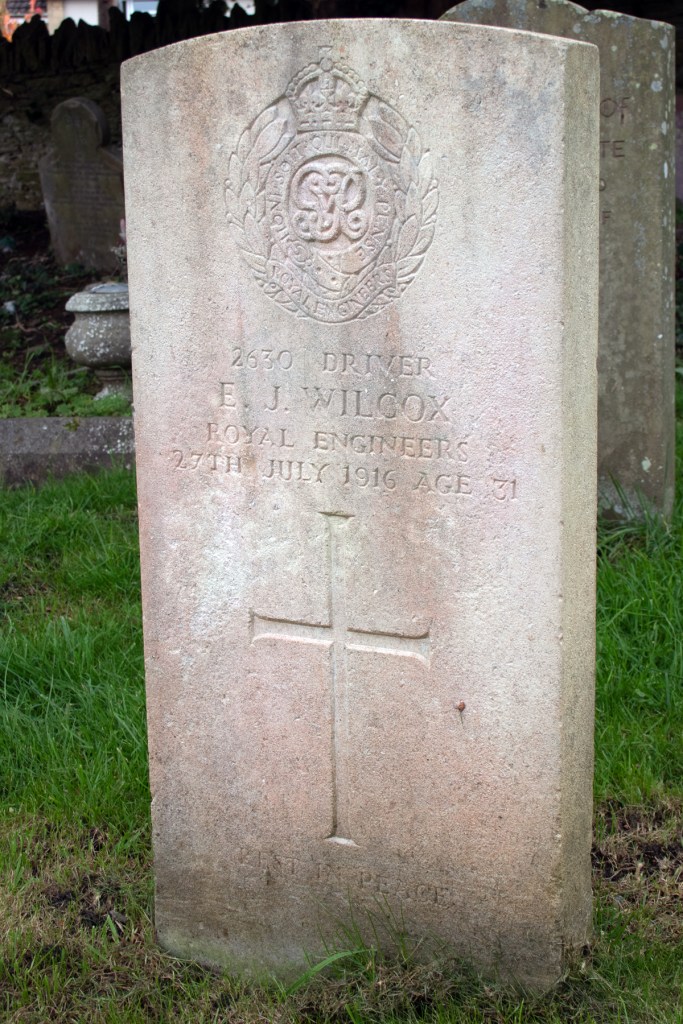
Edgar James Wilcox was born in Frome, Somerset, on 2nd February 1885, and was the third of six children to Robert and Louisa Wilcox. Robert was a coal dealer and he and Louisa raised their family in the town of their own birth.
When he left school, Edgar found work on a local farm, tending to, and milking the cows. He met a woman called Ellen Snelgrove and, on 31st October 1908, the couple married at the parish church in Ellen’s home village of Corsley, just over the border in Wiltshire.
By the time of their wedding, Edgar had found employment as a carman for the local railways. The young couple set up home in Frome, and went on to have four children, Edward, Phyllis, Gladys and Cecil.
War was coming to Europe, and, when the conflict broke out, Edgar initially enlisted in the National Reserves in Frome. From there, he joined the Royal Engineers and was assigned as a Driver in the Wessex Regiment Field Company. In his new regiment, he was first based in Taunton, but soon moved to the East Coast.
It was while Driver Wilcox was here that Germany carried out a number of Zeppelin raids on the east of the country. One of these raids, in the spring of 1916, proved too much for Edgar and he suffered a nervous breakdown. He was brought back to Somerset for treatment and admitted to a hospital in Bath.
A contemporary newspaper picked up his story:
On Thursday last week Mrs Wilcox paid her husband one of her periodical visits. They spent several happy hours together, and in the afternoon he went to see her off by train. She then wishes him good-bye, when he seemed as usual, and Mrs Wilcox went to catch a train. It now seems that deceased did not return to the hospital, and after being missing for three days his body was found in the river at Bath.
Somerset Standard: Friday 4th August 1916
Driver Wilcox had taken his own life on 27th July 1916. He was just 31 years of age. An inquest was held and the verdict of ‘drowned’ was reached.
Edgar James Wilcox’s body was brought back to Frome: he was laid to rest in the graveyard of the Holy Trinity Church in the town.
Fergusson Barclay was born in Cheltenham, Gloucestershire, towards the end of 1877 and was the oldest of six children. His father, Henry, was a retired army captain, and so it is of little surprise that Fergusson and his siblings had something of a privileged upbringing.
The 1881 census recorded Henry and his wife, Agnes, bringing up the family in Tenby, South Wales. With three children under four, the Barclays employed two live-in nursemaids to support them.
Ten years later, the family had moved to Weston-super-Mare, Somerset, living in a large house to the north of the town centre. With five children now living at home, Henry and Agnes found additional help was needed: they were now employing a governess, manservant, cook and a housemaid. The family were not alone in this support: the 1891 census shows that all of the Barclays’ neighbours had at least one domestic servant.
The new century turned, and a new census followed. Captain Barclay and his family were still living in their three-storey Victorian villa in Weston-super-Mare. By this point, however, only three of the children were still living at home. Fergusson, now 23, was working as an architect, his brother Herbert was a legal professional, and his sister, Hermione, also still lived there. The house was not empty, however, as the Barclays’ retinue of staff remained. By this point, they were employing a gardener, groom, coachman, parlour maid, cook, kitchen maid and house maid. Agnes, who was around 20 years younger than her husband, also had a live-in companion, spinster Helen Empson.
Little had changed for the family when the next census was recorded in 1911. Henry was by now 84 years old, and he and Agnes had been married 34 years. Fergusson and Herbert were still living at home, fully immersed in their jobs. Helen was still providing companionship for Agnes, and the family still employed four members of staff: butler Daniel O’Brien and his wife, Jesse, who was the cook; parlour maid Rosie Davies and house maid Edith Booden.
In March 1912, Henry passed away, and it was inevitable that things would change for the Barclay household. Fergusson had been a volunteer for the Royal Engineers since the late 1890s and had steadily worked his way up through the ranks. With the outbreak of war, he found himself called into a more formal role.
Full details of his military career are not evident, but it is clear that, by the spring of 1918, Fergusson had gained the rank of Captain. He joined the Royal Air Force and was assigned to 75th Squadron.
On the afternoon of 7th December 1918, Captain Barclay took off from Elmswell Aerodrome in Suffolk, when the engine of his Avro 504K aircraft cut out. He attempted to turn the plane to land, but it nosedived into the ground and Fergusson was seriously wounded. He was taken to hospital, and died of his injuries later that day. He was 40 years old.
Captain Fergusson Barclay’s body was taken back to Somerset – he lies at rest in the Milton Road Cemetery in Weston-super-Mare, walking distance from his family home.
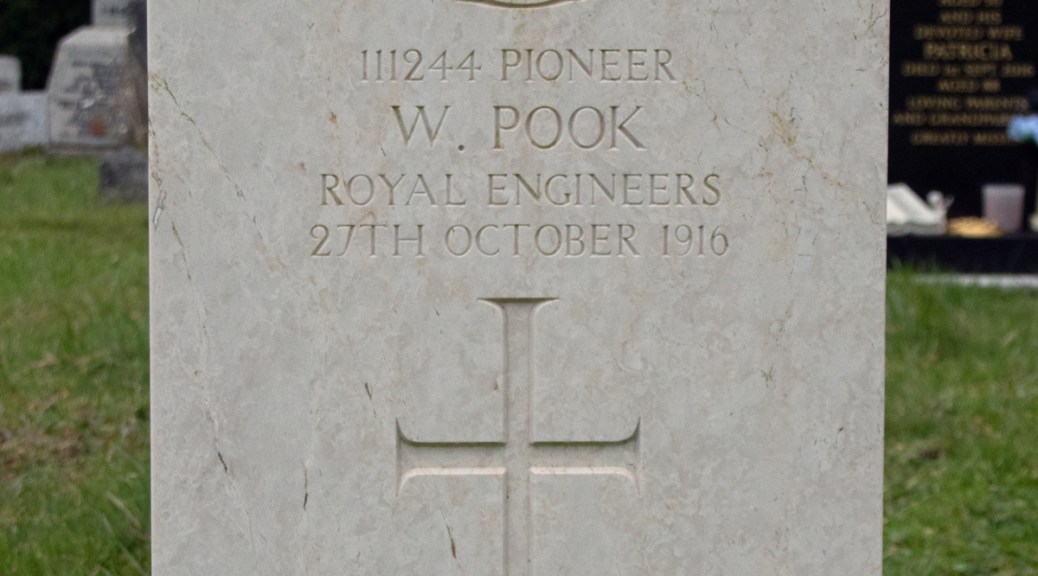
William Pook was born in 1869. There is little specific evidence available about his early life, but his service records confirm that he married Jessie Elizabeth Moxey on 25th January 1890: they went on to have four children.
The 1891 census records the young family living in the village of Highweek, near Newton Abbot in Devon, where William was working as a fellmonger, dealing in hides and sheepskins. This was a trade he continued through the years, and is confirmed as his line of work by the time of the 1911 census. At that point, the expanding family had moved from Highweek to nearby Wolborough.
War was coming to Europe and, in August 1915, at the age of 46, William joined up. His age suggests that this was something he did voluntarily – compulsory enlistment was only introduced the following year – and he joined the Royal Engineers as a Pioneer. The role was designed to relieve the infantry from some of the duties that kept them from the front line, effectively acting as a labour force to free up those who were fighting.
Pioneer Pook was sent to France in August 1915, remaining there for nine months. Health issues started to intervene, and, in June 1916, he was dismissed from military service as being medically unfit because of his asthma.
At this point, William’s trail goes cold. The next record confirms that he died on 27th October 1916, in Newton Abbot. No cause of death is evident, but it seems likely to have been related to his lung condition. He was about 47 years old.
William Pook was laid to rest in Newton Abbot Cemetery.
William Henry Merrifield was born on 29th December 1893, in Newton Abbot, Devon. One of six children to Henry and Kezia Merrifield, his father was an agent for the removal company Pickford’s.
When William left school, he found work as a labourer for a local tannery. War was, by this time, on the horizon, and William soon found himself caught up in it. Full details of his military service are not available, but it is clear that he had a varied career.
William initially worked for the British Red Cross as a cook, and was sent to France in October 1914. He Subsequently joined the Royal Field Artillery as a Gunner, before transferring across to the Royal Garrison Artillery. By June 1915, he had made the move again, and was recorded as a Sapper in the Royal Engineers. During this time, he had been awarded the Victory and British Medals and the 1914 and 1915 Stars for his war efforts.
By this point, William had seen a fair amount of tragedy in his life. Kezia had died in 1905, at the age of 44, and his sister Evelyn had passed away in 1914, aged just 25 years old. The following year, Henry also died, aged 52 years of age.
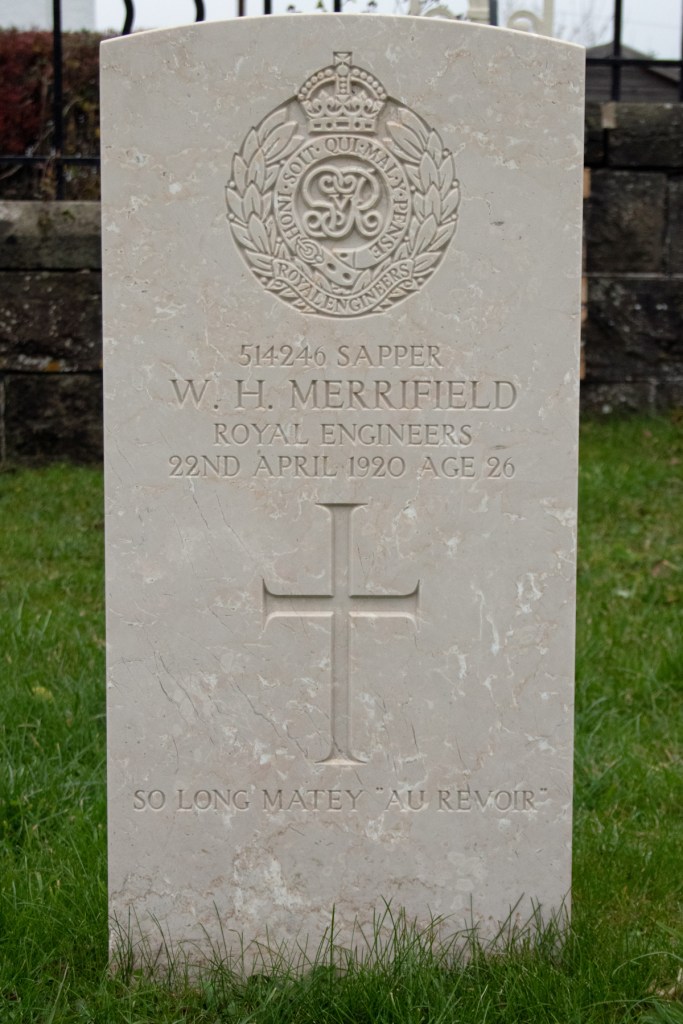
Sapper Merrifield survived the war and was demobbed in February 1919. At this point, his trail goes cold. He returned to Newton Abbot, and passed away just over a year later, on 22nd April 1920. He was 26 years old.
William Henry Merrifield was laid to rest in Newton Abbot Cemetery; his gravestone marked with the message ‘SO LONG MATEY “AU REVOIR”.
Charles Churchill was born towards the end of 1883, in the Somerset village of West Chinnock. One of six children, his parents were Isaac Churchill and his wife Elizabeth. Isaac was an agricultural labourer, and the family lived in a cottage on Eastfield Farm, where he worked.
When he left school, Charles also found work on the farm. He knew the owners well and, in 1909, married their servant, Ellen Mary Young, in the parish church. The couple moved in with Ellen’s widowed mother, Harriet, and went on to have two children, Florence, born in 1909, and George, who was born three years later.
By this time war was on the horizon. Full details of his military service are not available, but it appears that Charles initially enlisted in the Royal Berkshire Regiment. He subsequently transferred to the Labour Corps, before being reassigned again to the Royal Engineers.
There are no dates available for the transfers, so it’s impossible to know how quickly they took place. Charles’ record shows that he was awarded the Victory and British Medals while in the Royal Engineers, however, so it is likely that he spent most of his time in this regiment.
The medal record also confirms that Pioneer Churchill did not serve in a theatre of war, so would have spent his time on home soil.
Sadly, this is where information on Charles seems to dry up. He survived the war, but contracted pneumonia late in 1919 and passed away on Christmas Day that year. He was just 36 years of age.
Charles Churchill was laid to rest in the graveyard of St Mary’s Church in his home village of West Chinnock, the place where he and Ellen had been married ten years earlier.
Patrick Tynan was born in Roscrea, Southern Ireland, on 9th June 1893. He was the eldest of four children to John and Anne Tynan, but sadly, there is no further information available for his early years.
Patrick’s story really picks up on 14th December 1915, when he joined the Royal Engineers as a Private. His service record states that he was living in Bangor, Gwynedd, and that he was a stall keeper at a fairground – a subsequent document noted his trade as a showman. He was noted to be 5ft 8ins (1.72m) tall, weighed 151lbs (68.5kg), and had numerous scars on his back.
Private Tynan did not stay in the UK for long. Assigned the new role of Driver, he was attached to the GHQ Signal Company and sailed from Devonport on 30th June 1916, bound for Mesopotamia. Arriving in Margil – the port connected to Basra – he was based here for more than a year, before moving north to Baghdad.
By this time, Patrick had risen to the rank of Lance Corporal, and was obviously a trustworthy member of the company. Towards the end of 1917, he had again been promoted, this time to Corporal.
During his time in modern day Iraq, Patrick was admitted to hospital a handful of times; there is little information on the conditions he suffered, but none appear to have been life threatening, as they were only for short periods. It’s also interesting to find that his service records confirm a month’s leave in May 1918, spent in India.
When the war came to a close, Corporal Tynan was still in the Middle East. Ready to be demobbed, his company moved to India and boarded the SS Chupra in Calcutta on 26th February 1919, bound for home.
Back in the UK, however, Patrick was not ready to give up the formal military life. Having returned to Gillingham in Kent, where the Royal Engineers were based, he initially found work as a tram conductor, but soon signed up for a five year term with the Royal Navy as a stoker.
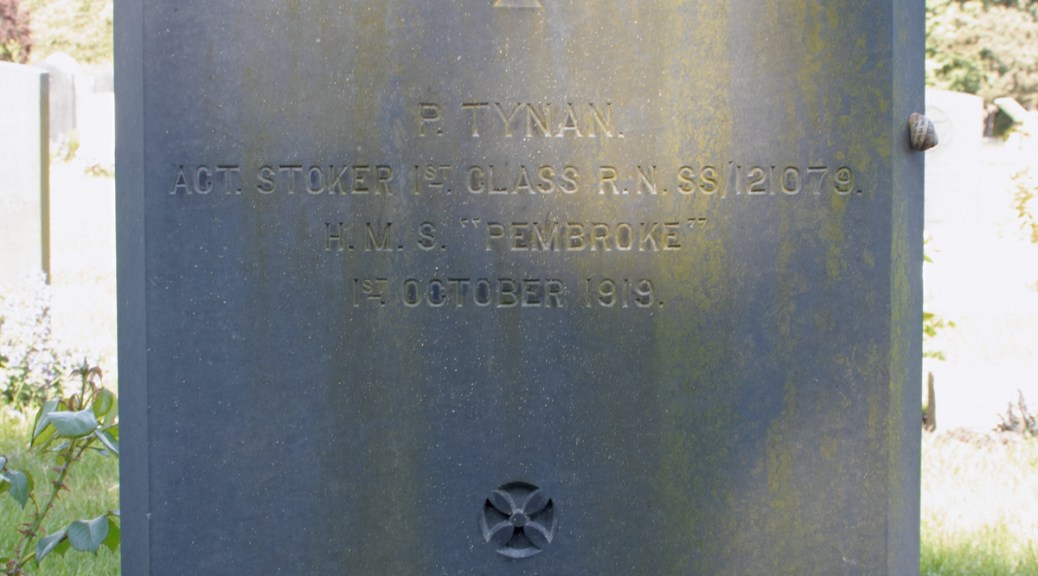
He was based on HMS Pembroke II, the shore-based establishment at Chatham Dockyard, but sadly, his time in the navy was to be a short one. Admitted to the Royal Naval Hospital in the town with pneumonia, he passed away form the condition on 1st October 1919. He was just 26 years old.
Patrick Tynan was laid to rest in the Woodlands Cemetery in Gillingham. He had a short but full life, something his modest gravestone doesn’t begin to hint at.












 Death and Service