Rondaine Tristram Cary was born in Lancashire in the autumn of 1896 and was the oldest of two children to Henry and Wilhelmina. Henry was an insurance agent, and, by the time of the 1901 census, the family had moved to the parish of Linsfort in County Donegal, Ireland. This is near where Wilhelmina had been born, so it seems likely that the draw of family had been partially responsible.
The 1911 census found the Carys living a few miles down the road, in Buncrana. Rondaine was listed as being a scholar, while his younger brother, five year old John, completed the family setup. John was employed as a commission agent, and all four members of the household were listed as being Episcopalian.
When war came to Europe in 1914, Rondaine was keen to play his part. He seems to have enlisted almost at once, joining the Royal Inniskilling Fusiliers. Assigned to the 11th (Service) Battalion (Donegal and Fermanagh), Private Cary was sent to Ballymena, County Antrim, for training.
Rondaine had only been in the camp for a matter of weeks, when he contracted measles. He was admitted to a hospital in Ballymena on 17th February 1915, but his condition worsened, and his father came to visit. Private Cary passed away on 27th February 1915, aged just 18 years of age.
The Cary family seemed unable to afford the cost of bringing their son’s body back to Buncrana. Instead, the local authority paid for Rondaine Tristram Cary’s coffin and funeral at Ballymena Cemetery, while his army colleague funded his headstone.
Charles McManus was born in Ballymena, County Antrim, in 1891. The middle of three children, his parents were John and Maryann McManus. John was a horse dealer: when they finished their schooling Charles’ older brother, John Jr, found work as a hawker.
Maryann died in 1907, aged just 47 years of age. The next census record, in 1911, found John Jr living with his wife and family in Ballymena, while John Sr was boarding with a fishmonger elsewhere in the town. Alexander, Charles’ younger brother, was a pupil at an industrial school in Dublin, but Charles himself is missing from the census return.
John Sr passed away in 1913, at the age of 53 years old. Charles was 22 years old and an orphan. The following year war was declared, and Charles was one of the first to step up and serve his country. He joined the Royal Inniskilling Fusiliers on 14th September 1914, and was attached to the 1st Battalion.
Full service records for Private McManus are lost to time. However, his unit was sent to Gallipoli in the spring of 1915, only to be evacuated from the region the following January. The 1st Battalion was then sent to France where it became entrenched at the Somme. For Private McManus and his colleagues, this must have felt like going from the frying pan into the fire, but this time he was not to emerge unscathed.
At some point Charles was wounded. He was medically evacuated to Britain for treatment, and admitted to the King George’s Hospital in London. Whatever his injuries, they were to prove too severe: he died on 24th July 1916, at the age of 25 years old.
Charles McManus’ body was taken back to Antrim for burial. He was laid to rest in the Crebilly Cemetery, overlooking his home town, Ballymena. His pension ledger suggests there was happiness in his life, beyond the killing fields. His next of kin is noted as Miss Mary Gordon of Ballymena, recorded as his unmarried wife.
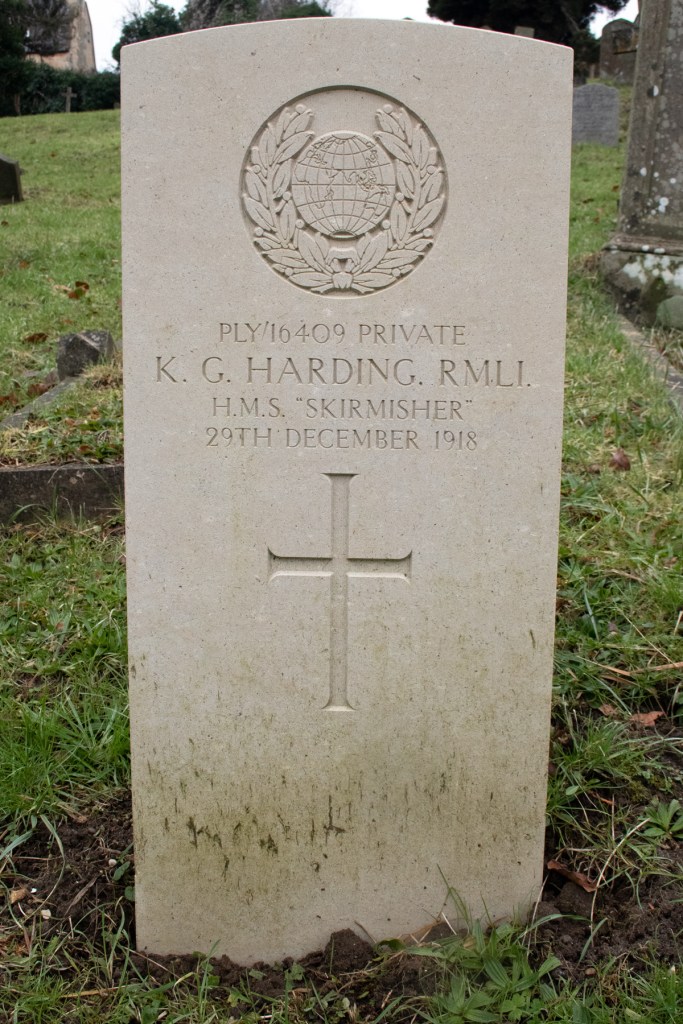
Kenneth Gordon Harding was born in the autumn of 1896, in the Somerset village of Batheaston. The oldest of nine children, his parents were Lawrence and Fanny Harding. Lawrence was a market gardener when Kenneth was born, but by the time of the 1911 census – and with a growing family to support – he found other employment as a roadman.
When he left school, Kenneth found work as a gardener, but he had his sight set on distant shores. On 25th September 1913 he enlisted in the Royal Marine Light Infantry, determined to see the world. His service records show that he was 5ft 3ins (1.6m) tall, with light hair, blue eyes and a light complexion.
For the duration of his naval career, Private Harding was based out of Plymouth Dockyard, returning there in between each of his voyages. Over the next four years, he served on three different vessels – HMS Heroic, HMS Duke of Edinburgh and HMS Skirmisher. His service records shows that he maintained a satisfactory level of conduct, and that his general character was very good.
By January 1917, Kenneth had fallen ill, and was medically discharged from the army, having contracted tuberculosis. He returned home, but his illness continued to dog him.
On 22nd May 1918, Kenneth’s younger brother, Leonard Harding, who was serving with the Royal Inniskilling Fusiliers, was killed while fighting in France. Private Leonard Harding was just 19 years old. He was laid to rest in the Duhallow ADS Cemetery at Ypres.
With Kenneth’s own health not looking good, his parents must have feared the worst. The worst was to some, sadly, when he breathed his last at home on 29th December 1918. He was just 22 years of age.
Kenneth Gordon Harding was laid to rest in the graveyard of St John the Baptist Church in his home village, Batheaston.
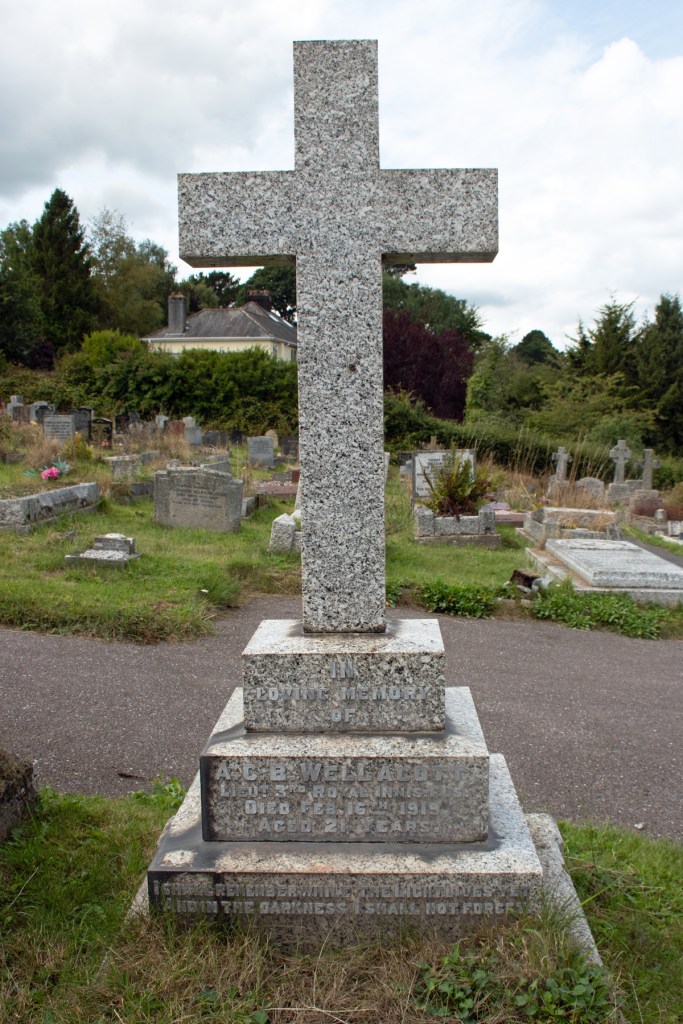
Arthur Cecil Baber Wellacott was born the summer of 1897, in the village of Bradworthy, North Devon. Ond of seven children, his parents were William and Ada Wellacott. William was the parish vicar and with his status came additional support for the family.
The 1901 census saw the vicarage employ three members of staff, and William was hosting two students as well as his and Ada’s own children. Ten years later, with Arthur and his younger brother William, boarding at a school in Bude, Cornwall, the Wellacott retinue remained in place.
On leaving boarding school, Arthur studied at Kelly College in Tavistock and, at around the same time his father took up a new post in Totnes. When Arthur left the college, he joined the 7th (Cyclist) Battalion of the Devonshire Regiment. He was subsequently given a commission in th 3rd Battalion of the Royal Inniskilling Fusiliers, and was based in Londonderry.
At Easter 1916, Lieutenant Wellacott took part in quelling the rebellion in Dublin, and was subsequently sent to France. In the battle for Contalmaison his platoon was gassed and buried, and Arthur was badly injured. Suffering from shell shock, the experience had a lasting impact on him “and from that time his health had given cause for anxiety…” [Western Morning News: Tuesday 18th February 1919]
Lieutenant Wellacott returned to England and he was billeted near Leeds. During the winter of 1918/1919, he contracted pneumonia, and was admitted to the Drax Hospital. Sadly, the condition was to prove too much for his already damaged lungs and he died on 16th February 1919. He was just 21 years of age.
Arthur Cecil Baber Wellacott was brought back to Devon for burial. He was laid to rest in the cemetery in Totnes, Devon.
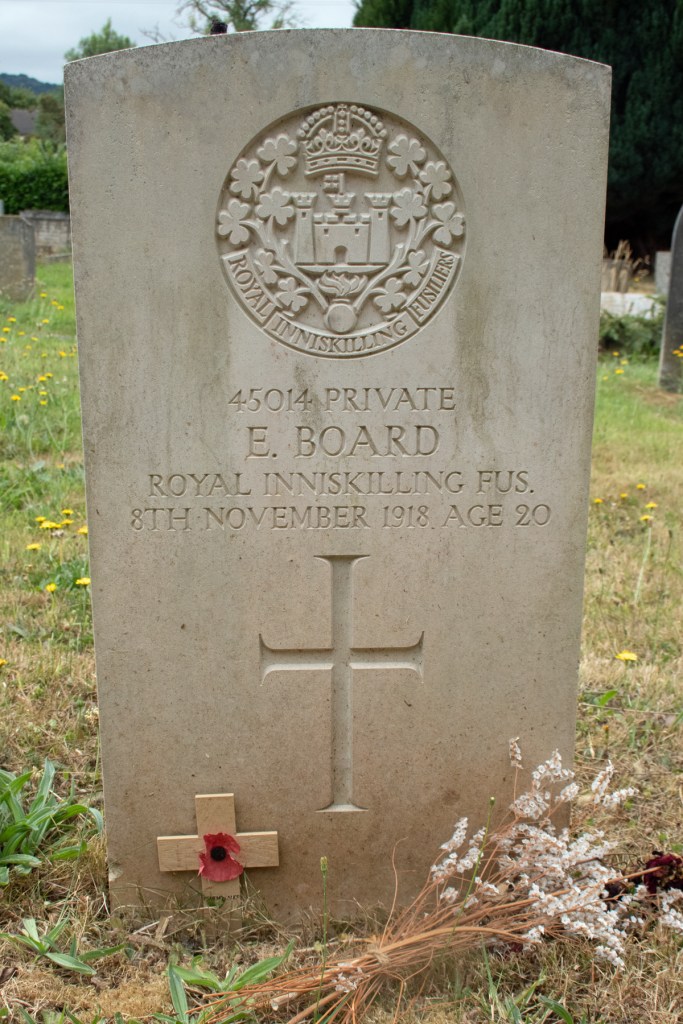
Ernest Board was born in Taunton, Somerset, on 20th September 1898 and was one of at least six children to Walter and Mary Board. Walter was a carter for the town’s gasworks, but, when Mary passed away in 1910, things changed dramatically for the family.
The 1911 census found Walter working as a cowman on a farm in Milverton, Somerset. All but two of his children are missing from that year’s national record, but Ernest and his older brother Arthur are noted as being ‘inmates’ at the National Nautical School in Portishead, near Bristol.
This was an establishment set up in 1869 for the destitute and neglected boys of the area. Ernest and Arthur were two of more than 320 students at the school which, at that time, was under the control of Commander Willoughby Still. School life was very strongly based on the running of a ship, with hammocks instead of beds, and a parade ground in front of the building.
There is no information about how long the brothers remained at the school, but, when war came to Europe, it would seem that they were keen to play their part. Sadly little detail remains of Ernest’s military life.
What can be determined, however, is that he enlisted in the Royal Inniskilling Fusiliers, and was assigned to the 1st Battalion as a Private. His battalion fought at, and were evacuated from, Gallipoli, before moving to France. There is no record where Private Board was involved, sadly, although his Medal Roll Card shows that he was assigned the Victory and British Medals, although may not have actually seen time overseas.
Private Board’s passing is also lost to time. All that can be confirmed is that he died on 8th November 1918, and was just 20 years of age.
Ernest Board was laid to rest in Wellington Cemetery, Somerset: as this is not far from where his father was recorded on the census seven years earlier, it is likely that his place of burial was due to family connections in the area.
Albert Cairns was born on 22nd October 1894, one of ten children to Wilson and Maria Cairns. Both of his parents were born in Northern Ireland, and flax dresser Wilson raised his family in the capital, Belfast.
When he left school, Albert began shop work, but he wanted bigger and better things. On 2nd March 1912, having already been a volunteer in the Royal Inniskilling Fusiliers, he enlisted in the regiment full time. His service records show that he was 5ft 4.5ins (1.64m) tall, weighed 125lbs (56.7kg) and had blue eyes, brown hair and a fresh complexion.
Private Cairns’ army service was brief, however, as, on 23rd March he was discharged for “having made a mis-statement as to [his] age on enlistment.”
Undeterred, six months later, Albert tried again, this time enlisting in the Royal Navy as a Stoker 2nd Class. His determination was clear, as he lied about his age again, giving his year of birth as 1893. This was overlooked (or at the very least not checked), and he was sent to HMS Pembroke, the Royal Naval Dockyard in Chatham, Kent, for his training.
In February 1913, Stoker Cairns was assigned to the cruiser HMS Blonde. He spent the next two years on board, and was promoted to Stoker 1st Class.
For all his desire to serve, Albert’s military career was a chequered one. Over the period of five years, he served on four ships, returning to Chatham after each voyage. His character began as Very Good, but as time went on this slipped to Good and then to Indifferent. On four separate occasions he was detained for going AWOL, and he spent a total of 159 days in the brig.
In May 1917 he returned to HMS Pembroke; that summer was a busy time for the base, and Stoker 1st Class Cairns found himself billeted in overflow accommodation set up in the barracks’ Drill Hall.
On the night of 3rd September, Chatham came under attack from a German air raid, and the Drill Hall received a direct hit. Stoker Cairns was among those to be killed that night. He was 22 years of age.
Albert Cairns was laid to rest in the Woodlands Cemetery in Gillingham, Kent, alongside the other victims of the Chatham Air Raid.
Tragically, Albert was not the first boy of that name to be born to the family. Albert Wilson Cairns was born in 1888, but died when only a toddler.
Wilson and Maria also had three sons called Wilson: the first, born in 1889, died at the age of two. The second was born in 1892, but passed away at the age of seven months.
The third Wilson Cairns was born in 1896. He went on to become a mill labourer, before joining the Royal Inniskilling Fusiliers in February 1913. Just like his older brother had done before him, however, he had lied about his age, and was soon discharged. Two years later he tried again, and this time succeeded in joining up.
Private Cairns was assigned to the 2nd Battalion, and soon found himself in France and in the thick of it. Fighting in the Battle of Ancre, he was killed on 23rd November 1916. He was just 20 years of age, and was laid to rest in the Waggon Road Cemetery near Beaumont-Hamel.
Private Wilson Cairns (from findagrave.com)
The Belfast Telegraph reported on Albert’s death, and noted Wilson’s death ten months previously. It also confirmed that Wilson and Maria’s oldest son, George, had also been wounded, and was recovering in a convalescent camp.
The same newspaper ran a number of messages of condolence for Albert, including one from his loving sweetheart, Katie Rollins.
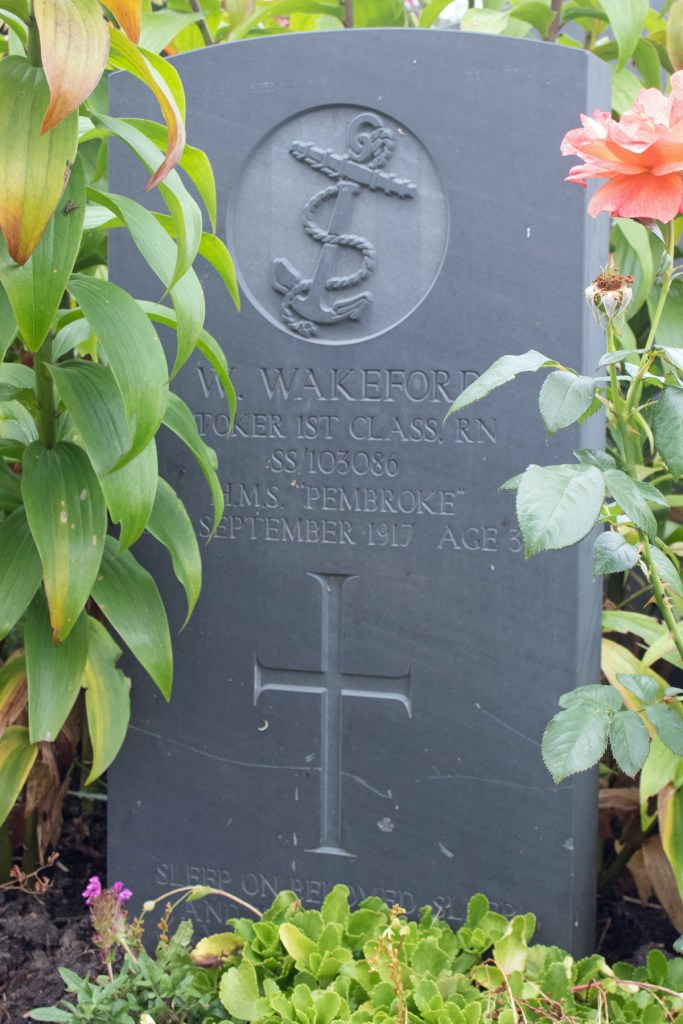
William Edward Wakeford was born on 18th April 1885, the oldest of seven children to William and Theresa. William Sr had been born in East London and was a labourer for the engineering company Vickers. Theresa came from south of the Thames, in Greenwich, and it was in South East London that the Wakefords raised their family.
When he left school, William Jr found work as an assistant to a corn dealer. He was set on a better life and career, however, and, on 1st June 1906, at the age of 20, he enlisted in the Royal Navy with the rank of Stoker 2nd Class.
William learnt on the job; he was initially assigned to HMS Acheron and, during his initial five-year term of service, he served on five further vessels, rising to the rank of Stoker 1st Class as a result of his hard work. In between his voyages, however, he was based at HMS Pembroke, the Royal Naval Dockyard at Chatham, Kent.
When his contract came to an end in May 1911, Stoker Wakeford was assigned to the Royal Naval Reserve. With war looming, however, this did not turn out to be for long and, when hostilities begun in 1914, he was called back into action. He was assigned to the battleship HMS Cornwallis, and spent more than two years on board. During this time, the ship saw action in the Eastern Mediterranean, primarily the Dardanelles Campaign, and the fighting around Gallipoli.
By the start of 1917, Stoker Wakeford was back on dry land, and based at HMS Pembroke. For a variety of reasons, that was a particularly busy year at the dockyard, and temporary additional accommodation was set up at the Chatham Drill Hall nearby; this is where William found himself billeted.
On the 3rd September 1917, the German Air Force carried out its first night air raid: Chatham was heavily bombed and the Drill Hall received a direct hit; Stoker 1st Class Wakeford was among those killed instantly. He was 32 years of age.
William Edward Wakeford was laid to rest, along with the other victims of the Chatham Air Raid, in the Woodlands Cemetery, Gillingham.
William’s younger brother Cecil also fought in the Great War. Serving as a Private in the 2nd Battalion Royal Inniskilling Fusiliers, he saw fighting on the Western Front. Caught up in the Battle of St Quentin in March 1918, he was killed as the regiment were cut off by German advances. He was just 22 years old. He was laid to rest in France, and is commemorated at the Pozières Memorial.







 Death and Service