John Henry Bellamy was born in Leicester, Leicestershire, on 14th August 1890. The oldest of four children, his parents were Joseph and Alice Bellamy. Joseph worked as an iron moulder, and the couple lived at 70 Friars’ Causeway when their first child was born.
By the time of the next census, taken in 1901, the Bellamy family had moved, and were living at 19 Pingle Street. Close to the river, this was presumably also close to the foundry where Joseph was employed. John sought a more regular income, however, and, on 22nd November 1907, he gave up his work as a shoe dresser, and enlisted in the Royal Marine Light Infantry.
John’s service records show that he was just over 5ft 5ins (1.65m) tall, with light brown hair, grey eyes and a fair complexion. He had a number of scars, including one by his left elbow and another on the right side of his chin.
Private Bellamy was sent to Deal, Kent, for his training. He spent a year at the Royal Marines base there, and this is where his ability to swim was tested. Over the next seven years, he would go on to serve aboard five ships, more often than not being based in Portsmouth, Hampshire, between assignments.
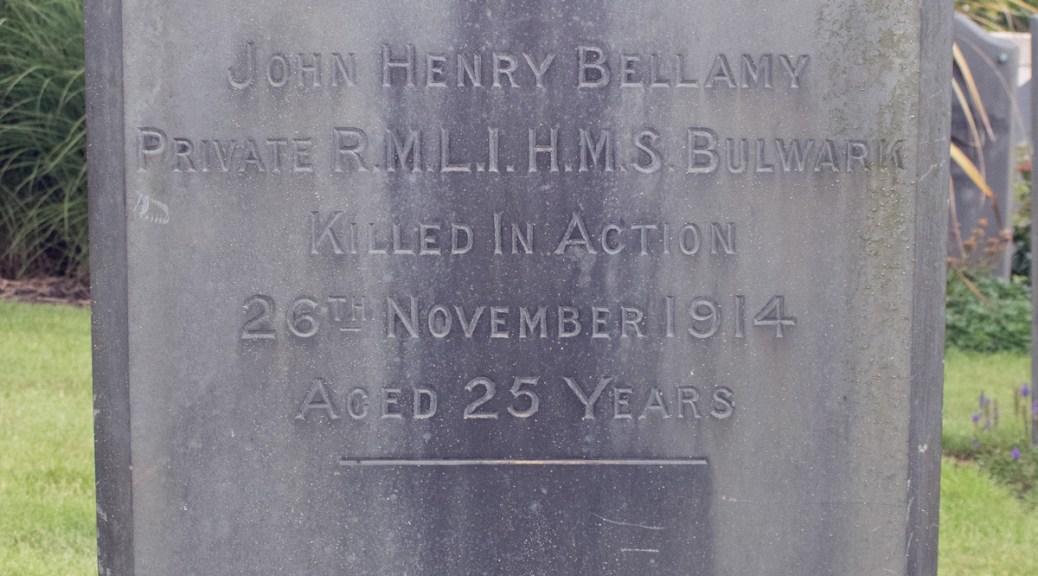
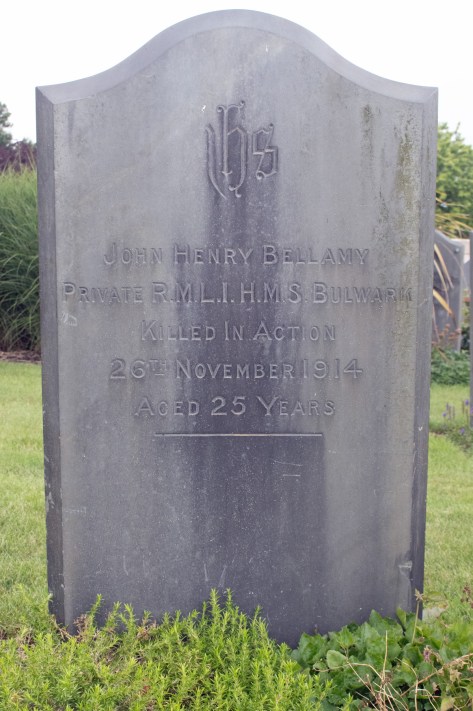
In July 1914, John was assigned to HMS Bulwark, and would remain with her for the next few months. Indeed, he was on board Bulwark on the 26th November 1914, when she was moored close to Sheerness, Kent. That morning, an explosion ripped through the ship, sinking it and killing more than 740 people. Private Bellamy was amongst them: he was just 24 years of age.
The body of John Henry Bellamy was laid to rest in a marked grave in the naval section of Woodlands Cemetery, Gillingham, Kent.
George Wilson was born on 1st February 1879 in the village of Worfield, Shoprshire. Details of his early life are unclear, although his father’s name was John.
When he completed his schooling, George found work as a porter. However, he was keen on adventure and a decent career, and so, on 31st May 1898, he enlisted in the Royal Marine Light Infantry. His service papers show that he was 5ft 7.5ins (1.71m) tall, with brown hair, blue eyes and a dark complexion. He was also noted as having a birth mark above his navel.
Private Wilson signed up for a period of twelve years and, during that time, he would serve around the world. Initially sent to barracks in Walmer, Kent, he would become based at Plymouth, Devon, in between assignments. Time overseas would include two years attached to HMS Magnificent (the 1901 census recording the battleship being moored in Gibraltar), two years on board HMS Spartan and three aboard HMS Encounter.
Away from the military, love blossomed and, in January 1909, George married Annie Curtis. She had a daughter, Gladys, who was either George’s, or was adopted by him. The couple set up home in Plymouth, and went on to have a son, Leslie, in 1911.
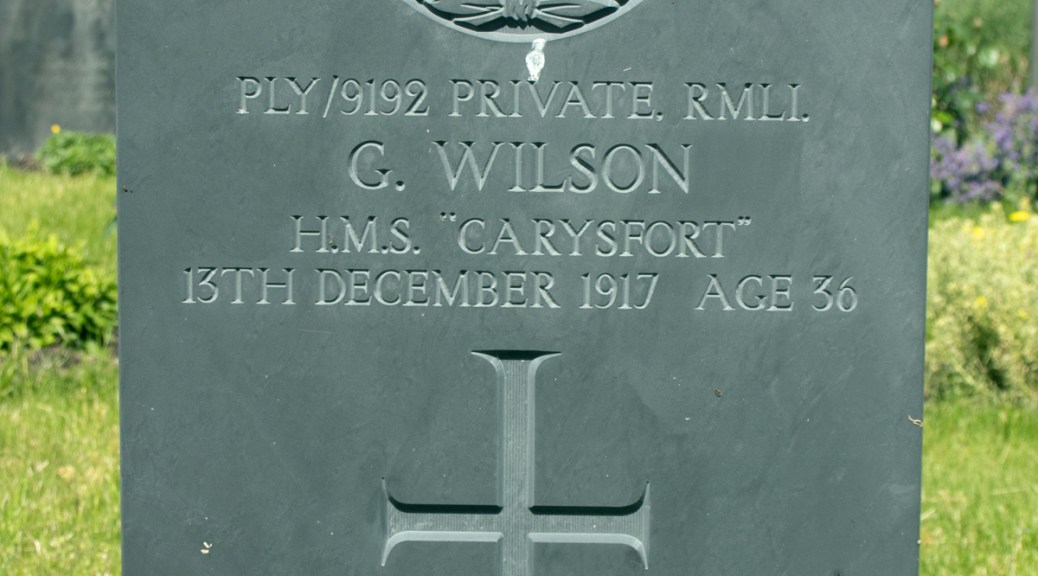
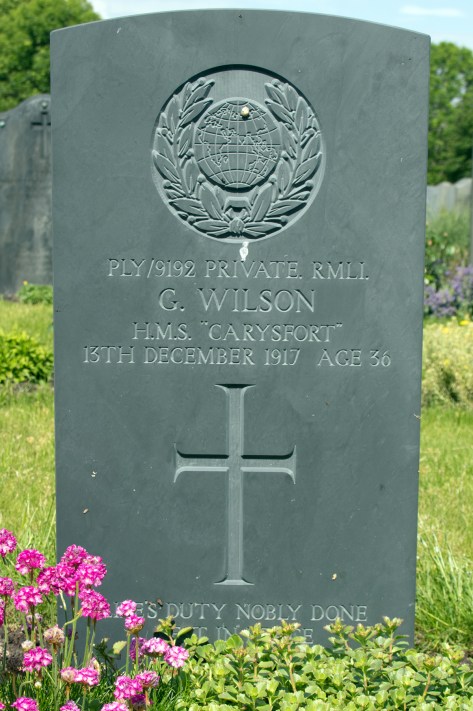
By this point, Private Wilson had renewed his military contract, and would go on to serve for a further seven years in the Royal Marines. In June 1915, he was assigned to the light cruiser HMS Carysfort. Part of the Harwich Force, her role was to patrol the waters off the east coast of England. During his time on board, George would have been involved in a number of sorties, including an attempt to intercept an enemy raid on Sunderland in August 1916, and another attempt to make contact with German ships off Zeebrugge, Belgium, that October.
In December 1917, while patrolling off Orford Ness, Suffolk. the Carysfort collided with the SS Glentaise, a collier ship. Two crew were killed in the incident, including Private Wilson: he was 37 years of age.
Carysfort sailed to HMS Pembroke, the Royal Navy Dockyard in Chatham, Kent. From here the body of George Wilson was taken to Woodlands Cemetery in nearby Gillingham, and he was laid to rest in the naval section there.
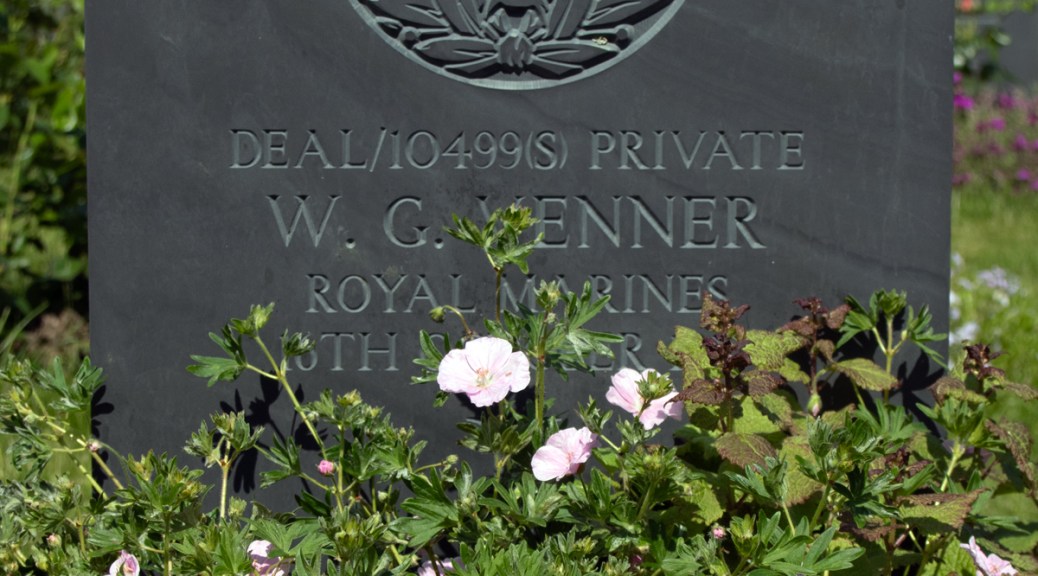
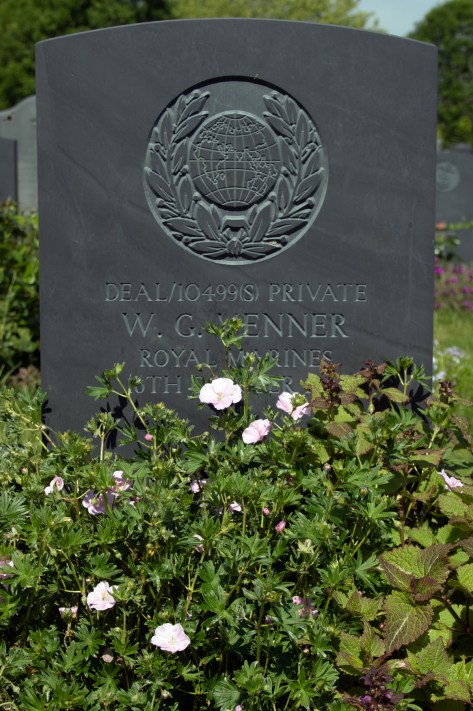
In the Royal Naval section of the Woodlands Cemetery in Gillingham, Kent, is a headstone dedicated to Private WG Venner of the Royal Marines.
William George Venner died on 16th October 1917, through causes unknown. His service papers no longer have been lost to time, although the Commonwealth War Graves Commission’s records show that he served in the Royal Marine Labour Corps out of the Deal Depot, Kent.
Private Venner’s entry on the British Army and Navy Birth, Marriage and Death records confirms that William was born in Gravesend, Kent, on 21st August 1864, and gives his next of kin as his niece, Emily Blackman, who lived in Northfleet, Kent.
There are no birth or census records for William, so it’s not possible to uncover any more of his family history. He died of disease at the age of 53 years old, and was buried in the Gillingham cemetery.
William James King was born on 7th March 1883 in Kensington, Middlesex. He was the fourth of eight children to bricklayer and builder’s labourer John King and his wife, Hannah.
There is little specific information available about William’s early life. The 1891 census found the family living at 16 Burlington Mews in Paddington, but he does not appear on any census returns after this date.
On 4th August 1906, William married Marion Oliver. Born in Chelsea, she was the daughter of a house painter, and the couple exchanged vows in St Luke’s Church, Paddington. The marriage certificate noted William’s trade as a bricklayer, and the couple went on to have two children: daughter Gwendoline, born in 1911, and son Henry, born two years later.
When war came to Europe, William was quick to step up and play his part. He enlisted on 5th October 1914, joining the Royal Marines. His service records show that he was 5ft 4ins (1,62m) tall, with brown hair, grey eyes and a fresh complexion.
Sent to Deal, Kent for training, Private King was initially assigned to the 2nd Field Company of the Mediterranean Expeditionary Force. Appointed to the rank of Lance Corporal he soon found himself ensconced at Gallipoli. On 15th May he was medically evacuated to Britain with an injury to his spinal cord. Admitted to Charing Cross Hospital, London, he was discharged from the army on 27th March 1916.
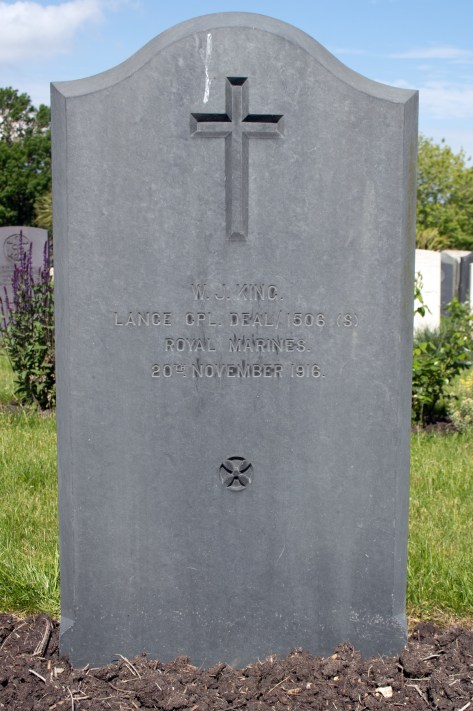
William’s treatment was ongoing, and by the autumn of 1916, he had been admitted to Gillingham Hospital in Kent. It was here that he would died, passing away on 20th November: he was 33 years of age.
William John King was laid to rest in Woodlands Cemetery, Gillingham, Kent.
Alfred John Reed was born in St Pancras, Middlesex, on 29th September 1865. One of twelve children, his parents were Charles and Eliza Reed. Charles was a carman, possibly working out of the nearby railway stations, and the 1871 census found the family taking rooms at 70 Aldenham Street.
Details of Alfred’s life is a little sketchy. By the time of the 1881 census he had finished his schooling and was employed as a coach painter, again probably connected to the railways. At some point shortly after this, however, he enlisted as a Private in the Royal Marine Light Infantry. It is likely that he was still a teenager when he made this move, as he seems to have lied about his age to get in – later records give his date of birth as 8th June 1863.
We next pick up Private Reed in the 1901 census. By this point, he was assigned to the floating battery HMS Terror, which was based in Bermuda, under the remit of Captain Thomas McGill.
Alfred appears to have served his contract, as by 1911 he was living at 56 Northview Road, Hornsey, Middlesex. Employed as a house painter, the census records him as being having been married to Clara Emily for nine years. This may have been for the sake of appearance, as the formal record of the couple’s marriage suggests that exchanged vows in the summer of 1914. The census showed that the couple had a son – Alfred John Reed – who was two years old.
When war broke out, Alfred was 49 years old. While over the age to formally enlist, it seems that he did re-join the Royal Marines. By the spring of 1917, he was attached to HMS Spey, an old gunboat, which served in the River Medway, close to Chatham Dockyard.
On the 7th March 1917, she was accidentally rammed by a sludge vessel carrying 1000 tons of sewage. The Spey sank in the shallow water, and one of the crew – Private Alfred Reed – was drowned. He was 51 years of age.
The body of Alfred John Reed was laid to rest in the naval section of Woodlands Cemetery, Gillingham, not far from the Royal Naval Base in which he had been helping.
The 1921 census sheds more light onto the family that Alfred had left behind.
Clara had re-married, her new husband being motor fitter George Comer. The couple had a daughter, eighteen-month-old Eileen, and George was noted as being stepfather to Alfred and Clara’s children, Alfred and Ernest (who was born in 1911).
There is another mystery, however, as the census gives the name of 18 year old Louie Reed. She may also have been Alfred and Clara’s daughter, although she is not recorded as being so on the 1911 census. She may, therefore, have been Clara’s child from a former relationship, then adopted by Alfred.
The early life of Charles Miles, whose body lies at rest in the Woodlands Cemetery in Gillingham, Kent, is a challenge to unpick, and the starting point is the last document relating to him.
His military Pension Ledger confirms that he died on 13th May 1918, from empyema, a bacterial infection affecting the lungs. The document cites his next-of-kin as Miss Hilda Miles, of 15 St John’s Road in Gillingham. She is noted as being the guardian of two children – Ada, born in 1905, and George, born the following year – because their mother, Charles’ wife, had passed away on 30th May 1912.
An online search for Ada and George gives an entry in the 1911 census. This finds them as the youngest two of six children to Charles and Elizabeth Miles. The document also gives a clue about their future guardian, Hilda: she is their older sister.
The Miles family were living at 45 Commercial Street in Whitechapel, East London. Charles, at 39, was recorded as a Royal Marines Pensioner and schoolkeeper. His wife, Elizabeth, was assisting with this role, and the couple had two other surviving children, Charles Jr and Walter.
While it is still difficult to piece together Charles’ childhood, his Royal Marine service records do shed a little light onto it. Born in Hampstead on 23rd November 1871, he was working as an ironmonger’s assistant when he enlisted. He joined up on 23rd August 1889, the document showing that he was 5ft 6ins (1.68m) tall, with brown hair, grey eyes and a fresh complexion. He also had a tattoo on his right forearm.
Private Miles had joined up in London but, as with most Royal Marine recruits, he was sent to the base in Walmer, Kent, for his initial training. In the spring of 1890 he moved to the Royal Naval Dockyard in Chatham, Kent, and this would become his regular port for the remainder of his service.
Charles’ service proved to be a committed one. Over the next decade he would serve on five ships, and would rise through the ranks. In October 1894 he was promoted to Lance Corporal, making full Corporal less than a year later. On 1st January 1899 he was promoted to Sergeant, and by the start of 1908, he held the rank of Colour Sergeant. Formally stood down to reserve status on 22nd November 1910, he was noted as having a very good character.
Away from the service, there is no record for Charles and Elizabeth’s marriage. She had been born in Sheerness, Kent, and was a year younger than her husband. It is likely that they were married by 1897, as this is when their oldest child was born. The 1901 census recorded them living on Manor Street in Gillingham, but, once Charles had been stood down, the school keeper’s position in the East End came up.
When war broke out, Charles was called upon to play his part once more. He returned to Chatham, leaving his younger children in Hilda’s care. By September 1914 he had moved to HMS Victory, the Royal Naval Dockyard in Portsmouth, Hampshire, and he would remain there for the next eighteen months. His shore base and naval experience suggest that, at 43 years of age, his was more of a training or mentoring role, although there is nothing in his records to confirm this.
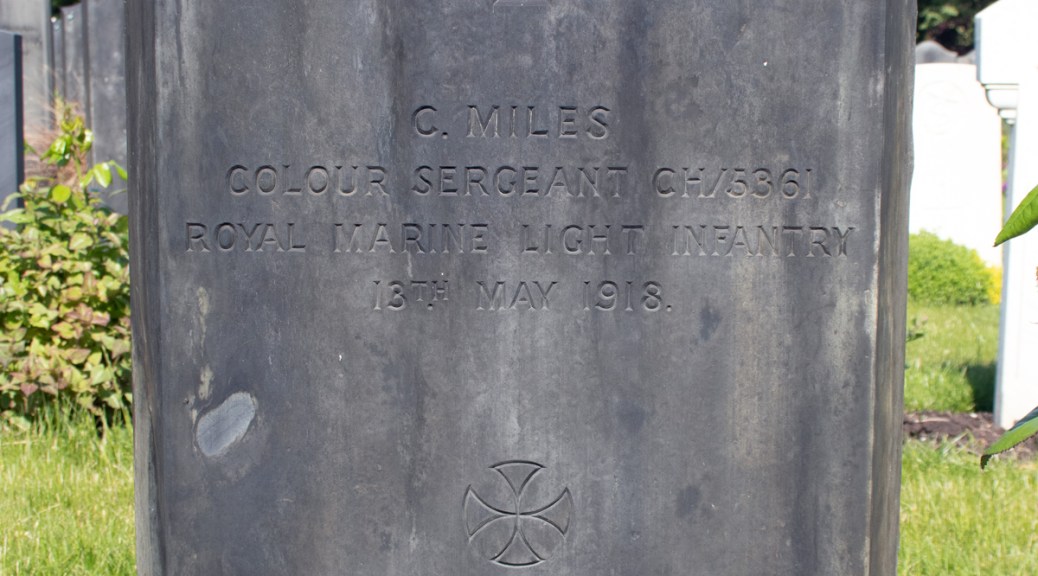
In February 1916, Colour Sergeant Miles returned once more to Chatham, and the naval base there would be his home for the next few years. He was admitted to the Royal Naval Hospital in the spring of 1918, and passed away from the infection on 13th May 1918. He was 46 years old.
Charles Miles was laid to rest in Woodlands Cemetery, Gillingham.
After their father’s death, the Miles siblings found their own way in life.
By the time of the 1921 census, Ada, now 16 years old, was working as a domestic servant for Henry Chapman, a ship’s surveyor, and his family. They were living at 73 Milton Street in Fleetwood, a short stroll from the Lancashire coast.
Hilda, into whose care Charles had given his youngest children, was now 22 years of age. She had married William Swift, a pattern maker for the Admiralty, in the summer of 1918. They would not have any children, and the 1921 census found the couple living at 15 Milner Road, Gillingham. She too was just a short walk from the shoreline, but was also within walking distance from the cemetery in which her father had been buried.
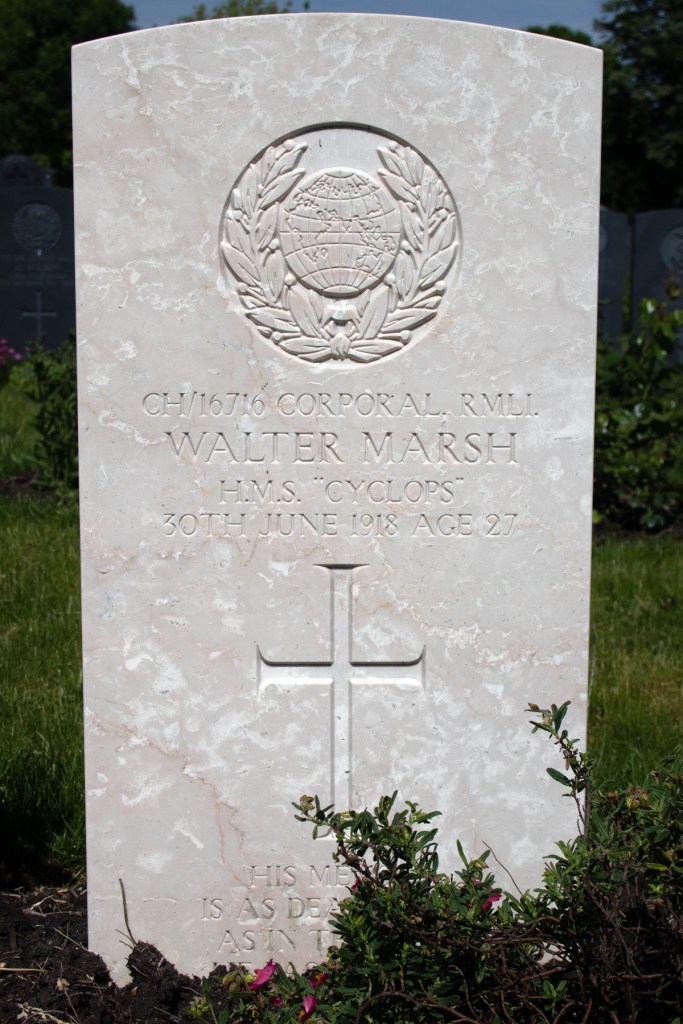
Walter Marsh was born on 17th April 1891 in Beckenham, Kent. The fifth of thirteen children, his parents were Harry and Louisa Marsh. Harry was a bricklayer from Doncaster, Yorkshire, while his wife was from Enfield, Middlesex. By the time their first child was born, however, they had moved to Kent, and the 1901 census found the family living in a small terrace at 77 Birkbeck Road.
In such a large family, it would have been a challenge to find your place. It seems that Walter wasn’t able to make his mark on the world within the constrains of his siblings and so, on 11th August 1910, he enlisted in the Royal Marine Light Infantry. His service records confirm that he was 5ft 6ins (1.68m) tall, with brown hair, blue eyes and a dark complexion. He was also noted as having a scar on his back, and passed his swimming exam when he was tested on 4th November.
Private Marsh’s initial training was undertaken in Deal, Kent, but over the following eight years, his main base was to be the Royal Naval Dockyard in Chatham. In six separate postings, he would spend more than three-and-a-half years at sea, including a year on the battleship HMS Russell and the submarine depot ship HMS Cyclops.
In January 1915 Walter was promoted to the rank of Corporal, and it was around this time that he got married. In the summer of that year, he tied the knot with Gertrude Crozier, a domestic servant, and daughter of a Chatham flour mill labourer.
Corporal Marsh would continue in the Royal Marine Light Infantry until January 1918. Medically discharged, he was seen to no longer be fit for military service, although it is unclear what condition or injury led to the end of his eight year career.
As this point, Walter’s trail goes cold, and the next record relates to his passing. He died in Chatham on 30th June 1918, at the age of 27 years old. Gertrude had given birth to their first child, a daughter named after her mother, just six months before.
The body of Walter Marsh was laid to rest in the naval section of Woodlands Cemetery, Gillingham, Kent, not far from the base that had become a home from home.
After the loss of her husband, Gertrude would go on to marry again, wedding Royal Navy Petty Officer Frederick Harris on 1st January 1920. The couple went on to have a child of their own, daughter Florence, towards the end of that year.
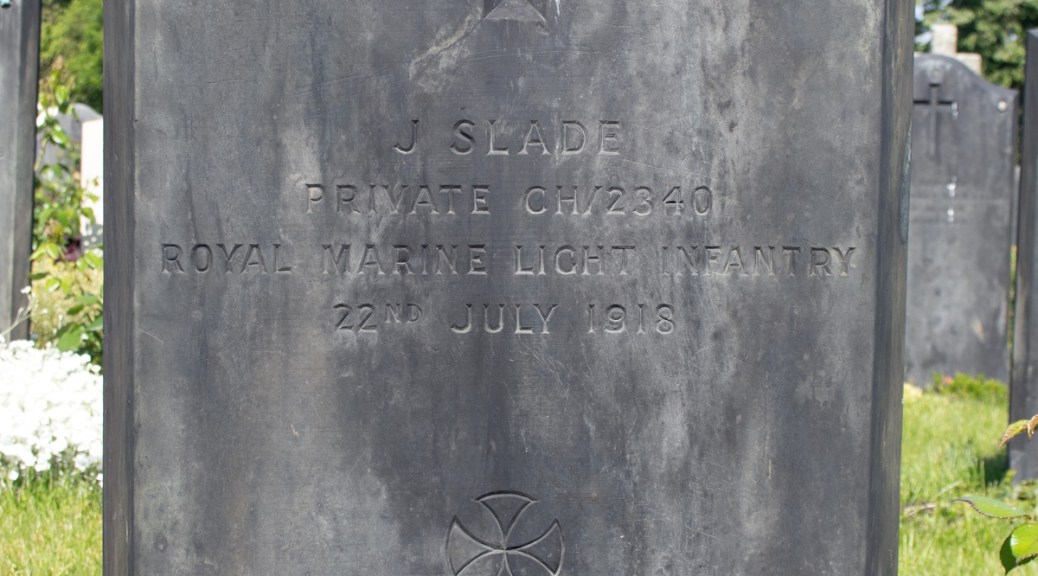
John Slade was born in Winchmore Hill, Buckinghamshire, in 1865. One of three children to Edward and Mary, he also had three half-siblings from his mother’s previous marriage. Edward was a hawker, but when he left school, his son sought bigger and better things. By the time of the 1891 census he was recorded as being a Private in the Royal Marine Light Infantry, and was based in Chatham, Kent.
Sadly, Private Slade’s service records have been lost to time, so it is not possible to identify where his role took him. The 1901 census, however, shed some light on his time in the navy. It found him living at 36 Cross Street in Gillingham, Kent, with his wife, Annie, and his adopted daughter, Lillie. They had also taken on three boarders – Frank Hall, Harry Monk and Charles Barwell – all of whom were in the navy as well.
Ten years later on, and thing had changed once more. Still living in Gillingham, it seems that John’s time in the Royal Marine Light Infantry had come to an end. Instead, he was living at 54 James Street and giving his trade as an unemployed labourer. Still noted as being married, there is no sign of either Annie or Lillie: instead John was living with widow Laura Greyson and her two teenage boys, Charles and George.
At this point, John’s trail goes cold. As he was formally granted a Commonwealth War Grave, he must have stepped up to serve his country once more when war broke out in 1914. He would, however, have been getting on in years at this point, so how for long that service continued is anyone’s guess. He passed away from ‘disease’ on 22nd July 1918, at the age of 53 years of age.
John Slade was laid to rest in the military section of Woodlands Cemetery, Gllingham, the town that had been his home for more than three decades.
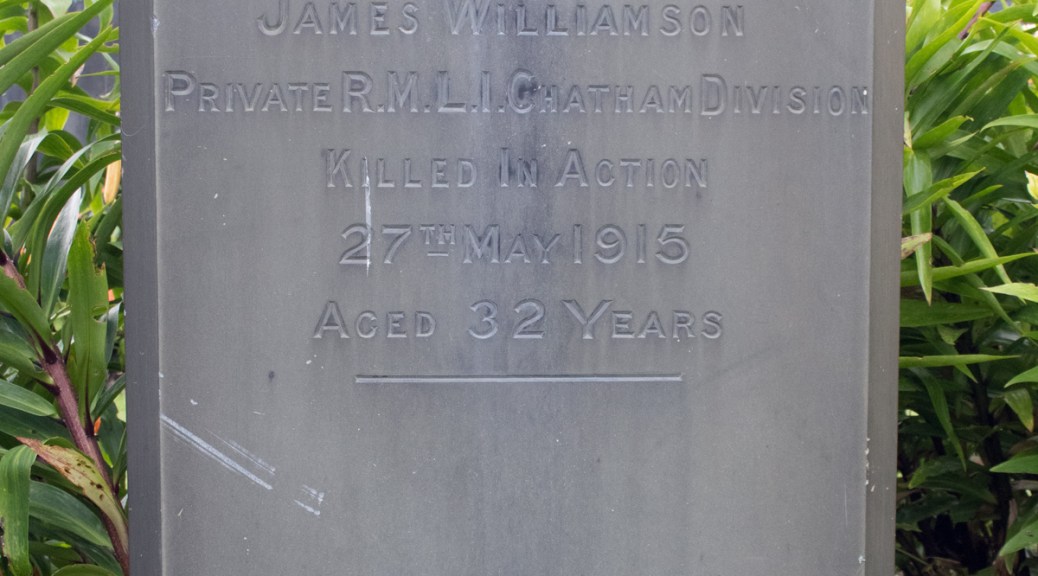
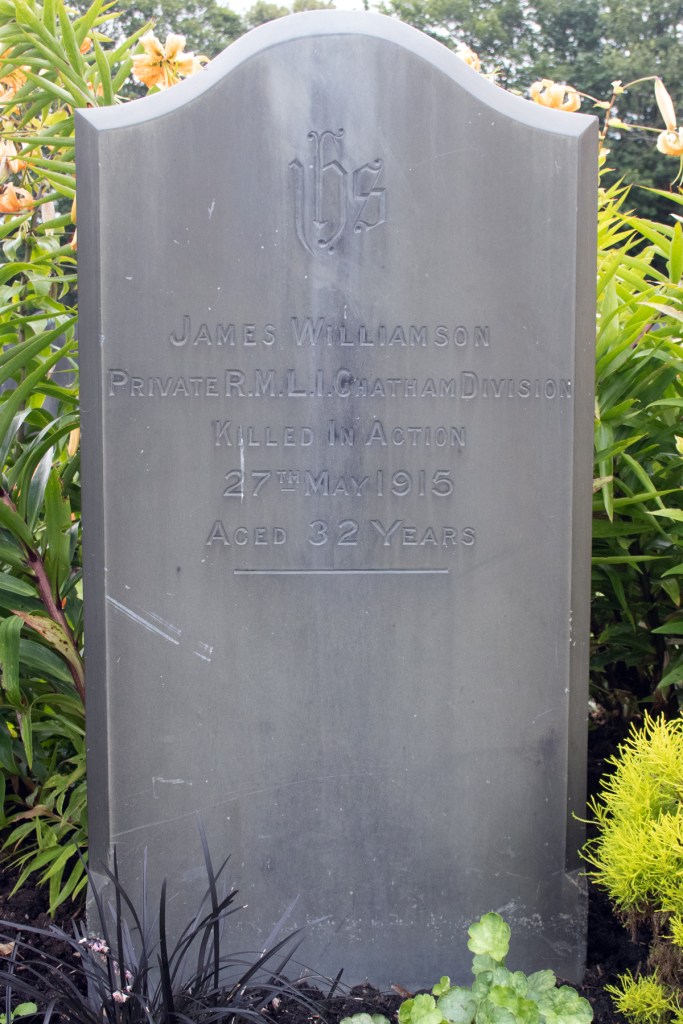
In amongst the rows of naval headstones in the Woodlands Cemetery in Gillingham, Kent, is one dedicated to James Williamson, a Private in the Royal Marine Light Infantry. He was killed in action on 27th May 1915, while attached to the ship HMS Princess Irene, and was 32 years of age when he passed.
There is little specific documentation relating to Private Williamson’s life, but what remains allows us to piece together something of the man he was.
James was born in the Dennistoun area of Glasgow in around 1883, and was one of five children to William and Jane Williamson. When he finished his schooling, he seems to have had a pull to the sea: whether this was because he was following in his father’s footsteps, or because of his home’s proximity to the river and docks is unclear.
By the time of the 1911 census, James was already serving in the Royal Marines. He was based on the cruiser HMS Philomel, which was in the Gulf of Oman on the day the census was taken, and was one of 19 Royal Marines on board our of a total compliment of 244 crew.
There is little more concrete information about Private Williamson’s life. By the spring of 1915, he had been assigned to the HMS Princess Irene, an ocean liner requisitioned during the war and converted into a mine layer. On 27th May, she was moored off Sheerness in Kent, when a series of explosions ripped her apart. More than 270 crewmen were killed: this included the 32-year-old James.
The crew whose bodies were not able to be identified were laid to rest in a communal grave in Woodlands Cemetery: James Williamson was laid to rest nearby, in a burial of his own.
Interestingly, James’ entry on the Royal Navy and Royal Marines War Graves Roll gives his next of kin as a friend, Miss J Malone of 3 Ashview Terrace, Newton Mearns, near Glasgow. There is no other information about her.
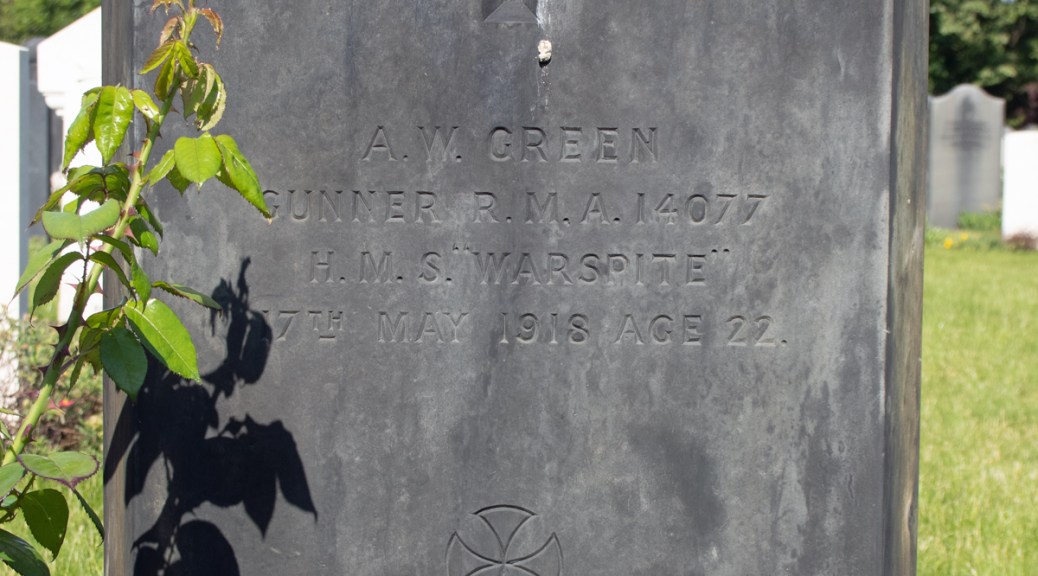
Arthur William Green was born on 27th August 1896, the middle of five children to William and Mary Green. William was a shoemaker, who was employed at the Clark’s factory in Street, Somerset, and this is where the family were born and raised.
Clark’s was the key employer in Street and, by the time of the 1911 census, five of the Green family were working for them. This included the 15 year old Arthur, whose job was a shoe cutter.
When war came to Europe, Arthur had already stepped up to play his part. He enlisted in the Royal Marine Artillery in March 1914. His service records confirm that he was 5ft 8ins (1.72m) tall, with brown hair, blue eyes and a fresh complexion. He was also noted as having a scar on the back of his neck.
Private Green was initially under age for service in the regiment, only coming of age at the end of August 1914. He initially completed his training either in Chatham, Kent, or Plymouth, Devon, becoming a Gunner on 5th February 1915. That spring he was assigned to the battleship HMS Warspite, and would remain on board for the next four years.
In February 1918, Gunner Green was assigned to the 4th Battalion of the Royal Marines. Still serving on Warspite, on 23rd April he was involved in the Raid on Zeebrugge. A combined action by the Royal Navy and Royal Marines, the aim was to block the entrance to the port of Bruges-Zeebrugge by sinking obsolete ships. A total of 1700 men were involved, and, in the ensuing battle, some 200 were killed and 400 wounded.
Gunner Green was one of those who was injured in the battle. When the Warspite returned home, he was admitted to the Royal Naval Hospital in Chatham, Kent, but his injuries were to prove too severe for him to overcome. He passed away on 17th May 1918, at the age of just 21 years old.
Arthur William Green was laid to rest in Woodlands Cemetery, Gillingham, not far from the Chatham base he had briefly known as home.