Tag Archives: Royal Naval Air Service

Leading Mechanic Charles Harris

Leading Mechanic Charles Harris

Charles William Harris was born in Wingham, near Canterbury, Kent, on 19th July 1879. The fourth of eleven children, his parents were Charles and Kate Harris. Charles Sr was a carpenter and builder, and his son was to follow in his stead.

By the time of the 1901 census, however, Charles Jr had stepped out on his own. He had moved to London, and was boarding with the Hurley family, in rooms at 408 Bethnal Green Road, Middlesex.

On 1th June 1902, Charles Jr, now a plumber, married Esther Danton. An engine driver’s daughter from Kent, she was four years her new husband’s senior. The couple set up home at 5 Leatherdale Street in Mile End, and had two children: daughter Lilian was born in 1905, with son George following three years later.

When war broke out, Charles was called upon to play his part. He enlisted in the Royal Naval Air Service as an Air Mechanic, and was quickly promoted to Leading Mechanic. His service records show that, when he joined up on 15th June 1916, he was 5ft 7.5ins (1.71m) tall, with light brown hair, blue eyes and a fresh complexion.

Leading Mechanic Harris would be based out of HMS President, the umbrella name for the Royal Navy’s London bases. He spent time working at Wormwood Scrubs, and, in February 1917, was moved to Kingsnorth, Kent.

What happened next is summed up in a simple statement on Charles’ service papers: “26th May 1917 Accidentally killed by explosion of gas holder.” There is no further information, and nothing in the media about the incident. Leading Mechanic Harris was 37 years of age.

The body of Charles William Harris was taken to the Woodlands Cemetery, Gillingham, Kent. He was laid to rest in the naval section of the burial ground.


Tragedy was to strike again just two years later, when Charles and Esther’s daughter also passed away:

Much sympathy and respect were shown at Holy Trinity Church, Springfield, when the funeral of Lily Harris, the fourteen-year-old daughter of Mrs and the late Mr CW Harris took place. Deceased’s father, who was chauffeur to the Bishop of Chelmsford, lost his life in the war while serving with the RNAS, and this fact added to the regret felt by the parishioners at the further sad loss sustained by his widow, who is now left with only one little boy. The funeral procession included a large number of the scholars of the Springfield Day and Sunday Schools, with Mr R Coward of the day school, and practically every child carried a floral tribute. There was also a large attendance of neighbours and friends, including children, assembled at the church. The Bishop of Chelmsford officiated… [and] gave a touching address to the church, speaking particularly to the children; and his lordship also performed the last sad rites at the graveside.

[Essex Newsman: Saturday 29th November 1919]

There is no evidence of any connection between Charles and the Bishop of Chelmsford: as far as the records show, he was never a chauffeur, working as a builder, plumber and gas fitter before enlisting.


Captain Percy Rawlings

Captain Percy Rawlings

Percy Townley Rawlings was born on 22nd September 1887 in Clapham, Surrey. Details of his early life are sketchy, and most of the information comes from second hand accounts. His baptism record gives his parents as Edward and Lizzie Rawlings. Edward was listed as being a gentleman, but there is no record of the family on the 1891, or 1901 census returns.

He was educated at Westminster School and Cambridge University, where he obtained honours in the Mechanical Sciences Tripos.

In 1910 he went to Woolwich Arsenal as [an] advanced workshop student, and in the following year he obtained a Commission in the Royal Engineers…

In 1912 he entered the Public Works Department of the Sudan Government, and during 1913-14 acted as engineer to the Egyptian Irrigation Service on the construction of the Blue Nile Dam.

On the outbreak of the War he was sent to France [as a Lieutenant in the Royal Engineers], in the 2nd Field Co., being transferred in the following year to the [Royal Naval Volunteer Reserve], for engineering duties with the [Royal Naval Air Service].

In 1917 he flew to Constantinople in a Handley-Page machine, and bombed the Goeben, for which he received the DSC.

[1921 Institution of Mechanical Engineers: Obituaries]

By the end of the conflict, Percy had been promoted to Captain. After the Armistice he remained involved in the Royal Air Force, and was involved in testing the rapidly changing technology of flight.

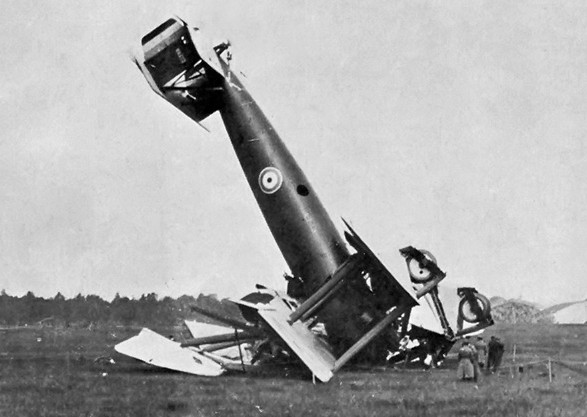
A Tarrant triplane, constructed at the Royal Aircraft Factory, Farnborough, was wrecked on a trial flight on Monday. The machine, which had six engines, each developing 500 horse power, after running along the ground toppled forward and seemed to bury itself in the earth. One of the pilots… Captain Rawlings, has died, and the other, Capt. Dunn, is in a very grave condition.

[Waterford Standard: Wednesday 28th May 1919]

Captain Percy Rawlings’ Tarrant triplane after the crash

Captain Dunn also died in the crash, which happened on 26th May 1919. Percy was 31 years of age when he died.

A close friend, Henry Edmunds, wrote to the Flight Magazine to express his sympathy at the loss:

As a boy, Rawlings was always interested in scientific matters, particularly photography and motors..

He was manly, open, and frank, fearless and honest, of an enquiring mind, and fond of experimenting. I remember his pre-heating paraffin vapour electrically, as a fuel for explosive engines…

It was at my house at Brighton that Rawlings met Mr. W. G. Tarrant, who was spending the week-end with me. Rawlings had just returned from the famous flight in the Handley Page to Constantinople, where he bombed the ‘Goeben.’ I remember his describing vividly his impressions of that memorable journey. If I recollect correctly, he motored down to Folkestone somewhat rapidly. He told me he believed the police were on the look-out for him for exceeding the speed-limit; but he went from Folkestone by air, proceeding to Naples. It was delightful to hear him recount that remarkable voyage. Their fears lest they should not be able to cross some of the high mountain ranges with the heavy load they were carrying, and where, had anything happened, they would have been out of the reach of all human aid. How he availed himself of a special camera for photographing portions of his trip, the results of which he feared it might be unwise to disclose at that time, so he brought the negatives back with him, and I believe they wore kept personally until after the War.

He and Mr. Tarrant were mutually attracted to each other, and discussed with much seriousness the construction of a new type of bombing-plane, which eventuated in the great Tarrant machine. Rawlings joined Tarrant shortly afterwards, and devoted all his energies to carrying on the work of design and construction. On several occasions he came down to see me, and related his experiences. He was full of confidence as to the future of his work; and invited me to take my first flight with him.

Townley Rawlings was a gallant gentleman. Those whom the gods love are taken early.

[Flight Magazine: 29th May 1919]

The speeding incident is an interesting anecdote, another similar incident recorded in a separate newspaper report:

Chauffeur Summoned for Fast Driving

Capt. Rawlings, who was killed in the Tarrant triplane accident, should have appeared as a witness yesterday in the Kingston court.

His chauffeur, Arthur B Cogger, of West Byfleet, summoned for exceeding the limit, was driving Captain Rawlings to Farnborough on Saturday, before the accident.

He said the captain told him he wanted to get along as quickly as possible as he was going to test an aeroplane. He had intended to come to court.

The summons was dismissed.

[Dublin Daily Express: Saturday 31st May 1919]

Percy Townley Rawlings was laid to rest in Highgate Cemetery, possibly close to where he or his family had been living.


Second Aircraftman Albert Jenner

Second Aircraftman Albert Jenner

Albert Jenner was born on 27th April 1887 in the Kent village of Hollingbourne. He was one of nine children to scaffolder and builder’s labourer Thomas Jenner and his wife, Emma.

By the time of the 1911 census, Albert was living with his parents and three of his siblings in a house on Well Street in Loose, near Maidstone. He was employed as a bricklayer’s labourer, while his brothers and father were all doing farm work.

At this point, Albert’s trail goes cold. It is clear that, when war was declared, he enlisted in the Royal Naval Air Service, although the specific dates are unknown. His younger brother Private Arthur Jenner, of the 6th Battalion of the Queen’s Own (Royal West Kent) Regiment died in northern France in July 1916, but it is unclear whether Albert had already stepped up to serve by this point.

Second Aircraftman Jenner was based at the Kingsnorth Air Base, on the Hoo Peninsula in Kent. This was a Royal Naval Air Service training station, which also experimented with air ships. There is little to document Albert’s time there, however, and, given his rank, it is likely that he was not there for very long.

The only other document directly connected to Albert confirms his passing. He died at the base on 3rd April 1917, having contracted measles, which escalated into pyaemia, or sepsis. He was a few days away from his 30th birthday.

Albert Jenner was laid to rest in the Woodlands Cemetery, in Gillingham, Kent.


Boy Mechanic William Mackay

Boy Mechanic William Mackay

William James Mackay was born in Bath, Somerset, on 2nd January 1900. The son of a woman called Matilda, the following year’s census found him living as a nurse child in the home of John and Elizabeth Logie. The household was made up of the Logies, their five children, a boarder, and another nurse child, Harold Fellows.

The next census, taken in the spring of 1911, shows a change in circumstances for the family. Matilda and William were living in the Walcot area of the city, with Matilda’s husband, William Smith. The document suggests that the couple had been married for twelve years, but this would not account for the younger William’s original surname. The census return states that he had taken the name of Smith as well, and there was a fourth resident in the household, widow Elizabeth Clarke.

War came to Europe in the summer of 1914, and William Jr was keen to step up and play his part. Because of his age he was unable to enlist immediately, and it was not until the start of 1917, that he was able to enlist.

William – who had returned to the name Mackay by this point – was working as a clerk when he joined the Royal Naval Air Service (RNAS) on 23rd January 1917. His service records show that he enlisted as a Boy Mechanic, and that he was 5ft 8.5ins (1.74m) tall. He had brown hair, brown eyes and a fresh complexion.

Boy Mechanic Mackey was assigned to HMS Daedelus, one of the RNAS shore-based facilities: it was here that he was to receive his training over the spring and summer. Military barracks were notoriously cramped and hotbeds for illness and disease, and William was not to be immune to health issues. He contracted cerebrospinal meningitis within months of arriving at the base, and passed away on 5th August 1917. He was just 17 years of age.

William James Mackay was brought back to Somerset for burial. He was laid to rest in the sweeping grounds of Bath’s Locksbrook Cemetery.


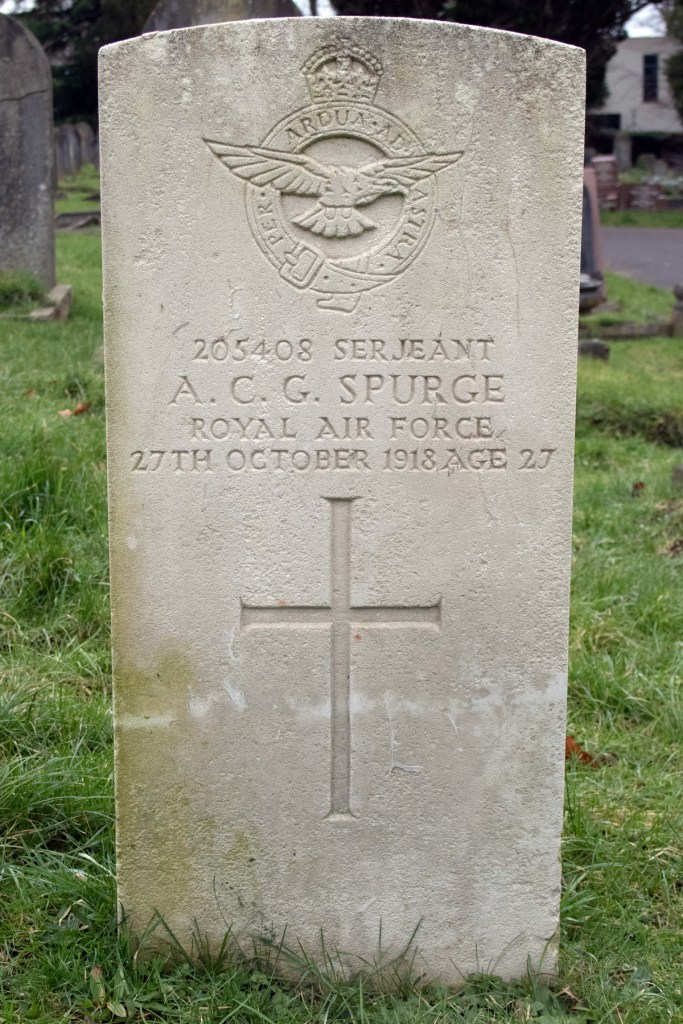
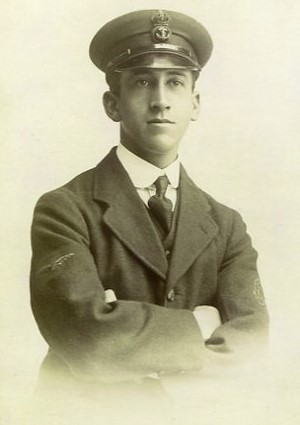
Serjeant Algernon Spurge

Serjeant Algernon Spurge

Algernon Carlyle Graham Spurge was born on 27th August 1891 in Bath, Somerset. The middle of five children, his parents were Algernon and Ida Spurge.

Algernon Sr was a portrait photographer, based in the Twerton area of the city, and this was very much a family business. The 1901 census recorded the Spurges as living in Victoria Road, Bath, with Ida’s brother, Tom Leaman, who was working as a photographic reloader.

Later that year, however, things were to take a turn for the worst. Algernon Sr seems to have been having some business worries and, on the morning of 16th December, he set off for work as usual. His and Ida’s daughter, also called Ida, arrived at the studio to find her father in some distress, a bottle of potassium cyanide – used as part of the photographic process at the time – next to him. He asked Ida to fetch him some water and salt, but when she returned, he declared it was too late, and lost consciousness. A doctor was called, but Algernon passed away shortly after he arrived.

A note was found, which read “My dearest wife, I really cannot stand the worry and anxiety of another day, to say nothing of weeks and perhaps months. Ask Mr Ashman and Mr Withy to be kind enough to help you straighten out matters a little. My best love to you and all my dear ones. AS” [Somerset Guardian and Radstock Observer – Saturday 21 December 1901] Ashman and Withy were family friends, who were also in the photography business.

An inquest was held and a verdict of suicide while temporarily insane was recorded.

The family rallied round, and Algernon’s widow and children moved in with Ida’s widowed mother in Bristol. Algernon’s daughter Ida continued working in photography, and Algernon Jr also took up the business. The 1911 census found him boarding with, and working for, his uncle Tom in Bath.

War was closing in on Europe by this point and, when it was declared, Algernon stepped up to play his part. He enlisted in the Royal Naval Air Service on 4th June 1915 as a Leading Mechanic (Photography). His service records show that he was 5ft 5ins (1.66m) tall, with dark brown hair, brown eyes and a dark complexion.

Algernon was initially assigned to the shore establishment HMS President in London for three years, rising to the rank of Petty Officer Mechanic (Photography). In April 1918, when the Royal Air Force was created he transferred across to HMS Daedalus in Lee-on-Solent, Hampshire, and rising to the rank of Sergeant Mechanic.

That autumn, with the end of the war in sight, Algernon fell ill. He contracted influenza, and this developed into pneumonia. He was admitted to the Military Hospital in York, but the conditions were to prove too much for his body to take. He died on 27th October 1918, aged just 27 years old.

The body of Algernon Carlyle Graham Spurge was brought back to Somerset for burial. He was laid to rest in St James Cemetery, Bath, not far from his father. When Ida passed away in 1926, she was buried in the same cemetery, father, mother and son reunited once more


Serjeant Algernon Spurge
(from ancestry.co.uk)

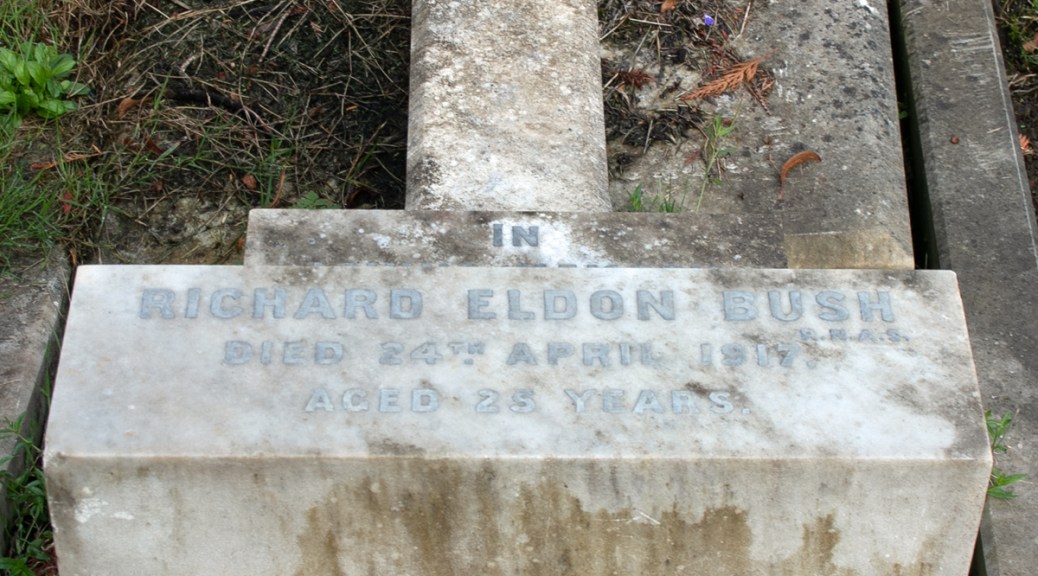
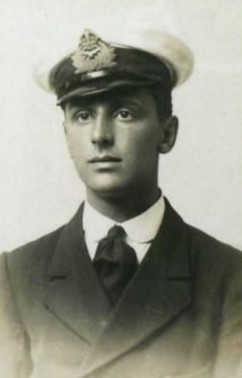
Flight Lieutenant Richard Bush

Flight Lieutenant Richard Bush

Richard Eldon Bush was born on 16th June 1891 in Keynsham, Somerset. The second of four children (all of whom were boys), his parents were Philip and Maria Bush. Philip was a solicitor, and with that status came opportunity for his children.

The 1911 census recorded the Bush family living in Keynsham with two servants – cook Clara Jones and parlour maid Laura Day. The two older boys – Richard and his older brother, Whittington, were both listed as Cambridge undergraduates, while his two young brothers were boarding at a private school in Repton, Yorkshire.

Richard had aspirations for a good life. In March 1914, he set sail for a life in Canada, looking to take up architecture in the colony. His time overseas wasn’t to be long, though, and, when war broke out in Europe, he returned home.

Full details of Richard’s military service are not available, but he joined the Royal Naval Air Service and, on 20th August 1915, he gained his wings. Richard rose to the rank of Flight Lieutenant, but tragedy was ahead.

On 24th April 1917, he was piloting a scout seaplane around the harbour in Fishguard, Pembrokeshire.

[He] failed to clear some overhead wires, and the seaplane swerved against the cliff with considerable violence, smashing the machine, which the petrol set alight, and crashed to the earth. When liberated from the blazing machine Lieutenant Bush rolled and extinguished his burning clothes.

Somerset Guardian and Radstock Observer: Friday 27th April 1917

Sadly, Flight Lieutenant Bush’s injuries proved too severe. He passed away a couple of days later, on 24th April 1917, at the age of 25 years old.

Brought back to Somerset for burial, Richard Eldon Bush was laid to rest in the cemetery of his home town, Keynsham.


Flight Lieutenant Richard Bush
(from astreetnearyou.org)

The same newspaper report noted that Richard’s brother Graham was an officer in the Royal Flying Corps. He had also been badly injured in a flying accident, but was, according to the report, “flying again now.