Tag Archives: Royal Navy

Ship’s Corporal Thomas Berry

Ship’s Corporal Thomas Berry

Details of the civilian life of Thomas Joseph Berry are a challenge to piece together. He is not recognisable in any census returns, and baptism records don’t tally either.

The main resource for building a picture of Thomas’ life is the service record for his time in the Royal Navy. This provides his date of birth – 6th May 1882 – and suggests that he was born in Hornsey, Middlesex. He was working as a cabinet maker when he enlisted, the document also confirming that he was 5ft 4ins (1.62m) tall, with brown hair, brown eyes and a fresh complexion.

Thomas began his naval career on 29th July 1898. Below the age to formally enlist, he was given the rank of Boy 2nd Class. Over the next eighteen months, his time was split between two training ships based in Devonport, Devon, HMS Impregnable and HMS Lion. In April 1899 he was promoted to Boy 1st Class.

In February 1900, Thomas moved to HMS Vivid, the Royal Naval Dockyard in Devonport. On 6th May he came of age, and was formally enrolled in the navy, receiving the rank of Ordinary Seaman. From this point his career took off and, over the next sixteen years, he would go on to serve on board fifteen ships, seeing the world.

At his annual reports, Thomas’ conduct was regularly identified as Very Good, and his commitment was reflected in the progress he made through the ranks. By June 1901, he had been promoted to Able Seaman Berry. The summer of 1907 saw him move up to Leading Seaman, and three years later, Thomas was a Petty Officer. In November 1911 he was made Ship’s Corporal 2nd Class, and by the following spring he had been promoted again, this time to Ship’s Corporal 1st Class.

Away from the Royal Navy, Thomas’ personal life was developing. Again there is little documentation to provide any specifics, but he married a woman called Albertine Elizabeth in the early 1910s. The couple went on to have a son, Bernard, who was born on 15th January 1913, and the family seemed to settle down in Paignton, Devon – a later record giving Albertine’s address as 3 Alma Terrace, Well Street.

When war broke out in the summer of 1914, Ship’s Corporal Berry was serving on board the protected cruiser HMS Blake. In February 1916, he was assigned to the battleship HMS Revenge which served in the English Channel.

By this point, Thomas’ health seemed to be taking a downturn. He was posted back to HMS Vivid on 7th March, but was then transferred to Devon County Asylum in Exminster, suffering from “general paralysis of the insane“. His condition worsened and he passed away on 29th April 1916: he was days away from his 34th birthday.

Thomas Joseph Berry’s body was brought back to Paignton for burial. He was laid to rest in the town’s cemetery.


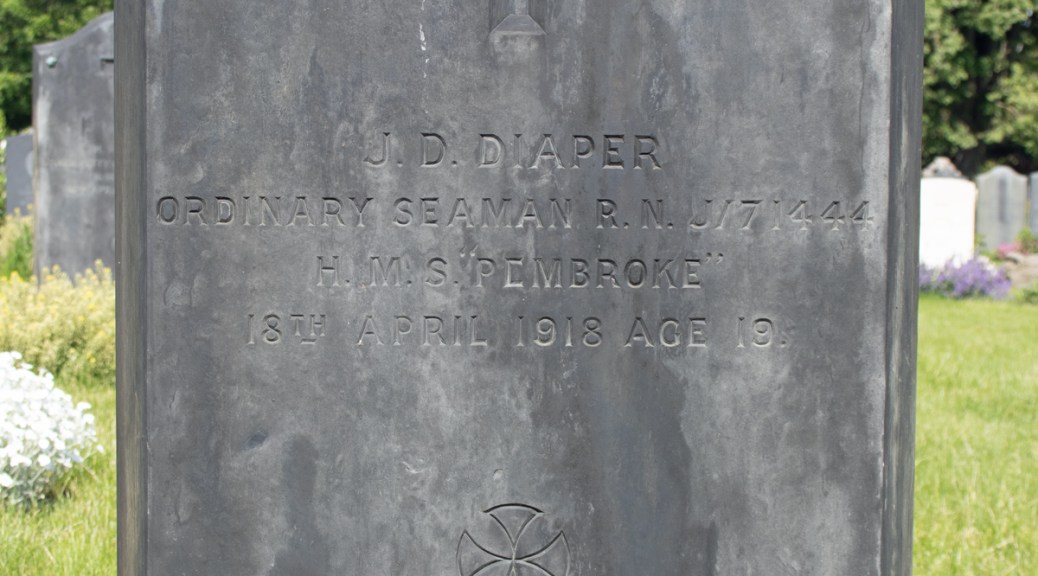
Ordinary Seaman John Diaper

Ordinary Seaman John Diaper

John Dolby Diaper was born in Stowupland, Suffolk, on 1st June 1898. He was the second youngest of ten children to George and Martha, and the older of two sons. George was a cattleman turned gardener, and it seems that John went into farm work when he completed his schooling.

When war broke out, John was called upon to play his part. He enlisted in the Royal Navy on 6th June 1917, joining as an Ordinary Seaman. His service records show that he was 5ft 4.5ins (1.63m) tall, with brown hair, grey eyes and a fair complexion.

Ordinary Seaman Diaper was sent to HMS Pembroke, the Royal Naval Dockyard in Chatham, Kent, for his training. The summer of 1917 was a particularly busy for the base, and temporary accommodation was set up in the Drill Hall; this is where John was billeted.

On the night of 3rd September 1917, Chatham suddenly found itself in the firing line as a wave of German aircraft bombed the town. The Drill Hall received a direct hit, and Ordinary Seaman Diaper was badly injured. He was admitted to the Royal Naval Hospital in the town, and would remain there for some time.

John’s injuries were severe and, although his treatment was ongoing, the impact on his overall health was detrimental. Ultimately, the air raid weakened his system, and his heart gave out. He died on 18th April 1918, more than seven months after the bombing: he was 19 years of age.

John Dolby Diaper was laid to rest in Woodlands Cemetery, Gillingham, alongside those who had given their lives on 3rd September.


Officer’s Steward Giovanni Teuma

Officer’s Steward Giovanni Teuma

Giovanni Teuma was born on 25th December 1878 in Valetta, Malta. There is little information about his early life, but documents confirm that his parents were Paulo and Vinza Teuma.

Most of the information about Giovanni comes from his service records. He enlisted in the Royal Navy on 13th February 1898 as a Domestic 3rd Class. He was noted as being 5ft 5ins (1.65m) tall, with brown eyes, black hair and a dark complexion.

Giovanni’s first posting was on the cruiser HMS Venus. He remained on board for more than three years, which would be his longest assignment. Over the next fifteen years, he would serve on another dozen vessels, returning to shore at HMS Victory and HMS Pembroke – the Royal Naval Dockyards in Portsmouth, Hampshire, and Chatham, Kent, respectively – in between voyages.

Giovanni continually attained a Very Good rating at his annual reviews, and rose through the ranks over the years. He was promoted to Domestic 2nd Class in March 1905 and Officer’s Steward 2nd Class in October 1907. At this point, however, his ranks started to vary, spending just over a year as Officer’s Cook 1st Class before returning to the rank of Officer’s Steward 2nd Class.

On 21st January 1914, Giovanni was stood down: he seems to have requested extended shore leave. He returned to action three months later, retaking his previous rank. On 11th August, just a few weeks after war was declared, he was assigned to the light cruiser HMS Arethusa, as Officer’s Steward 1st Class.

The Arethusa had been launched in the autumn of 1913, and was confirmed as the flotilla leader of the Harwich Force when was was declared. Within weeks of Officer Steward Teuma boarding her, she was involved in the Battle of Heligoland Bight. Severely damaged by two German cruisers, a number of the crew were killed and injured, and she had to be towed home.

When the Arethusa docked at HMS Pembroke, those who were injured were taken to the Royal Naval Hospital in Chatham. Officer’s Steward Teuma was one of those treated there but, sadly, his wounds were to prove too severe. He passed away on 29th August 1914, the day after the battle: he was 35 years of age.

Givoanni Teuma was laid to rest in Woodlands Cemetery, Gillingham, not far from the Kent naval base he had visited regularly.


Petty Officer John Baker

Petty Officer John Baker

John Patrick Baker was born on 20th March 1883, the only child to Henry and Mary Baker. Henry was naval pensioner-turned-labourer from Belfast, Ireland, while Mary was born in Queenstown, Ireland. By the time of the John’s birth, however, they had moved to Kent, settling in the village of Cheriton.

John is noticeable by his absence in the coming years. The 1901 census return found his parents living in the same home, but the only other resident was boarder Jesse Fuller.

The 1911 census, however, helps explain this disappearance. The document records John as being one of more than 500 crew on board the cruiser HMS Highflyer. He was notes as being a Leading Seaman and, on the day that the census was taken, the ship was in the Laccadive Sea, off the coast of western India, to the south of Goa.

John is also noted as being married, and it seems that he wed a woman called Adela the previous year. Her entry in the 1911 census noted she was living in a room at 206 Risboro Lane in Cheriton, Kent. The house was also occupied by the Leach family – William, Hannah and daughter Margaret – and a Christina Hawkes, who was also married. Whether they were all related is unclear, but Adela, at 30 years of age, was working as a domestic servant to pay her way.

Adela and John would go on to have two children: John Jr was born on 31st July 1911 – just four months after the census. His younger brother Ernest was born on 21st May 1914, four months before the outbreak of war.

There is little further information available on the Baker Family. John progressed in his naval career, and had risen to the rank of Petty Officer by the end of 1915. That winter he became unwell, although the condition is not readily documented. He was posted at HMS Pembroke, the Royal Naval Dockyard in Chatham, Kent, by this point, and he may well have been admitted to the nearby Naval Hospital.

His illness was to prove fatal, however, and Petty Officer Baker passed away on 13th January 1916. He was 32 years of age.

John Patrick Baker was laid to rest in the Roman Catholic section of the Woodland Cemetery in Gillingham, Kent, not far from the base he had known so well.


Engine Room Artificer James Donnelly

Engine Room Artificer James Donnelly

James Donnelly’s life is a challenging one to pin down. Based on the Commonwealth War Graves Commission information, he was born in 1888 in Cappagh, County Tyrone, Northern Ireland, and was the son of Owen and Mary Donnelly. Unfortunately, there are no baptism or census records to expand on his family background.

Military records are equally sparse. James enlisted in the Royal Navy as an Engine Room Artificer 4th Class. He was assigned to HMS Pembroke, the Royal Naval Dockyard in Chatham, Kent; given how early in the conflict, and his position at the lower end of the ERA rankings, is it likely that he was posted there for training.

James’ time in the military was to be brief. He was admitted to the Royal Naval Hospital in Chatham, suffering from cerebrospinal meningitis. The condition was to prove severe: he succumbed to it on 19th May 1915, at the age of 27 years old.

Finances may have prevented the Donnelly family from bringing their boy back home. Instead, James was laid to rest in the Roman Catholic section of Woodlands Cemetery, Gillingham, not far from the naval base at which he had served.


Engine Room Artificer James Donnelly
(from findagrave.com)

Stoker 2nd Class John Gearing

Stoker 2nd Class John Gearing

John Gearing was born in Paddington, Middlesex, on 12th August 1894. There is little concrete information about his early life, although a later document confirms he was the son of Mrs E Gearing, of 5 York Place, Hammersmith.

John was working as a fireman when war was declared. When he was called upon to serve his King and Country, he chose to enlist in the Royal Navy, joining up on 5th January 1916. His service records show that he was 5ft 9.5ins (1.76m) tall, with brown hair, blue eyes and a fresh complexion.

Stoker 2nd Class Gearing was initially sent to HMS Pembroke, the Royal Naval Dockyard in Chatham, Kent, for his training. He would remain attached to the base, and was assigned to HMS Victorious, the dockyard’s repair ship, from April 1916.

John’s time in the navy was not to be a lengthy one. Transferred back to HMS Pembroke in September, it seems that his health was becoming affected by the work he was doing. He was admitted to the Royal Naval Hospital in Chatham, suffering from what was later identified as carcinoma of the intestines. He passed away from the condition on 22nd December 1916, aged just 22 years old.

John Gearing was laid to rest in the Woodlands Cemetery, Gillingham, not far from the naval base he had come to call home.


Petty Officer Ellis Sayer

Petty Officer Ellis Sayer

Much of the life of Ellis Edward Sayer seems destined to remained shrouded in the mists of time. Born in Attleborough, Norfolk on 31st January 1888, the only census return he appears on dates from 1891. This records him as living with his grandmother, Maria Simons, who was noted as being married and working as a laundress. Ellis’ 16-year-old uncle, William, was also living there and employed as a groom.

Jumping forward a few years and, on 31st December 1907, Ellis enlisted in the Royal Navy. His service records note that he had previously been employed as a messenger, and there seems to have been some previous marine connection. The document shows that he was 5ft 8ins (1.72m), with dark brown hair, blue eyes and a fresh complexion. He was also noted as having tattoos of a dragon, a rose and the word ‘unity’ on his left forearm.

As an Ordinary Seaman, Ellis was initially sent to HMS Pembroke, the Royal Naval Dockyard in Chatham, Kent, for his training. He was only there for a matter of weeks before being assigned to the HMS Cochrane then HMS Natal.

On 7th April 1908, Ordinary Seaman Sayer was attached to the cruiser HMS Lancaster, and he was to remain with her for close to two years. Promoted to Able Seaman on 26th November 1909, his time on board came to a close in May 1910.

Over the next few years, Ellis continued his progress in his naval career. After a year on shore in Chatham, he was assigned to HMS Blonde, and was promoted to Leading Seaman in August 1912. He returned to HMS Pembroke the next month, and remained attached to the dockyard for the next year and a half: his experience likely being used to support newer recruits.

On 6th March 1914, Leading Seaman Sayer was assigned to the battleship HMS Commonwealth. Over the next three years she patrolled the North Sea, from the Norwegian coast and Shetland in the north to Dogger Bank in the south. On 1st August 1915, Ellis receive a further promotion, holding the rank of Petty Officer for the remainder of his time on board Commonwealth.

On 18th February 1917, Ellis’ life came to an abrupt end. There is little information available about his passing, one record stating that he died from an injury to his kidney which was as a result of an accident, while another states ‘rupture of kidney caused through [a] fall’. HMS Commonwealth seems to have been moored in Chatham, however, as he passed away in the town’s Royal Naval Hospital. He was 29 years of age.

Petty Officer Sayer’s next-of-kins were noted as his sister, Mrs J Andrews, who lived in Norwich, and a friend, Mrs Ethel Hampton, who lived in Gillingham, Kent.

Ellis Edward Sayer’s body was laid to rest in the Woodlands Cemetery, Gillingham, not far from the dockyard he had called home for so long.


Able Seaman Horace Freeman

Able Seaman Horace Freeman

Horace James Freeman was born in Hackney, East London, on 16th September 1879. The second of five children, his parents were Archibald and Mary Freeman. According to the 1891 census, Archibald was employed as a carman, but the next document had him listed simply as a ‘traveller’.

When he completed his schooling, Horace found work as a baker’s assistant. He sought bigger and better things, however, and, on 13th February 1897, he enlisted in the Royal Navy. His service records show that he was 5ft 5.5ins (1.66m) tall, with brown hair, hazel eyes and a fresh complexion.

A few months under full age, Horace was initially given the rank of Boy 2nd Class. He was sent to the training ship HMS Northampton, and seemingly impressed his superiors, rising to Boy 1st Class within a couple of months. He moved to another training vessel, HMS Calliope, in July 1897, and was serving on board when he came of age that September.

Now formally inducted into the Royal Navy, Ordinary Seaman Freeman began what was to be an eighteen year career at sea. He would become based at HMS Pembroke, the Royal Naval Dockyard in Chatham, Kent, and went on to serve aboard nine ships during his time.

Promoted to the rank of Able Seaman in October 1899, Horace’s time in the navy was not to be without incident. He spent eight separate periods of time in the cells, 158 days in total. Full details of his misdemeanours are lost to time, but at least on at least one occasion he was placed in the brig for refusing orders.

On Christmas Day 1911, Horace married Sarah Byatt. She was a bricklayer’s daughter from Tottenham, and the couple went on to have two children: Clifford, born in 1913, and Leslie, born two years later.

While Sarah was looking after their young family, Horace spent a lot of his time at sea. As time moved on, however, he was based at HMS Pembroke for longer spells, and it was while he was in Chatham early in 1916 that fate befell him.

The body of Horace J Freeman, an able seaman of the RFR, who had been missing from his ship since February 25th, was found floating in South Lock at Chatham Dockyard on Saturday.

[South Eastern Gazette: Tuesday 11th April 1916]

Little additional information is available about Horace’s death, and it is unclear how he had fallen into the lock. He was 36 years of age.

The body of Able Seaman Horace James Freeman was laid to rest in Gillingham’s Woodlands Cemetery, not far from the naval base he had called home for so long.


Able Seaman Charles Dorman

Able Seaman Charles Dorman

Charles Columbus Dorman was born on 21st October 1892, and was the middle of three children to James and Margaret Dorman. Charles’ parents both hailed from Belfast, Country Antrim, but the 1901 census records his and his older sister’s birthplace as America. No baptism documents are available and no later information supports this, so, while his unusual middle name may suggest the place of his birth, it seems destined to remain unclear.

When he left school, Charles found work as a printer’s apprentice. He sought more, however, and was drawn to a life at sea. On 29th November 1910, he enlisted in the Royal Navy as an Ordinary Seaman. His service records confirm that he was 5ft 3.5ins (1.61m) tall, with brown hair, hazel eyes and a fresh complexion.

Charles was sent to HMS Pembroke – the Royal Naval Dockyard in Chatham, Kent – for his training. In January 1911, he was assigned to the ill-fated HMS Bulwark, before moving to the battleship HMS Implacable three months later. He would remain on board until the summer of 1914, gaining a promotion to Able Seaman during his three year stint there.

Charles was serving on Implacable when war was declared. At the beginning of September, after a week back in Chatham, was assigned to the sloop HMS Cormorant. After six months aboard, the cruiser HMS Blenheim became his home, and he spent the next month supporting troops who were being sent to Gallipoli.

By this point, Able Seaman Dorman had become unwell. He had contracted the autoimmune disease pemphigus, resulting in blistering to his skin and body. He returned to HMS Pembroke, and was stood down from the service on medical grounds 9th July 1916.

It is unclear whether or not Charles was admitted to hospital for his condition. Either way, he succumbed to the illness on 31st August 1916. He was just 23 years of age.

Charles Columbus Dorman’s family appear to have been unable to bring their boy back to Ireland for burial. Instead, he was laid to rest in Woodlands Cemetery, Gillingham, not far from the Kent naval base he had come to call home.

Officer’s Steward Thomas Ounan

Officer’s Steward Thomas Ounan

Thomas Peter Ounan was born on 21st July 1894 in St Helier, Jersey. The oldest of three children, his parents were Thomas and Augustine Ounan. Thomas Sr was a groom from England, who had married his Jersey-born wife and settled on the island to raise their family.

There is, in fact, little documented information about young Thomas’ life. From his military service records, it would seem that he found employment as a steward when he left school. When war broke out, he was called upon to play his part and, on 10th June 1916, he enlisted in the Royal Navy as an Officer’s Steward 3rd Class.

Thomas was initially sent to HMS Victory – the Royal Naval Dockyard in Portsmouth, Hampshire – for training. After a month he was assigned to the steam ship HMS Lucia, spending the next few months on board. At this point, he became unwell, having contracted tuberculosis. and was admitted to hospital in Portsmouth for treatment.

On 30th August 1916, Officer’s Steward Ounan was medically discharge from naval duty due to the condition. He returned to Jersey, remaining in the family home for the next year.

Thomas’ condition was to get the better of him, though. He passed away from tuberculosis at home on 6th October 1917: he was 23 years of age.

Thomas Peter Ounan was laid to rest in the peaceful La Croix Cemetery in Grouville.