Leonard Francis Tucker was born in 1898, the middle of three children to Arthur and Frances Tucker. Arthur was a tailor from Taunton, Somerset, and this is where he brought his young family up.
Sadly, little documentation remains of Leonard’s life. His grave confirms that, when war came, he served in the Royal Navy, and, at the time of his death, he was a Deck Hand on HMS Vivid.
His Commonwealth War Graves Records confirm that his parents were living in Melbourne – his pension ledger confirms Arthur as his next of kin, with an Australian address. There is nothing to confirm their emigration, or whether Leonard emigrated as well.
Leonard’s young life is summed up in a short notice in the local newspaper, which has the simple comment “Tucker – Sept. 28th, at 10 Westgate-street, Taunton, Leonard Francis Tucker, aged 20.” [Taunton Courier and Western Advertiser: Wednesday 9th October 1918]
Slightly more confusing is the next name on that list: “Tucker – Sept. 29, at 10 Westgate-street, Taunton, Frances Ellen Tucker, aged 44.” It would seem that Leonard’s mother was in England, not Australia, at the time of his death, and that she passed away a day after him.
Combined with when Leonard died, it would suggest both he and his mother died from one of the respiratory conditions running rampant through England at the time, possibly influenza or pneumonia. There is nothing to confirm this outright, but it seems the likeliest outcome for the poor mother and son.
Leonard Francis Tucker lies at rest in St Mary’s Cemetery in his home town of Taunton.
As an aside to this, there is no record of where Frances was buried, but it is likely that she too was laid to rest in St Mary’s Cemetery.
Gerald Montague Brine war born in October 1897, the youngest of seven children to John and Annie Brine. John was a potter, and, while the children were born in Dorset, the family soon moved to the Somerset village of Binegar.
Gerald’s three older brothers all went to work in a local stone quarry, as an engineer, breaker and foreman respectively. When Gerald left school, he found work with the local blacksmith as a striker. It was while employed there, in 1912, that his mother Annie passed away, aged just 50 years old.
War was on its way however, and where his brothers enlisted in the army, Gerald was bound for the sea. He enlisted in the Royal Navy on 3rd November 1915 and, as an Ordinary Seaman, was assigned to HMS Iron Duke. He was aboard the vessel when it became embroiled in the Battle of Jutland in May 1916, and was subsequently transferred to HMS Discoverer.
Promoted to Able Seaman in April 1918, the Discoverer headed back to Chatham a couple of months later. A Somerset newspaper picks up on Gerald’s sad tale from there.
When one of His Majesty’s ships was returning to port, and her crew were looking forward to “leave”, an unfortunate tragedy occurred by which Gerald Montague Brine, a young Able Seaman [and] a native of Binegar, lost his life. It appears that in the course of storing gear, a loaded revolver was removed by mistake to the armourer’s room, instead of to the officer’s cabin, and was placed on a table.
Curiosity led Peter Macfarlane, another able seaman, to handle it, and as he was bringing it to his side from an upward position, he, to use his own words, unconsciously pulled the trigger. It fired, and the bullet entered Brine’s body just under his left shoulder, fracturing his spine and producing paralysis of his lower limbs.
Wells Journal: Friday 12th July 1918
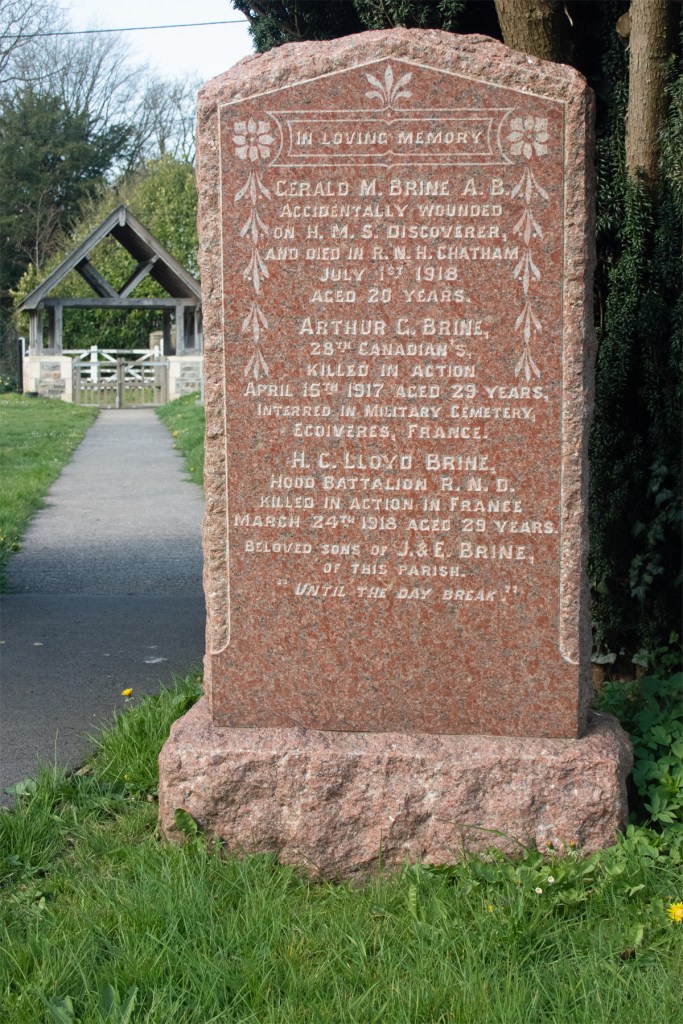
Gerald’s parents had a telegram to say that he was seriously wounded and in the Royal Naval Hospital, Chatham. They travelled at once to Chatham and found him very ill, but conscious. They remained with him until he died a week later, on 1st July 1918. He was just 20 years of age.
At the inquest, Macfarlane described Brine as his best chum, and all witnesses agreed that “the best possible relations existed between the members of the crew.” According to the doctor’s evidence at the inquest, Gerald was unable to be saved. The jury reached a verdict of Accidental Death.
Able Seaman was brought home to Binegar, and lies at rest in the graveyard of Holy Trinity Church.
Gerald’s grave also acts as a memorial to two of his older brothers.
Arthur Brine, who had been the stone breaker in the quarry, emigrated to Canada after his mother had died, finding work there as a fireman. The Great War brought him back to European shores, however, and he enlisted in the Canadian Expeditionary Force, joining the 188th Battalion.
Private Brine arrived in England in October 1916; he transferred to the 28th Canadians, and set off for France the following January. He was caught up in the Battle of Arras and was hit and killed by a piece of shrapnel on 15th April 1917. He was just 29 years old.
Arthur Brine lies at peace in the Ecoivres Cemetery to the north west of Arras in Northern France.
Herbert Brine had been the foreman at the stone quarry He married Sarah Lucy James shortly before his mother’s death in 1912; the couple went on to have two children, Arthur and Kenneth.
Herbert was mobilised in July 1917, initially joining the 3rd Reserve Battalion. He was drafted, as an Able Seaman, to the Hood Battalion, Royal Naval Division (RND) in November 1917, before re-joining his RND Battalion at Flesquières, near Cambrai, two months later.
In early March 1918, the Germans started bombardments in preparation for a major offensive. For ten days from 12th March, the Flesquières salient was drenched with nearly a quarter of a million (mostly mustard) gas shells, There were over 2,000 resultant casualties in the RND. After this preparatory shelling, the Germans attacked in enormous numbers.
By the end of the day, the situation was precarious and the Division was forced to retreat in steps, through Bertincourt, Ytres and the Metz lines, through the old Somme battlefields.
Able Seaman Brine was first reported missing on 24th March, but was only accepted as having been killed in action on that date nine months later. As such, Herbert is commemorated by name on the Arras Memorial; his name also resides on Gerald’s gravestone back home in Binegar.
The Great War took its toll on the Brine family. Three of the four brothers died during those tumultuous years, leaving only John’s oldest son, Wallace, to carry on the family name. John himself died in 1942, aged 84, and lies with his wife and youngest boy in the small Binegar churchyard.
Thomas Tannahill Cochran was born on 28th February 1899, in Gillingham, Kent. He was one of nine children to Woodrow Cochran and his wife, Janet, née Tannahill. Woodrow was an engine fitter and both he and Janet were from Paisley in Scotland; they moved to Kent not long after getting married, presumably as Woodrow found work in the Naval Dockyard in Chatham.
Thomas followed his father and older brothers into the Navy, initially enlisting as a Boy Shipwright on 12th August 1913. He served most of his time at the local dockyard, before setting out to sea in March 1918.
At this point, Shipwright Cochran’s service records need a bit of translation. Tragedy certainly occurred, but the details are a bit disparate.
According his naval service records, Shipwright Cochran was aboard HMS Pembroke II when he was killed in action off the Belgian coast on 23rd April 1918. However, HMS Pembroke II was actually a land-based vessel in Kent.
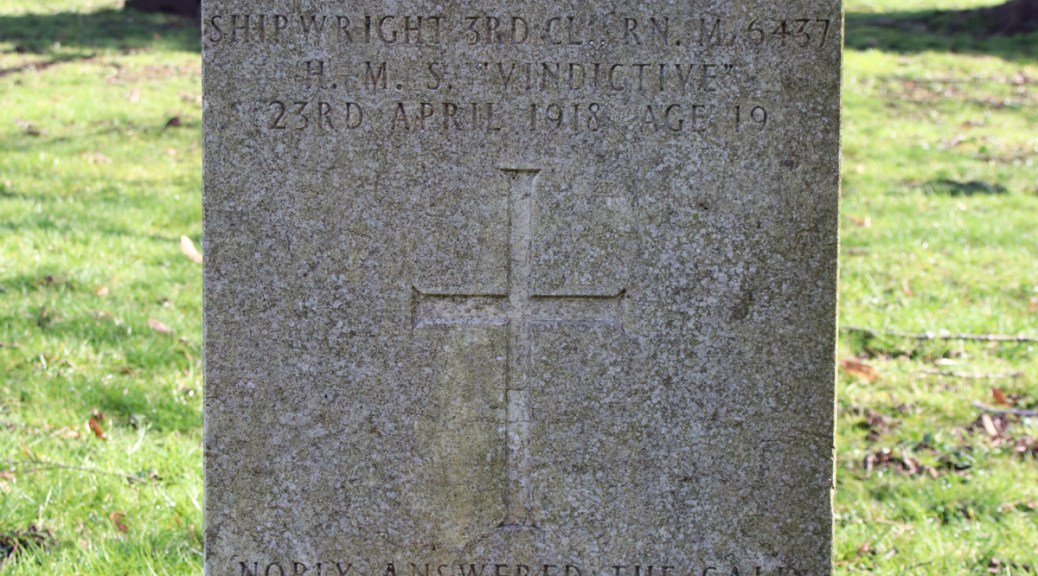
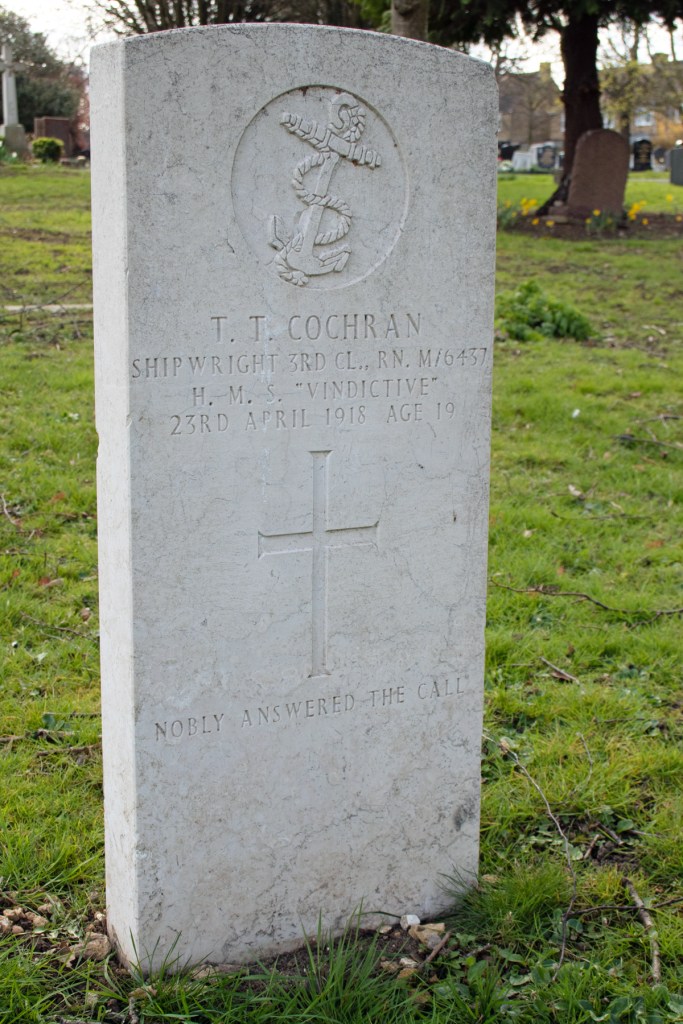
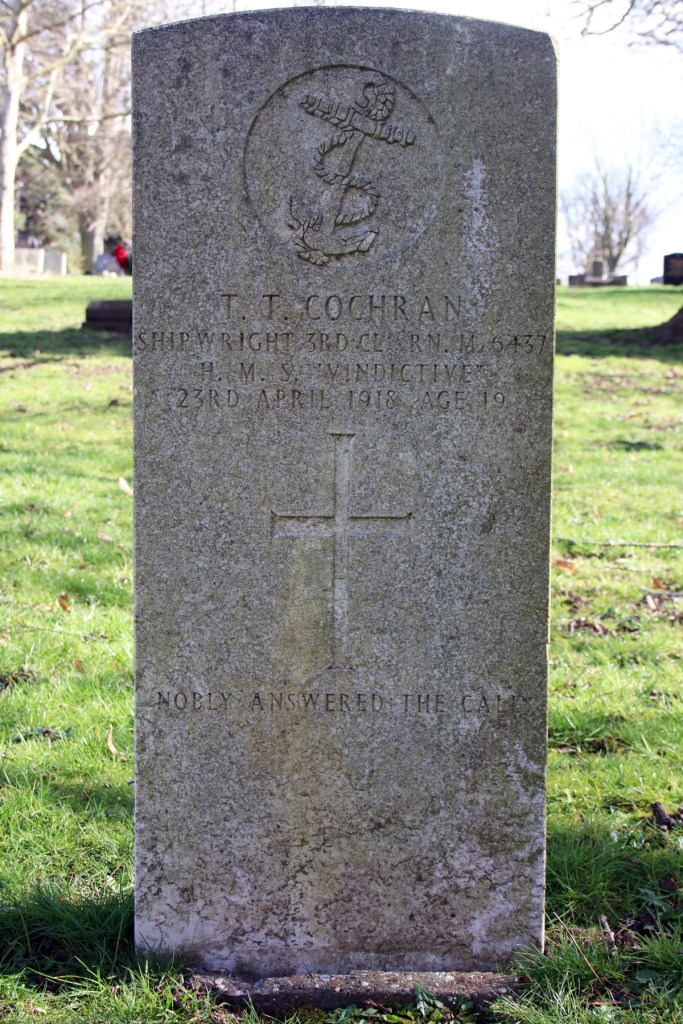
His gravestone, however suggested that he was assigned to another ship – HMS Vindictive. This was one of the vessels involved in the “Zeebrugge Raid”, an attempt by the Royal Navy to block the Belgian port by scuppering obsolete vessels in the canal entrance.
The Vindictive was to lead a diversion, drawing any attack away from the raid’s true target. However, bad weather blew the ship off course, which brought her within reach of enemy guns. Sadly, casualties were numerous, and Shipwright Cochran was one of those who fell in the German attack. He died on 23rd April 1918 at just 19 years old.
Thomas Tannahill Cochran’s body was recovered, and he lies at rest in the Woodlands Cemetery in his home town of Gillingham, Kent.
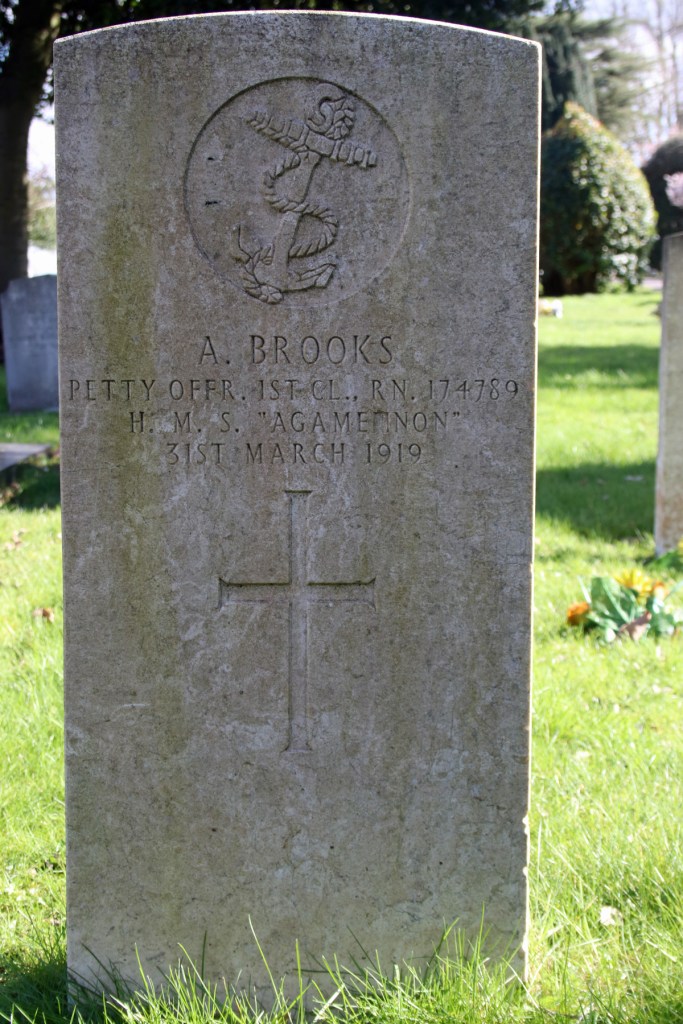
Albert Brooks was born in February 1877 in Cambridge. Sadly, a lot of the documentation for his early life is lost to time, but he enlisted in the Royal Navy in July 1893, at the rank of Boy 2nd Class.
He formally enrolled in naval service in February 1895, initially for a period of twelve years. Beginning as an Ordinary Seaman aboard HMS Thunderer, during his initial time in the navy, he was promoted to Able Seaman and then Petty Officer 2nd Class, while serving on vessels including Hawke, Wildfire, Eclipse and Vernon.
In 1904, Albert married Rosina Wise. A couple of years younger than her new husband, she had been born in Camberwell, South London. The couple had a daughter, Gwendoline, and they set up home in Gillingham, Kent, where Albert was based when not at sea.
War was on the horizon, however, and Petty Officer Brooks’ naval service was extended until the end of the conflict.
Albert was promoted to Petty Officer 1st Class, and continued his service on vessels that included Andromache, London and Hibernia. He transferred to what would be his final ship, HMS Agamemnon, in November 1917.
Petty Officer Brooks served aboard Agamemnon for eighteen months, but it was while stationed at the Naval Dockyard in Chatham that he fell ill. He passed away from aortic disease of the heart – more than likely a heart attack or cardiac arrest – on 31st March 1919. He had just turned 42 years of age.
Albert Brooks lies at rest in the Woodlands Cemetery in Gillingham, Kent.
Ernest George Ware was born in the autumn of 1871 in Marylebone, London. Details of his early life are scant, but records show that he enlisted in the Royal Navy in February 1895, serving as a Stoker for an initial period of twelve years.
During this time, he worked on a number of different vessels – Wildfire, Theseus, Warspite, Amphion, Acheron and Sapphire. He was also based on a number of shore vessels; potentially Southsea in Hampshire and Pembroke in Wales.
In 1905 he married Mary Emery; she was the same age as Ernest, and was born in Hampshire. The young couple had a daughter, Muriel, and, by the time of the 1911 census, the family were living in Pembroke Dock, in South Wales.
War was inching closer, and Stoker Ware’s service was extended for the duration; he served on a number of other vessels – Leander, Blenheim, Blake and Tyne – before being promoted to Chief Stoker on HMS Blonde in 1911. He transferred to HMS St George two years later, before moving on shore to the training vessel HMS Victory II (based in Crystal Palace, South London) in 1915.
Chief Stoker Ware’s health seemed to have been in decline by this point; he was admitted to the Royal Naval Hospital Haslar in Gosport in early 1916, suffering from malignant endocarditis. Sadly, he passed away on 16th February, aged 44 years old.
Ernest George Ware was buried in the Woodlands Cemetery in Gillingham, Kent, close to where his widow was now living.
There are some lives that just don’t want to be discovered, that just hide tantalisingly out of reach. James Davidson’s was one of those lives.
The main two research websites I use – cwgc.org and findagrave.com – only have his initial and surname, which is understandable, as this is what is inscribed on his headstone. Unfortunately, that doesn’t act as a good base on which to carry out further research.
HMS Gunner was the wartime moniker for Granton Harbour, near Edinburgh. A naval history website managed to identify Chief Artificer Davidson’s first name – James – but again, with no other information to go on, this is still too common a name – particularly in Scotland – to narrow down any real results.
Sadly, then, the story behind James Davidson is destined to remain a mystery. All that can be confirmed for certain is that he passed away on 23rd January 1919, though the cause of his passing is lost to time, as is his age.
James Davidson lies at rest in the Woodlands Cemetery in Gillingham, Kent.
Arthur Herring was born on 5th December 1877, the third of five children to William and Constance Herring. William was a sign writer at the Naval Dockyard in Chatham, Kent, and the family lived in neighbouring Gillingham.
Arthur joined the Royal Navy in September 1899, just short of his 22nd birthday. He worked as an Engine Room Artificer (ERA), and over the twelve years of his initial service, he crewed on board ten different ships. This was in addition to his service at HMS Pembroke, the shore vessel in his home town of Chatham.
Arthur was evidently a hard worker, and he rose through the ranks from ERA 5th Class to ERA 1st Class during this time.
In September 1912, Arthur married Angela Beck; she was also born in Chatham, and was the daughter of a naval Sergeant. The couple didn’t go on to have any children.
War was looming by the time Arthur completed his twelve years’ service. Arthur was recommissioned, serving as Chief Engine Room Artificer 2nd Class on HMS Aquarius and HMS Tyne during the conflict.
In February 1917, Artificer Herring transferred to HMS Torrent. This was a naval destroyer, part of the Harwich Force, patrolling the North Sea.
One of the duties of the Harwich Force was manning the “Beef Run”; the convoys between England and the Netherlands. It was on one of these runs that tragedy struck HMS Torrent.
At about 2am on 23rd December, the convoy, including HMS Torrent, ran into a German minefield, and Torrent struck a German mine. Two of the other ships in the convoy, HMS Surprise and HMS Tornado went to rescue Torrent’s crew, but Torrent struck a second mine and quickly sank. In an attempt to rescue survivors, Surprise and Tornado also struck mines and sank.
Only the fourth convoy ship, HMS Radiant was undamaged and picked up the survivors from the three ships. In total, 12 officers and 240 other ranks were killed from the three ships. On HMS Torrent, only three of the crew survived; sixty-eight others perished that night. This included Artificer Herring, although his body was rescued from the water; he was 40 years old.
Arthur Herring lies at peace in the Woodlands Cemetery in his home town of Gillingham, Kent.
Charles Frederick Caleb Miller was born on 12th December 1887 in Gillingham, Kent. His parents were Charles and Harriet Miller, and he had two younger siblings, Mabel and Harriet.
Tragically, Charles Jr’s mother died when he was only three years old; his father went on to marry again – to his widow’s younger sister, Jane – and the couple had two further children – Jane and Beatrice – who were Charles Jr’s half-sisters.
Charles Sr worked as a ship’s rigger in the Military Dockyard in Chatham, and naval life obviously caught his son’s eye. In 1903, having left school, he enlisted in the Royal Navy, started as a ‘boy artificer’, working in the engine and boiler rooms of ships.
His initial service was for twelve years, and he worked on a number of vessels, as well as being assigned to HMS Pembroke, the shore base in Chatham. He worked his way through the ranks to Engine Room Artificer 2nd Class by 1915.
In June of that year, Charles married Ellen Holden. the daughter of a dairyman from Chelsea. The couple went on to have a daughter, Joan, who was born in 1918. At the time of their wedding, Charles was based on HMS Lance, and his military service was to continue.
His period of service extended until the end of the war, Charles served on a number of other vessels, including HMS Surprise, Blenheim and Prince George and rose to Chief Engine Room Artificer 2nd Class.
It was while he was assigned to HMS Ganges in January 1920 that he became unwell, however. He had contracted bronchial pneumonia, and died of a combination of that and heart failure on 9th February 1920. He was 32 years old.
Charles Frederick Caleb Miller lies at rest in Woodlands Cemetery in his home town of Gillingham, Kent.
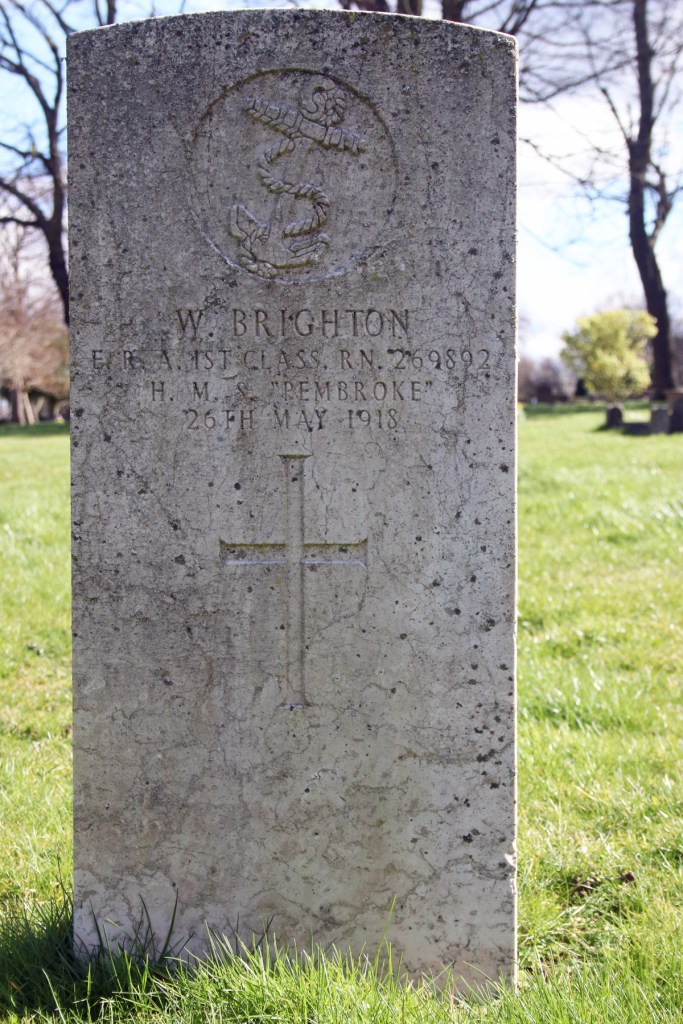
William Brighton was born on 13th August 1877 in Peterborough, Northamptonshire. Sadly, details of his early life are lost to time, so his parents’ names, and details of any siblings are a mystery.
William chose a military life early on; he enlisted in the Royal Navy in October 1899 for twelve years’ service. Working as an Engine Room Artificer, he was an engine fitter and repairer on a number of vessels in his time, including the battleship HMS Repulse and the cruisers HMS Andromache and Scylla.
William married Lily Franklin in the autumn of 1904, and the couple went on to have three children; Mona, Lily and John. With William away at sea a lot of the time, Lily set up home in Gillingham, Kent, close to the shore facility – HMS Pembroke – where her husband was based.
The uncertainty around potential conflict meant that William extended his service when it initially came to an end in November 1911. He continued to serve on a number of vessels during the war and was based on a ship off the Scottish coast when he fell ill in May 1918.
William was transferred to the US Hospital in Strathpeffer, near Inverness, suffering from an abdominal aneurysm. Sadly the treatment did not work, and he passed away on 26th May 1918. He was 40 years old.
William Brighton lies at rest in the Woodlands Cemetery in Gillingham, Kent.
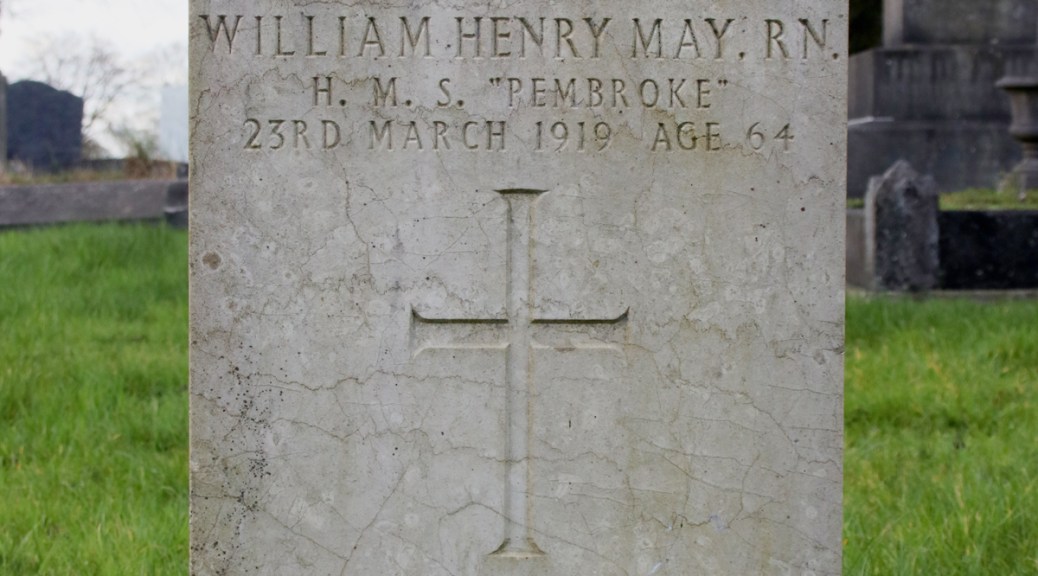
William Henry May was born on 10th August 1854, the oldest of three children to James and Selina May. James was a carpenter’s mate from Plymouth, and the family lived in the Stonehouse area of the city, right next to the dockyard.
Maritime adventure was obviously going to be in William’s blood; by the time of the 1881 census, at the age of 25, he is working as a gunner’s mate and instructor for the Royal Navy. He married a Mary Jane Channing, the daughter of a labourer and fishmonger, in 1879; the coupe were living in their home town of Plymouth.
There are definite gaps in the William’s trail; this may be because he was abroad, or because the documentation relating to him has been lost or destroyed. He next appears on the 1901 census.
By this point, William was a Warrant Officer in the Royal Navy. He is married to Kate Doling, from Gosport in Hampshire, and the couple were living in Sheerness, Kent.
William continued to live close to port; ten years on, and aged 56, he and Kate had moved along the Kent coast to Gillingham, not far from the dockyards at Chatham. The couple had been married 23 years by this point, but had had no children.
By this point, William’s naval service had come to an end. He had served for twenty years, and had reached the rank of Lieutenant, but the census lists him as retired.
War arrived, however, and William’s services were called upon once more. He was assigned to HMS Pembroke, the shore-based naval barracks in Chatham, and served with the rank of Lieutenant Commander.
From this point, however, William’s trail goes cold. His gravestone confirms that he passed away on 23rd March 1919, at the age of 64, but I have been unable to find a cause of death. His entry on the Commonwealth War Graves Commission site confirms he was the husband of the late Kate Emily May, so she too must have passed away at some point after 1911.
William Henry May lies at rest in the Woodlands Cemetery in his adopted home of Gillingham, Kent.









 Death and Service