Tag Archives: Shropshire

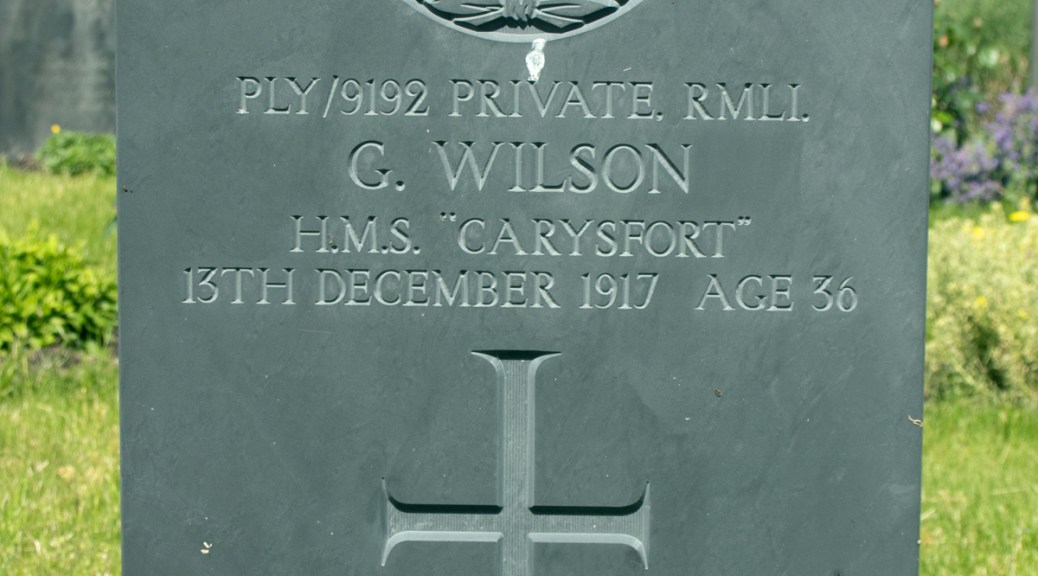
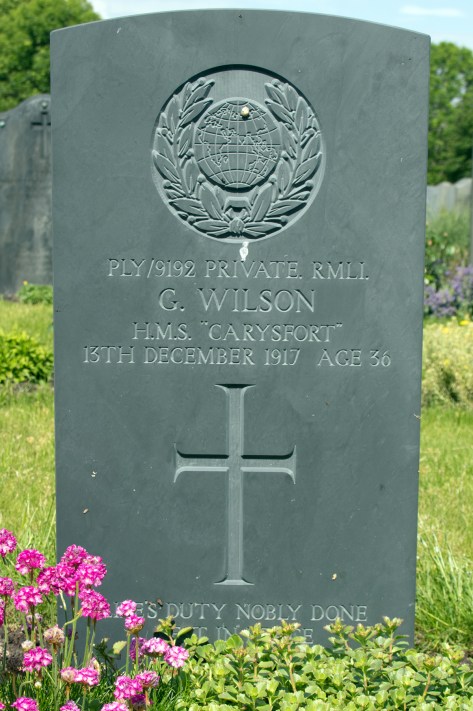
Private George Wilson

Private George Wilson

George Wilson was born on 1st February 1879 in the village of Worfield, Shoprshire. Details of his early life are unclear, although his father’s name was John.

When he completed his schooling, George found work as a porter. However, he was keen on adventure and a decent career, and so, on 31st May 1898, he enlisted in the Royal Marine Light Infantry. His service papers show that he was 5ft 7.5ins (1.71m) tall, with brown hair, blue eyes and a dark complexion. He was also noted as having a birth mark above his navel.

Private Wilson signed up for a period of twelve years and, during that time, he would serve around the world. Initially sent to barracks in Walmer, Kent, he would become based at Plymouth, Devon, in between assignments. Time overseas would include two years attached to HMS Magnificent (the 1901 census recording the battleship being moored in Gibraltar), two years on board HMS Spartan and three aboard HMS Encounter.

Away from the military, love blossomed and, in January 1909, George married Annie Curtis. She had a daughter, Gladys, who was either George’s, or was adopted by him. The couple set up home in Plymouth, and went on to have a son, Leslie, in 1911.

By this point, Private Wilson had renewed his military contract, and would go on to serve for a further seven years in the Royal Marines. In June 1915, he was assigned to the light cruiser HMS Carysfort. Part of the Harwich Force, her role was to patrol the waters off the east coast of England. During his time on board, George would have been involved in a number of sorties, including an attempt to intercept an enemy raid on Sunderland in August 1916, and another attempt to make contact with German ships off Zeebrugge, Belgium, that October.

In December 1917, while patrolling off Orford Ness, Suffolk. the Carysfort collided with the SS Glentaise, a collier ship. Two crew were killed in the incident, including Private Wilson: he was 37 years of age.

Carysfort sailed to HMS Pembroke, the Royal Navy Dockyard in Chatham, Kent. From here the body of George Wilson was taken to Woodlands Cemetery in nearby Gillingham, and he was laid to rest in the naval section there.


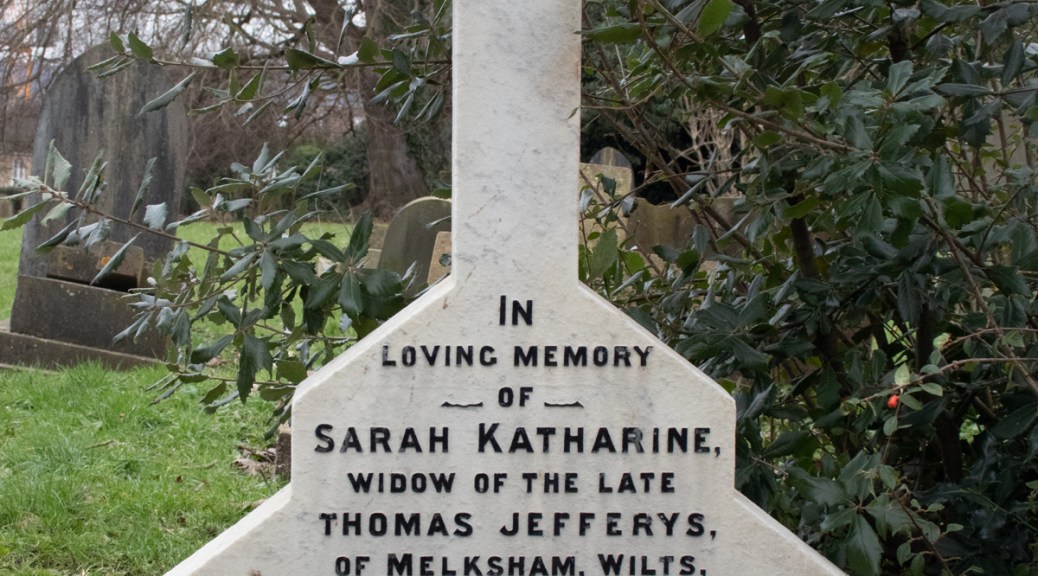
Reverend Charles Jefferys

Reverend Charles Jefferys

Charles Thomas Claude Jefferys was born on 23rd August 1880 in the small Carmarthenshire town of Laugharne. One of five children, his parents were naturalist Charles Jefferys and his wife Adeline.

Charles’ Jr’s life was to be one of education, and his father’s standing allowed for the best. He studied at Ellesmere College, Shropshire, then attended Durham University and Durham Theological College. By the 1901 census he was passing that education on to others: he was listed as a schoolmaster at Stow Wood College in Hampshire.

By 1908 Charles had returned to Wales, and was living in Monmouth. On 2nd January he married Eva Pride, an estate agent’s daughter from Tetbury, Gloucestershire. The marriage certificate confirms that, by this point, Charles was a clerk in holy orders, on his way to his true calling.

The 1911 census showed what a transient life the church could lead to: Charles and Eva were listed as living in a house in Oswaldkirk, North Yorshire. Their two young children, George and Charles, born in 1909 and 1910 respectively, were living with Eva’s sister, back in Tetbury.

When war came to Europe, Reverend Jefferys must have felt compelled to play his part. He joined the Army Chaplains’ Department, and by May 1916, he found himself in France. His role – providing pastoral care to the troops – would have led him to some of the darkest places of the Front Line. He remained there for the next couple of years, only returning to the family home – now in Chelsea, London – towards the end of the conflict.

Reverend Jefferys had contracted pneumonia, and he had returned from the continent to recuperate. Sadly, the condition was to prove too much, and he succumbed to it on 20th November 1918, at the age of 38.

Charles Thomas Claude Jefferys was taken to Somerset for burial – there were close family connections in the Bath area. He was laid to rest in the family plot, alongside his paternal grandmother in the city’s St James’ Cemetery.


Further tragedy was to strike in June 1925 when Eva also passed away. Details of her death are unclear, but this left George and Charles as orphans in their early teens.


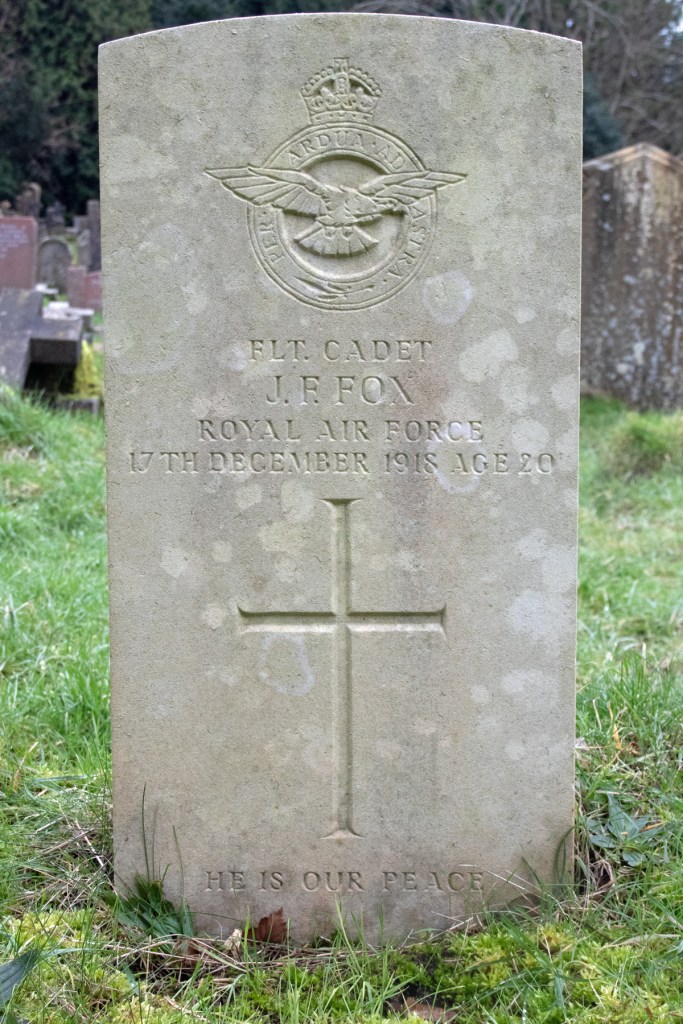
Flight Cadet John Fox

Flight Cadet John Fox

John Francis Fox was born early in 1898 in the village of Alkerton, Oxfordshire. One of eight children, he was the only son to miller-turned-butcher George Fox, and his wife, Ann. The family remained in Oxfordshire until at least the outbreak of war, when George and Ann appeared to have moved to Somerset.

When John left school, he took up an apprenticeship at Stothert & Pitt’s engineering works in Bath and in May 1918, with the First World War entering its last few bloody months, he was finally old enough to enlist. He joined the Royal Air Force as a Flight Cadet and was based at the 13th Training Depot Station near Market Drayton, Shropshire.

On 21st December 1918, Flight Cadet Fox was undertaking his first solo flight, on board an Avro 504K. His aircraft collided with another, which was piloted by a Captain Edgar Beamer. Both were killed in the accident: John was just 20 years of age.

An inquest into the crash, which also involved a third man, Captain Harrison, who was a passenger in Beamer’s plane, returned verdicts of accidental death.

John Francis Fox’s body was brought back to Somerset for burial. He was laid to rest in the graveyard of St Mary the Virgin’s Church, Bath.


Rifleman William Locke

Rifleman William Locke

William Thomas Locke was born at the start of 1900 in the Kent village of Eccles. His parents were Thomas and Annie Locke, although it seems that he was orphaned early on. The 1901 census recorded him as living with his grandparents John and Mary Locke. Their daughter Annie is also recorded as living at the property, although there is nothing to confirm whether she was William’s mother or an aunt.

By the time of the 1911 census John Locke had died. Mary was living in the same house, with two of her sons – Frederick and Alfred – and her grandchildren, William and his cousin Gladys. Both of William’s uncles were labourers in the local cement works, and it seems likely that this would be work that he would have followed them into once he had completed school.

William’s trail goes cold at this point, although he would have been too young to join up at the outbreak of the First World War. Records confirm that he had enlisted by March 1918, and it seems likely that he would have done so as soon as he came of age.

Rifleman Locke joined the 5th Battalion of the King’s (Liverpool Regiment), but this is the only detail of his military service that can be confirmed. The next record for him confirms that he passed away on 5th October 1918, having been admitted to hospital in Oswestry, Shropshire, suffering from intestinal problems. He was just 18 years old when he passed.

William Thomas Locke’s body was brought back to Kent for burial. He was laid to rest in the graveyard of St Peter & St Paul’s Church in Aylesford, the parish church for his home village of Eccles.

The specific location of William’s grave is not known, although it is likely that he was laid to rest near his grandfather. Instead, he is commemorated on a joint headstone in the First World War section of the graveyard. William’s grandmother passed away the following year, and records confirm that his next of kin was noted as his aunt, Mary Ann Longley.


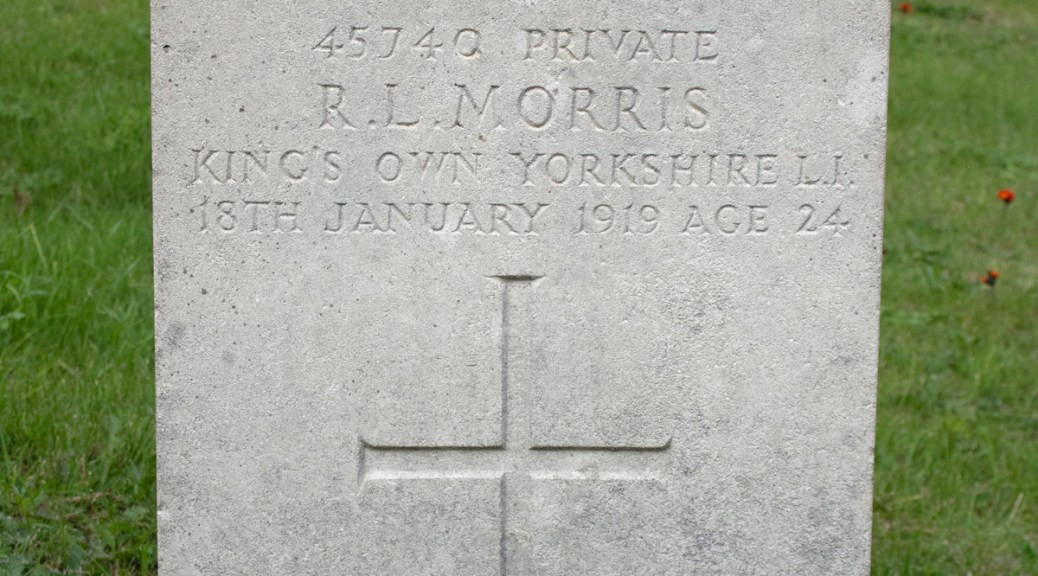
Private Richard Morris

Private Richard Morris

Richard Levi Morris was born in the village of Carno, mid-Wales, in the autumn of 1895. He was the oldest of five children to John and Hannah Morris. John was a tailor who, when Richard was still a babe in arms, moved the family north to the Denbighshire town of Llangollen.

When he left school, Richard found work as baker’s apprentice. He was employed by the Model Bakery on Church Street, Llangollen, a business that would go on to win, according to its subsequent advertising, a bronze medal for both its white and brown bread in both 1912 and 1913 [North Wales Journal: Friday 7th August 1914].

War was coming to Europe, and Richard stepped up to play his part. Full details of his service are sadly lost to time, but he had enlisted in the King’s Own Yorkshire Light Infantry by the summer of 1918. Initially assigned to the 9th (Service) Battalion, Private Morris subsequently transferred to the 2nd/4th Battalion and was attached to one of the regiment’s depots.

What little documentation around Richard’s actual service confirms that he was sent to the Western Front. At some point towards the end of the conflict – possibly during the final advance in Picardy – he was wounded. Medically evacuated to Britain, he was admitted to a cottage hospital in Oswestry, Shropshire.

Sadly, it was here that Private Morris was to breath his last: he succumbed to his injuries on 18th January 1919, at the tender age of just 24 years old.

The body of Richard Levi Morris was brought back to Wales for burial. He was laid to rest in the quiet Fron Cemetery in Llangollen.


Private John Payne

Private John Payne

John Spencer Payne’s life is a bit of a challenge to piece together, as there is little documentation available. He was born in 1894 in the village of Overton-on-Dee, near Wrexham and was one of two children to Charles and Elizabeth Payne. John was christened in Tenby, Pembrokeshire, at which point, his father’s trade was ‘gentleman’.

The next available document for John is the 1911 census. This records him as living in Weston-super-Mare, Somerset, where he was working as a bank clerk. He was living in Severn Road, to the south of the town centre, with his now-widowed mother, his older sister and his maternal aunt.

War came to Europe in 1914, and, while there is limited information about John’s service, it is clear that he had enlisted by September 1915. He joined the Royal Gloucestershire Hussars as a Private and was assigned to the 2nd/1st Battalion.

The battalion was a second-line unit, that remained in England until late in the war, when it transferred to Ireland. By the spring of 1916, it had become a cyclist unit although, with no other documentation for Private Payne, it is impossible to determine how or when he served.

Sadly, too, the only other document about Private Payne’s life is the confirmation of his death. He passed away at home on 10th February 1916, although the cause of his death is not recorded. He was just 22 years old.

John Spencer Payne was laid to rest in the Milton Road Cemetery in Weston-super-Mare.


Private John Payne
(from findagrave.com)

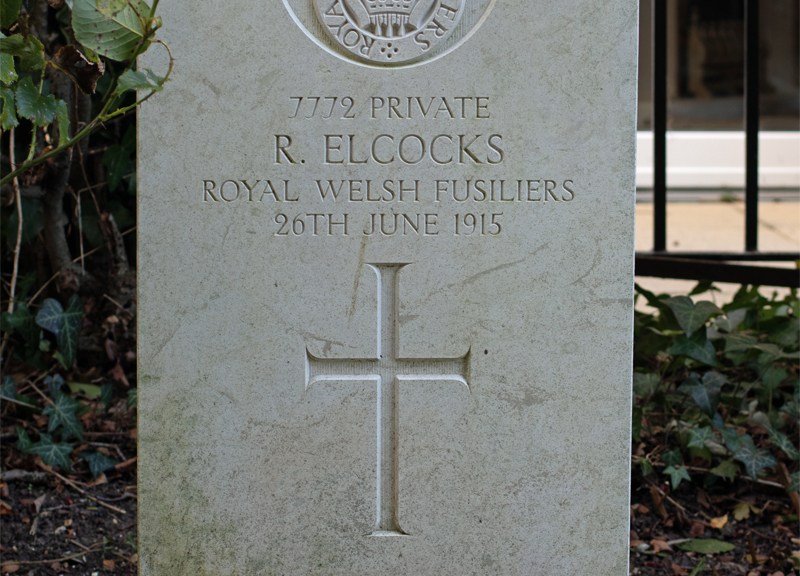
Private Richard Elcocks

Private Richard Elcocks

Richard William Elcocks was born in Wellington, Shropshire, the second son of foundryman Thomas Elcocks and his wife Emma. Born in June 1883, he was one of nine children.

After initially becoming a printer’s apprentice, he enlisted in the Royal Welsh Fusiliers in May 1903. After his initial training and service, Private Elcocks was transferred to the Army Reserve in 1911.

In January 1914, Richard married Charlotte Shenton. Charlotte was a widow ten years his senior, and had two children, Albert and Fred.

When war broke out, Private Elcocks was again called up and shipped to France as part of the British Expeditionary Force. His records confirm that he received a gunshot wound to the left arm on 31st October 1914; the injury was enough for him to be shipped back to the UK for treatment.

He was treated in the Yeatman Hospital in Sherborne, Dorset, and appears to have been there for some time. His records state that he died on 26th June 1915 from an ‘intestical [intestinal?] obstruction following gun shot wound of left humerous’. He was 32 years of age.

Private Richard Elcocks lies at rest in Sherborne cemetery.