Tag Archives: war

Gunner Douglas James

Gunner Douglas James

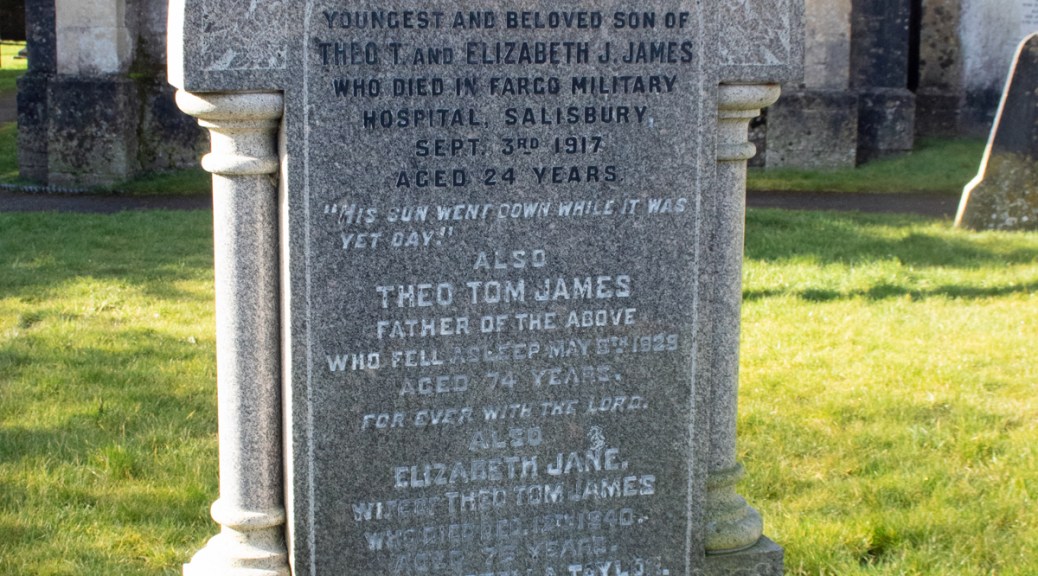
Douglas Arthur James was born on 8th May 1893 near Shepton Mallet, Somerset (records variously quote Oakhill, Stoke St Michael and Shepton itself, but all are within a few miles of each other). One of seven children, his parents were dairy farmers Theo and Elizabeth James.

When Douglas and his siblings left school, they all took up work on the farm, but when war broke out, Douglas wanted to play his part. He would not get his chance to do so until the spring of 1917, when he joined the Royal Field Artillery.

Again, the records differ, one suggesting that he was assigned to the 3rd (Reserve) Brigade, while another suggests that Gunner James was actually assigned to the 15th Reserve Battery. Both units served overseas, although it is impossible to determine whether Douglas went as well.

The only other identified document relating to Gunner James confirms that he was admitted to the Fargo Military Hospital at Larkhill, Wiltshire. The cause of his admission is unclear, but he passed away while there on 3rd September 1917. He was just 24 years of age.

The body of Douglas Arthur James was brought back to Somerset for burial. He was laid to rest in the family plot in the graveyard of St Bartholomew’s Church in West Cranmore.


Douglas remained alone in the family plot for a number of years. The family were eventually reunited, however, when Theo, who died in 1929, and Elizabeth, who passed in 1940, were also laid to rest there. Two of Douglas’ sisters were also buried in the plot – Evelyn, the oldest James daughter, who died in 1952, and Emily, the youngest of the siblings, who passed away in 1977.


Private Edgar Cox

Private Edgar Cox

Edgar Albert Cox was born in Wanstrow, Somerset, in the spring of 1897. The youngest of five children, his parents were railway packer Herbert Cox and his wife, Orpha.

When he left school, Edgar found employment as a live-in farm hand in Upton Noble, a mile from where his parents lived. When war came to Europe, however, he felt a pull to serve, and enlisted in the Somerset Light Infantry.

Full details of Private Cox’s military service are lost to time, but he was assigned to the 8th (Service) Battalion, and arrived in France towards the end of July 1915. He certainly saw action at the Somme, where his troop was involved in the battles of Bazentin Ridge, Flers-Courcelette and Morval.

It was in the battle of le Transloy, however, that Edgar was injured. His wounds were severe enough for him to be medically evacuated to Britain for treatment, and he was admitted to the 1st Southern General Hospital in King’s Norton, Birmingham. Sadly his wounds were too much for his body to bear: he passed away on 9th October 1916, at the age of just 19 years old.

The body of Edgar Albert Cox was brought back to Somerset for burial. He was laid to rest in the quiet graveyard of St Mary’s Church in his home village of Wanstrow.


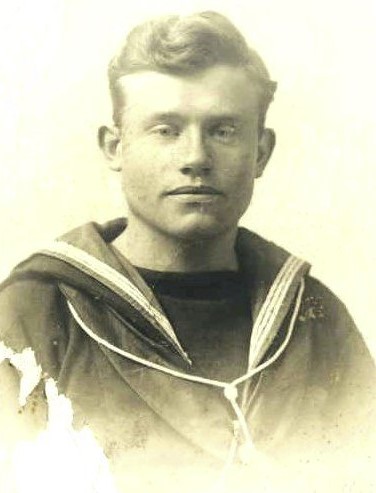
Able Seaman Jesse Baber

Able Seaman Jesse Baber

Jesse Baber was born on 28th February 1889 and was the youngest of thirteen children to John and Jane Baber. John was a farm labourer from Westcombe in Somerset, and it was in this village that he and Jane raised their family.

Jesse chose not to follow his father and siblings into farm work and instead, on 6th October 1906, he enlisted in the Royal Navy. As he was underage for full service at the time, he was given the rank of Boy 2nd Class and sent to HMS Ganges, a training establishment on the outskirts of Ipswich, Suffolk. His service records confirm that he was 5ft 5.5ins (1.66m) tall at the time of joining. He was also noted as having dark brown hair, grey eyes and a fresh complexion, with a mole on his right cheek being highlighted as a distinguishing mark.

Boy Baber spent six months at HMS Ganges, and was promoted to Boy 1st Class for his commitment. He was then transferred to HMS London, a dreadnaught battleship for a further six months. During his time on board, Jesse came of age, and was formally enrolled in the Royal Navy with the rank of Ordinary Seaman.

Over the next eight years, Jesse served on eleven different vessels, sailing between his British base of HMS Vivid in Devonport and the East Indies. His service seems to have generally been very good – he was promoted to Able Seaman in February 1909 – although he did spend five days in the brig in July 1912 for reasons unrecorded.

When war broke out, the ships that Able Seaman Baber served on patrolled the waters of the Mediterranean. In the summer of 1916, while on board HMS Dartmouth, he contracted malaria. Jesse was admitted to a hospital in Malta, where he remained for six weeks, and was then sent on leave home to recover.

He arrived at Castle Cary [in Somerset] on the evening of the 23rd August, on a visit to his sister, in a very serious condition, being practically in a state of collapse. Medical attention was immediately obtained, but his condition was hopeless, and he lay in an unconscious condition until Friday September 1st, when he expired, death being due to meningitis, following malaria.

[Shepton Mallet Journal: Friday 15th September 1916]

Jesse Baber was 27 years old when he passed away. He was laid to rest in the quiet graveyard of St Mary’s Church in Batcombe, not far from where his mother, who was now 74 years old, was living.


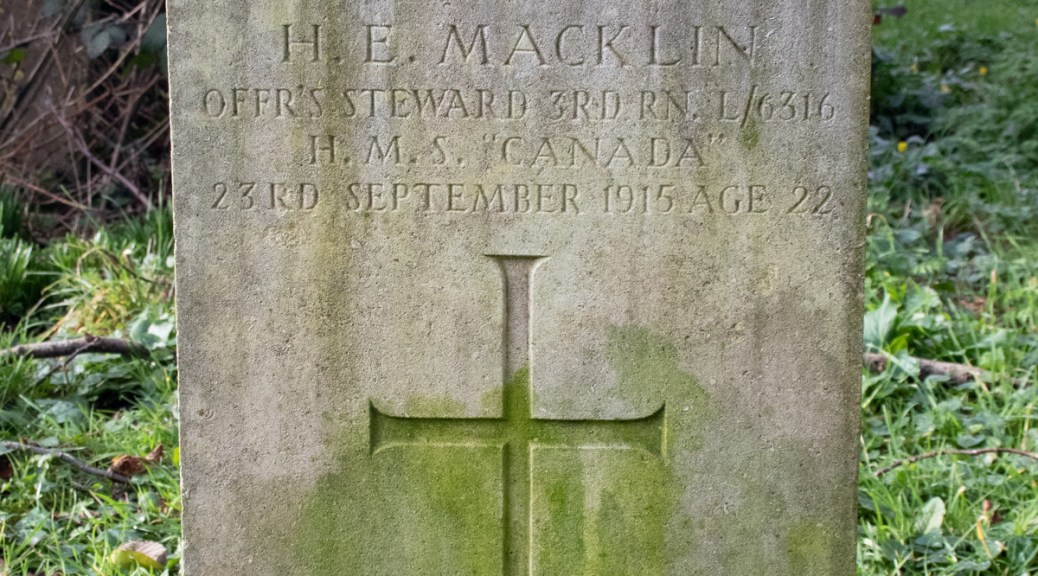
Officer’s Steward 3rd Class Harry Macklin

Officer’s Steward 3rd Class Harry Macklin

Harry Ernest Macklin was born in the Frome area of Somerset in the autumn of 1893. The oldest of four children, his parents were Henry and Elizabeth Macklin. Henry Sr was a groom who travelled with work, and by the time of the 1901 census, the family were living in East Adderbury, Oxfordshire, which is where the third of the four siblings, Evelyn, was born.

Harry Jr seems to have been known as Ernest, probably to avoid confusion with his father. When he left school, he found work as a page. The family had moved again by 1902, to Witham Friary, to the south east of Frome. Harry Sr was now working as a farm labourer, while Minnie, his and Elizabeth’s second child, was employed as a house maid. The two younger children – Evelyn and George – were both at school, while Elizabeth’s widowed father, also called George, was visiting his daughter and their family.

Ernest changed jobs, becoming a gardener – possibly a euphemistic way of saying he had followed his father into agricultural labouring – but when war was declared he found the need to play his part. On 15th February 1915 he joined the Royal Navy as an Officer’s Steward 3rd Class, possibly drawing on his experience as a page.

For some reason, Ernest’s service records give his date of birth as 18th October 1894: they also confirm he was 5th 7.5ins (1.71m) tall, had dark brown hair, brown eyes and a fresh complexion. They also note that he had a scar on his left thigh.

Officer’s Steward 3rd Class Macklin’s first posting was HMS Victory, the Royal Naval Dockyard in Portsmouth, Hampshire. This is where he received his training and, on 10th August 1915, he was given his first posting, on board the Chilean-built HMS Canada.

The ship sailed to Scapa Flow, following the North Sea Coast. When it reached Newcastle-upon-Tyne, however, Ernest was disembarked, and admitted to the Armstrong College Hospital, suffering from an ear infection. Tragically his condition turned septic, and he died of blood poisoning on 23rd September 1915, having served just 43 days at sea. Officer’s Steward 3rd Class Macklin was just 22 years of age.

Harry Ernest Macklin’s body was brought back to Somerset for burial. He was laid to rest in the quiet graveyard of St Mary’s Church in Witham Friary. “He was a promising young fellow, liked by all who knew him, and he was a member of the Witham Church Choir from boyhood.” [Somerset Standard : Friday 1st October 1915]


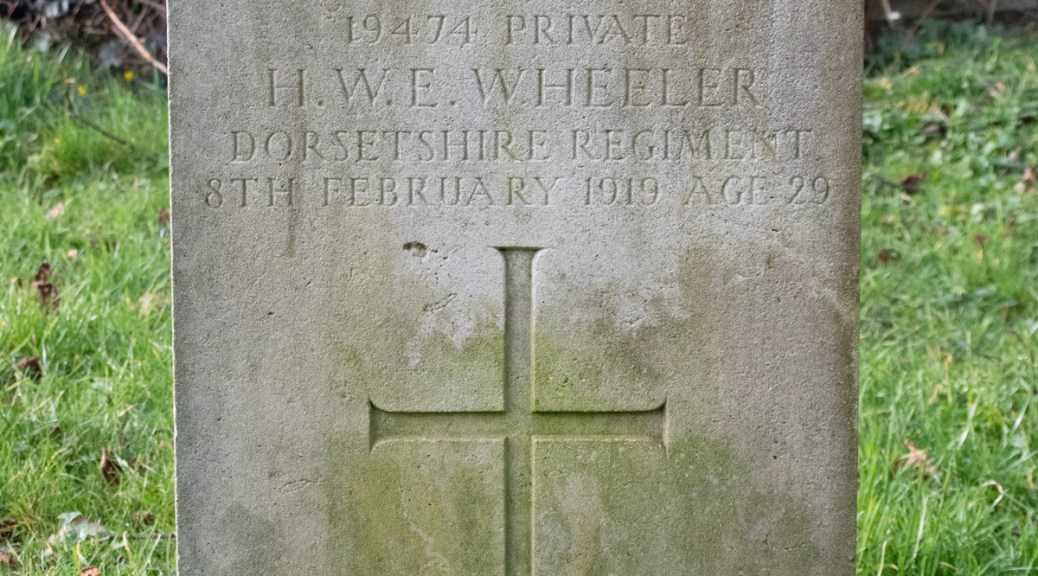
Private Henry Wheeler

Private Henry Wheeler

Henry William Edward Wheeler was born in early 1890, the fifth of thirteen children – and the oldest son – to Henry and Anne Wheeler. Henry Sr was a labourer from Witham Friary in Somerset, and this is where the family were born and raised.

When he left school, young Henry – who became known as Harry to avoid confusion with his father – found work as a postman. When war broke out, however, he enlisted as a Private in the Somerset Light Infantry. Full details of his military service are unclear, but his marriage certificate confirms that he was a soldier by the spring of 1915.

Harry’s wedding was to a woman called Mabel Hulbert, who was working as a domestic servant in Wotton-under-Edge, Gloucestershire. It was in the village’s church that the couple exchanged vows, and within a matter of weeks, Private Wheeler was sent to France.

Harry’s troop – the 1st Battalion – was involved in some of the fiercest fighting of the war, and it is likely that he was involved at The Somme in July 1916. At some point, though, he moved across to the 5th (Service) Battalion of the Dorsetshire Regiment, who had moved to France, having been fighting at Gallipoli. The specifics of Private Wheeler’s time in the army are, however, destined to be lost to time.

Private Wheeler’s trail can be picked up again after the end of the war, presumably when he had returned to Britain prior to being demobbed. Sadly, however, he was admitted to a military hospital in Wilton, Wiltshire, suffering from ‘disease’. He passed away on 8th February 1919, at the age of 29 years old.

The body of Henry William Edward Wheeler was brought back to Somerset for burial. He was laid to rest in the quiet graveyard of St Mary’s Church in his home village of Witham Friary.


Henry’s younger brother, John, also served in the First World War. He enlisted in the 8th (Service) Battalion of the Somerset Light Infantry, and arrived in France on 4th October 1915, just a couple of months after his older brother.

John was killed in fighting on 11th October 1917 – possibly as part of the opening salvos of the Battle of Passchendaele – and was just 20 years old. He was laid to rest in the Outtersteene Communal Cemetery in northern France.


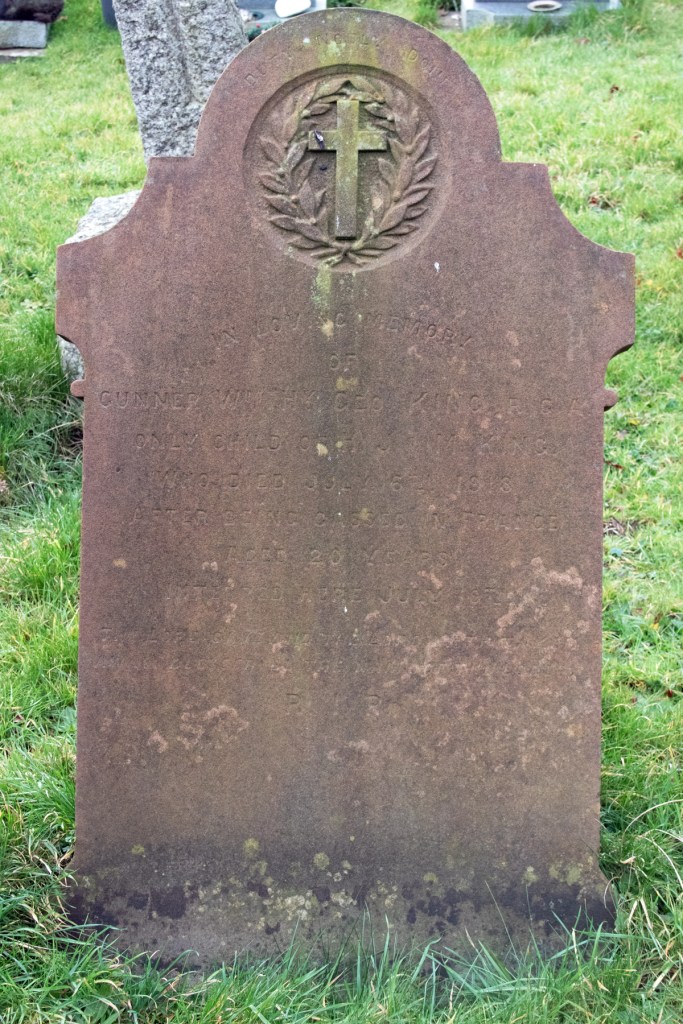
Gunner William King

Gunner William King

William Henry George King was born in the summer of 1898 and was the only child of Henry and Martha King. Henry was a grocer in the Somerset village of Witham Friary, and this is where William was born and raised.

When he left school, William found work as a draper’s assistant in Wells, but when he turned 18, with war raging across Europe, he gave that up to play his part. He enlisted in the Royal Garrison Artillery in August 1916, and was assigned as a Gunner in the 99th Siege Battery. His service records show that he was 6ft (1.83m) tall and weighed in at 140lbs (63.5kg).

Gunner King received his initial training in Plymouth, but was eventually shipped to France, arriving there in August 1917. He was caught up in a German gas attack at the end of June 1918, and was invalided back to Britain for treatment on 2nd July. He was admitted to the War Hospital in Bradford, but died of a combination of his injuries and the resulting bronchitis on 6th July 1918. He was just 20 years of age.

The body of William Henry George King was brought back to Somerset for burial He was laid to rest in the family plot in the graveyard of St Mary’s Church in his home village of Witham Friary.


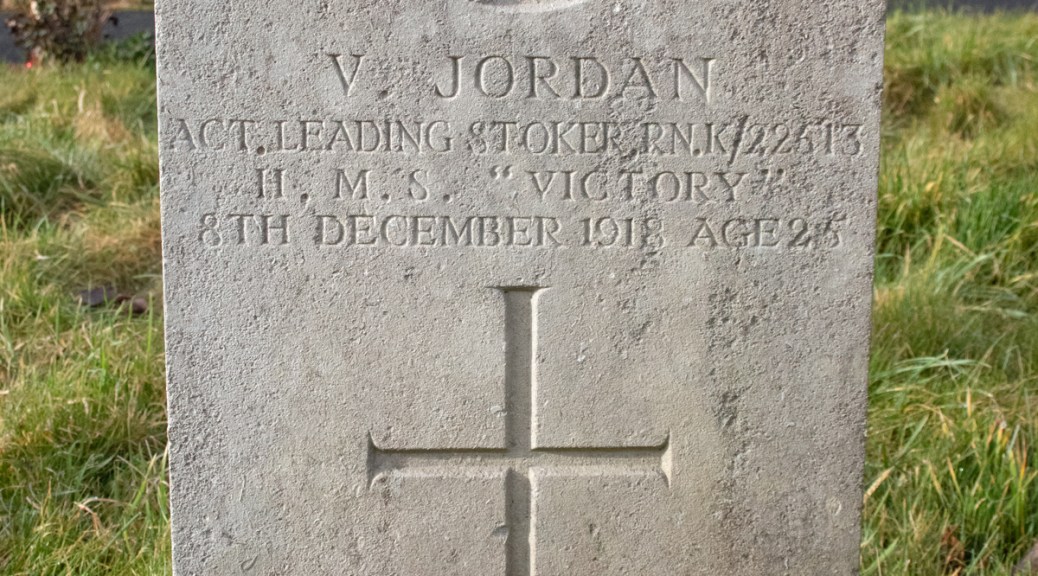
Leading Stoker Victor Jordan

Leading Stoker Victor Jordan

Victor Jordan was born on 20th November 1893 in Beeston Regis on the north Norfolk coast. The second of four children, his parents were school teachers Albert and Melletta Jordan.

By the time of the 1911 census, the family had moved from one coast to another, setting up home in Bognor Regis, Sussex. Albert had given up teaching, and had become an insurance agent for Prudential. Victor had left school and found work as a wheelwright, while his older sister, Emily, had taken up where her father had left off, teaching in an elementary school, The family of six was expanded by the inclusion of Albert’s mother, Emily, who had moved in with them.

By 1914, war was on the horizon, and Victor sought out a career beyond wheel work. On 21st May he enlisted in the Royal Navy as a Stoker 2nd Class. His service records show that he was 5ft 6ins (1.78m) tall, had light brown hair, blue eyes and a fair complexion.

Stoker Jordan was initially sent to HMS Victory, the Royal Naval Dockyard in Portsmouth, Hampshire, for training. After an initial six-month period, he was assigned to the battleship HMS Indomitable, on board which he was to serve for the next four years.

During his time on board, Victor proved to be a disciplined and determined worker. He was promoted to Stoker 1st Class in July 1915, and reached the rank of Leading Stoker in the summer of 1918. HMS Indomitable was involved in some of the key naval battles of the First World War – including Dogger Bank and Jutland – and Victor would have been on the forefront of maintaining the vessel’s power.

By October 1918, Leading Stoker Jordan was back on dry land, and was based once again in Portsmouth. As the war came to a close, however, he became unwell, and was admitted to Haslar Naval Hospital in nearby Gosport, suffering from acute tonsillitis.

Tragically, the condition was to get the better of him: Leading Stoker Jordan died of heart failure on 8th December 1918, having not long turned 25 years old.

Victor Jordan’s family were, by now, living in the Somerset hamlet of Brewham, and this is where his body was brought for burial: he was laid to rest in the peaceful graveyard of St John the Baptist’s Church.


Leading Stoker Victor Jordan
(from findagrave.com)

Scandal was set to rock the grieving family. Albert, who was now teaching again, was charged with indecently assaulting a nine-year-old girl three times over the winter of 1918/19. He denied the accusation and a jury found him not guilty after only a few minutes’ deliberation.

Albert and Melletta seem to have found it impossible to remain in the quiet corner of Somerset, and moved to Essex. The couple took up new teaching posts, Albert eventually becoming the headmaster of Doddinghurst Church of England School, near Brentwood, while his wife worked as a school mistress for one of the classes.

Melletta died in February 1931, and at this point, Albert came back to Somerset to live with his daughter and her family in Cheddar. He was 75 years old when he passed away at Emily’s family home – called Melletta after her mother – and was laid to rest in St Andrew’s Churchyard, Cheddar.


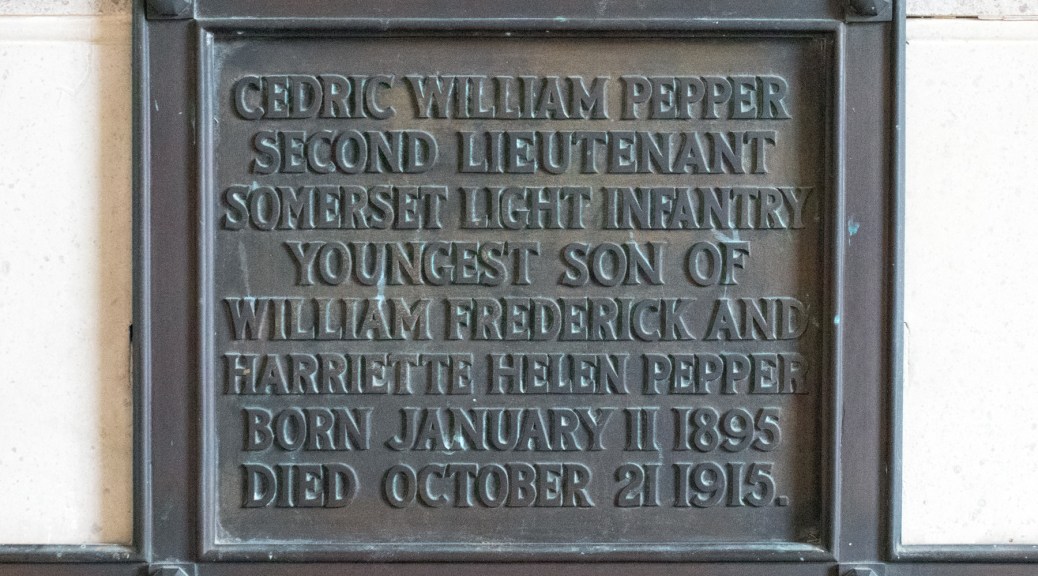
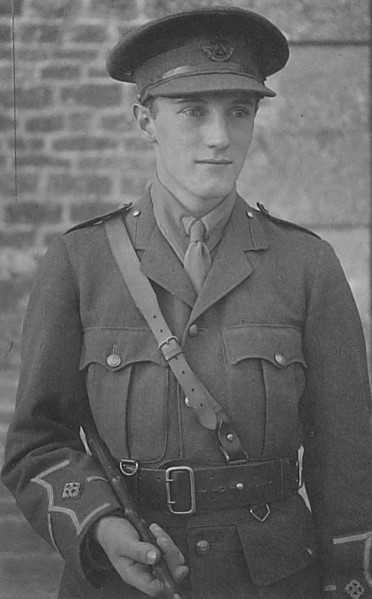
Second Lieutenant Cedric Pepper

Second Lieutenant Cedric Pepper

Cedric William Pepper was born in 1895 in South Kirkby, Yorkshire. He was the middle of three children to William and Harriette Pepper. William was a colliery owner from Leeds, and the family lived in some comfort in Rawdon Hill in Wharfdale. The 1901 census records show that they employed a governess, cook, two housemaids, a kitchen maid and a page.

By the time of the next census, in 1911, the Pepper family had moved to Shipton in Oxfordshire, where they lived in the 27-room Shipton Court. Cedric, by this time, was still studying, having been taught at Winchester College, where he lasted only a year, Tonbridge School, and then Worcester College in Oxford.

When war broke out, he had taken time away from his studies, and was working on a ranch in Rhodesia (present-day Zimbabwe). He returned to Britain at the start of the conflict and enlisted in the King’s Royal Rifle Corps. Assigned to the 2nd Battalion, Private Pepper arrived in France in November 1914, and was wounded in his thigh the summer of 1915.

Private Pepper returned to Britain to recuperate and, when he had recovered, he was given a commission in the 3rd Battalion of the Somerset Light Infantry. It was while he was training in Oxfordshire that the now Second Lieutenant Pepper met his end.

The evidence at the inquest… suggested that the death from a bullet wound… was accidental.

Second-Lieutenant William Eric Warburton… stated that early last week Lieutenant Pepper told him he was in some difficulty with a woman, but he did not explain it. Lieutenant Warburton did not think that this caused him to take his life. In his opinion Lieutenant Pepper knew nothing of the working of an automatic pistol he possessed.

The medical evidence was that a bullet entered the centre of the forehead. The doctor said that if the wound was self-inflicted it was quite possible that it was accidental.

The jury returned a verdict of Death from a bullet from an automatic pistol, but that there was no evidence to show how the wound was inflicted.

Central Somerset Gazette: Friday 29th October 1915

Second Lieutenant Pepper died from the bullet wound on 21st October 1915. He was just 20 years of age.

Pepper Family Memorial

Cedric William Pepper’s family were, by this time, living in Redlynch House, near Bruton, Somerset. He was cremated, and his ashes immured in the wall of St Peter’s Church in the hamlet.


Second Lieutenant Cedric Pepper
(from findagrave.com)

In researching Cedric’s life, there is a definite sense of a young man desperately looking to please his father. A successful Yorkshire colliery owner, he may have expected more from his oldest son, a drop out from Winchester College, possibly sent to Southern Africa to find himself. While an immediate return to Britain to serve his country would have been commonplace, the suggestion of difficulty with a woman and the subsequent accident with his gun just adds to the sense of a need for Cedric to not disappoint his father.


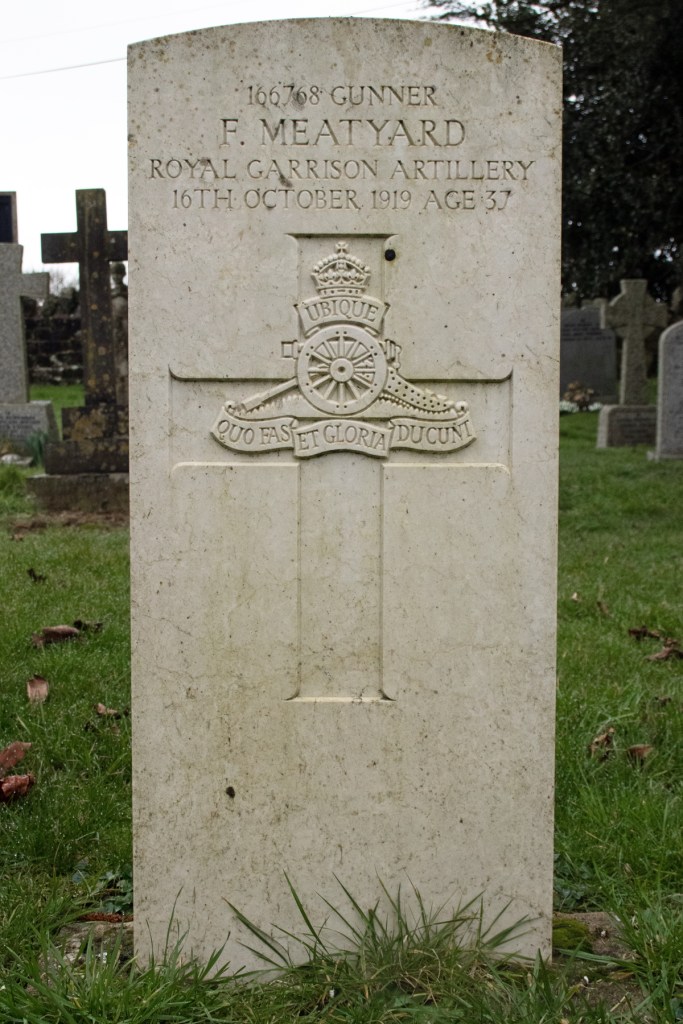
Gunner Fred Meatyard

Gunner Fred Meatyard

Fred Radford Meatyard was born in Penselwood, Somerset, in September 1882. The son of Henry and Ellen Meatyard, they seem to have been distant in his life. Fred was raised by his paternal grandparents, Henry and Caroline, in nearby Wincanton.

Fred was an intelligent young man. The 1901 census found him boarding with printer and stationer Walter Eaglestone and his family, on Erith High Street, in Kent. He was working as a compositor himself, pulling the type together for his boss to print. This appeared to be a springboard for him, and he soon moved to Oxford finding similar work there.

In 1907 Fred briefly returned to Penselwood, where he married Lily Extence in the parish church. The marriage certificate showed that Fred was living in William Street, Oxford, and was still employed as a compositor, working for the local newspaper, the Oxford Chronicle. His father, Henry, is listed as deceased, and as having been employed as an engineer. Lily was the same age as her new husband, and was the daughter of labourer Francis Extence.

The couple moved back to Oxford, and went on to have three children: Linda (born in 1908), Joan (born 1913) and Frances (born in 1915). The 1911 census record found them living in an end of terrace house in Boulter Street, the River Cherwell flowing past the bottom of their cul-de-sac. Theirs was a five-room house, and they had a boarder, Mancunian William Murphy, who was employed as a vocalist and guitarist.

When war came to Europe, Fred stepped up to play his part. He enlisted on 30th August 1916, but was not formally mobilised into the Royal Field Artillery until the following January. Gunner Meatyard’s service records show that he was a wiry man, 5ft 10ins (1.78m) tall, and weighing 126lbs (57.2kg).

In June 1917, Fred was transferred across to the Royal Garrison Artillery, and was sent to France. Aside from a couple of periods of leave, he remained overseas until the end of the war, and was attached to a couple of the regiment’s Siege Batteries.

When hostilities ceased, Gunner Meatyard finally returned to Britain in the summer of 1919. Based on Salisbury Plain, Wiltshire, while waiting to be demobbed, he fell ill, and was admitted to the Fovant Military Hospital. He was suffering from acute appendicitis, and the condition came on so quickly, that any treatment did not come soon enough. Fred passed away at the hospital on 16th October 1919, at the age of 37 years of age.

Fred Radford Meatyard was brought back to Somerset for burial. He was laid to rest in the quiet graveyard of St Michael’s Church in Penselwood. The newspaper for which he had worked for so long noted that “he was buried with full military honours… Deceased was on the printing staff of the ‘Oxford Chronicle’ for some years… He was a member of the St John’s Ambulance Brigade. Some time ago he returned from the Rhine, having previously fought in France. Much sympathy is felt with the widow and three children, two of whom, it will be remembered, took a prominent part as dancers in the pagent.” [Oxford Chronicle and Reading Gazette: Friday 24th October 1919]


Private Frederick Coward

Private Frederick Coward

Frederick John Coward was born in the Somerset village of Cucklington, in September 1900. The youngest of eight children, his parents were farm labourer Frank Coward and his wife, Agnes.

It is likely that Frederick followed in his father’s footsteps when he left school, labouring on a farm. He was only thirteen when war broke out in the summer of 1914, and over the next few years, he probably watched with envy as his older peers – and older brothers – went off to serve their King and Country.

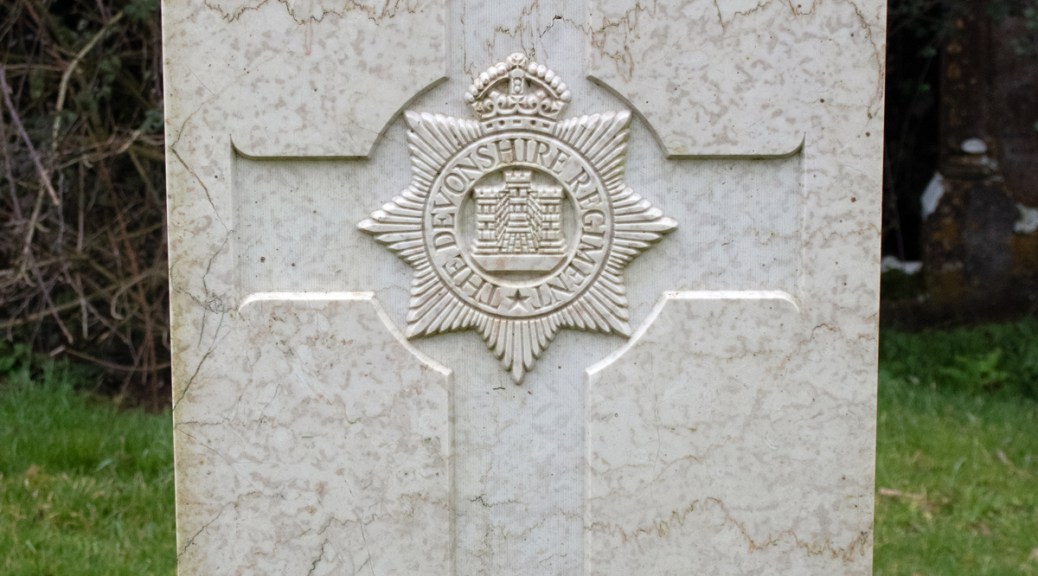
While full details are no longer available, Frederick probably enlisted as soon as he turned eighteen. He joined the Devonshire Regiment as a Private and was attached to the 53rd (Young Soldier) Battalion. He was sent off to Wiltshire and billeted at the Rollestone Camp, to the north of Stonehenge.

Army and naval barracks were crowded places, and brought together boys and men from all over the country in a way that had never happened before. The cramped nature of the billets meant that disease would run rampant and, once it took hold, it could prove fatal. Sadly, young Frederick was not to be immune from this: he was admitted to the camp hospital, and passed away from ‘disease’ on 6th October 1918. He was just 18 years of age.

The body of Frederick John Coward was brought back to Somerset for burial. He was laid to rest in the picturesque graveyard of St Lawrence’s Church in his home village of Cucklington.


The loss of her youngest boy seems to have proved too much for Agnes to bear. She died the following spring, at the age of 55 years old.