The early life of Henry Watkin Lewis is a challenge to piece together, and a lot of the detail comes from his later service records.
The document confirms that Henry was born in Pontypool, Monmouthshire, in December 1885. It gives his next of kin as his aunt, Ann Dunning, and there are no details about his parents.
Henry joined up in the days after war was declared. He was working as a plumber by this point, and enlisted in Preston, Lancashire, although it is not clear whether he was living in the area at this point. His records showing that he was 5ft (1.52m) tall and weighed 116lbs (52.6kg). With brown hair, blue eyes and a fresh complexion, he had a scar across the bridge of his nose and another on his lower lip.
Henry’s military career is an intriguing one. Assigned to the Loyal North Lancashire Regiment, he was initially given the rank of Private. He was promoted to Lance Corporal on 5th September 1914, just two weeks after enlisting. Four days later his rank was increased to Corporal, and by 14th October he had been promoted again, this time to Lance Sergeant. There is no evidence of any previous military background for him, and the cause of this rapid rise is unclear.
With any rapid rise, a rapid fall is often likely to follow, and Henry’s case was to be no different. He service records note that he was discharged from the army on 16th January 1915, as he was ‘not likely to become an efficient soldier’. Again, there is no further record as to why, although his papers do not suggest the cause was anything medical.
Lance Sergeant Lewis’ unit was based in Tidworth, Wiltshire, by this point, but he must have moved to Warminster following his discharge. It was here that he died on 23rd April 1915, the cause of his passing unknown. He was 29 years of age.
Henry Watkin Lewis was laid to rest in the graveyard of St Denys’ Church, Warminster.
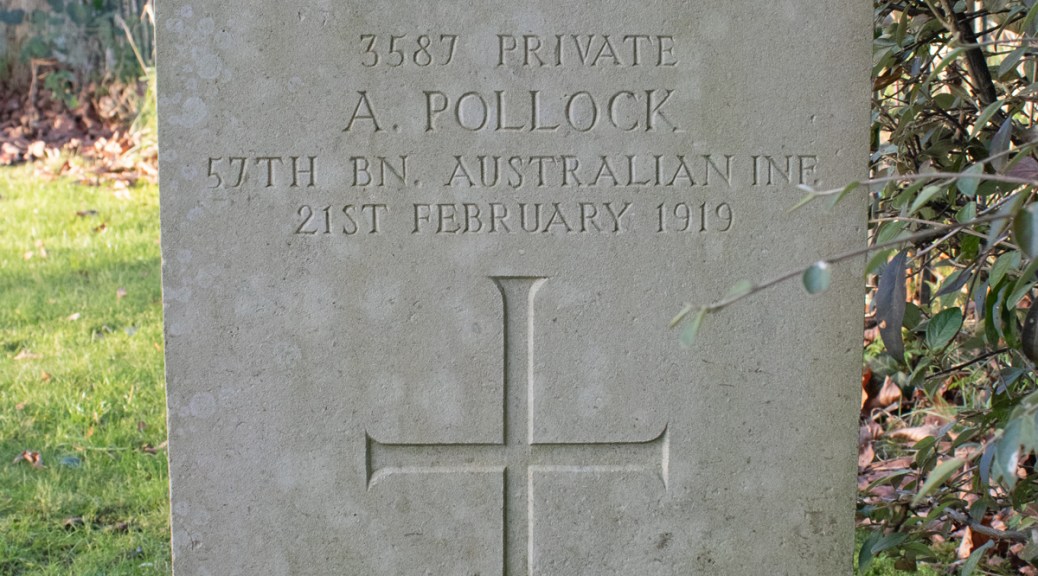
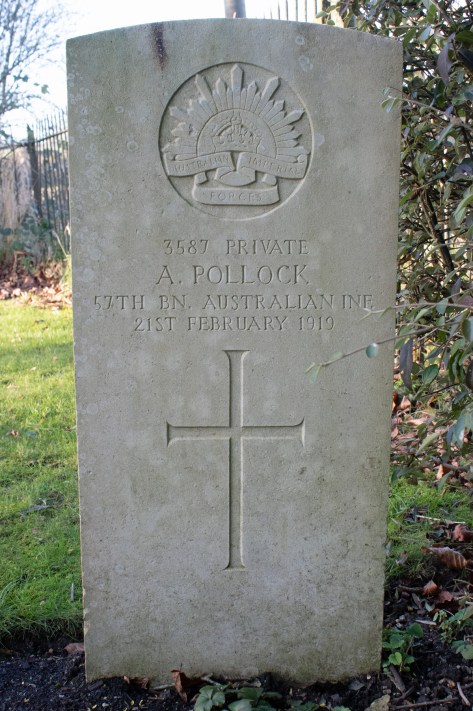
Alexander Pollock was born on 17th April 1893 in Bendigo, Victoria, Australia. The oldest of eight children, his parents were David and Annie. There is little information about his early life, but when he completed his schooling, he found work as a general labourer.
When war broke out, Alexander – who was better known as Ike – stepped up to play his part. He enlisted in the Australian Imperial Force (AIF) on 12th July 1915, just four months after his father had passed away. Private Pollock’s service records show that he was 5ft 6ins (1.68m) tall and weighed in at 13st 4lbs (84.4kg). He had dark brown hair, blue eyes and a fresh complexion, with a scar on his left bicep.
Private Pollock’s unit – the 57th Battalion – left Australia at the start of 1916, arriving in Egypt towards the end of February. They spent the next couple of months training at the Tell el Kebir camp, to the north of Cairo, before setting off to France, arriving in Marseilles on 23rd June.
Ike’s first taste of battle came within a matter of weeks, when his unit acted as a back-up force during the Battle of Fromelles. Described as the worst day in Australia’s history, the AIF suffered more than 5,000 casualties. The 57th Battalion, held in reserve, did not incur as many losses as other units and, as a result, Private Pollock would have remained entrenched on the Front Line after the worst hit battalions pulled back.
The next few years would see Ike remain on the Western Front. His service papers suggest that he did not see any leave until March 1918, but he was soon back in the action.
After the Armistice was declared, Private Pollock remained in France. He had a second period of leave from 22nd December 1918, spending the festivities in Britain. Back in France on 13th January 1919, he was moved to a training camp in Le Havre. By this point, however, his health was suffering, and he was moved back to Britain weeks after arriving.
Billeted at the ANZAC base in Codford, Wiltshire, Ike came down with influenza and pneumonia. He was admitted to the New Zealand General Hospital not far from the base, but the conditions were to prove fatal. He died on 21st February 1919, at the age of 25 years old.
Thousands of miles from home, and with his mother having also passed the previous year, the body of Alexander ‘Ike’ Pollock was laid to rest in the graveyard extension to St Mary’s Church, Codford.
The early life of Albert James Button is a challenge to piece together. Born in Melbourne, Australia, in 1892, his father was also called Albert. When he finished his schooling, he found work as a hotel clerk, settling at 58 Stirling Street, Fremantle. He married a woman called Gladys, and, in his free time, he volunteered in the local militia.
When war broke out, Albert stepped up to play his part. He enlisted in the Australian Imperial Force on 9th December 1915, his service papers confirming that he was 5ft 8ins (1.72m) tall and weighed 129lbs (58.5kg). He was noted as having fair hair, blue eyes and a fresh complexion: he also had two vaccination marks on his left arm, and a mole on the right side of his neck.
Private Button spent the first half of 1916 training. His voluntary experience put him in good stead, and, he was promoted to Sergeant on 28th March. Towards the end of July, his unit – the 44th Battalion – left Fremantle for Britain, and he arrived in Plymouth, Devon, some two months later.
Sergeant Button was billeted at the ANZAC camp in Codford, Wiltshire. For a unknown reason, when he arrived at the base on 19th September, he was demoted to the rank of Corporal – it is unclear whether or not this was his choice. At this point, he was transferred to the 51st Battalion.
While in Wiltshire, Albert’s training continued. A local newspaper described what happened next:
Mr FAP Sylvester held an inquest at Codford, on Saturday, relative to the death of Corporal Albert James Button, 23, of the Australian Imperial Forces. The deceased, with several of his comrades, was in a bay awaiting his turn to throw a hand grenade, when a private named Taylor, who was in the throwing bay with an instructor, landed his grenade in the opposite direction to that intended, with the result that it pitched into the midst of the soldiers in the waiting bay. Being warned most of the men got away, but the deceased seemed paralysed and stayed until the bomb exploded. He was struck in the head and died almost immediately. Several of his comrades were struck i the legs, but their wounds were not serious. Pte. Taylor’s explanation was that the lever of the grenade caught in his thumb and caused him to swing his arm around. A verdict of “Accidental death” was returned.
[Devizes and Wilts Advertiser: Thursday 30th November 1916]
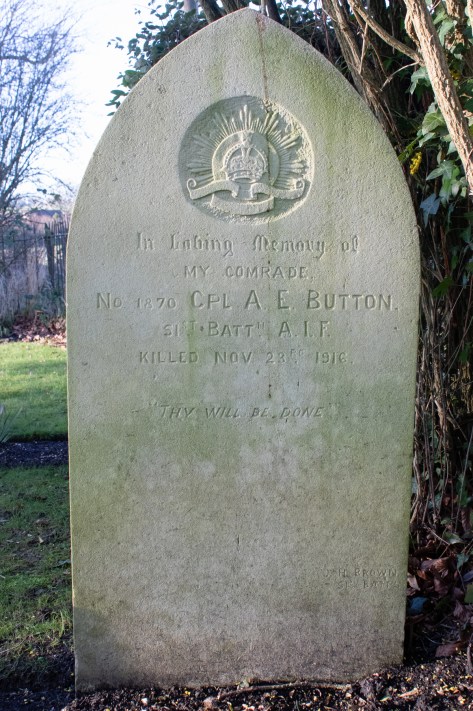
Albert James Button died on 23rd November 1916: he was 24 years of age. He was laid to rest in the recently extended graveyard of St Mary’s Church, Codford. The epitaph on his headstone starts “In loving memory of my comrade”, but it is unclear who specifically paid for it. Was it Private Taylor? We may never know.
Gladys seems to have distanced herself from her husband’s passing. His memorial plaque and medals were returned undelivered, and his pension seems to have gone unclaimed. It was only in 1923 that the Australian Military Forces were able to confirm that she had remarried, and moved to Sydney.
Private Albert Button (from findagrave.com)
Private Button’s service papers shed more detail on the incident that took his life. Evidently a summary of notes taken during the inquest, they are light on punctuation:
Inquiry into the death of a soldier in that he on 23.11.16 at Codford whiles in the bay of a live bomb throwing pitch was killed. The bomb was known by 2264 Pte Taylor of 50th Btn now attached to the 13th Inf Btn, which struck against the top of the parapet to the head of the thrower, owing probably to the spin of the bomb came back and dropped on the inside edge of the bay. All men were warned… to reach cover with the exception of 1870 Cpl Button AJJ 51st Battn. who seemed paralysed with fear. He remained in the bay and was found after the explosion lying across the sandbags which were placed at the entrance to prevent the bombs which were thrown against the parapet from falling into the pen. Other soldiers were wounded by shrapnel effect, because instead of falling down flat when a short distance from the bay, continued to run. The bomb not being as was thought a five second bomb, exploded in three seconds (witness 2nd Liet. JW Swanse 45th Bn)… The Court declared that the occurrence was purely accidental owing to the inexperience of live bomb throwing and nervousness on the part of the thrower, also that no blame is attached to any persons concerned in the practice.
Michael Smith was born in Melbourne, Australia, in the spring of 1878. Details of his early life are scarce, but he seems to have been one of five children to Michael and Mary Smith.
Michael Jr married Lucy Mungovan, twelve years his senior, on 7th August 1915. By this point he had moved to Sydney and was working as a cook. The couple had had a son, William, in 1903, and the wedding seems to have been a way of formalising their relationship in anticipation of the coming war.
Michael Jr enlisted in the Australian Imperial Force on 13th July 1916. His service records show that, at 38 years of age, he was 5ft 3.5ins (1.61m) tall and weighed 125lbs (56.7kg). A Roman Catholic, he had brown hair, although he was balding, blue eyes and a fresh brown complexion. He was also noted as having two scars: one on the back of his right shoulder, the other on the back of his right thigh.
Assigned to the 45th Battalion of the Australian Infantry, Private Smith’s unit left Sydney on 7th October 1916 for its seven week voyage to Britain. The A40 Ceramic troop ship reached Plymouth, Devon, on 21st November, and Michael was marched to the ANZAC base in Codford, Wiltshire the same day.
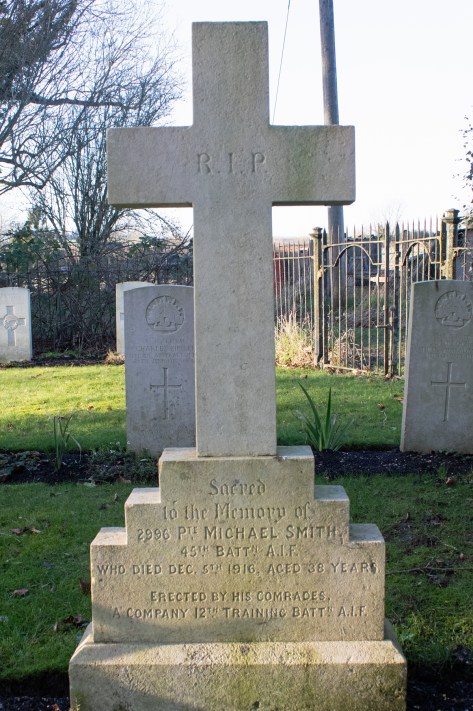
The voyage took its toll on the soldiers, and Private Smith was not to be immune. Within a fortnight he had been admitted to the Military Hospital in Sutton Veny, five miles to the north west. He was suffering from pneumonia, but it was to prove too late. He passed away on 5th December 1916 – the day he arrived at the hospital – at the age of 38.
Thousands of miles from home, the body of Michael Smith was laid to rest in the extension to St Mary’s Churchyard in Codford, Wiltshire.
The shock of her husband’s death was to prove too much for Lucy. She passed away on 16th January 1918, at the age of 52.
Thomas Ernest Osborne was born in the spring of 1884 in the New South Wales town of Cardiff. One of twelve children, his parents were Bartholomew and Hannah Osborne.
Little information is available about Thomas’ early life, but he found employment as a miner when he completed his schooling. In 1903 he married Florence McLean: they settled in Wollongong, to the south of Sydney, and had six children.
When war broke out, Thomas stepped up to play his part, and he enlisted in the Australian Imperial Force on 12th June 1916. His service records show that he was 5ft 7.5ins (1.71m) tall, and weighed 168lbs (76.2kg). He had brown hair, brown eyes and a fair complexion. He was also noted has having two vaccination marks on his left arm, and an inch-long scar on his lower lip.
Private Osborne boarded the A40 Ceramic troop ship on 3rd October 1916. It took nearly two months to make the trip from Sydney to Britain, and his unit – the 45th Battalion of the Australian Infantry – finally disembarked in Plymouth, Devon, on 21st November. From here, he marched into the ANZAC base in Codford, Wiltshire.
The voyage from Australia took its toll on a significant number of troops, and Thomas’ health was also impacted. He was admitted to the military hospital in Sutton Veny – just a few miles from base – suffering from pneumonia. The condition was to prove fatal: Private Osborne died on 10th December 1916, at the age of 33 years old.
The body of Thomas Ernest Osborne was laid to rest in the newly extended graveyard of St Mary’s Church, Codford.
Thomas’ effects were sent to his widow, although she was still chasing their return some nine months after his passing. They consisted of “diary, pocket book (leather), wristlet watch and strap, pipe, writing tablet, soap dish, jack knife, pencil, letters, postcards, photos, Testament, money belt, 2 keys, small penknife, ring.”
Florence married again on 16th February 1918, to a Victor Johnson. Thomas’ papers show that communications about her late husband continued, however. On 27th July 1921, an urgent missive was sent to Florence regarding the erection of a permanent headstone for his grave. There is no evidence of any response, and it seems likely that the now Mrs Johnson was unable to cover the cost. Thomas’ grave marker was eventually erected by his army colleagues.
Thomas’ youngest sibling, Reuben, also fought in the First World War. Eleven years younger than his brother, Private R Osborne was attached to the 35th Battalion of the Australian Infantry. By the spring of 1917 his unit was firmly entrenched on the Western Front. Rueben was killed on 7th June, and is commemorated on the Menin Gate at Ypres.
Richard Charles Gladstone Ryan was born in Talia, South Australia, on 31st March 1895. The son of Richard and Margaret Ryan, he was the older of two chidren.
There is little information available about Richard Jr’s early life. When he finished his schooling, he found work as a farm hand, and this was the trade he was following when war broke out. In his spare time, he was a member of the Elliston Rifle Club, and, on receiving the call to serve his King and Empire, he stepped up to play his part.
Private Ryan’s service papers show that he enlisted in the Australian Imperial Force on 13th March 1916. The document shows that he was 5ft 4.75 (1.64m) tall, and weighed 143lbs (64.9kg). A Roman Catholic, Richard had auburn hair, brown eyes and a medium complexion.
Richard ‘s unit – the 50th Battalion of the Australian Infantry – left Adelaide on 21st September 1916. The ship he was on, the A73 Commonwealth, would take nearly two months to reach Britain, and he disembarked in Plymouth, Devon, on 14th November. From there, he was marched to the ANZAC base in Codford, Wiltshire.
Soon after arriving, Private Ryan became unwell. He had contracted pneumonia, and was admitted to the No. 3 New Zealand General Hospital in Codford on 13th December 1916. His condition quickly worsened, and he passed away just three days later. He was 21 years of age.
The body of Richard Charles Gladstone Ryan was laid to rest in the newly extended graveyard of St Mary’s Church in Codford.
Thomas Hulkes Bingham Day was born on 2nd January 1855 in Frindsbury, Kent. The youngest of four children, his parents were Thomas and Emma Day. Thomas Sr was a banker and a justice of the peace. He died when his youngest was just a child, and Emma was left to raise the family, albeit with the help of five servants.
Thomas sought out a life in the military. After volunteering in the local militia, for a number of years, he gained a commission in the Dorsetshire Regiment. He took on the role of Lieutenant on 29th November 1876.
Over the next two decades, Thomas served around the world, spending time in Malta, Gibraltar, and the East Indies. He was also promoted through the ranks, rising to Captain in 1883 and Major in 1893.
On 25th March 1884, while serving in India, Thomas married Katharine Watts. The couple had a daughter, Winifred, who was born in July 1885, and, eventually they settled in Wiltshire as their base in Britain.
Major Bingham Day served in South Africa during the Boer War, taking part “in the operations at Parde Kraal, and in the operations at Poplar Grove… Vet River, Zand River, Johannesberg and Pretoria. He had the Queen’s and the King’s medals with five bars.” [Lincoln Leader and County Advertiser – Saturday 28 April 1917]
Thomas retired in 1903, and his trail goes cold until the time of the 1911 census. He and Katherine were on holiday when it was taken, and they were listed as boarding at the Beach Lodge on Roseville Street in St Helier, Jersey.
When war broke out, Thomas stepped up to play his part once more. He was put in charge of the 4th (Reserve) Battalion of the Devonshire Regiment, which was based at Sutton Veny in Wiltshire. It seems that he lived off site, as he and Katherine moved into a house in nearby Warminster.
A military funeral took place… on Monday, when Lieutenant-Colonel TH Bingham-Day, in command of a regiment at Sutton Veny, was laid to rest in the churchyard. The deceased officer died suddenly while at mess, as the result of a seizure.
[Devizes and Wilts Advertiser: Thursday 19th April 1917]
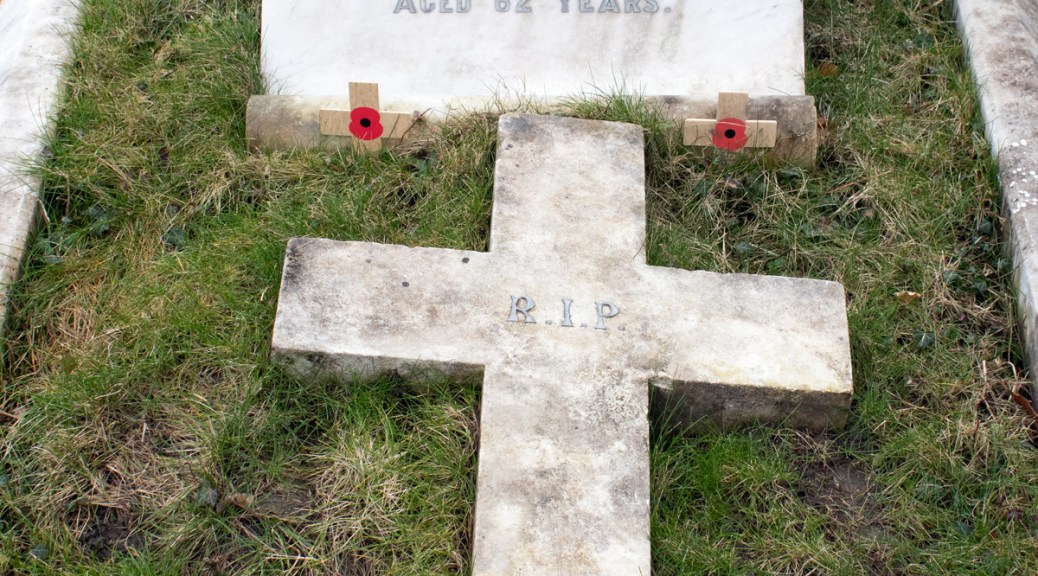
Lieutenant Colonel Thomas Hulkes Bingham Day was 62 years of age when he passed away on 11th April 1917. He was laid to rest in the graveyard of St Aldhelm’s Church in Bishopstrow, Wiltshire, not far from the base at which he had so dutifully served.
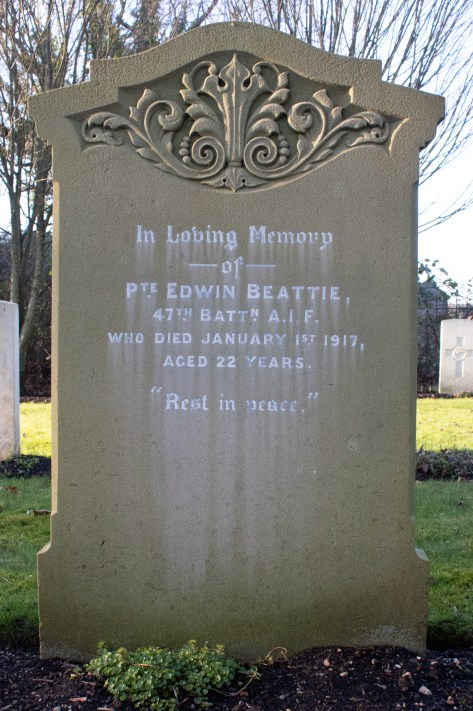
Edwin Beattie was born on 14th March 1894, in the town of Coomera, Queensland, Australia. He was the youngest of three children to John and Mary Beattie.
There is little information available about Edwin’s early life, but when he completed his schooling, he took up farm work. When war broke out, he was keen to play his part, and enlisted in the Australian Imperial Force on 28th March 1916.
Private Beattie’s service records show that he was 5ft 9.5ins (1.65m) tall, and weighed 136lbs (61.7kg). A Methodist, he was recorded as having brown hair, blue eyes and a medium complexion. He also had a birthmark on the small of his back, and scars on both knees.
Edwin was assigned to the 44th Battalion of the Australian Infantry. His After training, his unit boarded the SS Seang Choon in Brisbane, and set off on the ten month voyage to Britain, arriving in Devonport, Devon, on the 9th December 1916.
During the voyage, Private Beattie had fallen ill, and, on disembarking, he was taken to the local hospital for treatment. By 23rd December, he was moved to the Military Hospital connected to the ANZAC camp in Codford, Wiltshire. His condition – pneumonia – worsened over the coming days, and Edwin would eventually succumb. As a new year began, he breathed his last, passing away on 1st January 1917, at the age of just 22 years of age.
Thousand of miles from home, Edwin Beattie was laid to rest in the newly extended graveyard of St Mary’s Church, Codford.
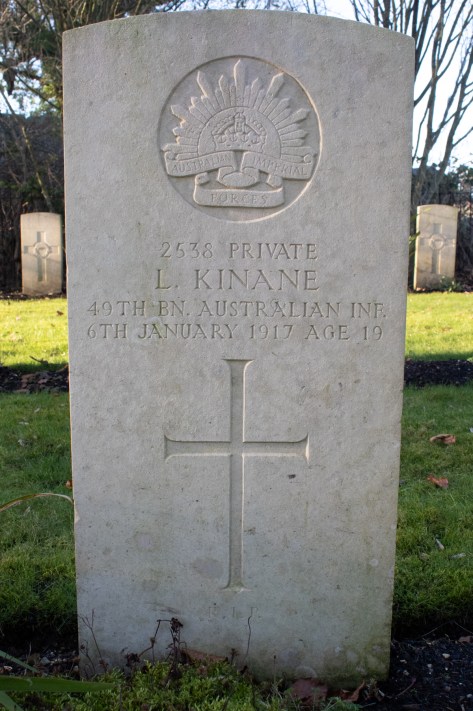
Lawrence Kinane was born in Tipperary, Ireland, in 1896. One of eight children, his parents were Daniel and Catherine Kinane. Daniel was a farmer and, when Catherine died when Lawrence was just 10 years old, he was left to raise the support the family on his own.
At this point, the family’s trail goes cold, and it later picked up in an unexpected way. Daniel and some of the children seem to have emigrated to the United States, and he died in Brooklyn in March 1914. Lawrence, meanwhile, seems to have gone further, seeking a new life in Australia. A cousin, Mary Mulcahey, was living with her husband in Warwick, Queensland, and, by the time war broke out, he had moved to Brisbane.
Lawrence was working as a labourer when, on 10th June 1916, he enlisted in the Australian Imperial Force. His service papers show that he was 5ft 11ins (1.8m) tall and weighed 147lbs (66.7kg). A Roman Catholic, he had dark brown hair, grey eyes and a medium complexion. Under Distinctive Marks, he was recorded as having a large patch of scars on his left side, about 7ins (18cm) above his buttock.
Private Kinane’s unit – the 49th Battalion of the Australian Infantry – set sail from Brisbane on the 19th September 1916. His ship – the SS Seang Choon – would take ten weeks to reach its destination – Devonport, Devon, and Lawrence finally arrived at the ANZAC base in Codford, Wiltshire in mid-December.
The lengthy sea voyage had taken its toll on a lot of the soldiers being transported, and Private Kinane was not to be immune. Within weeks of arriving, he came down with pneumonia, and was admitted to the No. 3 New Zealand General Hospital in nearby Sutton Veny on 31st December. Lawrence’s condition worsened, and he finally succumbed to it on 6th January 1917. He was just 20 years of age.
Thousands of miles from Australia, and with no family close by, the body of Lawrence Kinane was instead laid to rest in the graveyard of St Mary’s Church in Codford, not far from the base that had been his home for just a few short weeks.
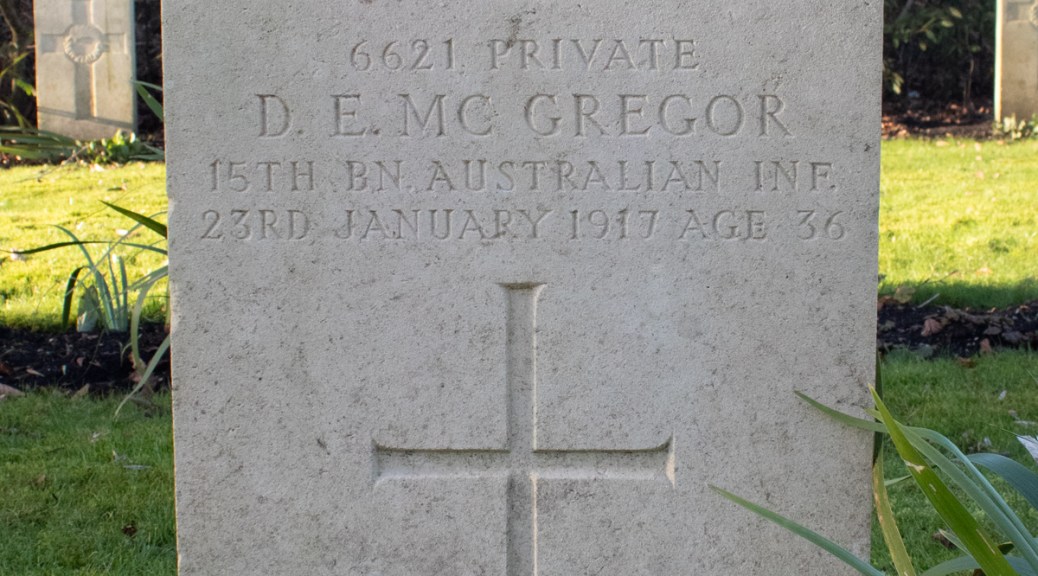
David Edward McGregor was born in Bega, New South Wales, Australia, in the summer of 1880. One of fourteen children, his parents were John and Isabella McGregor.
There is little information about David’s early life, but when he completed his schooling, he found work in a dairy, eventually becoming employed as a cheesemaker.
When war broke out, David stepped up to serve his King and Empire, enlisting in the Australian Imperial Force as a Driver on 7th July 1916. His service records show that he was 5ft 10.5ins (1.79m) tall and weighed in at 168lbs (76.2kg). A Presbyterian, he was noted as having black hair, brown eyes and a medium complexion.
Driver McGregor’s unit – the 15th Battalion of the Australian Infantry – set sail from Brisbane on the SS Boonah on 21st October 1916. Their journey would take ten weeks, arriving in Devonport, Devon, on 10th January 1917. From here David was marched in to the ANZAC camp at Codford, Wiltshire.
The lengthy sea voyage had taken its toll on a lot of the troops, and David was not to be immune. He came down with pneumonia and, after initially being treated in the camp hospital, he was admitted to the military hospital in Codford in a moribund condition. Driver Brooks’ move was to prove too little, too late, and he passed away on 23rd January 1917, just a day after being admitted. He was 36 years of age.
David Edward McGregor was laid to rest in the ANZAC extension to St Mary’s Churchyard in Codford, Wiltshire, not far from the base he had so briefly called home.















 Death and Service