Alexander Bertram Cain was born on 31st July 1885 in Ormskirk, Lancashire. He was the ninth of eleven children to concert promoter Robert Cain and his wife, Sarah.
By 1901, Robert and Sarah had moved the family to Jersey, setting up home in St Saviour’s. Robert was noted as living off his own means, but Alexander, who would have been 15 by this point, is noticeable by his absence and, in fact, does not appear on that year’s census return.
Robert died in 1909, and on 26th January 1911, Alexander married a woman called Hilda Bedford. They settled down in St Helier, and went on to have two children, daughters Yvonne and Elizabeth. The census taken three months after the couple’s wedding recorded Alexander as living on his own means, so money appeared not to be an issue for the young family.
When war came to Europe, Alexander was called upon to play his part. On 12th March 1917, he enlisted in the Royal Jersey Militia, and was attached to the regiment’s Garrison Battalion, stationed on the island. His service records confirm that he was 5ft 7ins (1.7m) tall, and that he had a scar on his left cheek. The document also suggests that he had spent time in the Gloucestershire Regiment, but no further information about this is available.
Private Cain spent the next two years in the army. Towards the end of this time, however, his health appears to have been impacted, to the point that, on 6th May 1919, he was medically discharged from the Royal Jersey Militia.
Whatever his condition, it was to prove fatal. Alexander passed away at home on 31st May 1919: he was 33 years of age.
Alexander Bertram Cain was laid to rest in the family plot in La Croix Cemetery in Grouville, Jersey, Hilda left widowed and with two children – Elizabeth just four months old – to raise.
Thomas Peter Ounan was born on 21st July 1894 in St Helier, Jersey. The oldest of three children, his parents were Thomas and Augustine Ounan. Thomas Sr was a groom from England, who had married his Jersey-born wife and settled on the island to raise their family.
There is, in fact, little documented information about young Thomas’ life. From his military service records, it would seem that he found employment as a steward when he left school. When war broke out, he was called upon to play his part and, on 10th June 1916, he enlisted in the Royal Navy as an Officer’s Steward 3rd Class.
Thomas was initially sent to HMS Victory – the Royal Naval Dockyard in Portsmouth, Hampshire – for training. After a month he was assigned to the steam ship HMS Lucia, spending the next few months on board. At this point, he became unwell, having contracted tuberculosis. and was admitted to hospital in Portsmouth for treatment.
On 30th August 1916, Officer’s Steward Ounan was medically discharge from naval duty due to the condition. He returned to Jersey, remaining in the family home for the next year.
Thomas’ condition was to get the better of him, though. He passed away from tuberculosis at home on 6th October 1917: he was 23 years of age.
Thomas Peter Ounan was laid to rest in the peaceful La Croix Cemetery in Grouville.
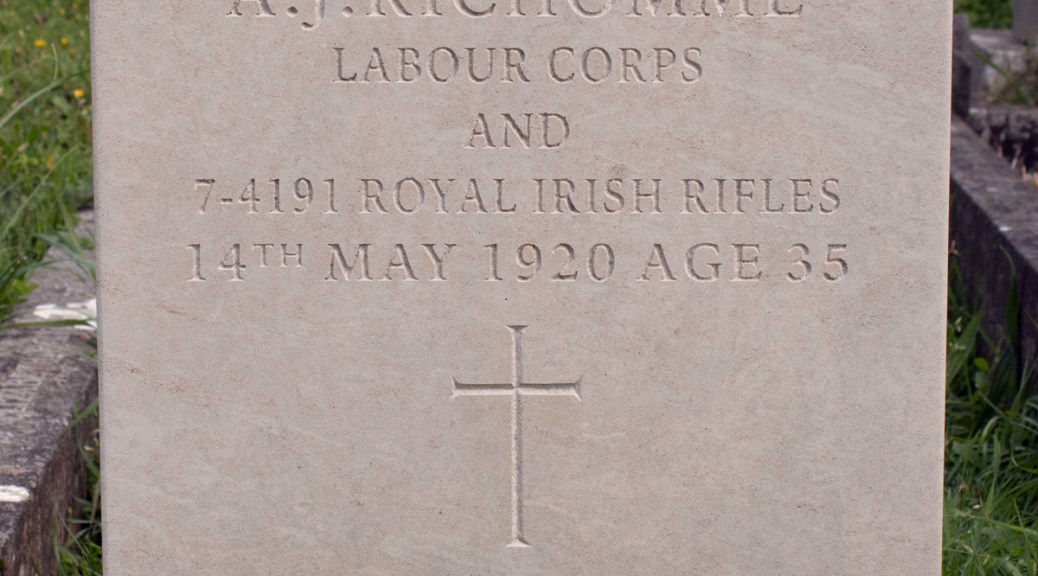
Albert John Richomme was born on 13th June 1885 and was one of eight children to Charles and Marie Richomme. Both were from France, but had moved to Jersey in the Channel Islands before Albert’s oldest sibling, Charles, was born. The couple farmed land near Grouville, the children helping out as they became old enough.
On 28th September 1904, Albert married Linda Rouland at St Thomas’ Roman Catholic Church. The couple set up home in Trinity, and went on to have six children. The 1911 census recorded Albert as being a jobbing gardener, with the family living in the four-roomed Sunny Side Cottage.
When war came to Europe, Albert stepped up to play his part. Initially enlisting in the Royal Jersey Militia, his unit was absorbed into the 7th (Reserve) Battalion of the Royal Irish Rifles. By the end of 1915, he found himself in France.
Full details of Private Richomme’s service are lost to time, but is seems that he was caught up in a gas attack and, after being medically evacuated to Britain to recuperate, he was transferred to the Labour Corps.
At this point, Private Richomme’s trail goes cold. He survived the war and returned home, but passed away from pneumonia on 14th May 1920, just short of his 35th birthday.
Albert John Richomme was laid to rest in the peaceful grounds of La Croix Cemetery in Grouville.
While meeting the appropriate criteria for his burial site to be granted a Commonwealth War Grave, Albert is not recognised by the Commission.
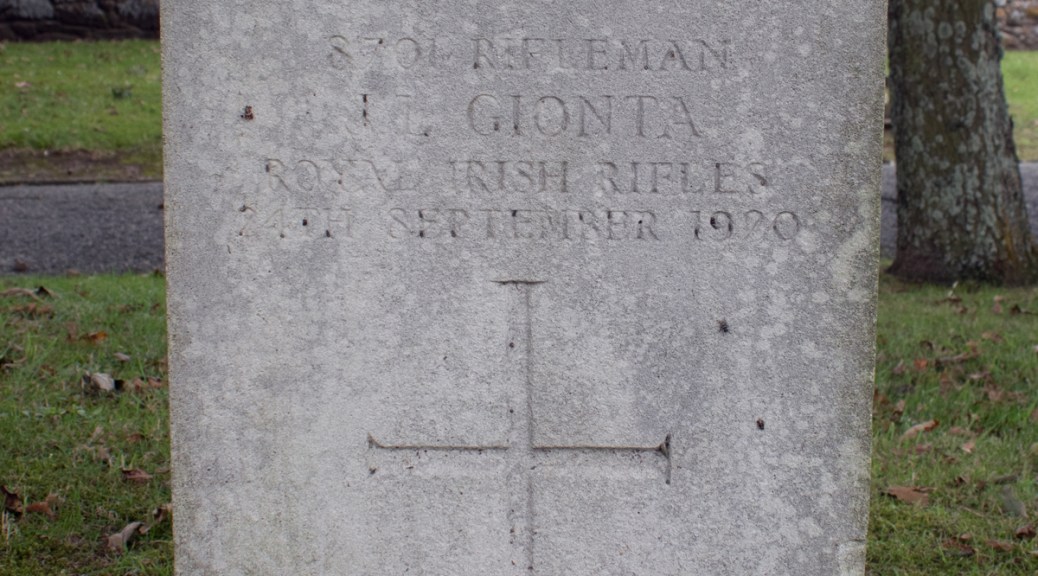
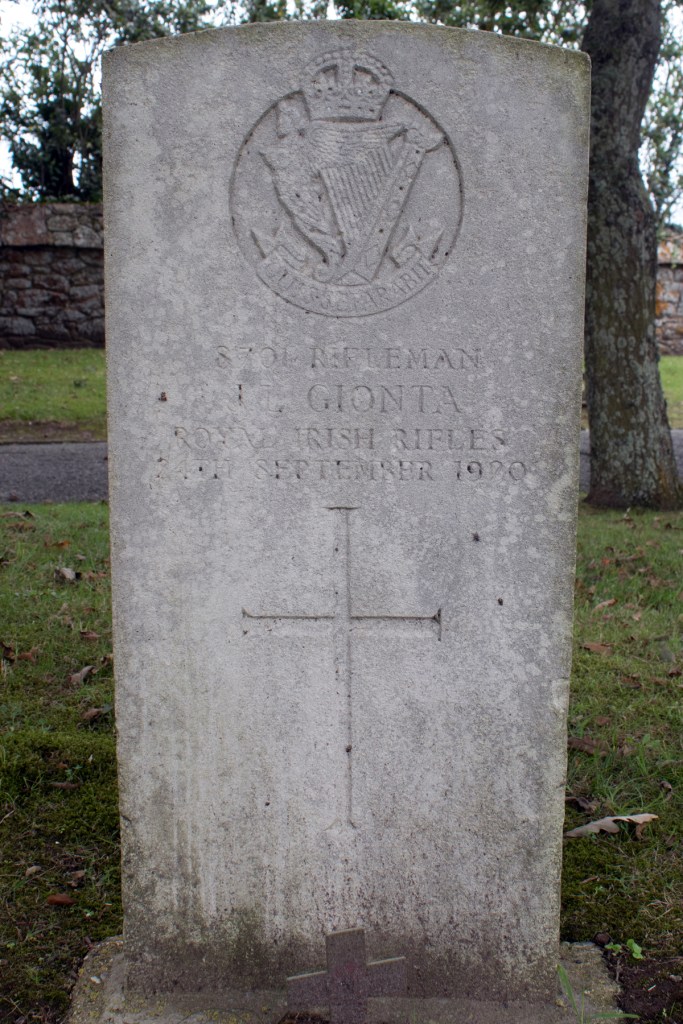
Joseph Marie Louis Gionta was born on 7th January 1897 in St Ouen, Jersey. He was the oldest of three children to Matthieu and Marie Gionta. Marie has been married before, and so her two children – Joseph’s older stepbrothers – made up the household.
Shoemaker Matthieu passed away when Joseph was just a teenager. By the time of the 1911 census, Marie was living in two rooms in St Ouen’s, supported by her five children. She was working as a charwoman, while her two children from her first marriage were farm labourers, bringing in three probably meagre wages to the family home.
When war broke out, Joseph stepped up to play his part. Initially enlisting in the Royal Jersey Militia, his unit was absorbed by the 7th (Service) Battalion of the Royal Irish Rifles shortly after he joined up. Rifleman Gionta’s service records confirm he was 5ft 3.5ins (1.61m) tall, and that he was 19 years old when he enlisted.
Joseph’s battalion served in France from December 1915, and he spent the next ten months overseas. In October 1916, he returned to the UK, and was transferred to the regiment’s 4th (Extra Reserve) Battalion, serving in Ireland.
Towards the end of 1917, Rifleman Gionta became unwell, contracting tuberculosis. This led to his medical discharge from the army on 29th January 1918, and he returned to the Channel Islands. At this point, his trail goes cold, and it is not until the autumn of 1920 that he resurfaces.
Joseph Marie Louis Gionta passed away on 24th September 1920: he was 23 years of age. A cause of death is unclear, although the likelihood is that it was related to the lung condition that he picked up while on active duty. He was laid to rest in the peaceful St Ouen’s Churchyard in Jersey.
John Francis Turner was born on 24th March 1899 in the St Ouen region of the Channel Island of Jersey. He was the only surviving child of Francis and Eugenie Turner, his older brother, Francis Jr, having passed away before John was born.
Francis was a farm labourer, but when John finished his schooling, he found work as a carpenter. When war broke out across Europe, he was conscripted to play his part and, on 31st March 1917, he enlisted in the army.
Private Turner was noted as being 5ft 5ins (1.65m) tall and weighing 115lbs (52kg). His medical records show that his vision was defective, but not so bad as to exclude him from service, but he was also found to have flat feet.
John was assigned to the Royal Army Medical Corps, and was sent to Blackpool, Lancashire, where he was attached to the local depot. He spent the next two years in the army, although his time was not without incident.
In December 1917, he was confined to barracks for five days for overstaying his pass by more than eight hours. This seems to have been Private Turner’s only misdemeanour, however, and there is nothing to suggest anything other than good service.
John’s time in the army does not seem to have been limited to home soil, and, in the spring of 1919, he was attached to one of the Russian convoys ferrying aid and supplies overseas. On his return, however, he fell ill, and on 2nd February, he was admitted to hospital in Edinburgh, suffering from pleurisy.
Private Turner was to remain in hospital for the next few months. He slowly recovered, but then contracted meningitis, and, with his body already weakened by illness, this was to prove his undoing. He passed away on 23rd June 1919, aged just 20 years of age.
John Francis Turner’s body was taken back to Jersey for burial. He was laid to rest in the peaceful churchyard of St Ouen’s.
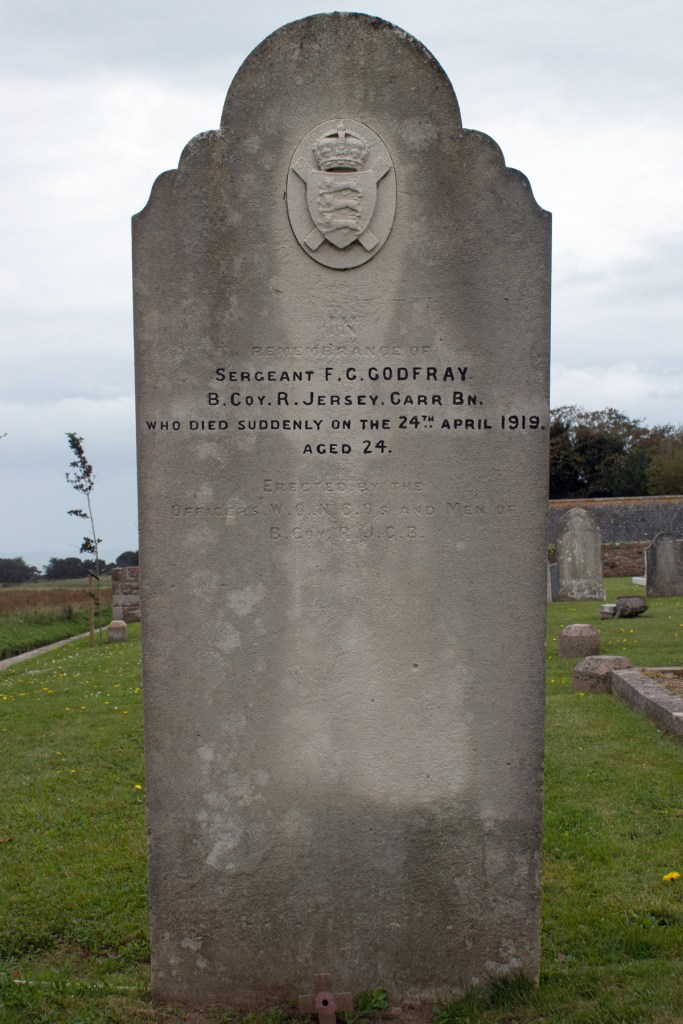
Francis George Godfray was born in Jersey, Channel Islands, on 10th April 1895. One of fifteen children, his parents were Philippe and Alice Godfray. Philippe was a quarryman-turned-agricultural labourer and, by the time of the 1911 census, Francis had also gone into farm work.
War was closing on on Europe’s shores, and Francis stepped up to play his part. Full details of his service have been lost to time, but it is clear that he had enlisted in the Royal Jersey Militia by 1918. Attached to B Company of the regiment’s Garrison Battalion, by the end of the conflict he had been promoted to the rank of Sergeant.
Sergeant Godfray survived the conflict and had returned home by the spring of 1919. On 24th April, he collapsed and died suddenly, his death later confirmed as heart failure. Francis was just 24 years of age.
Francis George Godfray was laid to rest in the peaceful St Ouen’s Churchyard in Jersey.
Sydney William Ecobichon was the youngest of five children to French-born farmers Mathurin and Ann Ecobichon. The couple had moved to Jersey in the Channel Islands in the late 1860s, setting up home in St Peter’s by the time their children were born.
Mathurin passed away in 1895, aged 53 years old, leaving Ann and the children to managed the farm. By the time of the 1901 census, Sydney’s older brother Ernest was the farm manager, with Ann remaining head of the household.
When Sydney finished his schooling, he also started work on the farm. The 1911 census recorded Ernest and his family living in on part of the farm, with Ann, and Sydney living in their own accommodation with Sydney’s sister Anna, her husband and two children.
On 28th February 1917, Sydney married Lilla Amy, a farmer’s daughter from St Ouen. Sydney’s trade was listed as farmer, and it seems likely that the young couple married ahead of his conscription into the army.
Details of Sydney’s military service are lost to time. It is clear from his headstone that he enlisted in the Royal Jersey Militia, and the Commonwealth War Graves Commission records suggest that he was attached to the regiment’s Garrison Battalion.
The only other details for Private Ecobichon’s life are that of his passing. Sydney died on 19th October 1918, and was laid to rest in St Ouen’s Churchyard. The cause of his death is unclear, but he was 30 years old when he died.
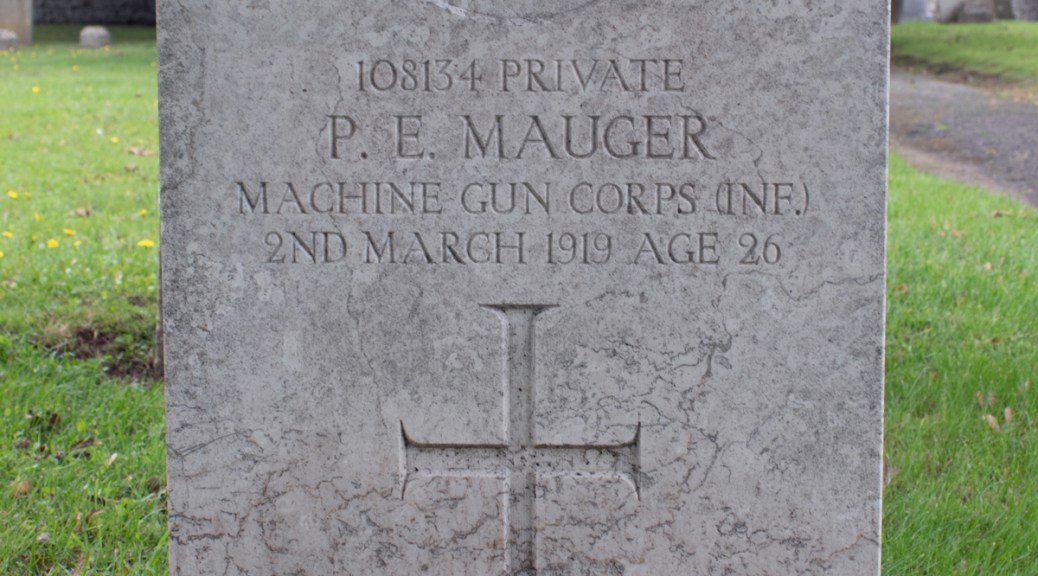
Philip Mauger was born in 1893 in the St Peter’s area of Jersey, Channel Islands. He was the oldest of six children to Albert and Jane Mauger. Albert was a labourer, alternating between road-building and farm work, depending on the time of year. When he finished his schooling, however, Philip fund work as a wheelwright’s assistant.
On 10th February 1917, Philip married Florence Dimmick, a shoemaker’s daughter from St Ouen. Their marriage certificate confirms Philip was a farmer by this point, and it seems likely that the young couple tied the knot ahead of his conscription the army.
Full details of his military service are lost to time, but it is clear that Philip enlisted in the Machine Gun Corps. Private Mauger survived the conflict, but here his trail fades. All that can be confirmed is that he passed away on 2nd March 1919, at the age of 26 years old. He was laid to rest in St Ouen’s Churchyard.
After her husband’s passing, Florence did not remarry. The couple had not had children, and it appears that she reverted to her maiden name. Husband and wife were reunited, however, when Florence passed away in 1937, and she was buried alongside Philip.
Sidney James White was born on 9th April 1899 in Bath, Somerset. The second of six children – and the oldest son – his parents were Sidney and Ann White. Sidney Sr was a butcher by trade and, by the time of the 1911 census, the family were living in Walcot Buildings in the city.
Sidney Jr was only 15 years of age when war came to Europe. However, he was still keen to do hit bit and, on 13th October 1915, he gave up his job as a fitter’s mate and enlisted in the Royal Navy. As he was underage, he was given the rank of Boy 2nd Class, his service records showing that he was 5ft 7.5ins (1.61m) tall, with brown hair, blue eyes and a fresh complexion.
Boy 2nd Class White was dispatched to the ship HMS Impregnable for his initial service. Moored in Devon, she was a training vessel, used to school young recruits in the art of seamanship. In May 1916, Sidney was promoted to the rank of Boy 1st Class, but his time in the Royal Navy was to be cut tragically short.
Holed up in cramped billets, disease often ran rife in military barracks, and Sidney was not to be immune. He contracted meningitis, and was admitted to the Royal Naval Hospital in Plymouth. While initially appearing to recover, the condition was to prove too severe, and his young body succumbed on 18th June 1916: he was just 17 years of age.
Sidney James White’s body was brought back to Somerset for burial. He was laid to rest in a shady spot in Bath’s sweeping Locksbrook Cemetery.
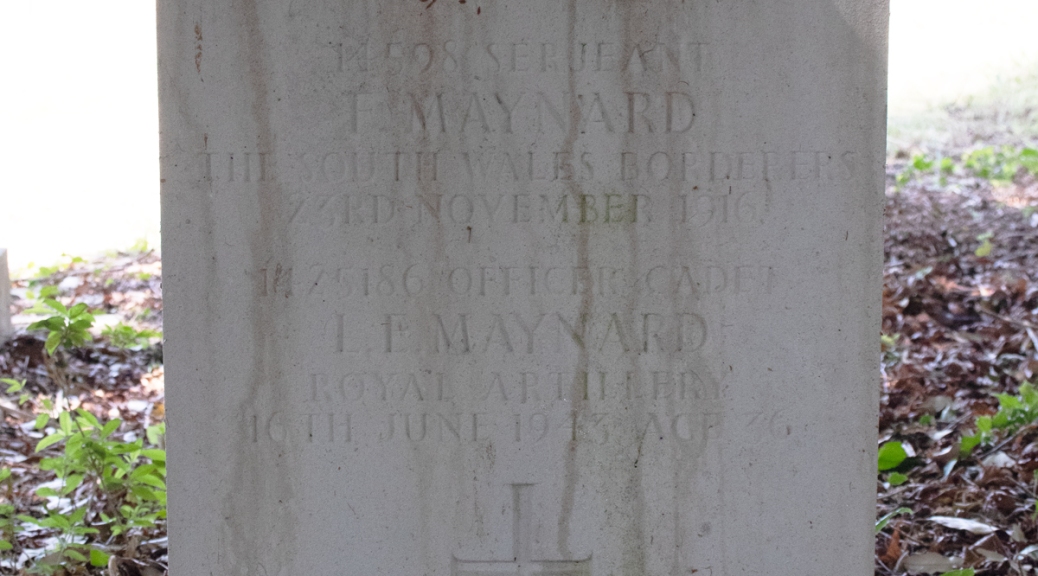
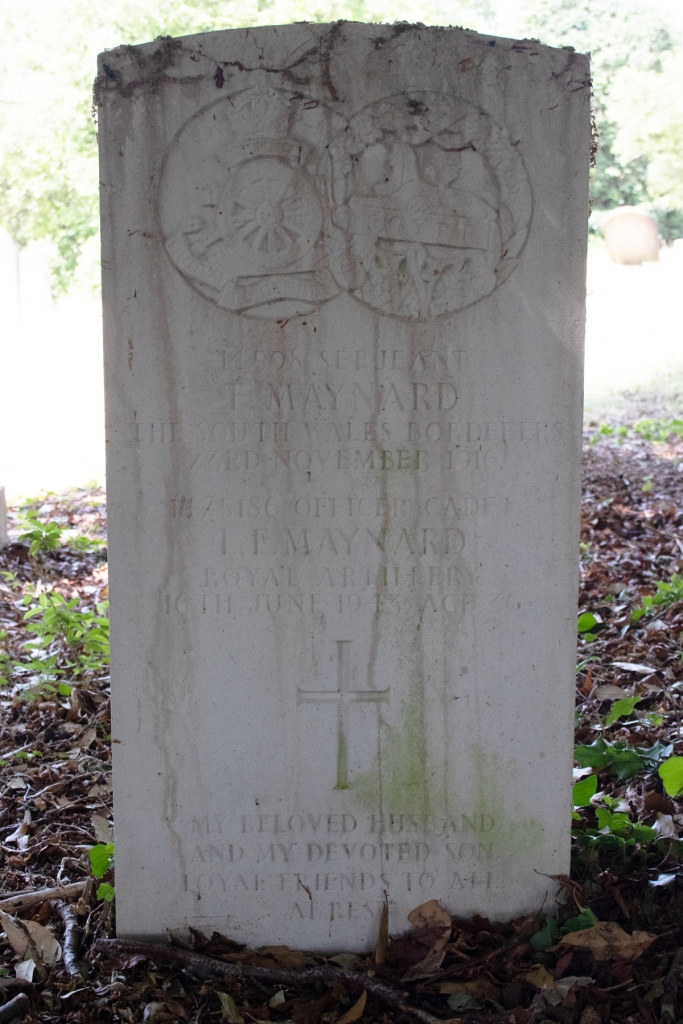
Details of Fred Maynard’s early life are a challenge to piece together. His First World War service records give his age as 44 years old when he enlisted in September 1914, and confirm his place of birth as Melksham, Wiltshire.
A newspaper report of his funeral gives the name of three brothers – Charles, Frank and Arthur – while only one census return, from 1881, provides a potential match for the family. This suggests Fred’s parents were iron fitter Alfred Maynard and his wife, Deborah, and gives the family’s address as Waterworks Road in Trowbridge.
Fred joined the army in the autumn of 1888. Initially assigned to the Gloucestershire Regiment, he had transferred to the Wiltshire Regiment by the following spring. Private Maynard showed a commitment to duty: in December 1890 he was promoted to Lance Corporal, rising to Corporal in the summer of 1893.
Fred was stood down to reserve status after his seven years’ active duty, but was recalled to the army in December 1899, when war broke out in South Africa. Promoted to Serjeant, he was sent to fight in the Boer War, and was mentioned in dispatches on 2nd April 1901 for special and meritorious service in South Africa. He was stood back down to reserve status in October 1901.
On 21st November 1895, Fred had married Louisa Card. The couple set up home in Trowbridge, but soon moved to London. They went on to have six children: Ernest, Nora and Leslie, who were all born in the London; and Arthur, Martha and Stuart, who were born in Cardiff, the family having moved to Wales by 1910.
The army was not finished with Fred, however, and, within weeks of war breaking out in the summer of 1914, he was called back into service. Given the rank of Serjeant again, he was attached to the South Wales Borderers. Fred was 44 years of age by this point, his service records confirming that he stood 5ft 8ins (1.73m) tall, weighed 164lbs (74.4kg) and had brown hair and hazel eyes.
Attached to one of the regiment’s depots, it seems unlikely that Fred saw service overseas this time around. He was discharged from the army on 1st September 1916 and this seems to have been on medical grounds. Later documents suggest that Serjeant Maynard had been diagnosed with carcinoma of the pylorus, or stomach cancer.
Fred returned to Cardiff, but his time back home was to be short. He was admitted to the Lansdown Road Military Hospital, and passed away on 23rd November 1916. He was 46 years of age.
It seems that Fred’s brother’s had some sway in his funeral. Instead of being laid to rest in Cardiff, where Louisa and the children were living, he was, instead, buried in the Locksbrook Cemetery, Bath, Somerset. His sibling Charles, who was a sergeant in Bath City Police, lived in the city, as did another brother, Frank.
Fred’s headstone also commemorates his and Louisa’s son, Leslie. He had joined the army in the 1920s and, in the summer of 1943, was in Yorkshire, undergoing officer training.
The death of an officer cadet through the accidental discharge of a rifle whose bolt had jammed was described at an inquest…
Captain WH Price said he was in charge of an exercise on the moors which involved the used of small arms and the firing of live ammunition. A squad of cadets lay on the ground in front of a trench firing over a range. All finished firing except Cadet Frank Holroyd, who said his bolt had hammed while firing a second round. [Price] told him to release the bolt by knocking the cocking piece up and back.
This attempt failed, and he told Holroyd to get back into the trench, turn the rifle magazine upwards, place the butt on the side of the trench, and kick the bolt down with his foot. While Holroyd was doing this he noticed Maynard standing in the trench about 4ft away from Holroyd and on his right-hand side.
Captain Price said he saw the rifle was pointing down the range when Holroyd kicked the butt. The cartridge suddenly exploded and Maynard dropped into the trench, shot in the head, and was dead when they reached him.
[Bradford Observer: Saturday 19th June 1943]
Officer Cadet Leslie Maynard was 36 years of age when he was killed. His body was taken back to Somerset for burial: he was laid to rest in the same grave as Fred, father and son reunited after 27 years.
Louisa remained somewhat elusive as time wore on. Fred’s military records confirm that she had moved from Cardiff to the Isle of Wight by 1922. By the time of her son’s death, she was living in Sidcup, Kent.











 Death and Service