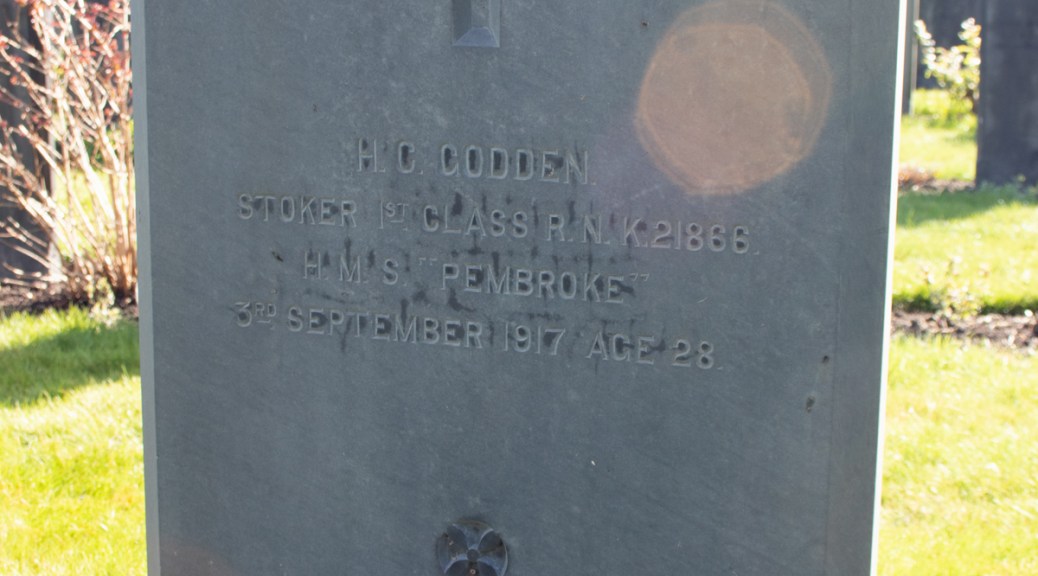
Horace Cecil Godden was born on 8th February 1889 in the Suffolk village of Boxford. He was one of eleven children to Charles and Sarah Ann Godden. Charles was a butcher and pig trader, and butchering was a trade that Horace also got into on leaving school.
He was after bigger and better things, however, and on 23rd January 1914, he enlisted in the Royal Navy. as a Stoker 2nd Class. His service records show that he stood 5ft 3ins (1.59m) tall, had brown hair, brown eyes and a fresh complexion. Horace was also noted as having a scar on the back of his left hand.
Stoker Godden was initially sent to HMS Pembroke – the Royal Naval Dockyard in Chatham, Kent – for training. His first sea-going assignment was on board the gunboat HMS Jason and, during his first year with the navy, he served on three ships in total.
Horace was promoted to Stoker 1st Class in December 1914, and served on board another two ships before returning to Chatham in November 1915. His time was not without incident, however, and he spent time in the brig on two separate occasions – for 7 days in May 1915, and for two weeks that October – although his crimes are not recorded.
In March 1916, Stoker 1st Class Godden returned to sea once more, this time on board the sloop HMS Cadmus. He came back to Chatham the following February, and then remained at the HMS Pembroke.
That summer, the Royal Naval Dockyard was packed to capacity, and Horace was billeted in temporary accommodation put in place at Chatham Drill Hall. On the night of the 3rd September 1917, during a German air raid, the Hall received a direct hit and Stoker 1st Class Godden was among those to be killed. He was just 27 years of age.
Horace Cecil Godden was laid to rest, along with the other victims of the Chatham Air Raid, in the Woodlands Cemetery in Gillingham, Kent.
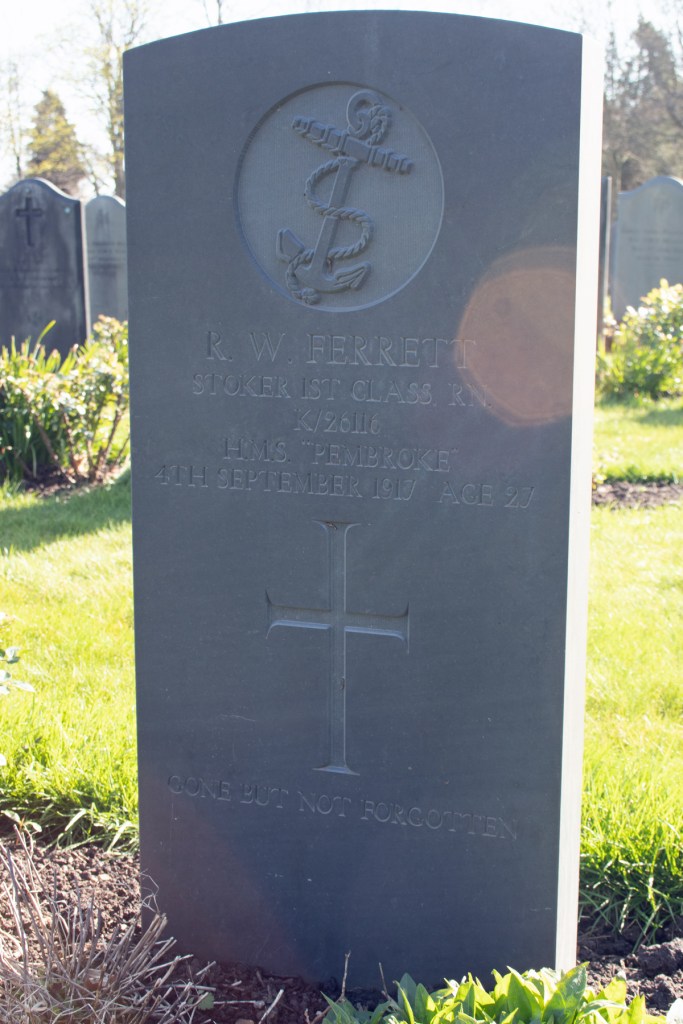
William Robert Ferrett (known as Robert) was born on 14th December 1889, and was the oldest of three children to William and Annie. William was a farm labourer from Dorset; Annie was born in Camberwell, South London, but, by the time Robert was born, the couple had settled in Kingsbury, Middlesex, where they raised their family.
Robert also took up labouring work in a washhouse when he left school, and had left home by the time of the 1911 census. He was recorded as boarding with James and Sarah Kemp in Willesden Green. There may have been an ulterior motive for him as, that summer, he married their daughter, Daisy. There may have been an ulterior motive for the marriage as well as, later that year, the couple had the first of their two children, who they named William.
War was on the horizon and, in the spring of 1915, Robert enlisted, joining the Royal Navy as a Stoker 2nd Class. His service records show that he stood just 5ft 1.5ins (1.56m) tall, had brown hair, brown eyes and a medium complexion. He was also noted as having tattoos on both arms and a scar on his forehead.
Stoker Ferrett’s first posting was at HMS Pembroke, the Royal Naval Dockyard in Chatham, Kent. After three months’ training, he was assigned to the battleship HMS Vanguard, on board which he spent the next two years. While he was promoted to Stoker 1st Class during this time, it was not all plain sailing. The records show that Robert spent two separate periods of time in the brig – 14 days in December 1916, and a further 14 days in June 1917 – although his misdemeanours are unclear.
In June 1917, soon after his second imprisonment, Stoker Ferrett was transferred back to HMS Pembroke. The dockyard was particularly busy that summer and Robert found himself billeted in temporary accommodation in Chatham Drill Hall.
On the night of the 3rd September, the German Air Force conducted the first night time raid on England. Chatham came in the firing line, and the Drill Hall received a direct hit. Stoker 1st Class Ferrett was badly wounded and was taken to the Royal Naval Hospital in the town. His injuries proved too severe, however, and he passed away the following day. He was 27 years of age.
Robert Ferrett was laid to rest in the Woodlands Cemetery in nearby Gillingham, along with the other victims of the Chatham Air Raid.
Robert’s younger brother, Robert Frederick Ferrett, also fought in the Great War. He served as a Private in the 7th Battalion of the London Regiment, but was killed at the Somme on 23rd July 1918, aged just 21 years old. He was laid to rest in the Pernois Cemetery in Picardie.
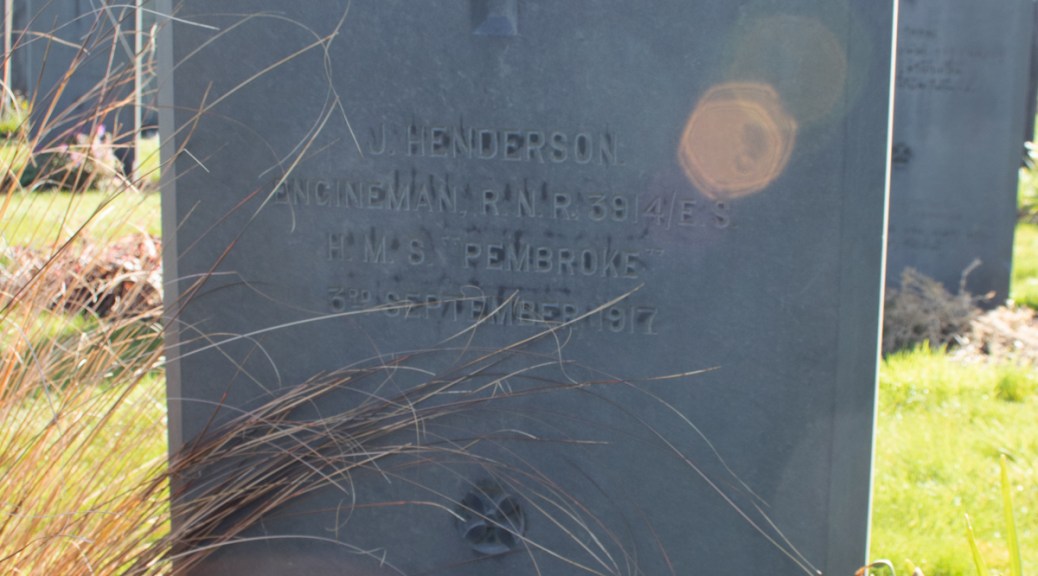
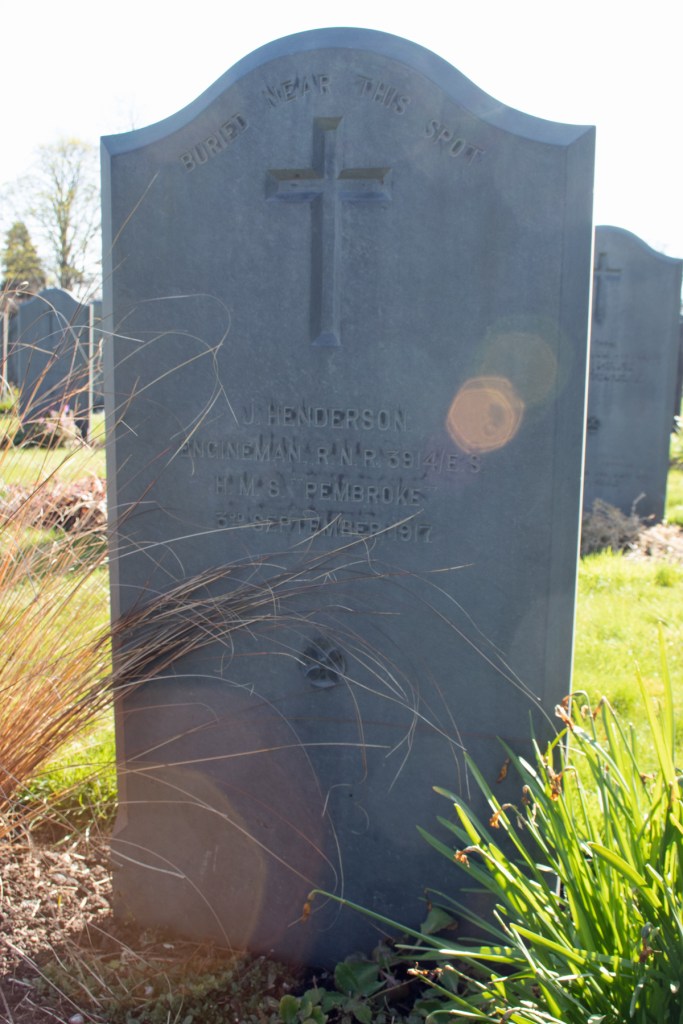
John Henderson was born on 21st May 1887 in Leith, near Edinburgh. His parents were John William Henderson (known by both of his first names) and Matilda Jane Henderson (known as Jane), and he was one of eight children.
There is little documented about John’s early life and, in fact, the main information about him comes from his service records during his time in the Royal Naval Reserve. Before enlisting he was already involved in shipping in some form – again, however, this is not detailed – but he formally enlisted on 13th August 1915, serving as an Engineman.
John’s records confirm that he was 5ft 4.5ins (1.63m) tall, with blue eyes and a ruddy complexion. He was also noted as having a couple of tattoos on his forearms, including a pair of clasped hands over a heart.
All of Engineman Henderson’s postings were shore-based. He was initially assigned to HMS Columbine, the naval base at Port Edgar, on the Firth of Forth. This was bring constructed at the time, and John was employed as part of that construction process. While here, he was injured on his left hands while laying some cables in April 1916 and lost the tip of his finger.
When he had recovered, Engineman Henderson was transferred to HMS Gunner, the Granton Naval Base in Edinburgh. He spent fifteen months working there, before being assigned to HMS Pembroke, the Royal Naval Dockyard in Chatham, Kent, in August 1917.
The Dockyard was particularly busy that summer, and the large number of extra servicemen meant that John was billeted in temporary accommodation in Chatham Drill Hall.
On the 3rd September 1917, the first night air raid carried out by the German Air Force bombarded the town, and scored a direct hit on the Drill Hall; Engineman Henderson was among those killed that night. He was just 30 years of age.
John Henderson was laid to rest, along with the other victims of the Chatham Air Raid, in the Woodlands Cemetery, Gillingham.
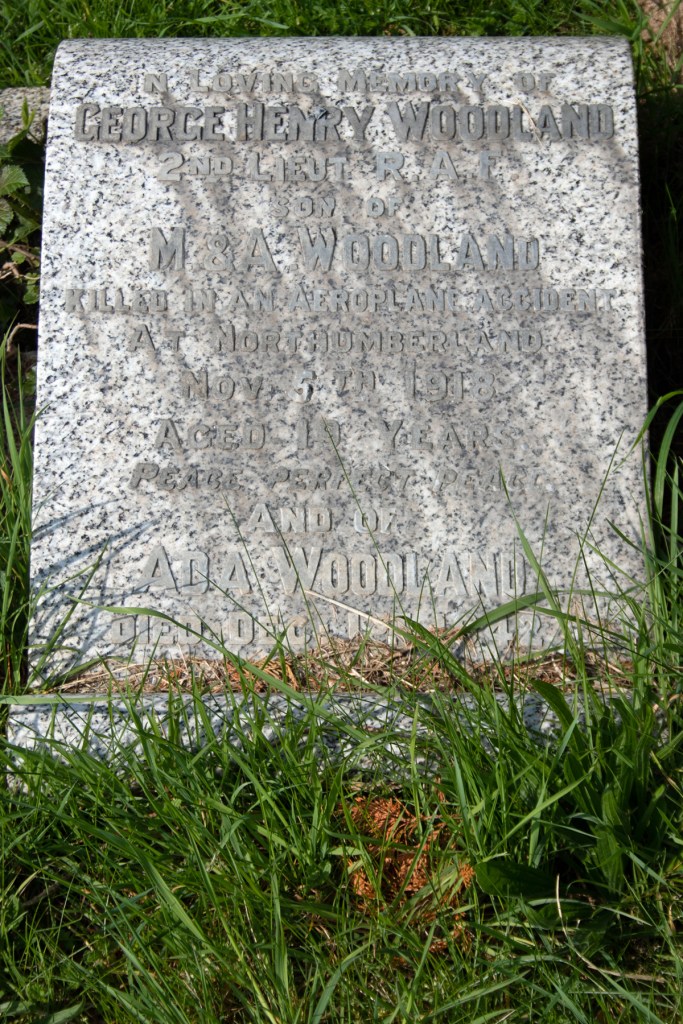
George Henry Woodland was born on 9th June 1899, and was one of six children – three boys and three girls – to Mark and Ada Woodland. Mark was a hewer in a coalmine in Radstock, Somerset, and this is where the family were raised.
George – who was better known as Harry – was still at school when war broke out. He had been taught at the Church of England School in his home town, before winning a scholarship to Shepton Mallet Grammar School. Having passed his exams there, he was taken on as a member of staff at his former school, before joining the army in June 1917 when he turned eighteen.
Initially joining the Infantry Training Reserve, Harry was subsequently transferred to the Royal Air Force. After training in Yorkshire for five months, he was transferred to the 52nd Training Depot Station at Cramlington Airfield in Northumberland.
Second Lieutenant Woodland returned home on leave in October 1918. This was the first time that he and his two brothers had been together since war had been declared – one had been serving in France, the other had been injured and was recuperating at a hospital in Bristol. Harry returned to Northumberland on 14th October.
On 5th November 1918, Harry was flying at the Cramlington base; shortly after take off, while carrying out a flat turn at a height of about 100ft, his aircraft stalled and nosedived, catching fire on impact. Tragically, Second Lieutenant Woodland and his passenger – Air Mechanic Ryder – were burnt to death. Harry was just 19 years of age.
George Henry “Harry” Woodland was brought back to Somerset for burial. He was laid to rest in the family plot in the graveyard of St Nicholas’ Church in his home town of Radstock.
Second Lieutenant George Woodland (from britishnewspaperarchive.co.uk)
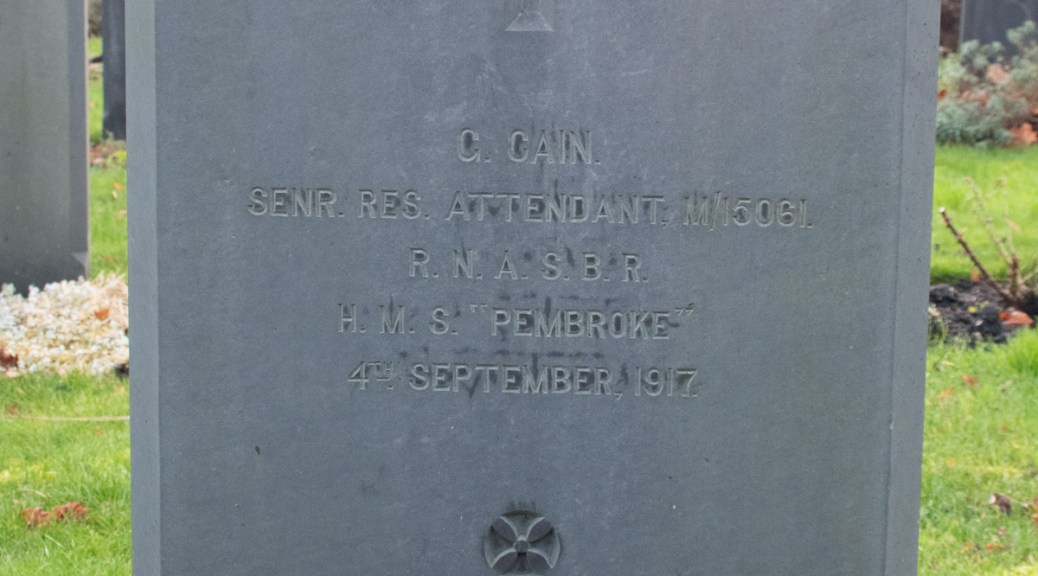
George Cain was born on 27th December 1896, and was one of eleven children to Edward and Florence Cain. Edward was a house painter from Richmond in Surrey, who passed away when George was a child, leaving Florence to raise the family. She found work as a shopkeeper in the town, and, when he left school, George was apprenticed to a printer to help bring in some extra money.
He had moved on to compositing – setting type – when war broke out. With conflict raging in Europe, George felt the need to play his part and, on 31st July 1915, he enlisted in the Royal Navy. His records show that he was 5ft 7ins (1.7m) tall, had dark brown hair, brown eyes and a pale complexion.
George was given the rank of Junior Reserve Attendant, supporting medical staff in the navy’s sick bays. After a couple of weeks at HMS Pembroke, the Royal Naval Dockyard in Chatham, Kent, he was posted to the town’s main hospital, where he remained for just under two years, and where he received a promotion to Senior Reserve Attendant.
In July 1917, George was reassigned to HMS Pembroke. That summer was particularly busy for the base, and temporary accommodation was set up in the Drill Hall; this is where George found himself billeted.
On the night of 3rd September 1917, Chatham suddenly found itself in the firing line as a wave of German aircraft bombed the town. The Drill Hall received a direct hit, and Senior Reserve Assistant Cain was injured. He was admitted to the hospital at which he had worked just weeks before, but died of his wounds the following day. He was just 20 years old.
George Cain was laid to rest in the Woodlands Cemetery in nearby Gillingham, along with the other servicemen who had perished during the Chatham Air Raid that night.
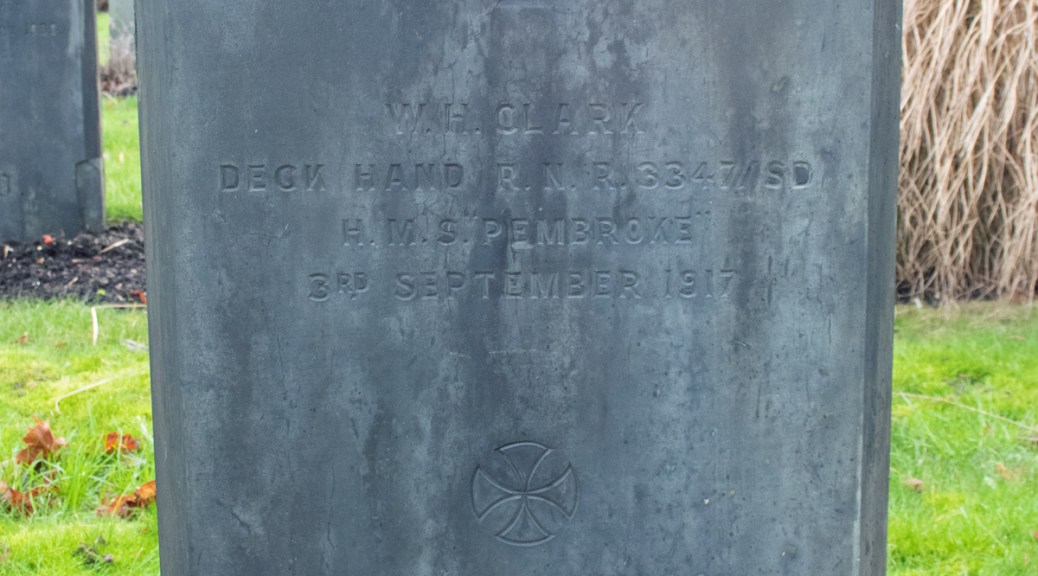
William Henry Clark was born in Whitby, North Yorkshire, on 15th March 1884 and was the younger of two children to James and Fanny Clark. Fisherman James drowned in September 1885, when the boat owned by his brothers-in-law – Robert and Mark Dryden – capsized.
Fanny and her children moved in with her Robert and her widowed mother, Martha, who was a lodging house keeper. In the spring of 1892, she married quarry labourer William Bennison. Her and James’ two children remained living with their grandmother; she went on to have three children with her new husband.
The 1901 census recorded young William working as a rivet heater in the local iron shipyard. He progressed in his work and, by the next census in 1911, remained living with his grandmother and uncle, but was working as a boilermaker in the shipyard.
When war broke out, William was called upon to play his part. While he had done engineering work, he also worked with his Uncle Robert on his fishing boat; this meant he was placed on reserve in the Royal Navy, and was not formally called upon as a Deck Hand until November 1915. Full details of his service are not available, but it is clear that he was based at HMS Pembroke – the Royal Naval Dockyard in Chatham, Kent – by the summer of 1917.
HMS Pembroke was a generally bustling place, but by the summer of 1917, it had exceeded capacity to the point where temporary accommodation was set up. William found himself billeted at The Drill Hall, away from the main barracks.
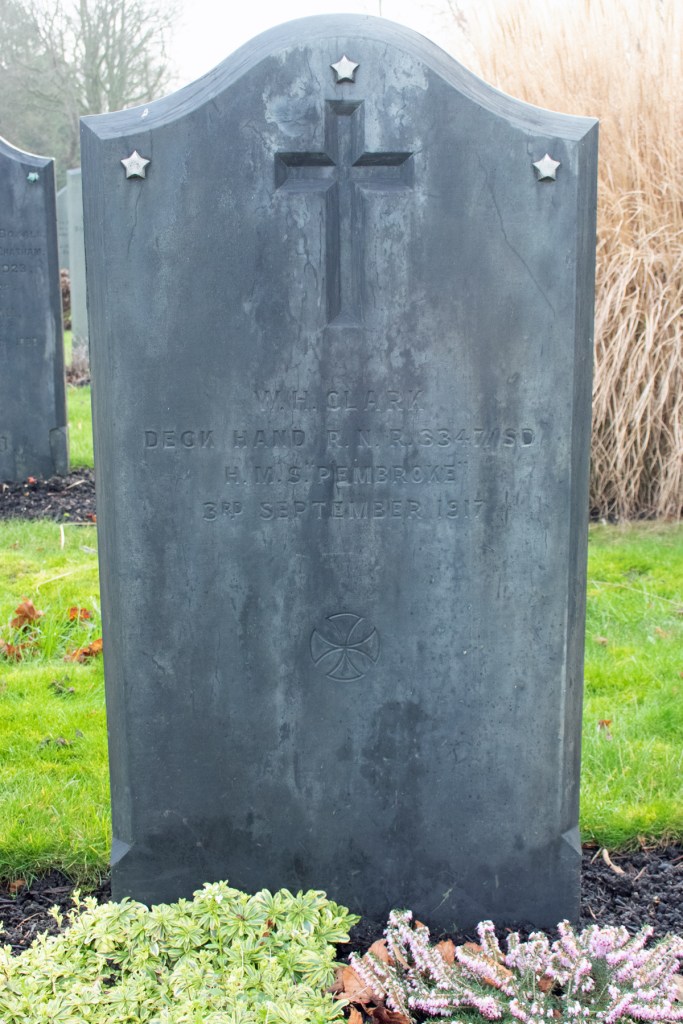
On the night of 3rd September 1917, Chatham suddenly found itself in the firing line, as the German Air Force launched a bombing raid. One of the bombs landed squarely on the Drill Hall, and Deck Hand Clark was killed. He was 33 years of age.
Ninety-eight servicemen perished during the Chatham Air Raid that night. They were buried in a mass funeral at the Woodlands Cemetery in nearby Gillingham. This is where William Henry Clark was also laid to rest.
Deck Hand William Clark (from britishnewspaperarchive.co.uk)
A local newspaper had reported on William’s father’s death:
FATAL COBLE ACCIDENT: SURVIVOR’S NARRATIVE
We append the personal account of Robert Dryden, who was capsized along with his two comrades, James Clark and Mark Dryden, in the fishing coble Ann Maria… off Robin Hood’s Bay, on the morning of Saturday, the 19th inst. The tale tells of the marvellous escape of the narrator and of the sad drowning of his two mates, who each leave a widow and two children. The survivor, who is a stout and healthy fellow, had his left leg amputated some years ago, and a wooden support substituted. The following is his account:
“We were coming in from the fishing grounds on Saturday morning in our coble under a three-reefed sail, with two hundred herrings. There was a stiff breeze blowing form the south-east, with occasional squalls, and it was very dark. We should be, I reckon, about two miles from land… I had just gone into her head to see how she was coming for the land, leaving Mark at the helm, when a puff of wind took her on the starboard quarter and sent her over. We were floated out, and she sank directly, each of us catching hold of an oar.
“Just then a steamer passed us, and we shouted, but could not get their attention, and we all swam about, talking to each other, and I told them to keep their hearts up. We all had knee boots on, and, poor Jim, I think he must have been caught by the cold, for about twenty minutes after he sank. He was a fine fellow, as fine a fellow as you would meet in the streets.
“Shortly after he had gone, poor fellow, a tug boat passed us with a black and flesh-coloured funnel. I was too exhausted to shout much, and had to swim across her bows to keep clear. When she had passed, poor Mark had disappeared. I could then see the land, and with the sea beating on my left shoulder I set out for it…
“I was very disheartened after losing my mates, and all I had – for the coble belonged half to me and half to my brother – nets, money, and, all together, about £60 had gone…
“After a long swim, I neared the shore, and swam for the Blue Rock, because I could not swim further to a calm spot. I found myself on the rock after being, I think, knocked senseless by the seas. I climbed the cliff – it’s a bad coast about here – and walked for about two miles before I met anyone…
“I was several times almost in despair when in the water, and was much distressed at having to return with such a sad tale… It’s a great loss to me. Jim was my brother-in-law, and was 29 years of age, and Mark was my cousin, and 23 years old. It’s thirteen years since I had my other narrow escape, and I would sooner go to the poor-house than go through such another time of it.”
By this melancholy accident, two families have been plunged into deep grief and dire poverty, and deserve the sympathy and practical support of all kind and well-to-do-people.
Claud Millar McIntyre was born on 3rd June 1895, and was the youngest of three children to Alexander and Margaret McIntyre. Both of Claud’s parents – and his two older siblings – were born in Scotland, but the family moved to London in the early 1890s, and it was in Plaistow that Claud was born.
Alexander worked as an engineer at the Thames docks, and, when Claud left school, he followed his father into the same line of work. War was coming to Europe, however, and Claud was very keen on playing his part.
On 22nd December 1914, he enlisted in the Royal Navy. His boiler work obviously stood him in good stead, as he was employed as an Engine Room Artificer (ERA) 4th Class. Claud’s service records confirm that he stood 5ft 8ins (1.72m) tall, had dark brown hair, blue eyes and a fresh complexion. The document also gives his year of birth as 1893, which suggests that he may have lied about his age to get into the action.
The same record gives an indication of the harshness of the work Claud has been doing before joining up. Under Wounds, Scars or Marks, it was noted that he had a scar on the outside right thigh and on his right little finger. He also had lost the fingertip of his right hand.
ERA McIntyre’s training took place at HMS Pembroke, the Royal Naval Dockyard in Chatham, Kent. He was soon given a posting, however, and served at HMS Acteon, the shore-based establishment in Sheerness, for just over a year.
In August 1916, after a brief return to HMS Pembroke, ERA McIntyre was given a second posting, this time on board Q12, one of a number of the war’s most closely guarded naval secrets. The Q-boats (a code name referring to their home port of Queenstown in Ireland) were vessels designed to look like an easy target, but which actually carried hidden armaments. Understandably, little is known about the ship on which Claud served, or his time aboard; all that is documented is that he was assigned to her from 28th August 1916 to 30th April 1917, at which point he returned to HMS Pembroke.
Chatham Dockyard was particularly busy that summer, and the large number of extra servicemen meant that Claud was billeted in temporary accommodation in Chatham Drill Hall.
On the 3rd September 1917, the first night air raid carried out by the German Air Force bombarded the town, and scored a direct hit on the Drill Hall; ERA was injured that night, but died of his wounds the following day at the Fort Pitt Military Hospital. He was just 22 years of age.
Claud Millar McIntyre was laid to rest, along with the other victims of the Chatham Air Raid, in the Woodlands Cemetery, Gillingham.
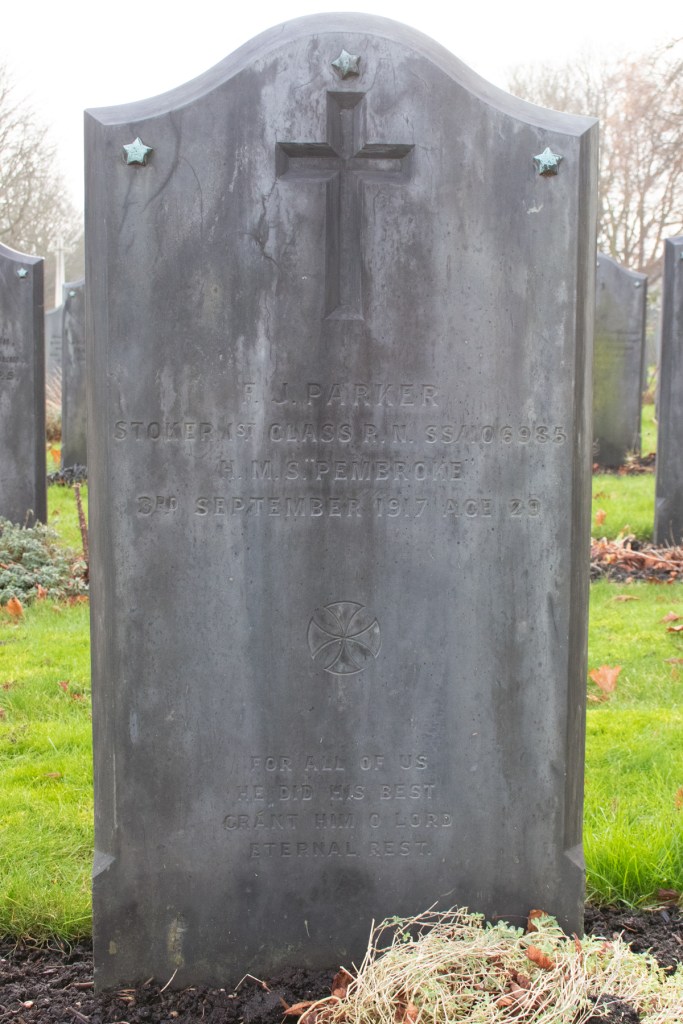
Frederick John Parker was born on 26th November 1889 in Wavertree, Liverpool. He was the oldest of four children to John and Ellen Parker, both of whom had been born in North Ireland, and had sought out a new life in the busy English port.
There is little concrete information about Frederick’s early life. What is clear is that he wound work as a painter when he left school, and enlisted in the Royal Navy on 22nd April 1908, as a Stoker. He joined the service for five years, and was places on reserve in 1913.
When war broke out, Stoker Parker was called into action again and, during his time back in the Royal Navy was based at HMS Pembroke, the shore-based establishment in Chatham, Kent.
The base was a bustling place during the war and, by the summer of 1917 temporary accommodation was set up in the barracks’ Drill Hall; this is where Frederick found himself billeted.
On the night of 3rd September 1917, Chatham suddenly found itself in the firing line as a wave of German aircraft bombed the town. The Drill Hall received a direct hit, and Stoker 1st Class Parker was amongst those to be instantly killed. He was 29 years old.
Ninety-eight servicemen perished during the Chatham Air Raid that night. They were buried in a mass funeral at the Woodlands Cemetery in nearby Gillingham. This, too, is where Frederick John Parker was laid to rest.
Knight Cooke was born in Vancouver, Canada, on 10th December 1892. He was one of nine children to John and Mary Cooke. John was a tallyman, selling goods by instalments. Knight, however, preferred working with his hands, and when he left school, found a job in a wood mill, as a planer.
When war came to Europe, those in the Commonwealth were asked to play their part. Knight enlisted, joining the Canadian Expeditionary Force on 22nd April 1916. His service records show that he stood 5ft 9ins (1.75m) tall and weighed 135lbs (61kg): he had dark brown hair, brown eyes and a dark complexion.
When he arrived in England, Knight was initially transferred to the 72nd Regiment of the Seaforth Highlanders, although he was quickly moved again to the 13th Field Ambulance. Within a matter of weeks, Knight was discharged under the King’s Regulations that suggested he would not become an efficient soldier.
At this point, Knight’s trail goes cold. It seems that he remained in England, and it seems that he was still keen to play his part. What is clear is that he enlisted in the Royal Naval Canadian Volunteer Reserve at some point in the months after being discharged from the army.
Knight was given the rank of Ordinary Seaman, and was, by the summer of 1917, based at HMS Pembroke, the Royal Naval Dockyard at Chatham in Kent. This was a busy, overcrowded place at that time, and Knight found himself billeted in temporary accommodation at Chatham Drill Hall.
On the 3rd September 1917, the German Air Force carried out its first night-time air raid: Chatham was heavily bombed and the Drill Hall received a direct hit; Ordinary Seaman Cooke was among those who were killed. He was just 24 years of age.
Knight Cooke was laid to rest alongside the other victims of the Chatham Air Raid, in the Woodlands Cemetery, Gillingham, not far from the Dockyard in which he finally managed to serve.
Knight’s headstone gives his surname as Cook, although his service records – and signature – give the spelling as Cooke.
Owen Henry Jones was born in Islington, Middlesex, on 23rd October 1888. His father was tailor Edward Jones, but little additional information about Owen’s early life remains.
By the end of 1913, he was working as a packing case maker and living in Shoreditch. He had met Ada Elizabeth Cornelius, the daughter of a dock labourer, and the couple married on Christmas Day at St Peter’s Church in Hoxton Square.
Within a year, war had engulfed Europe and, on 1st June 1915, Owen enlisted in the Royal Navy. His service records show that he had swapped his names round, and was going by Henry Owen Jones. He was 5ft 9ins (1.75m) tall, had light brown hair, brown eyes and a fresh complexion.
Stoker 2nd Class Jones was initially sent to HMS Pembroke, the Royal Naval Dockyard in Chatham, Kent, for his training, but, within a couple of months, was assigned to the monitor vessel HMS Lord Clive. He served on board for just over a year, gaining a promotion to Stoker 1st Class in the process.
After six months back in Chatham, Henry was given his second posting, on board another monitor ship, HMS General Wolfe. After just three months, however, he found himself back on shore at HMS Pembroke.
The Dockyard was particularly busy that summer, and the large number of extra servicemen meant that Henry was billeted in temporary accommodation in Chatham Drill Hall.
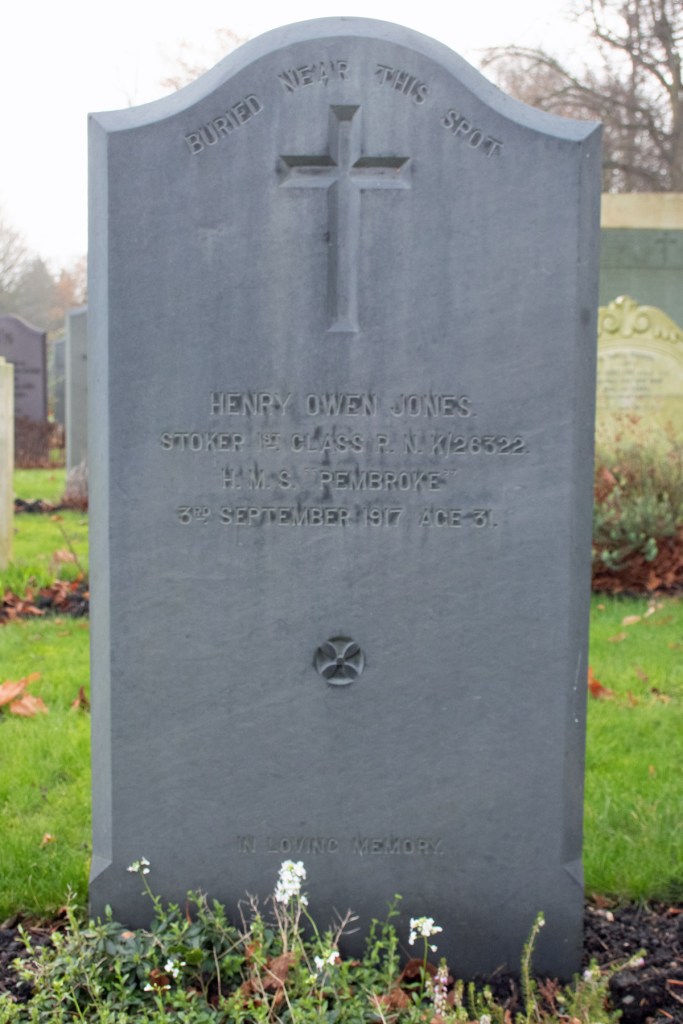
On the 3rd September 1917, the first night air raid carried out by the German Air Force bombarded the town, and scored a direct hit on the Drill Hall; Stoker 1st Class Jones was among those killed instantly. He was just 28 years of age.
Henry Owen Jones was laid to rest, along with the other victims of the Chatham Air Raid, in the Woodlands Cemetery, Gillingham. Tragically he was buried as ‘unidentified’: the records state that he lies “in one of the following graves: 516, 522, 735, 935, 937, 948, 642.”










 Death and Service