Category Archives: Cornwall

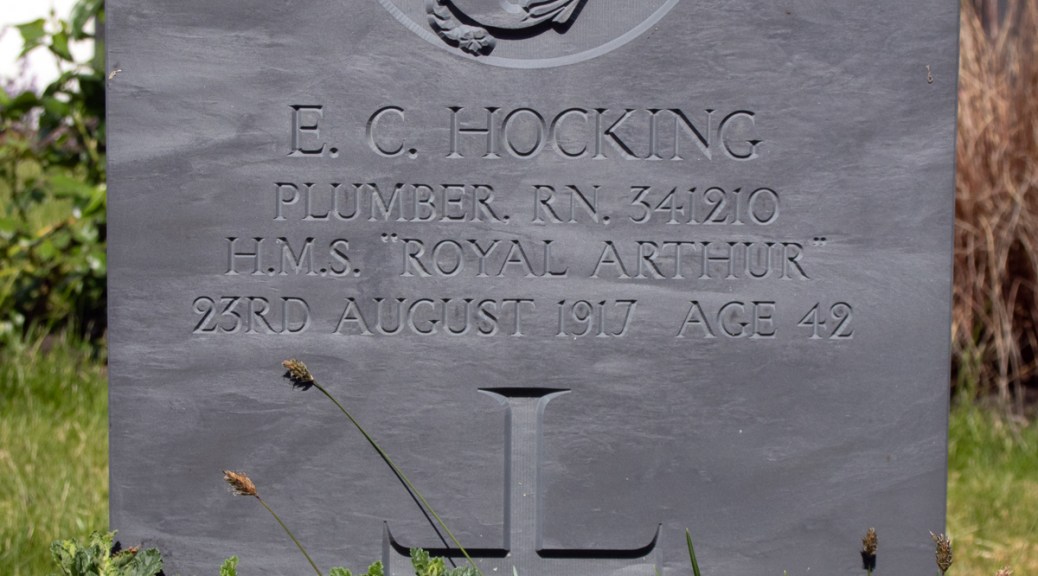
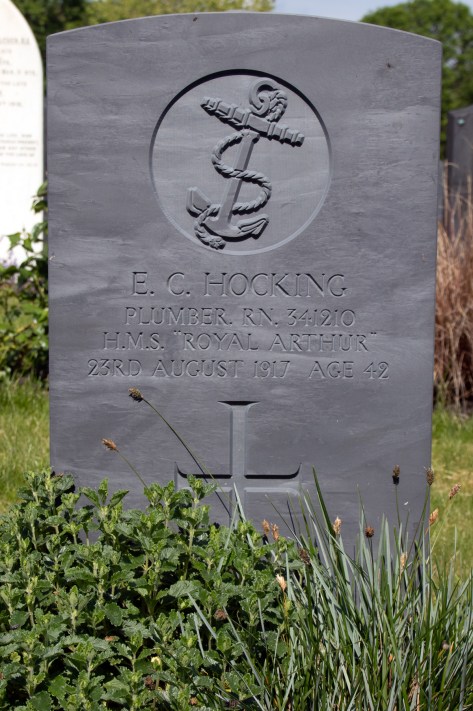
Plumber Edwin Hocking

Plumber Edwin Hocking

Edwin Charles Hocking was born in Newton Abbot, Devon, on 28th January 1873. The youngest of four children, his parents were Richard and Harriet Hocking. Richard was an engine driver, and he was to die less than a year after his youngest boy’s birth:

Mr Deputy-Coroner Square and a jury of twenty-two to-day brought to a conclusion the inquest on the death of the engine driver Richard Hocking. The evidence of numerous witnesses went to show that the accident, which occurred on the morning of the 2nd inst., between Menheniot and St Germans stations occurred in consequence of the guards of two trains being called Dick. The morning was very dark, and at Menheniot there was standing at the station an up and a down goods, and a second down goods was on its way from St Germans, but this was unknown to the up goods. The porter Pratt at Menheniot gave the order to the guard (Wills) of the down train to start, saying “All right, Dick.” The driver of the up train (Scantlebury) was also called Dick, and when he heard the words he said “Is it right for me?” and Pratt, not seeing Scantlebury, and thinking Wills asked the question, repeated “It’s all right, Dick.” Scantlebury through it was meant for him, and gave the order to the deceased, “Right away.” Pratt, who had gone to let out the down train, hearing the starting whistle of the up train, rushed back to the platform waving his hand “danger” light. This attracted the attention of Scantlebury, the head guard, and he missed his van in consequence. Pratt said, “Wherever are you going?” Scantlebury replied, “Right away isn’t it?” Pratt said “God bless the man, who gave you ‘right’? The up goods is ten minutes off St Germans.” Scantlebury cried out “Oh! my God! Oh! my God!” Together they shouted and waved the danger light, but were unable to attract the drivers of either of the two engines attached to the train. The trains came into collision at full speed about two miles away. The deceased and the other driver were at great fault in leaving Menheniot, notwithstanding the order of the guard, for the signal was against them, and they did not observe the rules of the Company. They should not have gone on without hearing the second whistle of the guard, and after starting they should have satisfied themselves that they had the head guard in the train by seeing his lamp. Richard Scantlebury, the head guard, after being cautioned that he need not say anything to criminate himself, gave evidence that when Pratt said “All right Dick” he certainly thought it referred to him, especially as his train had nothing to do at Menheniot.

The jury deliberated for half-an-hour, and then returned a verdict of “Accidental death,” exonerating Pratt and Scantlebury from all blame. The appended a recommendation to the South Devon and Cornwall Railways to provide for a strict observance of their bye-laws for the use of some definite word for the up and down trains, and Christian names never to be used in such cases; that there be communication between the driver and guard on luggage trains as well as passenger trains, and that there be to men at least at each station on duty.

[Western Times: Wednesday 17th December 1873]

Harriet was just 28 years old when her husband died. With four children to raise, she married again – to John Staple – and went on to have four children with him too.

John also passed away in the spring of 1885, and the 1891 census found Harriet and six of her children living at 43 Richmond Terrace, to the west of the centre of Truro, Cornwall. Harriet was working as a washer woman, while Edwin, who was 18 by this point, was employed as a plumber’s assistant.

It is clear that Edwin wanted a better life for himself and in the spring of 1896, he took the skills that he learnt and signed up to the Royal Navy. His service papers show that he was 5ft 5ins (1.64m) tall with dark brown hair, grey eyes and a fresh complexion. He was also noted as having a tattoo on his left forearm.

Edwin took the rank of Plumber’s Mate, and spent the first two years split between two shore establishments – HMS Vivid and HMS Pembroke, the Royal Naval Dockyards in Devonport, Devon, and Chatham, Kent. He had enlisted for a twelve-year term and, over that time, he would serve on five ships, returning to Chatham in between assignments.

Plumber’s Mate Hocking consistently received very good reviews at his annual appraisals and, when his initial contract came to an end in May 1908, he immediately re-enlisted. He had a family to support by this point, having married Fanny Sears in Camberwell, Surrey, on 16th March 1902. A bricklayer’s daughter, she moved to Gillingham, Kent, to be close to Chatham Dockyard. The couple went on to have five children: Henry, Raymond, Doris, Elsie and Percival.

Back at sea, Edwin’s career continued with some consistency. His annual appraisals noted not on a character that was very good, but an excellent ability. Nevertheless, it would only be in the spring of 1916 that he would gain a promotion to full Plumber. Notwithstanding his general character, Edwin seems to have been a flawed character: in 1909 he applied for a discharge to the Royal Naval Reserve, but this was not approved as he had been found to be “carrying on a business as [a] bookmaker.” Instead, he was to be sent “to sea forthwith and warned that unless his betting practices [were] not stopped his discharge will have to be considered.”

By the summer of 1916, Plumber Hocking was eight years into his second term of service, and had served on five further ships. HMS Pembroke remained his shore base, and it was here that he attained his increased rank.

In October 1916, Edwin was given what would be his final assignment, on board the armoured cruiser HMS Royal Arthur. Based at Scapa Flow in the Orkneys, she was employed as a depot ship for submarines. Plumber Hocking spent ten months on board, before illness hit. Coming down with gastroenteritis following food poisoning, he was transferred back to Kent, and admitted to the Royal Naval Hospital in Chatham. The condition was to prove his undoing, and he passed away on 23rd August 1917: he was 44 years of age.

The body of Edwin Charles Hocking was laid to rest in the naval section of Woodlands Cemetery, Gillingham, a short distance from his grieving family’s home in King Edward Road.

Leading Boatman Peter Moran

Leading Boatman Peter Moran

Peter Moran was born in Kilmeena, County Mayo, Ireland, on 29th January 1876. Details of his early life are hard to track down, but when he finished his schooling, he wound work as a fisherman.

By 19th August 1891, Peter sought to make a more permanent career of the sea. He signed up to the Royal Navy, and was sent to HMS Impregnable, the shore base in Devonport, Devon, for his training. Being just 15 years of age, he was too young to formally enlist, and was given the rank of Boy 2nd Class.

Over the next few years, Peter learnt the tools of his trade. On 2nd July 1892 he was promoted to Boy 1st Class, and the following February he was given his first sea-faring assignment, on board the battleship HMS Neptune. By March 1893 Boy Moran found himself serving on board HMS Daphne, a screw sloop which would become his home for the next three years.

During his time aboard Daphne, Peter came of age, and was given the rank of Ordinary Seaman. His service records show that he was 5ft 4ins (1.63m) tall, with light hair, grey-blue eyes and a fresh complexion. Within eighteen months he had proved his mettle, and was promoted to Able Seaman.

Over the next decade, Peter would serve on eight vessels. By the time the term of his contract came to an end in September 1903, he had been promoted twice – to Leading Seaman, then to Petty Officer 2nd Class.

Peter renewed his contract, but seems to have chosen a new career path. On 2nd October 1903 he moved to HM Coastguard and, as a Boatman, was assigned to Pendeen Cove, Cornwall.

Love blossomed for Peter, and he married a woman called Caroline in the next few years. There is little further information about her, but the couple would go on to have three children – Mary in 1908, Florence in 1911 and Thomas in 1913.

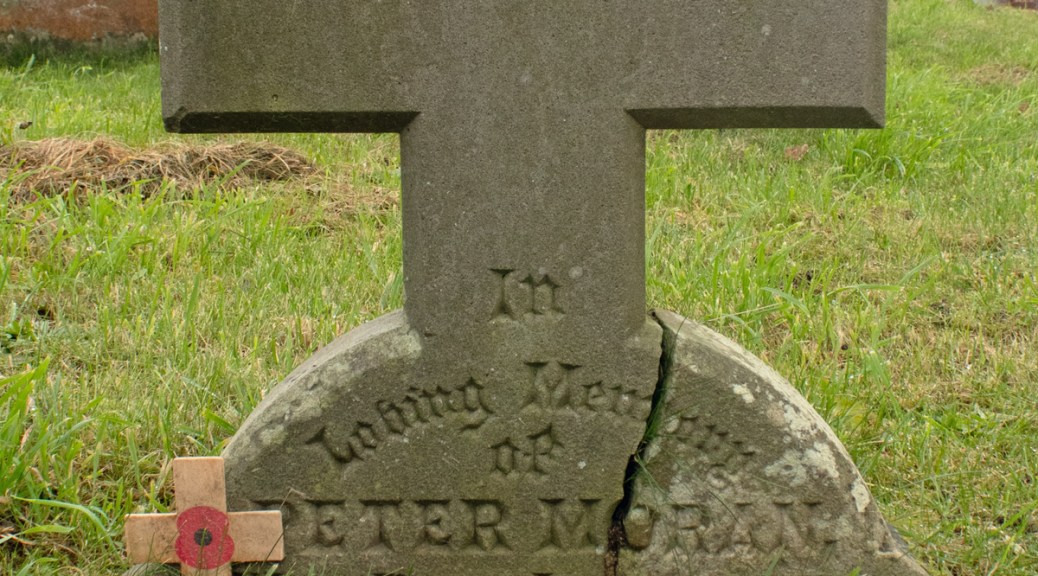
Boatman Moran would spend twelve years with the coastguard, moving to St Ives, Cornwall, in September 1908, and Fishguard, Pembrokeshire, in March 1914. By this point he had been promoted to Leading Boatman, and was set on a new life in Wales. Sadly, the new life was not to be: on 2nd June 1915 he passed away from pneumonia. He was 39 years of age.

The body of Peter Moran was laid to rest in Fishguard Cemetery: a life at sea, and forging homes in three countries at an end.


Private Arthur Candey

Private Arthur Candey

Pte. Arthur Candey, of the Devon (Cyclists) Territorials, was found shot at Rotterdam, Talland, near Polperro, early on Friday morning. About six weeks ago Candey was drafted to Polperro from Looe and had been engaged in watching the coast, and the deceased and Pts. C Harris went on patrol duty. At Rotterdam Cottage, Candey complained of feeling tired and unwell. so Harris told him to remain in a hut close by while he went on alone and met the other patrol. While on the return journey Harris heard the report of a gun, and deceased was found dead with a bullet wound in the head. Death must have been instantaneous. Pte. Harris was away from the deceased for fifty minutes altogether…

At the inquest at Talland… the jury… returned a verdict that Candey took his life while temporarily insane.

[West Briton and Cornwall Advertiser: Monday 21st June 1915]

Arthur Candey was born in the spring of 1897 in Tiverton, Devon. One of thirteen children, and the youngest surviving son, his parents were Richard and Ellen Candey. Richard was a lace maker, and the family lived in a small terraced house in John Street, to the west of the town.

There is little information available about Arthur’s life. The 1911 census showed that he was still in school, and his army service records have been lost to time. It is clear that he enlisted in the 2nd/7th (Cyclist) Battalion of the Devonshire Regiment, and the newspaper report confirms that he served in Cornwall.

Private Arthur Candey was just 18 years of age, when he died on 18th June 1915. His body was taken back to Devon for burial. He was laid to rest in Tiverton Cemetery, a short walk from where his grieving family still lived.


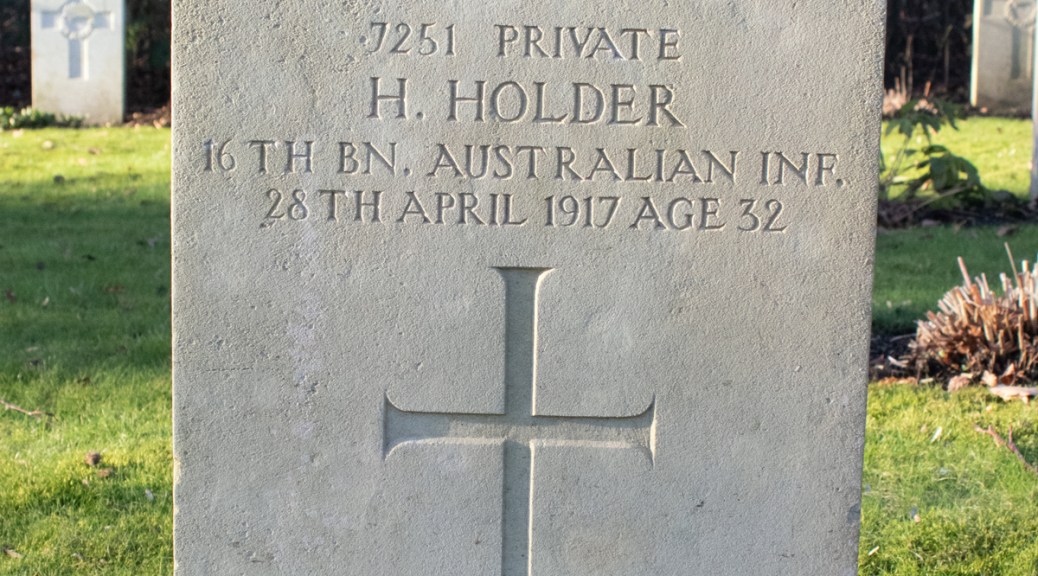
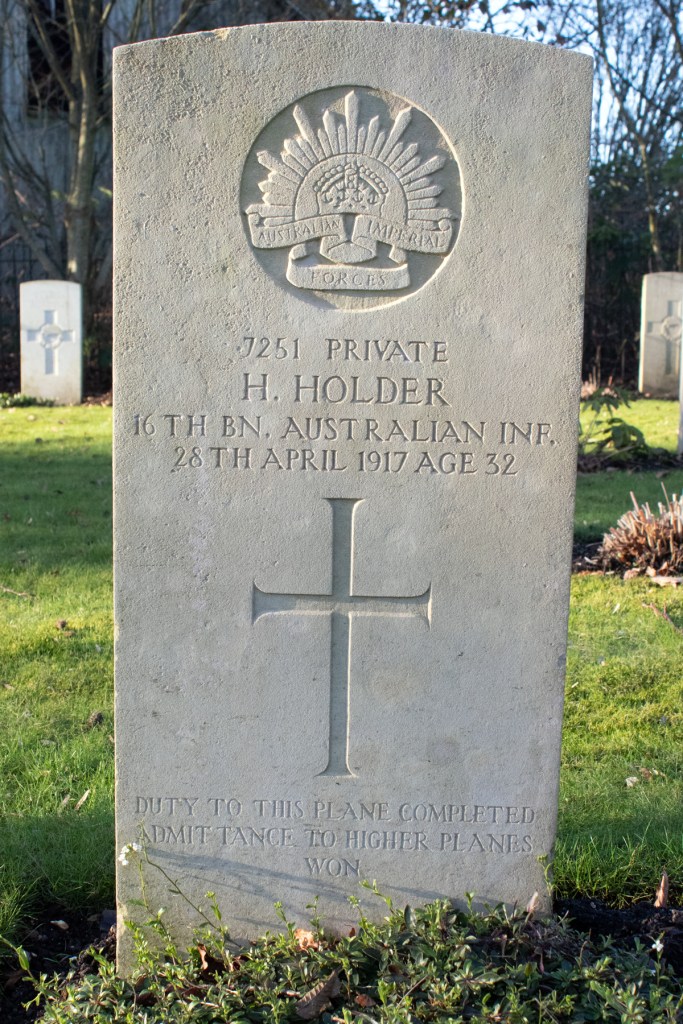
Private Harry Holder

Private Harry Holder

Harry Holder was born in the village of Ludgvan, Cornwall, in the summer of 1885. The oldest of fourteen children, his parents were Harry and Grace Holder. Harry Sr was a market gardener, and his oldest son was to follow in his footsteps.

By the time of the 1911 census, the Holders had moved to Cheltenham, Gloucestershire. Settling in a seven-room house in Leckhampton Road, the household of eleven people had six wages coming in, split between market gardening for the men and floristry for the women.

The following year, Harry Sr took his family on the long journey to Australia for a new life. They found work on a farm near Perth, and Harry Jr was employed as an agricultural labourer when war broke out. When the call came, he stepped up to play his part and his service records suggest that he had spent four years in the territorial army back in Britain. Harry had been turned down for service because of the state of his teeth just a month before trying to enlist again. The second time, however, he was successful, and he joined the Australian Imperial Force on 13th September 1916.

Private Holder’s medical report confirmed the man he had become. At 31 years of age, he was 5ft 10.5ins (1.79m) tall, and weighed 140lbs (63.5kg). A Roman Catholic, he had brown hair, blue eyes and a fresh complexion.

Assigned to the 16th Battalion of the Australian Infantry, Private Holder’s unit departed from Fremantle on 21st January 1917, travelling no board the ship Miltiades. Just under two months later, on 27th March, Harry arrived back in Britain, docking at Devonport, Devon, before moving with his battalion to a camp on the outskirts of Codford, Wiltshire.

A significant proportion of the ANZAC troops became unwell within weeks of arriving at the camp, and Harry was not to avoid illness. On 27th April he was admitted to the barracks’ hospital with cerebrospinal meningitis, but the treatment was to prove too little, too late. Private Holder died on 28th April 1917: he was 31 years of age.

Harry Holder was laid to rest in a new extension to St Mary’s Churchyard in Codford, close to the base where he had breathed his last.


Private Harry Holder
(from findagrave.com)

Captain William Mence

Captain William Mence

William Charles Mence was born in Blackheath, Kent in the spring of 1877. He was the oldest of five children to William Cookes Mence and his wife, Susanna.

William Sr was a chemist-turned-dentist, and by the time of the 1881 census, the family had moved to prestigious lodgings on the corner of Claremont and Victoria Roads in Kingston-upon-Thames, Surrey. William had set up practice in the building, and employed two servants to assist him with the practice, and two more to help Susanna with the family.

Dentistry would keep William Sr occupied for at least the next thirty years, a move to nearby Surbiton in the late 1890s being the only change tot he business.

William Jr, meanwhile, was making his own way in the medical world. The 1901 census recorded the 24-year-old Mr Mence visiting a possible mentor, physician and surgeon Charles Gallie, in Camberwell. William was also noted as being a physician and surgeon, and this was to become the career in which he forged his way.

On 9th August 1906, William married Dorothy Mytton in the Saint Aelhaiarn’s Church in Guilsfield, Powys, Wales. Dorothy was the daughter of a retired army captain, Devereaux Mytton. She had been born in Guilsfield and, at the time of the 1901 census, was living with her family and ten servants at Garth Hall, close to the village.

The young couple’s marriage certificate also sheds some light on William’s career. It confirms that he was working as a medical practitioner, and was living in the village of Perranzabuloe in Cornwall.

William and Dorothy went on to have five children, and named them to reflect their combined family histories. Daughter Evaline Dorothy Cookes Mytton Mence was born first, in 1907, followed by sons John Herbert Myttone Cookes Mence, Devereaux Mervyn Mytton Cookes Mence and Godfrey Powis Mytton Cookes Mence. Their fifth child, daughter Myfanwy Susan Mence, was born in 1914.

When war broke out in Europe, William was drawn to play his part. While full details about his service are not available, his public standing meant that he took a commission as Captain in the Royal Army Medical Corps. His Medal Roll Index Card confirms that he was awarded the 1914-1915 star, so he joined early in the conflict. It also outlines that he served in Mesopotamia from 4th February 1916, in France in 1917 and in Salonika from 1917 to 1919.

Ill health seemed to have dogged him in later years, and by the summer of 1919, Captain Mence had returned to British shores, and to Devon, where his practice had moved to shortly before the conflict.

Dr William Charles Mence, of Axminster, who died in Axminster Cottage Hospital on Friday night, recently returned from active service… He was a medical officer under Axminster Board of Guardians…

Western Morning News: Monday 28th July 1919

William Charles Mence died on 25th July 1919 as a result of an ongoing illness: he was 42 years of age. He was laid to rest in Axminster Cemetery, not far from the family home.


Private William Moore

Private William Moore

On Saturday last an inquest was held at the Seaman’s Institute on the body of Gunner Wm. Moore, RNTS.

Mrs Brennan, sister of the deceased, stated that he was 43 years of age, and lived when off duty with her at Somerville, Seacombe, Cheshire. He joined the Royal Marine Light Infantry over 20 years ago.

Mr R Sussex Langford, Lloyd’s agent, stated that he saw deceased on landing. He help to get him into a cart, but found he was too ill to travel that way, so he had him put on an ambulance and taken to the Royal National Mission for Deep Sea Fishermen, and immediately sent for the doctor. Deceased was semi-conscious and very sick. He was a gunner from a torpedoed ship. Deceased died on Thursday [25th July 1918] at 6 o’clock.

Dr Sargent stated that he was called on the 23rd to see deceased, and found him semi-conscious, complaining of great pain in the abdomen and vomiting. He lay in that condition until the 25th, when death took place. The cause of death was acute traumatic peritonitis, the result of injuries received by the explosion of an enemy torpedo.

[Newquay Express and Cornwall County Chronicle – Friday 02 August 1918]

Other than the details outlined in the newspaper report, little concrete information is available about the life of William Moore. The name does crop up in the 1891 census in Seacombe, Cheshire, and, if this relates to Gunner Moore, then he was one of five children to widowed lithographer Margaret Moore. Beyond that one census, however, it is not possible to find any more specific details.

William was on board the steam ship SS Anna Sophie in the summer of 1918, which was sailing from Rouen to South Wales, On 23rd July, she was torpedoed by the German submarine U-55 off Trevose Head, Cornwall. The Anna Sofie was sunk, Gunner Moore was one of those who subsequently passed from their injuries.

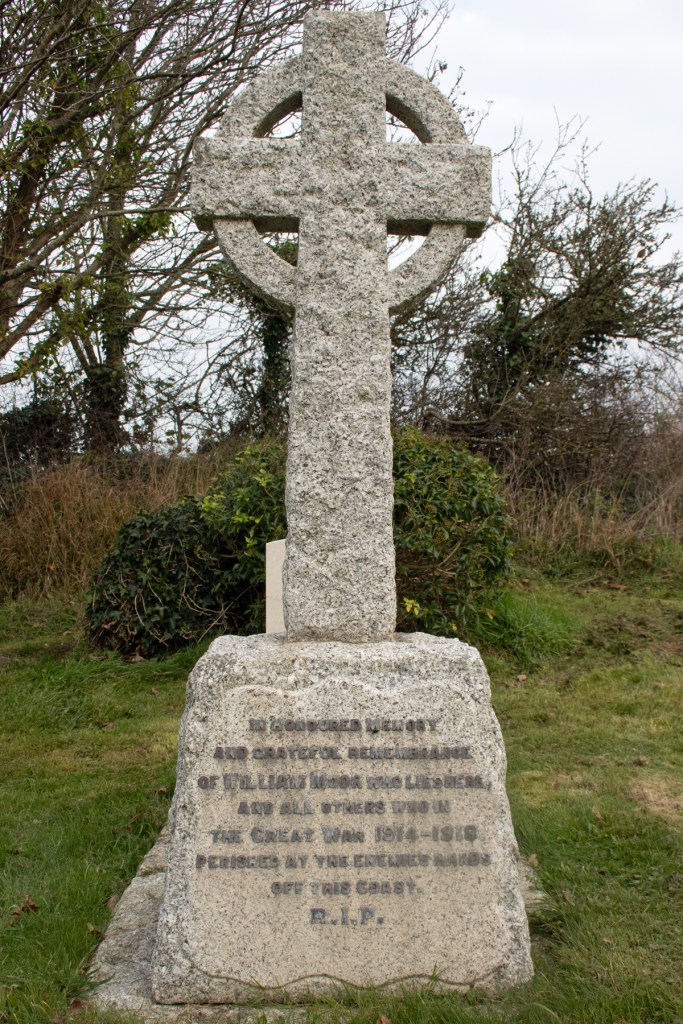
William Moore’s sister may not have been able to pay for her brother to be brought back to Cheshire for burial. Instead, he was laid to rest in Padstow Cemetery, and shares his resting place with another member of the crew, Lance Corporal William Whitmore.

William’s headstone reads: “In honoured memory and grateful remembrance of William Moor [sic] who lies here, and all others who in the Great War 1914-1918, perished at the enemies hands off this coast. RIP.”


Private Charles Edwards

Private Charles Edwards

Charles Henry Edwards was born in Padstow, Cornwall, in around 1888. One of three children, his parents were Charles and Elizabeth Edwards. Charles Sr was a farm labourer, and his son, who was one of four children, followed suit when he finished his schooling.

Charles Sr passed away in 1903: the next census record found Charles and two of his sisters living with Elizabeth. She was claiming parish relief, while her daughters were doing occasional char work to bring in a little more money.

Charles married a woman called Florence Dunn in the summer of 1911: little information is available for her, other than she was born in Devon, to Joseph and Maria. The couple set up home in Leadwell Street, Padstow, and went on to have four children: Lilian, Charles, Elsie and Alfred.

When war came to Europe, Charles stepped up to play his part. He enlisted 11th December 1915, by which point, he had found work as a cowman. He joined the Devonshire Regiment as a Private and spend the next fourteen months on home soil, moving across to the 5th Labour Company in February 1917.

At this point, Private Edwards was sent to France, and he spent most of that year overseas. He returned to Britain on 8th November, having contracted bronchitis while serving at Etaples. When he had recovered, Charles returned to duties, and was attached to the 650th Labour Coy.

Alfred, Charles and Florence’s youngest child, was born on 1st April 1918, but seemed to be a sickly boy. He passed away on 27th September, aged just six months, from a combination of influenza and bronchitis. Tragically, Charles was also unwell at this point, and he passed away just four days later from pneumonia. He was just 30 years of age.

Charles Henry Edwards was laid to rest in Padstow Cemetery. The report of his funeral does not mention Alfred, but it seems likely that father and son were buried together.


Florence lived on until 1964. She passed away in Bodmin, at the age of 78, and was laid to rest with her husband, reunited after more than four decades.


Stoker 1st Class John Stone

Stoker 1st Class John Stone

John Edward Stone was born on 10th April 1894 in Torquay, Devon. The oldest of seven siblings – of whom three survived childhood, his parents were John and Hannah Stone.

John Sr was a masons labourer, but when his son finished his schooling, he found work initially as a grocer’s errand boy, then as an outdoor porter. John Jr sought bigger and better things, however, and, in February 1913, he enlisted in the Royal Navy.

Stoker 2nd Class Stone’s service records show that he was 5ft 5ins (1.65m) tall when he joined up, and that he had brown hair, grey eyes and a fresh complexion. He was based at HMS Vivid, the Royal Naval Dockyard in Devonport, and this is where he spent the first six months training.

John’s first sea-going posting was on board the armoured cruiser HMS Defence and she was to be his home from 2nd September 1913 to May 1916, when she was sunk during the Battle of Jutland. During his month aboard, he was placed in the brig for 14 days due to ‘absence’. This imprisonment seemed to have refocused John’s priorities, however, and he was promoted to Stoker 1st Class on 26th February 1914.

Rescued from the lost Defence, John was taken back to Devonport, and he remained there until the end of August 1916. From here he transferred to the depot ship, HMS Blake, which was to be his home until the end of the war.

In the spring of 1917, John married Sarah Juliff in St Columb, Cornwall. The couple went on to have a daughter, Christiana, a few months later.

Stoker 1st Class Stone fell ill towards the close of the war, contracting pneumonia. He passed away while still on board HMS Blake, on 15th November 1918. He was 24 years of age.

Sarah was living in Middle Street, Padstow when her husband passed. He was brought back to the county, and was laid to rest in the town’s cemetery.


The official documents go on to say that Sarah moved to the Caerwilliam Hotel in Cabres Bay. However, there are no records for the hotel or location, although it could refer to Carbis Bay in St Ives, Cornwall.


Gunner Richard Dale

Gunner Richard Dale

Richard George Dale was born Padstow, Cornwall, in the summer of 1889, the oldest child to Alice Dale. She married Frederick Bryant in March 1894, but and went on to have two children – Frederick and Albert – but, by the time of the 1901 census, her husband has passed away. The document gives Richard’s surname as Bryant, but there is no real indication that he was Frederick’s son.

Alice had been living with her greengrocer parents, but the 1901 census in a small cottage off Lanadwell Street, a couple of door away from them. As a widow at 31 years old, she is noted as being on parochial relief.

Details of Richard’s later life are a challenge to track down. Absent from the 1911 census, it was around that time that he married Agnes MacKintosh. While she was born in Edinburgh, the wedding took place in St Columb, Cornwall.

When war broke out, Richard was working as a farmer. He enlisted the day after hostilities were declared, and joined the Royal Garrison Artillery. Gunner Dale was, according to the records, 5ft 3ins (1.6m) tall, with medium colour hair, blue eyes and a fresh complexion. He had a scar between his eyebrows.

Gunner Dale served for nearly four years, all the time being based on home soil. He suffered from epilepsy, however, and this is what led to his eventual discharged from armed service in March 1918.

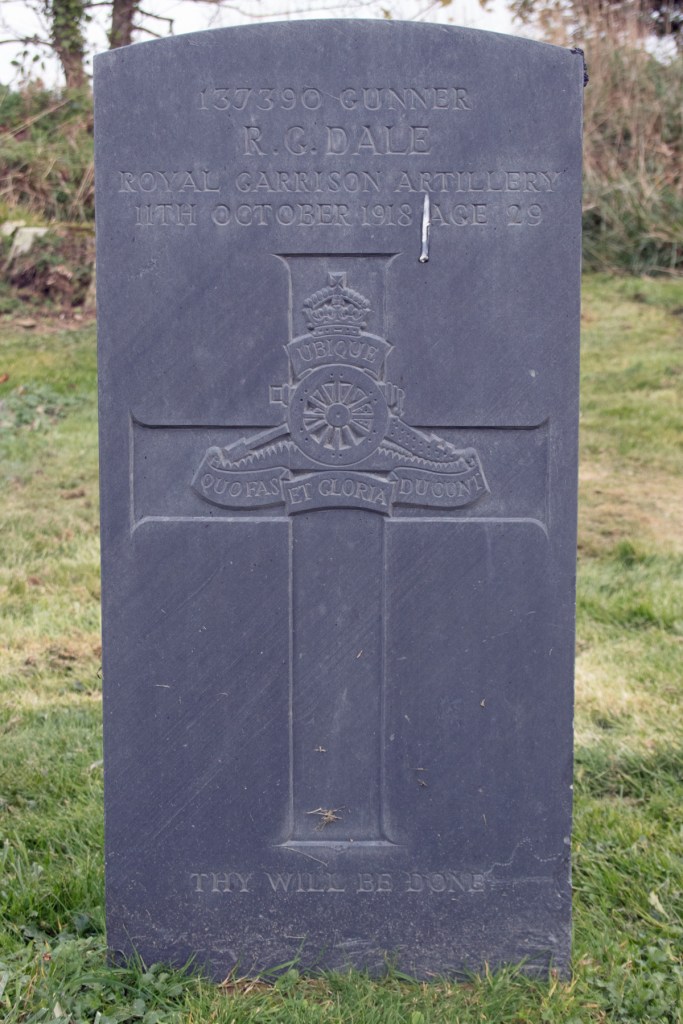
Richard returned home, but his health was compromised. He passed away on 11th October 1918, from a combination of influenza and pneumonia. He was 29 years of age.

Richard George Dale was laid to rest in Padstow Cemetery, in sight of his younger brother Albert, who had passed away eleven years before.


Able Seaman William Masters

Able Seaman William Masters

William George Masters was born in Padstow, Cornwall, on 15th April 1877. The older of two children, his parents were Samuel and Catherine (or Kate) Masters. Samuel was an agricultural labourer, but his son sought a life at sea.

On 7th November 1894, William enlisted in the Royal Navy. Sent to HMS Northampton, an armoured cruiser repurposed as a training ship, he took on the role of Boy 2nd Class. His service records show that he was 5ft 6.5ins (1.69m) tall, with brown eyes, auburn hair and a freckled complexion. He was noted as having a scar on the third finger of his right hand.

Over the next six months, William showed a remarkable dedication to the job. On 7th February 1895 he was promoted to Boy 1st Class, and, just three months later, he came of age and assumed the rank of Ordinary Seaman.

William’s shore base was to be HMS Vivid, the Royal Naval Dockyard in Devonport, Devon, and he returned here regularly over the twelve years of his service. Ordinary Seaman Masters served on ten ships during this time and, on 1st May 1902, was promoted to Able Seaman.

His time in the navy wasn’t to be without incident, however, and he had two spells in the brig – for three days in July 1897, and ten days in December 1905. His misdemeanours are lost to time, but they did blemish an otherwise clear term of service for William.

William married Laura Oldham in 1905: they would go on to have three children – William Jr, Emily and Katharine. He was stood down to reserve status in April 1907 and, by the time of the next census in 1911, the family were living in Church Street, Padstow. No longer working for the Royal Navy, he was, instead, self-employed as a general labourer.

When war was declared in August 1914, William was called back into action. Assigned to HMS Argonaut, he once again too the rank of Able Seaman. He spent a year on board, patrolling the Atlantic, before the protected cruiser was converted to a hospital ship.

In September 1915, Able Seaman Masters transferred to another cruiser – HMS King Alfred – which served in the Mediterranean. He remained on board until the following summer, by which point his health was beginning to become affected.

William returned to Devonport in August 1916, remaining there for a couple of months. On 4th October, he as medically discharged, suffering from myocarditis, a heart condition.

At this point William’s trail goes cold. He returned to Cornwall, passing away at home on 13th September 1917: he was 40 years of age.

William George Masters was laid to rest in Padstow Cemetery, on the outskirts of the town he called home.