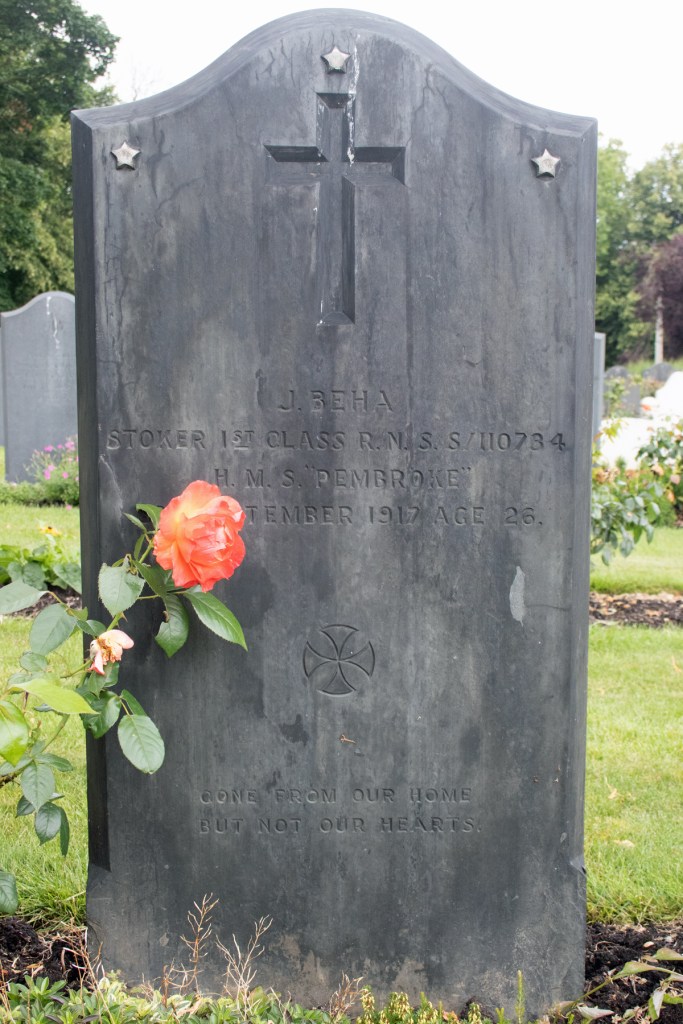
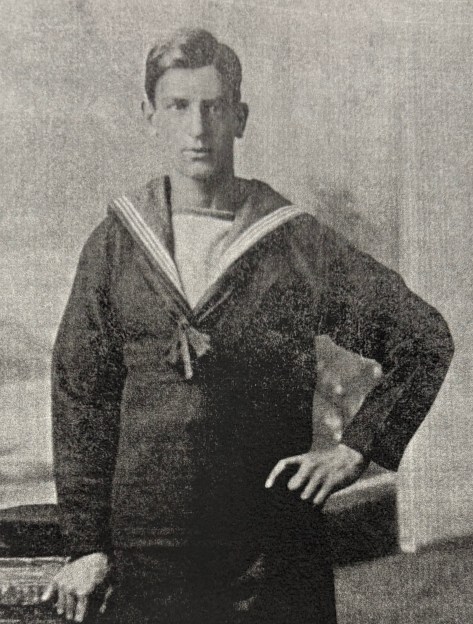
Joseph Beha was born on 16th June 1891, in the Yorkshire town of Whitby. He was the middle of five children to Joseph and Alice Beha, and had a half-sister, through his mother’s previous relationship.
Joseph Sr was a labourer in the local shipyard, and the family had moved to Hartlepool by the time his son had reached 10 years old. The sea had a definite draw for Joseph Jr, and by his twentieth birthday he had enlisted in the Royal Navy as a Stoker 2nd Class.
The service records show Joseph Jr stood 5ft 3.5ins (1.61m) tall, had brown eyes, dark hair and a fresh complexion. His land base was HMS Pembroke, the alternative name for the Royal Naval Dockyard at Chatham, Kent, and it was here that he received his initial six months’ training.
Stoker Beha’s first sea posting was HMS Falmouth, a light cruiser, on board which he served for more than eighteen months, gaining a promotion to Stoker 1st Class in the process. Over the next few years, he was posted to two further ships and, by the time the First World War broke out, was serving on the armoured cruiser HMS Lancaster.
While his record suggests he was of generally good character, Joseph’s time was totally without blemish. He served time in the cells on three separate occasions – for five days in 1913, fourteen days in 1915 and ten days in 1917 – although no evidence of his misdemeanours remains.
The summer of 1917, found Stoker Beha back on dry land in Chatham. HMS Pembroke was a particularly busy place at that point in the war and temporary accommodation was set up. Joseph found himself billeted at The Drill Hall, away from the main barracks.
On the night of 3rd September 1917, Chatham suddenly found itself in the firing line, as the German Air Force launched a bombing raid. One of the bombs landed squarely on the Drill Hall, and Stoker Beha was killed instantly. He was just 26 years old.
Ninety-eight servicemen perished during the Chatham Air Raid that night. They were buried in a mass funeral at the Woodlands Cemetery in nearby Gillingham. This, too, is where Joseph Beha was laid to rest.
Stoker 1st Class Joseph Beha (from Chatham Air Raid, Vol. 2 by Marcus Bedingfield)
George Wilfred Simpson was born early in 1882, the second of seven children to Robert and Mary Simpson. Robert was a shipbuilder from Yorkshire, and the family were raised in Thornaby, on the River Tees near Middlesbrough.
Details of George’s early life are a bit patchy, but when he left school he found work as a warehouseman. He met Florence Unwin, who was born in Stockton-upon-Tees, and they married in the spring of 1906. They young couple set up home in the town and went on to have four children, all boys.
When the war came to Europe, George wanted to do his part. His full service records are not available, but he enlisted in the Royal Naval Reserve as a Stoker at some point during the conflict. By the summer of 1917, he was based at HMS Pembroke, the Royal Naval Dockyard in Chatham, Kent.
The base was a particularly busy place at that point in the war and additional accommodation was desperately needed. Stoker Simpson found himself billeted at Chatham Drill Hall, away from the main barracks.
On the night of 3rd September 1917, Chatham suddenly found itself in the firing line, as the German Air Force launched a bombing raid. One of the bombs landed squarely on the Drill Hall, and Stoker Simpson was killed. He was just 35 years old.
Ninety-eight servicemen perished during the Chatham Air Raid that night. They were buried in a mass funeral at the Woodlands Cemetery in nearby Gillingham. This, too, is where George Wilfred Simpson was laid to rest.
Cuthbert Kean was born on 2nd October 1862, the eldest of four children to John and Jane Kean. John was a tailor from Manchester, who brought his young family up in the town of Crook, County Durham.
Cuthbert followed in his father’s footsteps and, by the time of the 1891 census – when he was 26 years old – was lodging in central Edinburgh, and was working as a tailor.
There is little more information available on Cuthbert’s early years. When war broke out, he enlisted in the Royal Navy, joining up on 26th October 1914. His papers show that he stood 5ft 2ins (1.57m) tall, had a fair complexion and grey eyes.
By 1917, having turned 55, he was transferred to the Royal Naval Reserve, and worked as a Trimmer – an alternative title for a Stoker. He had served on a number of vessels, joining HMS Firefly towards the end of the war.
Early in 1919, Trimmer Kean was admitted to the Royal Naval Hospital in Chatham, Kent, suffering from a sarcoma of the neck. Sadly, he was to succumb to this, and he passed away on 4th March 1919. He was 58 years old. His records give his next of kin as his sister Mary, who was living in Durham.
Cuthbert Kean was laid to rest in the Woodlands Cemetery in Gillingham, Kent.
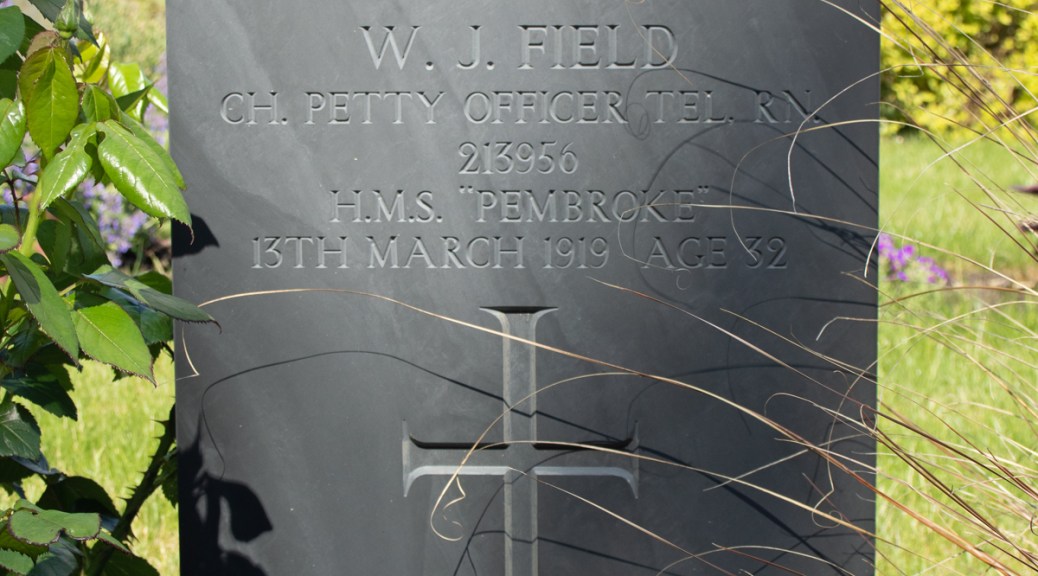
William John Field was born on 8th October 1885 in Boston, Lincolnshire. The eldest of four children, his parents were Charles and Ellen. Charles was a boatman for the coastguard; his job, by the time of the 1891 census, had taken the family to the village of Dawdon on the County Durham coastline.
Given his father’s job, it is not unsurprising that William was destined for a life at sea. As soon as he left school in the spring of 1901, he joined the Royal Navy and was sent to HMS Ganges, the shore-based training establishment in Suffolk. Being underage, he was initially assigned the role of Boy, moving, after a year, to HMS Pembroke, also known as the Naval Dockyard in Chatham, Kent.
By November 1902 Boy Field was moved to HMS Venerable, a ship that was to be his home for the next three years. During this time, William came of age, and was formally enrolled in the Royal Navy as a Signalman. He evidently worked hard on the Venerable, rising through the ranks to Qualified Signalman and Leading Signalman.
In June 1905, William was moved to HMS Leviathan, where he was again promoted, to Second Yeoman of Signals, before again being assigned to Chatham Naval Dockyard six months later.
While based in Kent, William met Nelly Watt, the daughter of a labourer at the dockyard. The couple married in 1906, and went on to have four children.
Over the next few years, the now Petty Officer Telegraphist Field spent an almost equal amount of time at sea and on shore. War was coming and when his initial term of service came to an end in October 1915, he immediately renewed his contract through to the end of the hostilities.
All of William’s time was now spent on land, primarily at HMS Pembroke, but also at HMS Actaeon in Portsmouth, HMS Victory VI at Crystal Palace, London and HMS Bacchante in Aberdeen.
While Chief Petty Officer Telegraphist Field’s naval service records are quite detailed, his passing is anything but. The war over, he moved back to Chatham Dockyard in January 1919. At some point he was admitted to the Royal Naval Hospital in the town, and died from ‘disease’ on 13th March that year. He was just 33 years of age.
William John Field was laid to rest in the Woodlands Cemetery in nearby Gillingham.
A sad aside to the story is that, at the time of he husband’s death, Nellie was pregnant with the couple’s fourth child. John William Field was born on 16th October 1919, destined never to know his father.
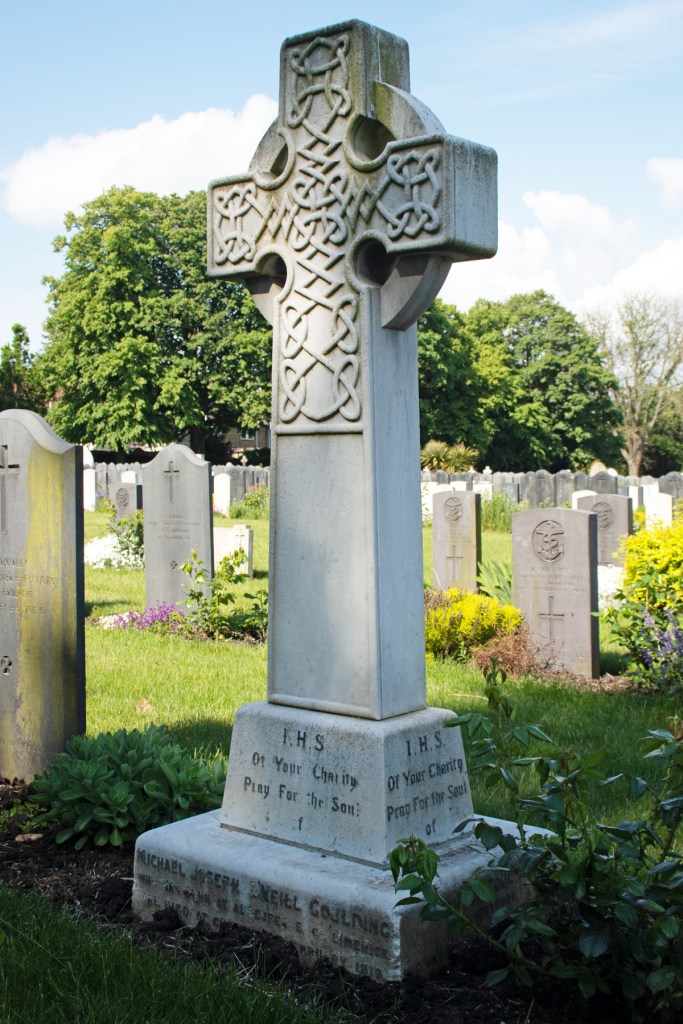
Michael Joseph O’Neill Goulding was born on 5th May 1884, the oldest of six children to Michael and Ellen Goulding (née O’Neill). Michael Sr worked for the inland revenue and his job took him around most parts of the British Isles.
Michael Jr had been born in Limerick – both of his parents came from Ireland – but his subsequent three siblings (Patrick, Margaret and William) had all been born in Scotland. His second youngest sibling, Lily, was born in County Durham, the youngest back in Scotland, while, by the time of the 1901 census, the whole family were living in Forest Gate, East London.
The census also shows that Michael Jr, having left school, was working at Customs House (presumably where his father was employed), as a boy copyist on tea accounts. The inland revenue at that time was a career for life; by the next census in 1911, the family had moved to Hertford, where Michael Sr was a customs and excise supervisor, and Michael Jr was an assistant clerk at the same place of employment.
War was on its way, but Michael seems not to have enlisted immediately. While specific dates for his joining up are not available, it appears that he was still working for the Inland Revenue when he got married in Shoreditch, in April 1917. His wife was called Bridget Mary Gough (known as Bryde), and she had also been born in Ireland. The couple went on to have a daughter, Ellen (or Eileen), the following year.
By this time, Michael had definitely enlisted. He joined the Royal Naval Volunteer Reserve, and was based at HMS Pembroke, the shore-based establishment in Chatham, Kent. This was the location for the Navy’s main accounting base, so it is likely that he was employed for financial, rather than his military, skills.
Able Seaman Goulding served through to the end of the war and beyond, and it was while he was based in Kent that he became unwell. Admitted to the Royal Naval Hospital in Chatham, he succumbed to a combination of bronchitis and pneumonia on 22nd February 1919. He was 34 years of age.
Michael Joseph O’Neill Goulding was laid to rest in the Woodlands Cemetery in nearby Gillingham. His family were still in Hertford, while his widow and daughter moved back to Ireland.
Michael Joseph O’Neill Goulding (courtesy of ancestry.co.uk)
James Henry Green was born in Brixham, Devon, on 13th April 1868, the only child to Isaac and Sarah Green. Isaac was the son of a miller from Essex, who found work as a miner in the south west; he sadly died in 1871, when James was just a toddler.
Sarah had been married before she met Isaac; she had had two children, both daughters, with her first husband, William Tozer, so James had two half-sisters. William had died in 1865, and Sarah had gone on to marry James’ father later that year.
The 1881 census found Sarah and the children living in a cottage in the middle of Brixham; she was listed (somewhat uncharitably by current standards) as a mangle woman. She had taken in a couple of lodgers and James – then aged 13 – was listed as a scholar.
James was evidently keen to make a place for himself in the world. In 1885 he enlisted in the Royal Navy, working as a Boy on a number of ships until, on his 18th birthday, he was given the rank of Ordinary Seaman. His naval records show that he had a dark complexion, brown eyes and brown hair and stood as just 5ft 1in (1.55m) tall.
During his initial ten years’ service, James served on nine ships as well as shore-based establishments, working his way up to the rank of Able Seaman. One the initial period of enlistment was up, he extended his time in the navy voluntarily, eventually serving on a further five vessels and reaching the rank of Able Seaman before transferring to the Coastguard in South Shields. James was stood down form active naval duties in January 1908 and transferred to the Royal Naval Reserve, based in Chatham, Kent.
It was while he was in County Durham that he met Edith Hansford (or Handforth), a horse keeper’s daughter from Whitburn. The couple married in the spring of 1901, and settled down in Sculcoates, to the north of Hull.
When war was declared, those in the Royal Naval Reserve were called into immediate action, and James was no exception. Given the rank of Petty Officer, he was initially assigned to HMS Pembroke, the shore establishment in Chatham, before a brief tour on HMS Columbine, and a longer term on the gunboat HMS Britomart.
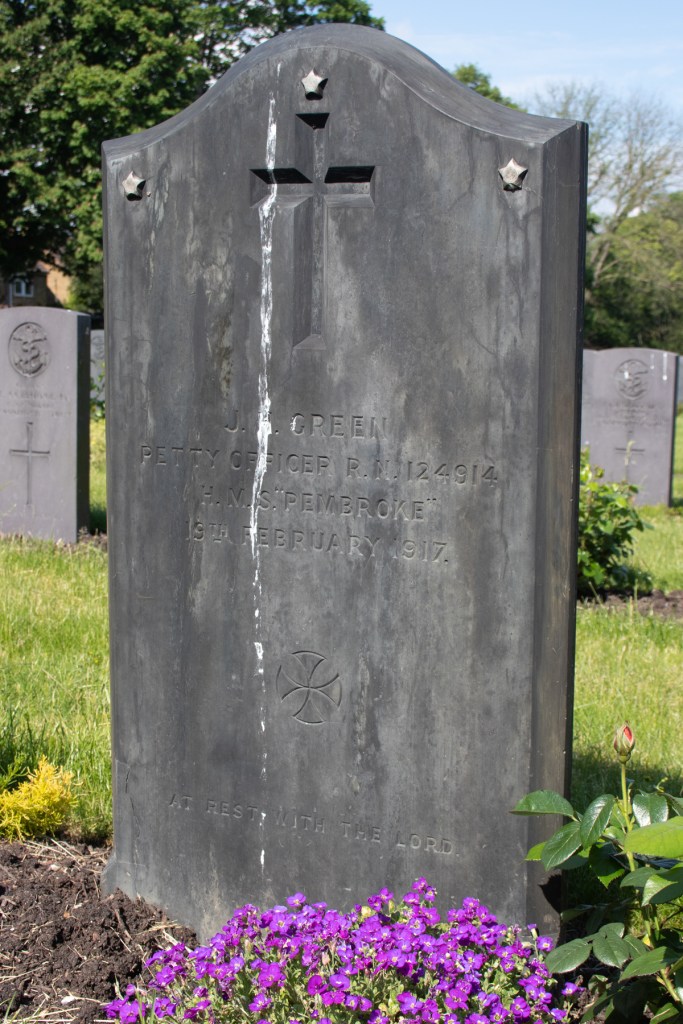
In July 1916, Petty Officer Green returned to HMS Pembroke; he remained based there for six months, before being admitted to hospital, suffering from phlebitis (an inflammation of the veins in the legs). Sadly, the condition got the better of him; he passed away in the Royal Naval Hospital in Chatham on 19th February 1917, at the age of 48.
James Henry Green was laid to rest in the Woodlands Cemetery in his adopted home town of Gillingham, Kent.
Arthur Webb Butler Bentley was born on 1st January 1884 to Dr Arthur Bentley and his wife Letitia. The oldest of five children, they were a well-travelled family. Dr Bentley had been born in Devon, but his and Letitia’s first two children were born in Singapore, while their second two were born in Ireland, where Letitia herself had been born.
By the time of the 1891 census, the family were living in Paddington, London, where Arthur’s father was a medical practitioner.
Arthur Jr looked set to follow in his father’s footsteps; becoming a student of medicine in Edinburgh, although it seems his life was destined to take a different route.
By 1905, his father was working at a practice in Egypt. It was around this time that his mother made the newspaper headlines.
VICTIM OF CHROLODYNE
A painful story was told at the Clerkenwell Sessions when Letitia Bentley, the wife of a doctor holding an official position in Cairo, pleaded guilty to the theft of a diamond and ruby ring from the shop of Messrs. Attenborough, Oxford Street [London]. It was stated that Mrs Bentley was addicted to the drinking of spirits and chlorodyne, and that 240 empty bottles which had contained the latter drug had been found in her rooms in Bloomsbury.
Dr Bentley said he would keep his wife under strict supervision in the future, and she was bound over.
Shetland Times: Saturday 3rd June 1905.
The ring concerned was valued at five guineas (around £700 in today’s money), and another report confirmed that her husband “supplied her with ample means” [financially].
In the 19th century, chlorodyne was readily used as a treatment for a number of medical conditions. Its principal ingredients were a mixture of laudanum (an alcoholic solution of opium), tincture of cannabis, and chloroform, it readily lived up to its claims of relieving pain and a sedative.
Letitia does not appear in any other contemporary media; sadly, however, she passed away “at sea” in June 1907, presumably on the way to or from Cairo, where Arthur Sr was still working. She was just 47 years old.
Arthur seems to have taken the decision to move away, and he emigrated to Canada, settling in Winnipeg. Leaving England behind, he left the idea of medicine with it, finding work as a lineman instead, constructing and maintaining telegraph and power lines.
Arthur’s father is the next member of the family to appear in the local newspapers. Working in Cairo during the winter and Llandrindod Wells in the summer, he travelled to Wales in April 1911. One evening he collapsed and died while in the smoking room of his hotel. The media reported that he was “formerly Colonial Surgeon to the Straits Civil Service, Singapore” and that “he was going to deliver a lecture at Owen’s College [now the Victoria College of Manchester] on tropical diseases, upon which he was an expert.“
Arthur Jr was now 27, and had lost both of his parents. War was on the horizon, though, and he seemed keen to become involved. He enlisted in December 1915, joining the Canadian Expeditionary Force. His sign-up papers gave him as just short of 32 years old, standing at 5ft 8ins (1.72m) tall, with a fair complexion, blue eyes and brown hair. The document also recorded his next of kin as his brother, William, who was living near Cairo.
Arthur arrived in England on 25th September 1916; during his time in the army he remained on English soil, primarily at a signal base in Seaford. Transferred to a reserve battalion in January 1917, he was eventually discharged seven months later.
His records suggest that his services were no longer required, but t is likely that Arthur’s discharge was his transfer to the Yorkshire Regiment, complete with a commission.
The now Second Lieutenant Bentley was assigned to the 3rd Special Reserve Battalion but never saw action in Europe. The troop’s main duties were to train men for service overseas and to provide coastal defences. While there is no confirmation of exactly where Arthur was based, there were units in and around Hartlepool, County Durham.
Sadly, there is little further information about Arthur. By the end of the war, he was living in Taunton, Somerset, where his younger sister Eileen had settled. Second Lieutenant Bentley survived the war, but passed away not long afterwards, on 2nd December 1918. There is no cause given for his death. He was just 35 years old.
Arthur Webb Butler Bentley lies at rest in St Mary’s Cemetery in Taunton, Somerset.










 Death and Service