Category Archives: Devon

Private Garfield Peardon

Private Garfield Peardon

Garfield Ambrose Peardon was born on 24th February 1899, the older of two children to William and Margaret. Both farm labourer William, who had been widowed in 1885, and his second wife, Margaret were from Devon. The 1891 census found the extended family – Garfield and his parents and his older half-brother, William Jr., living in Market Street, Buckfastleigh.

Ten years later, and the family had moved just up the road to Market Street. Both of Garfield’s parents were working for the local woollen mill, William as a horseman and Margaret as a serge weaver. Garfield and his younger brother, Eric, were too young to work, and were both still at school.

Garfield stepped up to play his part for King and Country, although details of his service are a bit of a mystery. He had certainly enlisted by the start of 1918, presumably as soon as he came of age. He joined the Worcestershire Regiment, and was attached to the 3rd Battalion.

Private Peardon served in France, and was likely involved in the Battles of the Somme and Lys in the spring of 1918. His pension ledger records note that, on 27th May, he was recorded as ‘missing’: this was the day of a massive German gas and artillery bombardment and, in the confusion that followed, it appears that Garfield was identified as a potential casualty.

At this point, Private Peardon’s trail goes cold. The next available document is his entry on the Army Register of Soldiers’ Effects: this confirms that he passed away on 28th January 1919 in the 2nd Scottish General Hospital in Edinburgh. This would suggest that Garfield was wounded in the attack, and medically evacuated to Britain for treatment. He was a month short of his 20th birthday when he died.

The body of Garfield Ambrose Peardon was taken back to Devon for burial. He was laid to rest in the the grounds of Holy Trinity Church, Buckfastleigh.


Private William Allen

Private William Allen

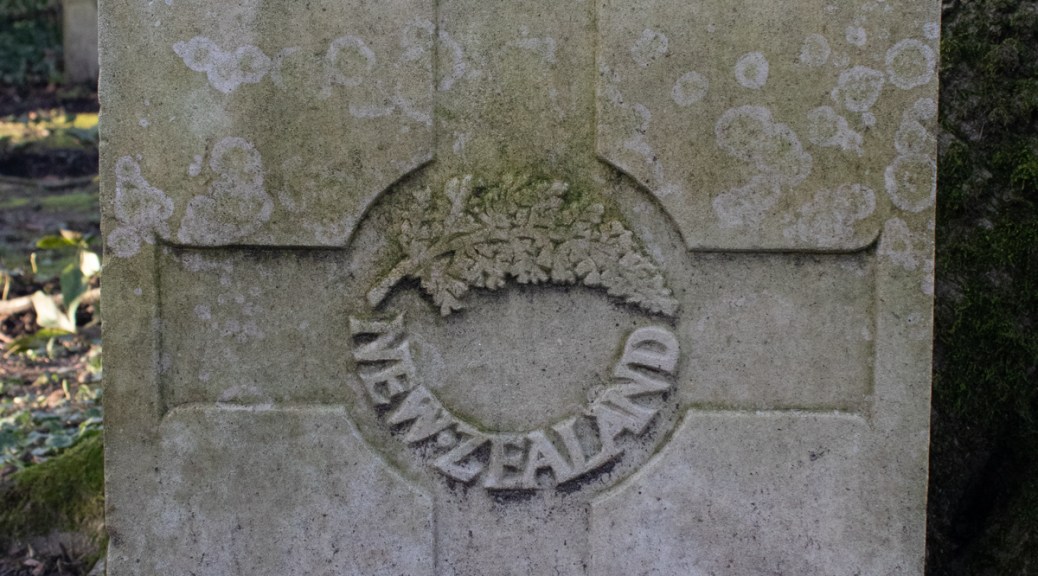
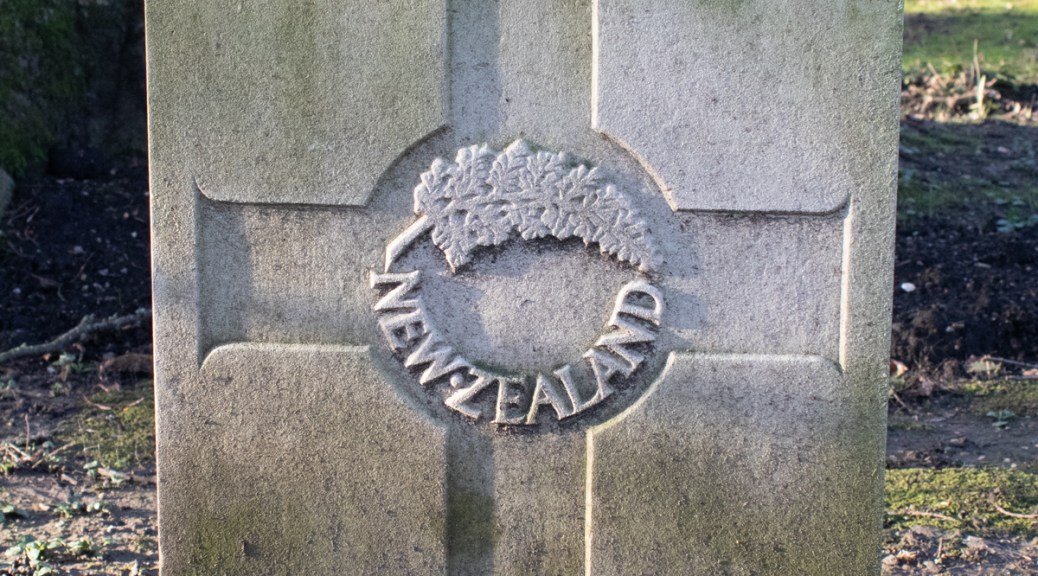
William Allen was born on 24th June 1888, and was the third of ten children to Joseph and Leah. The family lived in Oxford, on New Zealand’s South Island, and when Leah passed away in 1900, Joseph married again, and William soon had four half-siblings.

When he finished his schooling, William found employment as a labourer. At the outbreak of war, William was called to play his part, and he enlisted on 26th July 1916. His service documents note that he was small of stature, just 5ft 2ins (1.57m) tall, and weighing 120lbs (54.4kg). A Baptist, he had dark hair, brown eyes and a dark complexion.

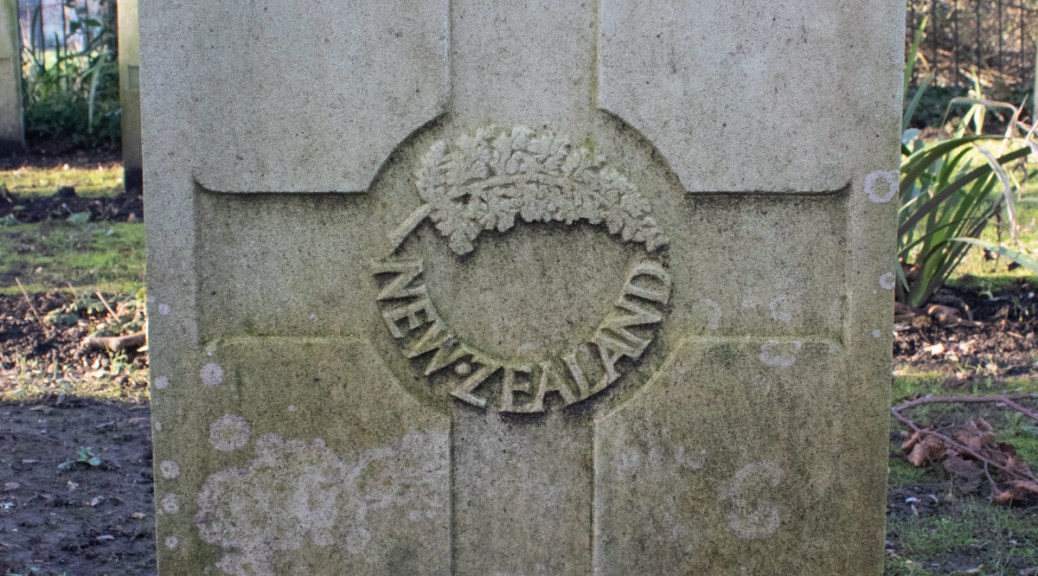
Private Allen was assigned to the New Zealand Canterbury Regiment. His unit departed from Wellington for the ten week journey to Britain, the SS Tahiti finally docking in Devonport, Devon, on 29th January 1917. From here the battalion marched to Codford, Wiltshire, where the developing ANZAC base was located.

Tragically for William, this would be the last stage of his journey. After weeks at sea, in cramped conditions, the incoming troops found they were battling a different enemy from the one they had expected. Many fell ill, and this included Private Allen. He was admitted to the No. 3 New Zealand General Hospital, which was connected to the base, with pneumonia on 19th February 1917. Treatment proved too little, too late, however, and he passed away just four days later, on 23rd February. He was just 28 years of age.

William Allen was laid to rest in the ANZAC extension to St Mary’s Churchyard, Codford, not far from where he had breathed his last.


Private Gordon McDonald

Private Gordon McDonald

Gordon McDonald was born on 28th January 1893 in Pongaroa, New Zealand. The youngest of six children, and the only son, his parents were Scottish-born farmers John and Helen – or Ellen – McDonald.

Little information is available about Gordon’s early life. When he completed his schooling, he went into agricultural work, and this was his employment when, on 27th June 1916, he answered the call to play a part in a conflict on the other side of the globe.

Gordon’s service papers show that he would have been an imposing figure of a man. He was 6ft 3ins (1.91m) tall, and weighed 160lbs (72.6kg). A Presbyterian, he had brown hair, blue eyes and a medium complexion. He was also noted as having two scars, one on the outside of his right forearm, the other on his left thumb.

Assigned to the New Zealand Wellington Regiment, Private McDonald’s unit left the country of his birth on 16th October 1916. The SS Willochra would take two-and-a-half months to reach Britain, arriving in Devonport, Devon, on 29th December. From there Gordon and his unit were sent to Codford, Wiltshire, where their ANZAC base was set up.

Private McDonald’s time in Britain was to be tragically brief. At this point in the war, disease was rife in the Codford billets, and he was not to be immune to its effects. On 13th February 1917, he was admitted to the No. 3 New Zealand General Hospital, attached to the camp, with tubercular meningitis. The condition would prove too severe, and he passed away on 5th March 1917. He was 24 years of age.

Gordon McDonald was laid to rest in the ANZAC graveyard extension to St Mary’s Church in Codford, close to the camp where he had breathed his last.


Private Gordon McDonald
(from findagrave.com)

Private Walter Watson

Private Walter Watson

Walter Robert Watson was born in Wai-Iti, to the south of Nelson, New Zealand, on 12th November 1889. The third of four children, his parents were Edward and Eliza Watson.

When he finished his schooling, Walter found farming work, and this is what he was doing when, in the spring of 1916, he married Beatrice Godbaz. By this point war was raging across Europe, and it seems likely that the couple exchanged vows ahead of his departure for the conflict.

Walter joined up on 26th July 1916, and, as a Private, was assigned to the New Zealand Canterbury Regiment. His service records show that he was 6ft (1.83m) tall and 161lbs (73kg) in weight. A Methodist by religion, he had fair hair, blue-grey eyes and a fair complexion.

Private Watson’s unit departed for Britain on 15th November 1916. Leaving from Wellington on board the SS Tahiti, the journey would take nearly three months. The Canterbury Regiment arrived in Devonport, Devon, on 29th January 1917, and from there the unit moved to their camp on the outskirts of Codford, in Wiltshire.

Walter was feeling every mile of the journey by this point. He contracted lobar pneumonia, and was admitted to the No. 3 New Zealand General Hospital on the outskirts of the camp. The condition was to prove fatal: Private Watson passed away on 20th March 1917, at the age of just 27 years old.

Walter Robert Watson was laid to rest in the ANZAC graveyard extension to St Mary’s Church in Codford.


Private Walter Watson
(from findagrave.com)

Walter’s younger brother, Herbert, had taken a different path in life. Also a farmer, he had volunteered in the 12th Nelson Regiment. When war broke out, he was one of the first to enlist, joining the Canterbury Mounted Rifles on 15th August 1914.

By December that year, his unit had left New Zealand and arrived in Egypt. On the subsequent journey to Britain, Herbert became unwell, and he was admitted to the General Hospital in Gibraltar with dysentery. The condition would prove his undoing, and Trooper Herbert Watson passed away on 30th August 1915, at the age of just 24 years old.

Herbert Percy Watson was buried in Gibraltar’s North Front Cemetery.


Trooper Herbert Watson
(from findagrave.com)

Private Frederick Browning

Private Frederick Browning

Frederick Henry Browning was born on 19th March 1884, and was the third of five children to John and Elizabeth Browning. Born in Dunedin, New Zealand, there is little information about his early life, but as he grew up, he found work as a blacksmith.

When war broke out in Europe, Frederick was working for JS Collins at the Mountain Hotel in Queenstown. By this point he had also spent three years in military service, working for the Ambulance Brigade in Nelson, at the northern tip of South Island.

Frederick stepped up to play his part, enlisting on 22nd August 1916. His service documents show that he was 5ft 7ins (1.7m) tall, and weighed 153lbs (69.4kg). A Methodist, he had black hair, brown eyes and a dark complexion.

Attached to the New Zealand Otago Regiment, Private Browning was sent to Trentham, on the North Island, for training. An asthmatic, he spent two weeks in hospital with the condition in October 1916. On 30th December 1916 his unit departed for Europe on board the SS Athenic, a White Star Line ship conscripted for troop use at the start of the war.

Frederick’s asthma returned on the journey, and he spent a further week of the journey in his sick bed. The Athenic docked in Devonport, Devon, on 3rd March 1917, and Private Browning was sent straight to the town’s military hospital, his lung condition once again affecting him.

It would not be until 14th March that Frederick eventually re-joined his unit, who were based in a camp just outside the Wiltshire village of Codford. His health was really struggling, however, and he came down with a bout of pneumonia. On 24th March he was admitted to the No. 3 New Zealand General Hospital near the camp, but the condition was to get the better of his weakened body. Private Browning passed away on 31st March 1917, at the age of 33 years old.

The body of Frederick Henry Browning was laid to rest in the ANZAC graveyard extension of St Mary’s Church, Codford, not far from the base he had so briefly called home.


Boy 1st Class Robert Atkins

Boy 1st Class Robert Atkins

Robert Reginald Atkins was born in the Kent village of Sarre, on 8th January 1900. The younger of two children, his parents were carter Reginald Atkins and his wife, Alice. Alice died in 1908, aged just 30, and her widower moved the family to the village of Martin, near Dover, where he took up work as a miller.

Robert found work as a grocer’s assistant when he completed his schooling. Being so close to the English Channel, the conflict in Europe must have seemed unavoidable. On 7th August 1917, he stepped up to play his part, and enlisted in the Royal Navy.

Boy 2nd Class Atkins was sent to HMS Powerful, the training ship in Devonport, Devon, for his initial instruction. After just two months he was promoted to the rank of Boy 1st Class, and given a posting to the battleship HMS Dominion.

Robert’s time on board was to be brief. By 3rd November he stepped ashore at HMS Pembroke, the Royal Naval Dockyard in Chatham, Kent. He would remain there for the next few months, during which time he came of age. His service records show that Robert was 5ft 7ins (1.71m) tall, with brown hair, blue eyes and a fresh complexion.

While stationed at Pembroke, Boy 1st Class Atkins fell ill. He was admitted to the Royal Naval Hospital in Chatham, but his condition, pulmonary tuberculosis, was to prove fatal. He died on 21st April 1918, at just 18 years of age.

Robert Reginald Atkins was laid to rest in the Naval section of the Woodlands Cemetery in Gillingham, Kent, not far from the dockyard he had briefly called home.


Following Alice’s death, Reginald re-married. By the time of the 1921 census, he was living in Ashford, Kent, with his new wife, Rosa, and their two children, William and Frank. He was still employed as a miller, but this time was working for Mersham Mills.

According to the same census, Robert’s older sister, Monica, was employed in domestic service. She was working for stockbroker Frank Newton-Smith and his family, in their Dover home.


Able Seaman Sydney Broughton

Able Seaman Sydney Broughton

Sydney Broughton was born on 21st November 1872 in the Lincolnshire village of East Halton. The sixth of nine children – of whom eight were boys – his parents were William and Emma Broughton.

William was a boot an shoe dealer, and his older sons were destined to follow him into the business. Sydney, however, sought bigger and better things and, on 13th November 1888, he joined the Royal Navy. Being only 15 years of age, he wasn’t able to full enlist, and was taken on as a Boy 2nd Class.

Sydney was sent to Devonport, Devon, for his training. Assigned to the training vessel HMS Impregnable, she would become his home for just over two years. On 12th March 1890 he was promoted to Boy 1st Class and on his eighteenth birthday, he was formally enlisted in the Royal Navy.

Ordinary Seaman Broughton’s service records show that he was 5ft 4ins (1.63m) tall, with dark brown hair, light grey eyes and a fair complexion. He was also noted as having a slight scar under his right eye. Now of age, Sydney was moved to barracks at HMS Vivid, onshore at the heart of Devonport itself.

On 28th January 1891, Ordinary Seaman Broughton was given his first posting, on board the cruiser HMS Tauranga. He would remain there for only six months, however, as the ship was in the process of being transferred to the Australian Navy. His new assignment would be the survey sloop HMS Penguin, and she would be his home for the next two years.

Shortly before leaving Penguin, Sydney was promoted to the rank of Able Seaman. He spent the next nine months split between HMS Victory, the Royal Naval Dockyard in Portsmouth, and HMS Excellent, a base that was also connected to the dockyard.

On 26th January 1894 Able Seaman Broughton was posted to the cruiser HMS Galatea. He remained there for the rest of the year, including fourteen days spent in cells for an unknown offence that April. He then moved to the battleship HMS Edinburgh, with whose crew he would spend the next two years.

In September 1896, Sydney transferred to what would become his home base, HMS Pembroke, also known as the Royal Naval Dockyard in Chatham, Kent. Over the remaining six years of his twelve year contract, he would keep returning there, also spending time in the dockyard’s training base, HMS Wildfire.

On 10th February 1901, Able Seaman Broughton was imprisoned for 42 days for misappropriating mess funds, while based in the Dockyard. Surprisingly, the misdemeanour seems not too have impacted his career too adversely, however, and when his contract came up for renewal the following year, he voluntarily remained with the navy.

Sydney was on board the cruiser HMS Amphritite when his new term of service began. In March 1902 he was promoted to Leading Seaman and, over the next five years, he would go on to serve on a further five ships. In October 1907 he was reduced in rank to Able Seaman once more, although his service records don’t confirm whether this was through his own choice or not.

Over the next six years, Sydney would serve on three further ships. When was formally stood down to reserve status on 19th January 1913, his home was HMS Actaeon, the navy’s torpedo school in Chatham: he had been assigned there for nearly three years, and in the Royal Navy as a whole for more than 24 years.

When war broke out in the summer of 1914, Able Seaman Broughton was called back into action. He remained on solid ground, however, and split the next three years between HMS Pembroke and HMS Wildfire, places he knew well. Sydney’s health may have been a factor in his lack of seaworthiness: in the spring of 1917 he was admitted to the Royal Naval Hospital in Chatham, suffering from mouth cancer. The condition was to prove fatal: he passed away on 24th June 1917, at the age of 44 years old.

Sydney Broughton’s body was laid to rest in the naval section of Woodlands Cemetery in Gillingham, Kent, not far from his beloved dockyard.


Sydney’s next-of-kin was noted as being his wife, Edith Mary Broughton. There is no record of their marriage, but her details on his records correspond to an entry on the 1921 census.

The document recorded Edith living in Sittingbourne, Kent. 45 years and seven months old, she was sharing her home with her widowed mother, Harriett Pearce, and her two-year-old granddaughter, Edith May.

Further digging suggests that Edith had been a widow when she and Sydney exchanged vows: the 1911 census found her married to Herbert Busbridge, the couple having a daughter, Edith Nellie, who had been born in 1896.

Widowed twice, Edith Mary carried on as best she could: she passed away in the spring of 1963, at the age of 87.


Private Herbert Kingdon

Private Herbert Kingdon

Born in the spring of 1872, Herbert James Kingdon was the ninth of ten children to George and Elizabeth. George was an agricultural labourer from the Devon village of George Nympton, it was here that the family was born and raised.

George died in 1900, at the age of 72, from this point on, Elizabeth also disappears from the records. In the spring of 1900, Herbert, now also a farm labourer, married Elizabeth – or Bessie – Speed. She was a farmworker’s daughter from South Molton, just two miles to the north. The couple set up home close to where Herbert had been living, and would go on to have five children by the time war was declared: Frederick, Florence, Frank, Annie and Herbert Jr.

George Nympton was a small village, and most of Herbert’s siblings remained close. The 1911 census found Herbert and Bessie living in the village, next door to Bessie’s parents who appear to have moved closer to support their daughter’s family. Three of their four children now old enough to attend the local school, while Herbert was still doing farm work, alongside his father-in-law, George Speed, and his brother-in-law, Fred.

When war broke out, Herbert stepped up to play his part. His full service records are no longer available, but the documents that do still exist suggest that he had enlisted by the start of 1917. Joining the Devonshire Regiment, he was assigned to the No. 4 Agricultural Company, and remained on home soil. By this point, Bessie had had a sixth child, Edward, and it is likely that she needed all the help she could get. With her husband remaining close by, and with her parents still living next door, she seems to have been supported.

By the summer of 1917, Private Kingdon had become unwell, and was suffering from a combination of pneumonia and pleurisy. Convalescing at home, the conditions were to get the better of him: he passed away on 27th June 1917, at the age of 45 years old.

Herbert James Kingdon was laid to rest in the graveyard of St George’s Church, George Nympton, in sight of his former home.


Bessie was pregnant when her husband passed: she gave birth on 13th January 1918, to a baby girl, Mary.

Bessie would only outlive her husband by five years. The last record for her is the 1921 census, when she was living in the family home with five of her children, and her parents, now in their mid-60s, living next door.


Sergeant James Gard

Sergeant James Gard

James Gard was born on 8th March 1889 in the Devon village of Rose Ash. One of fourteen children, he was the fourth of six sons to George and Mary Gard. George was a poultry dealer, but when both he and Mary died within two months of each other in 1897, their children were suddenly left as orphans.

The 1901 census found 12-year-old James visiting the Cole family, farmers who lived a few miles away in Bishops Nympton. James’ older brother Philip had plans, however, and in 1907, the two of them set out for a new life in Canada.

Boarding the SS Saxonia in Liverpool, they arrived in Boston with 50s (approx. £390 in today’s money) between them. Their final destination was to be Winnipeg in Manitoba, but the soon moved further north, setting up neighbouring homes in the town of Fisher Branch.

Both siblings found farming work, but when war broke out in Europe, James stepped up to play his part. On 24th February 1916 he enlisted in the Canadian Expeditionary Force, and was assigned to the Canadian Infantry. His service records show that he was 6ft (1.83m) tall and weighed 155lbs (70.3kg). He had dark brown hair, blue eyes and a ruddy complexion.

Private Gard set sail for Britain within a matter of weeks, arriving in Shorncliffe, Kent, on 12th May 1916. His unit – the 44th Battalion – moved to their base in Bramshott, Hampshire, and this is where he would receive his training.

James’ unit was involved in the fighting at the Somme and Ancre, and his commitment was rewarded when, on 20th January 1917, he was promoted to the rank of Sergeant. Just days later, however, he was badly injured.

A high explosive shell exploded near Sergeant Gard that day, bursting both of his eardrums. Initially treated on site, he was medically evacuated to Britain for treatment, and was admitted to the Military Hospital in Tooting, Surrey. He developed mastoiditis in both ears, and this, combined with septicaemia, lead to his ultimate death. He passed away on 1st April 1917, at the age of 28 years of age.

The body of James Gard was taken back to Devon for burial. He was laid to rest in the graveyard of St Peter’s Church in his home village, Rose Ash.


Sergeant James Gard
(from findagrave.com)

Private Albert Chapple

Private Albert Chapple

Albert Chapple was born early in 1895, and was the son of Elizabeth Chapple. She was just 16 years of age when he was born, and her parents, John and Sarah, unofficially adopted him as their own. John was a church sexton from the village of Knowstone, Devon, and this is where the Chapple family were raised.

Elizabeth married William Dart, a fishmonger from Dawlish, in 1909, and by the time of the census two years later, they had set up home in Beach Street, close to the town’s railway station.

Albert, meanwhile, was still living with his grandparents back in Knowstone. John, now 66 years of age, was employed as an agricultural labourer, while his grandson was working as a cattle boy on the same farm.

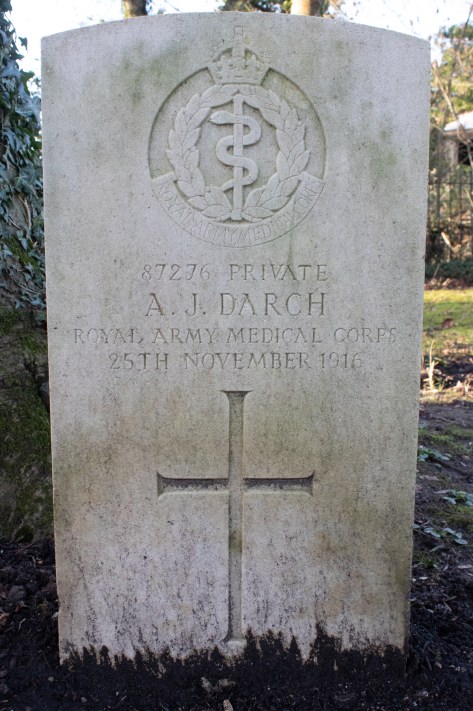
When war broke out, Albert was called upon to play his part. Sadly, full details of his military service have been lost, but it is clear that he had enlisted by June 1916. He enlisted in the Royal Army Medical Corps as a Private, with his entry in the British Army of Soldiers’ Effects suggesting that his unit was attached to the 2nd/1st Wessex Field Artillery.

Private Chapple’s pension record confirms that he had been admitted to the 2nd Western General Hospital in Exeter, Devon. He passed away on 10th December 1916, following an operation, although the document gives no clue as to why he had needed surgery. He was just 21 years of age.

Albert Chapple’s body was taken back to Knowstone for burial. He was laid to rest in the graveyard of St Peter’s Hospital in the village.


The next census return, taken in 1921, found Elizabeth and William still plying their trade in fish in Dawlish. By this point, they had had a son, Edmund, who was five years old. Elizabeth’s sister, Rosie, was living with them, and assisting in the business.