Category Archives: Devon

Able Seaman William Masters

Able Seaman William Masters

William George Masters was born in Padstow, Cornwall, on 15th April 1877. The older of two children, his parents were Samuel and Catherine (or Kate) Masters. Samuel was an agricultural labourer, but his son sought a life at sea.

On 7th November 1894, William enlisted in the Royal Navy. Sent to HMS Northampton, an armoured cruiser repurposed as a training ship, he took on the role of Boy 2nd Class. His service records show that he was 5ft 6.5ins (1.69m) tall, with brown eyes, auburn hair and a freckled complexion. He was noted as having a scar on the third finger of his right hand.

Over the next six months, William showed a remarkable dedication to the job. On 7th February 1895 he was promoted to Boy 1st Class, and, just three months later, he came of age and assumed the rank of Ordinary Seaman.

William’s shore base was to be HMS Vivid, the Royal Naval Dockyard in Devonport, Devon, and he returned here regularly over the twelve years of his service. Ordinary Seaman Masters served on ten ships during this time and, on 1st May 1902, was promoted to Able Seaman.

His time in the navy wasn’t to be without incident, however, and he had two spells in the brig – for three days in July 1897, and ten days in December 1905. His misdemeanours are lost to time, but they did blemish an otherwise clear term of service for William.

William married Laura Oldham in 1905: they would go on to have three children – William Jr, Emily and Katharine. He was stood down to reserve status in April 1907 and, by the time of the next census in 1911, the family were living in Church Street, Padstow. No longer working for the Royal Navy, he was, instead, self-employed as a general labourer.

When war was declared in August 1914, William was called back into action. Assigned to HMS Argonaut, he once again too the rank of Able Seaman. He spent a year on board, patrolling the Atlantic, before the protected cruiser was converted to a hospital ship.

In September 1915, Able Seaman Masters transferred to another cruiser – HMS King Alfred – which served in the Mediterranean. He remained on board until the following summer, by which point his health was beginning to become affected.

William returned to Devonport in August 1916, remaining there for a couple of months. On 4th October, he as medically discharged, suffering from myocarditis, a heart condition.

At this point William’s trail goes cold. He returned to Cornwall, passing away at home on 13th September 1917: he was 40 years of age.

William George Masters was laid to rest in Padstow Cemetery, on the outskirts of the town he called home.

Lance Corporal George Carey

Lance Corporal George Carey

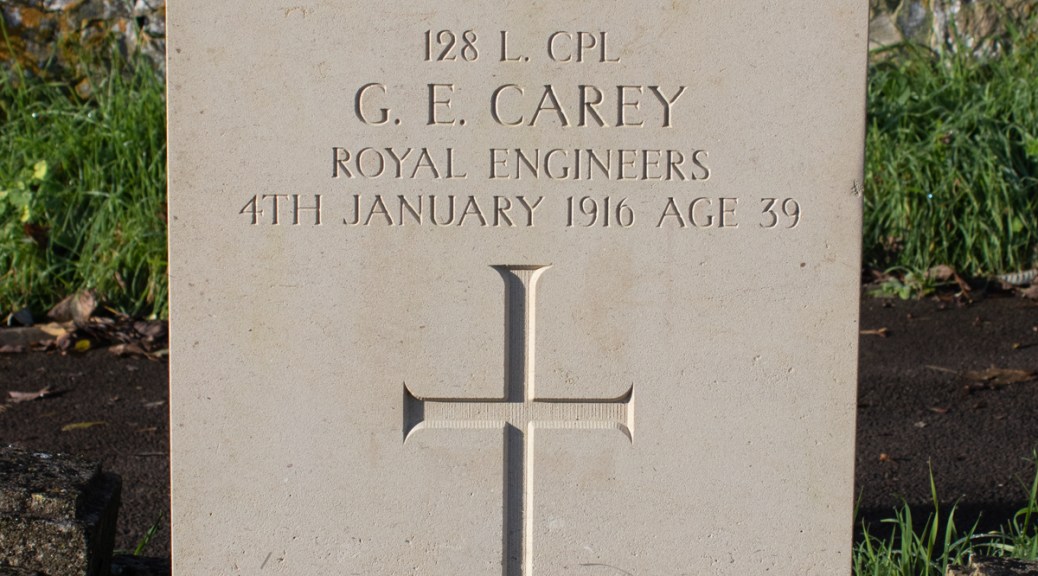
George Edward Carey was born at the start of 1877 and was the oldest of eight children to Samuel and Hester Carey. Samuel was a solicitor’s clerk from Clevedon in Somerset, and this is where the family were born and raised. Samuel was not one to sit on his laurels, however, and the 1891 census recorded his occupations as law clerk, innkeeper and insurance agent.

George followed a different path to his father, and found work as a printer’s apprentice when he finished his schooling. He worked up to being a full compositor quite quickly, and was employed as such when, on 30th January 1899, he married Lizzie Taylor. A civil engineer’s daughter, she was working as a teacher when the couple wed: they set up home in Clevedon, and went on to have four children.

By 1911, the Carey family were living in a seven-room house on Strode Road, Clevedon. George was still working as a compositor, but was employed by the local sanitary works. His widowed brother, Albert, who was lodging with his brother and sister-in-law also did the same job.

With storm clouds brewing over Europe, George stepped up to play his part. He enlisted in the Royal Engineers in the autumn of 1914 and was attached to the 503rd Field Company in Exeter. Little information is available about his time in the army, and he only comes to light again a year or so later.

Lance-Corporal Carey, 2nd Wessex RE, who has been employed at the office in Colleton-crescent, Exeter, was found dead, with his neck broken, at the bottom of a flight of stairs at the Grapes Inn, South-street, on Thursday morning. The discovery was made by Mrs Dorothy, wife of the licensee of the inn. Information was given to the police, and Dr Pereira visited the scene, and subsequently the body was removed to the mortuary by PCs Wise and Barrett. Carey was fully dressed. He was about 48 years of age, and leaves a widow and four children. For about fourteen months he had been engaged on the Wessex RE staff, and was billeted at a house in the Friars. His home is at Clevedon, Somerset, where he was engaged as a compositor before mobilisation with the Territorials. He was under orders for transfer to another station.

Taunton Courier and Western Advertiser: Wednesday 12th January 1916

George Edward Carey died on 4th January 1916: he was, in fact, not quite 39 years of age. His body was brought back to Somerset for burial and was laid to rest in the stunning graveyard of St Andrew’s Church in his home town of Clevedon.


Private George Buse

Private George Buse

George Henry Buse was born in the Cornish village of St Minver in 1880. One of four children, his parents were Richard and Angelina. Richard was an agricultural labourer, but his son followed a different trade, finding employment as a stonemason.

In the summer of 1904, George married a woman called Mary. They went on to have a daughter, Olive, who was born in 1906, and set up home in Splatt, on the outskirts of the village.

When war came to Europe in the summer of 1914, George stepped up to play his part. He enlisted by the summer of 1916, and joined the 2nd Battalion of the Devonshire Regiment. Private Buse’s unit served on the Western Front, but it is unclear whether he fought overseas.

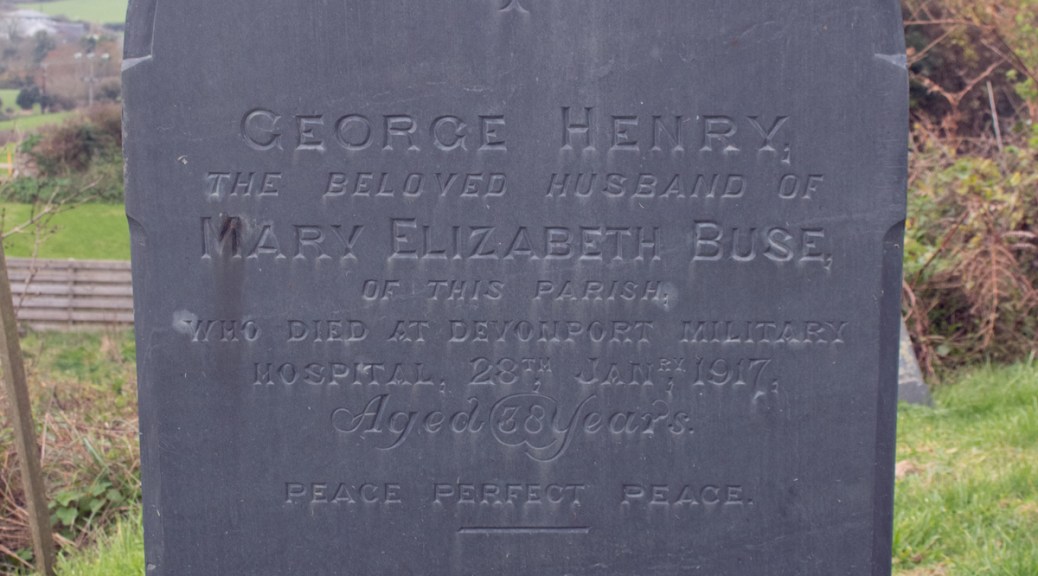
By the winter of 1916, George had fallen ill. He contracted pneumonia, and was admitted to the military hospital in Devonport, Devon. The condition was to prove too severe, however, and he passed away on 28th January 1917: he was 36 years of age.

George Henry Buse was brought back to Cornwall for burial. He was laid to rest in the peaceful graveyard of St Menefreda’s Church in St Minver.


Private William Whaites

Private William Whaites

William Whaites was born on 12th April 1879 in Milverton, Somerset. One of nine children, his parents were George and Anne Whaites. George was an agricultural labourer, and that is work that all of his sons went into at some point.

By the time of the 1911 census, George and Anne were living at Court Bottom in the village, with three of their adult sons – William included – living with them – and doing farm work.

When war was declared, William was called upon to play his part. He enlisted at some point after October 1915, joining the Somerset Light Infantry. Assigned to the 3rd (Reserve) Battalion, Private Whaites was sent to the unit’s base in Devonport, Devon, for training.

Army barracks were cramped places, and often breeding grounds for illness and disease. William was not to be immune to this, and, in the spring of 1916, he contracted pneumonia. He was admitted to the military hospital in Devonport, but quickly succumbed to the condition. He died on 21st April 1916, having just turned 37 years of age.

William Whaites’ body was taken back to Somerset for burial. He was laid to rest in the graveyard of St Michael’s Church in his home town, Milverton.


Serjeant John Chambers

Serjeant John Chambers

John Dwelly Chambers was born on 21st August 1846, in Holborn, Middlesex. The second of four children, his parents were John and Sarah Chambers. John Sr was a tailor, and this was a trade into which his oldest son followed.

Unusually, John Jr travelled widely with his work and, by the late 1860s, he was based in Devon. It was here that he met and, on 5th March 1870, married Isabella Smith. She was born in Exeter, and couple initially made a life for themselves there.

The 1881 census return shows just how far the family moved in the coming years. John and Isabella were to have nine children: their first, Louise, was born in Exeter a hear after their marriage. The second child, son John, was born in Armagh, Ireland, though; their third, Emily, was born in Glasgow; while their fourth, George, was born in Surrey. It was only by the time their fifth and sixth children, Thomas and Charles, were born that they family returned to Devon. Their youngest three children – Percy, Victoria and Ivor, were all born in Somerset, when the family had settled in Taunton.

The reason for these moves seem to have been because his tailoring work was for the army. The 1891 census found the family living in army barracks, where John was listed as being a soldier. Ten years on, and John was recorded as being a Lance Sergeant in the Somerset Light Infantry, the Chambers’ still being billeted in barrack accommodation in Taunton.

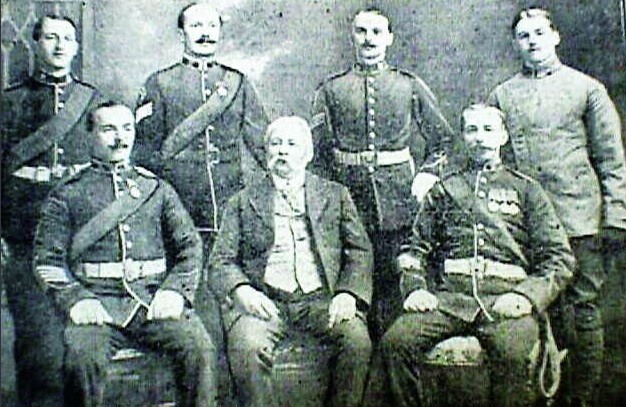
By this point, Percy, now 17 years of age, was employed as a gunsmith, and a later photo suggests that all six of John’s sons went into the army.

Isabella died in 1906, at the age of 58: the following year, John married Elizabeth Dunning, a widow with her own children to raise. The 1911 census found the extended family living in the barracks: John, Elizabeth, Ivor and Elizabeth’s two daughters, Kate and Beatrice. John, by now, was listed as being a master tailor (military), Ivor was now a gunsmith, and the two girls were employed as a book binder and dressmaker respectively.

John had officially been discharged from the army by this point, but it seems likely that the outbreak of war brought him back into service. His life over the next few years is largely undocumented, but it is fair to assume that Serjeant Chambers was called back to the army, possibly to train newer recruits in the trade he had been working in for decades.

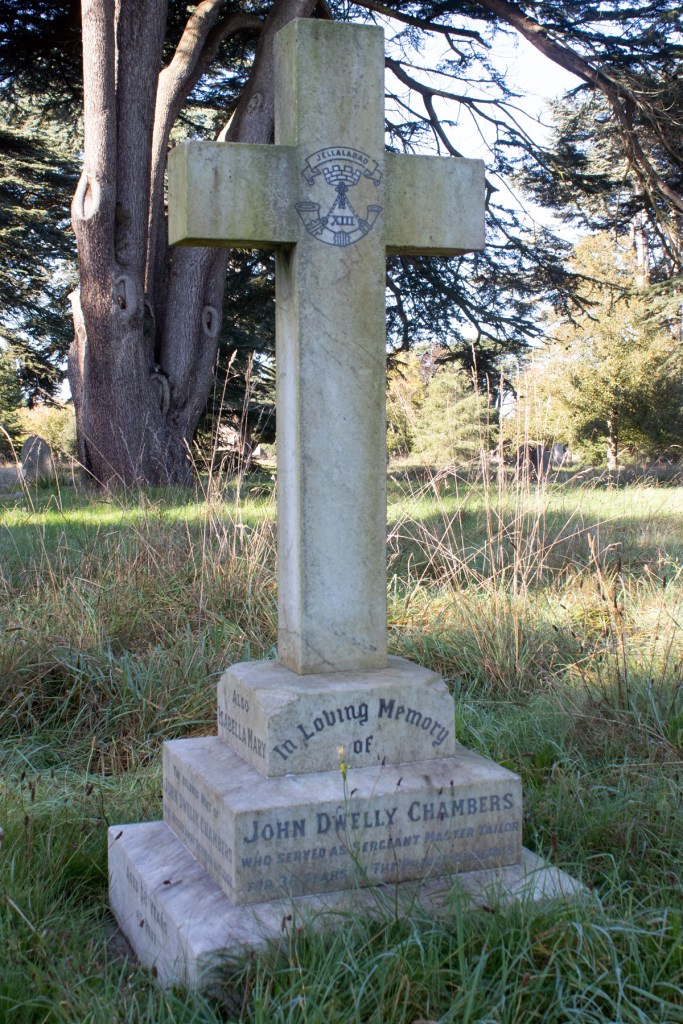
John Dwelly Chambers died of a heart attack on 2nd August 1915: he was just short of his 69th birthday. John was laid to rest in the sprawling St Mary’s Cemetery in Taunton, not far from the barracks to which he had devoted his life.


Serjeant John Chambers (seated middle, with his sons)
(from ancestry.co.uk)

Shipwright 1st Class Thomas Collins

Shipwright 1st Class Thomas Collins

Thomas Collins was born in the Blackfriars area of Glasgow on 12th March 1877. His was a common name, and it is a challenge to find identify much about his early life. He did, however, have a brother called Andrew, and, when he finished his schooling, he found work as a carpenter and joiner.

Thomas sought new opportunities and, on 21st January 1899, he enlisted in the Royal Navy. Working as a Carpenter’s Crew, he was initially assigned to HMS Vivid, the Royal Naval Barracks in Devonport, Devon. His service records show that he was 5ft 5ins (1,65m) tall, with dark brown hair, grey eyes and a dark complexion.

Devonport was to become Thomas’ base, but, over the twelve years of his initial navy contract, he went on to serve on eight separate vessels. He records suggest that he was good at what he did, and his moved up through the ranks as a result. However, he seemed to have another side to him, which occasionally revealed itself.

Thomas was promoted to Leading Carpenter’s Crew on 19th December 1901, but what had been noted as a very good character seemed to take a downturn at this point. He was committed to cells for two weeks in January/February 1903, while serving on HMS Highflyer, with an incident leading to his demotion to Carpenter’s Crew once more. This also appears to match with a drop in his character: noted as Very Good in his reviews of 1899 to 1901, he slipped to Good in 1902 and fair in 1903 and 1904.

His imprisonment seems to have been the shake up Thomas needed. From here on in, his character was consistently recorded as Very Good and, by August 1909, he had regained the rank of Leading Carpenter’s Crew. There was, however, a serious blip in this good behaviour, noted in his service records:

This man was tried for the manslaughter of Richard Ernest Bell, blacksmith, on [illegible date], who died from injuries received in a fight with Collins on HMS Cambridge. Verdict of Jury at Assizes: “Not guilty”. Judge in summing up stated that he considered Collins was technically guilty of manslaughter.

Thomas had been on the mess deck of HMS Cambridge on 26th August 1905, when he became embroiled in a fight with Petty Officer Bell. Medical evidence showed that Bell died as a result of a blow behind his ear, the punch delivered by Leading Carpenter’s Crew Collins. While it seems likely that he unintentionally caused the Petty Officer’s death, he was cleared by the jury, and remained assigned to HMS Cambridge until November 1905.

Thomas’ initial term of service came to an end on 20th January 1911, and he had no hesitation in re-enlisting. On board HMS St George at the time, his new contract brought with it the rank of Shipwright 2nd Class. Over the next five years, he served on four more ships, and rose a rank to Shipwright 1st Class.

On 8th January 1916, Thomas married Flora Peacock. Little information is available about here, although the wedding took place in Harwich, Essex. Thomas was serving on board the cruiser HMS Conquest by this point, and was based out of the Royal Naval Dockyard in Chatham, Kent.

On Tuesday evening, March 28th, a cutter belonging to HMS Conquest, which was taking forty liberty men off to the ship, was caught in a blizzard and nothing was seen or heard of her again till the morning, when she was found cast up on shore many miles away. All hands were drowned.

The cutter was being towed out by a steam-launch. The hawser broke and the boat drifted away ad capsized.

Westerham Herald: Saturday 8th April 1916

Shipwright 1st Class Thomas Collins was one of those lost from the cutter. He had not long turned 39 years of age. He was laid to rest in the Roman Catholic section of Woodlands Cemetery, Gillingham, not far from the dockyard at which he had been based.


Thomas’ headstone incorrectly gives his surname as Collings.


Serjeant Alfred Pollard

Serjeant Alfred Pollard

Alfred Pollard was born in the spring of 1869 in Hinton Charterhouse, Somerset. His early life seems to have been a little disjointed. The son of Harriett Pollard, who had him out of wedlock, his baptism record gives no details of his father.

The 1871 census found him living with his mother and her widowed father, Thomas Pollard. Ten years later, Harriett is living with her husband, Walter Hayden, and four children, including Alfred – who has also taken the name of Hayden. Thomas is also recorded as living with the family.

Alfred is missing from the 1891 census return. Harriett, however, is now listed as married and the head of the household. She and Walter had a further three children – their youngest, Percy, being just three months old. Times must have been tough for her: the same census recorded Walter as being an inmate of the Somerset and Bath Asylum, where he is listed as being a lunatic.

Harriett died at the start of 1892, aged just 46 years old: Walter died three years later, at the age of 55. Both are buried in the graveyard of St John the Baptist Church, Hinton Charterhouse.

The passing of his mother and the diminishing health of his stepfather seems to have spurred Alfred into building a career to support his siblings. Having been working as an engine driver, on 7th December 1892, he enlisted in the Somerset Light Infantry.

Alfred’s service records give his height as 5ft 7ins (1.7m) and his weight as 137lbs (62kg). He was noted as having black hair, bark eyes and a coarse complexion. He also had a number of tattoos, including a cross on his right forearm; a circle of dots on his right wrist; crossed flags, an anchor and Jubilee 1887 VR and crown on his left forearm; and a bracelet on his left wrist. The records also noted the loss part of the middle finger on his right hand.

Private Pollard quickly became a career soldier. Over 21 years, he rose through the ranks to Lance Corporal (July 1902), Corporal (April 1906), Lance Sergeant (November 1907) and Serjeant (June 1911). He spent more than 14 years in India, and was involved in the Mohmand Campaign of 1897. He was formally discharged on 6th December 1913, having served as a signaller for eleven years, and a Provost Sergeant for three. His discharge papers confirmed his exemplary character, and that he was “thoroughly hardworking, sober and reliable.

Back on civvy street, Alfred found work as a labourer in an iron foundry. This was not to last long, however, as he stepped up once more when war was declared in the summer of 1914. Joining the Somerset Light Infantry on 12th October, he retook his previous rank of Serjeant.

Alfred served on home soil during this second period in the army. Initially attached to the 3rd (Reserve) Battalion, his unit was based in Devonport, Devon. In September 1916, Sergeant Pollard was transferred to the 2nd Garrison Battalion of the Devonshire Regiment, which was based in nearby Plymouth. In January 1917, he moved again, to the Hampshire Regiment. He spent most of the year with 18th (Home Service) Battalion in Aldershot, Hampshire, and by December had moved to the 3rd (Reserve) Battalion, which was based in Gosport.

Sergeant Pollard remained on active service until the end of February 1919, when he was formally demobbed. At this point, his trail goes cold, although he seems to have settled in Bath, Somerset. He went on to marry, although details of his wife are limited to the name Mrs AE Pollard and her date of birth, 15th March 1879.

Alfred Pollard died of cardiac failure on 7th March 1921: he was 52 years of age. He was laid to rest in the army section of Bath’s Locksbrook Cemetery.


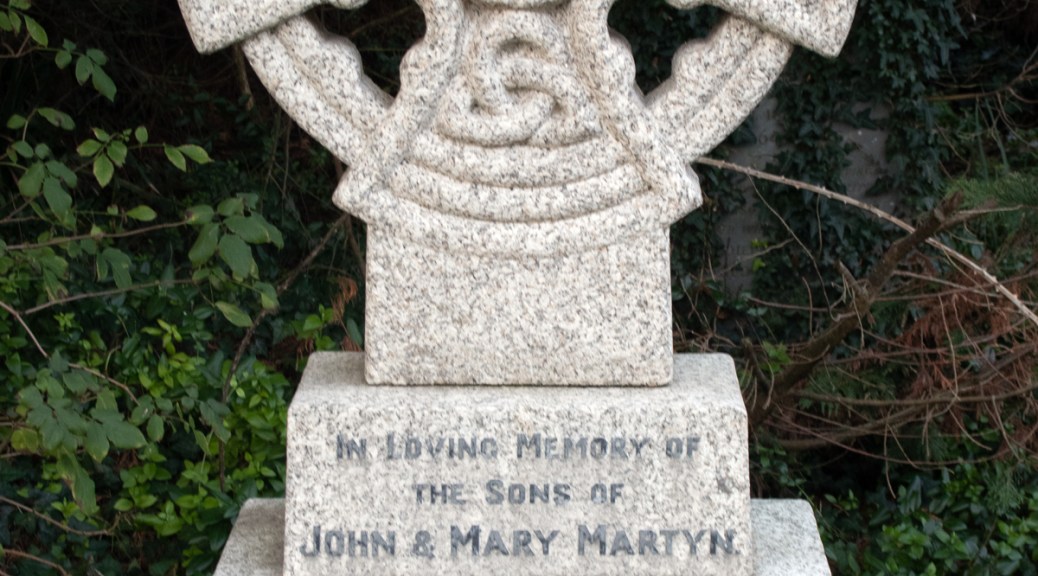
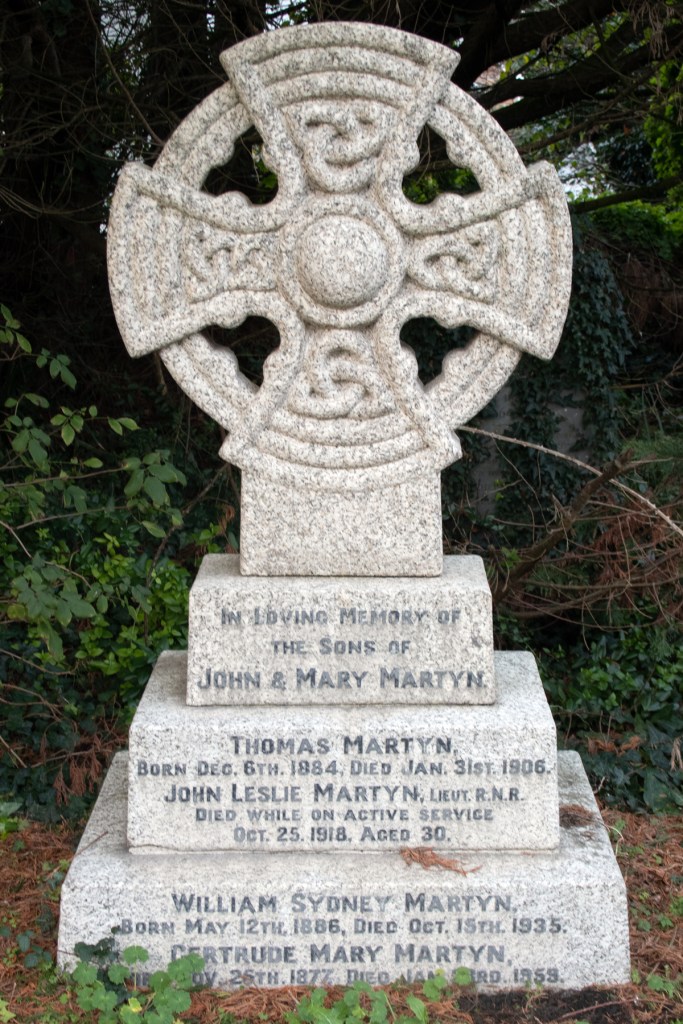
Lieutenant John Martyn

Lieutenant John Martyn

John Leslie Martyn was born in Egloshayle, Cornwall, on 15th February 1888. He was the youngest of five children, and was the third son to John and Mary Martyn. John Sr was a general merchant, and the household had a couple of live-in servants to help both with the household and the business.

When John Sr died in 1904, William, his middle son, took over the running of what was a decent family business.

John Jr, however, had sought another way of life and, was set on a life at sea. He enlisted on the training ship Conway in 1902. Based on the River Mersey, by the time of the 1911 census, he was boarding in the Sailor’s Home in Liverpool. The document confirms that he held the rank of Ship’s Mate in the merchant service, and it would seem that he was doing what he could to build on his skills.

On 26th August 1912, John received his certificate of competency to be the Master of a foreign-going ship. He received a commission in the Royal Naval Reserve, before joining the New Zealand Shipping Co. two years later. When war came to Europe, however, he was called back into naval service.

After serving a few months on the air defences in the Thames Estuary he sailed on his Majesty’s ship Laconia for the coast of German South-West Africa, where he remained. He became a Lieutenant in 1915, and in 1917 was given his first command of HMS Prattler. It is not too much to say that most promising young life has been given to his country.

Cornish Guardian: Friday 8th November 1918

In the summer of 1918, John came home on leave. On 25th July he married Lucy Dudfield in Stanway, Gloucestershire. Tragically, their married life was not to be a lengthy one.

Lieutenant Martyn returned to Devon, and, for reasons undetermined, was admitted to the Royal Naval Hospital in East Stonehouse, Plymouth in October. Whatever the cause of his ailment, he was not to survive it. He passed away while still admitted, on 25th October 1918. He was 30 years of age.

John Leslie Martyn’s body was taken back to Cornwall for burial. He was laid to rest in the family plot in Egloshayle Cemetery.


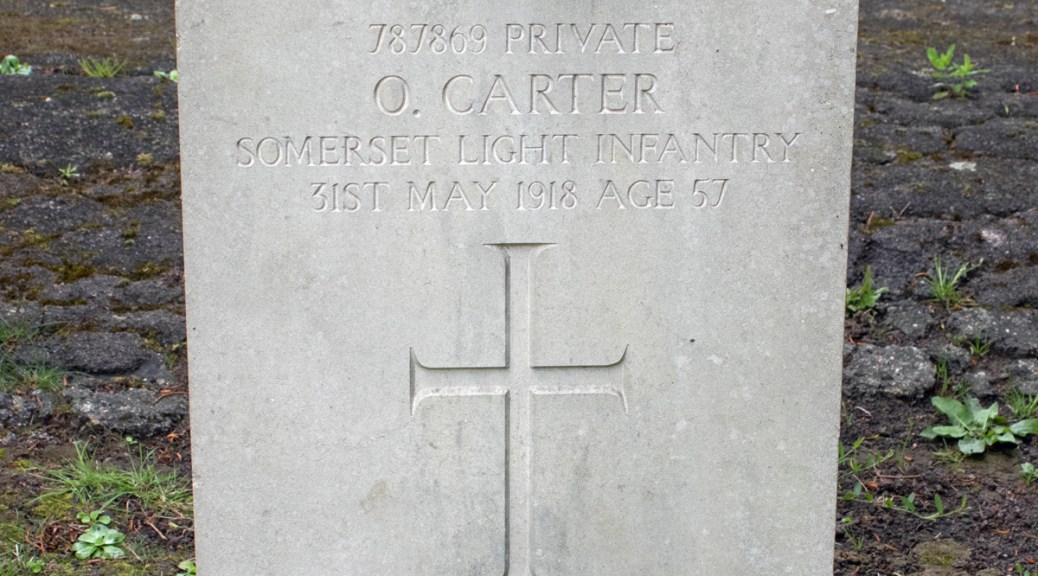
Private Oliver Carter

Private Oliver Carter

Oliver Carter was born in the spring of 1861 in East Budleigh, Devon. The youngest of four children, his parents were Ellis, who was a farm labourer, and Jane Carter.

As the years passed, Oliver’s older siblings left home and, by the 1881 census, he was the last of Ellis and Jane’s children to remain living with them. He was employed as a baker by this point, although he seemed to want more permanent employment.

On 9th February 1883, Oliver enlisted in the army. His service records show that he was 5ft 6.5ins (1.69m) tall and weighed 120lbs (54.4kg). He had a sallow complexion, with brown hair and grey eyes. The document confirmed no distinguishing marks (in the event that his body needed to be identified) and that his religious denomination was Church of England.

Private Carter was assigned the Commissariat and Transport Corps – a forerunner to the Royal Army Service Corps – for a period of twelve years. After eighteen months on home soil his unit was sent to South Africa, where he remained until December 1885. On returning to Britain, he spent the next nine years on reserve status, and was formally stood down from army service un February 1895.

The 1891 census return found Oliver back in Devon, where he working as a general labourer alongside his army commitments. Ellis, meanwhile, was employed as a miller’s waggoner, while Jane had also started taking in lacemaking jobs.

In the autumn of 1893, Oliver married Elizabeth Morrish. Eight years his senior, she was a widow with eight children of her own. The 1901 census recorded the couple living in a cottage near the King’s Arms Hotel in East Budleigh. They shared their home with three of Elizabeth’s children and their own daughter, Hilda. Oliver had changed jobs again, and was employed as a cowman on a farm.

Life continued on for the Carters. A chance of more regular employment as a labourer for the local council brought a move to Highbridge in Somerset. Elizabeth had her own account as a dressmaker, Hilda was keeping house and the family also had a boarder, Charles Smith, who was a butcher’s assistant. While they had made the move to a new county, they did not forget their roots: their house was called Budleigh.

When war broke out, Oliver seemed to be drawn to serve his country again. Full details of his second period of army service are lost to the mists of time, but some things can be gleaned from a contemporary newspaper report of his passing:

Death of a Volunteer

Much regret was expressed at Highbridge on Saturday when it became known that Mrs Carter, of Newtown Road, had received a telegram containing the news that her husband, Mr Oliver Carter, a member of the Somerset Volunteer Regiment, had died while undergoing training with his company under canvas.

Central Somerset Gazette: Friday 7th June 1918

Oliver had been assigned to the 1st (Volunteer) Battalion of the Somerset Light Infantry. His death was registered in Wiveliscombe, and the canvas reference would suggest that he was being trained on nearby Exmoor.

Given he was being trained at the time of his passing, Private Carter is likely to have been a new recruit to the Somersets. As he was 57 years of age when he passed, it is no surprise that he had volunteered for service. His age was to act against him, however: he passed away having contracted pneumonia.

Oliver Carter was brought back to Highbridge for burial. He was laid to rest in the town’s cemetery, a short walk from where his widow and daughter lived.


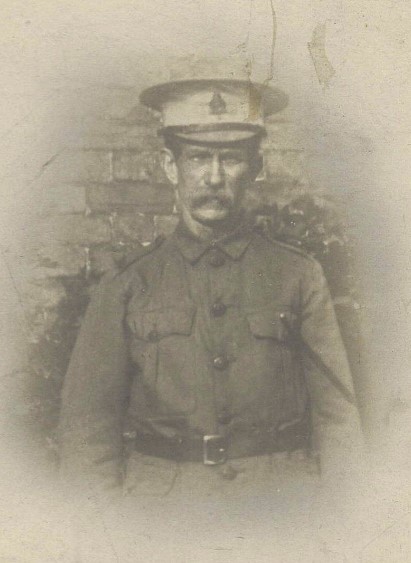
Private Oliver Carter
(from findagrave.com)

Private William Higgins

Private William Higgins

William George Newton was born in Culmstock, Devon, early in 1889. His mother, Ada, was unmarried at the time, and there is no indication as to who his father was. The 1891 census found mother and son living with Ada’s parents, John and Hannah, in South Street, Wellington, Somerset.

In the summer of 1892, Ada married Frederick Higgins, a police constable from Baltonsborough. The couple set up home in the village of Mark, and went on to have ten children. It was at this point that William took on Frederick’s name, though whether that was because he was actually his birth father is unclear.

When he finished his schooling, William found labouring work. On 9th March 1910, he married Annie Achilles, a painter’s daughter from Glastonbury. The couple set up home in a small cottage in Bank Street, Highbridge, and went on to have three children.

The next year’s census recorded that William was employed as a stoker for Highbridge Bacon Co Ltd, a large factory to the south of the town. His and Annie’s oldest child, son William Jr, who was just two months old at this point, and William’s grandfather, the now widowed John, completed the household.

When war broke out, William stepped up to play his part. He enlisted on 28th October 1915, joining the 3rd Battalion of the Gloucestershire Regiment as a Private. His service records show that he was 26 years and 10 months old, and stood 5ft 2ins (1.57m) tall.

Private Higgins’ service documents confirm that he served for nine months before being medically discharged from the army. He had contracted haemoptysis and had an enlarged heart. His medical records confirmed that, at the time of his dismissal, he was totally incapacitated and unable to work.

William returned to Somerset, but is would seem that his health continued to dog him over the next couple of years. He passed away on 29th October 1918, at the age of 29 years of age.

William George Higgins was laid to rest in the cemetery of his adopted home town, Highbridge.


Annie was now a widow, with three young children to support. She married again in the spring of 1922, to bus conductor William Davey. Annie was to outlive not only her husband, but all three of her children.

William and Annie’s youngest, Cyril, passed away when he was just a couple of months old.

Albert, their middle son, “had been for a great while a cripple from trouble in his leg, but was able to get about on crutches.” [Central Somerset Gazette: Friday 22nd July 1932] He passed away on 16th July 1932, aged just 18 years old.

William Jr had tried out in the Royal Navy when he was sixteen years of age. Beginning with the rank of Boy 2nd Class, he was dismissed in March 1928, as he was deemed unsuitable for the rank of Boy 1st Class.

In the autumn of 1934, he married Nettie King, the daughter of a factory worker from Street, Somerset. The couple went on to have three children, although in an echo of his parents’ tragedy, their middle child, Phyllis, passed away when just eighteen months old.

When war came to Europe for a second time, William sought to serve his country for a second time. He enlisted in the Royal Air Force, and rose to the rank of Leading Aircraftman. On 18th June 1940, he was on board a Blenheim aircraft flying from the UK to Malta, when the plane came down in bad weather near Marseille. William and his two companions, Pilot Officer Johnston and Sergeant Micklethwaite were all killed.

Leading Aircraftman Higgins was laid to rest in the Mazargues War Cemetery near Marseille.