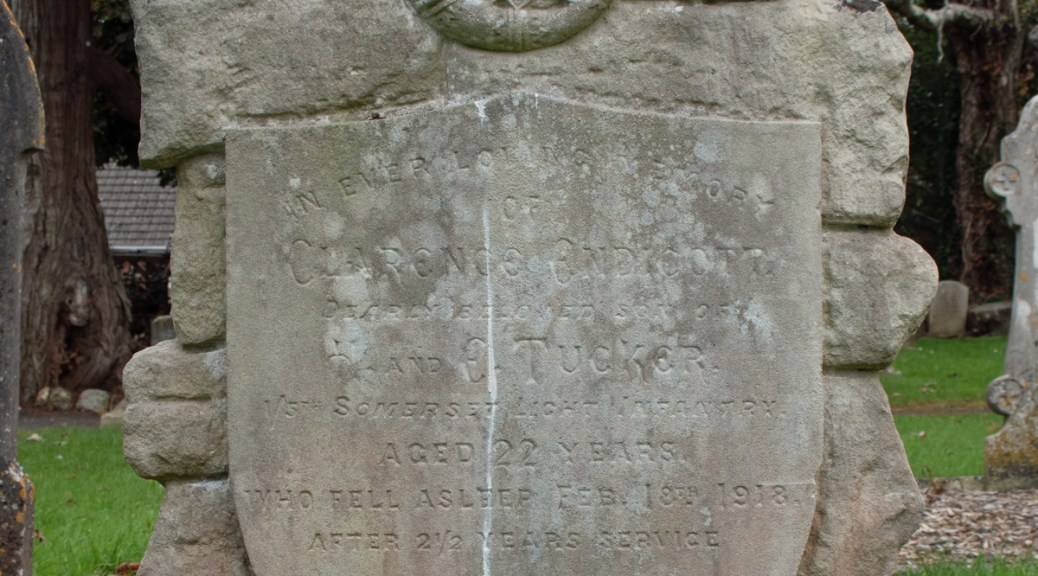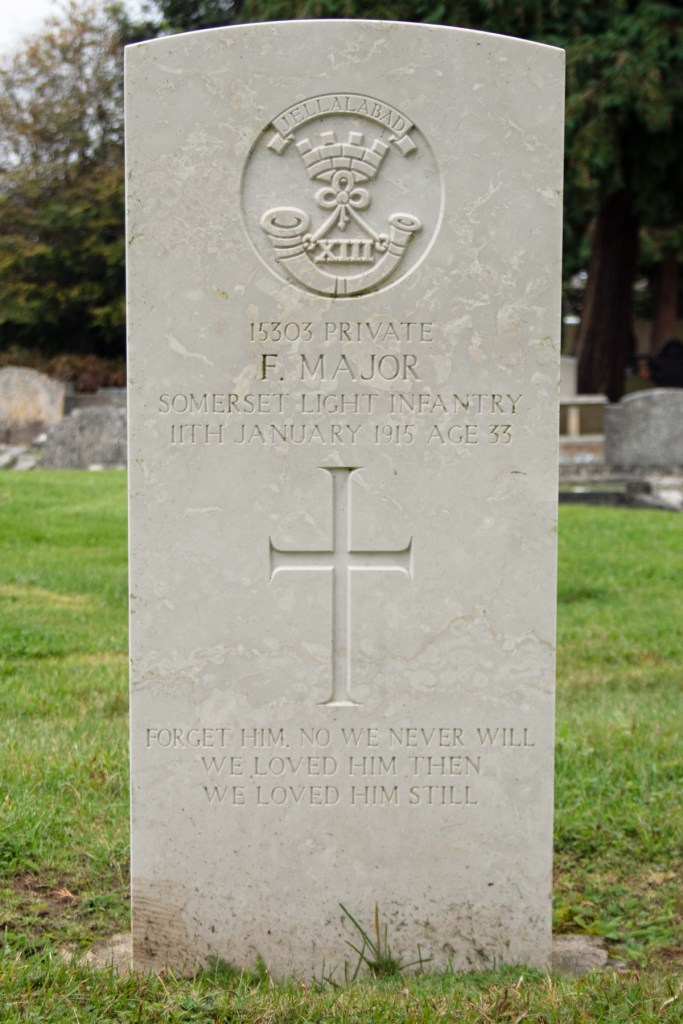
Frederick John Major was born in the spring of 1882, the oldest of seven children to John and Eliza Major. John was a farm labourer and he and Eliza – who was 20 years his junior – raised their family in the Dorset village of Batcombe.
John passed away in 1900, when Frederick was just 18 years old. He was already working as a carter, and continued to live with his mother, helping support her financially, along with his brother and sister.
With war on the horizon, Frederick was keen to do his part. He enlisted in the Somerset Light Infantry, and was assigned to the 9th Battalion as a Private. This was a service battalion based in Plymouth, and it is unlikely, therefore, that Private Major saw any active service overseas.
Sadly, Frederick’s time in the army was to be short. He passed away in Somerset on 11th January 1915, aged just 33 years old. No evidence of the cause of his death is documented.
Frederick John Major was laid to rest in Yeovil Cemetery, in the town in which he died.
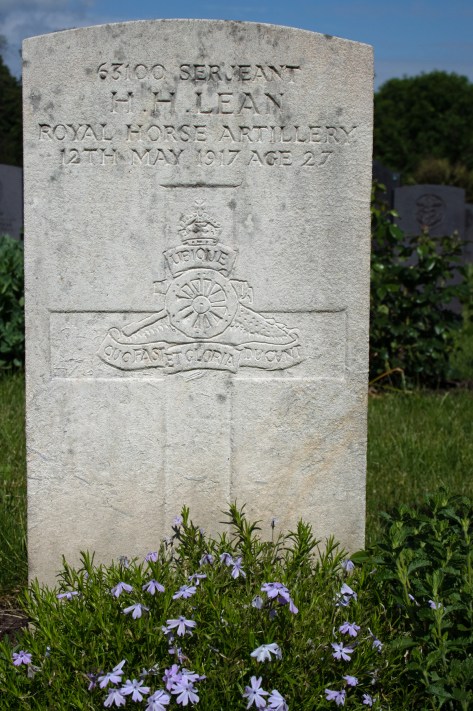
Harold Henry Lean was born in Gillingham, Kent, in the summer of 1890. The youngest of eight children, his parents were tailor Robert Lean and his wife Sarah. His siblings followed a variety of trades – coachman, painter, shoemaker – but Harold was keen to follow a more long-term career.
When he left school (and after his father’s death in 1901), he enlisted in the army, becoming a Gunner in the Royal Horse Artillery. Little remains of his service documents, but at the time of the 1911 census, he was firmly ensconced in the Artillery Barracks in Leeds.
The next record for Harold comes, sadly, in the form of a news report, detailing the inquest surrounding his death:
SUICIDE OF A SERGEANT AT TOPSHAM BARRACKS
Mr Hamilton Brown, Deputy Coroner for Exeter, held an inquest at Topsham Barracks last evening touching the death of Acting-Sergt. Harold Henry Lean, 26, of the [Royal Field Artillery], who died on Saturday as a result of a self-inflicted wound in the throat.
The evidence given by Bombardier JE Driscoll, of the [Royal Military Police], Trumpeter Sydney Russell, deceased’s batman, Bombardier Biddlescombe and Corporal J Williams signalling instructor was that Sergeant Lean, who had some time ago been ill, on Saturday morning was in his room with Russell, but did not speak all the morning.
Shortly after eleven o’clock he took his razor from a shelf in the corner of the room where he kept his shaving materials. Going to his bed he lay across it with his knees nearly touching the floor and drew the razor across his throat. Russell ran to him and caught him by the shoulders, but deceased pushed him away. Russell then called the assistance of Driscoll and Biddlescombe from an adjoining room.
Williams, who was a personal friend and worked with deceased as a signaller, said that deceased worried about the illness from which he had suffered, and two days previously said he thought he was going insane. He had never threatened to take his life.
Captain RW Statham, [Royal Army Medical Corps], said deceased joined that unit in October 1916, and a month later he reported sick. He was sent away to a military hospital, but was returned this year cured and reported for full duty. The illness had a tendency to create mental depression.
On Saturday morning had entered his name on the sick list, but did not attend the sick parade at 9am. At 11:10 when witness was called to him he found him dead. Witness described the wound, which was a very severe one.
The jury returned a verdict of “Suicide during temporary insanity”.
Wester Times: Tuesday 15th May 1917
Serjeant Harold Henry Lean’s body was brought back to Kent from Devon. He was laid to rest in the Woodlands Cemetery in Gillingham.
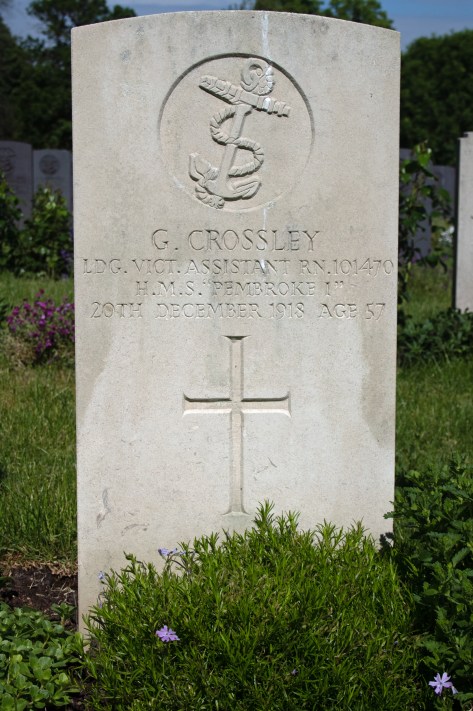
George Crossley was born on 30th December 1861 in the Stonehouse area of Plymouth, Devon. The oldest of five children, his parents were John and Charlotte. John died when George was only ten years old, leaving his widow to raise the family alone.
Left as the technical head of the family, George sought a reliable career and, in August 1877, aged just 15 years old he joined the merchant navy. After two years at the rank of Boy, he formally joined the crew, working as a Ship’s Steward’s Assistant.
Over the initial ten years of his service, George served on four ships, primarily the Royal Adelaide. In 1889, having seen the world, he signed up for a further decade. This new period of service saw him move up to Ship’s Steward, before working back in the assistant role.
In December 1899, George’s twenty years’ service came to an end. Charlotte, by this time, was in her mid-60s, and perhaps he felt it better to spend time ashore with her, rather than leaving her alone.
His experience did not count for nothing, however, and he found employment as a labourer in the Naval Dockyard in Chatham, Kent. And so another fourteen years passed, before war rose its ugly head.
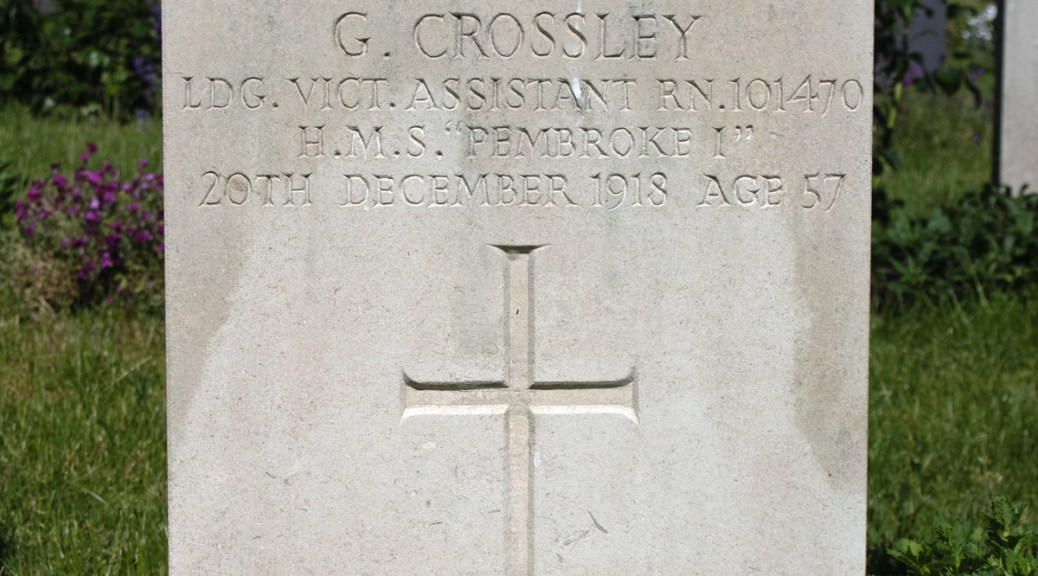
George was called back into service at the start of the conflict, and resumed his role as a Ship’s Steward’s Assistant. Over the next few years, he served on a couple of ships, but the majority of his time was spent at the shore establishments in Portsmouth, Dover and Chatham. In 1917, George gained the rank of Leading Victualling Assistant, giving him some of the responsibility for the food stores at Chatham Dockyard.
Towards the end of 1918, George seems to have been in the east of the county, when he fractured and dislocated his left ankle. Little specific information is available, but it seems that he was admitted to the Royal Infirmary in Deal, but died of his wounds on 20th December. He was ten days short of his 57th birthday. An inquest later that month reached a verdict of accidental death.
Brought back to Gillingham, George Crossley was laid to rest in the Woodlands Cemetery in the town.
John Frederick Dyer was born in Crediton, Devon, on 3rd July 1864. He was one of twelve children to William Dyer, a shoemaker, and his wife Sarah.
When he left school, John initially found work as a tanner – presumably helping with his father’s business. He soon moved on from this, however, and worked as a labourer and then a stone mason.
In 1888, aged 24, he married a woman called Emily; they went on to have four children. By the time of the 1901 census, John was a fully fledged mason, and the family had moved to Weston-super-Mare in Somerset.
From this point in, there is little information available relating to John’s life. The 1911 census records him as living in the centre of Weston-super-Mare, in a six-room house with his wife, two of his children and his niece.
Storm clouds were on the horizon in Europe, but not much documentation records his military service. He was 50 years old when war was declared, and he was old enough to be exempt from volunteering or conscription. However, he did put his name forward, and enlisted at some point at the beginning of 1915.
Private Dyer joined the 4th Battalion of the Somerset Light Infantry. This was a primarily territorial force, that served in India and the Middle East, although there is no confirmation that he was anywhere outside of the UK during his time in the army.
In fact, Private Dyer’s service was not destined to be a long one; the next available record shows that he died on 9th July 1915 at the 2nd Southern General Hospital in Bristol. He had just turned 51 years old. Sadly, no details of the cause of death exist.
John Frederick Dyer’s body was brought back to Somerset for burial. He lies at rest in the Milton Road Cemetery in his adopted home town of Weston-super-Mare.
Wallis Rowland Henry Rochfort-Davies was born August 1895, the youngest of two children to Reverend Charles Rochfort-Davies and his wife, Ethel. Charles was, for some time, the vicar at St Leonard’s Church in Shipham, Somerset, and both Wallis and his older sister Agnes, were both at school until at least their late teens.
Details of Wallis’ military service are scant. He enlisted in the Somerset Light Infantry, and was assigned to the 3rd (Reserve) Battalion, which was based initially in Taunton and then Devonport, near Plymouth.
Sadly, the next information available for Wallis relates to his death. A contemporary local newspaper initially.
It is reported that Sec.-Lieut. Wallis Rowland Henry Rochfort-Davies, 3rd (Reserve) Batt. Somerset LI, died on March 8th. He was the only son of Rev. CH Rochfort-Davies, of Shipham Rectory, Weston-super-Mare. Aged 20, he obtained his commission in Somerset LI in August 1914.
Western Morning News: Thursday 16 March 1916
No details of the cause of Wallis’ death were announced, but a post mortem and inquest were held, and the findings came out later that month.
At the Coroner’s Court yesterday afternoon, Mr AE Baker resumed the inquiry into the circumstances surrounding the death of Wallis Roland [sic] Henry Rochfort-Davies, aged 20, a Second Lieutenant in the Somerset Light Infantry. The inquest was opened on the 9th when evidence was given to the effect that deceased was found dead at the Royal Hotel on March 8. The adjournment was rendered necessary in order that the contents of the stomach might be analysed.
Mr Russell, the City Analyst, gave evidence as to the examination of the contents of the stomach. This showed the presence of morphia.
Dr PW White said he was called to the Royal Hotel about 3:30 in the afternoon of March 8. He found the deceased lying in bed, life being extinct. Death had take place probably 8 or 9 hours previously. There were no external marks of violence. The post mortem examination showed some congestion of the internal organs, but nothing to account for death. He had no hesitation in saying that the cause of death was morphia poisoning, probably hypodermically administered.
Charles Greenslade, a plain clothes officer, said he was called to the Royal Hotel on Wednesday 8 March about 4:30pm. Witness made an examination of the room. He found on the dressing table a case containing two small bottles: one was filled with morphia tablets and the other empty. There was also a blue bottle found, which contained a lotion. Needles and a hypodermic syringe were also found…
Reginald Francis Cheese, a friend of the deceased, said he had shown him some drugs on two occasions. He identified a case of drugs produced as having been shown him by the deceased.
The jury returned a verdict of “Death from an overdose of morphia, self-administered”. The expressed sympathy with the father of the deceased and desired to severely censure the witness Cheese.
The Coroner spoke of the increased habit of drug taking among officers, and of the amount of drugs which the case that had been produced contained. Deceased, he said, could not have purchased from any chemist such a quantity of drugs, and it must have got into his hands through the medium of a friend. It was a grossly wicked act that such a large quantity of drugs was ever allowed to get into the hands of this unfortunate young man.
Western Daily Press: Friday 31st March 1916
Wallis Rowland Henry Rochfort-Davies was just 20 years old when he died. He was laid to rest in the Milton Cemetery in Weston-super-Mare, in his home county of Somerset.
Stanley James Payne was born towards the end of 1882, one of eleven children to Stephen and Elizabeth Payne. Stephen was a leather salesman from Essex, who had moved his family to Weston-super-Mare in Somerset in around 1880.
Stanley seems to have been drawn in to a military life from an early age. In January 1900, he enlisted as a Private in the Somerset Light Infantry, and the 1901 census listed him as living at the Raglan Barracks in Devonport, near Plymouth.
Military service took Private Payne to India, where he served for six years. His success and ambition were clear; in 1906 he was promoted to first to Corporal and then to Sergeant. By 1911 – and now back in England – as a Lance Sergeant, Stanley was working as a military clerk at the Royal Horse Artillery Barracks in Dorchester, although he was still attached to the Somerset Light Infantry.
Stanley’s ambition and sense of adventure continued; by July 1912 he had made the transfer over to the newly-formed Royal Flying Corps, as a Sergeant.
It was while he was based in Dorchester that he met Winifred Bell. She was the daughter of a local council worker, and the couple married in the town in September 1912. Stanley and Winifred went on to have a daughter, Doris, who was born in July 1914.
War had arrived in Europe, and on 7th October, the now Warrant Officer Payne was shipped to France. During his nine months on the Western Front, he was mentioned in despatches and received the Croix de Guerre for his gallantry. The local newspaper also reported that he:
…had also the honour of being presented to the King on the occasion of His Majesty’s last visit to the front, and at a home station had also been presented to Queen Mary.
Western Daily Press: Saturday 8th March 1919
Returning to England on 1st June 1915, he was again promoted to Lieutenant and Quartermaster, although here his military records dry up. By this time, he had been in the armed forces for more than fifteen years, but his military records seem to confirm this as the last day of his service.
The next record for Stanley confirms his passing. Admitted to the Central Air Force Hospital in Hampstead with a combination of influenza and pneumonia, he died on 3rd March 1919. He was just 36 years of age.
Brought back to Weston-super-Mare, where his now widowed father was still living, Stanley James Payne was laid to rest in the Milton Cemetery in his home town.
Stanley’s gravestone gives his rank as Major. While there is no documented evidence of any additional promotions after June 1915, the rank is the equivalent of Quartermaster in the Army Reserve. It seems likely, therefore, that the end date of his military service marked the start of his time in the reserves.
Cecil William Beresford was born in June 1875, the oldest of five children. He shared the same first name as his father, so became known as William. Cecil Sr was a barrister in London and he and his wife, Caroline, brought the family up in Kingsbury, London.
Things certainly went well for the Beresford family. By 1901, Cecil was a county judge, and had relocated the family to Devon. William, by this time, was training to be a barrister, and lived with his parents, siblings and four servants in Weare Hall, overlooking the village of Weare Giffard, near Bideford.
From this point on, information about William is a bit sketchy. He does not appear on the 1911 census – by this time Cecil and Caroline had moved to Weston-super-Mare, where Cecil died a year later. It is likely that William had enlisted in the army by this point, and was posted overseas.
William’s military records are not available, but when war broke out in 1914, he joined the Royal Defence Corps and, through his service, had attained the rank of Major.
In October 1917, a number of the local newspapers ran this brief report:
The death has occurred in a military hospital at Weymouth of Major Cecil William Beresford (RDC), eldest son of his Honour, the late Judge Beresford and Mrs Beresford, late of Wear Gifford Hall, and subsequently of Penquarry, Weston-super-Mare. He was 42 years old.
Western Times: 17th October 1917
Sadly, this is all that remains to document Major Beresford’s passing. There is nothing to confirm whether he had been wounded or had fallen ill, and there are no newspaper reports around his funeral.
Cecil William Beresford was laid to rest in the Milton Cemetery in his mother’s adopted home town of Weston-super-Mare.
John Nelson Trayler was born on 2nd December 1876, the oldest of seven siblings. His father, Jonas Trayler, was born in London, but moved to South Wales to become a farmer. He married Elizabeth Green, who was from Haverfordwest, and John was their eldest child, born in Pembrokeshire.
In December 1895, having just turned 19, John joined the 1st Devonshire Volunteer Corps. He seemed eager for a life of action; given that the 1901 census lists his profession simply as ‘farmer’s son’, it’s easy to see why. By this time, the family had moved to a farm in Broadclyst, to the north east of Exeter in Devon.
There was a change of direction for the family, however. By 1908, both father and son were working as tanners; John had moved back to Wales, while Jonas had set up work in Bridgwater, Somerset.
John, by this time, had met Eunice Sully; she was the daughter of a gentleman, and her family lived in Wembdon, near Bridgwater. They married in July 1908, and lived in the village of Lamphey in Pembroke.
John was, by now, the managing director of a tannery and obviously had the business acumen to run a company. He joined the local freemason’s – the Lodge of Perpetual Friendship – but, in January 1914, it was reported in the local newspaper that the business was to be voluntarily wound up.
John’s father Jonas was also forging ahead with his ambitions, and was a councillor for the Bridgwater area.
When the Great War broke out, John’s time with the Devonshire Volunteer Corps was such that he had attained the rank of Captain. Assigned to the 11th (Reserve) Battalion, John was based out of Exeter and it is unlikely that he saw any active service in France.
In August 1915, the Exeter and Plymouth Gazette reported that Captain Trayler had relinquished his commission on account of poor health, and this seems to have been an ongoing issue. In fact, when he was staying with Eunice’s parents in Clevedon later that year, he fell seriously ill. While his medical condition is lost to time, sadly it was one he succumbed to. He died at his in-laws’ house on 27th November 1915, at the age of 39 years old.
John Nelson Trayler was laid to rest in the picturesque graveyard of St Mary’s Church in Clevedon, Somerset.
Harry Stephens was born in Banwell, near Weston-super-Mare on 4th January 1873. He was one of six children to Frederick Stephens and his wife, Emma. Frederick was a butcher, and this was a trade that both Harry and his older brother, Fred, would go into when they left school.
It appears that being a butcher was not the full-time career that Harry was looking for, and so, in the 1890s, he found other employment as a farmer, and moved to Lynton, on the north coast of Devon.
It was here that he met Norah Watts, another farmer’s daughter and, in 1898, the couple married. They set up home at Furzehill Farm, and went on to have four children, Frederick, Alice, Albert and Herbert.
By the time of the 1911 census, Harry had moved his family back to Banwell, where they lived in a four-roomed house on the High Street. Harry was now a cattle dealer, and was presumably supplying meat to his mother who, having been widowed in 1902, was now running the butcher’s shop with three of Harry’s siblings.
War was coming, though, and on 21st July 1915, Harry enlisted. Given his farming background, he was assigned to the Army Veterinary Corps and, while remaining on the Home Front, over the next few years he gained promotion.
Towards the end of 1917, when Serjeant Stephens was serving in Romsey, Hampshire, he fell ill, complaining of chest pains and breathlessness. He was taken to Hursley Hospital near Winchester for cardiac checks, and it became apparent that he was no longer fit for active duty.
Discharged from military service on 5th July 1918, he returned home. Admitted to the Military Hospital in Taunton, it was only a matter of weeks later than Serjeant Stephens passed away. He was 45 years of age.
Harry Stephens was laid to rest in the St James’ Cemetery in Taunton.
Henry Oaten was born in 1876, the second youngest of seven children to Henry and Mary Ann Oaten. Henry Sr was an agricultural labourer, who raised his family in his home village of Pitminster, to the south of Taunton in Somerset.
When he left school, Henry Jr followed in his father’s footsteps as a farm worker. Sadly, however, there is very little further documentation to expand on his life.
Henry married a woman called Emily; this is likely to have been at some point around 1900, although there is nothing to confirm an exact date. The couple went on to have four children – John, Albert, William and Howard.
When war broke out, Henry joined up. Again, dates for his military service are not available, but he enlisted in the Devonshire Regiment as a Private. He was assigned to the 13th (Works) Battalion, which was a territorial force, based in Plymouth.
Little further documentation exists in relation to Private Oaten. The next time he appears is on his pension record, which confirms that he passed away on 20th February 1917, having been suffering from bronchitis. He was just 40 years old.
Henry Oaten was brought back to Taunton and laid to rest in the St James’ Cemetery in the town.
As an aside to this story, while researching Private Oaten, an additional piece of information about his father came to light. A record confirms that, on the 1st October 1851, at the age of just 16, Henry Oaten was admitted to gaol. Sadly further details – including that of his crime and his sentence – are lost to time, but it adds an interesting footnote to his son’s background.