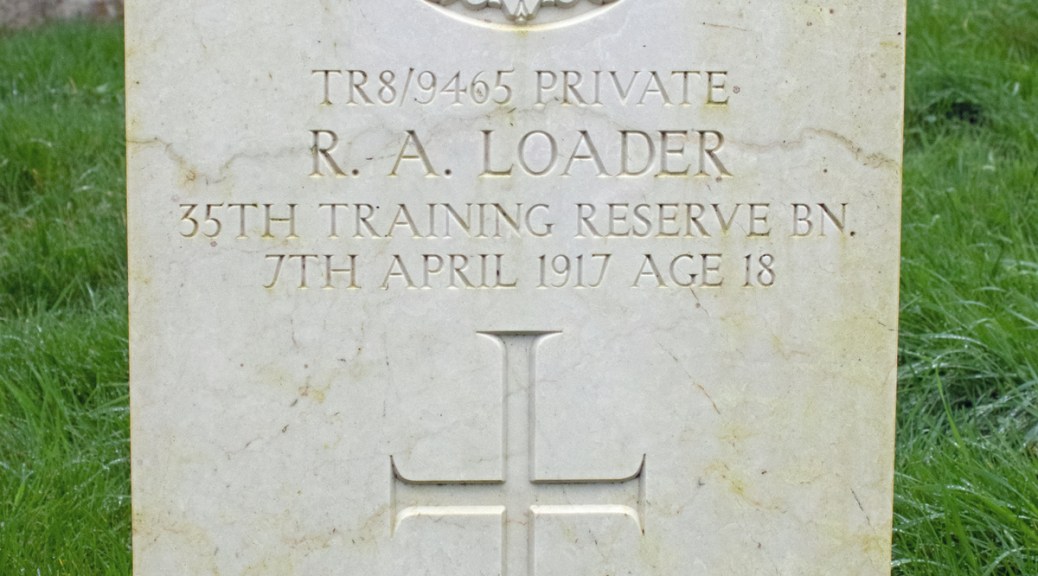
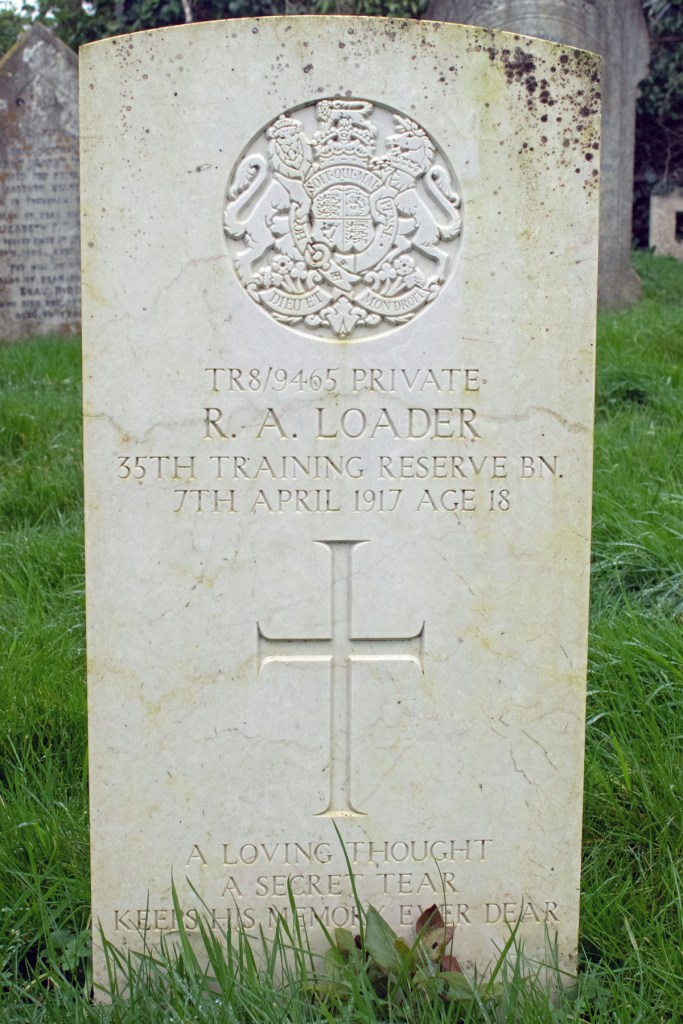
Reginald Alfred Loader was born in the autumn of 1898, and was the eighth of nine children. His parents – Robert and Amelia – both came from the Dorset village of Lillington, and this is where they raised their family.
Sadly, there is little specific information on Reginald’s life. When war broke out, he stepped up to play his part, and enlisted in the Training Reserve Battalion at some point after October 1916. His unit, the 35th Battalion, was based in Wool, Dorset, but there is no further information about his time there.
The only other concrete information about Private Loader confirms his passing. He died in hospital – through causes unknown – on 7th April 1913. He was just 18 years of age.
Reginald Alfred Loader’s body was taken back to Lillington for burial. He was laid to rest in the graveyard of St Martin’s Church in the village.
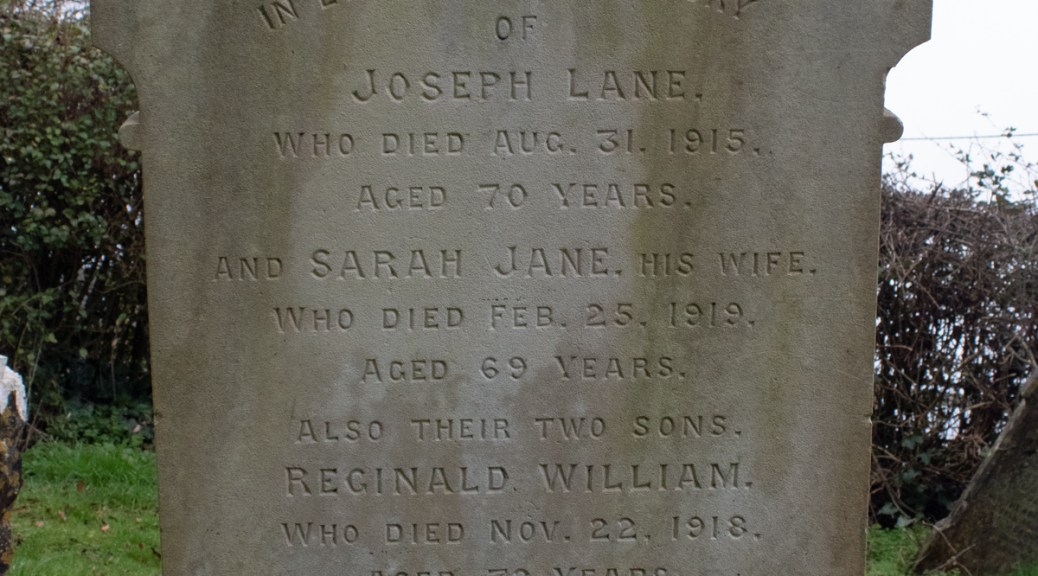
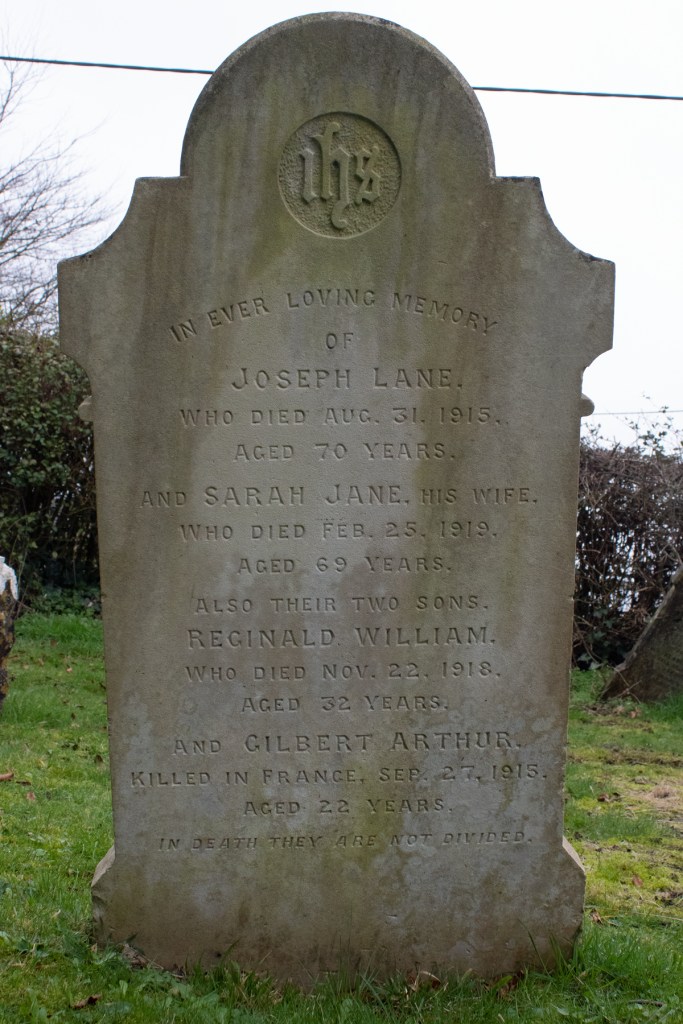
Reginald William Lane was born in the autumn of 1886, the eighth of ten children to Joseph and Sarah. Joseph was an agricultural labourer and he and his wife raised their family in their home village of Thornford in Dorset.
When he finished his schooling, he found work as a gardener’s boy. He went on to make a career out of this and was employed as a gardener when he married Evelyn Sharp on 15th April 1914. The couple exchanged vows in St Swithun’s Church, Hinton Parva, Dorset, the marriage certificate noting that the groom’s father was now employed as a woodsman.
War came to Europe later that year, and Reginald enlisted to serve the King and Empire. Little information is available about his military career: he joined the Dorsetshire Regiment, but there is no confirmation that he spent any time overseas. Private Lane transferred over to the 3rd (Reserve) Battalion of the Wiltshire Regiment, his new unit serving on home soil. Based in Kent, Reginald was part of the Thames & Medway Garrison.
Joseph died at the end of August 1915, and was laid to rest in the St Mary Magdalene Churchyard. Just weeks later, Reginald’s younger brother, Gilbert, a Private in the 3rd Battalion of the Middlesex Regiment, was killed during the Battle of Loos. He was commemorated on the Loos Memorial in Dud Corner Cemetery in France.
Private Reginald William Lane survived the war, but only by eleven days. While based in Kent, he contracted influenza and pneumonia. He died on 22nd November 1918, aged 32 years. His body was brought back to Dorset, and was laid to rest alongside his father.
There is no further information available for Evelyn.
Reginald’s mother, Sarah, however, only lived for another couple of months. She passed away on 25th February 1919, at the age of 69 years old. She was reunited with her husband and son in St Mary Magdalene Churchyard, the family headstone commemorating Private Gilbert Lane as well.
The early life of Ernest Brister is a challenge to piece together. His baptism record – at St Mary Magdalene Church in Thornford, Dorset – suggests that he was born in the summer of 1891, but gives only the name of his mother, Rosina Brister.
The 1901 census identifies the 9-year-old Ernest as a visitor to the house of Eliza Brister, a 65-year-old widow working as a laundress. There are several other Bristers in the village – including Eliza’s own to children – but Rosina is nowhere to be seen.
The next census, taken in 1911, sheds a little more light on the situation. Ernest is still living with Eliza, but he is now recorded as being her grandson. Aged 75, she was still taking in laundry, but Ernest was employed as a mason.
In the autumn of 1913, Ernest married Beatrice Chalker. She was a shepherd’s daughter from Dewlish in Dorset. The couple wed in Dorchester and went on to have two children, Doris and Edwin.
When war broke out, Ernest stepped up to play his part. He enlisted in the Dorsetshire Regiment, and found himself in France by the summer of 1915.
There is little information about Ernest’s time in the army, but later in the war, he seems to have transferred over to the Wiltshire Regiment. Attached to the 3rd (Reserve) Battalion, his new unit served on home soil and, based in Kent, was part of the Thames & Medway Garrison.
Private Brister was based in Maidstone in the autumn of 1918, when he contracted influenza and pneumonia. He was admitted to the military hospital in Aylesford, but the conditions were to prove to severe. He passed away on 24th November 1918, aged 27 years old.
Ernest Brister’s body was taken back to Dorset for burial. He was laid to rest in the graveyard of St Mary Magdalene Church. His grandmother, Eliza, passed away just a month later, at the age of 82. She was laid to rest close to her beloved grandson.
The 1910s were harsh for Ernest’s widow, Beatrice. Her youngest son was born in March 1915, her mother dying a couple of months later. She lost her brother, Edwin, to the war – he was serving with the 1st Battalion of the Gloucestershire Regiment, when he was killed on 28th August 1916. He was just 19 years of age. Two years later, she was widowed when Ernest passed away.
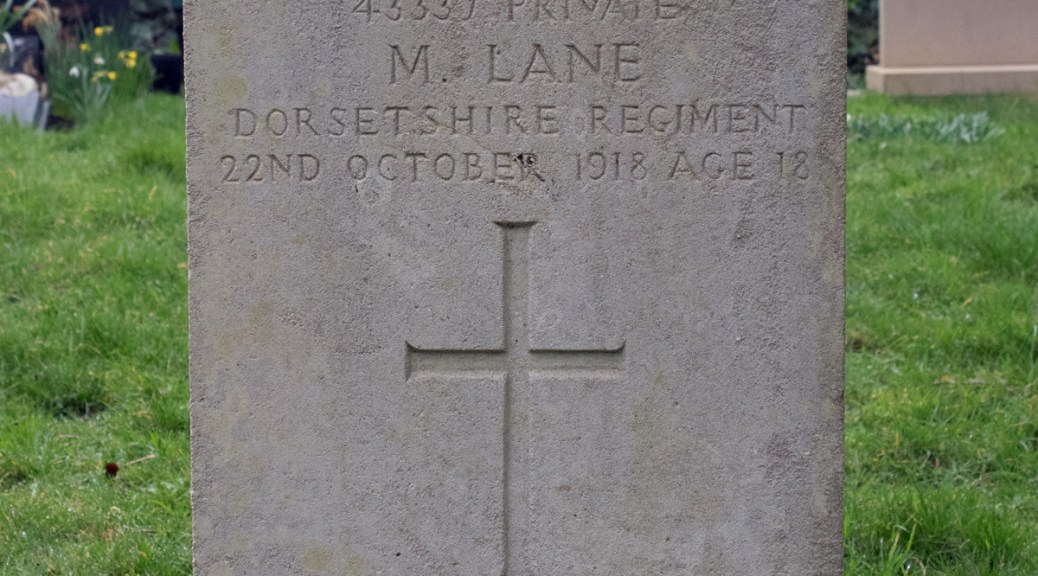
Mark Lane was born in the summer of 1900 in Thornford, Dorset. One of ten children, his parents were estate drainer Albert Lane and his wife, Sarah. Sadly. there is little concrete information about Mark’s life.
When war broke out, his eldest brother, Gilbert, served in the 5th Battalion of the Dorsetshire Regiment, rising to the rank of Serjeant. Having fought at, and survived, Gallipoli. his unit moved to France in July 1916. Involved in the Battle of the Somme, Gilbert was killed and was laid to rest at Bulls Road Cemetery in France.
His oldest brother dead, Mark seems to have wanted to serve his country and do Gilbert’s memory proud. He did not turn 18 until the summer of 1918, and he seems to have used this as an opportunity to enlist. He also enlisted in the Dorsetshire Regiment and, as part of the 4th (Reserve) Battalion was sent off to do his training.
Unfortunately, details of what happened to Private Lane are lost in the mists of time. He was admitted to a military hospital in the autumn of 1918, and died there on 22nd Octover. He was just 18 years of age.
The body of Mark Lane was laid to rest in the graveyard of St Mary Magdalene Church in his home village of Thornford.
Anyone who attended the funeral of Captain George Lee, IMT (late Rifle Brigade), held in the churchyard of his old home, Yetminster, on Wednesday could not but have been impressed by the wonderful sense of peace and rest that pervaded the place. After a life of unique adventure in Africa, India, America, and Canada his worn and suffering body was laid to rest beside his beloved father. The solemn service was taken by his uncle, Red. EHH Lee (vicar of Whitchurch Canonicorum) and his cousin, Rev. E Hertslet (vicar of Ramsgate), and Rev. MJ Morgan (vicar of Yetminster), there being also present his old schoolfellow, Rev. J Lynes, and Rev. Hall, curate of Yetminster. Besides the chief mourners Captain Lee’s mother, sister and brother-in-law, there were many friends present and numerous villagers who had known him from boyhood. The coffin was attended throughout the service and for many hours before by his most faithful servant and friend, Rajab Ali Khan, who was with his master through India, Persia, Beluchistan, and Afghanistan, and came to England as his personal attendant when Captain Lee was sent home on sick leave. After the service in the churchyard Rajab, through the kindness of Mr Hall, who translated for him, was able to tell everybody what his master had been to him.
Dorset County Chronicle: Thursday 9th September 1920
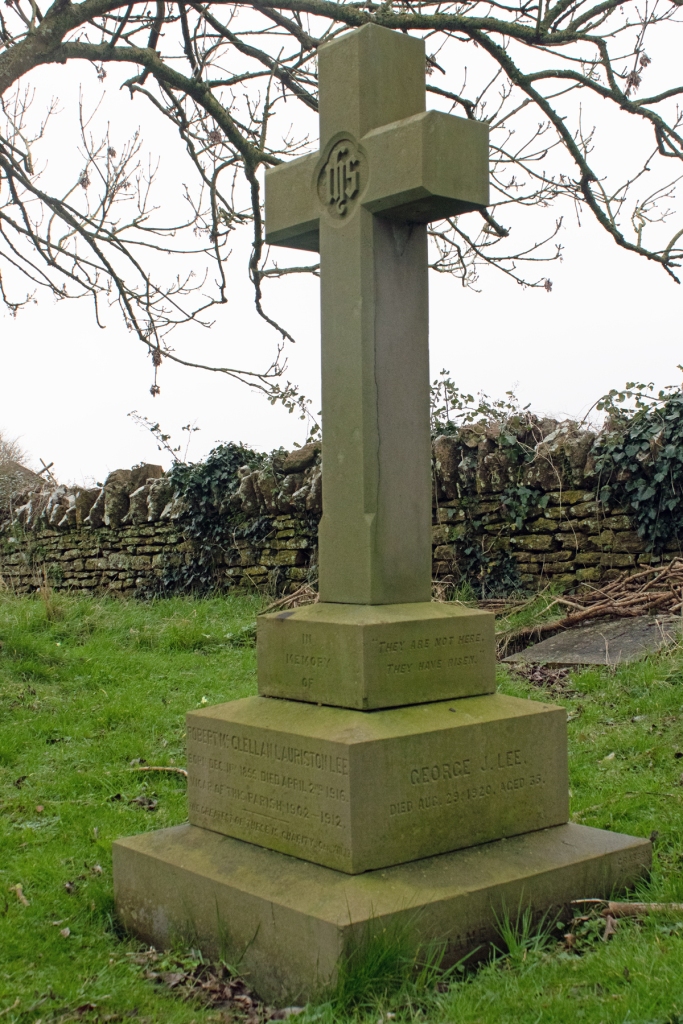
George Johnston Lee was born in the summer of 1886, the second of four children to Reverend Robert Lee and his wife, Elizabeth. Robert was the vicar of St George’s Church in Fordington, Dorset, when George was born, but moved west to Toller Porcoram not long after he was born.
Tantalisingly little information about George’s early life remains. He does not appear on the 1901 or 1911 census records, and it is likely that he was already away travelling the world by this point. It seems clear that he followed a military, rather than a clerical, career and, by the end of the First World War he was serving in the Indian Army Reserve of Officers. Attached to the Rifle Brigade, George had reached the rank of Captain.
George’s father had become ill in the early 1910s, and having moved to St Andrew’s Church in Yetminster, he retired from the post in 1912. He and Elizabeth moved to Dorchester, but when he passed away in 1916, at the age of 59, his last wishes were to be buried in Yetminster, the village having held a special place in his heart.
Captain Lee survived the First World War, but, as the newspaper report suggests, he became unwell. George had contracted amoebic dysentery, and returned to England to recuperate. The condition was to prove too severe, and he passed away in London on 29th August 1920, at the age of 34 years old.
In accordance with the family’s wishes, George Johnston Lee’s body was taken back to Dorset, and he was laid to rest next to his father, in the tranquil St Andrew’s Churchyard, Yetminster.
The early life of James Payne is a challenge to piece together. The first document that can be properly attributed to him is his marriage certificate from 27th May 1901.
This confirms that he was 21 years old, and working as a labourer. His father’s details are noticeable by their absence. The document also gives his wife’s name, Kate Bessie Warr, and information about her father – labourer Sydney Warr. James was also working as a labour at this point, and the two of them were living in Pulham, Dorset.
By the time of the 1911 census, the newlyweds had moved to the village of Yetminster. James was working as domestic gardener, and the couple had two children – Cyril and Louis. James’ place of birth is given just as Somerset, further clouding his past.
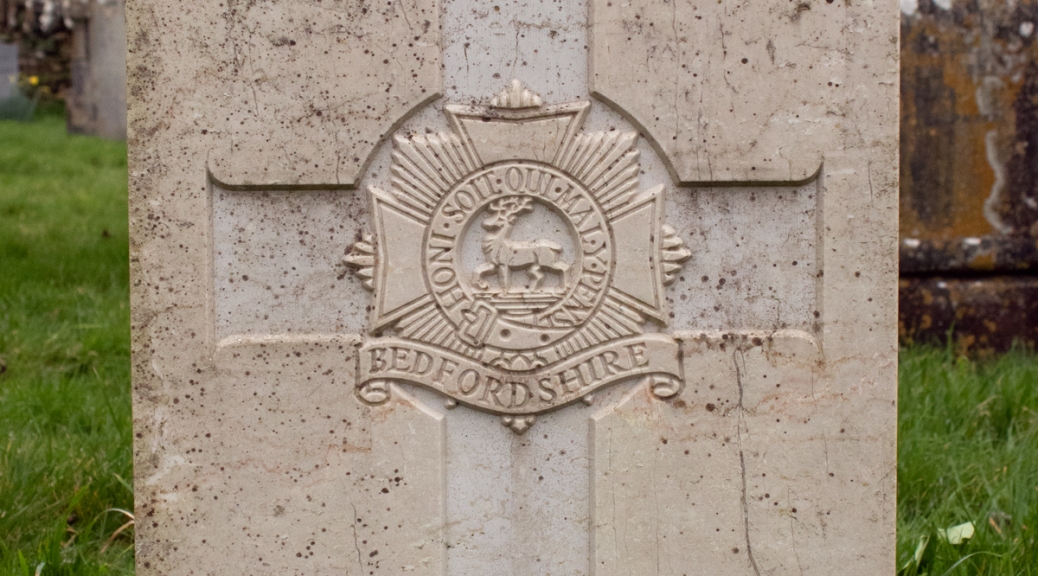
When war came to Europe, James stepped up to play his part. Full details of his time in the army are lost to time, but documents suggest that he had enlisted by October 1917 at the latest. Private Payne joined the Bedfordshire Regiment, and was attached to the 1st Battalion. His unit service on the Western Front throughout the conflict, although there is no evidence that James spent any times overseas himself.
Piecing the sparse number of documents together suggest that in March 1918, James was admitted to the 3rd Western General Hospital in Cardiff, Glamorganshire. He was suffering from nephritis and pneumonia, but it is unclear whether he was serving in Wales at the time, or was taken there for treatment. Either way, his condition was to prove too severe. Private Payne passed away on 20th March 1918: he was 38 years old.
James Payne’s body was taken back to Dorset for burial. He was laid to rest in the peaceful graveyard of St Andrew’s Church in his adopted home of Yetminster.
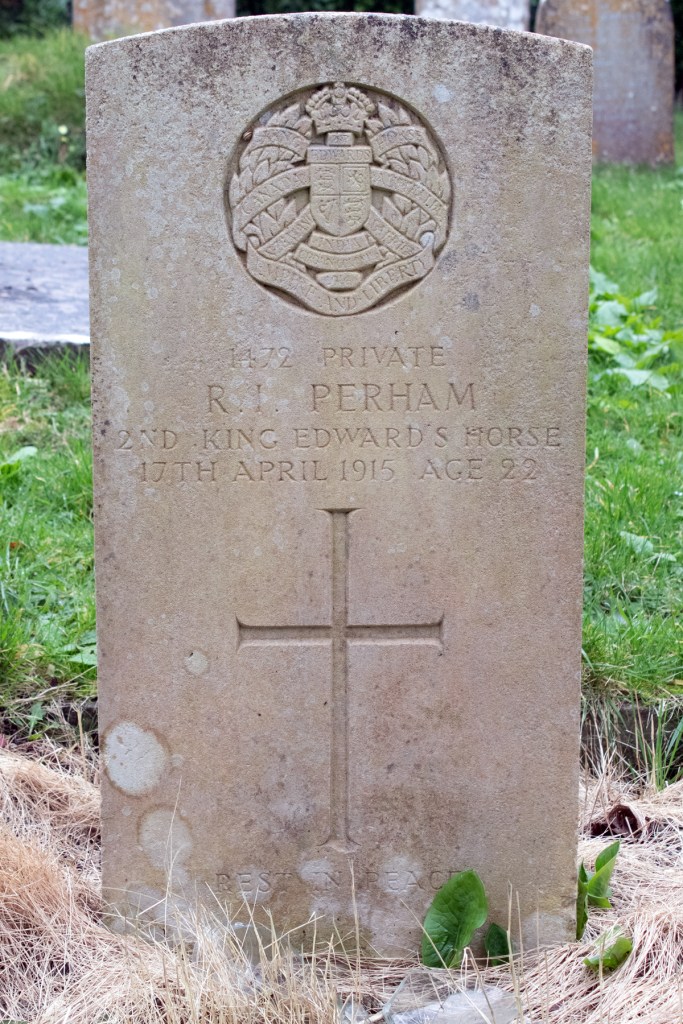
Robert Ivor Perham was born in the Dorset village of Purse Caundle in the autumn of 1892. The oldest of eight children – and thirteen years older than his youngest sibling – his parents were farmers Thomas and Annie Perham.
Thomas took the family where the work was: the 1901 census found them living at Manor Farm in West Chelborough, Dorset. Ten years later, they had moved north in the county, to Ryme Intrinseca. Robert was helping his father on the farm by now, his seven siblings all still being at school.
Robert saw an opportunity for farming to give him an adventure and, on 27th March 1913, he set off for Australia to work as a ranch hand. His time in the Antipodes was to be cut short, however, when, in the summer of 1914, war broke out in Europe. He made the lengthy journey back to Britain to serve his King, and was assigned to the 2nd King Edward’s Horse regiment.
Private Perham’s time in the army seemed not to have been a lengthy one. Full details of his service are lost to time, but it is likely that he arrived back in Blighty in the early weeks of 1915. He quickly fell ill – from ‘spotted fever’, or meningitis – and was admitted to the 2nd Eastern General Hospital in Brighton, Sussex. Sadly, it was a condition to which he would succumb: Robert passed away on 17th April 1915, at the age of 22 years old.
The body of Robert Ivor Perham was taken back to Dorset for burial. He was laid to rest in the peaceful graveyard of St Hippolyte’s Church in Ryme Intrinseca.
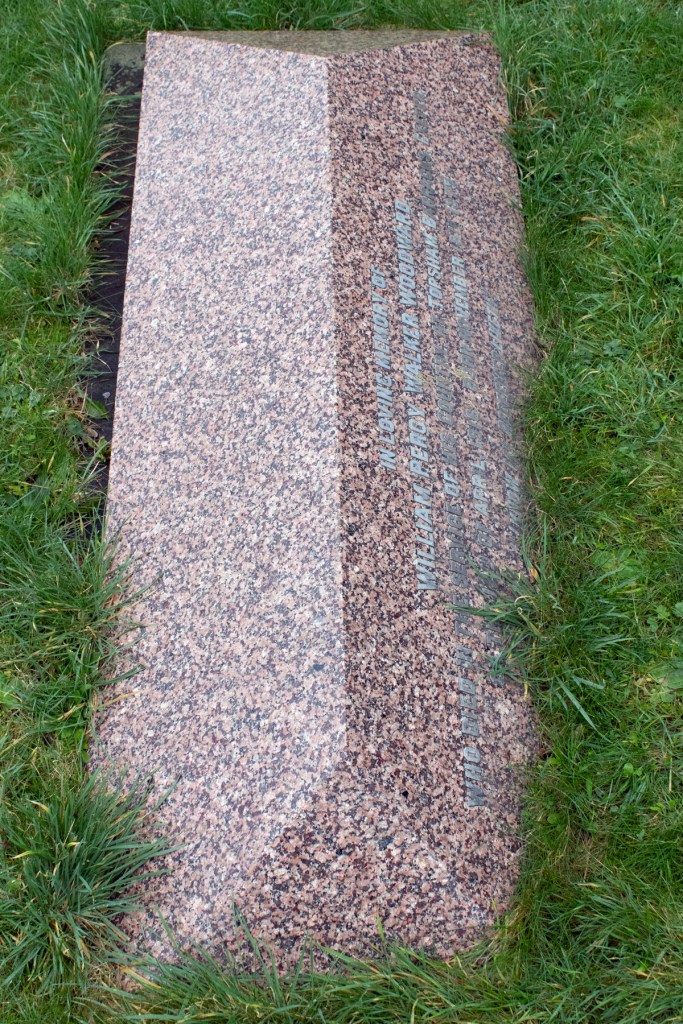
William Percy Walker Woodward was born on 18th November 1879, and was the third of six children to James and Mary Woodward. James was a manufacturer of sanitaryware and had been born in Derbyshire, but it was in Ashby-de-la-Zouch, Leicestershire that he and Mary raised their family.
James passed away in the spring of 1886, leaving Mary to raise the family on her own. His obituary in the local media underlined the business that he had built up: “Mr Woodward succeeded his father and eldest brother to the fire brick business, established by the late Mr John Hunt of Swadlincote, of 1790.In 1856 Mr Woodward added to the above trade that of glazed sewerage pipe and terra cotta earthenware, and in 1873 that of general sanitary appliances, and by industry, perseverance, and foresight developed the same into one of the largest manufactories of the kind in the Midland counties, and became well known throughout the greater part of the kingdom as a leading manufacturer of these goods. He was a large employer of labour, kind and considerate, always manifesting great interest in the welfare of his employees.” [Hinckley News – Saturday 15 May 1886]
Mary was left to raise six children, but, thanks to the business, did not do so without support. The 1891 census found the family living at High Fields in Ashby, with a cook, housemaid, children’s maid and a coachman and his family living next door. William and his siblings were all taught at home by their governess.
By the time of the next census, William seemed to have taken on the running of his late father’s business, along with two of his brothers, James and Harold. Things were to change for the Woodward family, however, as they began to go their separate ways.
The 1911 censes shows a divide: James was living on his own means in Snarestone, Leicestershire, with his young family and household retinue. Harold, meanwhile, had emigrated to Canada with another sibling, younger brother Ernest, where they had both set up as farmers.
Mary had also moved, setting up home in Weston-super-Mare, Somerset. She lived on Clarence Road South with William and her daughter, Lilian. The house – Glencathara – was twelve-roomed property, and they had a live0in cook, Emily Young, supporting them. Notably, William’s employment was listed as ‘none, on account of health’, so the move to the coast may have been brought about for medical reasons.
When war came to Europe in summer of 1914, William stepped up to play his part. His service records have been lost, but he had enlisted in the Royal Field Artillery no earlier than the autumn of 1915. He was attached to the 18th Reserve Battery, and came to be based in Topsham Barracks in Exeter.
Little is known of Gunner Woodward’s time in the army, but it was to be brief. He passed away, through causes unknown, on 13th April 1916, at the age of 36.
It is unclear where Mary was living at this point. The body of William Percy Walker Woodward was taken to Dorset for burial, and he was laid to rest in the peaceful graveyard of St Hippolyte’s Church, in Ryme Intrinseca. Interestingly, the parish records note that William was ‘a personal friend of [the] rector’.
Walter Brett was born in Batheaston, Somerset, on 12th July 1896. The fourth of seven children, he was the second son of George and Louisa Brett. George was a groom and coachman from Norfolk, and his work took the family around the country. Louisa had been born in Staffordshire, their oldest child, daughter Florence, had been born in South Wales. By 1893, the family had settled in Somerset, but the next census, taken in 1901, found them in Branksome, Dorset.
When Walter finished his schooling, he found work as an errand boy for a hairdresser. By now the Bretts had moved back to Somerset, where George – and his widowed father, John – were working as coachmen for a Mr Page. There were seven in the household – George, Louisa, Walter and three of his siblings, and George Sr – and the family were living at 1 Nelson Terrace, on Walcot Street, Bath, in a six-roomed cottage.
Walter sought bigger and better things for himself. His older brother, Frederick, had left home, and was working as a grocer’s assistant in Brislington – now a suburb of Bristol – and he too wanted a career. On 23rd January 1912, he enlisted in the Royal Navy. As he was only 15 year of age, he was given the rank of Boy 2nd Class, and was sent to HMS Impregnable, a training ship based in Devonport, Devon, for his induction.
Obviously showing signs of ability and commitment to the role, Walter was promoted to Boy 1st Class just seven months later. His first assignment was on board the battleship HMS Cornwallis, and he spent the remainder of 1912 serving with her.
After a brief period back in Devonport – this time at HMS Vivid – and six weeks aboard HMS Lancaster, Boy 1st Class Brett was assigned to the ship that would become his home for the next three years. HMS Lion was a battlecruiser, and she was to serve as the flagship of her class of ships during the First World War.
Walter came of age while serving on Lion, and was given the rank of Ordinary Seaman on his eighteenth birthday. His service records show that he was 5ft 6ins (1.68m) tall, with brown hair, blue eyes and a fresh complexion. He was also noted as having a mole on his stomach.
Walter was promoted to Able Seaman in the summer of 1915, and remained on board HMS Lion until the end of April the following year. His ship had been involved in a number of skirmishes by this point, including the Battle of Heligoland Bight, the defence of the raid on Scarborough and the Battle of Dogger Bank. In June 1916, she would be caught up in the Battle of Jutland, but Able Seaman Brett was back on terra firma by this point, and was billeted in Devonport.
On 1st August 1916, Walter was given a new posting, when he was assigned to the dreadnought battleship HMS Ajax. Acting as support to the Norwegian convoys in the North Sea, he was to remain on board until the closing weeks of the war.
Walter’s brother Frederick, meanwhile, was also caught up in the conflict. He had enlisted in the Gloucestershire Regiment, and was assigned to the 12th Battalion. By the spring of 1917, his unit was based in Arras, and was Private Brett was heavily involved. Following an attack on 8th May, he was declared missing, presumed dead. He was 24 years of age, and is commemorated on the Arras memorial.
Back at sea, in October 1918, Able Seaman Walter Brett became unwell, contracting a combination of influenza and pneumonia. He was transferred to the Hospital Ship Garth Castle, but the conditions were to get the better of him. He passed away on 27th October, at the age of 22 years old.
Walter Brett was brought back to Somerset for burial. His parents had lost both of their sons, but were able to lay their youngest to rest in Locksbrook Cemetery, Bath.
William Charles Biddlecombe was born in the spring of 1896, and was the third of nine children to Robert and Eliza. Both of his parents came from Hampshire, but their older children – William included – were born and raised in Poole, Dorset. Robert was a police constable there, but moved to the village of Longburton, near Sherborne, in around 1910.
According to the 1911 census, William was two of the household of eight to be employed, having found work as a gardener when he finished his schooling. Storm clouds were brewing across Europe, however, and he would be called upon to play his part.
Full service details have been lost to time, but it is clear that William had joined the Dorset Yeomanry (Queen’s Own) by the summer of 1915. He was attached to the 3rd/1st Battalion. The unit was based on home soil and there is no evidence that Private Biddlecombe saw any action overseas.
At this point, William’s trail goes cold and, in fact, the next record for him is that of his passing: “The funeral took place on Wednesday amid every token of respect and esteem of Trooper W Biddlecombe, of B Squadron (3/1st Dorset QO Yeomanry, son of PC and Mrs Biddlecombe of Westhill Police-station.” [Western Gazette – Friday 18 February 1916]
William Charles Biddlecombe died on 15th February 1916: he was 20 years of age. He was laid to rest in the peaceful graveyard of St James the Great Church in Longburton, close to where his grieving family lived.
William’s was not the only passing that his grieving mother would have to attend to. On 18th December, Robert was on duty, which had taken him into Sherborne. He was suddenly taken ill, and rushed to the town’s Yeatman Hospital, but died the same day. He was laid to rest close to his son in Longburton.
William’s younger brother, Robert, also served during the First World War. As a Private, he was attached to the 8th Battalion of the Somerset Light Infantry, and spent time fighting in Northern France. He was caught up and was killed in the Second Battle of Cambrai. He died on 9th October 1918, and was laid to rest in Naves Communal Cemetery Extension.
The pain for Eliza at having lost her husband and two of her sons in such a short space of time is unimaginable. However, she still had children to support, and so had to keep on going. The 1921 census recorded her as living in Weymouth with her youngest boy, Bertram. She was carrying out home duties, and it is unclear how she was making ends meet. She would remain in Weymouth for the rest of her life, passing away in the autumn of 1937, aged 71.










 Death and Service