William Gladstone Jennings was born in Kent, in the summer of 1898, the only child of James and Emma Jennings. James was a marine engineer in the Naval Dockyard in Chatham, and it was here that the family lived.
Sadly, due to his age, and the lack of military service documentation, there is little written about William’s life. He was still at school by the time of the 1911 census, and the next records available confirm that he enlisted in the army. The date for this is not available, but it would have been by May 1917 at the latest and he seems to have enlisted with the surname Hickson, which was possibly his mother’s maiden name.
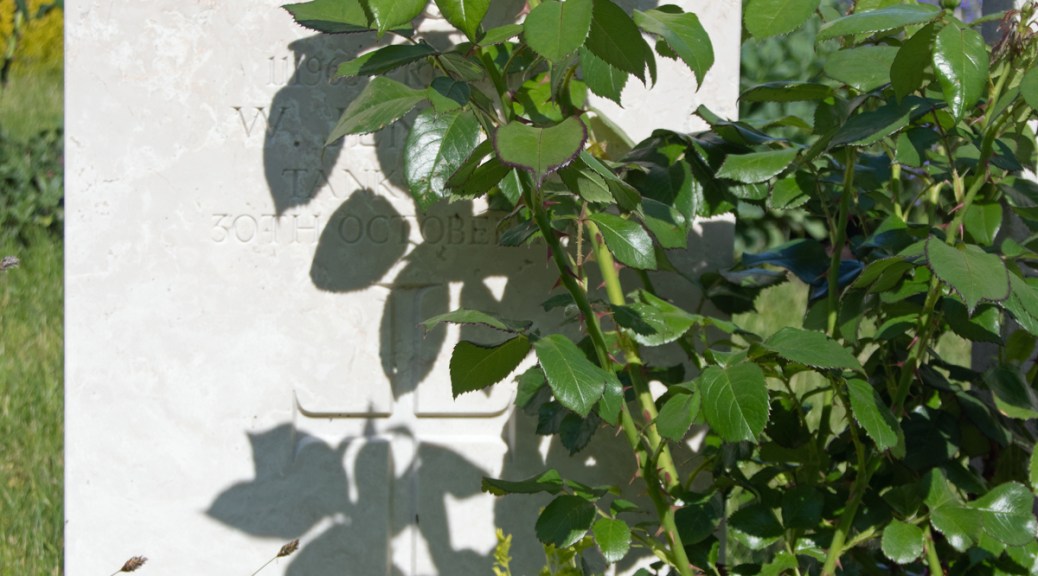
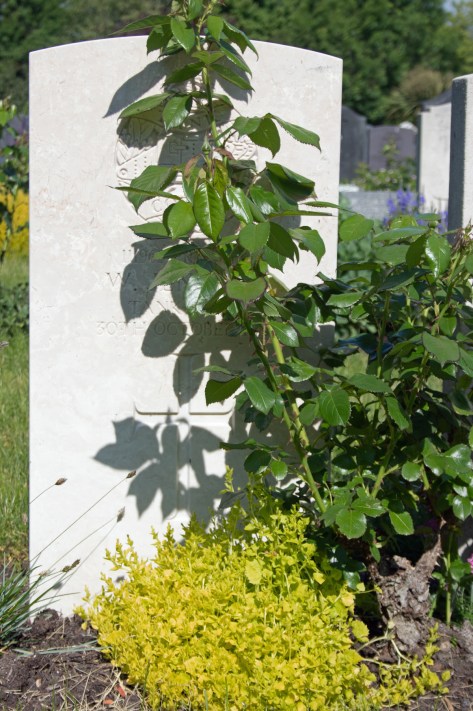
Private Jennings transferred to the Tank Corps when it was formed in July 1917. What his specific role was is lost to time, but it appears that his time in the regiment was short. The next available document is the Army Register of Soldiers’ Effects; this confirms that William passed away on 30th October 1917, in the Military Hospital in Woolwich.
There is no confirmation of the cause of his death, but Private Jennings was just 19 years old.
William Gladstone Jennings was brought back to his home town for burial, and he lies at rest in the Woodlands Cemetery in Gillingham.
Charles William Debney was born in the spring of 1887, one of eight children to George Debney and his wife Susannah. George was a cooper for a cement works, who had brought his family from Norfolk to Kent in the mid-1890s, presumably for employment.
When Charles left school, he found work as a bricklayer; war was on the horizon, though, and when the call came, he signed up quickly.
While full details of Charles’ service are not available, it is evident that he had joined the Northamptonshire Regiment by November 1914. He was assigned to the 5th Service Battalion as a Private. Formed in Northampton, the battalion moved to Kent in the early months of the war, before moving to the Western Front at the end of May 1915.
Sadly, there is limited additional information available on Private Debney. He passed away on 29th May 1915, but there is no confirmation of the cause of his death. He was just 28 years of age.
Charles William Debney was laid to rest in the Woodlands Cemetery, in his home town of Gillingham, Kent.
Thomas Francis Myers is destined to be one of those people whose story is destined to be lost to the annals of time. The only definite documents available for him are his pension records, which give his wife’s name as Ellen.
Sadly, with no date of birth for Thomas, no location other than his place of burial, and the potential for any number of alternative spellings for his surname, it’s impossible to track down any further details on his life.
His records show that he was a Serjeant in the Royal Engineers, and that he was discharged on medical grounds on 12th October 1918. Sadly, he succumbed to the conditions just a few days later, passing away from phthysis (tuberculosis) and exhaustion on 23rd October.
Thomas lies at rest in in the Woodlands Cemetery in Gillingham, Kent.
William Francis Morgan was born on 22nd January 1884 in Bengal, India. The youngest of three children, he was the son of James Morgan and his wife Mary. Both came from Ireland, marrying in 1876. They moved to London, before James was posted to India as part of his role in the Royal Horse Artillery.
Sadly James died when William was just a toddler; this prompted Mary to move the family back to England. She married again in 1887, to Edward Curling, who was a carpenter in the Royal Artillery, and the family settled on the Isle of Grain in Kent, living in the fort where Edward worked.
Surrounded by those in military service and with an army heritage himself, is it no surprise that William felt drawn to the life. In September 1898 he enlisted in the Royal Garrison Artillery. Though not yet fifteen years old, he stood 5ft 11ins (1.69m) tall and weighed in at 101lbs (46kg). He had a fresh complexion, grey eyes and light brown hair and four distinctive marks were noted – three scars on his head and one on his right knee.
Trumpeter Morgan certainly got to see a lot of the world during his time in the army. After a period on home soil, he was sent to Egypt on Christmas Eve 1901, staying there for just over a year. He moved on to India, returning to England five years later, by which time he had achieved the rank of Gunner.
War was imminent, and in September 1914 he was sent to France as part of the British Expeditionary Force. Barring a short period at home, Gunner Morgan remained on the Western Front for the remainder of the war, finally returning to the UK in January 1919.
William’s time in the army was one of two halves. He had several bouts of illness during his service, coming down with phimosis in 1901, scarlet fever and gonorrhoea in 1902, a fractured clavicle in 1903, pneumonia in 1904, rheumatism in 1906, ague in 1908, pleurisy in 1909, and had to return from France to England for an operation to remove a carbuncle between his shoulder blades in the summer of 1915.
Gunner Morgan was also pulled up for his conduct a few times too. He was punished for neglect of duty in August 1908, disobeyed orders in May 1909, was pulled up for being improperly dressed while in Portsmouth’s Highbury Arms Pub in November 1909 and went AWOL for ten hours on 31st July 1913.
There were positives to William’s service too, however. He was awarded the British and Victory Medals as well as the 1914 Star during the First World War. He was mentioned in dispatches and received the Military Medal in 1917 an the Long Service and Good Conduct Medal two years later.
Sadly, though, after Gunner Morgan’s positive and lengthy military service, his time out of the army was to be brief. Returning to England on 13th January 1919, he contracted influenza and pneumonia and succumbed to the lung conditions within weeks. He passed away on 27th February 1919, at the age of just 35 years of age.
William Francis Morgan was laid to rest in the Woodlands Cemetery, Gillingham, Kent, just minutes’ walk from where his mother now lived.
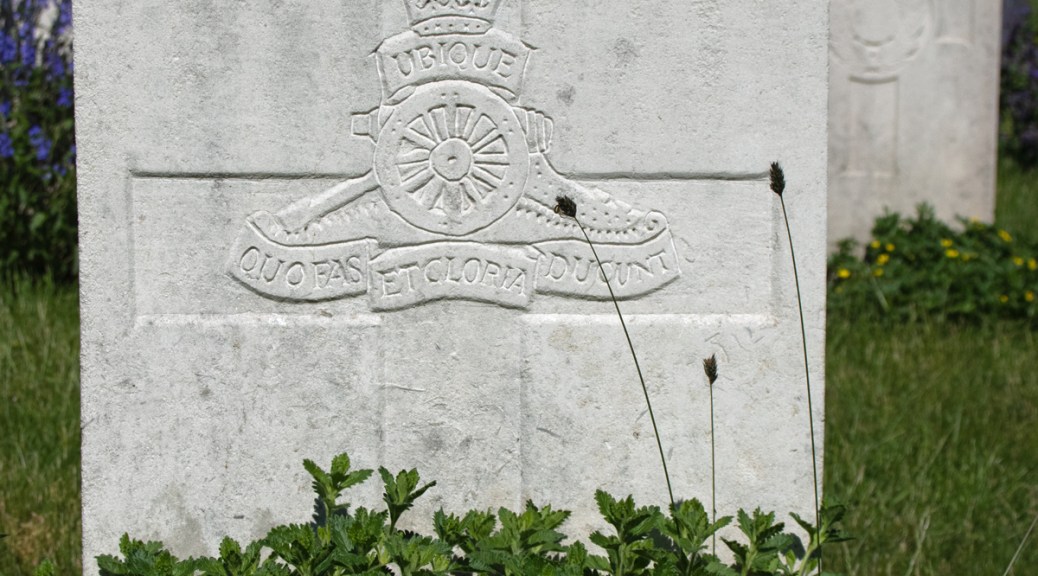
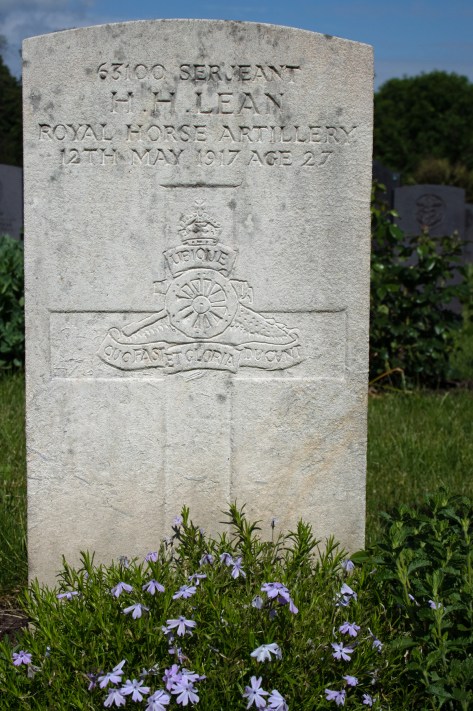
Harold Henry Lean was born in Gillingham, Kent, in the summer of 1890. The youngest of eight children, his parents were tailor Robert Lean and his wife Sarah. His siblings followed a variety of trades – coachman, painter, shoemaker – but Harold was keen to follow a more long-term career.
When he left school (and after his father’s death in 1901), he enlisted in the army, becoming a Gunner in the Royal Horse Artillery. Little remains of his service documents, but at the time of the 1911 census, he was firmly ensconced in the Artillery Barracks in Leeds.
The next record for Harold comes, sadly, in the form of a news report, detailing the inquest surrounding his death:
SUICIDE OF A SERGEANT AT TOPSHAM BARRACKS
Mr Hamilton Brown, Deputy Coroner for Exeter, held an inquest at Topsham Barracks last evening touching the death of Acting-Sergt. Harold Henry Lean, 26, of the [Royal Field Artillery], who died on Saturday as a result of a self-inflicted wound in the throat.
The evidence given by Bombardier JE Driscoll, of the [Royal Military Police], Trumpeter Sydney Russell, deceased’s batman, Bombardier Biddlescombe and Corporal J Williams signalling instructor was that Sergeant Lean, who had some time ago been ill, on Saturday morning was in his room with Russell, but did not speak all the morning.
Shortly after eleven o’clock he took his razor from a shelf in the corner of the room where he kept his shaving materials. Going to his bed he lay across it with his knees nearly touching the floor and drew the razor across his throat. Russell ran to him and caught him by the shoulders, but deceased pushed him away. Russell then called the assistance of Driscoll and Biddlescombe from an adjoining room.
Williams, who was a personal friend and worked with deceased as a signaller, said that deceased worried about the illness from which he had suffered, and two days previously said he thought he was going insane. He had never threatened to take his life.
Captain RW Statham, [Royal Army Medical Corps], said deceased joined that unit in October 1916, and a month later he reported sick. He was sent away to a military hospital, but was returned this year cured and reported for full duty. The illness had a tendency to create mental depression.
On Saturday morning had entered his name on the sick list, but did not attend the sick parade at 9am. At 11:10 when witness was called to him he found him dead. Witness described the wound, which was a very severe one.
The jury returned a verdict of “Suicide during temporary insanity”.
Wester Times: Tuesday 15th May 1917
Serjeant Harold Henry Lean’s body was brought back to Kent from Devon. He was laid to rest in the Woodlands Cemetery in Gillingham.
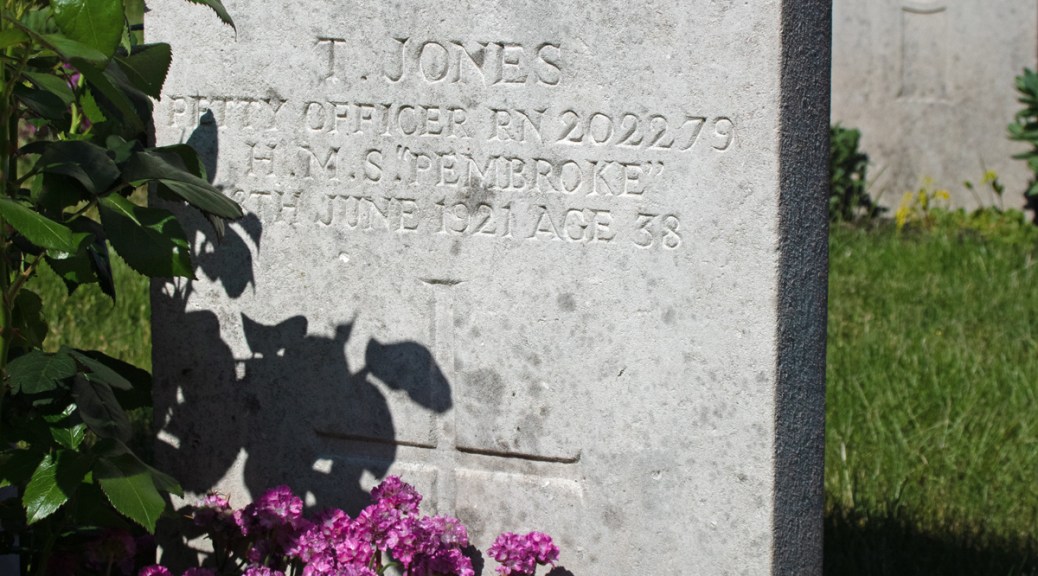
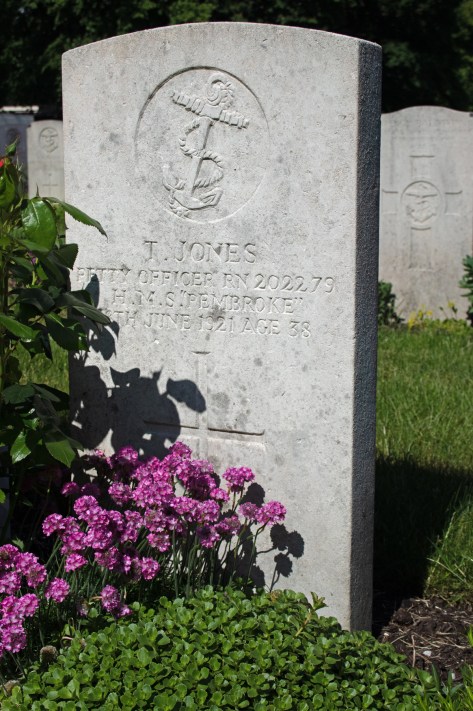
Thomas Jones (known as Tom) was born in Wednesbury on 7th September 1882 and was the middle of seven children. His father, also called Thomas, was a grocer and, with his mother Mary, they raised their family first in the Staffordshire town and then in Blackpool, Lancashire.
When he left school Tom helped his dad in the shop, primarily dealing with meat. His mind was on greater adventures, however, and in November 1898, he enlisted in the Royal Navy. Due to his age, he was initially given the rank of Boy, but was officially signed up as an Ordinary Seaman on the day after his 18th birthday.
Over the time of his initial twelve years’ service, Tom rose through the ranks, from Able Seaman to Leading Seaman and Petty Officer. In May 1912, however, he was ‘disrated’ back to Able Seaman, but there is no evidence to confirm why this was done. By this time, he had served on nine ships, as well as having time in shore-based establishments, and had completed his twelve years as a mariner.
Meanwhile, in the autumn of 1904, Tom had married Hannah Kennedy, a dockyard labourer’s daughter from Gillingham, Kent. The couple went on to have four children and set up home in the centre of the town, not far from the Naval Dockyard where Tom was sometimes based.
With war in Europe on the horizon, Tom immediately volunteered to continue his duty when he term of service came to an end. Working hard, he soon regained the rank of Leading Seaman and, by April 1915, was back up to Petty Officer once more.
During the remainder of his time in the Royal Navy, Petty Officer Jones served on a further seven vessels. In October 1920, after more than two decades’ service, he was invalided out, having contracted tuberculosis, rendering him unfit to continue.
At this point Tom’s trail goes cold. It seems likely that his lung condition got the better of him; he passed away on 20th June 1921, at the age of 38 years old.
Petty Officer Tom Jones was laid to rest in the Woodlands Cemetery in Gillingham, Kent.
Petty Officer Tom Jones (courtesy of ancestry.co.uk)
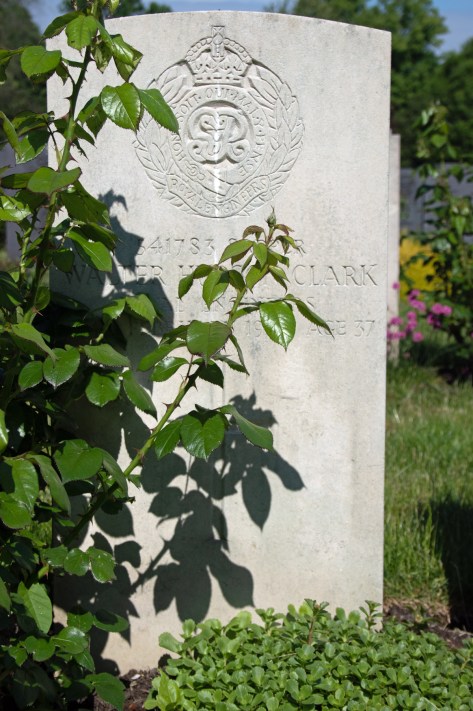
Walter Hudson Clark was born in 1883, the youngest of eight children to Thomas and Isabella Clark from Gillingham, Kent. Thomas was a miller who, with his wife, who was affectionately known as Sibella, raised their family in the centre of town.
When he left school, Walter found work as an apprentice to a painter and decorator. After Sibella died in 1903, he and two of his sisters remained living at home and, by the time of the 1911 census, he was supporting his father by working as a cooper in the nearby Naval Dockyard in Chatham.
Thomas passed away in December 1915, and this may have been the spur to guide his son into enlisting. Little documentation about Walter’s military service remains available although he joined the 480th Field Company of the Royal Engineers as a Sapper. He was in receipt of the Victory and British Medals, but there is nothing to confirm that he served abroad, so it seems likely that he was part of the territorial force.
Sadly this is where Sapper Clark’s trail goes cold. He survived the war, but died on 20th February 1920, at the age of 37 years old. There is no cause of death available either, but Walter was laid to rest in the Woodlands Cemetery in his home town of Gillingham, Kent.
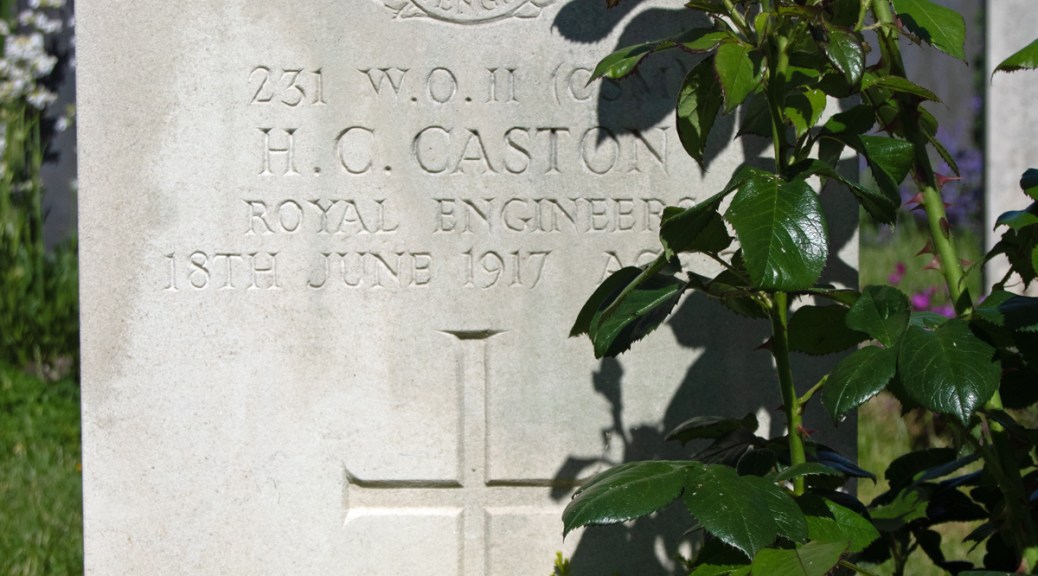
Hugh Charles Caston was born in Chelsea in the summer of 1881, the oldest of three children to Emily and Hugh Caston. Hugh Sr died in the late 1880, leaving Emily to raise the family on her own. She moved the family to Gillingham, Kent, to be near her family. She found work as a seamstress and took in boarders.
As the effective head of the family, Hugh obviously felt he had to earn a wage. On 1st August 1896, he enlisted in the Royal Engineers as a Bugler.
Hugh’s medical report shows he stood at 5ft 4.5ins (1.63m) tall and weighed 97lbs (44kg). He had a medium complexion, with brown eyes and brown hair. The report also gave his distinctive marks as being a scar on his forehead, a brown patch on his left buttock and that his eyebrows meet.
Initially too young for full active service, Hugh formally joined up on 1st June 1897. He spent more than five years on home soil, rising through the ranks from Sapper to Lance Corporal to 2nd Corporal. In May 1902, he was posted to Malta, returning home nearly two years later. Hugh’s promotions continued over the next decade, and, by the time war broke out, he had reached the rank of Company Sergeant Major.
By this point, Hugh had married, wedding Rochester woman Mary May Coast in September 1907. The couple went on to have two children, Hubert, who sadly died young, and Joan.
War came to Europe, and things took a turn for Company Sergeant Major Caston. He was admitted to Netley Hospital near Portsmouth, with mania:
Patient’s very restless, often gets ‘excited’ is thwarted in any way. Has a delusion that he is to be promoted to Major and that he possesses great wealth. He continually asks that his motor may be sent round to take him out, also that his tailor be sent for to rig him out. Stated this morning that he wished all the other patients be supplied with Egyptian cigarettes.
Medical Report on Hugh Caston, 20th January 1915
The medical officer went on to state that he did not consider that military service had in any contributed to the mania; he was dismissed from the army on medical grounds on 2nd February 1915, after nearly 20 years’ service.
Sadly, at this point Hugh’s trail goes cold. There is no documentation relating to his time after being discharged from the army and, tragically, after his death Mary was not granted a war pension, as he had served for less that six months during the First World War.
Hugh Charles Caston died on 18th June 1917, at the age of 36 years old. While the cause of his passing is lost to time, he was laid to rest in the Woodlands Cemetery in Gillingham, Kent.
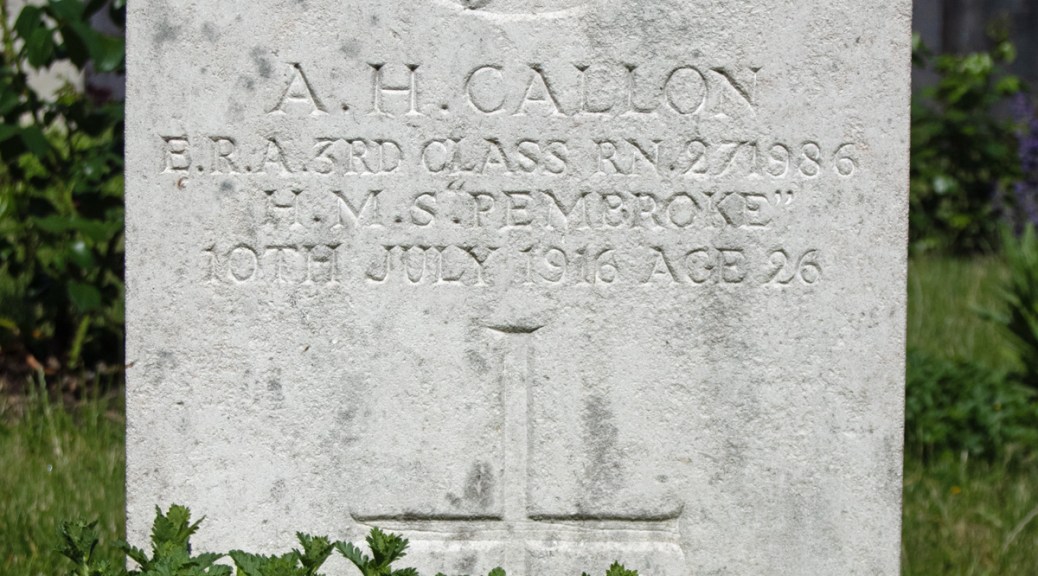
Archibald Hubert Callon – also known as Archie – was born on 2nd January 1890 in Pembroke Dock, South Wales. One of eight children, his parents were shipwright Michael Callon and his wife, Mary. Soon after Archie was born, Michael moved the family to Gillingham, Kent, presumably as work at the nearby Naval Dockyard was plentiful.
The sea was clearly in his blood as, in 1905, Archie joined the Royal Navy, initially as a Boy Artificer, before taking on full employment there once he reached the age of 18. The 1911 census found him working as an Engine Room Artificer 4th Class, one of a crew of 57 aboard the torpedo destroyer HMS Swale, moored in Grimsby.
Archie slowly rose through the ranks and, by 1913, had become Engine Room Artificer 3rd Class, while serving on HMS Clio. He remained on this vessel through to April 1916, before returning to HMS Pembroke, the shore-based naval establishment in Chatham, Kent.
Sadly, Archie’s time back home was short. The next record for him is stark; it is noted that on 10th July 1916, he committed suicide, during temporary insanity. I have been unable to uncover anything further about his passing. He was just 26 years old.
Archibald Hubert Callon was laid to rest in the Woodlands Cemetery in Gillingham, Kent, not far from where his family lived.
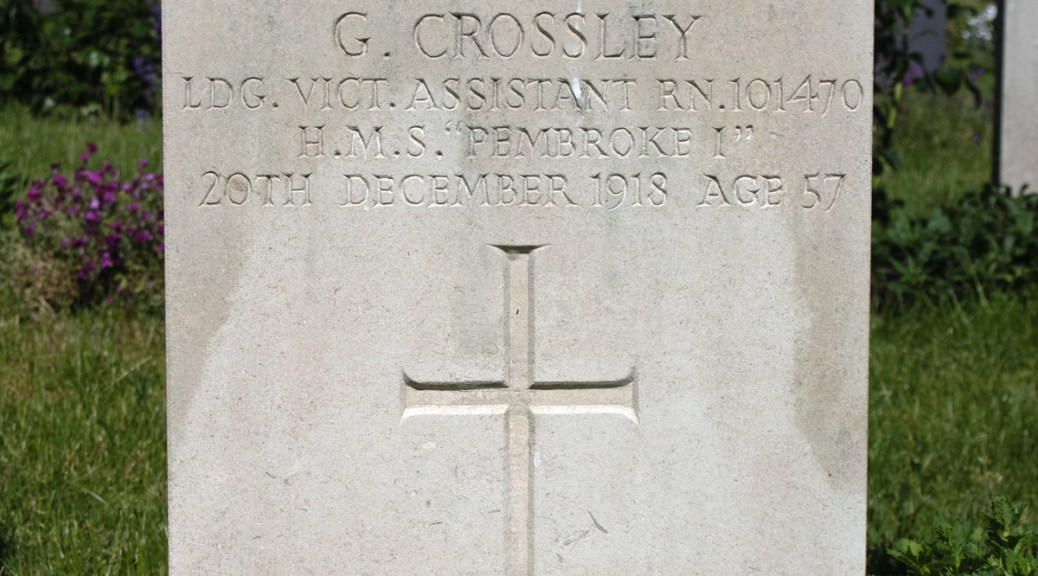
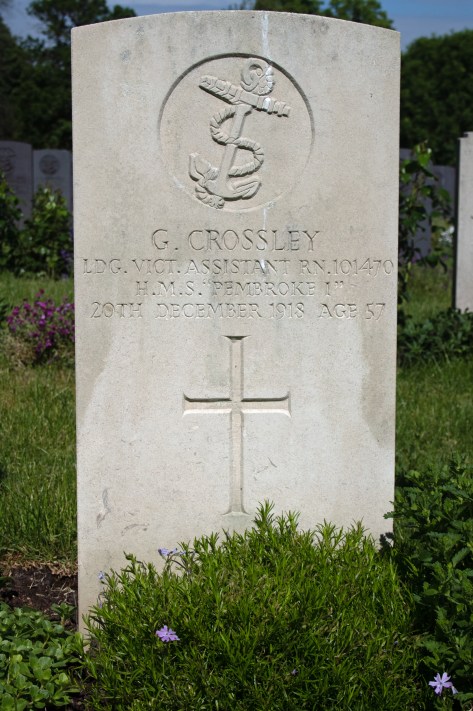
George Crossley was born on 30th December 1861 in the Stonehouse area of Plymouth, Devon. The oldest of five children, his parents were John and Charlotte. John died when George was only ten years old, leaving his widow to raise the family alone.
Left as the technical head of the family, George sought a reliable career and, in August 1877, aged just 15 years old he joined the merchant navy. After two years at the rank of Boy, he formally joined the crew, working as a Ship’s Steward’s Assistant.
Over the initial ten years of his service, George served on four ships, primarily the Royal Adelaide. In 1889, having seen the world, he signed up for a further decade. This new period of service saw him move up to Ship’s Steward, before working back in the assistant role.
In December 1899, George’s twenty years’ service came to an end. Charlotte, by this time, was in her mid-60s, and perhaps he felt it better to spend time ashore with her, rather than leaving her alone.
His experience did not count for nothing, however, and he found employment as a labourer in the Naval Dockyard in Chatham, Kent. And so another fourteen years passed, before war rose its ugly head.
George was called back into service at the start of the conflict, and resumed his role as a Ship’s Steward’s Assistant. Over the next few years, he served on a couple of ships, but the majority of his time was spent at the shore establishments in Portsmouth, Dover and Chatham. In 1917, George gained the rank of Leading Victualling Assistant, giving him some of the responsibility for the food stores at Chatham Dockyard.
Towards the end of 1918, George seems to have been in the east of the county, when he fractured and dislocated his left ankle. Little specific information is available, but it seems that he was admitted to the Royal Infirmary in Deal, but died of his wounds on 20th December. He was ten days short of his 57th birthday. An inquest later that month reached a verdict of accidental death.
Brought back to Gillingham, George Crossley was laid to rest in the Woodlands Cemetery in the town.









 Death and Service