Category Archives: Kent

Fireman Nier Kaloo

Fireman Nier Kaloo

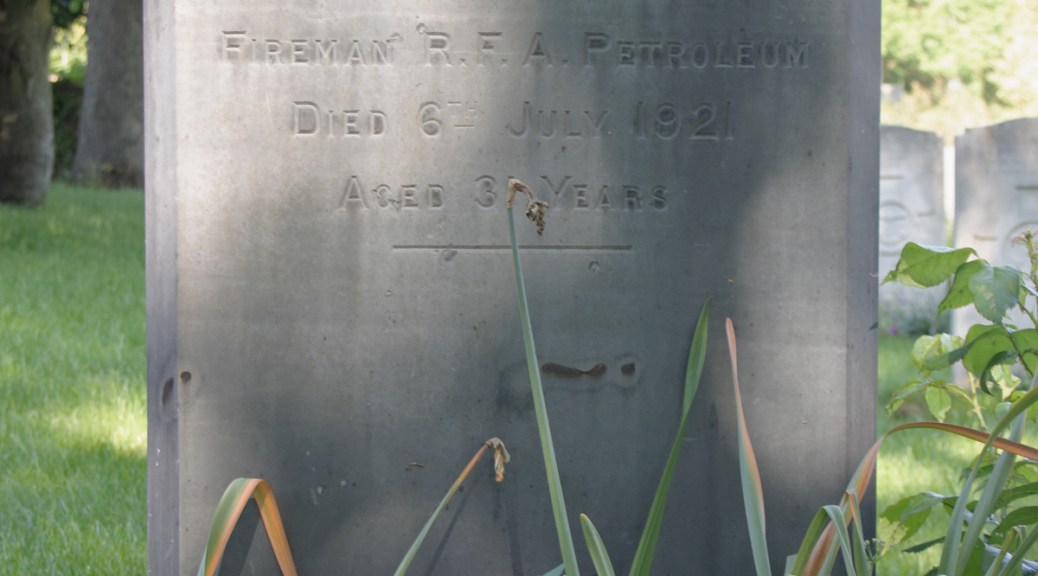
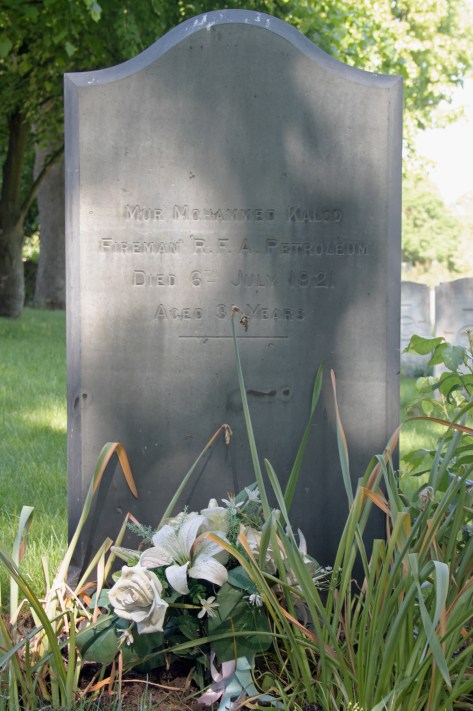
Sadly, there is extremely limited information on the man commemorated no this gravestone.

Nier Mohammed Kaloo (or, alternatively, Mur Muhammed Kaloo), was born in around 1890. He joined the Royal Navy and, by the end of the war at the latest, he had been transferred to the Royal Auxiliary Fleet as a Fireman.

His ship, the SS Petroleum, acted as a tanker for other naval vessels. In the immediate aftermath of the war, she travelled between Portsmouth and Copenhagen, but soon took on longer trips, to Hong Kong and the Far East.

It was after returning from Singapore in the first half of 1921 that Fireman Kaloo died, although the cause of his passing is lost to time. He was 31 years old. The ship having moored at the Naval Dockyard in Chatham, Kent, he was laid to rest in the Woodlands Cemetery in nearby Gillingham.


Private Holdsworth Elphick

Private Holdsworth Elphick

Holdsworth Elphick was born on 7th June 1891, one of five children to Herbert and Mary Elphick. Herbert was a billiard marker and professional player, who had been born in Brighton. Mary was from Ireland, but the couple raised their family in London, presumably as this is where the best opportunities for work were.

When he left school, Holdsworth found work at the George Hotel in Balham, South London, where he was employed as a barman. The 1911 census shows another barman there called Geoffrey Elphick, who, while not one of Holdsworth’s brothers, may well have been a cousin.

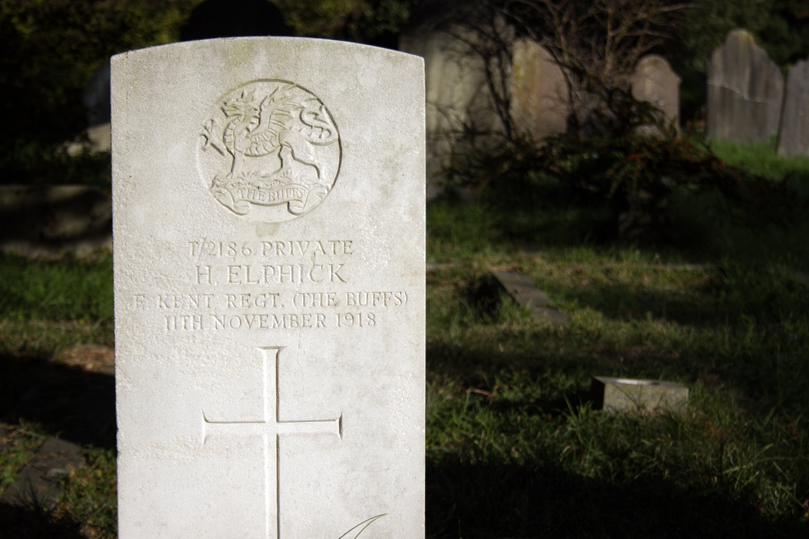
When war broke out, Holdsworth was quick to sign up. He enlisted as a Private in the Buffs (the East Kent Regiment) on 9th September 1914 and, after a year on the Home Front, he was sent out to France as part of the British Expeditionary Force in August 1915.

There is little further information available about Private Elphick’s time in the army. He returned to England on 25th February 1916; this appears to have been a medical evacuation as, two months later, he was discharged from the army as he was no longer physically fit to continue.

Life continued for Holdsworth. In September 1917, he married Lydia Ann Armstrong, a dock labourer’s daughter from Southampton, although this is where his trail seems to end.

The next available evidence for Private Elphick is his gravestone. This confirms that he passed away on 11th November 1918 – Armistice Day – but no further information is available. He was just 27 years of age.

Holdsworth Elphick lies at rest in the Broadwater Cemetery in Worthing, West Sussex (presumably this is where he and Lydia moved after their marriage, although there is nothing to confirm this).


Serjeant George Carpenter

Serjeant George Carpenter

George Palmer Carpenter was born in Worthing, West Sussex, in 1881, one of fourteen children to James and Elizabeth Carpenter. James ran the Steyne Hotel on the seafront, and sent his boys off to the Lucton Boarding School in Henfield for their education.

A regimented life seems to have suited George. When he left school, he enlisted in army, joining the Royal Engineers as a Sapper. The 1901 census found him billeted at the Elphinstone Barracks in Portsmouth.

Sadly, there is little further documentation on the life of Sapper Carpenter. He served through to and during the Great War, attaining the rank of Serjeant. He was sent to France in May 1915, though there is little to confirm his role there, or how long he stayed.

Serjeant Carpenter was subsequently attached to G Depot Company of the Royal Engineers, which received men returned from Expeditionary Force and also men enlisted for Tunnelling Companies, Special Companies and other specialist units. By this time – presumably later on in the conflict – he was based back in England, at the regiment’s barracks in Chatham, Kent.

When the war came to a close, George continued with his army career. With conflict in Europe coming end, he was shipped to Singapore in 1917, where he served through to 1920. A Sussex newspaper picked up his story from there:

Much sympathy will be extended to Mrs Carpenter and her family, of the Steyne Hotel, consequent upon the death of Sergeant George Carpenter, of the Royal Engineers, another of our Worthing boys whose life has been laid down in his country’s service. He arrived home in a bad state of health on the 25th of February last from Singapore, where he had been on duty for three years. Suffering from gastric influenza, it was found necessary that he should undergo an operation, which was carried out at midnight on Saturday. But he sank from weakness, and died at half-past eight on Sunday morning. This is the second son of whom Mrs Carpenter has been bereaved within a year, and there is pathos in the words addressed to us by her: “I have again the sorrowful task of sending the news of the death of one of my sons this morning.

Worthing Gazette: Wednesday 24th March 1920

George Palmer Carpenter was 39 years old. He was laid to rest in the Broadwater Cemetery of his home town, Worthing, in West Sussex.


The other brother referred to in the report was George’s younger brother Norman.

He had emigrated to Canada in 1906, but returned to Europe as part of the Canadian Expeditionary Force when war broke out. Wounded in battle in May 1917, he returned to the UK for treatment and recuperation, and remained on home soil for the rest of the war.

In the spring of 1919, he was admitted to hospital with pleurisy and anaemia, and seems that he never fully recovered, succumbing to the conditions in August of that year. He was just 32 years old.


Private Albert Farrell

Private Albert Farrell

Albert Sydney Farrell was born in Mayfield, East Sussex, in the summer of 1899. One of four children his parents were gardener and coachman Arthur Farrell and his wife, Sarah Ann. Arthur had been born in Findon, a village to the north of Worthing, and is was to this town that he returned with his family. By the time of the 1911 census, when Albert was listed as a schoolboy, they were living in a small cottage within spitting distance of the sea.

Because of his youth, there is little further documentation on Albert’s early life. The war was coming, however, and he wanted to do his part. Dates cannot be confirmed, but he enlisted later in the conflict, at east before June 1918.

Private Farrell joined the Suffolk Regiment, and was assigned to the 1st (Reserve) Garrison Battalion. He would have carried out guard, escort and other similar duties from where he was based on the Isle of Grain in Kent.

Towards the end of the conflict, Albert fell ill; he was admitted to the Military Hospital in Sheerness, but sadly passed away on 3rd December 1918. He was just 19 years of age.

Albert Sydney Farrell was brought back to Worthing; he lies buried in the Broadwater Cemetery to the north of the town.


Leading Seaman Albert Heasman

Leading Seaman Albert Heasman

Albert Andrew Heasman was born in 1890 or 1891, and, like his date of birth, much of his life remains a mystery. He was one of five children to William and Kate Heasman, who brought their family up in the West Sussex town of Worthing.

Documentation on Albert is scarce. He does not appear on census records until 1911, by which time he is working as a mate on a fishing boat, based out of Ramsgate, Kent.

Naval records are also patchy; he certainly enlisted during the war, and, by 1918 had joined the Royal Naval Reserve. He was assigned to HMS President III, a training ship based at the Royal India Dock in London.

The only other concrete information available on Leading Seaman Heasman is that he passed away from pneumonia on 21st October 1918. He was just 28 years old. His pension record confirms that his sister, Ethel, was listed as a dependent.

Albert Andrew Heasman’s body was brought back to Worthing, where he lies buried in the Broadwater Cemetery, to the north of the town.


Petty Officer William Dale

Petty Officer William Dale

William Edmund Dale was born in Worthing, West Sussex on 25th November 1886 and was the older of six children. His father, also called William, was a carman, and he and William’s mother, Eliza, brought the family up in the Sussex town.

William Jr seems to have had a number of jobs, working as a draper’s errand boy, a milkman’s assistant and a gardener. He found his true calling at the age of 12, however, when he enlisted in the Royal Navy.

Initially acting as a Boy 2nd Class, over his initial twelve years’ employ he served on eleven vessels, and rose through the ranks to Boy, Ordinary Seaman and Able Seaman.

It was while serving on HMS Blake in 1910, that he married Mary Williams. The couple went on to have two children, William, born in 1910, and Harry, born the following year. The family set up home in Portsmouth, where the sailor was based.

With his initial service complete in 1916, William’s term of duty was extended until the end of hostilities. A promotion to Leading Seaman followed, and he was assigned to HMS Attentive, part of the Dover Patrol guard.

In 1917, William was promoted again, this time to the role of Petty Officer, and was assigned to HMS Royal Sovereign, the Navy’s new battleship. He served on the vessel for the remainder of the way, and through into the summer of 1919.

It was in the last month of his service, that Petty Officer Dale fell ill. He was taken ashore, and sent to the Royal Naval Hospital in Chatham, Kent. He had contracted meningitis, and sadly succumbed to it within days of being admitted. He died on 4th August 1919, at the age of just 32 years old.

William Edmund Dale was brought back to the town of his birth; he lies at rest in a quiet corner of the Broadwater Cemetery in Worthing, West Sussex.


Private Frederick Willmer

Private Frederick Wilmer

Frederick Ernest Potter Willmer was born in Worthing in 1878 and was the oldest of five children to Eliza Emma Willmer. She married Charles William Sparks Green in December 1880, and the couple went on to have four children – Frederick’s half-siblings.

Frederick falls off the radar for a number of years, only reappearing in 1898 when, on 26th October, he married Gertrude Boote. The couple would go on to have two children, Maude and Leslie.

By 1901, the young family were living near Tunbridge Wells in Kent, where Frederick was working as a coachman and groom. Sussex was calling, however, and, by the time of the census ten years later, the family had returned to Worthing. Frederick was now working as a gardener, and the family were living in two rooms in a house near the centre of the town.

With war calling, Frederick signed up to do his bit. His full service records no longer exist, but it is clear that he joined the Royal Sussex Regiment, and, as a Private, was assigned to the 72nd Provisional Battalion.

It seems that Private Willmer was part of the territorial force, serving instead on home soil, rather than overseas. The next record available for him – his pension record – confirms that he died on 12th December 1915 as a result of a cerebral haemorrhage following an illness. He was just 37 years old.

Brought home to Worthing, Frederick Ernest Potter Willmer was laid to rest in the Broadwater Cemetery in the town.


Private Sidney Ford

Private Sidney Ford

Sidney Ford was born in Kent in 1896, the son of Stephen John Ford and his second wife, Elizabeth Ann (née Underdown). The couple had four children – Frederick, Sidney, Ethel and Alice – although it seems that Elizabeth brought them up almost singlehandedly. Sidney’s military records gives his father’s name, although simply notes that he was an imbecile, in the stark way that only Edwardian officials could.

Sadly, little of Sidney’s early life remains documented. By the time war broke out, he was working as a farm labourer in Yalding, close to where he was born. He enlisted at the end of October 1914, joining the Queen’s Own (Royal West Kent Regiment), and was assigned to the 8th (Service) Battalion as a Private.

Joining up in Maidstone, by the end of the year, Private Ford’s battalion was soon billeted in Worthing, West Sussex. Tragically, his service was destined to be a short one, and he passed away after only a month in the town.

The first death from the Red Cross Hospital, Cecil’s, at West Worthing, had to be recorded. Since it has been opened there have been a large number of cases, and many of them have been of a serious nature, but happily all except the one under notice have made progress, thanks to the skill of the Medical Officers and Nursing Staff of the institution.

The deceased in this instance was a Private of the Eighth Battalion of the West Kent Regiment, now stationed locally. His name was Sidney Ford, and he was twenty-five years of age. He died on Friday, and at the funeral, which took place on Monday, full Military honours were accorded him.

Colonel Vansittart (who commands the Eighth Battalion) and Major Bock-Hollinshead attended, as also did other members of the Staff of the Hospital. A large number of the public were also at the Cemetery to witness the last rites, the progress of so long and so imposing a procession through the streets attracting considerable attention.

Worthing Gazette: Wednesday 20th January 1915

Private Ford has died on 15th January 1915, and was actually just 20 years of age, not 25, as had been reported. The Worthing Gazette does not give no mention to Sidney’s family, so it can only be assumed that they were unable to make the journey from Kent to the funeral. I have been unable to uncover details of the cause of his death, but, given that there is no mention of the cause in the newspaper, it is likely to have been following an illness than anything more sensational or unusual.

Sidney Ford lies at rest in the Broadwater Cemetery in Worthing, one of the first in the town to have passed because of the Great War.


Sidney’s older brother, Frederick, was also involved in the Great War. While there is little specific information about his service, it is evident that he was a Private in the Duke of Wellington’s (West Riding Regiment).

Unlike his younger brother, Frederick did see military action, but list his life on the Western Front on 4th November 1915, ten months after Sidney had passed in Worthing.

Frederick lies at rest in the Royal Irish Rifles Graveyard in Laventie, in Northern France.


Serjeant Major Charles Clarke

Serjeant Major Charles Clarke

Charles Edward Nesbit Clarke was born in December 1884, the son of Ralph Clarke. Sadly, there is little documentation to flesh out his early life. He had at least one sibling, a sister called Nellie, and was born in London, possibly in Hampstead.

Charles seemed to have been mechanically minded; when he left school, he found work with a motor vehicle fitter, before going on to get employment as an electrical engineer.

He met a woman called Elizabeth Bertha Gould, and the couple married in Islington in November 1908. Four years later, the couple had a child, Edward. The boy’s baptism record shows that the family were living in the St John’s Road Workhouse in Islington, so things seemed to have been really tough for them. (There are no other workhouse records available, so it may be that it was a temporary residence, while Edward was born, but this cannot be confirmed either way.)

The Great War broke out, and Charles enlisted straight away. He had found employment as a foreman fitter by this point, and joined the Army Service Corps, in the Motor Transport Division. He was sent to France a week later, as part of the British Expeditionary Force, and served there for seven months.

When he returned to England, having gained the 1914 Star and the British and Victory Medals for his service, he was assigned to the military camp at Burnham-on-Sea, Somerset.

Five months later, a local newspaper picked up the sorry story of what happened next.

At Weston-super-Mare Hospital… Dr S Craddock held an inquest on the body of Staff Sergeant Major Charles Clark [sic], Army Service Corps, who was admitted to that institution suffering from a mortal and self-inflicted wound received at the Burnham military camp on Sunday morning.

Captain Budibent deposed that at the time the deceased was detained in camp as the result of having been absent from duty for four days without leave. On hearing of his return, witness (who liked the man and recognised his great value, having served with him in France) went to the tent to see him. Deceased was very upset, and in reply to a question said “I can’t account for staying away; I must have been mad.” Witness tried to cheer him up, reminding him that is was not “a hanging matter”, to which Clark replied “No, sir, I wish it was.” When they were in France together Clark confided to witness that a girl who once lived with him desired him to marry her on his returning from the Front, but he stated that he could not do so, as he loved another girl. As he was depressed, witness advised him on returning home to see the girl who considered she had a claim upon him, and, if it were a matter of money, to settle it, and then marry the other girl. On later returning to the Front from England, deceased said his troubles were over, that he had married the other girl, and that he could now do his work with a good heart. Witness, however, believed other troubles had arisen.

Sergeant Belt, ASC, said he had slept in the same tent with the deceased. Clark had a good night, but next morning became very depressed over the fact that half the Company were leaving the came for another destination, and would be losing close friends. He remarked “The last hour has been the worst in my life.” Later, when outside the tent, witness heard a rifle shot and, rushing in, found Clark lying in bed with a rifle wound in his chest. Deceased admitted that he had fired the rifle himself. Death occurred in Weston Hospital, whither he was removed the same night. The medical evidence revealed terrible internal injuries, the bullet having practically severed deceased’s liver.

The jury returned a verdict that Clark committed suicide while temporarily insane.

Taunton Courier & Western Advertiser: Wednesday 18th August 1915

The report, particularly Captain Budibent’s comments, raises some questions. By the time of the First World War, Charles was married to Bertha. There is no record of him having married anyone else, so where the girl he loved, and the other who loved him came into it, it is impossible to say.

Sergeant Major Clarke had taken his own life at the age of just 31 years old. Bertha and their son were living in Chatham, Kent, at the time, and it seems likely that the cost of moving him closer to home may have ruled that out.

Charles Edward Nesbit Clarke’s body was buried instead in the Milton Cemetery in Weston-super-Mare.


Private Reginald Morriss

Private Reginald Morriss

Reginald Benjamin James Morriss was born in the spring of 1886 and was the youngest of twelve children. His father, Thomas, was a bootmaker from Leeds, who had moved to Somerset and married Mary Ann Pennell. The couple brought their family up in her home town of Weston-super-Mare.

Thomas died in 1901, when Reginald was just 14 years old. Mary Ann, by this point, still had a lot of her family with her, including Reginald, three of his sisters, his brother-in-law and four nieces.

Reginald was about to leave school, and found work as a French polisher in Bristol, eventually moving in with his employer as a lodger. This may not have suited him, however, as, by the time he enlisted, he gave his trade as baker and confectioner, and he was living back with his mother in Weston-super-Mare.

Private Morriss was 30 when he joined up in 1916, and stood 5ft 7ins (1.7m) tall. He joined the Army Service Corps as a baker, and was initially based in Aldershot. He was moved to Kent in September 1918, having been assigned to the 351st Horse Transport Company. The war was drawing to an end, but a new threat was on the horizon.

The following February, Private Morriss was admitted to St John’s Hospital in Hastings, suffering from influenza and pneumonia. Sadly, he was to succumb to the lung conditions, and he passed away on 3rd March 1919. He was just 32 years old.

Reginald Benjamin James Morriss’ body was brought back to Weston-super-Mare, and he was laid to rest in the Milton Cemetery in his home town.