Category Archives: Lincolnshire

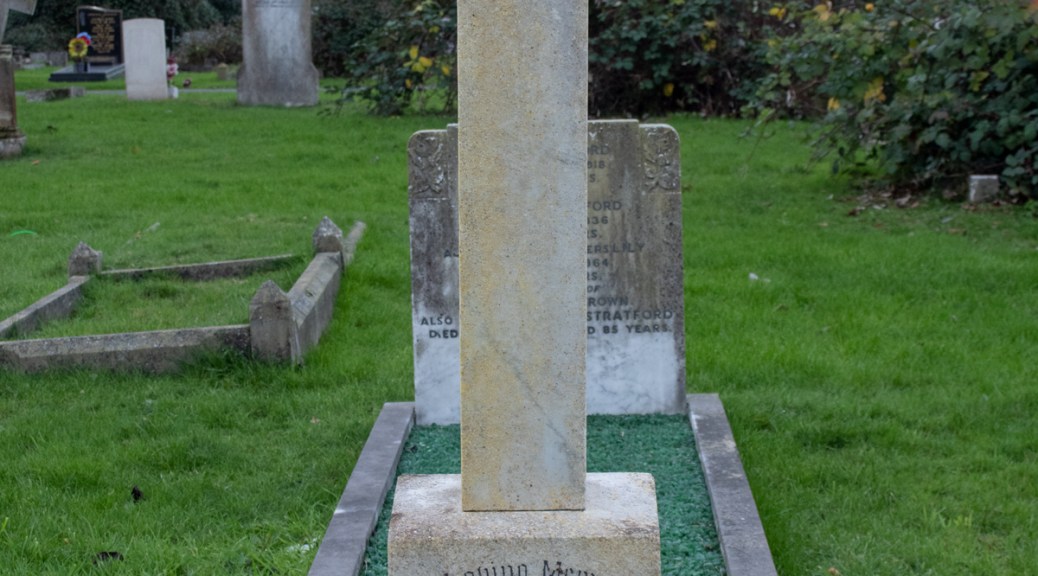
Sapper Arthur Naile

Sapper Arthur Naile

Arthur Edward Naile was born in the summer of 1888, the youngest of ten children to James and Mary Naile. Both of his parents were born in Bath, Somerset, and this is where they raised their growing family.

The Nailes lived in the Camden area of the city, consecutive census returns showing different addresses, as the children grew and then left home. In 1891, they lived at 11 Malvern Buildings, a small terraced house on a steep hill. Ten years later, they had moved to 3 George’s Road, to another terraced cottage close to their old home. By 1911, only Arthur was still living at home, which was now the four-roomed terrace at 51 Brooklyn Road, in the more built up Larkhall area no the northern outskirts of the city.

During all of this time, James had worked as a printer’s compositor. By 1911 he was 64 years of age, and was employed by a newspaper in the area. Arthur, meanwhile, was working as a grocer’s assistant.

On 9th August 1914, he married soldier’s daughter Bessie Brine. She was working as a dressmaker, and lodging with Charles and Eleanor Richman, in a small cottage in Dover Place. Their marriage certificate shows that Arthur was living three doors down, so it is likely she caught his eye not long after he moved in. They went on to have a son, Leslie, in November 1916.

War was raging across Europe by this point, and Arthur had stepped up to serve his country. He joined the Royal Engineers as a Sapper, but there is little concrete information about his time in the army. He was awarded the Silver War Badge, which was given to men medically discharged from military service during the conflict, which would suggest that he was badly wounded at some point. He died in a hospital in Hastings, East Sussex, an annexe of which was dedicated to personnel who had been blinded during the war.

Sapper Arthur Edward Naile passed away from a combination of influenza and diabetes on 31st October 1918: he was 30 years of age. His body was taken back to Somerset for burial, and he lies at rest in a peaceful corner of Bath’s sweeping Locksbrook Cemetery.


After Arthur’s death, Bessie was left to bring up their young son. In the autumn of 1923, she married again, to John Forman, and not long afterwards the three of them emigrated to Australia, in search of a better life. They settled in Bunbury, Western Australia, and went on to have two children, Ron and Nan.

When war broke out again, Leslie was old enough to step up, and joined the Royal Australian Air Force. By 1943, he found himself as a Flight Sergeant in Waltham, Lincolnshire. He had joined 100 Squadron of Bomber Command and, on the night of 25th June 1943, was piloting a Lancaster over the Netherlands. His plane was hit and destroyed, killing all those on board. Father and son both lost to war, Flight Sergeant Naile was just 26 years of age when he passed. He was buried in Westbeemster, and commemorated on memorials in Runnymede, Surrey, and Canberra, Australia.

Bessie lived on until her early 70s. She died on 8th December 1960, and is buried in the family plot in Bunbury Cemetery.

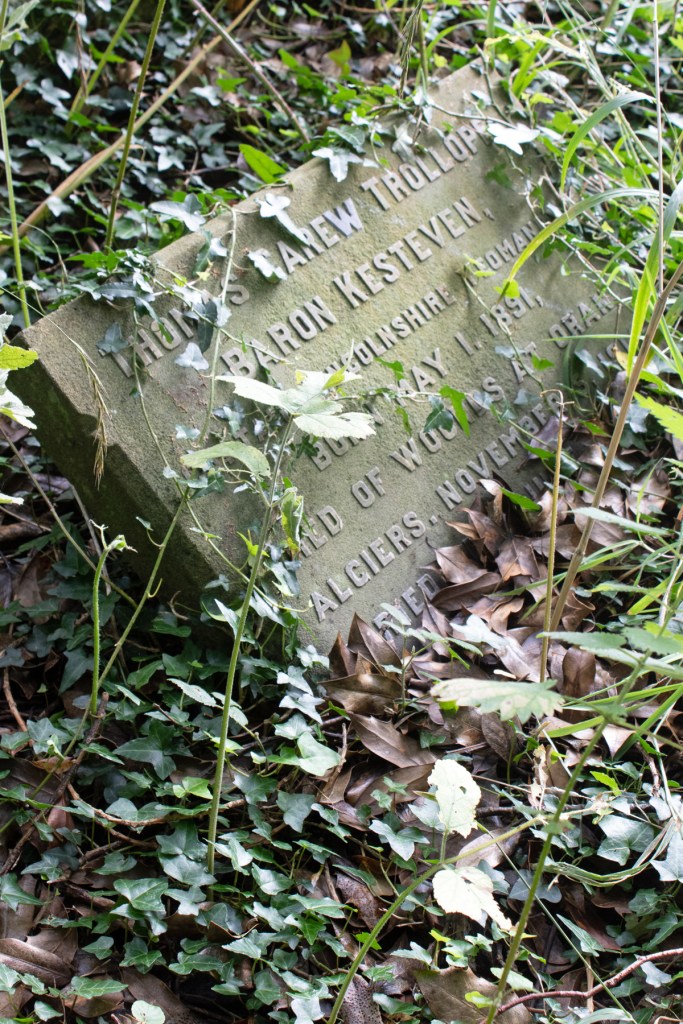
Captain Sir Thomas Trollope, Baron Kesteven

Captain Sir Thomas Trollope, Baron Kesteven

Official intimation has been received of the death of Capt. Lord Kesteven, of the Lincolnshire Yeomanry, who sailed for the Balkans last week. Sir Thomas Carew Trollope… third Baron Kesteven, who was born in May 1891, was the only son of the late Hon. Robert Cranmer Trollope and the Hon. Mrs Trollope, of Crowcombe Court, Taunton, and was educated at Eton. He succeeded to the barony on the death of his uncle, the second Baron, in July last. He joined the Lincolnshire Yeomanry about six years ago, when his uncle was Colonel of the regiment, and was gazetted Captain in October 1914. He had seen service in France during the present war, being attached to Jacob’s Horse, Indian Cavalry, until he succeeded to the title. Lord Kesteven was unmarried, and the title becomes extinct, but the baronetcy goes to Mr William Henry Trollope.

Bath Chronicle and Weekly Gazette: Saturday 13th November 1915

Thomas Carew Trollope was born in Middlesex, London on 1st May 1891. He was the younger of two children to Robert and Ethel Trollope, whose main residence was Crowcombe Court in Somerset.

Thomas was destined for great things. The 1901 census recorded him as being a boarder at Naish House Preparatory School in Wraxall, Somerset, while his older sister, Dorothy, remained at home with their parents and ten live-in servants.

Ten years later, and on his way to being prepared for the barony, Thomas was living with his uncle, John Trollope, the Baron Kesteven, at his estate, Casewick, in Uffington, Lincolnshire.

On the 5th November 1915, on Thomas’ journey to the Balkans, the ship he was on, the SS Mercian, was shelled by U-Boat SM U-38. After more than an hour being bombarded, the Mercian escaped. By that time, however, 78 men were wounded, 23 were killed, and 22 troops and eight crew members were missing. The Mercian managed to dock at Oran, Algeria, and those killed were either buried at sea or in the city’s cemetery.

Captain Sir Thomas Carew Trollope was also killed: he was just 24 years of age. It is unclear whether Thomas’ body was brought back to Britain or was buried in Oran, but the family plot includes a memorial to him.

A memorial service was held in the Church of the Holy Ghost, Crowcombe, on Monday 15th November 1915, the villagers commemorating the untimely passing of their favourite “Mr Tom Trollope”.


Captain Sir Thomas Trollope, Baron Kesteven
(from findagrave.com)

Private Herbert Perry

Private Herbert Perry

Herbert Perry was born in Sampford Brett, Somerset, on 2nd July 1887. One of fifteen children, his parents were Henry and Mary Perry. Henry was a groom and gardener, and the family were raised in a small cottage in the centre of the village.

Herbert and his siblings attended the local Church of England school, but once he finished his education his own trail goes cold. The next records relate to his military service, although they are also a bit scarce.

What is clear is that Herbert enlisted early in the war. He joined the 1st Battalion of the Devonshire Regiment, and was in France as soon as January 1915. Private Perry found himself at Ypres, and it was here, in July, that he was badly injured.

Private Perry was medically evacuated to Britain for treatment, and he was admitted to the 5th Northern General Hospital in Leicester. Sadly, this was to be where he would breathe his last: his wounds were to prove too severe, and he succumbed to them on 1st August 1915. He had not long turned 28 years of age.

Herbert Perry’s body was taken back to Somerset for burial. He was laid to rest in the family plot in the peaceful graveyard of St George’s Church. There he was reunited with his mother, Mary, who had died three years before.


Herbert’s older brother, William, joined the Duke of Cornwall’s Light Infantry when war broke out. Assigned to the 1st Battalion, he rose to the rank of Lance Corporal. William fought at the Somme, and was killed there. He is commemorated at the Thiepval Memorial, and remembered on the family headstone in Sampford Brett.


Second Lieutenant William Tyler

Second Lieutenant William Tyler

William Eric Tyler was born in the spring of 1888 in Carhampton, Somerset, the older of two children to farmers William and Nina Tyler. The details of William Jr’s early life are a bit sketchy: he was sent to a private school in Minehead, where he boarded for a while.

William Sr died in 1908, and Nina re-married, to farmer George Risden a couple of years later. Of William Jr there is no trace in the 1911 census, and the next record for him relates to his military service. He enlisted in the Somerset Light Infantry when war broke out, but transferred to the Machine Gun Corps in May 1918, receiving a commission to Second Lieutenant when he did so.

Again, details of Second Lieutenant Tyler’s time in the army are scarce. The only other document relating to him is that of his passing. He died, on 28th October 1918 at Belton Park Military Hospital near Grantham, Lincolnshire. He was 30 years of age.

Belton Park was primarily a facility to treat wounded soldiers returning from the Front Line, but it was also treated Machine Gun Corps personnel connected to the neighbouring camp. It is not possible, therefore, to identify the cause of his death.

William Eric Tyler’s body was taken back to Somerset for burial. He was laid to rest in the family plot in the graveyard of St John the Baptist Church in his home village, Carhampton. Buried alongside his father, he was reunited with his mother, when Nina died in 1946.


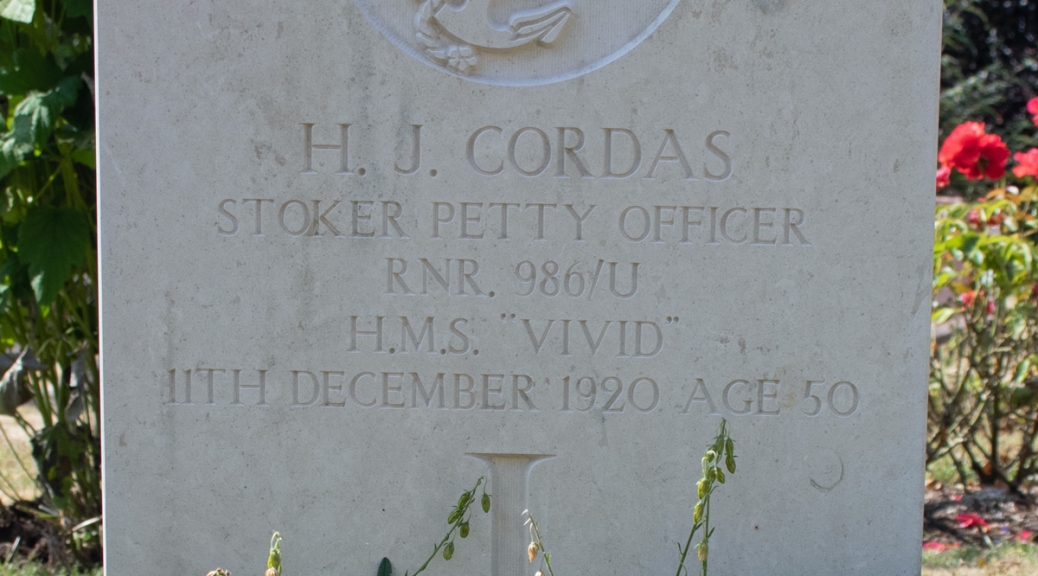
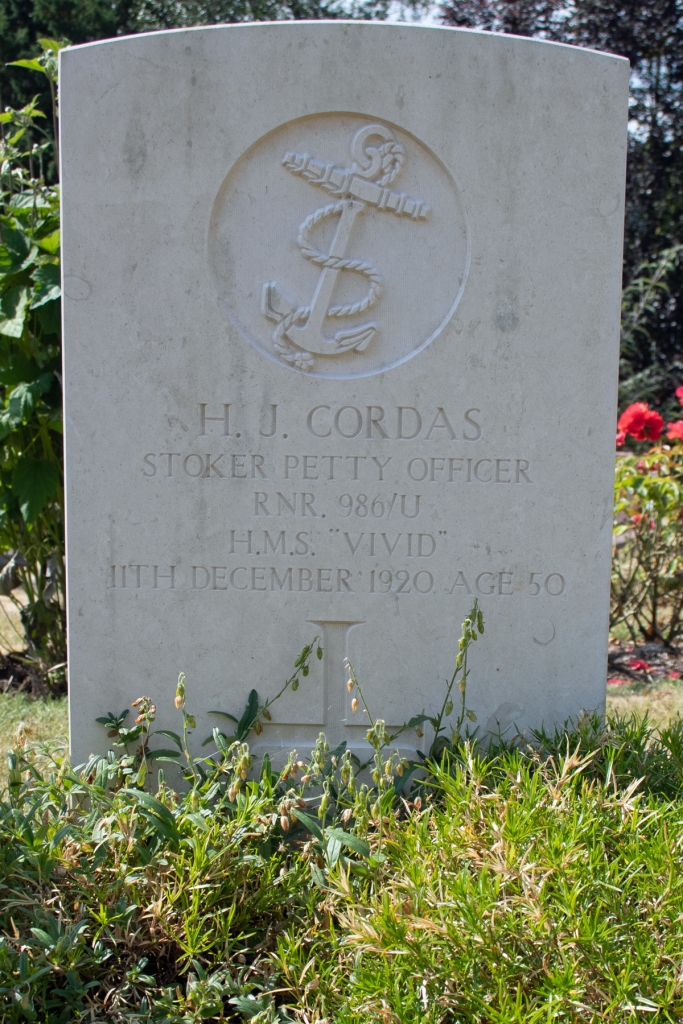
Stoker Petty Officer Henry Cordas

Stoker Petty Officer Henry Cordas

Much of Henry John Cordas’ early life is destined to remain a mystery. The first record for him is the 1881 census, which gives is his address as St Mary’s Orphanage in Heston, Middlesex, where he was one of 650 children.

The 1891 census recorded Henry as living in Humber Street, Grimsby, Lincolnshire, right next to the town’s docks. He is noted as being a fisherman, and is married to a woman called Mary, who was born in Deptford, Surrey.

The next available census record for Henry adds confusion to his story. The document, dating from 1911, confirms that he and Mary are now living in Hotwell Road, Bristol, Gloucestershire, again within spitting distance of the docks. Henry was employed as a marine fisherman in the merchant service. The document suggests that the couple had been married for ten years, and give Mary’s place of birth as Swansea, Glamorganshire.

While the document matches previous information for Henry, it seems unlikely that the Marys in the 1891 and 1911 censuses are one and the same. Either way, the couple were sharing their house with Mary’s niece, Ellen.

Henry seems to have joined the merchant fleet in a more official capacity in the autumn of 1900. His records show that he was 5ft 11ins (1.8m) tall, with blue eyes and a fair complexion. He served out of Bristol and, in the years leading up to the outbreak of war, he was assigned to a number of ships, travelling the Atlantic to Montreal and Jamaica, amongst other far-flung places.

When hostilities commenced, Henry was assigned to the Royal Naval Reserve. Over the next few years, he served on a number of ships, including the armoured cruisers HMS Suffolk and HMS Doris. He worked as a Stoker, but by the end of the conflict had been promoted to Stoker Petty Officer.

In December 1918, Henry’s service came to an end. He was, by now, based at HMS Vivid, the Royal Naval Dockyard in Devonport, but his health was suffering. Medically discharged with a combination of chronic bronchitis and rheumatic pain, he seems to have returned to Bristol.

On 6th December 1920, Henry was admitted to Bath War Hospital in Somerset, as he was coughing up blood. The plan was to transfer him to Greenwich Hospital in Surrey, but he suffered an aneurysm before that move could be made. He passed away on 11th December 1920, at the age of 50 years old.

The body of Henry John Cordas did not travel far for burial. He was laid to rest in the peaceful expanse of Bath’s Locksbrook Cemetery.


Bombardier Charles Newbery

Bombardier Charles Newbery

Charles James Anderson Newbery was born in Misterton, a stone’s throw from Crewkerne, Somerset, in the spring of 1895. The oldest of eight children, his parents were Benjamin and Edith Newbery. Benjamin was a farmer, who passed away in 1908, when his son was just 13 years of age.

Charles seems not to have spent a great deal of time in the family home, however: the 1901 census found him living with his paternal grandmother, while the 1911 census, taken three years after his father’s death, recorded him as living with his paternal aunt, and working on their farm.

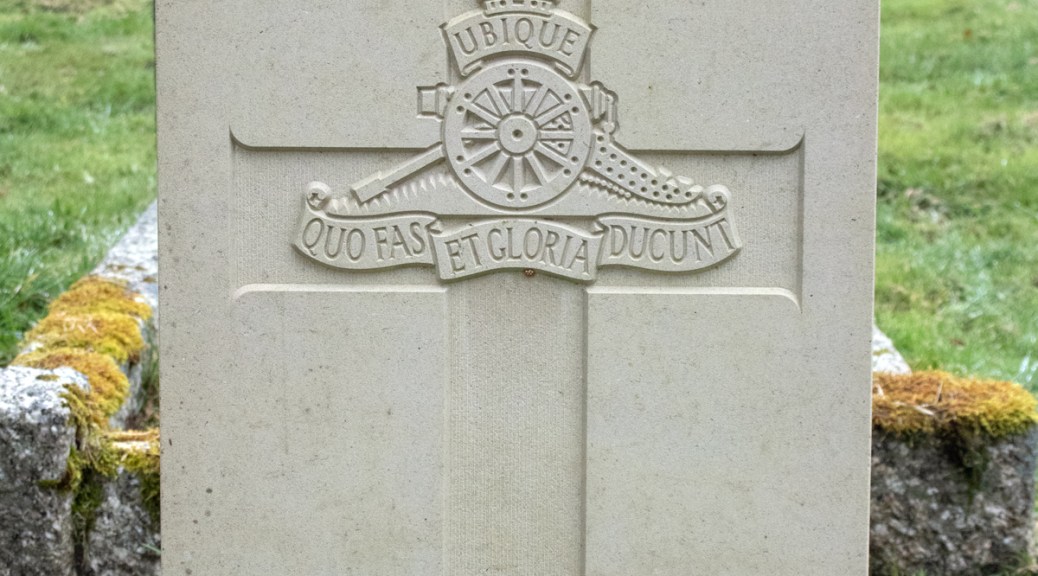
The farming life seemed to suit Charles: indeed he emigrated to Australia to pursue the life. When war broke out in Europe, however, he returned to England’s shores to better serve King and Country. He enlisted in the Royal Garrison Artillery on 18th October 1915, and was given the rank of Gunner.

Charles’ service records confirm that he was 5ft 5ins (1.65m) tall and weighed 140lbs (63.5kg). He was noted as having a mole on his left shoulder and an upper denture.

Private Newbery was sent to France in April 1916 and, a little over a year later, was promoted to Bombardier. He was attached to the 137th Heavy Battery and all seemed to be going reasonably well for him. He had ten days’ in England in July 1917, and a further two weeks’ in March 1918.

On 13th August 1918, possible during the Battle of Amiens, Charles was injured by a gun shot wound to his right leg. He was initially treated at the 47th General Hospital at Le Treport on the French coast, but was medically evacuated to Britain for further treatment.

Charles was moved to the 4th Northern General Hospital in Lincoln. To complicate matters, he had contracted bronchitis and, while his injury was being managed, it was a combination of the lung condition and cardiac failure to which he succumbed. Private Newbery passed away on 2nd September 1918, his mother and sisters by his side. He was just 23 years of age.

Charles James Anderson Newbery was taken back to Somerset for burial. He was laid to rest in Crewkerne’s Townsend Cemetery, not far from the family home.


Bombardier Charles Newbery
(from ancestry.co.uk)

Edith had to write to the regimental office three times to get her late son’s belongings back, and in the end it took more than six months to do so. She received the items he had on him in Lincoln in April 1919: they included and “upper row [of] teeth, cigarette case, wallet containing letters, hair brush [and] comb, disc, letter, wristlet watch, note paper and envelopes.”


Air Mechanic 1st Class Joseph Chivers

Air Mechanic 1st Class Joseph Chivers

Joseph Shore Chivers was born in the summer of 1889 in Walcot, Bath, Somerset. He was the youngest of seven children to William and Jane Chivers. William was a blacksmith and, after he and Jane died within nine months of each other in 1904/05, Joseph went to live with his brother, Edward, remaining there with his sister-in-law when his sibling also died in 1910.

Joseph had found work as a French polisher and cabinet maker by this point and this is what he was doing when he married local woman Ellen West in on 11th September 1915.

War was on the horizon by this point and Joseph was soon called on to serve his country. On 26th July 1916 he enlisted in the Royal Flying Corps, as an Air Mechanic 2nd Class. His service records give little away, but do confirm that he was 5ft 8ins (1.73m) tall.

Joseph was dedicated to his role and, on 1st January 1918, was promoted to Air Mechanic 1st Class. Three months later, when the Royal Flying Corps and Royal Naval Air Service combined to become the Royal Air Force, Joseph made the transfer across.

In August, Air Mechanic Chivers moved to RAF Bracebridge, to the south of Lincoln, where he remained until the end of the war and beyond. He was attached to 120 Squadron, which delivered mail and communications to the troops overseas. Little additional information is available about his life there, other than his admission to the 4th Northern Hospital in April 1919, through causes unknown.

Whatever the cause of his need to be admitted, he was to succumb to it. Air Mechanic Chivers passed away on 1st May 1919, at the age of 29 years old.

Joseph Shore Chivers’ body was brought back to Somerset for burial. He was laid to rest in St James’ Cemetery, in his home city of Bath.


Private Harry Etherton

Private Harry Etherton

Harry Etherton was born in Ansty, near Cuckfield, West Sussex on 3rd April 1872. The oldest of five children, his parents were Edwin and Louisa Etherton. Edwin was an agricultural labourer, and this was work in which his son followed his father.

On 29th April 1899, Harry married Annie Eliza Pennifold, a labourer’s daughter who was also from Ansty. The couple set up home in Cuckfield, and went on to have five children. Harry was, by this point, working as a road labourer for the local council, and this was a job he was to continue doing until the outbreak of the war.

Harry enlisted in 1915, joining the Royal Sussex Regiment as part of the National Reserve. As Private Etherton, he was then transferred across to the Labour Corps, and was assigned to the 409th Labour Coy. which was based at the Infantry Depot in Lincoln.

It was while Private Etherton was here, in the spring of 1918, that he contracted meningitis, and was admitted to the Northern General Hospital in the city. Sadly, he was to succumb to the disease, passing away on 30th June 1918, at the age of 46 years old.

Harry Etherton’s body was brought back to West Sussex for burial. He was laid to rest in Cuckfield Cemetery, not far from where his widow and children still lived.


Corporal Herbert Lyon

Corporal Herbert Lyon

Herbert Woodley Lyon was born in Lincoln early in 1897, one of five children to Walter and Emma Lyon. Walter was a cashier for an engineering company, and the family grew up in some comfort, employing a housekeeper, sick nurse and servant by the time of the 1911 census.

When he finished school, Herbert found work as a draper’s assistant, but with war closing in things were to change. Initially joining the Lincolnshire Regiment, by February 1918, he had transferred across to the Royal Flying Corps, moving to the Royal Air Force when it was founded that April.

Corporal Lyon was based with 112 Squadron at RAF Throwley, just to the south of Faversham, Kent. Details of his service are scarce, but it seems that he trained and qualified as a fitter, helping with the maintenance of the aircraft. His service records show that he stood 5ft (1.52m) tall.

Herbert’s time in the Royal Air Force was limited. His records show that he died of natural causes on 1st November 1918. He was just 21 years of age.

Corporal Herbert Woodley Lyon’s family had relocated to Wells in Somerset by this point. He was laid to rest in Faversham Borough Cemetery, not far from the airfield at which he had been based.


Flight Officer Walter Stevens

Flight Officer Walter Stevens

Walter James Stevens was born on 29th November 1899, the oldest of three children to James and Elizabeth. James was a labourer in the munitions factory in Faversham, Kent, and this is where Walter and his siblings were born and raised.

Initially attending the council schools, Walter won a scholarship to Wreight’s Grammar School, before gaining work as a clerk at the Shepherd Neame brewery in the town.

From the age of 11, Walter was also an active member of the local United Methodist Church. He was a keen organist, taught at the Sunday School, and played a key role in the Wesley Guild. He was also a sometime member of the St John’s Ambulance, undertaking duties at The Mount Hospital in the town.

When was broke out, Walter was keen to play his part. He enlisted in the Royal Naval Air Service, and was sent for training at their air base in Cranwell, Lincolnshire. While on a flight on 11th March 1918, Flight Officer Stevens’ aircraft crashed, and he was killed instantly. He was just 18 years of age.

Walter James Stevens’ body was brought back to Kent: he was laid to rest in the Faversham Borough Cemetery, not fat from his family home. At the funeral, Walter’s senior officers reported the promise he had shown, and that he was close to passing his probationary exams. Two weeks after his burial, a memorial service to him was given at the church to which he had dedicated so much of his young life.